Tag: UPA

  • MIB addresses Congress MP Manish Tewari’s query on govt’s ad spends

    MIB addresses Congress MP Manish Tewari’s query on govt’s ad spends

    MUMBAI: Congress MP Manish Tewari, asked the Ministry of Information and Broadcasting (MIB) to reveal details about the yearly amount spent by the Government of India (GOI) on print, broadcasting, social media and outdoor advertisements between 26 May 2014 and 30 September 2019 on 29 November. He also has asked for details about the amount spent on ads in foreign media.

    Tewari inquired about the Government’s advertising share in the revenue streams of the top 20 Indian media firms between 04 April 2014 and 09 September 2014.

    MIB minister Prakash Javadekar replied “The Bureau of Outreach and Communication (BOC) releases notices, tenders, auctions, recruitments, etc. and also undertakes awareness campaigns and dissemination of information about the government schemes and programmes through various media.”

    Javadekar wrote in his reply that the details about the release of advertisements on various media between the said dates are available on BOC’s website.

    He explained that the revelation of per sq cm rate of ads in print media has increased from Rs. 42.31 to Rs. 62.13, but the average per year print media space of advertisements given by the BOC between FY 2014-15 and 2018-19 has reduced during NDA’s rule from Rs. 11.88 crore sq cm to Rs. 10.95 crore sq cm in UPA II rule between FY 2009-10 and 2013-14.

    Javadekar lastly said that GOI does not maintain details about the Indian media companies. He also emphasised that the Ministry does not issue advertisements in foreign newspapers and TV channels.

  • Prasar Bharati CEO Jawhar Sircar officially seeks early retirement

    Prasar Bharati CEO Jawhar Sircar officially seeks early retirement

    MUMBAI: Prasar Bharati CEO Jawhar Sircar has been known to not pull any punches. Last month, he had expressed his desire to resign from his post to the media as he was not getting anywhere with the organisaton and neither was Prasar Bharati. Now, he has written to the ministry of information & broadcasting secretary (MIB) Ajay Mittal stating that he would like to resign prematurely from 4 November, says a PTI report.

    He has also written to I&B minister Venkaiah Naidu, expressing his desire to resign from his position post-Diwali – that is after 30 October. The report goes on to state that he would like to relocate to Kolkata.

    Sircar was yanked out of his position as secretary, culture, and installed as the Prasar Bharati CEO by an eminent panel led by the then Indian vice-president and a Supreme Court judge during the UPA government’s tenure in 2012. He serves as the vice-president of the Asia Pacific Broadcasting Union, which is a club of broadcasters from 67 countries. He has also had two short stints MIB secretary during his career.

  • Prasar Bharati CEO Jawhar Sircar officially seeks early retirement

    Prasar Bharati CEO Jawhar Sircar officially seeks early retirement

    MUMBAI: Prasar Bharati CEO Jawhar Sircar has been known to not pull any punches. Last month, he had expressed his desire to resign from his post to the media as he was not getting anywhere with the organisaton and neither was Prasar Bharati. Now, he has written to the ministry of information & broadcasting secretary (MIB) Ajay Mittal stating that he would like to resign prematurely from 4 November, says a PTI report.

    He has also written to I&B minister Venkaiah Naidu, expressing his desire to resign from his position post-Diwali – that is after 30 October. The report goes on to state that he would like to relocate to Kolkata.

    Sircar was yanked out of his position as secretary, culture, and installed as the Prasar Bharati CEO by an eminent panel led by the then Indian vice-president and a Supreme Court judge during the UPA government’s tenure in 2012. He serves as the vice-president of the Asia Pacific Broadcasting Union, which is a club of broadcasters from 67 countries. He has also had two short stints MIB secretary during his career.

  • Govt. cans plans of introducing comprehensive broadcast legislation

    Govt. cans plans of introducing comprehensive broadcast legislation

    NEW DELHI: Contrary to plans of the previous United Progressive Alliance (UPA) government, the present government has said there are no plans to introduce a comprehensive broadcast legislation in the Parliament.


    Replying to a question in the Lok Sabha, Information and Broadcasting Minister Arun Jaitley said, “No such proposal is under consideration of the Ministry.”


    The previous government had not only drawn up plans for such legislation but placed it on the Ministry website. In fact, a draft of the proposed Broadcasting Services Regulation Bill 2007 – which was a revised version of the proposed legislation of 2006 – is still on the website.   


    Meanwhile, Jaitley told Lok Sabha that all the areas uncovered by terrestrial transmitters along with rest of the country have been provided with multichannel TV coverage through Doordarshan’s free to air direct-to-home Freedish service anywhere in the country. 


    Doordarshan coverage is estimated to be available to about 92 per cent population spread over about 81 per cent area of the country.


    DD has 1416 TV transmitters of varying power in terrestrial mode, whereas DD’s Free Dish services on DTH has currently 64 TV channels on air.

  • UPA government kept security lapses secret: Finance Ministry Enquiry Report

    UPA government kept security lapses secret: Finance Ministry Enquiry Report

    MUMBAI: TV18’s news English news channel CNN IBN acquired possession of an internal enquiry report by the finance ministry, which reveals that during the printing of Indian currency, security features were compromised. The lapses were also kept under wraps by senior officials working under Ministry of Finance. The incident happened during the previous UPA (United Progressive Alliance) regime in 2012.


    The use of a security thread is the most distinguishing feature of bank notes. The enquiry report, which says the security thread inserted in currency paper at the Hoshangabad Security Paper Mill were from an Islamic nation. The defect in the paper intended for 10 rupee notes was reported on 8 November, 2012, but was kept a secret.


    The report says:


    Examination of the 10 rupee notes showed indecipherable text on the security thread.


    The notes either had Arabic text inscribed on the security thread or did not have any security thread at all.


    The security thread was also found to be non-magnetic when examined on a quality control device.


    The currency paper with the defective security thread initially escaped at least four to five quality checks.


    It was later found that four boxes of sheets had defective currency paper. 


    At 5,000 sheets to a box, and 50 notes printed on each sheet, it works out to a whopping 10 lakh defective notes printed.


    The company, which supplied the defective security thread, New Delhi-based Aristocraft International, faced no action. The MD of Aristocraft refused to comment.


    The serious lapse was also kept under wraps by senior officers at Security Paper Mill and Security Printing and Minting Corporation of India for over three months. No report was sent to Home Ministry or Finance Ministry. In fact, officers allowed the supplier to change the security thread stock without punitive action. Even now no action has been taken against the officers or the supplier.


    It is yet to be verified if there was any corruption involved. But clearly the lapses were so serious that it could have impacted national security  exposing the country to allegations of counterfeiting its own currency.

  • Over Rs 400 crore spent on Bharat Nirman campaign in three years

    Over Rs 400 crore spent on Bharat Nirman campaign in three years

    NEW DELHI: The United Progressive Alliance (UPA) spent a total amount of Rs 411.91 crore between 2011-12 and 2014-15 through the Information and Broadcasting Ministry to publicise Bharat Nirmal programmes.


    The amount spent in 2014-15 was only Rs 32.23 crore as against Rs 188.88 crore for the previous year. The amount spent in 2011-12 was Rs 87.78 crore and that in 2012-13 was Rs 103.02 crore.


    I&B Minister Prakash Javadekar told the Lok Sabha today that there was no plan at present to undertake any campaign under the umbrella of Bharat Nirman.


    The promotion through I&B Ministry was part of the media outreach strategy under the plan sub-scheme titled “People’s Empowerment through Development Communication Conception and Dissemination” by the Directorate of Advertising and Visual Publicity.


    While a sum of Rs 48 crore was spent covering 6444 newspapers and Rs 96.19 crore was spent on 125 television channels in 2013-14, no campaign was launched in 2014-15 as the Model Conduct had come into force in view of the General Elections in May.


    I&B Ministry sources said that the amount of Rs 32.23 crore for 2014-15 related to old bills.

  • Jayalalitha again seeks DAS licence for state-run Arasu

    Jayalalitha again seeks DAS licence for state-run Arasu

    NEW DELHI: After she failed to convince him through a memorandum presented last month, Tamil Nadu Chief Minister J Jayalalithaa has now written to the Prime Minister Narendra Modi to intervene to secure Digital Addressable System (DAS) licence for the state run TV Cable Corporation.


    The application has been pending with the state for three years but has not been cleared in view of the opinion by the Telecom Regulatory Authority of India (TRAI) that political party, state and centre-run TV channels or TV distribution networks should not be permitted in the country.


    The Regulator had given this opinion in 2008 and then reiterated it earlier this year after the Information and Broadcasting Ministry referred the matter to it for a second time.


     In her letter to Modi, Jayalalithaa said the previous United Progressive Alliance regime sanctioned licenses to nine Multi System Operators in Tamil Nadu but did not respond to the state’s plea. She claimed that her government had revived the ‘defunct’ Tamil Nadu Arasu Cable TV Corporation (TACTV), a state run TV Cable Corporation, after coming to power in 2011 to adhere to its commitment to provide inexpensive and quality Cable TV services.


    TACTV, an initiative of the previous DMK government at the height of family feud in the party’s first family involving M Karunanidhi and his grandnephews, Maran brothers, was however later put in cold storage after they patched up.


    TACTV was providing 100 channels for Rs 70 as against the Rs 150-250 charged by some other MSOs, she said in the letter. After the Cable Television Networks (Regulation) Act, 1995 was amended, paving way for DAS, TACTV took steps to commence operations in the digital mode in Chennai and applied to the Ministry for DAS license.


    Orders were also placed for the supply of Set Top Boxes, Conditional Access System and Subscriber Management System and installing of a headend at a cost of about Rs 50 crore, she told Modi.


    Jayalalithaa in her letter has asserted that as per the provisions of the Cable TV Network (Regulations) Act, 1995, and Rules thereof, TACTV is qualified for such a licence. She also alleged that she strongly suspects that the non-issuance of license by the previous UPA government was only to facilitate particular private business interests. 

  • Mission 2014: The rise of the political campaign

    Mission 2014: The rise of the political campaign

    While the two-horse race hasn’t disappointed so far, what with all the mudslinging, sloganeering, crowd-pleasing and promising, there seems to be not a marked difference between the election strategies of the main opponents.


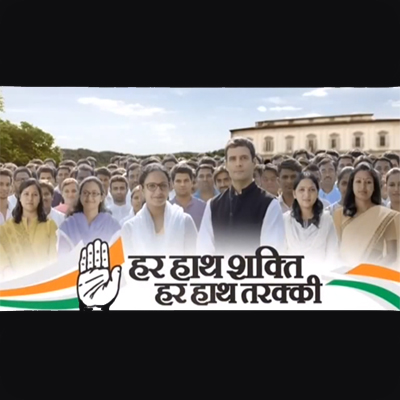
    The Congress Party has flagged off its Rs 500 crore advertising and publicity campaign to promote leading light Rahul Gandhi. With a slogan that reads ‘Har haath shakti, har haath tarakki’, the blitzkrieg mirrors the idea of power and progress to each and every person while focusing on the progress made by the nation in the past decade, albeit with the Congress at the helm of affairs. One of the ads even features a young, Muslim party member, Hasiba Amin, urging the youth to join RaGa along with the tagline ‘Kattar Soch Nahi, Yuva Josh’.


    Apart from this, the ruling alliance has initiated a Rs 100 crore Bharat Nirman campaign, which is being handled by ad agency Percept and run from the Information and Broadcasting Ministry’s budget headed by Manish Tewari.


    What’s more, recently, Times Now Editor-in-chief Arnab Goswami grilled the Gandhi scion in his first ever television interview since his political debut in 2004. RaGa answered questions including whether he is a reluctant politician and what are his views on the multiple scams facing UPA 2 but his answers elicited a mixed response where some found him frank and others felt he needed growing up, politically speaking.  


    Not far behind the Congress, the BJP is close to finalising the ad agency to kick-off its Rs 400 crore campaign around prime ministerial candidate Narendra Modi. It is learnt that McCann Worldgroup led by adman-lyricist Prasoon Joshi and WPP agency Contract Advertising are in the fray to grab the hotly-contested account.


    This – after the recent furore over Congress’ initial campaign slogan “Main nahin, hum”, which the party claimed had been lifted from NaMo’s tagline during the 2011 Gujarat Chintan Shivir. So much so, the Congress was forced to drop the tagline even after AICC media head Ajay Maken refuted BJP’s allegations by tweeting a picture featuring the slogan at a mushaira of Congress workers in Indore in 2010.


    So while the Congress and the BJP gear up for battle in the media space, it remains to be seen how much of this will translate into votes for their prime-ministerial hopefuls. Historically speaking, in 2004, the then ruling party, BJP, had run a similar campaign ‘India Shining’ highlighting all its good work but the aam junta wasn’t swayed. One of the main reasons for the failure of the campaign was people’s inability to relate to it.


    Whether things will work out differently this time one can’t really say but it might do well for both parties to take a cue from AAP’s unique strategy.


    Unlike its traditional parties, AAP has largely stuck to communicating through outdoor activation programs and social media while steering clear of mass media campaigns.


    The rookie party won 28 out of 70 seats in the Delhi Assembly Elections and went on to form the government in the national capital sans any campaigning worth writing home about.


    In establishing a door-to-door (person-to-person) connect with the common man in buses, trains, autos, juggis and bastis, the party’s volunteers stayed true to its one agenda – the aam aadmi.


    As Delhi Chief Minister, Arvind Kejriwal’s recent dharna won him (and the party) more brickbats than bouquets as it is unheard for a constitutional head in a democracy to resort to such means. However, it helped AAP become the darling of the masses at no humungous cost, allegations of using the media to advantage notwithstanding.


    Whether the junta will fall for the publicity and hype created by Congress and BJP or will give its nod to the AAP-brand of democracy, is highly debatable. Our only hope is let the best man (party) win!

  • Spirit of inquiry amongst media must not morph into a campaign of calumny, cautions PM

    Spirit of inquiry amongst media must not morph into a campaign of calumny, cautions PM

    NEW DELHI: Prime Minister Manmohan Singh on Saturday called for caution as mediapersons executing their responsibilities in a vibrant democracy which revels in free enquiry and quest for answers.


    He said the media industry had a special role in assessing, tackling and overcoming the challenges that two decades of socio-economic change have brought about. “But a spirit of inquiry must not morph into a campaign of calumny. A witch-hunt is no substitute for investigative journalism. And personal prejudices must not replace the public good.”


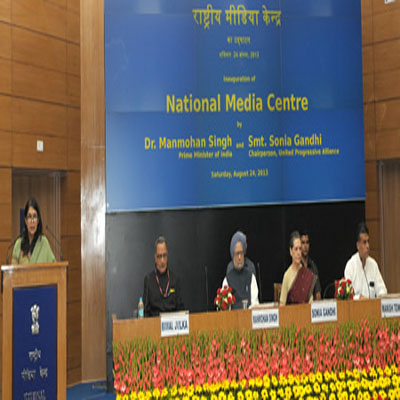
    Dr Singh was speaking after he and UPA Chairperson Sonia Gandhi inaugurated the National Media Centre in the capital this morning. Information and Broadcasting Minister Manish Tewari, I&B Secretary Bimal Julka, and Press Information Bureau Principal Director General Neelam Kapoor were also present.


    Singh said “It is a reality that journalism cannot be divorced from the business of which it is a part. The responsibilities of a media organization are not limited to the viewers and readers alone. The companies also have an obligation to their investors and shareholders. The tussle between bottom-lines and headlines is a fact of life for them. But this should not result in a situation where media organizations lose sight of their primary directive, which is to hold up a mirror to society and help provide a corrective. ”


    He said “This Centre showcases our ability to keep pace with similar state-of-the-art facilities across the world. It symbolizes the vibrant mood of the existing media landscape in our country. As a ‘Communication Hub’ and a ‘Single Window’ facility, I am sure it will fulfill the needs and requirements of our media fraternity, many of whom are present here today.”


    In her address, Gandhi said “The government and the media have the shared interest in disseminating programmes, policies, decisions and information. This is where an institution such as the National Press Centre assumes importance. I hope that it will represent a partnership in which both sides will be able to discharge their designated responsibilities.”  


    “In any society undergoing dramatic and rapid transformation there is constant need to renew and rebuild. This facility represents that evolution. I hope very much that it will become an effective nerve centre and a duct and an information bridge between the Government, the Media and the People,” she added.


    “I want to be quite clear we don’t favor propaganda or publicity campaign simply in order to score points for the government, but the people have a right to know their legal and other entitlements. They have a right to information. They have a right to be able to make informed decisions. Only an aware and conscious citizenry can be expected to make this system work well and hold governments and political parties to account.”


    Referring to the National Media Centre, Gandhi said “This beautiful building is not just brick and mortar. It is up to you media professionals, officials of Information and Broadcasting Ministry and others who will inhabit it to infuse life into it by making it an instrument to serve the people and empower them.”


    The Centre at 7E Raisina Marg in the proximity of Shastri Bhavan which presently houses the Press Information Bureau was inaugurated 21 years after it was first conceptualized during the 8th five year plan (1992-97).


    Tewari said: “We live in an era of an information overload. The media landscape has transformed exponentially over the past two decades. This transformation has brought its own set of challenges to the media industry. India today mirrors the world in global cross media consumption patterns.”


    He said a ‘very unfortunate collateral of this epoch making change’ is the print industry globally. It was distressing to learn that iconic newspapers and magazines around the world were ceasing to print. However, India appeared to have changed this trend. The Indian newspaper market will be the only one to grow at a double-digit CAGR [Compounded Annual Growth Rate] of 10 per cent and would emerge as the world’s sixth-largest newspaper market by 2017 as per industry reports on media and entertainment. The regional and vernacular print sector is growing on the back of rising literacy and low print media penetration as well as the heightened interest of advertisers wanting to leverage these markets.


    Tewari said according to industry sources, print has a combined market penetration of a ball park of 14 per cent. Thus, the print industry has the potential to expand its footprint and readership across the national canvas. This sector thus would be able to weather the shifting sands of technology at least in the Indian context.


    The Indian broadcasting sector had grown from one channel in 1991 to 852 at the last count.  After statutory rationalization the number now stood at 795 odd channels, he added. While this had brought about plurality, it had resulted in market fragmentation as well.


    “There are 15.4 crore TV households in India. Unfortunately the news and current affairs genre makes up only seven per cent of the total television viewership, according to TAM CS4+ all India weekly average for 2012. The remaining 93 per cent of this universe is occupied by general entrainment channels despite there being 395 odd news and current affairs channels.


    He said this generated hope that there is an exponential potential for growth, provided the news broadcasters and Multi System Operators (MSO’s) are prepared to re-imagine their content and carriage paradigms respectively.


    In both the print and television genres, he said the revenue model remains heavily dependent on advertising. As the advertisement cap requires a migration path synchronous with the roll out of digitization For the news broadcasting industry, Tewari hoped that the Telecom Regulatory Authority of India would re-consider its deadline.


    To give consumers the benefit of better quality of service and correct the skewed revenue models in the broadcasting sector government launched a massive digitization exercise in 2012.  With 10 million set top boxes seeded in Phase–I, another 20 million in Phase–II and yet another 80 million scheduled for Phase–III & IV, by the end of 2014 no one in the Broadcasting Sector can really say that bottom-lines and balance sheets in August 2013 are not looking better than in October, 2012.  


    The MSME sector must also endeavour to leverage this unique business opportunity and convert it into the India digitization story even in manufacturing terms.  


    India had 86.7 crore mobile phones, 12.4 crore Internet users with an expected growth up to 37 crore by 2017, eight crore people on Facebook and 1.8 crore on Twitter.


    The government had recently taken a decision to create a New Media Wing in the Ministry to have an institutional presence in this virtual civilization.


    He said the radio, till a decade back considered, was a casualty of the tectonic technological shifts but now stood poised on the threshold of a new wave. High mobile penetration and cheap call rates in our country had brought this renaissance into replay.


    The film industry had completed a century of existence. This industry had grown but still had tremendous potential. As per an industry estimate, about 14 million Indians go to the movies everyday. As per another report, the film industry is valued at Rs 112.4 billion [$1.741 billion], and is estimated to grow to about Rs 193.3 billion [$2.994 billion] by 2017, a compound annual growth rate (C.A.G.R.) of about 11.5 per cent. The regional film industry is a steady contributor to this growth process.


    The media sector had grown by a CAGR of over nine per cent between 2007-2012 and was projected to grow at 15 per cent between 2012 and 2017, Tewari added.


    But there were some paradoxes that all stakeholders in this sector must try and collectively resolve to find the elusive golden mean. These included flawed Revenue Models qua Questionable Revenue Generation practices; TRPs qua truth; Media Trials qua a Fair Judicial Trail guaranteed by article 21 of the Constitution; and anonymity masquerading as privacy in the new media space – the spectre of the ‘hidden’ people, apart from Last mile neutrality among carriage providers so that content providers get a level playing field and are able to reap the benefits of convergence.


    The National Media Centre (NMC) was initially conceptualized by the Press Information Bureau in 1989 to facilitate greater interaction between the Government and the media with a state-of- the-art equipped media centre. The Centre has been planned on the model of media centres in some of the capitals of the world such as Washington and Tokyo. It will have offices of the PIB as well as special facilities for the media to enable the Government to interact closely with the media.


    The Centre has a Press Conference Hall for 283 media persons, a briefing room for about 60 persons, 24 Work stations for the media, a library, media lounge and cafeteria. The press conference hall and media lounge are Wi-Fi enabled.


    Major Highlights:

    World Class Media Center, Ground + 4 Floors + 2 basements, Press Conference Hall with seating capacity for 283 persons, Media Lounge – Work area facilities for media personnel, Committee Room with video conferencing facilities, Library, Cafeteria, IT and AV Infrastructure in NMC.


    Facilities provided:

    Optic fibre internet backbone with redundancy, Mini Data Centre for application development and hosting, Webcast, including live webcast, Video feed to TV channels outside the building, Network with redundancy and expandability to 500 nodes, IT facilities to media persons in work area/Lounge, Internet Telephony, AV Video Wall.·        


    The NMC has been constructed by the National Buildings Construction Corporation (NBCC) over a period of three years with a total covered area of 13867 sq m. The plot size is 7787.46 sq m (1.95 acres).

  • Contractual employees of DD News to observe Black Friday

    Contractual employees of DD News to observe Black Friday

    NEW DELHI: The contractual employees of Doordarshan News who have been protesting peacefully by wearing black bands for a salary hike and better working conditions are to observe 5 August as Black Friday.

    These employees have been protesting since yesterday by wearing black badges on their arms and will wear black clothes to show solidarity. Almost the entire staff including the packaging, camera section, editors, assignment, anchors, and reporters is part of this peaceful protest.

    A senior anchor who did not want to be named said: “The UPA claims to be concerned about the welfare of the common man but we who have been working under this same government have not had a salary hike in the last 3 years. Inflation has risen drastically in this period and monthly expenditure has gone up at least twofold. Some of us have been working here for just Rs 10,000 for the last there years and every month we are given an assurance of a hike but nothing has happened yet”.    
      
    Currently, there are close to 350 employees with DD News. None of them are part of any social welfare scheme like medical/life insurance. They do not have the benefit of a Public Provident Fund. Even women employees are not given maternity benefits/leave and their salary is cut when they are on leave for delivery. Contractual employees are also not entitled to any national holidays.

    These employees had observed a snap strike at prime time for a few hours earlier this year. Following that, the DD News administration had sent a recommendation to the Prasar Bharati Board for increase in wages. However, no decision has yet been taken, because a Prasar Bharati board member told indiantelevision.com that the attempt was to collate details of contractual employees in all DD channels before taking a decision.

    DD News was launched in 2003 and is currently the only bi-lingual 24 hour TV channel on air. The anchor said several questions have been raised from time to time about the quality of news content on the channel, but this exploitation of employees is never put in the public domain. The protest is an effort to awaken the administration to their plight and take concrete steps to improve their quality of life.