Tag: undefined

  • The biggest buzz on Facebook in 2020

    The biggest buzz on Facebook in 2020

    KOLKATA: This year brought a wave of surprises which united people across countries and made them realise the power of doing ‘More Together’ while practicing social distancing. As we prepare ourselves to embrace what the coming year has in store for us, Facebook has given glimpses of some of the moments that united people across its family of apps.

    For instance, people came to Facebook to commemorate the figures who left a lasting legacy around the world. Kobe Bryant’s passing was this year's most discussed moment on Facebook, with the US, Mexico and Philippines sharing the most posts and photos celebrating his life. US Supreme Court justice Ruth Bader Ginsburg was commemorated in more than six million posts in one day across Facebook and Instagram, with many using the hashtag #restinpower. The passing of prominent personalities including Irrfan Khan, Rishi Kapoor, Sushant Singh Rajput, S P Balasubrahmanyam, and Pranab Mukherjee echoed deeply in the conversations in India.

    The incident which reshaped the year, Covid2019, was also discussed highly.  Throughout March, more than 1.5 million Spaniards posted to express their gratitude for medical staff using #aplausosanitario. Instagram and Facebook Live views doubled in Italy when lockdowns hit, as residents sang on balconies and broadcasted under quarantine. Meanwhile, in the US, Facebook Live viewership jumped 50 per cent, with many tuning into fitness classes, connecting with artists and more. Live broadcasts in India tripled in June 2020 compared to the same time last year. With the launch of the fundraiser feature in India,  ‘I for India’ fundraiser concert witnessed over 85 artists raise funds for people affected by the pandemic.

     Facebook’s global community elevated important issues that mattered to them more than ever. In the three weeks following George Floyd's death, conversations around Black Lives Matter tripled, with an average of 7.5 million mentions on the platform every day.  With 1.8 million members, The Blackout Coalition — a FB group supporting Black businesses, is the No.1 largest group among US users.

    People used Facebook platforms to build and maintain community, even at a distance. Communities rallied to shop local, as more than 47 million stories using the ‘Support Small Business’ sticker were created on Instagram globally in the past three months. With in-person services on hold due to Covid2019lockdowns, the holiday week of April 6 (Easter and Passover) was the biggest for group video calls on Messenger and the most popular week of Facebook Live broadcasts from spiritual pages, ever.

    With Diwali being a big cultural moment in India and social interactions taking a virtual route, more than four million people across the country made over 7.5 million posts and comments about Diwali on Facebook from 20 October till 10 November. Uniting the whole nation as well as cricket enthusiasts from across the globe, Indian Premier League (IPL) 2020 was a big conversation driver, registering as many as 10 million mentions on Facebook led by fervent fans around the world.

    With stakes high, people came to the platforms to make their voices heard. Kamala Harris’ vice presidential selection announcement was the most mentioned moment in August, drawing more than 10 million posts in one day. Further to that, her Indian lineage acted as a catalyst for conversations in India around her appointment.  Nearly all adults on Facebook and Instagram in the US saw access to our Voting Information Center, which offered authoritative information on how to register to vote, and well as key facts about voting deadlines.

     More than 1.3 million people globally contributed to the years’ largest Facebook fundraiser, its largest ever, raising more than $35 million to provide relief for those affected by the Australian wildfires. To date, more than 2.6 million people have raised more than $87 million through Facebook Fundraisers this year to combat climate change, promote ocean clean up, animal protection efforts, and much more.  In India, communities witnessed fundraiser concerts including ‘#BeForBENGAL’, held on World Music Day to raise funds for the victims of Amphan, along with many others.

  • Facebook, Twitter get transparent about ads

    Facebook, Twitter get transparent about ads

    MUMBAI: Microblogging platform Twitter has made it easier for users to identify political campaign ads and know who paid for them.

    According to Reuters, Twitter has launched a transparency centre to allow  users to view ads that have been put on Twitter, with greater transparency about US federal election campaign ads.

    The tool follows Twitter’s recently launched political campaign ads policy and a similar move by Facebook which started a searchable archive of US political ads last month.

    Additionally, Mark Zuckerberg-led Facebook has also announced that it would go even further by enabling users to see listings of all active ad campaigns, whether the advertiser is political in nature or not. Users can also view a log of name changes to a Facebook page.

    Facebook also mentioned that the features should help people spot misuse of the platform. 

    Twitter’s ads centre gives users access to details such as demographic targeting data for the ads from US political advertisers, along with billing information, ad spending, and impression data per tweet.

    The transparency centre will include all advertisers on Twitter globally, but at this stage only US federal election campaign ads that fall under its new policy will be shown.

    Following suit, Google has also pledged to launch a similar transparency centre for political ads on its services this summer. 

  • ‘M&E industry’s $100 billion dream remains elusive with choking of investment:’ Star India COO Sanjay Gupta

    ‘M&E industry’s $100 billion dream remains elusive with choking of investment:’ Star India COO Sanjay Gupta

    MUMBAI: Despite the India Shining and Digital India waves that the country has been witnessing, the $100 billion dream has remained elusive for the Indian media and entertainment (M&E) industry.


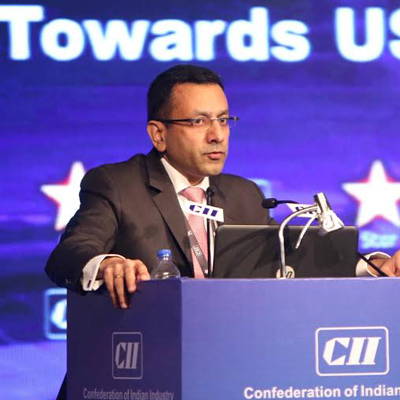
    Speaking at a CII conclave in New Delhi today, Star India COO Sanjay Gupta lamented this fact that saying that from 0.8 per cent of GDP three years ago, the industry had resolved to grow to 1.5 per cent within a decade. However, in the past three years, media as a percentage of GDP has instead fallen by two basis points and the $100 billion dream has continued to remain distant.


    “The biggest hurdle has been the choking of investment. To meet ambitious targets, a business either needs to generate large profits internally, which are then invested back into the business or they grow on the back of external investments – national or international. But the M&E industry boasts of neither,” he said


    CII National Committee on Media and Entertainment and Group CEO, Viacom 18 Group CEO and CII National Committee on Media and Entertainment chairman Sudhanshu Vats, Prasar Bharati CEO Jawahar Sircar, Information and Broadcasting Ministry special secretary JS Mathur and Minister of State for Information and Broadcasting Rajyavardhan Singh Rathore were among those present at the summit.


    During the past 15 years, the M&E sector has barely seen any new entrants and only around $4 billion in foreign direct investment (FDI). To garner $100 billion, the industry needs to invest at least $50 billion over the next decade – something that seems farfetched, given the present circumstances. “With M&E remaining an unattractive destination for investments, investors have no interest to invest in a fragmented and unprofitable business. Despite the 12 per cent year-on-year growth touted for the industry, the sector is paradoxically riddled with a host of unprofitable verticals. For example, sports is a $2 billion industry that could easily grow to around $10 in the next five years. Be it Hockey, Football, Kabaddi or Badminton, the new sporting leagues are being lapped up by the audiences,” Gupta said.


    Yet, the M&E industry has been unable to take off on the back of these investments. “Although Star India has been investing almost Rs 200 crore every season for the past two years, dividends are not commensurate. For this to happen, one needs to scale up the volume of content. In other words, more teams, more players and more days of Kabaddi are required annually to capitalize on this opportunity,” Gupta added.


    “A bizarre challenge confronts us here, however. Although Punjab and Haryana contribute large numbers of Kabaddi players, one cannot add more teams based in either of these two states because they do not have a single indoor stadium that could host a Kabaddi match. In Mumbai, the game is hosted at the NSCI Dome, but the biggest constraint is the availability of this facility for a reasonably long period of time. One venue for a city with more than 1,000 Kabaddi clubs simply does not make sense. In this case, consumer interest and the ability to invest are no hurdles, but the fact that the sporting infrastructure required is simply non-existent. Worse, there are no plans to address this situation,” Gupta continued.


    The movie business is no different. With around 7,000 screens, India has one of the world’s lowest screen densities. Despite breakthrough movies such as Queen, PK or Bajrangi Bhaijaan, revenues are stagnant, although the cost of producing these movies has soared dramatically in the past decade. Therefore, a $2 billion industry that sets a billion hearts racing earns zero profits.


    Even news channels fare no better. Without a robust business model, news channel have no money to invest in their business. Whether English or regional, number one channel or last, none of the channels make any money because none earn any money from subscription. Globally, subscription contributes as much as 60-70 per cent of the total earnings of a news channel.


    Television distribution is roughly a third of the total value of the media industry. In the past few years, immense investments have been made in both direct to home (DTH) and the cable business. But the tragedy of this sector is that even after many years of continued investment not a single company or business makes any money. Since the sector is considered a basic need from a consumer viewpoint, the prices at which content is sold by creators to platforms is regulated – prices frozen in 2003 haven’t changed in the past 12 years. In the same 12-year period, even the price of milk has jumped from Rs 12-15 a litre to Rs 35-40 a litre. 


    “Such anomalies are making the sector bleed. But no one seems to care,” Gupta lamented. “In Delhi, for example, the new government has doubled entertainment tax. Consequently, almost 30 per cent of revenue is paid as entertainment tax. The lack of political alignment and consistency of policy in the sector makes it impossible to plan a sustainable business model.”


    In 2015, where millions across the country receive their daily dose of news from Facebook feed, radio broadcasters can only air news snippets from All India Radio (AIR). “In the US, radio has gone hyper local and people spend an hour daily listening to radio. This gives a fillip to local brands since a quick and cheap platform is available to build their business. In India, conversely, there are a limited number of radio stations and limited content that can be aired – and without any news. It is no surprise then that even in large cities where FM exists, the time spent on radio per person is five minutes. Can any industry on Earth make money in such circumstances?” he asked.


    Gupta concluded by asserting, “Unless we unblock minds, we cannot unblock capital.”


    Accordingly, there is an urgent need to make distribution profitable, position animation as the next wave of export-oriented growth, support a serious scale-up of exhibition screens and sports stadiums and allow content innovation in radio. A hugely attractive pitch for domestic and international investors is required, giving them clarity on the policy environment for the next 10 years and confidence of generating sizeable returns on the investments.


    All stakeholders, businesses, policymakers and regulators need to stop being happy with the status quo and incrementalism. In the new era backed by technology, every sector from automobiles to financial institutions and even grocery shopping have witnessed dramatic growth and serious disruptions on the back of serious flow of capital.


    “M&E too needs to see brave new entrepreneurs, disruptive ideas and unconventional business models but this will only happen if we unblock the capital,” stressed Gupta.

  • Online advertising to overtake television by 2019: PwC

    Online advertising to overtake television by 2019: PwC

    MUMBAI: The latest edition of the ‘Global Entertainment and Media Outlook’ 2015-2019 compiled by PwC clearly indicates digital advertising as the way forward. According to the report, revenue for digital advertising is expected to grow at a fast a rate of 12.2 per cent Compound Annual Growth Rate (CAGR) against 1.2 per cent for non-digital. Though, non-digital advertising will still command 60 per cent of the total global ad spend in 2019.


    What’s worth noting is that the global revenue on advertisement will see a rise at a CAGR of 4.7 per cent to 2019, with Indonesia emerging as the fastest growing advertising market at CAGR of 12.9 per cent.


    By 2019, digital advertising as a whole – including digital out-of-home – will account for 38.7 per cent of total global advertising revenue. The internet’s triumph over television as a medium for advertising will be facilitated by the fast growing market for mobile and internet video advertising.


    Mobile internet advertising will surge at a 23.1 per cent CAGR to 2019, overtaking display internet advertising globally in 2018 and replacing paid search in the US by 2016 as the leading internet advertising category. Global video advertising spend which is also expected to rise at a CAGR of 19.5 per cent will be catalyzed by a near-doubling of global smartphone connections to 3.85billion in the said year. 
     

    This rapid rise in mobile and internet video advertising calls for media companies to offer both native and programmatory inventory of their advertising portfolios, taking into consideration the timescales and skills set of these two varied mediums which need different management.

  • Snapdeal appoints Govind Rajan as chief strategy officer

    Snapdeal appoints Govind Rajan as chief strategy officer

    MUMBAI: Snapdeal has roped in Govind Rajan as its chief strategy officer, effective August 2015.


    Prior to his appointment at Snapdeal, he most recently served as chief marketing officer (B2C) at Bharti Airtel, where he was responsible for revenue and market share growth, customer life cycle management, and building marketing capability across the organisation.  Concurrently he also served as CEO – Airtel Money.


    Before joining Airtel, Rajan was with Hindustan Unilever (HUL). He joined HUL as a management trainee in 1997 before serving in various marketing and leadership roles. In his 15 plus years at Unilever he worked across a diverse range of categories and also led sales teams in varied terrain and a wide variety of channels – from modern trade to rural.


    While at HUL, he was the regional VP south Asia for skin cleansing and prior to that, VP for the skin care business. He also served as the customer marketing and sales operations head of HUL.


    His portfolio included marquee brands such as Dove, Ponds, Fair & Lovely, Vaseline, Lakme, Pears, Lifebuoy and Lux. In these roles he was responsible for driving the P&L, Portfolio management across brands, building new categories such as body lotions, face-wash, and leading in market execution.


    Rajan has masters in international business from Indian Institute of Foreign Trade (IIFT) and a bachelor’s degree in Mechanical Engineering from the University of Madras.

  • Enjoy a devotional start to the day with big magic Bihar & Jharkhand

    Enjoy a devotional start to the day with big magic Bihar & Jharkhand

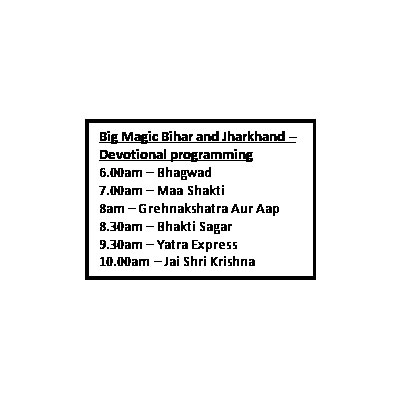
    MUMBAI: In Indian culture and diaspora where over 30,000 Gods co-exist, all good things begin with acknowledging the presence of this supreme power and reiterating an unwavering faith in His guidance. Moreover, in the Hindi Heartland, spirituality and devotion hold a special place in the hearts of adults and children alike.Celebrating this culture, BIG MAGIC Bihar and Jharkhand now ensures that viewers have a great start to their day by tuning in to the channel! With 5 new shows marking an exciting revamp of the morning slot, viewers can now enjoy devotional programming on their favorite channel with content ranging from devotional songs, musical recitals of Holy Scriptures, astrology, pilgrimage and mythology starting 30th September, 2013!

    The greatest and holiest of Hindu scriptures emphasizes the importance of Bhakti towards God. Viewers can start their day with Bhagwad at 6am where verses from the Holy Scripture will be presented as musical recitals. Viewers can then shop for spiritual products in the Teleshopping slot at 7am. Hindus have immense belief in astrology – to gain a scientific explanation to the ancient science of prediction, viewers can tune in to Grehnakshatra Aur Aap at 8am.

    Renownedastrological scholars Reena Kapoor and Astro Pandit Ramesh Bhojraj Dwivedi educate viewers about the calculations of the Planetary Movements that affects our life. Thereafter, viewers can enjoy devotional songs in Bhakti Sagar at 8.30am. India’s rich mythological past comes alive with numerous places of religious importance in Bihar and Jharkhand. Tour these mystic marvels with Yatra Express at 9.30am. The devotional band ends with the wonderful story of one of the favourite Hindu Gods – Lord Krishna. Catch the mythological story of the 8th avatar of Lord Vishnu in Jai Shri Krishna starting 10am.

    Commenting on the renewed programming, Mr. Sunil Kumaran, Business Head, Big Magic Bihar and Jharkhand said, “Big Magic Bihar and Jharkhand has been the No.1 channel in the region and we seek to consolidate our position by introducing brand new programming in the morning slot. We are confident viewers will enjoy their devotional mornings with us.”

  • Finolex Cables Expands its Operations -Opens Office in Patna

    Finolex Cables Expands its Operations -Opens Office in Patna

    Patna, August 01st, 2013: Finolex Cables, India’s largest and leading manufacturer of electrical and communication cables recently announced its entry into Patna. Headquartered in Pune, with several branches across Gujarat, Orissa, Goa, Tamil Nadu, Assam, Rajasthan, West Bengal to name a few, seeing increasing demands from Bihar, Finolex Cables would now be setting up office in the capital.

    Earlier, the Patna market was serviced from their Kolkata office and manufacturing plants. With this expansion, Finolex Cables would be able to strengthen their distribution network, achieve better operational efficency, sales and coordination not only in Patna but throughout the state of Bihar.

    The state of Bihar, which has emerged as the fastest growing state in the economy has vast opportunities for the company’s complete range of high quality Wires and Cables, Electrical Switches & Accessories, Lighting Products including CFLs, T5 Tubes and Fittings, LED lamps among others.

    Commenting on the same, Mr. Sridhar Reddy – President Marketing said, “We are strengthening the distribution network and our sales team in Bihar. We endeavour to tap at least Rs.15 crores of business in the first year and expect a growth of more than 100% in the second year.”

  • Spotlight on India and UK at 16th annual event in Halifax, Canada

    Spotlight on India and UK at 16th annual event in Halifax, Canada

    New Delhi: The spotlight at the 16th annual event in September in Halifax in Nova Scotia (Canada) will be on India

    And for the second year in a row, the United Kingdom will also be highlighted at the event from 12 to 15 September.

    Ms Laura Mackenzie, Director of Strategic Partners – one of the world’s top co-production/co-financing markets focusing on feature film, TV and multiplatform fiction – says "Strategic Partners held a soft focus on India to introduce a small number of India producers and officials to the event. This has already contributed to a Canadian film shot in India.”

    The spotlight on India and the UK is timely, she said, adding that: “Momentum continues to build in the number of Canadian and International producers looking to collaborate with India and the UK is a natural co-spotlight given their experience in successfully capitalizing on their co-pro treaty with India many times."

    Offering an intimate, organized forum for projects seeking financing, as well as those at an early stage – looking for the right partner, Strategic Partners’ linear program is designed to provide unparalleled access to international co-production possibilities – all under one roof.

    The deadline for the Strategic Partners‘ call for producer applications and industry registrations is June 28. Application/Registration forms are now available at www.atlanticfilm.com/sp

    Top Canadian and international industry players are selected to attend, including producers, investors, sales agents, funding agencies, broadcasters and distributors. Offering close to 1000 pre-scheduled one-to-one meetings, co-production focused roundtable sessions, cutting edge panels, visionary keynote speakers, screenings and receptions.

    Strategic Partners is a convergence of talent and innovation, producing tangible results.

    “It was at Strategic Partners that we were introduced to producer, Karen Shaw’s project Khoya in 2012. It‘s an interesting project and given our experience in International productions, we came onboard instantly," said Guneet Monga, producer, Sikhya Entertainment, India (Gangs of Wasseypur, Peddlers.)

    "Guneet Monga and I connected during our participation in Trans Atlantic Partners, and further cemented the relationship at Strategic Partners,” said Karen Shaw, producer, Quarterlife Crisis Productions, Canada (Khoya, The Good Fence). “Khoya was shot in India, where we worked with Guneet, and the film is now in post production."

    About Strategic Partners: An International Film, Television and Multiplatform Co-Production Market

    Strategic Partners is a part of the Atlantic Film Festival family of programmes. Today’s Atlantic Film Festival is now a year-round celebration, growing beyond our eight-day cornerstone event in September to include ViewFinders: Atlantic Film Festival for Youth, alFresco filmFesto, Strategic Partners and Music & Image.

  • Shonali Bose wins Mahindra Global Filmmaking award

    Shonali Bose wins Mahindra Global Filmmaking award

    MUMBAI: The Sundance Institute – Mahindra Global Filmmaking Award 2012 was presented to Indian director Shonali Bose for her film Margarita. With A Straw. With this, Bose stands among the four filmmakers who won the award announced at the Sundance Film Festival.

    The other winning directors and projects are Ariel Kleiman for Partisan (Australia), Etienne Kallos for Vrystaat (South Africa) and Dominga Sotomayor for Late To Die (Chile).

    Each of the four winning filmmakers will receive a cash award of $10,000, attendance at the Sundance Film Festival for targeted industry and creative meetings, year-round mentoring from Institute staff and creative advisors, participation in a Feature Film Program Lab, and ongoing creative and strategic support.

    Commenting on Sundance Institute’s association with the Mahindra Group, its president Robert Redford said, “We are grateful to the Mahindra Group for building with us, this multifaceted program, which embraces our joint global commitment to nurturing new storytellers and getting their voices out to the widest possible audiences.”

    The Global Filmmaking Award Nomination Committee in India include Shabana Azmi, Shyam Benegal, Ira Bhaskar (film professor), Anupama Chopra (film critic), director Gautam Ghose, K. Hariharan (Film Academy director), Shekhar Kapur, Anjum Rajabali and Ramesh Sippy.

    The Global Filmmaking award was instituted in 2011 in recognition and support of emerging independent filmmakers from around the world.

  • PVR prepones release of The Tree of Life

    PVR prepones release of The Tree of Life

    MUMBAI: Going back on its earlier announcement that it would release Terrence Malick‘s The Tree of Life in August, PVR has now confirmed that it will release the film on 29 July all over India.


    Starring Brad Pitt, Sean Penn and Jessica Chastain, the film deals with the questions of the origin and the meaning of life.


    The American film won the Palme d‘Or at the 64th Festival de Cannes this year where it received mixed reactions from the audience and the press at Cannes.


    The Tree of Life happens to be the fifth film of Terrence Malick in his filmmaking career that spanned four decades.