Tag: Unacademy

  • BCCI announces Unacademy as official partner for IPL

    BCCI announces Unacademy as official partner for IPL

    MUMBAI: The Indian Premier League governing council (IPL GC) announced India’s largest learning platform Unacademy as official partner for IPL beginning with the 2020 edition which will be held in the UAE from 19 September onwards. The partnership will cover three seasons of the IPL.

    The Bengaluru-based edutech firm, Unacademy, aims to build an online knowledge repository for multilingual education by bringing expert educators together from across the globe.

    IPL chairman Brijesh Patel said: “We are pleased to have Unacademy on board as the ‘official partner’ of the Indian Premier League 2020 to 2022. IPL Is the most watched cricket league in India and as a homegrown Indian edutech company we believe that Unacademy can create a huge positive impact on the aspirations of the audience watching, especially the millions of Indian youth who are seeking inspiration in their careers.”

    Unacademy vice-president marketing Karan Shroff said: “We are delighted to become the official partner of IPL. Unacademy is a high-intensity brand that has disrupted the education and learning market with innovations and broken geographical barriers for Learners and Educators. The IPL has a similar history of disruption and innovation that have not only brought cricket fans closer to the game but also catapulted it to become one of the top sporting events in the world. With this partnership, we will double-down on our efforts to make Unacademy the biggest brand in the consumer-internet space in India. We thank the BCCI and IPL for the opportunity and look forward to a long and fruitful partnership.”

  • How does Dream11 benefits from IPL sponsorship

    How does Dream11 benefits from IPL sponsorship

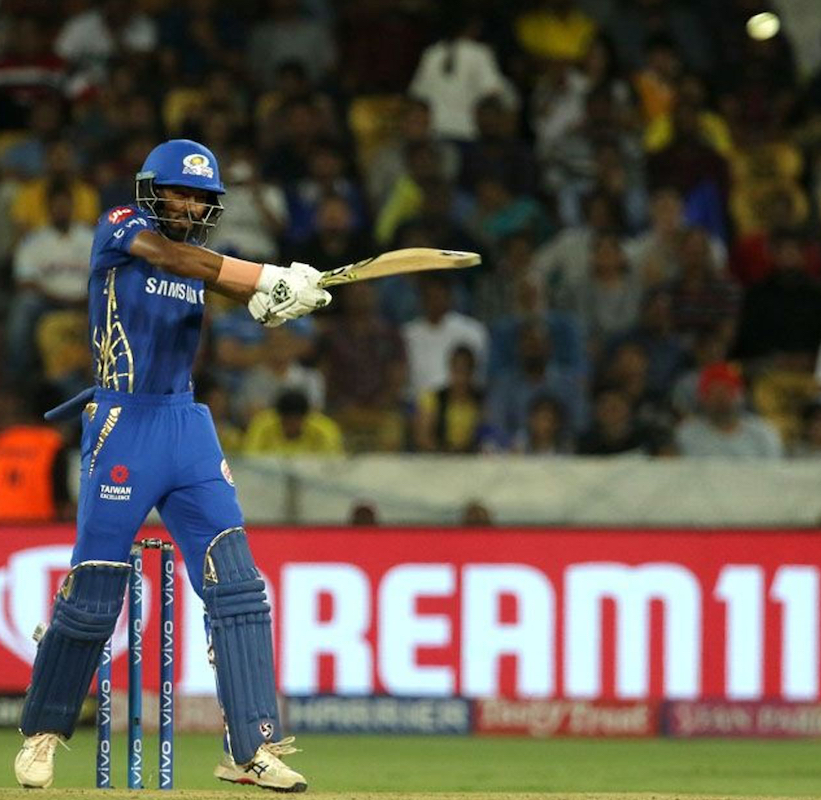
    NEW DELHI: Yesterday, the announcement around Fantasy sports platform Dream11 bagging the title sponsorship rights for IPL 2020 made it to news outlet across the world. The fantasy league platform won the right for Rs 222 crore and replaced the Chinese mobile phone brand, Vivo, for a four-and-a-half-month deal. For the record, Vivo this year pulled off the association due to the ongoing Indo-Sino tensions across after the border.

    Dream11 has managed to get the sponsorship title at nearly half the price to what Vivo was paying. Vivo signed the title sponsorship rights with BCCI for five years till 2021 at Rs 2,199 core. The Chinese smartphone brand was paying approximately Rs 440 crore per year to BCCI whereas Dream11 has only spent Rs 222 cr.

    According to Dream Sports (Dream11) CEO & co-founder Harsh Jain, "The launch of IPL in 2008 gave birth to the idea of Dream11. We would like to thank the BCCI for giving us an opportunity to become the Title Sponsor of IPL, which in our opinion is the world’s greatest sports property. We are happy to continue building our partnership with BCCI & IPL to further promote sports fan engagement in India, and look forward to 10 Crore+ Indians making their Dream11 for every Dream11 IPL match.”

    Founded by Jain and Bhavit Sheth, the brand became India’s first gaming unicorn in April 2019. In the last few years, Dream11 has scaled up the brand proposition in the market while creating a niche for itself. The fantasy game app in the last two years has associated with multiple sports platforms like ICC, IPL, and PKL. They have roped in former Indian cricket team captain Mahendra Singh Dhoni, the face of the brand that has helped them garner consumers' attention effectively . The brand has expanded its wings with the launch of Fancode and DreamX.

    Good Deal

    Dream11 is already a sponsor to several IPL teams and has grown in leaps and bounds in the recent past.

    Lloyd Mathias, Business Strategist, who was closely involved with cricket sponsorship as the executive VP Marketing of PepsiCo defines the deal a great opportunity to cement itself as the clear leader in fantasy and online gaming. "They now establish themselves firmly on consumers' minds ahead of MyTeam11 and My 11circle and Howzat. This is an opportunity to come in as title sponsor at a 50% discount," mentions Mathias.

    Top of the Mind Recall

    There is no doubt that Dream11 has emerged as the torchbearer of this category in India and has grown in leaps and bounds. From a base of two million users in 2016, fantasy gaming platform has over 90 million users, according to a report by accounting firm KPMG published earlier this year. They have built a strong social media community. Several reports suggest that the brand clocked revenue of Rs 700 cr in FY19.

    The association with IPL will generate a massive reach and exposure of the brand not just across India but beyond the borders also.

    Dentsu One president Harjot Singh Narang defines that the BCCI and Dream 11 coming together is the best way to synergise each other’s reach to make IPL this year really come back with a bang and use this to fulfill marketing and monetisation goals in a market with a pent-up demand. 

    He further added, "For Dream 11 particularly this is their moment to make it big and target catapulting themselves to a national pastime contender with the fantasy sports world. Dream 11 needed a moment in the spotlight for this jump and have aptly invested behind the country’s passion to power that leap just like great brands like Pepsi, CocaCola, Crick Info, etc. 

    Cricket tournaments and IPL, in particular, is the single most visible platform for any brand to gain extensive reach and frequency of exposure with their potential audience in India and Dream 11 will definitely get a solid bang for its buck".

    Dream11’s association with sports has grown over the years and it is presently partnering a total of 19 sporting leagues along with 6 Indian Premier League Franchises.

    Due to the prevailing Covid2019 situation in India, the IPL is happening this year in UAE whereas other marquee global sporting events like the Olympics and Wimbledon have been pushed to 2021. Participating brands will see a huge jump in TV viewership given the total absence of live sporting entertainment in the market over the past 6 months. 

    Mathias mentions that IPL gives huge awareness and adoption. In a span of 50 days a brand can establish itself in consumer minds across a broad demographic. He adds, “They see cricket as the shortest route to grow exponentially – and outpace their competitors.”

    Future Partner

    The one thing which is still not clear is whether or not Vivo will be making a comeback next year? However, there are speculations that BCCI will opt for a fresh bid next year. Even if Vivo doesn’t return, BCCI has decided not to go with the same amount as it is comparatively lower. 

    Since the title sponsorship, this year has been awarded at half price; will this hurt the brand value of IPL in the long run when it will choose a new sponsor next year? 

    Mathias believes that  “as far as the IPL is concerned there is virtually no loss of brand value. The biggest chunk of IPL’s revenues accrues from the STAR TV network who guarantee US $2.55 billion to the BCCI as an official broadcaster – so about US $ 500 million (Rs 3800 cr) a season. The drop in the price of the title sponsorship by half -about Rs 220 cr – is tiny in comparison.”

    It has been widely reported that the educational platform Unacademy and Bjyus were also in the sponsorship race. Unacademy had bid Rs 210 crore while Byju's had bid Rs 125 crore for the same period. Byju’s is the current jersey sponsor of the Indian cricket team. Even Tata Sons too showed interest in bagging the sponsorship rights, but the deal couldn’t take place due to the lower bidding offer. The Indian startup ecosystem is very keen on sports marketing (mainly cricket).

    Havas Media Group MD– India Mohit Joshi states that ed-tech is a sunrise sector currently and has a huge untapped potential in India. “Indian start-up ecosystem has always been associated with impact driving properties – whether it was the jackets in publications or the sponsorships of big-ticket programming in yesteryears. This year, IPL association is one of the biggest impact driving opportunities available, and hence it’s but natural that the Indian start-up ecosystem will be keen to associate with it.”

    However, there is a section of people who have not taken the news of BCCI & Dream11 association in the positive light because the latter has investments from Tencent Holdings, a Chinese investment firm.

  • Dream 11 bags IPL title sponsorship rights

    Dream 11 bags IPL title sponsorship rights

    NEW DELHI: Fantasy sports platform Dream11 has bagged the title sponsorship rights of IPL 2020 for Rs 222 crore, as per PTI reports. The fantasy league platform has replaced the Chinese mobile phone brand Vivo for a four-and-a-half-month deal.

    Dream11 has been one of the IPL sponsors for a couple of years now. "Dream11 has won the rights with a bid of Rs 222 crore," IPL Chairman Brijesh Patel told news agencies.

    However, there has been no confirmation from Dream 11, at the time of filing this story.

    Companies like Tata Sons, Unacademy, and Bjyus participated in the bidding process. According to multiple media reports, Unacademy had bid Rs 210 crore, Tata Sons had bid Rs 180 crore and Byju's had bid Rs 125 crore.

    Vivo and BCCI postponed their partnership for one year due to the prevailing Sino-India border stand-off. Under the deal with Vivo, BCCI was receiving Rs 440 crore per year. The IPL will be held from September 19 to November 10 in the UAE this year.

    On August 10, the Board of Control for Cricket in India (BCCI) had sent out invitations to third parties to express their interest (EOI) in acquiring the title sponsorship rights for IPL 2020.

  • What next after the WFH honeymoon?

    What next after the WFH honeymoon?

    NEW DELHI: The ‘new normal’ might already have started setting in with major conglomerates of the world taking calls like allowing their employees to work from home ‘forever’. Recently, Twitter CEO Jack Dorsey announced in a company-wide email that while opening the offices will be the company’s call, to come back will be totally an employee’s choice.

    Several other tech companies, including the other two giants Facebook and Google, have told their employees to work from home till the end of this year. Closer home, e-learning platform Unacademy announced that 60 per cent of its workforce will be working from home permanently, even after the lockdown.

    This gives a clear picture of what the future of workplaces is going to be like, at least for the tech firms where most of the work can be managed over servers and clouds. Reacting to the same, brand-thinker and independent consultant Harish Bijoor noted: “WFH makes sense for every factor: economic, social, family, commute, cost, time, and common sense. Corporate society does not need to artificially divide home and work anymore. It makes great sense!”

    Brand-nomics managing director Viren Razdan said: “While Google has announced WFH beyond the lockdown, the truth is tech companies have thrived on the idea of WFH or rather WFA or Work From Anywhere. Amazon and Apple were born in home-garages, giving birth to the cult of ‘ideas behind napkins’, start-up buzz at cafes, the informality bred a new culture of play.”

    Sharing his thoughts on how the culture can be embedded in other industries, he added, “This IS perhaps the WFH honeymoon; we are all learning and encouraging, holding each other’s hand firmly through this phase. The real truths would unveil once we bring the practice into regular play.  The biggest challenge perhaps would be to disrupt our culture to allow this fluidity and freedom. Our models at work based on firm control, checks and balances in place. The buzzing office is symbolic of efficiency and business as usual. Companies would be pushed to make accountability a key factor, and shed the weight of authority. A lot of companies are moving to fast-forward to agile models of work, which are perhaps more conducive to adapt to these new systems.”

    Recently, in  a webinar hosted by the Advertising Club of Bangalore, BBH India CEO and managing partner Subhash Kamath and Wunderman Thompson South Asia group CEO and chairman Tarun Rai supported the idea of allowing flexibility to agency workforce to work from home, citing reasons like the fact that it will bring more gender-equality within the teams and liberate the talent from geography.

    However, they had also noted that to make this culture a reality, people will have to bring some behavioural changes in themselves and leave control that they like to have on subordinates, and also the firms will have to rework their appraisal policies.

    Agreeing to this, Samsika Marketing Consultants MD Jagdeep Kapoor said: “I had learnt this from grandmother and it stands relevant today that when everything closes there should be one thing that remains open, and that is your mind. I think any transition will be possible if people keep an open mind and accept changes.”

    He also vouched for the many benefits that working from home will come with. “I think working from home increases productivity, saves time, and allows teams across cities to work together for better deliverables. Personally, I have been working from a home office for more than a decade now and it has been great. I have this policy that I don’t visit client offices and meet them at my place. With remote working, now clients have eased out even more and we have those meetings over video calls now.”

  • Ed-tech platforms reap gains during lockdown

    Ed-tech platforms reap gains during lockdown

    MUMBAI: When you are cooped up in your home courtesy the Covid-19 lockdown, you can spend your time cribbing or carping or learning a new skill by signing up with an online platform to make up for a gap you did not learn in university or school. It looks like Indians are preferring the latter, if one goes by the flurry of signups with education or edtech platforms. Signups aside, learners are also getting glued for longer on online courses daily at about 45 minutes as against 20 minutes prior to the explosive spread of the COVID-19 virus.

    Take the case of the Ronnie Screwvala-backed upGrad which took front page ads in mainline newspapers earlier this year.  According to its co-founder & chairman Mayank Kumar, the inflection point commenced in the second last week of February. Says he: “From that week (17-24 February) onwards, we started witnessing exponential traction towards our platform. In the last week of February, leads (interested learners / prospects) increased by around 34 per cent compared to the week before. In the first week of March, our interest went up by 75 per cent as well.”

    Additionally, discloses Kumar, the programme completion rate at upGrad is 80 per cent as of now, which is relatively high and he is quite certain that it is going to increase, as online education is no longer an option but becoming mainstream.

    Unacademy too has seen an eye popping uptake of its services. It recorded a whopping one billion minutes of watch time in the month of March across its platforms and YouTube channels.

    “We announced over 20,000 free live classes on the platform to ensure learners’ education is not obstructed amidst the COVID-19 crisis. We also opened up our platform for all educational institutions such as schools and colleges to conduct live classes for their respective students,” says Unacademy VP marketing Karan Shroff. “The number of new enrollments increased considerably during the month of March. We witnessed an increase of 110 per cent in new subscribers leading to over 1.5 million learners learning on the Unacademy platform, since the beginning of March.”

    Karan highlights that even searches for competitive courses like SSC, bank and railway entrance exams, UPSC have multiplied manifold.  Users are logging on to the platform to improve their knowledge of subjects and learn how to improve their exam scores through mock tests, quizzes, and feedback from educators.

    Schoolguru Eduserve founder & CEO Shantanu Rooj noticed some behavioural changes amongst the students as the daily logins have gone up by 2.5 times. He also highlighted that the app downloads have gone up, an indication that those who had earlier procrastinated their studies are completing them now. The participation in the virtual sessions has gone up. Course completion rates have also increased.

    He adds: “We have onboarded about 4000 new paid students for the degree programmes in March over and above our current 200,000 students. We have seen about 12-15 per cent of daily active users to monthly active user ratio."

    Simplilearn CEO Krishna  Kumar says the subjects which are traditionally popular like  data science and cyber security have gained importance during this lockdown.  There is a lot of uptake in the enquiries. “We have close to 10,000 enrolments in regular months. March was also pretty much the same. The real testing time is going to be April when the lockdown was extended. The last few weeks of March were challenging as people were still adjusting to the reality. April onwards we are hoping for an increase as people are sitting at homes they have more time.”

    At upGrad the domain of data science is the most popular, followed by digital marketing. Areas of machine learning (ML) and natural language processing (NLP) are also popular considering the current workforce. According to Mayank Kumar, the digital macro-trend, coupled with an increase in usage of data, is going to now drive the workplace ecosystem.

    He further adds: “We had brought global MBA programmes to India towards the end of February with Deakin University and Liverpool Business School, which eventually got popular in the following month. Both the programmes are seeing interest amongst working professionals, and around 50,000 individuals and counting have shown interest so far.”

    Experts believe that the current environment is a net positive for online education. It took a global pandemic to bring online education into the mainstream, which has otherwise played second fiddle to the offline model.

    Upgrad's Kumar elaborates: “Two to three weeks ago (in March), we used to get 2,500 enquiries a day, but there has been a 50 per cent upside with over 3,800 enquiries per day.”

    “Additionally, in Q4 upGrad recorded over 100 per cent Q-0-Q jump, as it expanded its portfolio twofold in the last quarter by adding new programmes under its management and data verticals. With our outcome-based learning approach, which comprises deep subject knowledge, finest university credentials, strong mentorship and finally steadfast placement support, upGrad is in a position to command the highest ARPU of Rs 2.4 lakh in the Indian online education sector,” he adds.

    In March Unacademy witnessed a significant rise in the number of daily active users and also a sharp increase in the views per week. The daily active users increased to around 500,000 per day and viewers per week for the free special classes increased by 150 per cent.

    At Simplilearn enquiries have grown by 30 to 40 per cent. On a quarterly basis they have 50,000 monthly active users. However, at present 75,000 monthly active users are scouring the platform for upskiling themselves.

    Simplilearn and Schoolguru are opting for LinkedIn and other social media sites as the best medium to promote their content. Schoolguru is also using direct e-mail marketing and PR as marketing platforms. This apart, the edtech platforms are also using events (both physical and digital) sporadically and participating in several industry events and rolling out  reports and whitepapers from time to time.

    Shroff says: “Our marketing efforts are focused on supporting this business vision and helping learners stay focused and prepare for their dream exams, even during this crisis. As part of these efforts to help build awareness that learning never stops with Unacademy, we are running our "Let’s Crack It" campaign on TV and other digital formats.”

    Unacademy recently launched the second edition of Legends on Unacademy – a programme for   learners where they bring well-known personalities to teach live classes on the platform. In this edition, they have Shashi Tharoor, Kiran Bedi, Virat Kohli and Anushka Sharma who will teach about international relations, crisis management, motivation, and determination, among other topics. In the first edition, that took place in early March, they had legendary cricketers such as Brian Lara, Bret Lee and Jonty Rhodes who took live classes on mental strength, dealing with failure, etc.

    In order to create awareness during the lockdown period Schoolguru has offered its learning experience platform (Lurningo) free of cost for the first three months across various colleges and universities in the country.

    Indeed, Covid-19 has left deep scars across many sectors which have been locked down. But, for the edtech industry, it has been a boon of sorts. And the men behind it are probably glad, as it has helped accelerate their business plans. Which is clearly good news for the promoters and their investors.
  • Unacademy launches 360-degree campaign ‘Let’s Crack It’

    Unacademy launches 360-degree campaign ‘Let’s Crack It’

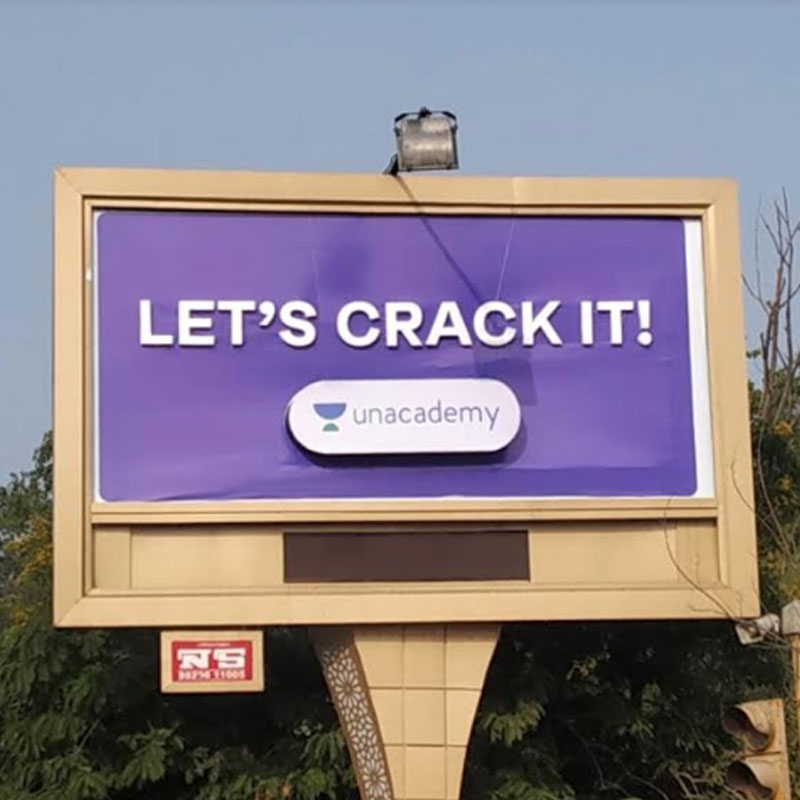
    MUMBAI: Education technology firm Unacademy launched a 360-degree campaign titled ‘Let’s Crack It’. The OOH duties to propagate the communication was handled by OMI, the Outdoor Agency arm of Laqshya Media Ltd.

    Unacademy endeavours to connect learners to educators and help the former prepare for over 30 different entrance examinations across disciplines. It is beautifully addressing the dire need of delivering quality education to all. It is serving as a one-stop solution for all education needs.

    OMI carved a 13-city plan for them with a sole objective of highlighting their brand communication 'Lets Crack It'. A very simple message delivered to the right audiences and using the right medium does the trick. Impactful billboards carefully handpicked in cities like Delhi, Bengaluru, Kolkata, Pune, Hyderabad, Ahmedabad, Cochin, Jaipur, Indore, Kota, Lucknow, Patna and Bhubaneshwar along with all unmissable media assets catering to the college-goers.

    Laqshya Media, OMI COO Naresh Bhandari commented "Unacademy is a very noble concept connecting learners to educators instantly. Their campaign stands for this value and the belief that they are part of this journey with the students. The messaging ‘Let’s Crack It' beautifully stresses the word ‘Let’s’ to assure this to every learner. We are extremely happy to have worked with them for this campaign. It was their first time on OOH and we had to ensure them the best of noticeability. Am glad the team could deliver the campaign’s much needed OTS. The creative looks great on OOH and the messaging is just apt for the outdoor scenario. The campaign buzz is around and a 3 – week duration would ensure that it stays with the TG for long."             

    Unacademy  vice president marketing Karan Shroff, commented "We are extremely content with the OOH campaign executed by OMI for us. The visibility is great, and the media assets deployed by them are all catering to our TG. We are confident of having reached out to a million aspirants looking for quality education. ‘Let’s Crack It' is the heart of our campaign and we are ecstatic to reach and inspire our audience through a very effective mass medium like outdoor advertising.”

  • Karan Shroff joins Unacademy as VP marketing

    Karan Shroff joins Unacademy as VP marketing

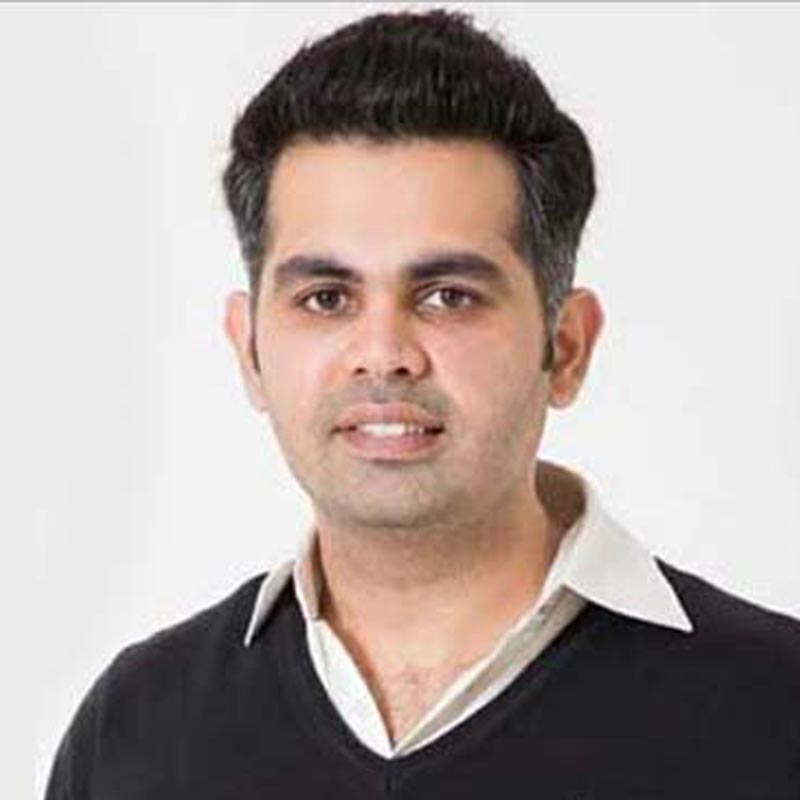
    MUMBAI: The former head of brand marketing at Xiaomi India, Karan Shroff, has moved to join educational technology start-up Unacademey as vice president marketing. In his new role, Shroff will be responsible for planning the overall marketing strategies for the brand and will be based out of its Bangalore office. 

    Shroff shared the news of his departure from Xiamoi, where he worked for more than four years, via a LinkedIn post expressing his gratitude to the team he worked with during the stint and did “tons of launches, 100s of campaigns”. 

    Screenshot_20190905-122753__01.jpg

    He had joined Xiaomi in 2015 as senior marketing manager. He ranked up steadily and was overseeing all the campaigns pertaining to the overall image and positioning of the brand in India. He was responsible for some of the iconic campaigns like “Kiska Baja”, “Naya Note”, and also the brand’s first Guinness World Record. 

    Prior to Xiaomi, Shroff has worked with companies such as Herbalife International India Pvt Ltd, Bertelsmann, Wizcraft International Entertainment Pvt Ltd and Pixies Events.