Tag: UGC

  • ShareRoot signs UGC contract with partner agency

    ShareRoot signs UGC contract with partner agency

    MUMBAI: ShareRoot has secured an additional contract through its partnership with the marketing agency MMGY Global. ShareRoot offers a Software as a Service (SaaS) platform that works with brands and digital agencies to easily find and legally source UGC.

    UGC (user-generated content) is continuing to emerge as a must-have tool for businesses, brands and marketers across a range of industry verticals. Industry data shows that visitors spend 90 per cent more time on websites that include UGC galleries.

    The revenue-generating contract is for an initial three-month pilot trial of ShareRoot’s unique cloud-based legal rights management (LRM) platform for UGC within MMGY’s hotel clients that manage hotel portfolios of over 1,000 properties and revenues of more than US $ 140 million per annum.

    ShareRoot chief revenue officer Scott Sorochak said: “This pilot contract is indicative of our strengthening sales pipeline and the recent success in our travel and hospitality vertical and is further validation for SRO’s ongoing strategy of adding new features to the UGC platform to drive sales and
    revenue growth this financial year.”

    Sorochak stated: “This revenue-generating contract is for an initial three-month trial of our UGC platform with the potential for a longer-term deal starting in 2018. The securing of this contract further increases the relevance and effectiveness of ShareRoot’s UGC platform for the tourism and hospitality sector.”

  • Six principles vital for acceptance of branded content: Vanessa Clifford

    Six principles vital for acceptance of branded content: Vanessa Clifford

    NEW DELHI: It’s the business of consumer connect, realistically. Noting that there was a dearth of good branded content and the British media invested 350,000 pounds sterling towards that every year, Newsworks deputy chief executive Vanessa Clifford said the aim should be to provide value to the consumer.

    Talking about opportunities for branded content at the session “All News is Good News” at ZEE Melt here, she listed six guiding principles for branded content.

    She said that the first was clearly the audience interest. One needed to attract the right kind of audience for a particular brand that one planned to sell through a specific advertisement, she said.

    There was need to plan the communication idea keeping the target audience and the platform – online or print – in mind. Secondly, the print medium was important as its expertise and heritage were built on reputation, she said.

    Trust and transparency was the third on Vanessa’s list of principles. She demonstrated examples of how a reader and viewer’s trust had been won in different advertisement campaigns.

    It was necessary for the advertiser and the media, she said, to set the right goals so that the objective of the campaign was fulfilled.

    Collaboration between the advertiser and the medium was of prime significance so that the message was conveyed perfectly well, Vanessa felt.

    Finally, Vanessa said, there was need to ‘create stories’ that kept the interest of the audience alive.

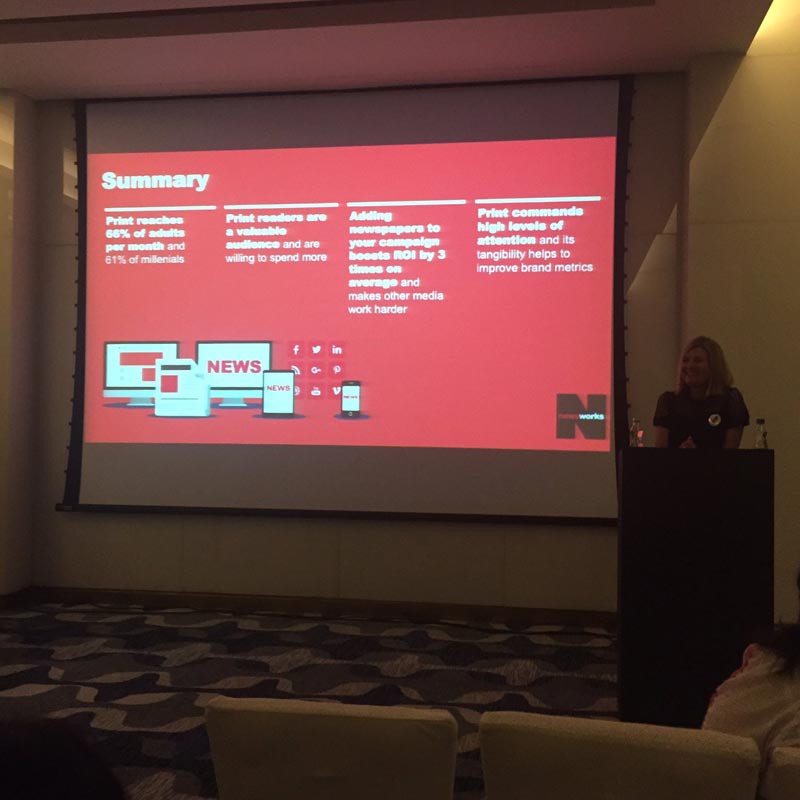
    Earlier, speaking in the same session on “The Role of Print”, Vanessa said that her experience in the United Kingdom had shown that the impact of the print medium was higher in the long-term and national newspapers drove news brands.

    She quoted Arthur Miller to say that a good newspaper was like a nation talking to itself.

    The print medium delivers results better than any other medium, and campaigners using the print news delivered stronger effects on businesses. News brands command a higher level of attention and 60% of that was focused on newspapers as against 57% on television.

    Referring to branding content, she said that there was greater engagement, trust and personal identification. She observed that advertisements worked on ‘sight and sound’ but often forgot the ‘touch’ aspect which actually drove brands, and this was achieved through the print medium.

    Furthermore, she said that physical interaction in researches had shown that 66% of the consumers considered buying or subscribing to a product if they saw it in print. The return on investments (ROI) by advertisers through the print medium was three times better than any other medium. The print also commanded a higher level of attention.

    Answering a question, she said credibility was higher in the print medium despite the influx of newer online media. Age of the consumer was not a consideration as far as the print medium was concerned, she noted.

    Speaking on “Brands and Marketers” in the age of democratized story-telling, News Corp Senior Vice President-Strategy Raju Narisetti said user-generated content (UGC) used by advertisers had greater effect than a commercial where it was clear that it was being enacted.

    “Everyone is creating content these days, and around 400 hours of content is produced on YouTube every minute,” he said. Democratized story-telling showed that anyone could tell a story through the mobile.

    Raju referred to studies that had shown that 92% consumers were more likely to trust their peers than an advertisement. But, he said, the challenges before UGC was volume, accuracy, acceptance and acquisition.

    There was need to align, identify, verify and license, and deploy before using technology for UGC, Raju concluded.

  • Six principles vital for acceptance of branded content: Vanessa Clifford

    Six principles vital for acceptance of branded content: Vanessa Clifford

    NEW DELHI: It’s the business of consumer connect, realistically. Noting that there was a dearth of good branded content and the British media invested 350,000 pounds sterling towards that every year, Newsworks deputy chief executive Vanessa Clifford said the aim should be to provide value to the consumer.

    Talking about opportunities for branded content at the session “All News is Good News” at ZEE Melt here, she listed six guiding principles for branded content.

    She said that the first was clearly the audience interest. One needed to attract the right kind of audience for a particular brand that one planned to sell through a specific advertisement, she said.

    There was need to plan the communication idea keeping the target audience and the platform – online or print – in mind. Secondly, the print medium was important as its expertise and heritage were built on reputation, she said.

    Trust and transparency was the third on Vanessa’s list of principles. She demonstrated examples of how a reader and viewer’s trust had been won in different advertisement campaigns.

    It was necessary for the advertiser and the media, she said, to set the right goals so that the objective of the campaign was fulfilled.

    Collaboration between the advertiser and the medium was of prime significance so that the message was conveyed perfectly well, Vanessa felt.

    Finally, Vanessa said, there was need to ‘create stories’ that kept the interest of the audience alive.

    Earlier, speaking in the same session on “The Role of Print”, Vanessa said that her experience in the United Kingdom had shown that the impact of the print medium was higher in the long-term and national newspapers drove news brands.

    She quoted Arthur Miller to say that a good newspaper was like a nation talking to itself.

    The print medium delivers results better than any other medium, and campaigners using the print news delivered stronger effects on businesses. News brands command a higher level of attention and 60% of that was focused on newspapers as against 57% on television.

    Referring to branding content, she said that there was greater engagement, trust and personal identification. She observed that advertisements worked on ‘sight and sound’ but often forgot the ‘touch’ aspect which actually drove brands, and this was achieved through the print medium.

    Furthermore, she said that physical interaction in researches had shown that 66% of the consumers considered buying or subscribing to a product if they saw it in print. The return on investments (ROI) by advertisers through the print medium was three times better than any other medium. The print also commanded a higher level of attention.

    Answering a question, she said credibility was higher in the print medium despite the influx of newer online media. Age of the consumer was not a consideration as far as the print medium was concerned, she noted.

    Speaking on “Brands and Marketers” in the age of democratized story-telling, News Corp Senior Vice President-Strategy Raju Narisetti said user-generated content (UGC) used by advertisers had greater effect than a commercial where it was clear that it was being enacted.

    “Everyone is creating content these days, and around 400 hours of content is produced on YouTube every minute,” he said. Democratized story-telling showed that anyone could tell a story through the mobile.

    Raju referred to studies that had shown that 92% consumers were more likely to trust their peers than an advertisement. But, he said, the challenges before UGC was volume, accuracy, acceptance and acquisition.

    There was need to align, identify, verify and license, and deploy before using technology for UGC, Raju concluded.

  • New Ku-band Telugu channel Manna TV launched

    New Ku-band Telugu channel Manna TV launched

    The southern Indian state of Andhra Pradesh yesterday witnessed the launch a new Telugu channel christened Manna TV on state-of-the art Ku band-based satellite communication network.


    The state’s chief minister N Chandrababu Naidu did the honours on the occasion of Ugadi, Telugu New Year, according to the Press Trust of India.


    As part of pilot transmission, Manna TV will commence telecasting long distance education programmes of Dr BR Ambedkar Open University and the University Grants Commission (UGC) respectively. It will also provide information about various state government departments and help farmers with prompt and timely update on weather and seasonal conditions.


    In his inauguration address, Naidu thanked the Indian Science Research Organisation (ISRO) for agreeing to his government’s request for providing the Ku band linkage. He said apart from literary and informative programmes, the channel would also focus on beaming entertainment programmes. The Ku band connected channel – which now caters to the needs of students belonging to 46 junior colleges, 12 degree colleges, 56 high schools and 94 government departments – will be expanded to more university colleges and schools from the next academic year.

  • Brandmovers launch new Puma digital campaign with Chitrangada

    Brandmovers launch new Puma digital campaign with Chitrangada

    MUMBAI: Brandmovers, the global digital creative agency today unveiled its first fitness centric campaign titled ‘Chitrangada Singh’s Gear Up buddies for Puma and Jabong.com’. The campaign can be seen at http://www.jabong.com/gearupbuddy.

    Brandmovers conceptualised, produced and developed this campaign in the form of an interactive video on fitness routines, for all fitness lovers. The video is live on the website of Jabong.com and would enable online users to experience interesting exercises such as running, zumba and crossfit.
    Watch the Video: Chitrangda Singh’s Fitness Workout #GearUpBuddy

     Brandmovers’ new Puma campaign includes three instructors along with Chitrangada who are known as Chitrangda Singh’s ‘Gear Up’ buddies and will train the viewers in zumba, crossfit and running. This video gives users the ability to change between exercises, while the people on screen switch into different Puma fitness gear. The most annotated YouTube video in history with over 1700 annotations, this exclusive video also gives users an option to know more about the particular fitness gear by clicking on it, and directing them to Jabong.com if they want to purchase.

    “With Puma’s first of its kind digital fitness campaign, we are trying to create online engagement by making people a part of the video experience rather than witness it. The concept of Chitrangda’s ‘Gear Up’ buddies is designed for people who like to stay fit. The campaign will attract and involve people, making them shop online at the same time”, said Brandmovers India co-founder and CEO Suvajyoti Ghosh.

    “The trend of e-commerce players partnering with retail brands is yet to evolve. We wanted to create an edgyimmersive brand experience that is shareable and linked to online sales on an e-Commerce website.” he added.

    Brandmovers has also brought in additional User-Generated Content (UGC) in this campaign by beginning a hunt for the fourth fitness expert, reaching out to bloggers and fitness-holics, who will get a chance to feature in the next edition of the interactive video as Chitrangada’s ‘Gear Up’ buddy.

  • Security concern over social networking, user-generated content: Deloitte

    Security concern over social networking, user-generated content: Deloitte

    MUMBAI: Deloitte’s Technology, Media and Telecommunications (TMT) industry group has predicted that this year expanding social networks will create a greater need for security and copyright protection technologies

    Meanwhile, user-generated content (UGC) from blogs, amateur filmmakers and others will both complement and threaten traditional media outlets.

    With global internet traffic reaching capacity, investment in laying new cable or lighting existing fiber may be needed — but may be stifled by continuing declines in wholesale capacity prices.

    Predictions 2007 is a series of three reports examining emerging developments and how they will shape the TMT market. They were written by the Deloitte TMT industry group with input from industry analysts and executives. Each report includes recommendations on how to best take advantage of these trends.

    Key trends identified in the reports include:

    — Social Networking Evolves — Social networks will continue to expand, creating a need for identification improvements, the ability to remove copyrighted material quickly, and making downloads as instantaneous as possible.

    — Digital Storage Expansion Driven by Laws — Digital storage needs will be impacted by companies’ legal obligations to keep years and petabytes worth of data, with costs passed onto the user.

    — Internet Capacity Woes — With the Internet reaching capacity, investment in laying new cable or lighting existing fiber may be needed

    — but may be stifled by continuing declines in wholesale capacity prices. Solutions will be found when Web surfers rebel after quality of service declines.

    — The Next Killer Application — Mobile TV may be the next killer application, taking video content off the phone and onto a device with a better screen.

    — Reinvention of TV — IPTV is poised to launch as a reinvention of television, rather than a pale imitation of current services. Operators could position the service as an affordable way for all content providers to deliver niche media to a growing mass audience, without the commission costs of broadcast-network middlemen.

    — The Consumer as the Media Mogul — UGC is increasing. Blogs, amateur filmmakers and others are creating content that complements — or perhaps threatens — traditional media outlets. Smart media companies will serve up user-generated content as a powerful promotional vehicle and use it as an
    effective medium for scouting talent.

    — It’s a New Media World After All — New media metrics are taking over, with old media metrics becoming a thing of the past. Development of comparable statistics will emerge, enabling companies, their customers and their investors to more accurately gauge performance.

    — DVD versus Vod: No Clear Winner in Sight — Simultaneous availability of movies on DVD and Vod will make them closer competitors.

  • ‘User generated content is popular in news, music and sports genres’ : Pankaj Thakar – Cellcast Interactive India CEO

    ‘User generated content is popular in news, music and sports genres’ : Pankaj Thakar – Cellcast Interactive India CEO

    With user generated content (UGC) on the rise globally,UK-based Cellcast is betting that its Sumo.TV platform for broadcasters would catch on in India and other parts of the world. People can send in video content and if it is fit for television viewing, it will be put up.


    Cellcast is also looking to launch shows on different TV channels for which it buys airtime. Indiantelevision.com’s Ashwin Pinto caught up with Cellcast Interactive India CEO Pankaj Thakar for a low-down on the company’s plans in India.


    Excerpts:

    Could you give me an overview of Cellcast and the services it provides?

    We work in the area of developing participative content. People watch television and consume it either by mobile or IVR or the internet. Cellcast is a technology and a format company mixed into one. We have integrated technology that is inexpensive to use. Both small and big broadcasters depending on what they want can use our formats.

    What are your different revenue sources?

    Our main revenue source is through mobile, IVR and internet. People pay for premium services like SMS, MMS, Wap, GPRS. We have a show called Bid2win which be participated through SMS or IVR or you can go to the net and log on to the website. We buy airtime on channels and showcase our content.

    In India you worked with Star on their reverse auction format and with Zee on their PlayTV channel. How was that experience in terms of viewer uptake and channel response?

    We did some projects with them. The results were positive with both and the projects were big. We got PlayTV off the ground pretty fast. However we feel that we have to be in control of our own destiny. We are out of PlayTV. We have bought airtime on Sony, Zee, Sahara, Zoom. That is why we could not continue with PlayTV.


    For PlayTV, we did a Housie format. We used formats that work in a diptest environment so you know whether or not the audience is ready to respond. We are now looking to increase the number of formats on air on different channels. By March we hope to have six formats on air.

    Could you talk more on this?

    We currently have bid2win and Bollywood Dhamaal. The latter was launched on Max on 7 January. In the first episode alone we got 100,000 responses. It is a game show where two anchors talk to the audience.


    There are some puzzles shown on TV. Some people get to call live and if they solve the puzzle they win prizes. At the end there is a jackpot round for Rs 100,000.

    What are the other formats being looked at?

    We have a sports format called Beat them All. We have been talking to Max about this. We are talking to Max to use this as the World Cup is coming up. It is a virtual cricket set up that you play along with. If you beat six top players you win Rs 10 million. We did an offline test with a mobile operator and we got 100,000 responses for an India versus South Africa match. This works via SMS and IVR. We are looking at an interactive astrology show, a social networking show, a music show and a matrimony show.


    By social networking, I mean making friends through television. Already it is happening on the net through sites like MySpace. For astrology a viewer can send in an SMS and the astrologer will answer the query. The matrimony show will involve helping the person make the initiative to find a partner. TV is a powerful social medium and can attract people from all parts of life if it is put in a social environment. I am not sure if girls would want to do this but a guy can put his picture and say that he is looking for a bride and this is his background.

    How cost effective is it to acquire airtime?

    It is cost effective in a sense. If the response rates are good, you will be fine. The rationale behind buying airtime is to show people that our formats work. 250 episodes of bid2win got 20 million responses. It has generated $1.4 million in revenue. It is a clear-cut winner. A broadcaster otherwise has to produce his own content, find advertising money. Here we give them free content and pay for the slots. So it is a win-win situation for everybody.

    Could you talk about your channel business in the UK?

    We run six channels on the Sky platform. We also have airtime on Freeview. We have been operating them since 2002. Since we run our own channels, we can experiment with different types of content, technology. This is then exported. Our channels include a psychic astrology channel. We started with one hour and the channel has grown. We have a network of psychics who take calls. We have a dating channel and so people can call up and find people and do matchmaking. We have a shopping and auctions channel.


    Apart from this we operate a channel in China in Shenzhen called Mymobile TV. We operate quite differently outside the UK. We form partnerships with broadcasters to provide programming or buy airtime.


    We would like to eventually start a channel in India on a DTH platform. Our goal is to set up channels on satellite in different countries. We have experience in running small, vertical channels in a multi-platform environment. Our speciality besides providing content lies in running channels in different genres. Our dream would be to run an auction channel and a game show channel in India for sure down the line. However we have not set a timeframe.

    What have the key learnings been from running your own channels?

    I think that it is in terms of the nature of your whole business model. To bring in a niche audience you have to really know how to engage that audience and look for alternative sources of revenue. There is no advertising and subscription income. While profits have taken a hit our revenues in the UK are strong.


    Our channels in the UK are freely available for those who have Sky. You have to provide an engaging experience that people are willing to pay for. Our motto is pay and play. Our experience has been that people will pay for services like an auction.

    Won’t it be difficult to launch a channel in India as DTH has a transponder space problem?

    We face universal constraints. Measat 2 has launched for South Asia. Suddenly space for 400 channels is available.

    bid2win got 20 million responses and generated $1.4 million in revenue. We will increase airtime buying on channels

    How did the concept of Sumo.TV come about and what were the technical challenges initially faced?

    It came out of the participative content that we do. In the UK when we did MMS participation, people sent pictures, lots of videos. We realised that since there is a huge market out there we can actually encourage people to create their own content and send it to us. The challenge was to build a content management system. The other challenge is how do people who participate be a part of the value chain. With mobile technology that allows you to download services we have solved that puzzle also.


    Sumo.TV basically invites individuals to share their personal or creative videos that can be featured on primetime television. Sumo.TV has already launched in China and in the UK. In fact in the UK we have started a 24-hour channel where content is distributed solely by the viewers. This exceeds what youtube and MySpace can do. All content can be shared through the site, www.sumo.in, where viewers can through the net or mobile post their content, which can then be viewed and shared.

    How does the monestisation process work?

    It is very simple. If you download content through mobile or net we charge for it. The content creator gets a percentage of the revenue accrued. There is a pre-agreed revenue sharing arrangement for all the partners in the value chain. Every time content is downloaded by another user or shown on television or streamed on the mobile the creator gets a percentage of revenues. Effectively Sumo.TV users are being invited to set up their own mini-channels. In the UK everyday the site gets 80,000 unique visitors. Of course there is a filtering process and so all submissions are not accepted. This is how we are different from youtube. Whatever is accepted must be fit for television viewing.

    What about India?

    We are talking with Indian broadcasters regarding airing user generated content on their channel.

    Have any special services been introduced in India?

    Cellcast India has introduced three services in India. One is Sumo Ki Pehchaan. This is where you submit a clip and the best one wins Rs 100,000. Then there is Sumo Ki Sangeet. Here you can submit a video of you singing or playing a band. While Indian idol gives an opportunity to talent, Sumo.TV will open avenues to talent that had been previously hesitated to come forward. Then there is the Super Sumo challenge. Here one can submit a short socially relevant film. We will look to help broadcasters build on content.


    A UGC platform like Sumo.TV allows for expansion of content and the most important part is that it connects viewers to viewers. Right now 100 TV programmers decide what a billion people should watch.

    But while India is a huge mobile market the concept of user generated videos is new. Mobile participation is as of now mostly limited to SMS, chat. How long do you feel it will be before UGC takes off in India?

    Well 30 per cent of mobile phones in India in 2009 will have a camera. This means 60 million camera phones or one camera for every 20 Indians. The question will be whether any event can remain in the private domain.


    An event which can’t be published in a newspaper or be seen on television can be put on Sumo.TV by someone who feels that the event is important. More video content will be consumed. This will however not replace traditional television. The fact that Apple has come out with the iPhone, which has video ipod, web, camera, shows convergence. Right now there are nine million phones that are GPRS enabled. This itself is a big number.


    The UGC process can be described as aim, shoot, compose, post and share. Our strategy with broadcasters will be with licensing and revenue sharing. The first step will be to help them aggregate content. Once that is done there will be licensing fee and a revenue share with downloads if for instance Sony asks viewers to send in content.

    What genres are popular with UGC? How do you authenticate content?

    In the short-term shock therapy works. So news, music videos and sports are the three main genres. For authentication we are developing tools. Doctored video we have figured out. But as far as the authenticity of the actual event is concerned, it is for the broadcaster to figure out.

    What are the advantages for advertisers in a participation environment?

    You can tag the product lines, do product placement along with return messages. Participation means a two way communication process. There is a chance for the advertiser to put in a tagline. At first advertisers did not understand the power of UGC. They were also worried about issues of IPR. Once those get sorted out, they will be more than happy to come on board.

    Could you talk about how Cellcast is taking advantage of the synergy between mobile and the internet?

    Going forward, five years from now net will be as present on the mobile as it is on the PC. I do not see a reason to treat them as two separate mediums. Once bandwith prices get rationalised, people will use the mobile to access the net.

    How important do you feel India will be for Cellcast five years down the line in terms of business being generated?

    India is a key market along with UK, China and Brazil. That is where the mobile uptake has been at its most healthy. It has been a long, hard road to get to where we are in India but now we are stable. We have a team that is expanding. From two people, we are now 30 people. We get creative work outsourced from India as the talent here is fantastic.

  • Cellcast launches Sumo.TV in India

    Cellcast launches Sumo.TV in India

    MUMBAI: Cellcast Interactive India has launched Sumo.TV, a pioneering product offering India’s first end-to-end user-generated content (UGC) solution for broadcasters.

    “Sumo.TV invites individuals to share their personal or creative videos that could be featured on prime time television”, said Cellcast Plc, UK, vice president Mahesh Ramachandra. Sumo.TV has already been launched in the UK and China markets.

    “In the UK market we have started a 24-hour channel with the content contributed solely by viewers. This exceeds what even YouTube or MySpace can provide for their communities,” Ramachandra added. All content can be contributed through the newly-launched website, at www.sumo.in, where individuals can view, share and manage their own content.

    Said Cellcast Interactive India CEO Pankaj Thakar, “UGC reflects a fundamental change in audience behavior, especially in the 18-34 age group in India where most of them are spending time online or on mobile creating and sharing their own content. Sumo.TV offers them an outlet to share their content with millions through the power of television.”

    “Importantly, the content contributors can earn revenue whenever their videos are watched or shown on television,” he added. Every time a user’s content is downloaded by another user, shown on television, or streamed on mobile services, he will receive a percentage of received revenues. Effectively, Sumo.TV users are being invited to set up their own mini-channels.

    Sumo.TV, said Thakar, brings together a compelling consumer proposition, offering users new ways of finding that ‘15 minutes’ of fame, new ways of making money from personal content and new ways of expressing themselves and making friends. In the U.K., the Sumo.TV website (www.sumo.tv) alone has an average of 80000 unique visitors per day.

    “India is experiencing a truly dynamic phase in media technology convergence and we, at Cellcast, are delighted to launch the revolutionary product Sumo.TV in the market that will help us derive the benefits over a long period. Cellcast India plans to air the video content on local television and are currently in talks with a number of television channels about the same,” he added.

    All the best videos submitted to the website or via mobile phone are selected by trained staff and broadcast on Sumo.TV channels and programmes. Broadcasters who license Sumo.TV have immediate access to all the components of next-generation UGC programming including original user-generated content, UGC-oriented interactive TV formats, 3D video jukebox, content management system and production tools Video-sharing and community website mobile services. These tools and services allow a broadcaster to create anything from an hour-long weekly television show to an entire UGC-driven 24/7 television channel.