Tag: Uday Shankar

  • Uday Shankar, Mukesh Ambani set the tone for FICCI FRAMES

    Uday Shankar, Mukesh Ambani set the tone for FICCI FRAMES

    MUMBAI: For a meet that is perhaps the largest in the country covering all all media and entertainment platforms, it was heartening to see the the universe of M & E industry gthered under one roof.

    FICCI Frames 2016 is up and rolling. ‘Change or Perish’ says the LED backdrop and that’s the theme of the 17th edition.

    And Communication and Information Technology Minister Ravi Shankar Prasad, Star India CEO Uday Shankar, Reliance Industries Ltd Chairman and MD Mukesh Ambani FICCI Entertainment wing Chairman Ramesh Sippy, Discovery President J B Perrete, and FICCI Secretary General Deedar Singh showed the way forward.  

    Star India CEO Uday Shankar, FICCI Chairman Ramesh Sippy, Minister of Telecom and Information Teachnology, Discovery President JB Perrete, and  Deedar Singh secretary general FICCI were among the dignataries who lit the lamp to mark the beginning of the edition.

    “Cable TV continues to struggle, struggling to be relevant in the ever changing scenario. Digitization is still to taste success; and the content is becoming more and more redundant. Overall the M&E sector is the same as it was while the timelines have changed and changed again,”

    Those opening lines by Star India CEO Uday Shankar touched many raw nerves, welcomes by loud claps at the inaugural session of the FICCI FRAMES 2016.

    But he added that even as there are certain teething issues that the industry is facing, there are great happenings to talk about too. In his un-orthodox manner, he touched on these. “But at the same time there is a disruption happening, there are four young boys who made more headlines than any other content creators. They took on the biggest of the players be it Mark Zukkerberg’s Facebook when their friendly internet’s neutrality came under threat. They had the guts to keep a name that the news channels in India chose not to pronounce wholly. They call them AIB.”
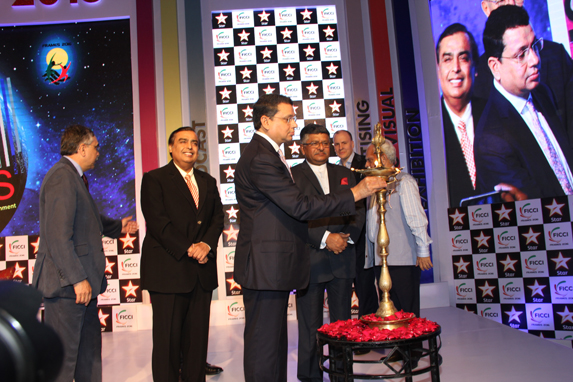
    Uday Shankar Mukesh Ambani and Shri Ravishankar Prasad at Ficci Frames 2016

    Talking about his own network, he said “the biggest launch in the media and entertainment industry was not a newspaper, nor a TV channel  but an app. Hotstar drove the wave, 5crore times the app was downloaded, more people watched EPL on Hotstar than on TV and this is how India is changing.”

    He also spoke about the global success story: “Imagine where Netflix Facebook were 10 years back and see the empire they have made in such a short span. Also remember the best animators are no longer sitting in California, they can now be spotted in Goregaon. Priyanka Chopra is now a global star and now India needs to be a global leader.”

    Concluding his remarks, he said: “The whole country today is looking at what Mukesh Ambani is busy with, there is a wave of expectation and the expectation is from Ravi Shankar Prasad (C and IT Minister) too. They are the two stakeholders on whom the digital wave depends. Hope they do the best as that will be the best of media and the entertainment Industry.”

    Reliance Industries  Chairman and MD Mukesh Ambani said: “I was here in 2004 when the industry was 2 billion dollars strong, and today it is 18 billion dollars strong. It is a great success and but there are miles to go. I believe the industry will be a 100 billion dollar one in the next decade, which means we have a major task in our hands.”

    Referring to the theme of the annual meet, he said: “There could not be a better theme than Change or Perish. To my mind digitization is the key to the industry’s success and that’s why we have JIO which can be called as the world’s largest startup.”

    He was confident that with the launch of Jio, India will be among the top ten in the next few years from the current rank of 155 among the top countries using mobile data. “Jio will provide coverage, and wherever you are you will be able to access. Quality will be 40 to 80 times faster than at present. Quantity and capacity currently is 0.15 GB per annum, with capacity of over 10 GB per user per annum  We will be affordable to consumers, and I believe affordability is the key “

    India, he said, will leapfrog and be a leader in the digital world. The world is moving from "orality to visuality. Images and videos will rule the digital world. Human beings and our thinking are linear.  Technology is an exponential idea. Exponential changes will create large opportunities," he said.

    Sharing his analysis he said, “The world is graduating to a telemedia world. The focus will be on all from all. The telco will focus on content, the broadcaster will invest on technology and producers will have  new delivery platforms. We are all part of a telemedia world. Downloading has now become streaming, linear has become interactive.”

    Ambani drew light on the way forward. “Abundance will be a global trend. Data is the new oil of this industry, and intelligent data is the petrol. It is not about technology – it is about humanity, the true power of technology is in the evolution of humanity. All our efforts need to be to make India the leader in 21st century. Together we can make India the leader with more than one-sixth of humanity residing in India.”



  • Viacom18’s Sudhanshu Vats appointed as chairman of IBF Credit and Collections Committee

    Viacom18’s Sudhanshu Vats appointed as chairman of IBF Credit and Collections Committee

    MUMBAI:  The Indian Broadcasting Foundation (IBF) announced the appointment of Viacom18 group CEO Sudhanshu Vats as the chairman of the IBF Credit and Collections Committee & co-chairman of the joint IBF- AAAI sub-committee.

    IBF, in association with AAAI (Advertising Agencies Association of India), had formed a joint credit collections committee which scrutinizes, regulates and evaluates the credit worthiness of the advertiser’s active through AAAI member advertising agencies on IBF member channels. It plays a pivotal role in dispute resolution between channels and agencies vis-a-vis advertisers.
    Vats, also an IBF Board member stated, “I am delighted to have been entrusted with this responsibility. Strengthening our relationship with the advertisers would be our goal and I look forward to introducing newer mechanisms in line with the global standards, to normalize the revenue mechanisms for all parties.”

    The outgoing chairman I Venkat said, “I know Sudhanshu would bring his ethos and greater clarity in the functioning of the committee. I am thankful to all the members for their support and  their valuable contribution and also to Ashish Bhasin , the co- chairman of the committee,  AAAI  who helped me conduct these meetings in a more organised and transparent manner”.

     Speaking on Vats appointment, IBF President Uday Shankar said, ”Both Mr Vats and Mr Venkat have been valuable colleagues in the IBF board and both deserve admiration and appreciation for taking up the task of revamping the broadcaster’s ad revenue flow. I am sure Sudhanshu will bring greater efficacy and democracy to the functioning of the committee.”

  • Viacom18’s Sudhanshu Vats appointed as chairman of IBF Credit and Collections Committee

    Viacom18’s Sudhanshu Vats appointed as chairman of IBF Credit and Collections Committee

    MUMBAI:  The Indian Broadcasting Foundation (IBF) announced the appointment of Viacom18 group CEO Sudhanshu Vats as the chairman of the IBF Credit and Collections Committee & co-chairman of the joint IBF- AAAI sub-committee.

    IBF, in association with AAAI (Advertising Agencies Association of India), had formed a joint credit collections committee which scrutinizes, regulates and evaluates the credit worthiness of the advertiser’s active through AAAI member advertising agencies on IBF member channels. It plays a pivotal role in dispute resolution between channels and agencies vis-a-vis advertisers.
    Vats, also an IBF Board member stated, “I am delighted to have been entrusted with this responsibility. Strengthening our relationship with the advertisers would be our goal and I look forward to introducing newer mechanisms in line with the global standards, to normalize the revenue mechanisms for all parties.”

    The outgoing chairman I Venkat said, “I know Sudhanshu would bring his ethos and greater clarity in the functioning of the committee. I am thankful to all the members for their support and  their valuable contribution and also to Ashish Bhasin , the co- chairman of the committee,  AAAI  who helped me conduct these meetings in a more organised and transparent manner”.

     Speaking on Vats appointment, IBF President Uday Shankar said, ”Both Mr Vats and Mr Venkat have been valuable colleagues in the IBF board and both deserve admiration and appreciation for taking up the task of revamping the broadcaster’s ad revenue flow. I am sure Sudhanshu will bring greater efficacy and democracy to the functioning of the committee.”

  • 60 crore ad revenue, 36% viewership hike: Pro Kabaddi League a hat-trick of success

    60 crore ad revenue, 36% viewership hike: Pro Kabaddi League a hat-trick of success

    MUMBAI: The third season did not make fans wait for the too long a period of a year. After a gap of merely a few months Star Sports Pro Kabaddi league was back in action. The mats were the same and there was no change in the number of teams or formats. The only change was the sport had become popular and the tournament had to deal with the burden of expectation. 

    “Star India is a champion when it comes to dealing with expectations” says a franchisee owner on condition of anonymity. He further adds, “Many media people will tell you about the marketing and packaging, but the distribution push that they have given has done a world of good for the sport. Only Star Sports would have got them 40 per cent of the reach they have got. Star Gold and other channels is what has done the trick.” 

    The broadcaster has roped in six associate sponsors for season 3 in Bajaj, TVS, Flipkart, State Bank of India, Gionee and Idea, while Fair & Lovely, Nissin and Mountain Dew are associated as partners. “The ad revenue generated this time would easily count to Rs 60 crore, which is a twenty per cent growth compared to the last edition. This signifies the smart way of monetising that Star has adopted” asserts a media sports media planning expert.

    The broadcaster did not sell the title sponsor slot as that takes away majority of the inventory, and instead decided to keep it to itself. “The biggest reason why it’s successful is because the broadcaster is the primary owner and the selling is packaged. The brands get the ROI by having presence both on ground and on television, hence they show immense interest.” opines a senior media planning expert.

    The 20 per cent hike in revenue is well complemented by a 36 per cent rise in viewership.  While viewership at All India Urban level increased by 36 per cent from 54.5 TVMs in season 2 to 74 TVMs in season 3, Rural India also joined the Star Sports Pro Kabaddi fan bandwagon, delivering a staggering 135 TVMs according to the BARC CS4+ Rural for its first week in season 3. 

    On the rise of viewership Star India CEO Uday Shankar had said in a media statement, “No other sport has grown so fast and gained such wide and deep following with fans across urban and rural India, across audience segments – men, women and kids and across screens (television and digital). The sport has truly become a unifier in its appeal, second only to cricket. This brings us a great sense of pride and is a reflection of our commitment to promote a multi-sports-culture in India.”

    The moment the twice a year concept was unveiled, critics started prophesising, possibilities of fatigue were magnified, and the quality of matches was questioned. “The seasons so far have answered all those questions, I believe” says Mashal Sports director Charu Sharma. He further adds, “The debate of exploitation does not exist in the case of Kabaddi because we are not there for a good 40 weeks time. The nature of the game is such that we need to be there twice at least for our fans.”

    The organisers are also toying with the idea of roping in more teams to make it a 12 team format. The new franchises will certainly be sold at a higher price when compared to the first set of buyers. “The game is now established and evolved, but all this will at least take more than a year. The plan is to make it a longer running tournament and then we might have a once a year outing” adds Sharma.

    Defending champion, U-Mumba is again in the semis and this makes a 100 per cent success ratio for the team. For all the three, seasons U-Mamba has managed to reach the semis which twice before they have won to qualify for the finals. “They are a formidable force with quality players in the team. The way it is managed, Ronnie and his team also plays a vital role behind their progress. I am happy with the fact that Bengal has made it to the semis, Earlier, Bengal was lacking when it comes to Kabaddi and this is a success of the tournament that new teams are reaching the knockouts” explains Sharma.

    “There has been no evidence of fatigue and the wear and tear that are common in any sport and to reach the final stages takes hard work. We had a great season and now we are looking ahead towards the semis,” says UMumba CEO Supratik Sen 

    Now steps taken by the franchises will determine the next level of success for the league.

  • 60 crore ad revenue, 36% viewership hike: Pro Kabaddi League a hat-trick of success

    60 crore ad revenue, 36% viewership hike: Pro Kabaddi League a hat-trick of success

    MUMBAI: The third season did not make fans wait for the too long a period of a year. After a gap of merely a few months Star Sports Pro Kabaddi league was back in action. The mats were the same and there was no change in the number of teams or formats. The only change was the sport had become popular and the tournament had to deal with the burden of expectation. 

    “Star India is a champion when it comes to dealing with expectations” says a franchisee owner on condition of anonymity. He further adds, “Many media people will tell you about the marketing and packaging, but the distribution push that they have given has done a world of good for the sport. Only Star Sports would have got them 40 per cent of the reach they have got. Star Gold and other channels is what has done the trick.” 

    The broadcaster has roped in six associate sponsors for season 3 in Bajaj, TVS, Flipkart, State Bank of India, Gionee and Idea, while Fair & Lovely, Nissin and Mountain Dew are associated as partners. “The ad revenue generated this time would easily count to Rs 60 crore, which is a twenty per cent growth compared to the last edition. This signifies the smart way of monetising that Star has adopted” asserts a media sports media planning expert.

    The broadcaster did not sell the title sponsor slot as that takes away majority of the inventory, and instead decided to keep it to itself. “The biggest reason why it’s successful is because the broadcaster is the primary owner and the selling is packaged. The brands get the ROI by having presence both on ground and on television, hence they show immense interest.” opines a senior media planning expert.

    The 20 per cent hike in revenue is well complemented by a 36 per cent rise in viewership.  While viewership at All India Urban level increased by 36 per cent from 54.5 TVMs in season 2 to 74 TVMs in season 3, Rural India also joined the Star Sports Pro Kabaddi fan bandwagon, delivering a staggering 135 TVMs according to the BARC CS4+ Rural for its first week in season 3. 

    On the rise of viewership Star India CEO Uday Shankar had said in a media statement, “No other sport has grown so fast and gained such wide and deep following with fans across urban and rural India, across audience segments – men, women and kids and across screens (television and digital). The sport has truly become a unifier in its appeal, second only to cricket. This brings us a great sense of pride and is a reflection of our commitment to promote a multi-sports-culture in India.”

    The moment the twice a year concept was unveiled, critics started prophesising, possibilities of fatigue were magnified, and the quality of matches was questioned. “The seasons so far have answered all those questions, I believe” says Mashal Sports director Charu Sharma. He further adds, “The debate of exploitation does not exist in the case of Kabaddi because we are not there for a good 40 weeks time. The nature of the game is such that we need to be there twice at least for our fans.”

    The organisers are also toying with the idea of roping in more teams to make it a 12 team format. The new franchises will certainly be sold at a higher price when compared to the first set of buyers. “The game is now established and evolved, but all this will at least take more than a year. The plan is to make it a longer running tournament and then we might have a once a year outing” adds Sharma.

    Defending champion, U-Mumba is again in the semis and this makes a 100 per cent success ratio for the team. For all the three, seasons U-Mamba has managed to reach the semis which twice before they have won to qualify for the finals. “They are a formidable force with quality players in the team. The way it is managed, Ronnie and his team also plays a vital role behind their progress. I am happy with the fact that Bengal has made it to the semis, Earlier, Bengal was lacking when it comes to Kabaddi and this is a success of the tournament that new teams are reaching the knockouts” explains Sharma.

    “There has been no evidence of fatigue and the wear and tear that are common in any sport and to reach the final stages takes hard work. We had a great season and now we are looking ahead towards the semis,” says UMumba CEO Supratik Sen 

    Now steps taken by the franchises will determine the next level of success for the league.

  • Star Sports Pro Kabaddi League season 3 ratings rise by 36%

    Star Sports Pro Kabaddi League season 3 ratings rise by 36%

    MUMBAI: The third season of Star Sports Pro Kabaddi, which was flagged off on 30 January, recorded a surge in viewership with the opening week ratings 36 per cent higher than the week one viewership for its last season.

    This growth in viewership makes Star Sports Pro Kabaddi the only domestic Indian sports league to witness continued rise in viewership through its first three successive seasons.

    While viewership at All India Urban level increased by 36 per cent from 54.5 TVMs in season 2 to 74 TVMs in season 3, Rural India also joined the Star Sports Pro Kabaddi fan bandwagon, delivering a staggering 135 TVMs according to the BARC CS4+ Rural for its first week in season 3.

    Affluent young audiences continued to embrace Star Sports Pro Kabaddi, reflecting in a 33 per cent growth in total minutes viewed on hotstar, the digital platform of Star India, over the first 11 days of Star Sports Pro Kabaddi season 3. Opening day engagement for season 3 was twice that of season 2.

    Star Sports Pro Kabaddi has also gained momentum on social media, with Twitter announcing that the event hashtag #LePanga saw a 254 per cent growth vs. last season.

    Star India CEO Uday Shankar said, “No other sport has grown so fast and gained such wide and deep following with fans across urban and rural India, across audience segments – men, women and kids and across screens (television and digital). The sport has truly become a unifier in its appeal, second only to cricket. This brings us a great sense of pride and is a reflection of our commitment to promote a multi-sports culture in India.”

    International Kabaddi Federation president Janardan Singh Gehlot added, “The triumph of Pro Kabaddi League in its successive seasons is proof of the tremendous partnership between Amateur Kabaddi Federation of India, the broadcaster Star, and the league organiser Mashal Sports. Kabaddi is set to become India’s iconic sport under our partnership. I would also like to congratulate all the eight PKL teams in this achievement.” 

  • Star Sports Pro Kabaddi League season 3 ratings rise by 36%

    Star Sports Pro Kabaddi League season 3 ratings rise by 36%

    MUMBAI: The third season of Star Sports Pro Kabaddi, which was flagged off on 30 January, recorded a surge in viewership with the opening week ratings 36 per cent higher than the week one viewership for its last season.

    This growth in viewership makes Star Sports Pro Kabaddi the only domestic Indian sports league to witness continued rise in viewership through its first three successive seasons.

    While viewership at All India Urban level increased by 36 per cent from 54.5 TVMs in season 2 to 74 TVMs in season 3, Rural India also joined the Star Sports Pro Kabaddi fan bandwagon, delivering a staggering 135 TVMs according to the BARC CS4+ Rural for its first week in season 3.

    Affluent young audiences continued to embrace Star Sports Pro Kabaddi, reflecting in a 33 per cent growth in total minutes viewed on hotstar, the digital platform of Star India, over the first 11 days of Star Sports Pro Kabaddi season 3. Opening day engagement for season 3 was twice that of season 2.

    Star Sports Pro Kabaddi has also gained momentum on social media, with Twitter announcing that the event hashtag #LePanga saw a 254 per cent growth vs. last season.

    Star India CEO Uday Shankar said, “No other sport has grown so fast and gained such wide and deep following with fans across urban and rural India, across audience segments – men, women and kids and across screens (television and digital). The sport has truly become a unifier in its appeal, second only to cricket. This brings us a great sense of pride and is a reflection of our commitment to promote a multi-sports culture in India.”

    International Kabaddi Federation president Janardan Singh Gehlot added, “The triumph of Pro Kabaddi League in its successive seasons is proof of the tremendous partnership between Amateur Kabaddi Federation of India, the broadcaster Star, and the league organiser Mashal Sports. Kabaddi is set to become India’s iconic sport under our partnership. I would also like to congratulate all the eight PKL teams in this achievement.” 

  • Star India & franchises set for Pro Kabaddi League season 3

    Star India & franchises set for Pro Kabaddi League season 3

    MUMBAI: What Star India did for the Indian sport of Kabbadi is unprecedented. With the success that Pro Kabaddi League (PKL) has seen in a short span of time, it almost seems as if the game was a dark horse waiting to be saddled. From a flying bubble to an established entity, Star India CEO Uday Shankar and Mashal Sports director Charu Sharma’s PKL, which is all set for its third season, has clearly emerged as the undisputed second after cricket when it comes to sports in India.


    Even as the maiden season in 2014 got a first-rate response, with the second season in 2015, the interest level had only escalated amongst fans and advertisers alike. Unrecognised names and faces suddenly became household names as Kabaddi players from various PKL franchises posed for selfies with fans. Such prodigious was the response that stakeholders didn’t bat an eyelid before making the tourney a bi-yearly proposition.


    Smelling an attractive proposition, advertisers too queued up briskly. While the first season did not see brands on board, the second season snagged a hefty Rs 55 crore by roping in as many as eight associate sponsors and two partners.


    PKL franchises also saw the benefits with Ronnie Screwvala’s UMumba breaking even before the team’s first raid.


    With PKL season 3 set to kick-start from 3 February, the official broadcaster and title sponsor Star Sports has started unveiled its marketing trump cards. Amitabh Bachchan is back with the Le-Panga anthem with a few modifications. Salman Khan was spotted talking about the tournament getting bigger and better. Last year every match kick-started with a famous dignitary singing the Indian National Anthem. This year too, the trend will continue.


    Aamir Khan will mark open the third edition of PKL by singing the National Anthem. “The entire Le-panga campaign has been orchestrated by Star Sports’ in-house team. We are associating with  brand ambassadors and will have specific videos with specific brand ambassadors,” a source close to the development tells Indiantelevision.com.


    Multi-lingual telecast feed will also continue this year. However, the sportscaster has dropped the number of languages from five to four. While the English, Hindi, Kannada and Telegu feeds will continue, the Marathi coverage, which was there last year, has been dropped this year.


    Brands like TVS, Bajaj, Flipkart, State Bank of India and Gionee have been roped in as associate sponsors. Fair and Lovely Men has also come on board as a partner.


    “We are in talks with a few more brands and will soon be in a position to disclose more names. The brand interaction this year has been very good and we are expecting good numbers,” said a senior Star India official.


    Speaking on the advertising dynamics for PKL, a media planning expert on condition of anonymity says, “Anything equal to what they raked in last year will be a great achievement, because PKL will now be held twice a year. The ad revenue from this year’s tourney will be somewhere between Rs 40 – 50 crore. An associate sponsor inventory will be between Rs 3 – 5 crore, whereas ad rates for a 10 second slot will be somewhere in the range of Rs 60,000 to 65,000.”


    CAA KWAN COO Indranil Das Blah is of the opinion that the twice a year proposition is a progressive one. “The nature of the league is such that it ends very fast. So having such an expedition twice a year is a good move. It gives broadcasters as well as the franchises added room of monetisation. It is a positive move and will be beneficiary for all the stakeholders.”


    The franchises too welcome the decision of making PKL a bi-yearly affair. “We are very happy that it’s happening twice a year now. It gives an added advantage of building the connect, both with brands and the audience. Apart from the associations, with the tournament becoming a bi-yearly proposition, now we can have various value adds for brands associated with us, our team as well as fans. We plan to travel to various regions this year along with our team,” informs UMumba CEO Supratik Sen.


    UMumba is the defending champion of the tournament and the franchise’s performance has been equally good on the commercial front too. “This year we are eying a 140 per cent growth in our sponsorship revenues. Global player Adidas has associated with us as apparel partner. This only goes to show that the tournament is garnering global attention,” adds Sen.


    Close to 60 per cent of UMumba’s revenue comes from sponsorships, while ticketing contributes to 10 per cent of the overall revenue. The remaining 30 per cent comes from central revenue. 


    A sports media planning expert says, “Ronnie and his team have done a fantastic job to uplift their brand value. Any brand associating with them knows for a fact that there will be high ROI and that’s why they get considerably high sponsorship revenue. Smart monetisation is what they practice. When they know they charge more, they enhance the inventory. To my knowledge, for a chest spot UMumba would be charging somewhere close to Rs 3 crore, which is a great figure. Overall from this edition they can rake in close to Rs 12 crore, which is a great return given the investments are not more than Rs 4 crore.”


    Another franchise, which is optimistic about breaking even this year and has demonstrated constant growth is Bengaluru Bulls. The franchise rakes in 45 per cent of its revenue from sponsorship and ticketing, while the rest comes from central sponsorship. For a chest spot, the team charges close to Rs 2 crore. Bengaluru Bulls CEO Uday Sinh Wala says, “We are witnessing a 20 per cent growth, which I think should have been more but we have to understand the subdued nature of our economy at this stage and the enormous high profile cricket happening around us. However, I am sure that it will grow rapidly in the future.”


    “The response to the bi-yearly proposition will be clearer when more seasons unfold but at this stage I can say that it’s a great move as it gives us an opportunity to endeavour into long term association with our clients,” he adds.


    How the PKL juggernaut continues its sojourn over the coming years will be interesting to watch.

  • Star India & franchises set for Pro Kabaddi League season 3

    Star India & franchises set for Pro Kabaddi League season 3

    MUMBAI: What Star India did for the Indian sport of Kabbadi is unprecedented. With the success that Pro Kabaddi League (PKL) has seen in a short span of time, it almost seems as if the game was a dark horse waiting to be saddled. From a flying bubble to an established entity, Star India CEO Uday Shankar and Mashal Sports director Charu Sharma’s PKL, which is all set for its third season, has clearly emerged as the undisputed second after cricket when it comes to sports in India.


    Even as the maiden season in 2014 got a first-rate response, with the second season in 2015, the interest level had only escalated amongst fans and advertisers alike. Unrecognised names and faces suddenly became household names as Kabaddi players from various PKL franchises posed for selfies with fans. Such prodigious was the response that stakeholders didn’t bat an eyelid before making the tourney a bi-yearly proposition.


    Smelling an attractive proposition, advertisers too queued up briskly. While the first season did not see brands on board, the second season snagged a hefty Rs 55 crore by roping in as many as eight associate sponsors and two partners.


    PKL franchises also saw the benefits with Ronnie Screwvala’s UMumba breaking even before the team’s first raid.


    With PKL season 3 set to kick-start from 3 February, the official broadcaster and title sponsor Star Sports has started unveiled its marketing trump cards. Amitabh Bachchan is back with the Le-Panga anthem with a few modifications. Salman Khan was spotted talking about the tournament getting bigger and better. Last year every match kick-started with a famous dignitary singing the Indian National Anthem. This year too, the trend will continue.


    Aamir Khan will mark open the third edition of PKL by singing the National Anthem. “The entire Le-panga campaign has been orchestrated by Star Sports’ in-house team. We are associating with  brand ambassadors and will have specific videos with specific brand ambassadors,” a source close to the development tells Indiantelevision.com.


    Multi-lingual telecast feed will also continue this year. However, the sportscaster has dropped the number of languages from five to four. While the English, Hindi, Kannada and Telegu feeds will continue, the Marathi coverage, which was there last year, has been dropped this year.


    Brands like TVS, Bajaj, Flipkart, State Bank of India and Gionee have been roped in as associate sponsors. Fair and Lovely Men has also come on board as a partner.


    “We are in talks with a few more brands and will soon be in a position to disclose more names. The brand interaction this year has been very good and we are expecting good numbers,” said a senior Star India official.


    Speaking on the advertising dynamics for PKL, a media planning expert on condition of anonymity says, “Anything equal to what they raked in last year will be a great achievement, because PKL will now be held twice a year. The ad revenue from this year’s tourney will be somewhere between Rs 40 – 50 crore. An associate sponsor inventory will be between Rs 3 – 5 crore, whereas ad rates for a 10 second slot will be somewhere in the range of Rs 60,000 to 65,000.”


    CAA KWAN COO Indranil Das Blah is of the opinion that the twice a year proposition is a progressive one. “The nature of the league is such that it ends very fast. So having such an expedition twice a year is a good move. It gives broadcasters as well as the franchises added room of monetisation. It is a positive move and will be beneficiary for all the stakeholders.”


    The franchises too welcome the decision of making PKL a bi-yearly affair. “We are very happy that it’s happening twice a year now. It gives an added advantage of building the connect, both with brands and the audience. Apart from the associations, with the tournament becoming a bi-yearly proposition, now we can have various value adds for brands associated with us, our team as well as fans. We plan to travel to various regions this year along with our team,” informs UMumba CEO Supratik Sen.


    UMumba is the defending champion of the tournament and the franchise’s performance has been equally good on the commercial front too. “This year we are eying a 140 per cent growth in our sponsorship revenues. Global player Adidas has associated with us as apparel partner. This only goes to show that the tournament is garnering global attention,” adds Sen.


    Close to 60 per cent of UMumba’s revenue comes from sponsorships, while ticketing contributes to 10 per cent of the overall revenue. The remaining 30 per cent comes from central revenue. 


    A sports media planning expert says, “Ronnie and his team have done a fantastic job to uplift their brand value. Any brand associating with them knows for a fact that there will be high ROI and that’s why they get considerably high sponsorship revenue. Smart monetisation is what they practice. When they know they charge more, they enhance the inventory. To my knowledge, for a chest spot UMumba would be charging somewhere close to Rs 3 crore, which is a great figure. Overall from this edition they can rake in close to Rs 12 crore, which is a great return given the investments are not more than Rs 4 crore.”


    Another franchise, which is optimistic about breaking even this year and has demonstrated constant growth is Bengaluru Bulls. The franchise rakes in 45 per cent of its revenue from sponsorship and ticketing, while the rest comes from central sponsorship. For a chest spot, the team charges close to Rs 2 crore. Bengaluru Bulls CEO Uday Sinh Wala says, “We are witnessing a 20 per cent growth, which I think should have been more but we have to understand the subdued nature of our economy at this stage and the enormous high profile cricket happening around us. However, I am sure that it will grow rapidly in the future.”


    “The response to the bi-yearly proposition will be clearer when more seasons unfold but at this stage I can say that it’s a great move as it gives us an opportunity to endeavour into long term association with our clients,” he adds.


    How the PKL juggernaut continues its sojourn over the coming years will be interesting to watch.

  • Star India completes integration of Maa Television’s broadcast business

    Star India completes integration of Maa Television’s broadcast business

    MUMBAI: Star India has successfully completed the integration of the Maa Television Network’s broadcast business.


    With this, Star India strengthens its offering in the Telugu speaking markets of South India.


    Star India CEO Uday Shankar said, “We are pleased to announce the completion of the integration of the broadcast business of Maa Television Network, a journey that we had embarked upon in February, earlier this year. We are very impressed by the solid creative core and quality and depth of the management team at Maa Television Network and are delighted to welcome them to the Star family.”


    “The acquisition fills a critical gap in our portfolio and will allow our advertisers targeted access to the large Telugu speaking population. We plan to invest further in this important market to fundamentally change the content quality paradigm. I am confident that team Maa under the leadership of K. Madhavan will transform the content experience for Telugu viewers,” Shankar added.


    The acquisition of Maa TV also opens up a significant opportunity for major content innovation in the Telugu television market, which is extremely important given that the Telugu TV market is the second largest regional market in India in terms of revenue potential.


    Maa Television’s bouquet of four channels includes Maa, Maa Music, Maa Movies and Maa Gold.


    With the completion of the necessary formalities, the broadcast business of Maa TV will now be integrated with the business of Star India.


    With the expansion into the Telugu market, Star looks to continue its tradition of innovation in content, building on the strong track record established by the team at Maa Television Network.