Tag: Uber eats

  • Uber Eats launches new interactive feature ‘Merchant Stories’

    Uber Eats launches new interactive feature ‘Merchant Stories’

    KOLKATA: Online food delivery app, Uber Eats on Tuesday launched a new interactive feature on its app- ‘Merchant Stories’ which allows merchant partners to connect directly with their eaters.

    The new feature developed by the company’s Hyderabad based engineering team helps eaters seamlessly discover the latest offerings from their favourite restaurants, while assisting Uber merchants to display their delicacies.

    Elaborating on the idea behind the launch, the company cited a consumer survey which showed people felt more comfortable making food decisions based on photos, and were more likely to place an order when they could see what their chosen food or beverage looked like. In early testing, 13 per cent of people who clicked through a restaurant’s story placed an order to that restaurant in the same session, it said on Tuesday.

    This feature has so far only been rolled out in the US and Canada and reinforces the ‘Make in India for the World’ vision of India’s tech centers, it added.

    Eats Engineering site lead Jaiteerth Patwari said: “We understand a picture is worth a thousand words, and that it’s much easier to order an item when you can see what it looks like. We heard feedback from partners who felt they needed to build a direct communication channel with their consumers, and our team worked to build a solution that addressed their unique needs.”

    Through this innovation, merchants can now sign up for the ‘Merchant Stories’ feature to post regular updates. They can upload photos and add text to tell their customers about special deals, menu changes, new services, or seasonal promotions.

    The Eats Engineering team has led several global innovations over the past year including integrating leading digital wallets in Japan and Belgium during 2020, and connecting more restaurant partners to consumers when cities were in lockdown. The team also led the tech backend for a new line of business — prescription delivery in the US.

  • Zomato acquires Uber India’s food delivery business

    Zomato acquires Uber India’s food delivery business

    MUMBAI: Online food delivery app Zomato has acquired Uber’s food delivery business, Uber Eats, in India in an all-stock deal. According to media reports, the acquisition was carried out at a value of $350 million ( Rs 2,485 crore). Moreover, Uber has got almost 10 per cent stake in Zomato.

    Post acquisition, Uber Eats in India will discontinue operations and direct restaurants, delivery partners, and users of the Uber Eats apps will migrate to the Zomato platform, effective Tuesday.

    “We are proud to have pioneered restaurant discovery and to have created a leading food delivery business across more than 500 cities in India. This acquisition significantly strengthens our position in the category,” Zomato CEO Deepinder Goyal said.

    “Our Uber Eats team in India has achieved an incredible amount over the last two years, and I couldn’t be prouder of their ingenuity and dedication, ” Uber CEO Dara Khosrowshahi said. He added Uber will continue to invest in growing its local rides business.

    Through this deal, Uber Eats India users now become Zomato users. Similarly, the delivery partners who were earlier associated with Uber Eats India will be on-boarded on Zomato’s fleet. The first big consolidation in online food delivery segment will pull Zomato ahead of Swiggy.

    The acquisition comes after Zomato’s latest fundraising led by existing investor Ant Financial, an Alibaba affiliate, which pumped in $150 million at a $3 billion valuation.

  • Uber Eats World Cup Binge-o-meter reveals India’s top match day meals

    Uber Eats World Cup Binge-o-meter reveals India’s top match day meals

    MUMBAI: Uber Eats, now available across more than 500+ cities globally, reveals ‘Uber Eats World Cup Binge-o-meter’, a round-up of India’s favorite match-day meals and munchies during the ICC Cricket World Cup 2019. 

    India’s love for cricket is the only thing that fans love more besides the love for good food. Conducted between the period of 30 May and 11 July 2019, Uber Eats reveals that while Indians were riding on the cricket fervour for the national team, they also preferred Indian food at their tables. Interesting findings reveal that across India, cricket enthusiasts were binge-eating on carbs while rooting for India with most orders for bread, followed by cooling off the pressure with ice-creams. 

    Interestingly, fans indulged into cheesy burgers to satiate their hunger pangs during the most awaited match of the year  –  India VS Pakistan.  Chennai clocked in the most orders during the season, closely followed by Bangalore and Pune. 

    Here are some of the top food trends that scored big this world cup:

    City

    Most Popular meals during match days

    Delhi, Jaipur, Indore, Kolkata, Pune, Lucknow

    Bread

    Bangalore

    Dosa

    Ahmedabad

    Pizza

    Mumbai

    Ice-cream

    Nagpur

    Samosa

    Amritsar

    Burger

    Chandigarh

    Paratha

    What did India eat to keep themselves gripped/energized during the sporting matchup of the year – India VS Pakistan match?

    While the ‘Rain Gods’ took over Old Trafford in England, it was raining Burgers across India, which emerged as the most savoured dish of the day, followed by the meal of the millennials – Pizza.

    City

    Top match day meal

    Chennai

    Pizza, Shawarma, Idli

    Chandigarh

    Samosa, Pizza, Burger

    Pune

    Burger, Pizza, Biryani

    Mumbai

    Ice Cream, Burger, Pizza

    Delhi

    Roti, Burger, Roll


    Every order matters: An eater from Indore (who was probably hosting a match-day gathering) placed the biggest order for 233 dishes including Paneer Biryani, Special Chicken Biryani and Kaju Biryani. While the smallest order was also placed by an eater from Indore for tawa roti at Rs. 13, followed by a consumer in Chennai who ordered for a bottle of water to quench their thirst.

    India celebrates big wins with dessert: The top sugar cravings during the World Cup were ice creams, followed by cakes and gulab jamuns.

    A hint of cricket on your plate: Hilariously, an eater ordered for  “a scoop of cricket instead of pistachios” while another fan politely requested Uber Eats to save the day with some sugar-rush. The comment read, “pls send change of 500 and also add 1 extra gulab jamun because today India lost the world cup I am a little bit in depression.”

    At Uber Eats, every order matters, right from a single bottle of water to many many jaw-breaking burgers. 

  • Regional representation in creative teams can help reduce blind spots: Karthik Srinivasan

    Regional representation in creative teams can help reduce blind spots: Karthik Srinivasan

    MUMBAI: If you’re not in tune with the intricacies of a different language, you’re going to land yourself in a soup. Just like Google’s voice assistant Alexa a few months ago when it had censored the word “chhod” (meaning ‘leave’ in English) from a number of popular Hindi songs, as it confused it with an expletive that is spelt the same way when written in English.

    While the world is currently moving in an inner spiral with people and cultures merging, the vernacular is extending outwards. And in an assorted country like India, this trend only deepens. As lucrative as it sounds, advertisers are still struggling to extract the most from this.

    Case in point is the latest ‘Tinda Moments’ campaign by Uber Eats, as highlighted by communications consultant on digital/social media marketing and PR Karthik Srinivasan in a LinkedIn post. Srinivasan, who has earlier worked with companies like Ogilvy, Flipkart, and Edelman, noted that a Tamilian or Malayali might not be able to get the reference of Hindi word ‘Tinda’. He asked an important question, “Is it too much to expect the brand to customise/localise the ad for the regions it is advertising in? Or is it ok in these multi-lingual metro-centric days where having your ad understood by those who can (and if it is assumed to be a sizeable number) is good enough?”

    Indiantelevision.com got in touch with Srinivasan to discuss more on the subject of the need of regional content in the advertising sphere and he shared some interesting insights with us. Edited excerpts follow:

    The need for vernacular content in advertising is rising steadily, especially after the boom of digital media. Most of the marketers are talking about it. But do you think the brands understand this requirement?

    First of all, I would like to note that the term vernacular might not be the best one to describe regional languages. The origin of the word goes back to the varna system in India – it is literally 'language spoken by different coloured people' according to the British. I believe that ‘regional language’ should be used in fact.

    On your question, I'd say that the local brands understand this better than the national brands. Those brands that have a strong regional-decision making team for marketing get this really well. If the decisions are made for all of India, in say a Mumbai or a Delhi, unless the teams have adequate representation from the regions or good, sensible counsel from the agencies, they could miss this aspect. It's hardly ever intentional but more of a blind spot.

    Isn’t it going to cost the brands more if they create the same ad in various languages? How can this progression towards personalised content be made more cost-effective?

    Brands (at least the ones that are national) already do this. Even regional brands, when they go national, do this quite effectively. For example, Manappuram had 8 versions and 8 brand ambassadors, one for each region (Mohanlal, Vikram, Venkatesh, Puneet Rajkumar, Utham Mohanty, Mithun Chakraborty and Sachin Khadekar). I'd not see it as a cost imperative. This is more targetting and effectiveness imperative. Having a nationally known brand ambassador is easy – there are enough Hindi film stars or sports stars, who can be recognised across the country. Having them talk in various regional languages is also a good deal and already happens. But, if you want to reach the heart of a region and not just its eyes, you need to contextualise its communication to appeal to its specific sensibilities. That's not just locally known brand ambassadors, but also locally nuanced content.

    How are programmatic advertising and artificial intelligence contributing to the growth of regional content in advertising space?

    To the best of my knowledge, AI hasn't really caught up with the nuances of Indian regional languages. There are broad efforts to get the basics right, like Google Maps translating names of areas in all Indian languages. But understanding and translating with context to local nuances is quite some time away. Programmatic does help in micro-targeting. There is better awareness in building a pool of localised content and let the right one be used for the right region. But even here, it is the intent that is the starting point. The marketing team should realise the need for localisation first.

    Can you think of any brand that is using regional content to its benefit smartly?

    For instance, take Muthoot's campaign featuring Vidya Balan. The choice of Vidya Balan as a brand ambassador is a good move, given her almost pan-Indian appeal and familiarity. But beyond that, it is very interesting that they use 'Blue' (an English word) as connecting glue for the campaign tagline. 'Blue' is the term for smart entrepreneurs (who get some help from Muthoot Finance, of course). The end tagline, 'Blue hai आत्मविश्वास' (Atmavishwas, meaning confidence) translates to 'நம்பிக்கையின் (Nambikkayin meaning confidence in Tamil) niram blue', for instance. The word blue is not translated and is retained as a common factor to connect across multiple regional languages. If blue was translated too, then the statement may seem different in each language. You can argue that 'neel' in Hindi or 'neelam' in Tamil or similar variants is the most common translation for blue in many Indian languages, but that may not be uniform in all languages. The effort in understanding local nuances and working accordingly shows. Another was an effort by ET Money last year in its “Upar Ki Kamayi” campaign, which was printed in seven different languages for different areas on the same day.

    What can be the key strategies of a brand to design and implement the right form of multi-linguistic content?

    The first, and most basic, is the intent. It is simply recognising the need that regional language content if you have a substantial target audience in that region, will simply work far better in reaching them. It is the humility in accepting that I don't know everything and I can do better by asking around and learning other kinds of effective communication.

    Then you have the strategies and processes. Ad agencies and brands simply need to look for inspiration from the dubbing and subtitling industries in India. If you switch on cable TV and look at any Hindi movie channel during non-peak hours (sometimes even during peak hours), they only play Hindi-dubbed South Indian movies. And that dubbing is done brilliantly, placing the location to Northern regions and even using local Northern dialects and nuances.

    The subtitling industry is also doing some stellar work since that's a basic requirement for films to be shown in OTT platforms. So, much of the subtitles are done professionally, understanding the context within films and not just transliterated. If the film industry can pull it off, there's no reason a far more professional and educated bunch of people in marketing and advertising cannot. It all boils down to the intent and getting the right people.

    How do you see the growth of regional content industry in general?

    I'd say it is the next big frontier. Most large brands like Google, Facebook and Twitter are trying to crack that in order to reach Indians better with better context. Even in the OTT space, there's a profusion of regional language content. From a user interface/user experience perspective too, most of the mobile wallets that are from startups have a multi-lingual interface, while those from larger, legacy banks still lack this feature and use English as default.

    To a large extent, the bigger technology brands are leapfrogging the complexities of written regional language by taking the voice input route. Google and Amazon's smart speakers already recognise and respond to a few Indian regional languages well and are improving.

    Any special pointers you want to share with the brands and marketers regarding the topic?

    The most important one is again on intent. We Indians seldom venture beyond our comfort zone when it comes to languages. For instance, our choice of music or movies is usually in English + our mother tongue. It is only now that subtitles have opened up the audience for all kinds of languages but they remain small. With music, is a classic case – if I ask a Hindi speaking person for his/her favourite Tamil or Telugu songs, the standard reaction would be to name a song from Baahubali (pan-India) and say they don't understand the language so they don't listen. But remember, music was supposed to be universal, and we gladly listen to Latin and Spanish hits from the US, like Despacito! The point is, if your target audience is in Karnataka, get to know the local nuances first and not assume that mere Hindi and English would do. They would, no doubt because most people have been conditioned to learn English and perhaps know functional Hindi too for day-to-day survival in cities, but when they see or hear something in their mother-tongue, the appeal goes straight to the heart. It’s much like you being in another part of India and seeing a car with a number plate from your state!

  • INDIAN, AMERICAN AND CHINESE ARE THE TOP CUISINES INDIA LOVES: UBER EATS

    INDIAN, AMERICAN AND CHINESE ARE THE TOP CUISINES INDIA LOVES: UBER EATS

    MUMBAI: Uber Eats, the world’s largest food delivery network, today revealed a comparative snapshot of India’s most loved cuisines.

    Despite India’s rising love for international cuisines, Uber Eats’ order analysis of the last 6 months reveals that Indian cuisine took the top spot as the most savored across the country, followed by American and Chinese. Hyderabad, Delhi and Chennai are the top cities that order the maximum Indian cuisine.

    Interestingly, for breakfast, it was variations of Indian cuisine all the way with Paratha, Masala Dosa, Poha, Idli and Samosa being the top 5 items ordered.

    Deepak Reddy – Head of Central Operations – Uber Eats India said, “While Indian cuisine still stands as the consumer’s top food preference in the country, there is a huge demand for a larger choice and selection of cuisines. At Uber Eats, our aim is to ensure that consumers have access to the cuisines of their choice wherever they may be. We stay committed to onboard unique restaurants on our platform and make greater choices available for consumers, so that they can enjoy their favorite meals delivered right at their doorstep or office desk at the tap of a button.”

    Between breads: According to the analysis, the cities of Indore, Delhi and Bengaluru recorded the highest cravings for classic American food, with Veg Hot Dog and Chicken Burgers topping charts.

    Love for Indo-Chinese: In 2018, cities that craved the flavors of China are Delhi, Hyderabad and Mumbai. While Delhi ordered baskets full of chilli potatoes, Mumbai loves a full-fledged Chinese meal inclusive of Fried Rice and Chicken Chilli Gravy

    Say cheese: Another global sensation savored across the nation – Italian. Mumbai recorded the highest number of orders for cheesy Italian delights. Not far behind, Delhi and

    Pune gobbled down large quantities of flavorful Italian food, mainly consisting of cheese loaded pizzas.

    Thai-tanic: Indians love relishing tangy and spicy flavors of Thai food. The popularity of this cuisine is seen highest among the cities of Bengaluru, Chennai and Pune.

    Middle-Eastern Delights: Interestingly, Chennai, Bengaluru and Coimbatore are the top three cities that opted for middle-eastern dishes.

  • Uber Eats appoints youth icon Alia Bhatt as its brand ambassador in India

    Uber Eats appoints youth icon Alia Bhatt as its brand ambassador in India

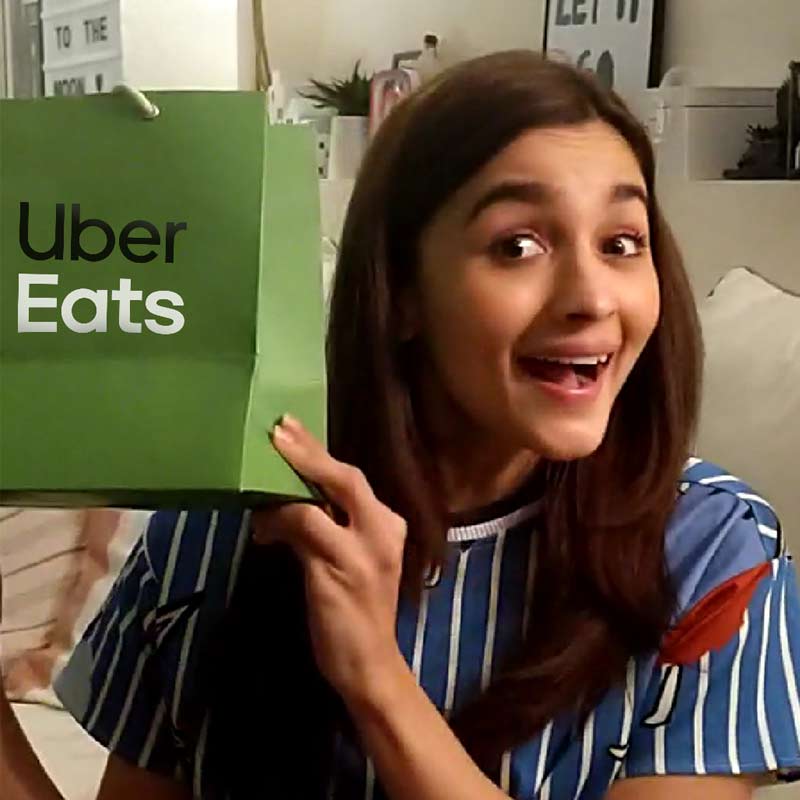
    MUMBAI: Taking its presence in India a notch higher, Uber Eats, the world’s largest food delivery platform, today announced the appointment of leading actress and youth icon, Alia Bhatt, as its brand ambassador. India will be the first country for Uber Eats globally, to have appointed a brand ambassador.

    Uber Eats is gaining popularity among consumers across 37 cities in India to order food of their choice at the click a button. Similarly, Alia Bhatt’s effortless performances in bringing out the essence of every character she plays, has positioned her as one of India’s most loved youth icons.  

    "Alia is an inspiration to Indian millennials and we are thrilled to have her on board. The youth today relates to her easy-going, carefree and energetic personality.  She is known for her unique style and agility as an actor – the same qualities are an integral part of the Uber Eats DNA; thus making her the perfect fit to represent our brand in India. We are excited to have Alia on board, as we stay focused on building and strengthening our presence in India,” said Bhavik Rathod, Head of Uber Eats India and South Asia.

    Alia Bhatt, expressing her excitement as Uber Eats’ first brand ambassador said, “My work hours and plans keep changing, so the freedom/flexibility to get what I’m craving for whenever I want, right at the tap of a button, almost seems magical. I’m delighted to be associated with a young, innovative and energetic brand like Uber Eats and I look forward to all the excitement that’s in store with this partnership.”

    Uber Eats India’s association with Alia Bhatt will lay the foundation for a host of brand-led interventions in the coming year. Besides being the face of the brand, consumers can expect to see Alia in different moods and never seen before avatars on social media platforms.

    Uber Eats recognizes the appetite for food delivery in India and in the past year and a half, has emerged as the fastest growing food delivery app. In 2018, Uber Eats will continue to focus on technology innovations and empowering people to broaden horizons of convenience and experience in the food delivery space.

  • Uber Eats, CCD partner to launch India’s largest virtual restaurant network

    Uber Eats, CCD partner to launch India’s largest virtual restaurant network

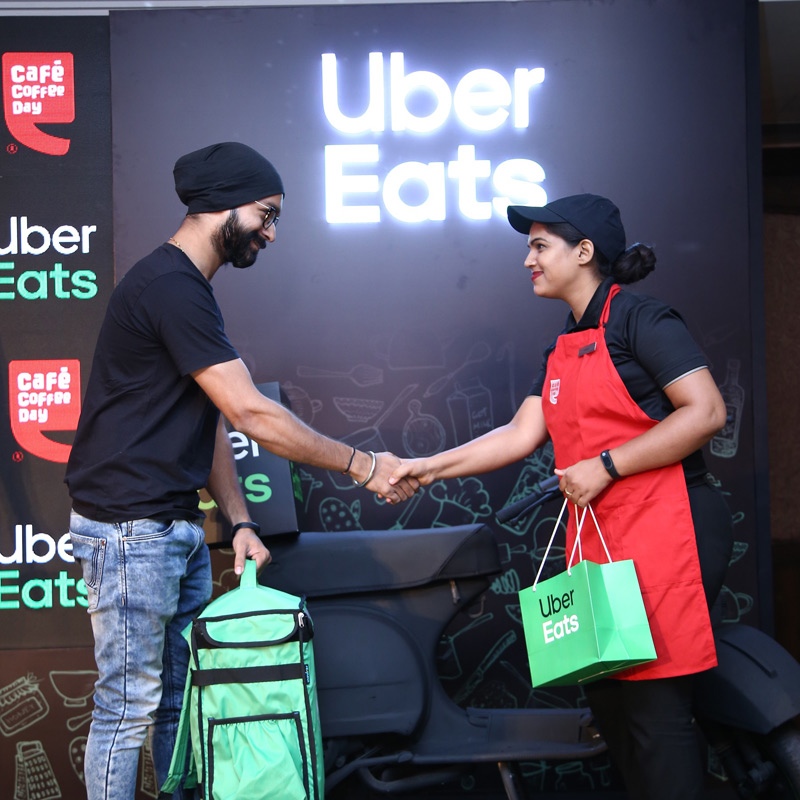
    MUMBAI: Uber Eats, the world’s largest food delivery network and Café Coffee Day, India’s largest café chain, have announced a partnership to launch the country’s largest network of virtual restaurants, which will soon bring foodies a greater choice of ‘delivery-only’ restaurant brands exclusively on the Uber Eats app.

    The first restaurant brand under this partnership is scheduled to launch in November.

    This partnership will leverage Café Coffee Day’s robust and innovative F&B expertise, pan India café network with the technology that Uber Eats is renowned for. Uber Eats will help Café Coffee Day with data, analytics and insights to help identify food or cuisines that consumers crave the most. This will enable Café Coffee Day and Uber Eats to launch menu offerings as per evolving consumer trends, for multiple ‘delivery-only’ virtual restaurants.

    Uber Technologies vice president Jason Droege says, “Using experience and lessons learnt in the virtual restaurant space from our global operations, we hope to provide our Indian restaurant partners greater growth opportunities. Our customers too will enjoy ordering and eating their favourite everyday meals at the tap of a button.”

    Café Coffee Day chief executive officer Venu Madhan adds, “With this association we aim to take the goodwill and trust earned in the F&B space and combine it with new age reality of virtual restaurants to offer everyday meals that can be delivered to nomadic millennials at home or at work in a convenient manner. Uber Eats’s strength and expertise in the business of home delivery will ensure delight to millions of aspiring youngsters who have moved away from their homes with great quality products from Café Coffee Day’s virtual restaurants every day across the country.”

    Virtual restaurants are digital-only eateries that allow business owners to explore new culinary options and reach a wider audience by using the space in their existing kitchen. Virtual restaurants allow partners to test new opportunities in today’s dynamic market in a nimble manner.

    Uber Eats is currently present in 37 cities in India with a strong presence in tier 2 cities. In the last 3 months, the number of orders on the app has grown 6 times and Uber Eats is adding 100 new restaurants to its platform everyday. Café Coffee Day currently has a network of 1742 cafes across 246 cities in India.

    Uber Eats started in 2014 as a small delivery pilot in Los Angeles and launched as a separate application in Toronto in December 2015. Since then, it has grown incredibly fast, and is now a stand-alone app available in 350+ cities around the globe. In India, Uber Eats was first launched in Mumbai in May 2017.