Tag: TV

  • Twitter will come to resemble TV as per a research

    Twitter will come to resemble TV as per a research

    MUMBAI: Twitter will become more like TV as the rate of typical users posting activities levels off. Research from two professors – Columbia Business School and University of Pittsburgh – believe the rate of social media user posts on Twitter will take a backseat to more TV content-based efforts from corporations and celebrities.


    “Twitter will become less of a communications vehicle and more of a content-delivery vehicle, much like TV,” said Olivier Toubia, the Glaubinger professor of business at Columbia Business School. The study was co-authored with Andrew T. Stephen, assistant professor of business administration and Katz Fellow in marketing at the University of Pittsburgh’s Joseph M. Katz Graduate School of Business and College of Business Administration.


    “Peer-to-peer contact is likely to evolve to the next great thing, but with 500 million followers, Twitter isn’t just going to disappear. It’s just going to become a new way to follow celebrities, corporations and the like.”


    The study examined some 2,500 noncommercial Twitter users where “synthetic” accounts increased the selected group’s followers. Initially, the selected group’s followers increased and their posting rates. However, when that group reached a moderately large amount of followers the posting rate declined significantly.


    Toubia said: “When posting activity no longer leads to additional followers, people will view Twitter as a non-evolving, static structure, like TV.”


    One of the study’s conclusions: noncommercial users will consume content by commercial users: “Twitter is likely to become more of a platform where noncommercial users consume content posted by commercial users, rather than a platform where non-commercial users share content with each other.”

  • Mipcom/MipTV reach out to Mumbai’s content community

    Mipcom/MipTV reach out to Mumbai’s content community

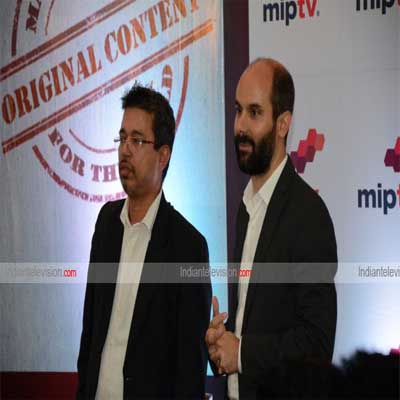
    MUMBAI: The Mumbai leg of Reed Midem’s Mipcom and MipTV road show went off like a dream with an attendance from about 80 professionals from the world of television and digital content. It was addressed by Reed Midem international business development director Ted Baracos, Asia sales manager Paul Barbaro and Indian representative (and indiantelevision.com founder & CEO) Anil Wanvari.


    The theme like the other two venues was “Can Indian content leave its stamp on the world?” But unlike Delhi and Hyderabad, the attendees were primarily professionals from TV and digital content production, broadcast syndication and distribution.


    TV producers were represented by Shyamashish Bhattachharrya, JD Majethia, Sumeet Mittal, Rakesh Paswan, Abhigyan and Mrinal Jha, Sudhir Sharma, Lalit Sharma, Asad Abid, Ram Talkit, Rahul Sarangi and Roopak Saluja. Zee TV, Indiacast, 9XM, Sahara TV, Times Television Network, and Travel XP HD were some of the broadcasters who attended. Independent film producers Imtiaz Barolia and Javed Rahman Khan also attended. Amongst the distributors included Bhupin Chhadva, Yuvamira Dwivedi, Vivek Lath, Ratnakar Kumar, Sanjay Hinduja and Rashmmi Menon.


    Rajjat Barjatya, Sandeep Mehra and Ram Seshan made up the digital players. Education companies Educmedia and Laughing Buddha Entertainment Knowledge were in attendance.


    Extremely interactive, the two hour seminar had all the constituents expressing their views. Broadcasters expressed that the two markets are a must attend for TV professionals and that the two markets help generate substantial business for content syndication for them. “Indian TV shows command about $350 to $700 per half hour,” said one of the broadcasters. “The sticker price of non-fiction shows is about $1,500 and above,” said another. “Films sell at anywhere from $500 to $15,-20,000 depending on the territory,” said a third.


    According to them, Pakistan, Afghanistan, Russian, CIS, Mynamar, Poland, middle east and other east European markets are some of the markets which have taken to Indian content well. Most of the attendees expressed that they would like to see an Indian pavilion come up at MipTV and Mipcom, representing the Indian content creation industry, just like 26 other regions from all over the world are doing, Wanvari said he was in conversation with National Film Development Corporation to set up the pavilion once again this year, while the Animation, VFX, Comic & Gaming Industry of Andhra Pradesh was also in the process of doing the same for this year’s Mipcom from 7-10 October.


    Film producer Javed Khan expressed that Mipcom is very conducive to doing co-production deals. He is currently executing a coproduction film with support from Turkey. “We nearly closed one co-production contract at Mipcom three to four years ago,” he said.


    Creative professional and producer Rahul Sarangi spoke about a non-fiction format developed by him which is going on the floors in four different countries. “Indian broadcasters were not very accommodating of my paper format,” he says. “So I invested about $40,000 and created a nice trailer and one of the overseas format distributors agreed to license it. It will be seen in several countries very soon. Mipcom and MipTV have really helped me realise my ambitions. Now an Indian broadcaster is negotiating to buy the licence for India.”


    The entire room gave a rousing ovation to digital producer Rajjat Barjatya who has generated 1.5 billion views for his 45 odd channels on YouTube. “Indian content can travel and is already travelling through my channels,” he said. “The most popular offering is a video Ba Ba Black sheep which has got 76 odd million views,” he said. “And it is being watched by a German mother and her daughter, an English mother and her son.. it has crossed language and cultural boundaries.”


    TV producers stated that they were totally hemmed in by the fact that they did not have the rights to the content they produce, but they would nonetheless like to attend to expand their horizons. Baracos said the Indian case was not unique. He gave the example of UK independent producer organisation Pact. “The UK market was quite similar to India’s as is Japan. The producers lobbied with industry and government to get their rights back again,” said Baracos. “They were successful with a caveat: they would share revenues with broadcasters on sales they achieved. Today, the UK Indies pavilion is generating close to 30 million pounds worth of deals annually. Everyone is happy: the broadcasters, and the producers.”


    Barbaro highlighted that it is imperative that India builds a brand for itself at international markets. “Korea has done it over years; China is doing it. India needs to do it,” he said. “Today, their content is traveling all over the world. Yes, the government supports their efforts with funds, but the Indian content community needs to awaken the Indian government about the opportunities available and what other governments are doing to help and propagate their culture – and indirectly generate national economic benefits – through markets such as Mipcom and MipTV.”

  • SingTel appeal over EPL cross-carriage rejected

    SingTel appeal over EPL cross-carriage rejected

    MUMBAI: Singaporean IPTV operator mioTV will have to share its English Premier League coverage with rival platform StarHub after losing an appeal seeking an exemption to the country’s cross-carriage rules for pay-TV content.


    In April, the Media Development Authority (MDA) ruled that SingTel-owned mioTV’s non-exclusive deal for EPL live matches for three seasons beginning this August triggers the “Cross-Carriage Measure,” which took effect in August 2011.


    Under the cross-carriage ruling, pay-TV platforms that acquired any exclusive content on or after 12 March, 2010, must make that programming available through the set-top boxes of other platforms. SingTel subsequently lodged an appeal against the MDA decision with the Minister of Communications and Information.


    “The minister’s decision to reject SingNet’s appeal was made based on the assessment of a number of factors,” a statement from the ministry said. “A key consideration was whether certain clauses in the agreement between SingNet and the Football Association Premier League prevent or restrict or are likely to prevent or restrict the EPL content from being acquired or otherwise obtained for transmission on selected network platforms in Singapore by other pay-TV operators.”


    “The minister considered the qualitative and quantitative effects of these clauses. The minister also noted that the key objectives of the cross-carriage measure include addressing the high degree of content fragmentation and encouraging pay-TV operators to shift from a content-centric strategy to other forms of competition, such as service and content innovation. Pay-TV operators should keep this in mind and continue to provide better value to the consumers. The minister has also suggested that MDA consider providing further guidance on the circumstances that may trigger the cross-carriage measure so that pay-TV operators can provide more certainty to consumers.”


    Customers on both platforms will be able to purchase an EPL stand-alone subscription, granting access to some nine channels, for S$59.90 ($47) a month.

  • Broadcasting and video equipment to show sizable increase in 2013

    Broadcasting and video equipment to show sizable increase in 2013

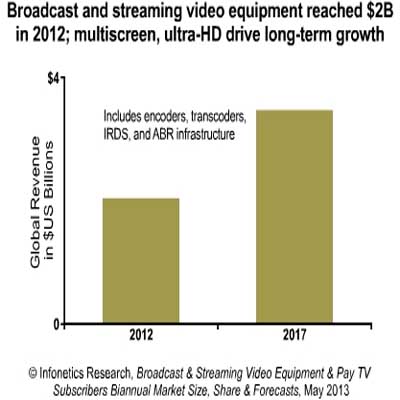
    NEW DELHI: Broadcast and streaming video equipment market is likely to grow 12 per cent in 2013 from two billion dollars in 2012.


    According to Infonetics Research, the market is projected to grow by more than 1/3 by 2017, and adaptive bitrate (ABR) origin and packaging servers are key components in the efficient delivery of over-the-top (OTT) content, especially as more pay-TV providers and content delivery networks move to ABR streaming.


    More and more, transcoders are being used to prepare linear broadcast and file-based content for distribution directly to subscribers.


    Telco IPTV subscribers have the highest 2012-2017 CAGR (17 per cent) of any pay-TV subscriber segment.


    With competition and content heating up, pay-TV providers are transitioning their traditional, broadcast-focused video processing environments to ones that can ingest, process, deliver, and decode video content from multiple sources.


    Jeff Heynen, principal analyst for broadband access and pay TV at Infonetics Research, said: “Content owners and studios are also adjusting their workflow and video output to support multiscreen and streaming services.”


    Infonetics Research noted that the net result of these transitions is steady investment in the platforms necessary to optimise video streams for a growing list of end devices and formats.

  • “You have to reinvent and live on everyday on TV” : Colors CEO Raj Nayak

    “You have to reinvent and live on everyday on TV” : Colors CEO Raj Nayak

     At five most babies are just about going to kindergarten. But this is one baby that has been fighting it out in the big bad competitive world of Indian TV broadcasting. Colors, which completed five years on 21 July, has, in the process, become almost as seasoned a campaigner as its older rivals in the Hindi general entertainment channel space.


    The channel’s CEO Raj Nayak – though he was a little under the weather when indiantelevision.com met him, nursing a cold and a fever – was rather chirpy and happy on the occasion of the channel’s fifth birthday. Preparations were on for a small inhouse celebration and everyone had smiles on their faces.


    “It’s been quite a journey,” said Nayak leaning back with a distant look in his eyes. “I can vouch for that, though I have been leading the channel for only half of that period. We have been game changers, a hatke (different) channel, and we have innovated continuously and will continue to do so. ”


    To know more what else Nayak had to say toIndiantelevision.com’s Vishaka Chakrapani on the channel’s fifth anniversary, read on:


    To what do you attribute the success of Colors?


    One of the reasons why Colors has been successful is because it has been a risk taker. And of course the great job done by my predecessor Rajesh Kamat. When Colors was launched it was the eleventh player in the GEC space and at that time when there was no digitization it was a bold and courageous move because it was seen to be entering in a crowded market.


    So what did Colors do? In my opinion the first thing it came and said that all channels are doing the same, we need to do something different. So the first thing the team did was to put on differentiated content, story lines on social issues, which no one wanted to touch. Initially the channel even got a little flak for it saying we are becoming regressive.


    Second, I think when you are launching as the eleventh player your ability to take risks is high because you are down there and expectations are low. Thirdly, they said we have to break viewing habits, so lets get disruptive. And that is what they did: they stripped nonfiction content Khatron ka khiladi during the week.


    They also strategically used movies as tentpoles to complement the overall offering. At one time if a movie was premiered it was on Colors.


    But as you go higher in life, your ability to take risks becomes less. I think that’s what was happening when I joined here. It had come to a point where it was stagnant. We were dilly-dallying to take big risks.That in my opinion was confidence in our strategy. And it led to a very good dividend – leadership and being a trend setter.


    That’s what we have done since. I have been here for the second part of the innings and we have only taken risks. Not all have paid off, some have been successful, some have not but at the end of the day this is the only way this business runs, you have to reinvent and live on everyday. Creativity is not someone’s monopoly. You don’t know what’s going to work and what’s not and the only way is by taking trying out. Of course you use your experience, some consumer insights and finally your gut.

    How has the performance been on the financial and people front?


    We have grown over 50% CAGR in terms of overall revenue in the last five years. We may have slowed down in the last two years because of the base going high. We are a reasonably profitable channel have been growing year on year. So while you hear people say that Colors spends so much money on content, we also monetise well and the truth is we are very focused on balance sheet and profitability.


    What is the attrition rate like in Colors?


    We put people first because we are an organization of people. In terms of people we have the lowest attrition rate in our business. If at all people have left, it may not be more than 5-10 per cent and if they have then hardly anybody has left to go and join competition. They have left to make a movie or something else. But they have not gone to competition. That speaks a lot for the culture, values and environment we provide. The whole team is just 160 across country, so you can imagine cost of return per employee.


    My second line, the top management team, their average age is 30. The organization structure is such that we are very lean mean team. We are very well structured. There’s not too much of layers and there’s not too much of bureaucracy. The other thing is that for everybody in this organization, there’s accountability with authority. Everybody can make decisions. I believe in delegation. The way we work is like a restaurant. When it’s full, everybody picks up the plates. We are first among equals.


    As far as people are concerned, I am told, that when we started (my operations head was saying), she had five people and no equipment and the show had to go on air. It was a very small team and today it’s grown, still not too big for a Rs 1000 crore plus business.


    The number of people handling content too has remained the same to a large extent. The team may not be more than 30 people. Except for two heads, everybody’s been here forever.


    The sales team has been here forever. Probably if there is any attrition that has happened in that team because it is so dynamic, it’s happened at the junior level because it is a dynamic team. The sales head Simran Hoon, has been here since day one.

    Which are your big markets internationally apart from India?


    Colors is in 140 countries. UK, Canada, Middle East, Africa, Austraila, New Zealand you name it. From the revenue perspective, the UK, the US and the MENA region contribute a large chunk.


    Colors was not in UK for first two years. I think the moment we went into UK we had the same success, which was obvious due to word of mouth from relatives of Britasians in India. Our subscription and advertising revenues did not kick off so well. But that’s also because we were a new channel. Today it competes with every GEC channel. We have now launched another channel in UK Rishtey which is also doing very well.

    And what have the past two years been like ever since you took over?


    I think it has been one of the most exciting, most rewarding, most challenging part of my career simply because whilst I had mastered or crafted myself at being very good in one genre- that is sales and marketing – this job gave me an opportunity to have a holistic view of the entire business and that way it was extremely challenging. I think it was also an advantage I carried because I understood the business part of it.


    In a sales job you tend to be creative by default because you have to go and sell things to people. I think that came in handy to me because when I looked at a show I just did not look at it from a viewership point of view but also from a marketability and revenue generation point of view. The proof of it is that we have maintained our leadership position these last two years.


    We have done things which are completely different, non-expected from Colors and as a channel last year we posted an EBIDTA growth of more than 40% over the previous year.

    How would you rate Colors today and before you joined?


    Without sounding pompous or critical I would say 50:50. It is an unfair question to me. Having said that, out of 11 in my management team, nine have been here for five years, somebody for three and rest for two. I think it would be fair to ask them the question.


    Personally I think the stage at which I took the channel, we‘ve run with the ball, we‘ve maintained leadership status and we rolled the profitability of the channel. When I came in, I had three KRAs (key result areas) – you have to get Colors where it belongs – maintain leadership, grow profits and build brand extensions. The third part will happen.

    What’s your plan for the next few years?


    I want to consolidate Colors. Right now we are strong number two. We would ideally like to be No 1, but not at the cost of profitability. A few years from now I want to see the petals of Colors extend in the regional and movie space.


    Colors will have to have more brand extensions in the TV and digital space. Expansion is the natural progress. It is a strong brand and we need to leverage its equity.

    What have been your high and low points last two and a half years of the five?


    My high point was when I landed in Cape Town and my office called me saying we are number one. I remember the date. It was 24 December. The second high point for me was when we did a show in the late Jagjit Singh’s memory called Yaadon ka Safar. In five minutes we took a call. Another show was Yuvraj Singh’s Zindagi Abhi Baaki Hai and for me that was a good real life social message to inspire people.


    Both of them did not get good ratings but the messages and good will we generated was not just in India but also across the globe.


    These little things where we are able to as a media company do some good back to society gives me a lot of satisfaction.

  • 7 broadcast networks have 72 hours to revert to weekly TV ratings

    7 broadcast networks have 72 hours to revert to weekly TV ratings

    MUMBAI: Seven broadcast networks which have told TAM to shift to monthly reporting of TV ratings of their channels have been given 72 hours to revert to weekly reporting, after which all advertising release orders (ROs) for spot bookings will stand cancelled. This is contrary to reports that advertisers have already sent RO cancellations effective last evening.


    The CEO of a channel told Indiantelevision.com that his network has received emails pertaining to large advertisers like Levers, Procter & Gamble, Loreal, Dabur, ITC, Britannia, Marico and Godrej. “But I don’t expect any cancellations between today and Monday. The action will begin on Tuesday.”


    Agrees Group M south Asia CEO C.V. L Srinivas: “Notices have been sent out across the board from our clients as of yesterday evening. Advertisers are quite clear: they are not going to carry spots on channels for which there is no data.”


    Almost 102 channels come under these networks and this figure has gone up to 105 with Discovery Networks also writing to TAM wanting to be reported on a monthly basis.

  • Mathrubhumi’s Kappa TV perks up Malayalam youth TV market

    Mathrubhumi’s Kappa TV perks up Malayalam youth TV market

    It‘s more than a cuppa coffee that most youth hold in their hands while they lounge about in Café Coffee Days or BruCafes. Kappa TV – the youth focused music channel promoted by the Kozhikode-based Mathrubhumi media group – has chosen to be different from others of its ilk – it has a programming mix in English, Hindi, Malayalam and Tamil. And this, from a group which has its origins in Kerala where Malayalam and English are the main spoken languages. As compared to this, mainline youth channels MTV, UTV Bindass, Channel V, 9XM have been sticking to one lingo – Hinglish.

    Mathrubhumi media group‘s Kappa TV adds some zing to its content with a host of English, Hindi, Malayalam and Tamil programming

    Mathrubhumi TV CEO Mohan Nair says this is but natural and expected from south India‘s first youth centric channel. He explains: “In south India, young viewers are very much into popular cultures which are represented by Hollywood, Bollywood, Mollywood, and Kollywood. Tamil and Malayali youth also tune into English and Hindi songs from Sony Mix, MTV, UTV Bindaas and 9XM. Hence, we decided to have an amalgam of these languages along with Malayalam and Tamil in our programming mix whether it is in the form of music videos we play or the language that is spoken.”

    Estimates are that the Malayalam TV ad market is around Rs 675 crore; while the reach of all Malayalam channels put together is 8.1 million households.

    Music Mojo on Kappa TV is a Malayalam me-too of MTV Unplugged and Coke Studio

    As for the ad rates for Kappa TV, sources say, they hover around Rs 850-Rs 1000 per 10-second spot.

    On the content front, Nair reveals that the channel has six to seven hours of original non-fiction content in Malayalam and English on air daily, with shows being repeated twice. Kappa TV is primarily programmed in Malayalam with 60 per cent being back-to-back music videos rolling out in Hindi, Tamil, Malayalam and English, and 40 per cent being non-fiction shows.

    Among the music-based shows, the channel airs Music Mojo, a Malayalam me-too of MTV Unplugged and Coke StudioAwesome Covers, a remix of songs of different languages; Mood Tapes, a show which captures the mood of the day and invites people across neighbourhoods to sing and compose songs; Bindaas Bollywood, which showcases Bollywood‘s best; and International Chart Busters.

    I Personally, which focuses on celebrity interviews is past of the channel‘s non-fiction portfolio

    Kappa TV‘s non-fiction portfolio includes: I Personally, which focuses on celebrity interviews; Film Lounge, a film review and recommendation show;Creative Chef and Simply Naadan – cookery shows, Street Magic, a magic show and Candid Camera which features celeb photo shoots and style tips from fashion experts. “We have chefs from hotel chain giants like Vivanta by Taj , Crowne Plaza,Holiday Innu and Le Meridien for our show Creative Chef,” informs Nair.

    A large number of celebrities from the south have already featured on I Personally. These include, Kavya Madhavan, Padmapriya, Rima Kallingal, Swathy Reddy, Mahesh Narayanan, Krish, Haricharan, Rashid Ali, Vijay Yesudas, Shyamaprasad, Kamal, Prathap Pothen , Sibi Malayil and also popular directors like Siddhique Prashant Pillai, Mohanlal and Mammootty.

    Creative Chef features some of the chefs from hotel chain giants like Vivanta by Taj, Crowne Plaza, Holiday Innu and Le Meridien

    The channel has also roped in celebrities to host its shows. The show Simply Naadan is hosted by Vishnu; Meghna Nair hosts Tales and Tunes and Sanjeev Nair anchors the show Filmography.

    Despite an array of shows in the kitty, Nair is quick to acknowledge that he needs more to push the bar as far as content is concerned. “We are mulling over experimenting with standup comedy shows, music video festivals, reality shows, short films and a series which would track the career of the top artistes or film personalities,” he notes.

    With a moving target such as the fickle youth whose attention span is hard to retain, Kappa TV has had to go the whole hog: continuous promotion, whether it is print or TV, or the outdoors or direct consumer engagement – both offline and online. It helps that it has very successful publications in-house for print communications and advertising in the shape of the Mathrubhumi newspaper – both in English and Malayalam.

    “We have allocated around 25-30 per cent of our budget each for print and television, 30 per cent for OOH mediums and the rest for digital,” says Nair.

    The channel‘s ad agency Maitri also helps out with its promotional activities and brand integrations. Promos and standups, posters and tent cards for shows likeMusic MojoFilm Lounge and Ragaramiyer can be regularly spotted in railway stations, cinema halls, coffee shops, ice-cream parlours like Baskin Robbins. “We have also tied up with certain Kerala online portals like Metro Matinee for advertising about our channel,” informs Nair. And he also narrates with pride how Music Mojo‘s popularity has seen a spinoff being played out on Club FM – an in-house radio station.

    Mathrubhumi director – marketing & electronic media Shreyams Kumar says the
    channel has ignited the imagination 
    of the young crowd, within months
    of its launch

    “International brands like Lulu, Perfetti, Baskin Robbins and national brands like ITC and Kalyan Jewellers are our current advertisers,” says Nair. “We also have a host of local advertisers like Kalyan Silks,Bhima Jewellers and Pothys Silks under our roof. We are in final negotiation with a whole host of brands including Idea Cellular and Nestle for brand tieups,” affirms Nair.

    The channel is available in almost four million cable & satellite TV homes in Kerala, on DEN, Asianet, Siticable and on select cable TV networks in Karnataka, Tamil Nadu, and Maharashtra. This apart, it is in the process of signing up with almost all the DTH providers nationally, which Nair expects will be done before Onam. It is also available internationally in north America and Europe on IPTV platforms, while it can be seen in the Gulf courtesy E-Vision.

    Kappa TV has also started pushing its content out digitally on YouTube, Facebook, Twitter and Pinterest. Video views on YouTube tot up to about 1.5 million, with some 9,550 odd Twitter followers. Facebook likes add up to some 15,000 plus.

    Definitely not something to crow about, but Nair says the digital push has been on for only four months and is helping build offline traction. “Viewers from India, United Arab Emirates, US, Saudi Arabia, UK, Qatar, Australia, Canada, Kuwait, Singapore, Oman, Bahrain, New Zealand, Germany, Malaysia and Ireland have been watching online versions of our music shows on YouTube. Videos of all our popular shows are updated daily on our YouTube channel”, he reveals.

    The digital initiative is handled by a four member team headed by Kappa TV director marketing and electronic media Shreyams Kumar.

    “Keralites and the wider Malayalee diaspora exposed to best in international entertainment was thirsting for an ethnic mélange. We at the Mathrubhumi sensed this opportunity, and this gave birth to Kappa, our specialty channel. With pulsating music, riotous humour, film review and intimate interviews, all tightly-edited, it has ignited the imagination of the young crowd, within months of launch”, says director – marketing & electronic media Shreyams Kumar.

    “This channel is a landmark achievement, since we have realised our long cherished goal of cross-media synergy. That this has occurred in our 90th anniversary year makes for reloaded pleasure.”

    The group already owns a news channel and a youth channel (both of which was launched in early 2013) under its umbrella. And it has two more licences approved by the ministry of information and broadcasting. One of these is for a general entertainment channel, which it has been planning to launch but has held back on it because of budgetary constraints. “But the desire to have at least one GEC is very much same like any other group,” discloses Nair.

    Mathrubhumi TV CEO Mohan Nair‘s Kappa TV is
    certainly serving some hot ‘cuppa‘ and has left the
    youth wanting for more

    To keep costs low, the group is using the same news channel infrastructure to roll out Kappa TV daily.

    Nair has the right pedigree to successfully steer the Mathrubhumi group‘s TV ambitions. For one, he has print media experience as bureau chief and senior editor of The Economic Times from 1988 to 1999. Then he has the requisite domestic and international TV experience, having worked for six years with Asianet Communications and with Maharaja TV in Sri Lanka before moving to Asianet Communications as COO for six years. He took up the challenge of steering a primarily print group into TV in 2010 and first off the blocks was the Mathrubhumi news channel, followed by Kappa TV.

    And his efforts have won some praise and even the attention of rivals.

    Leading Malayalam network Asianet has taken note of the success that Kappa TV has achieved. Plans are afoot to revamp one of its channels, Asianet Plus. “We are aware of the importance that a youth channel holds and that is why we are revamping Asianet plus for young viewers in the coming two months ,” affirms Asianet, business head, Anup Chandra Shekharan. Sources reveal that this revamp is going to see it emerge as an amalgam of Channel V and Life Ok

    The Sun TV group too has awakened to the potential. Music and movies channel Kiran TV has been converted into a movie channel called Kiran Movies. On the anvil, sources say, is another music channel which is quite likely to be under the Surya brand.

    Now what more could you ask for?

  • Voice your opinion on ‘Opinion Square’, a game introduced by Foreseegame.com

    Voice your opinion on ‘Opinion Square’, a game introduced by Foreseegame.com

    MUMBAI: Have an opinion on trending topics? Log on to Foreseegame.com. This unique game portal has introduced a new category of interesting and thought-provoking games called ‘Opinion Square’. The game helps in understanding the opinion of Indians on various trending topics.

    The latest from ‘Opinion Square’ is a set of ten games for smart phones which caters to the need of the gadget-savvy generation of today. This new set of games on smart phone is designed to explore the mindset of the consumers and their preferences regarding the smart phones they buy and use.

    Foreseegame.com which received an overwhelming response to this new set of opinion-based games, prepared a survey report in association with Microsec Research based on these results. Microsec Research is the research wing of Microsec Capital having experienced analysts across sectors.

    17,000 users of www.foreseegame.com participated in this survey, who were registered only on the basis of unique mobile numbers. The participation was monitored by Google.

    The report brings out a number of interesting facts about the growing smart phone market like consumers’ preference for touch screen phones, high-tech features, operating system and social networking on the go.

    The report states that majority of the buyers consider the operating system while buying a phone. Interestingly, Android holds the lion’s share amongst the most preferred operating systems. Blackberry and Windows, with almost equal fondness, are contesting for the distant second position.

    Touch screen rules the market while touch and type is the second preference. Sole keypad usage is fading away. Buying trend shows that most of the people like to buy a smart phone either with E.M.I without interest or one-time payment.

    Communication on the go is the best utility of smart phones and getting in touch via messengers such as WhatsApp and BBM wins the race. Respondents showed hesitance in using mobile banking due to data security issues and uneasiness of operating.

    Consumers today look for innovation related to battery like long lasting battery, wireless charger, solar power chargeable battery and link to home care management like integrated remote control for TV, A.C., home robot and car key.

    The report also states that even with the multiple features attached with mobile phone, it fails to replace the utility of a watch, which is still used to check time.

    The report has got the pulse of Indian consumers in relation to the fast growing smart phone market.

  • LINE, a free calling & messenger app launches brand and marketing campaign

    LINE, a free calling & messenger app launches brand and marketing campaign

    NEW DELHI: LINE Corporation has launched a brand marketing campaign through a series of TV commercials targeted at the Indian youth to promote its new mobile messenger service in India capable of various types of communication with free call, voice chat and sticker chat.


    LINE, headquartered in Shibuya-ward Tokyo and headed by Akira Morikawa as CEO, says its popular global messenger application is available on both smartphones and PCs across multiple carriers and operating systems including iOS, Android, Nokia Asha, Windows phone, BlackBerry, Windows and Mac. LINE messenger app comes packed with new features and functionality for a truly connected experience.


    LINE has launched its first TV campaign in India on 30 June with two very interesting advertisements highlighting the ‘group voice chat’ and ‘sticker’ features. The primary thought behind the ads was to target the Indian youth, by associating the key app features to their day-to-day activities.


    Born and headquartered in Japan on 23 June 2011, LINE has already achieved over 180 million registered users across 230 countries. LINE has already become popular messenger app in Asia with Japan having more than 45 million users, Taiwan and Thailand holding more than 15 million users respectively and 10 million users in Indonesia. LINE’s popularity is going beyond Asia with Spain now claiming more than 10 million users and South American countries such as Mexico and Argentine also witnessing significant registrations.


    Going forward, with its fast paced growth in overseas markets and expanding user base, LINE will further add new features and improve the usability of its service, with the aim to become the most preferred communication platform for consumers globally. LINE will also launch fun stickers that will suit the Indian sensibilities in the near future.


    One of the main reasons why LINE is growing so rapidly compared to other major messenger apps is its stickers function. It is extremely well-received by users as they can send large-sized character pictures with the tap of a finger, thereby providing a simple, casual and exciting way to express their emotions. The sticker characters, include LINE’s original characters and a variety of famous characters such as Disney, Hello Kitty and Ironman, are especially loved among the Asian youth, sparking LINE’s growth in many regions.


    Elaborating on the India launch LINE Corporation CEO Akira Morikawa said, “LINE has grown at a tremendous speed to reach more than 180 million in only 23 months after its launch. Today, it delivers five billion calls and messages across the world on its network per day. In fact, LINE is amongst a few services globally which has received an enthusiastic response by young generation in many countries in such a short period”.


    “After witnessing solid growth in Asia, Europe and US, making inroad into the Indian market was a part of our overall strategy. With its huge youth population, increasing mobile and internet penetration, lowering bandwidth costs, India makes a hotbed for LINE messenger application which will change the way people communicate in the country,” he added.

  • Miditech’s Shaitaan unveils a story on the vicious circle of superstitions

    Miditech’s Shaitaan unveils a story on the vicious circle of superstitions

    NEW DELHI: Miditech’s crime series on Colors, Shaitaan – A criminal mind, is now coming up with a special episode on the vicious circle of superstitions, where a man’s belief drives him to an extent of murdering an innocent girl.


    Hosted by the popular TV actor Sharad Khelkar the episode will be telecast on 22 June.


    Miditech CEO Nikhil Alva said, “Every weekend we try to bring forward the kind of crime cropping in our country and what people are facing or are the victim of. This week we are showcasing another frightening episode on superstitious belief. One very important reason, why individuals turn out to be a victim of superstition is the fear of failure or the anxiety about the outcome. Our upcoming episode on 22 June would telecast one such heinous crime.”


    TV Actor and the Show Host Sharad Khelkar, said on his association with Shaitaan, “With every episode, I come closer to the realities of life which most of the people are not aware of. Shaitaan captures people’s attention by making them aware of the harsh realities of life and how one should be a responsible citizen. While shooting for this episode, it was shocking to believe that even in the 21st century, there are people who believe in a number of omens, perform a number of ceremonies to achieve their ends.”


    The episode that will be showcased this weekend 22 June portrays the story of a superstitious man, who blindly follows a Swamiji. Advised by him, the man forces the girl, who is almost his daughter’s age, to marry him. The story revolves around how desperately the man tries to convince the innocent girl that leads to a murder.