Tag: TV

  • Sony Music gets the fastest 1 million subscribers on Line

    Sony Music gets the fastest 1 million subscribers on Line

    MUMBAI: Sony Music Entertainment’s exclusive tie-up with Line has garnered a massive response by crossing a subscription of 1 million users.

    It has earned the fastest million subscriptions on the application by providing the latest music information in India.

    The official account of Sony Music EWntertainment caters to fans of major genres of music including Bollywood, Indipop, Tamil, Telugu, Punjabi and International music with a catalogue of over a million songs.

    Commenting on the same, Sony Music Entertainment India marketing director Sanujeet Bhujabal said, “We are extremely thrilled with the response of 1 million users on LINE. We are the only Music Label actively engaging with the Social platform and it has helped us to move a step further and directly engage with consumers With this tie-up, we are very sure that LINE will secure its position as a favourite app for music in the near future.’ 

    Line, the free messenger application, broke the 200-million download mark worldwide. Since the initial launch, the company has expanded the service to roughly 230 countries in 11 languages, including Chinese, Spanish and Indonesian.

  • Prasar Bharati to be upgraded as MIB plans to invest Rs 3,500 crore in it

    Prasar Bharati to be upgraded as MIB plans to invest Rs 3,500 crore in it

    MUMBAI: The government broadcaster, Prasar Bharati is set to see a major advancement. Reportedly, the Ministry of Information and Broadcasting (MIB) is planning to invest close to Rs 3,500 crore on upgrading the pubcaster’s broadcast infrastructure and network development, especially in the border areas of Jammu and Kashmir and the North-Eastern states.

    According to a report by The Hindu Business Line, the proposal has been recommended by the Expenditure Finance Committee and is up for approval from the Cabinet Committee on Economic Affairs (CCEA). “The funds are expected to be used to strengthen the transmission in border areas by augmenting the broadcast infrastructure so as to counter anti-terrorist activities, among other initiatives,” reveals the daily.

    Apart from this, the fund is also expected to be used for digitisation of transmitters and studios of All India Radio (AIR) and Doordarshan, High Definition TV, expansion of DD Direct to Home and modernisation of DD and AIR. 

    Reportedly, the Ministry is already monitoring this project through inter-ministerial meetings with representatives from the Ministries of Home Affairs, External Affairs, Defence, and the Cabinet Secretariat, among others.

    Currently, 273 TV transmitters are operational in the border districts. “In J&K, five high power TV transmitter projects are under implementation, while plans are afoot to put in more transmitters in the Indo-Nepal border,” reports the daily.

  • BBC Worldwide sells Dancing with the Stars to Cambodian Broadcasting Service

    BBC Worldwide sells Dancing with the Stars to Cambodian Broadcasting Service

    MUMBAI: BBC Worldwide has announced that hit entertainment TV format Dancing with the Stars has been licensed to Cambodian Broadcasting Service (CBS). The series will air on CTN, Cambodia’s most watched terrestrial channel.


    The announcement marks the debut of Dancing with the Stars in Cambodia. It is also BBC Worldwide’s first format sale in the country.


    One of BBC Worldwide’s most popular global brands, Dancing with the Stars has been licensed in 49 countries, and a version of the show has been seen in over 75 countries, with over 220 series to date. Local versions of Dancing with the Stars air in countries as diverse as Lebanon, India and Russia.


    The brand has also extended into live events, gaming and digital properties. In Asia, the format has been sold in Thailand, Vietnam, Japan, China, South Korea and two versions in India. In India, the sixth and latest season of the Hindi version, Jhalak Dikhhla Jaa has achieved its best audience figures to date for Colors. The grand finale pushed the show to the top of weekend programming nearly doubling the ratings from 2012.


    The company thinks that Cambodia is an important market to grow in terms of business in Asia and thus it is looking at expanding there. Earlier, BBC World News, BBC Lifestyle and BBC Knowledge were launched in the country.


    The series is set to premiere in mid 2014.

  • Life OK gets a content head in Aniruddh Pathak

    Life OK gets a content head in Aniruddh Pathak

    MUMBAI: Even as the folks at Star India’s second GEC Life OK were popping the champagne on the occasion of its second anniversary, it announced that it had promoted Aniruddh Pathak to the position of content head. Pathak is the man behind the channel’s successful properties like Mahadev and now soon-to-be-launched fantasy series Hatim.


    So what will be his new responsibility as the content head? Answers Pathak: “There will be two major responsibilities. One is to develop new content and second how to make the content which is on-air more engaging and contemporary for the audiences.”


    He further goes on to say that: “If we talk about Mahadev, for the first three months the show was going haywire, but after three months we changed some plots and storyline and now it is the face of the channel.”


    Pathak, a creative professional who has been writing TV for more than 10 years. At Zee, he started in 2000, with shows like Piya Ka Ghar and later Kasamh Se. In 2007 he became the associate creative head at Star India, launching 10 shows including Bidaai and Yeh Rishta Kya Kehlata Hai.

  • Analog Terrestrial TV Homes to decline 24 per cent by 2008

    Analog Terrestrial TV Homes to decline 24 per cent by 2008

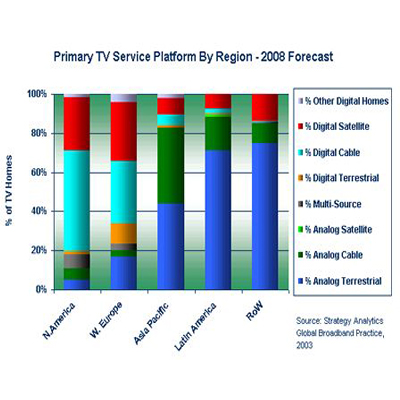
    LONDON : New research from Strategy Analytics, the global analyst and consulting firm, quantifies the steady decline of analog television broadcasting and the progress towards so-called ‘Analog Switch-Off’.
     

    The report, published to subscribers to the Broadband Entertainment Strategies service, shows that 597 million homes worldwide used analog terrestrial broadcasting as their primary TV service in 2002. With the growth of digital television services offered by satellite, cable and terrestrial operators, this number is forecast to decline by 24 per cent to 455 million by 2008.

    North America and Europe will be the most advanced markets in the digital TV transition by 2008, but the majority of homes in the rest of the world will still use analog terrestrial TV as their primary service. Even in the most advanced markets, however, a realistic analog switch-off strategy will have to account for the additional costs of converting hundreds of millions of secondary TV sets and VCRs.

    Analog switch-off is seen as a key policy goal by most governments. Releasing this valuable spectrum could ultimately lead to major new commercial and public revenue opportunities. The report suggests that few, if any, countries will be 100 per cent digital until well into the next decade. Some countries, such as Germany, will instead seek to use analog platforms such as cable as an alternative to terrestrial broadcasting. The report recommends that broadcasters relying strongly or wholly on analog terrestrial broadcasting for access to viewers must consider implementing alternative strategies and distribution partnerships in order to safeguard their long term position.

  • Ministry of home affairs spikes FDI hike in telecom, media

    Ministry of home affairs spikes FDI hike in telecom, media

    Mumbai: The Telecom Regulatory Authority of India’s proposal to increase foreign direct investment in the information and broadcasting and telecom sectors may never see the light of day.

    The reason: the ministry of home affairs has not agreed to increase FDI caps and/or entry routes in respect to “aviation, telecom and information and broadcasting sectors on account of their sensitivity and security concerns,” Minister of State for Home R P N Singh said in reply to a written question in parliament today, according to agency reports.

    Singh said the Home Ministry has also raised issues pertaining to “investments of concern” and in respect of different categories of investors and investments; source of investments and instruments of investment.

    Trai had earlier this year recommended hiking FDI caps for news television (TV) and private FM radio services to 49% from the current 26%. It had also proposed a FDI hike to 100 per cent (from 74 per cent currently) in distribution and carriage services such as direct-to-home (DTH) TV, cable networks and mobile TV.

  • TRAI ad cap case: Judgement day dawns?

    TRAI ad cap case: Judgement day dawns?

    MUMBAI: Exactly a month after hearings first began in the ad cap case in the Telecom Disputes Appellate Tribunal (TDSAT), the verdict is set to be pronounced today. The TDSAT has listed it in the cause list for 11 December.


    The case that is being fought by broadcasters led by the News Broadcasters Association(NBA) against the Telecom Regulatory Authority of India (TRAI) is all set to be given a new direction.


    Indiantelevision.com gives you the highlights of the broadcasters vs TRAI ad cap legal slugfest and the coincidental twist that came near the end.


    The NBA’s main contentions were that TRAI does not have the authority to regulate content and that the agreement between the two is not of a licensor and a licensee but is rather a registration. It also said that the TRAI had not fulfilled the laying requirements before parliament thus making the regulation invalid.


    However, the TRAI stated that there was no rule in the TRAI act saying that merely because they hadn’t done the laying requirements, the regulation cannot be implemented. It also claimed that according to the terms of the licence and by applying section 7 of the Cable TV Networks Act it was authorised to implement the regulation to ensure the customers get quality of content on TV.


    After hearing the NBA, the TRAI, music channels and some other channels the TDSAT had reserved the judgement. The twist that came last week was when in a separate case of BSNL vs TRAI and others, the Supreme Court had ruled that cases in which the validity of a regulation by TRAI is challenged, cannot be heard in the TDSAT and has to be appealed against in the High Court since by law a regulation needs to be passed through parliament. This has put the fate of the ad cap regulation in a fix since officially TRAI claims it is a regulation.


    We wonder how the TDSAT will decide the case. Most probably, the TDSAT will dismiss it and request the petitioners to move the Hight Court after the verdict the SC gave on Friday. Had the petition been regarding the application of the regulation, the TDSAT could still have decided on it. However, the SC judgement clearly states that TDSAT cannot take a call on the very act that created it. TDSAT was formed under section 14 of the TRAI act giving it legislative and administrative powers.


    Section 36, under which the regulation was formed clearly underlines that if it is framed, it needs to be consistent with the terms of the TRAI act.


    However, after the SC ruling, the TDSAT seems to have been rendered powerless to decide on this case, even after 20 days of hearings and a long wait for the result, which will now be affected by the SC ruling.


    If the broadcasters are asked to move the HC, it means more time for them to deliberate on the validity of the regulation. But it is possible that they will have to follow the 12 minute ruling till the time, the HC does not say anything about it.

  • Clement Schwebig joins Turner International Asia Pacific

    Clement Schwebig joins Turner International Asia Pacific

    MUMBAI: There’s a new member in the Turner International team who will handle its business development in the Asia Pacific region. Clement Schwebig has joined the network as the senior vice president and will look after the network’s growth strategy in the region.


    He will assist in the creation of new local and pan regional channels and develop local content as well. Schwebig has an experience of 15 years in TV operations in two continents – Europe and Asia. Recently, he was a part of the Europe’s leading entertainment company RTL group in Mumbai and led the launch of the channel BIG RTL Thrill. This was the first channel from the co-operation of RTL and Reliance Broadcast.


    Previously, he was the COO of Alpha Media Group in Greece and CFO of RTL Televizija in Croatia. His expertise includes TV broadcasting and production including strategy, finance and sales.

  • Cabinet set to deliberate on TV ratings guidelines

    Cabinet set to deliberate on TV ratings guidelines

    MUMBAI: The Telecom Regulatory Authority of India’s (TRAI’s) recommendations are seeing movement to enable them to serve as the gold standard for television ratings. Currently with the law ministry, the file relating to TV rating guidelines is expected to be presented to the Cabinet very soon.

    The TRAI had come up with its own analysis and recommendations around how TV ratings should be done in India following  discussions with the various stakeholders in September 2013; with the Union Cabinet expected to deliberate and give it sanction soon it could well be en route to become law.

     “The recommendations are fair and are neither pro nor against any measuring body. However, it is very clear that it will be passed by the cabinet,” says the highly placed source from the Indian Broadcasting Foundation (IBF).

    As reported by indiantelevison.com in September, the regulatory body had sent out the recommendations on what should serve as guidelines to put in place a transparent, credible and reliable television ratings process in the country.  

    Amongst the recommendations is that any agency wanting to offer TV viewership monitoring or rating services has to perforce get itself registered with the ministry of Information & Broadcasting (MIB) if it fulfills the following guidelines: “The rating agency shall be set up and registered as a company under the Companies Act, 1956; any member of the board of directors of the television rating agency should not be in the business of broadcasting/ advertising/advertising agency; the rating agency should have a minimum net worth of Rs 20 crore; the rating agency should also meet the prescribed cross-holdings requirements.”

    TRAI had also stated that to keep the ratings process credible, there should be a minimum of 20,000 panel homes which have to be set up within six months of the guidelines being implemented. Thereafter the number of panel homes has to be increased by 10,000 every year until it reaches 50,000.

    To meet and fulfill the last criteria, TAM, the current measuring body, will have to invest a large sum of moolah ( Rs 100 crore plus) every year. This could well be a major challenge for it, if sources are to be believed. For the Indian broadcast industry, has pretty much been chary of funding any of its expansion plans, in the past.

    “Its very existence will be under tremendous threat over the next year or so,” says a media observer. “If it manages to raise the money despite all the cross media equity holding restrictions, then it should be all right. But it will have to contend with BARC which will be getting the industry’s support and should start by mid to late next year.  I would not like to be in TAM’s shoes.”

    However, the source adds that most stakeholders involved in it hope that TAM will be able to participate in the working of BARC as well.

    Another industry source comments, “We don’t care about what happens to TAM. The industry has opted for a new measuring system, then why should we think about TAM’s fate?”

    Watever be the case, one thing is clear BARC is no more suffering teething problems and will sooner than later  bring about a paradigm shift in the audience measuring game in India. And as far as TAM goes, it needs come up to scratch and follow the TRAI guidelines.

    The ratings race may have only just begun.

  • BARC meets today, set to appoint Mediametrie as its rating partner

    BARC meets today, set to appoint Mediametrie as its rating partner

    MUMBAI: The French audience measurement company Médiamétrie will be the ratings partner for the Broadcast Audience Research Council (BARC). Though multiple vendors, both Indian and international had thrown in their bids to be the one who would power BARC’s ratings, sources reveal that the council has opted for the French research agency. Apparently, the final decision was taken over the weekend wherein the — members of BARC met along with Mediametrie reps to sign on the dotted line.


    Mediametrie will be using audio watermarking tech to monitor TV consumption by its 20,000 strong panel. It involves inserting an identifying  mark inaudible to the human ear into the channel’s feed which is delivered to TV homes.. The technology enables different reception modes to be used to measure a TV programme’s audience.

    Médiamétrie features in the world’s top 25 market research firms’ list.


    The formal announcement is expected to be made later this month.  Sources have confirmed that deadline set by BARC such as launching the ratings service by mid-2014 will be met.


    The meeting which went on for two hours in the BARC office also discussed the financial aspects of the ratings, but another meeting is slated to be held for the same.


    BARC CEO Partho Dasgupta did not confirm the finalisation of the appointment of Mediametrie. Responding in an email he said:  “The board of BARC met today to decide on technology and the path ahead. There was unanimity in deciding on a leap in technology to be used in television measurement.  The board approved the management and the technical and commercial committees to go ahead and finalise with a couple of international companies for this. The team will be completing the pilots and will start deployments soon. The board also decided on the funding mechanism and is encouraged by the response received from banks for funding the project.”


    But sources indicate that it is indeed Mediametrie which will get the go ahead.


    According to sources, BARC will start the field trial of meters from January 2014. While the seeding of meters will start from June, the commercial data will be available in the market from October. While initially 20,000 meters will be seeded, BARC will seed 25,000 boxes by 2014 end.