Tag: TV viewership

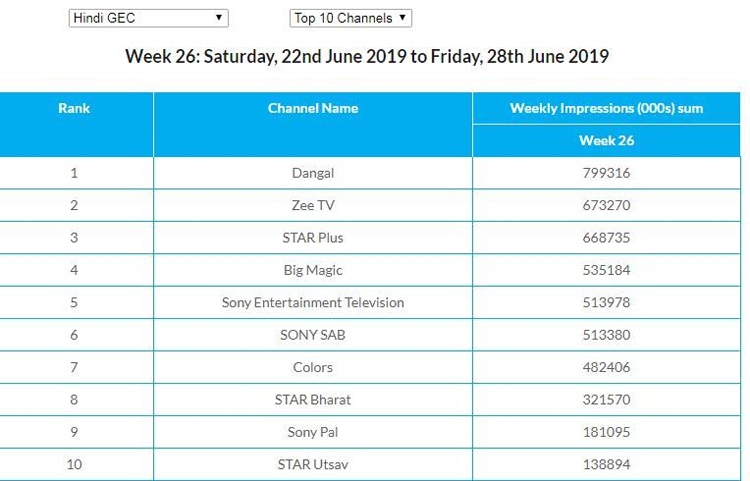
  • BARC week 26: Dangal TV retains leadership position in Hindi GEC

    BARC week 26: Dangal TV retains leadership position in Hindi GEC

    MUMBAI: There has been no major change in Broadcast Audience Research Council India (BARC) data for week 26 of 2019. While &TV emerged as the new player in the space of Hindi Urban GEC in week 25.

    Hindi GEC (U+R)

    Dangal TV retained its first position this week and Zee TV and Star Plus stood at second and third positions respectively. Sony Entertainment Television has moved up the ladder to fifth position replacing Sony Sab while Colors also came down to seventh position. Star Utsav has come back to the chart at 10th position replacing &TV.

    Hindi rural GEC

    In rural areas, Dangal TV, Big Magic, Zee TV and Star Plus continued to be in first, second, third and fourth positions respectively. Colors, Sony Sab, Sony Entertainment Television, Star Bharat, Sony Pal and Star Utsav also retained earlier positions.

    Hindi urban GEC

    In urban areas, Star Plus retained its leadership position and Zee TV its second position. Sony Entertainment Television emerged in the third position replacing SONY SAB. Colors, Star Bharat, Dangal, Big Magic, &TV and Sony Pal retained their fifth, sixth, seventh, eighth, ninth and tenth positions respectively as compared to the last week.

  • BARC resumes publishing viewership data on website ending stand-off with TRAI

    BARC resumes publishing viewership data on website ending stand-off with TRAI

    MUMBAI: Broadcast Audience Research Council of India (BARC) on Monday resumed publishing its weekly viewership data on the website, ending its stand-off with Telecom Regulatory Authority of India (TRAI). The audience measurement firm website has now carried its findings for week 13 of 2019 for the top 10 channels, brands and advertisers.

    Earlier, TRAI had issued a show-cause notice to BARC for not having adhered to the regulator’s directive of publishing weekly TV viewership data on its website during the new tariff order rollout.

    The sector regulator asked the TV audience measurement firm to explain why action should not be taken against it for contravention of sections of the TRAI Act. Earlier, the industry watchdog asked BARC to publish ratings and TV viewership data for the week ending 8 February and subsequent weeks with immediate effect.

    TRAI’s directive came in the wake of the latter's decision to release the weekly data only to its subscribers as opposed to publishing it on the website.

    The show-cause notice dated 29 March also noted that BARC India did not comply with TRAI’s 22 February directive seeking the release of viewership data with immediate effect.

    Following the show-cause notice, BARC issued a statement reiterating its position on the matter.

    “BARC India is a joint industry body, and operates under self-regulation model, in compliance with Ministry of I&B Guidelines. In the NTO transition period, due to distribution disruptions (which have been well documented in media reports), there is significant volatility in data.  Due to this, and the fact that data in this period does not truly reflect viewers’ choice, BARC India Technical Committee and Board took a decision to temporarily suspend placing the limited set of data our website,” a BARC spokesperson said.

    “Putting such misleading data on the website would be against public interest and could be misused by vested interests. BARC is constantly monitoring the ground situation on this.  We have made detailed submissions to TRAI and MIB, backed by data, on several occasions. Also, we would like to re-iterate that there has been no stoppage of data to our subscribers. Every week, our clients have been receiving weekly data without any disruption,” the spokesperson added.

    An earlier TRAI directive read, "BARC India has modified its Fair and Permissible Usage Policy in February 14, 2019, even after being repeatedly asked by the authority to not stop publishing of rating data and viewership data on its website during the migration to new regulatory framework until and unless explicitly permitted by the authority and are thus, in contravention of the direction of the authority dated December 21, 2018 and January 14, 2019.”

    According to the TRAI, BARC had ignored its previous directives of publishing ratings and viewership data for television channels. The regulator said that the audience measurement company had argued that disruption due to migration to a new regulatory framework could prevent consumers from gaining access to channels of their choice, thereby running the risk of an inaccurate portrayal of TV consumption trends in the country.

    The TRAI, however, is opposed to the idea of not publishing the data, which, it feels, is a true reflection of the market changes. BARC’s decision to "withhold" the data is not justified, the regulator pointed out.

    The TRAI also highlighted that BARC "failed to furnish any cogent reason for not publishing the rating and viewership data" and that "such action on part of BARC India reflects poorly on the creditworthiness of the data published by them."

    "Now…the authority…hereby directs Broadcast Audience Research Council to immediately release and publish viewership data for the week ending February 8, 2019 and weeks subsequent to it, on its website without any further delay and not to stop it in future also without explicit instruction/direction from the authority or Ministry of Information and Broadcasting…," said the previous TRAI directive

  • BARC responds after TRAI directive on ratings, TV viewership

    BARC responds after TRAI directive on ratings, TV viewership

    MUMBAI: After noticing that BARC India had stopped publishing TV viewership data on its website after the implementation of the new tariff order, the Telecom Regulatory Authority of India (TRAI), in a sternly worded letter, warned it to publish data for week ending 8 February by 25 February or else face consequences under the TRAI Act.

    BARC India has now released its statement on the same. It says, “To set the record straight, BARC India has not stopped publishing its viewership data. Every week, at 11 am sharp, all our subscribers have been getting all India weekly data without a hitch for the last 175 weeks, including the last 2 weeks that correspond to the NTO transition.

    “However, we have published data of last 2 weeks with the caveat that there are changes taking place on ground due to NTO rollout due to which viewership numbers will be volatile during the transition period. The India Society of Advertisers (ISA) too has advised its members that our data should not be used for media planning and buying in the transition period.

    “We also publish a limited amount of data on our website – intended only for larger benefit and information of trade and media. We temporarily held back release of this select headline data on our website. We did this purely to avoid misrepresentation of such data (Top 5 channels/programs etc) without looking at the larger context of NTO rollout and resulting volatility which could be misleading, lead to confusion and be counter-productive.

    “Our position is also aligned to Ministry of Information and Broadcasting Guidelines that govern us. The guidelines clearly say that “…data generated by the rating agency be made available, on paid basis, to all interested stakeholders…”. And “Sharing of the data/reports with a third party or in public domain be allowed subject to the fair usage policy of the rating agency. Such fair usage policy shall be provided on the website of the rating agency.”

    “TRAI has advised us that we should also consider resuming the display of top channels and programs data on our website. We are taking a considered view on that post consultation with our stakeholders.”

  • ISA advises against using BARC data for media planning, buying during tariff order transition

    ISA advises against using BARC data for media planning, buying during tariff order transition

    MUMBAI: With the new TRAI tariff order coming into force from 1 February, the consumption pattern of TV viewership is expected to vary significantly following the impact on the distribution value chain. Considering the challenges during this transition period, the Indian Society of Advertisers (ISA) executive council has advised its members against using the BARC viewership data for media planning, evaluation and buying perspective.

    ISA is of the opinion that it would take a minimum of six weeks to assess the stability of the viewership numbers post the tariff order implementation. The national body of advertisers also believes that the impact will be significantly different in each region of the country given the varied distribution and broadcast landscape .

    To drive home the point, the ISA has drawn a parallel to the implementation of GST that involved India moving to a new tax regime.

    ISA is also of the view that variance in pre and post evaluations will be higher than the usual and will be highly unpredictable.

    The advertisers’ body also reassured its members that it would work closely with BARC to ascertain the time period when data becomes stable and usable for planning and buying.

    The ISA Executive Council and the ISA Core Media Committee have been in active engagement with BARC Board, Technical Committee and NTO task force over the past few months to arrive at the way forward during this transition period.

  • Punit Goenka named new BARC India chairman

    Punit Goenka named new BARC India chairman

    MUMBAI: BARC India has elected Zee Entertainment Enterprises Ltd (ZEEL) MD and CEO Punit Goenka as the new chairman at its board meeting held on 29 January. Goenka will be taking over from Nakul Chopra who successfully completed his one year tenure as chairman of the joint industry body.

    Goenka was the founder chairman of BARC India and played an instrumental role in setting up of the TV viewership measurement company. Under his leadership, BARC India established a robust measurement system that has helped industry grow with accurate data and actionable insights.  

    "It is indeed an honour and a privilege to be re-elected as BARC India chairman. The company has grown and evolved over the years under the able chairmanship of Sudhanshu and Nakul. Partho and his highly talented team has been able to achieve what we had all set out to. I am honoured to be back as this responsibility has come to me at a time when our industry is undergoing enormous changes and BARC India’s robust and accurate measurement system will only accelerate this transition. I am hoping that in my tenure, we will be able to take BARC into the next generation of viewership measurement and stay true to its mission of ‘What India Watches',” he said.  

    “Being the chairman of BARC India has been a great experience. BARC India in the past one year has made enormous strides in the insights and analytics piece. That apart, with visualisation products like the BIO suite of products as well as OOH viewership measurement, BARC India has been able to give to the industry a powerful tool which will help in the growth of the industry. I am glad that I have been a part of this journey. I wish Punit all the best for all the future endeavours,” added BARC India former chairman Nakul Chopra.

    “We welcome Punit as our new chairman. He played a critical role in setting up of BARC India, and has also been guiding us all through. His support has always helped the organisation take bold steps and innovate. We look forward to his leadership when the whole distribution paradigm is changing,” concluded BARC India CEO Partho Dasgupta.

  • TV viewership remains consistent QoQ, each year: BARC

    TV viewership remains consistent QoQ, each year: BARC

    MUMBAI: The latest All India Broadcast Audience Research Council (BARC) report studied the seasonal nature of television audience with respect to the viewership data over the past two years. BARC made an attempt to uncover some trends and insights that may be of value to the stakeholders for anticipating and formulating annual plans.

    According to the report, TV viewing pattern remains consistent quarter on quarter, each year. Q2 (April-June) of the calendar year is traditionally the least performing quarter, as the viewership is seen to dip during this period. As the holiday season ends, viewership starts picking up in Q3 (July-September). The quarter witnessed a growth of five per cent in overall TV viewership from 2016 to 2017.

    Q4 (October-December) is the strongest quarter of the year with respect to TV viewership. However, this quarter witnessed the least growth of 1 per cent in 2017 over the same quarter in 2016. A lot of special, festive programming occurs in this quarter in lieu of Diwali, Christmas, New Year, and hence viewership may be maxed out in this season.

    The report also said that on a weekday, more viewership is garnered during a festival or a public holiday. Republic Day and Independence Day witness significantly high TV viewership, as viewers tune in to watch the live parade, President’s address, and other special programming such as patriotic movies that are aired to commemorate the occasion.

    Students and the working population get an extra day off in the middle of their hectic week prefer to stay at home and relax, while on long weekends they step out and enjoy the extended holiday. Hence, mid-week holidays typically witness better TV viewership than those on a long weekend.  

    On the genre trends, the report mentioned that the GEC did not observe major fluctuations across the year. Award shows and finale episodes of popular reality shows are the reason for the hike in the GEC genre. The programming strategy or airing blockbuster movies and premiers or world premiers led to the growth of movie genre.

    Also, a rise in viewership on movie channels is observed during Independence Day and T20 cricket tournaments. In addition to the movies genre, the kids genre too exhibits regular viewership spikes due to increased consumption of such channels on a weekend as opposed to a weekday.

    The music genre’s viewership share is similar to that of the kids genre among the 15+ audience. The genre seems to be growing with an upward linear trend. In the infotainment and youth genre, the latter is stable and consistent while the former exhibits a slightly downward trend line.

    During telecast of big-ticket properties such as the T20 World Cup and the ICC Champions Trophy, the average viewership of the sports genre surpassed the highest average viewership for GEC genre on a given day during the two-year period.

  • Sony Ent extends Kapil Sharma’s contract by a year

    MUMBAI: Speculation has been rife for several months now that Sony Pictures Networks India’s Sony Entertainment Television was going to dump the comedy man Kapil Sharma and his show. The reason: the viewership and following was consistently dropping, and the price that it was forking out for it was really high.

    But, the gossip has been put to rest now with SET announcing that it has renewed its partnership with Kapil and his team at K9 Productions. The extended contract between the two is valid for another year. The channel says it decided to go ahead with Kapil as his show continues to reinvent itself as the benchmark in comedy entertainment.

    Adds  SET EVP & head Danish Khan: “The Kapil Sharma Show bring smiles to millions of viewer every weekend nights across the globe. Kapil is an extraordinary talent and we are delighted to have further cemented our relationship with extension of this contract. We are confident that the show and its talented cast will continue to enthrall the audiences across the globe.”

    Sources indicate that the renewed contract has some caveats attached to it. For starters, they say, that its budget has been shaved by close to 25 per cent; in keeping with the shows downward trend in ratings.  The  cast of the show is also reportedly being pruned in keeping with the lower budget. Reports had suggested that the earlier contract was for Rs 110 crore.

    However, that was at  a time when Kapil was still ruling the ratings, and he  had parted ways with Colors. At that time, Kapil was being paid close to Rs 1.25 crore per episode, which catapulted him into the highest paid TV star list. Forbes had stated that his earnings totted up to Rs 30 crore in 2016.

    SET has expanded its weekend programming since by bringing in another comedy show called The Drama Company.

    ALSO READ :

    Most preferred Hindi GEC genres in weeks 1 to 10 of 2017

    Zee’s ‘Khwaabon Ke Darmiyaan’ emerges as top-ranking TV show in UAE

    Zee TV takes Silly Point’s ‘Relationship Agreement’ comedy to Singapore

  • Movies continue to dominate TV viewership, ads skewed towards male audience, observes BARC

    NEW DELHI / MUMBAI: Although the saas-bahu trend appeared to be taking over the Indian television about two decades ago, viewers have ultimately come back to the medium they love the most – cinema with song, dance and thrills.

    It is therefore no surprise that feature films aired on television contribute over 28 per cent to the total television viewership. The appeal of Movies is amplified by the fact that the varying content within films ensure that there is something for everyone – right from animations for kids to youth stories and mythological.

    Interestingly, though the movie channels have the largest viewership, general entertainment channels hold 17 per cent of feature film content. However, content availability on GEC channels is mainly driven by regional channels, according to a newsletter by the Broadcast Audience Research Council on ‘Decoding movies on television’.

    Feature films

    Feature Films are aired on nine channel genres. The genre which contributes the maximum content for Feature films is, as expected, Movie channels.  This is followed by GEC channels.

    public://1111111111111111_0.jpg

    The content availability on GEC channels is mainly driven by regional channels. The scenario is similar in the case of Music genre, where the content availability is driven by regional channels.

    On the other hand, regional channels do not have any feature films content on youth and Infotainment. Conversely, HSM channels do not air any feature films on Kids and devotional channels.

    GEC channels dominated by movies

    After movie the channel genre, GEC channels have the maximum share of feature film content, as a composition on terms of channel language shows.

    public://222222222222_0.jpg

    If one examines the language split within GEC channels, it is clear that the southern region channels drive the content availability. Even within these, Tamil and Telugu language channels have a substantial lead over the others.

    Interestingly, the south market is less fragmented that HSM. Over 90 per cent of the viewership is concentrated in only three genres – Movies, GEC and Kids.

    The differing viewership in HSM and South can also be explained by content availability.

    public://777777777777777.jpg

    Regional channels have higher content available on GEC and music channels. Additionally, unlike HSM which has no content in the kids genre, regional channels havefeature film content on kids genre.

    This also reflects in the viewership data, where the South has a higher share for GEC, Kids and music genre as compared to HSM. On a zonal level, eastern and western states see a higher preference for viewership of dubbed content.

    Audiences for movies in southern market are spread across movies, GEC and kids genre channels. However, in HSM it is heavily skewed towards movies.

    Feature films aimed at the young

    As compared to total TV viewership, audience for the feature films is skewed towards young (15 to 30 years) male audiences, especially from lower social grades(NCCS CDE), the BARC study shows.

    At an All India level, movie audiences are skewed towards males, the age group of 15 to 30 years and for NCCS C, D/E, as compared to Total TV viewership.

    public://33333333333333_0.jpg

    Viewership of feature films is skewed to female only in case of two genres – GEC and devotional.

    Thus movie channels have the maximum contribution to viewership of feature films, followed by GEC channels. It is interesting to note that the pattern across genres is in linewith the content availability shown previously, the study says.

    The only exceptions are kids genre and youth genre, where the performance is better vis-à-vis the content availability. This could be the result of these being targeted atspecific age-groups among which they have extremely high viewership.

    Feature films on kids channels have substantial co-viewership driven by parents (22 to 40 years). Movie themed content is more effective on youth genre channels thanany other genre in attracting audiences from all social grades.

    Viewership across genres is in line with content availability across genres.

    Holidays lead to greater viewership of movies

    Extended weekends with public holidays/festivals generate better viewership than mid-week holidays.

    public://1000000000000.jpg

    All the spikes (high viewership points) in 2016 have occurred due to some public holiday.

    The biggest peak in the year occurred on Independence Day (15-August) followed by Dussehra (11-October), Ganesh Chaturthi (5-September) and Pongal/Sankranti (15-January).

    With the exception of Dussehra, all the other top holidays were either on a Monday or a Friday. This shows that while public holidays lead to a spike in viewership, the ones that fall on a long weekend show a bigger spike.

    These spikes are further compounded due to special programming – the airing of a world television premiere or popular movies.

    Advertising skewed towards male audience

    Though Movies are skew towards male audience, advertising categories such as Food & Beverages, Personal care/Hygiene perform much better than Durables, Telecom products, etc.

    This indicates the perception of male consumers increasing for female oriented advertising categories, the study shows.

    public://999999999999999999999999.jpg

  • TV viewership jumps by a whopping 18%: BARC India

    MUMBAI: BARC India has released its weekly viewership data on the basis of a revised Universe Estimate (UE), which is based on the results of Broadcast India Survey – the largest-ever research study undertaken to ascertain TV universe & television viewing habits in India.

    With this, BARC India has updated and aligned its TV universe with ground-level changes in demographics, TV ownership and connection type, language preference and changes in NCCS profiles etc.

    Fieldwork for the Broadcast India Survey was carried out over November 2015 to Feb 2016, and covered 3,00,000 homes across 590 Districts comprising of about 4300 Towns/Villages. All 1 Lakh+ towns were covered, while towns below 1 Lakh were selected by a Probability Proportional to Size (PPS) method.

    With the new UE, Week 8 has seen a significant increase of 18Per cent in Total TV viewership in the country. Total TV impressions have grown from 22.7 billion in week 7 to 26.7 billion impressions in week 8.

    “BI 2016 is one of the biggest survey’s done in the country so far. The TV universe in India is ever growing and changing and so is the profile and choice of a TV viewer. The last survey done was in 2013 and the last Census was in 2011. The consumer and viewer landscape is changing rapidly – with electrification, prosperity, changing modes of signal and digitisation. We wanted to reflect this change in viewership numbers and hence conducted our own Establishment Survey. This will help our subscribers and the eco system align their strategies for better targeting. The new reality is TV viewership is rapidly growing and how,” said BARC India CEO Partho Dasgupta.

    The study also highlights the fact that TV HHs have grown faster in NCCS B and C, thus increasing the share of the middle class. While NCCS A has dropped from 22 per cent to 21 per cent , NCCS B and C have gone up from 24 per cent to 27 Per cent and 31 Per cent to 32 Per cent respectively. NCCS D/E on the other hand has de-grown from 23 per cent to 20 per cent . These trends are in line with fragmentation of family sizes (leading to lower average family sizes) and rising economic growth and rising prosperity. It also shows that India has more nuclear families without elders than ever before, and it is also the dominant family group among TV owning homes. While composition of joint families in the universe has come down from 26 per cent to 22 per cent, nuclear families with elders has grown from 53 per cent to 58 per cent .

    Some key changes have been seen in the BI study like electrification, migration, digitisation, rise in smaller and nuclear family culture, increase in middle class, inclusion of rural markets and single TV households which has an impact on TV viewership behaviour.

    BI-2016, the report based on the survey, contains not just an updated count and composition of TV homes across urban and rural India, but also offers data and insights that would be of immense value to marketers and advertisers. It contains granular data and information on media consumption habits of Indians, as well as select durable ownership and packaged goods purchase profiles. It is an updated database of Indian consumer behaviour.

  • Advertisers target rural north & south zone on serials & film-based content: BARC

    Advertisers target rural north & south zone on serials & film-based content: BARC

    MUMBAI: None realised the importance of rural market until BARC India started monitoring viewing habits in the countryside. After the TV audience measurement system gave its ratings, the industry woke up to the potential of this market.

    A recent newsletter released by BARC India emphasises on the viewing habits of the viewers on different fronts.

    From one front,  this research explores the advertisers and marketers targeting north and south zone on serials and film-based content to reach their respective audience.

    On an overall level for rural India, serial-based programmes secure the highest share, followed by film-based programmes. This pattern is consistent across zones with the exception of south India. Viewership for serials is driven majorly by the north zone while film-based programmes have maximum viewership in the south zone, which does not come as a surprise.

    public://barc6_0.jpg

    Most of the programme themes are driven by south zone. The only exception is music which is driven almost entirely by the north zone. For broadcasters in the serials and music genre, north rural market is the key.

    For advertisers and marketers targeting north and south zone, serials and film-based content will be the ‘Holy Grail’ to reach their audience respectively as over 30 per cent of the viewership is attributed to each of these content types across zones.

    For marketers targeting west or east zone, frequency-based plans yield results easily. On the other hand, for those targeting north, reach-based plans may be more achievable.

    On an overall level, the south zone registers the highest reach and ATS ( Average Time Spent) among the four zones in rural market. Looking at the west zone, ATS is the second highest after south zone. However, it has relatively lower reach. This shows that audience in the western rural market has lower reach but they spend a high amount of time consuming television content. Conversely, the north zone has the lowest ATS but has a comparatively better reach. One can infer that audience in the north zone does not stick to television viewing for as long as those in other zones.

    The rural viewership pattern

    Urban and rural India follow distinctly different viewing patterns across the day. Rural India starts its day much earlier than urban India around 5am, and continues to have higher viewership until 9am.

    Post 9am, urban India’s viewership catches up and has higher viewership than the rural India throughout the afternoon and evening. Both, urban and rural India see a marginal peak during 2-230pm. However, rural India sees an early spike for prime time as compared to urban India. The highest viewership in rural India is generated during the time-band 830-9pm followed by the time-band 8-830pm.

    Viewership starts declining around 1030pm hinting at an early wrap-up for the day for the rural audience.

    If one compares all the four zones in the rural market, it seems like the viewership is driven by southern rural market followed by the west zone. The lowest viewership in rural market can be observed in the north zone which has the lowest average rating percentage for the entire day.

    public://barc10_0.jpg

    public://barc9_0.jpg

    If one looks at the zone-wise viewership, both weekdays and weekends are driven by the south zone followed by west zone. Overall viewership for weekends is marginally higher than weekdays for rural India. At the zone level, this increase for weekend viewership is the maximum for the west zone and the least for the east zone.

    public://barc8_0.jpg

    public://barc7.jpg

    Viewership differs during prime time

    Millennials in rural India could be the next big target for broadcasters and advertisers to hold on to.

    Viewership in India during prime time is equally divided among both the genders. However, if compared by the four zones, north and west zone have a higher percentage of male viewers (51 per cent  and 52 per cent, respectively) and Millennials (age-group 15-30) form the largest percentage of audience in rural India. The pattern is the same among all the four zones with the exception of south where Gen X (age group 31-50) forms the largest percentage of the audience.

    NCCS C (New Consumer Classification System) has the highest share of viewership among all zones in rural India. While the west zone and the east zone display a composition similar to rural India, the north zone and south zone have some variations. The north zone has a substantially higher composition of NCCS A & NCCS B, while the contribution of NCCS C is lower than the rural India average. Conversely, in the south zone, the contribution of NCCS A is low.

    public://barc5_0.jpg

    Surprisingly, film-based programmes, which have the maximum reach during prime time, have one of the lowest stickiness across rural India for all the four zones. Game/talk/quiz and lifestyle-based programmes can hold the audience for long as they have a healthy ratio for reach to fidelity. In rural India, stickiness for serial-based programs is the highest across programme themes.

    Surprisingly, it is driven mostly by south zone, which had the lowest reach among all zones for this content. Interestingly, if one compares this to the audience composition analysed above, north zone and west zone, which have a higher percentage of male audience, also see higher stickiness for sports programmes. Lifestyle-based content in terms of stickiness has much better ratio of reach to fidelity across zones.

    public://barc4_0.jpg

    public://barc3_0.jpg

    Ad sector popularity

    The top ad sectors by viewership during prime time in rural India are personal care/hygiene, food & beverages, hair care and services etc.

    Personal care/hygiene and hair care sector have a higher share in the north zone. This can also be seen while comparing all the zones for the ‘personal healthcare’ category, where again the north zone takes the lead.

    On the other hand, the south zone is more inclined towards categories such as food and beverages, auto, durables and personal accessories.

    public://barc2_1.jpg

    Switching pattern for GEC & movie genre

    Since most of the TV viewership is generated by GEC and the movie genre, it would be interesting to understand the switching pattern of rural India on a day-part level.

    public://barc1_1.jpg

    As observed in the paragraphs above, throughout the day, most of the switching to or from a channel genre happens due to audience switching the TV on or not. However, it declines during the later time-bands. The only exception is 6pm to 12 midnight where switching between movies and GEC is higher than viewers switching TV on during that time-band (with movies as reference). On comparing switching from movies to GEC genre, switching percentage remains almost comparable throughout the day.

    On the other hand, switching from GEC to movies declines during later time-bands. On an overall level, switching from GEC to movies is seen more often that the switching from movies to GEC.