Tag: TV viewership

  • Bangla TV viewership sees sustained rise; Assembly polls insulate from Covid blow

    New Delhi: Even as the TV markets across the country reeled under the second wave, the regional Bangla market was insulated from its severe blow. The high-octane Assembly elections, which were also the longest-ever state polls to be held so far, kept the industry abuzz with a sustained rise in viewership.

    Overall, the viewership of Bangla news increased by 30 per cent during week 13-17 when the election process was underway, according to Broadcast Audience Research Council (BARC) data. The number of active advertisers on Bangla news channels also rose by 11 per cent during the election period, coupled with a 12 per cent growth in ad volume, as some national news networks also expanded their footprint into Bangla news to cash in on the election fervour.

    The data was presented by Broadcast Audience Research Council (BARC) India, head, client partnership & revenue function, Aaditya Pathak during the inaugural edition of the Tele-wise Bangla – the power of television organised by Indiantelevision.com on Tuesday. The day-long event was organised in partnership with Zee Bangla and witnessed insightful discussions with representatives from the field of television, advertising, marketing, and media.

    Impact of Second-wave & elections

    According to BARC, the overall television viewership across markets was subdued during the second wave. However, West Bengal witnessed less severe impacts, according to BARC. The state saw an eight per cent drop in viewership compared to last year, while the impact was much more severe in neighbouring Odisha, where the viewership declined by 18 per cent and north-eastern states of Assam and Sikkim where it dropped by 22 per cent.

    “In terms of Genres, the viewership for GECs sustained well during the second wave, with minimal disruption of original content. But, Bangla news and movie channels recorded higher viewership than the pre-Covid levels of 2020, partly on the back of tailwinds from elections,” said BARC India, head, client partnership & revenue function, Aaditya Pathak.

    West Bengal TV Market

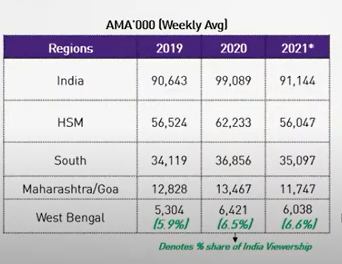
    West Bengal contributes roughly 15.3 million TV households (6.6 per cent) to the overall national TV market of 210 million TV households. This share has increased over the last three years, from 5.9 per cent in 2019 to 6.6 per cent in 2021, contrary to the viewership trends seen in Maharashtra/Goa, south, or the Hindi-speaking markets (HSM). (All India, 2+, Total TV viewership in AMA ‘000, weekly avg). Also, while the daily tune-ins fell across markets in 2021, they remained higher in West Bengal vs 2019 levels, showed BARC data.

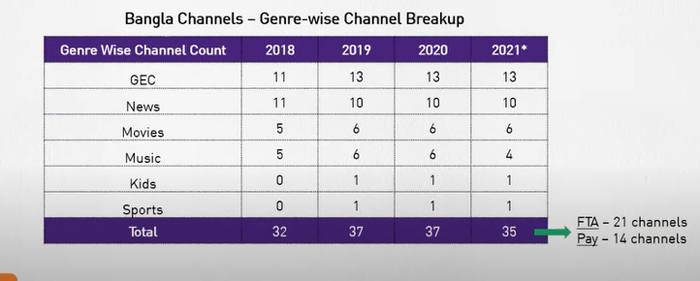
    As of 2021, the state has 35 channels on air that are part of the BARC ecosystem, out of which 21 channels are free-to-air (FTA), while 14 are on pay platforms. This includes 13 GECs, 10 news channels, six movie channels, four for music, and one each for kids and sports. The free platform contributes to 1.9 per cent of the TV viewership, while the share of the Pay platform stands at 98.1 per cent.

    However, unlike other regional markets like Maharashtra where Hindi rules TV viewership, the West Bengal TV market is dominated by its local language, Bangla which contributes 65 per cent to the overall TV viewership in the state, while Hindi’s share is 33 per cent. “In fact, Bangla is the fifth largest language in terms of TV viewership in the country, closely followed by Marathi,” said Pathak, “The average time spent on TV in West Bengal is also quite comparable to the Hindi-speaking market (HSM) average.”

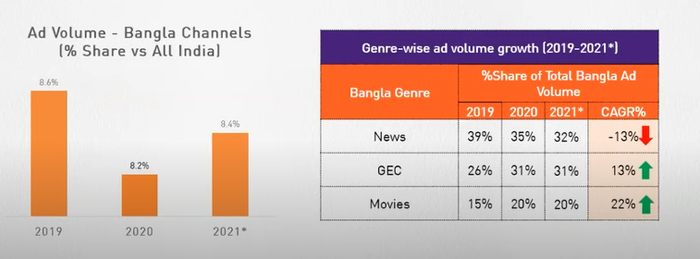
    Since 2019, the overall ad volume share for Bangla channels has not wavered much since 2019 and remained in the 8-9 per cent range compared to the all-India levels. “It’s a GEC-driven market and the ad volume shares for Bengali GEC and movies have demonstrated growth over the years of 13 per cent and 22 per cent, respectively. However, news channels have witnessed a decline in ad-volume of almost 13 per cent compared to 2019,” said Pathak.

  • BARC fires back at Republic for misrepresenting private emails

    BARC fires back at Republic for misrepresenting private emails

    KOLKATAT: The TRP rigging tale has developed a new twist with BARC India expressing disappointment over Republic Network’s action in in making public,  private and confidential communications between the agency and the newscaster and misrepresenting the same. Earlier in the day, Republic Media had  come out with a statement claiming that the TV measurement body has no complaints against it.

    “BARC India reiterates that it has not commented on the ongoing investigation and without prejudice to BARC India’s rights, it expresses its dismay at the actions of the Republic Network,” the ratings body has said in a release issued a short while ago.

    The news network had in its statement issued a few years back revealed that Republic CEO Vikas Khanchandani has in his possession an official email from BARC in which it has said “there is not a single complaint or malpractice found against Republic TV, Republic Bharat or any other affiliate of the news network.”

    Republic had crowed  that the email “crumbles the pack of lies floated and repeated over the last nine days by Param Bir Singh and a section of the media.”

    According to Republic Media, it received an email from BARC India on 17 October 2020, in which the agency stated that: “If there was any disciplinary action initiated under the said code against M/s ARG Outlier Media Private Ltd., then BARC India would have communicated the same to you along with necessary documents for your response.”

    In response to the network’s claim, BARC has not only voiced its discontent with the statement but also reiterated that it is providing necessary assistance to the law enforcement agency, namely the Mumbai Police.

  • A forgettable 10 days for the news broadcasting industry

    A forgettable 10 days for the news broadcasting industry

    KOLKATA: This past week saw news channels become the breaking news. It all started with the Mumbai police commissioner Param Bir Singh claiming to have uncovered a TRP rigging con. Matters came to a head when BARC decided to hit the pause button on weekly news channel ratings.

    Here are the important twists that shook the industry:

    The Mumbai Police on 8 October announced they have busted a TRP manipulation racket involving Republic TV and two Marathi channels. Hansa Research CEO Praveen Nijhara said the agency conducted an investigation with BARC which resulted in Hansa Research filing an FIR against an ex-employee who was engaged in some wrongdoing.

    However, the Arnab Goswami-led Republic TV denied any allegation of manipulating BARC data and accused the police of “personal vendetta." The channel stated that its name was not mentioned in the FIR for this case at all.

    At the same time, the TV viewership measurement body BARC also re-emphasised that it has always remained accurate and faithful. The News Broadcasters Association (NBA) called an emergency meeting of its board to discuss the TRP manipulation case.

    Read more news on BARC

    There was also a rumour that India Today had been named in the FIR as indulging in TRP gaming. But they issued a clarification: the channel’s name was mentioned but there was no evidence or witnesses to substantiate the allegation.

    Soon after, top executives from two major brands said that they would pull out advertisements from channels that promote toxic content. Many other brands came forward in support of the decision, reminding news channels about the need to improve content quality. The NBA also praised the move saying it would help the fight against toxic content.

    As the controversy dragged on, BARC board proposed that it’s technical committee (TechComm) would review and augment the current standards of measuring and reporting the data of niche genres, to improve their statistical robustness and to significantly hamper the  potential attempts of infiltrating the panel homes. This exercise would cover all Hindi, regional, English news and business news channels with immediate effect.

    Therefore, starting with the ‘news genre’, BARC decided to cease publishing the weekly individual ratings for all news channels during the exercise. The process is expected to take around eight-twelve weeks including validation and testing under the supervision of Tech Comm. BARC will continue to release weekly audience estimates for the genre of news by state and language.

    Following the announcement, NBA came forward in support of BARC. It is of the view that the suspension is an important step in the right direction. On the other hand, the News Broadcasters Federation (NBF), objected to the decision to pause audience estimates (ratings) of news channels.

    Meanwhile, a regulatory intervention could strike the industry soon. The parliamentary standing committee on information technology that met on Thursday to discuss ‘ethical standards in media coverage’ seemed none too happy about the TV viewership measurement system. It opined that the current metric of measuring audience estimates through TRPs is flawed, that the technology it depends on is outdated, and that the system is easily manipulated.

  • BARC is not keen to take part in industry rivalry: Sunil Lulla

    BARC is not keen to take part in industry rivalry: Sunil Lulla

    MUMBAI: Eight years ago India’s viewership monitoring agency Broadcast Audience Research Council (BARC) was born. Its conception was the result of an unhappy industry and several Telecom Regulatory Authority of India (TRAI) interventions that resulted in the  shutting down of viewership ratings as an industry currency by Tam Media Research. 

    Since its launch, BARC has done a commendable job of building the world’s largest audience measurement system in one of the most fragmented markets. Last year, the affable veteran media industry executive Sunil Lulla was brought in to lead the organisation after the departure of its CEO Partho Dasgupta.

    Lulla,a well-rounded professional, has had around three decades of work experience in advertising, music, the internet, youth and news broadcasting, production and OTT companies.  He could not have come in at a more challenging time: TRAI has been making noises about bringing in another viewership monitoring agency. Then some member or the other from time to time has been raising a stink about his channel’s viewership. Also, hardly six months of his joining, the pandemic hit, and Sunil and team BARC had to turn to working from home.

    Lulla got into a fireside chat with indiantelevision.com founder, CEO and editor-in-chief Anil Wanvari on all things related to the organisation he heads. He spoke at length about his vision for BARC 2.0, challenges faced during pandemic, controversies revolving around the company and much more insightful details. Excerpts from the interview as written by Shikha Singh.

    Watch our fireside chat with Sunil Lulla

    How are you guys working now?

    At the start of the epidemic, we were not equipped to do work from home. We got ready when we had to. We pick up people and drop them. We had to resize our company in terms of cost structure because we knew revenues were going to fall, and I was successful at doing that. I think the team has done a brilliant job of making sure BARC delivers output and stays relevant. We made sure that we ran at a commercial value that the industry warrants us to. I think it's all about how you approach things.

    We have got back to the office.  We are working with 83 employees across locations. Our productivity has gone up. People enjoy coming to the office. For a lot of people work from home is not easy in India, because of space or other constraints. Work from office is a professional space. There is enough social distancing. We have field operations in every state. In some places, they can’t travel in every city, because there may be a containment zone. But in many places they are. If I remember correctly, the stats for this week are that 97 per cent of people are on the road.

    Was there any impact on people who were having meters at their home?

    There is a people meter box in a particular home, and then there's a people meter box in a retail outlets, restaurants, bars and cafes. So the HoReCa (hotel, restaurant and café) business is shut because there is no out of home consumption of food, spirit beverages or any kind, no restaurant is open no coffee shop. We have access to those places but we are not utilising them as there is nobody there to measure television content.

    The home panel, as we closed in March, is continuing at the same pace. We have not added new homes until now, because in many places there were restrictions. But we will add new homes in the next few months as the restrictions open up. Some of the homes did move out,  some came back. We had to do routine maintenance of the box. During May and June some of the homes did not recharge their SIM cards, cable bills, DTH. But right now, relatively speaking, we are much better off and almost as good as before the lockdown happened. 

    The good part is that most of the people have watched television and TV viewing went up by 43 per cent. January 2020 is what we call the pre-Covid2019 period. We are now 15 percent higher in viewing, six per cent higher in daily reach,  nine  per cent higher in daily viewing, and 18 per cent higher in ad volumes as compared to January. July and August 2020 have done better than July and August of 2019. In September we are trending higher. All parameters of engagement are on the positive side.

    Read more news on BARC

    Was it an individual decision to invite you or was it a collective decision to have you onboard?

    A large part of my life has been representing the audiovisual industry directly or indirectly. TV networks have taken a large part of my professional existence. BARC represents the stakeholders of advertising, marketing, and audiences. It basically is a currency of  where the audience is and marketers and sellers, that is broadcasters, exchange that value. It is a big privilege for me to represent the stakeholder body. We help provide the information, for them to understand what India watches

    It was a board-based decision, the chairman of the company then and even now is Punit Goenka. Many people have known  me because I was involved in the TV and advertising business. So, they reached out to me and it was a good opportunity to build what we are building. It has lived upto the expectation and  I have set myself a calendar, and an agenda for all of us to build BARC 2.0. We are stretching and pushing harder with some constraints in this particular environment. But I think we will build a much stronger measurement system.

    What BARC 2.0 is going to look like?

    Measurement science is the heart of the company.  We have been able to build or reinforce that in terms of processes of measurement as well as in processes of validation. We have invested very heavily in terms of validation of  what we do. And there is that every day correction. It is not something that you dial up or down, but something you statistically wade in and out of. Because when we say that this is what India watches, we better be sure of that statement. Yes, it is a sample, it’s an extrapolation of that sample within a reasonable range that you can look from an estimate point of view. So there will always be those statistical errors, which are statistically validated. For us, it will be some amount of expansion that we will do in sample homes, the continuous corrections that we do, the processes we bring in, the volume of data that we generate is humungous and people tend to think of it in terms of audience measurement. But it is also picking up and hauling that data, storing it and being secure about it. It’s the ethics of the organisation that are really important – the standards that we set out over there.

    Also, if there is one big takeaway from this pandemic it is that there has been a huge adoption of digital consumption. We are working very closely with the industry to build something which can offer a ‘one video view.’ You may watch TV, you may watch the TV show on your telephone or you may watch an OTT content which is not coming on TV. We would like to bring that measure to bear and that’s what we are working towards. We will begin that process next year of being able to share that data in 2021.

    BARC’s previous attempts to monitor digital video consumption were ambitious. What you need to understand is that the currency starts with advertising. Television was estimated to be a Rs 32,000 crore industry. It is going to be a little less this year because of the pandemic. It’s going to bounce back pretty much. What is going to accelerate it is the advertising investment happening in digital.

    So you start from where the marketing money is being spent, because marketing drives consumption, consumption drives the economy.

    That’s where I see BARC’s role playing out in benchmarking, measuring, projecting or stating out on how the consumption is happening and how that economy is being driven. We already have had conversations with the stakeholders. We will now to have to build proof of concept, build pilots, though it could take a year. Everybody need not participate.  On TV all channels get watermarked, all channels want to get measured. In digital many players may or may not participate. But we will navigate this as we go along. I do believe that if we have a good successful commercial model, then there is one neutral entity called BARC that measures television and if we can bring other components that bring digital, give it time, then we should be able to deliver on both accounts. We are open to partnerships. At the end of the day, it is not about a number. Any independent streaming platform can give you a number. It's a demographic relationship that you need which comes from the audience. And that information is not easily available. That information is available at the TV end. We can link in those two and that’s a conversation for 2021. The right tool will come in place. We will all work together, learn together – both locally and globally how to build it.

    Read more news on BARC

    What about expanding the sample of TV?

    We are at 44,000 boxes today. We will get to 50,000. Expansion is a moot point given what’s happened within the industry. These things cost money. The industry pays for it. And we have to also be allowed to do the processes and measures we can do. So we have to wait for a little more unlock, a little less scare and then be able to progress this. Our repair centre has been working two shifts a day and we have started replacing repaired boxes.

    You took over BARC in end of 2019, what have you been doing since then?

    The big part of the exercise that we did was to report the data as is where is. And consistency is not a simple act. You need to sort that data and be consistent with your processes. You need to make sure you have all the safeguards in place, it’s not an easy act. The pandemic made it a lot more difficult as we were not able to move out, getting the data around, and getting the boxes going, not being able in expand in May, June and July.

    Installations were not happening as you are dealing with fear – both at the sample end and at the organisation end. We  made very big steps in data validation. The board appointed an oversight committee that validates every single thing we do. We brought back trust into the industry.

    I spent a lot of time from December to March, going from city to city and town to town talking to our stakeholders over there and explaining to them about what we were trying to do. The algorithm we were trying to do. One of the big demands which was coming in from the industry was to address the inflated viewership that sometimes comes due to the forced viewing due to landing pages. We took a long time to address that. It is a large scale technological and statistical project.

    We have got our company far more ingrained in deep processes, and the culture of measurement. For me that has been the changeover, that we have made within the company. I think the industry recognises it, the board too does, the stakeholder body too. We have continued to run our techcom measurement, oversight meetings in the same rigour that we did. The data goes out there. The same time every Thursday.

    Despite all this there was News Broadcast Association (NBA) writing to you about TV9 Networks' spiking viewership?

    The best part of doing something is to know that somebody is always  unhappy in the world. They are unhappy because everybody wants to be number one. Our job is for the marketing industry to give them credible evidence, that those people who are watching TV, we can report on that with accuracy.That’s what we do.  Which channel people choose to watch or how much time they want to spend is their choice. We have to make sure the sampling and representation of that sample is accurate. Competitive rivalry is part of the industry, we don't  partake   in that. There has been a shift in people's choices. Men have started watching a lot more television in non-prime time. Similarly kids got exposed to a lot of news. There was no original content for the first few months. A lot of habits changed over there. If you look today and compare it to a year back, there are significant changes in preference. And there are always changes, channel preferences change from year to year. There is a resettling back to where we were in January now. Some consumers may have started watching digital content. We are going to have live with these changes. 

    There have been departures in the past few months. Have we seen the last of that?

    BARC's functioning organisation is eight years old. The operations and release of data started five years back in 2015. On an average, over the last many years our average attrition of 10 per cent, and it is not a surprising number in this market. People who have worked for seven to eight years want to do other things and are justified. I am grateful for their contribution. Also I don't think you need to replace senior people with other experienced people, we have given a lot of younger people an opportunity to grow and redesign the organisation a bit so there is greater participation.We have given a lot more people a lot more say in the management of BARC. It’s not as pyramidic  as it used to be. When you start a company you start with a pyramid, then it starts expanding. We are at that part where we have started expanding. The natural evolution of BARC has been good. Apart from that the functioning of the company remains the same.

    Measurement science team has got stronger, more robust. Dr. Derrick Gray runs that.  Data and product team sit together. This was not as aligned over the last five years but because of I believe that data measurement is at the heart of the business and it will be consolidated. Technology which is a very important aspect of securing the data and churning the data as well as transporting that data has a very strong role to play in the day to day management of the company. Our commercial function is centric within our CFO. We have given other functions like HR, legal a lot of new leaders. I think the management is more robust, it is wider, it is less centric and more participative of the company.

    I would also like to have many more advertisers buying our products and services. We have a lot of broadcasters and agencies buying; we would like to have a lot more advertisers. Some have really shown confidence and faith, our large customers, and I would like to grow that pie. Because I would also like to have many more advertisers buying our products and services. We have a lot of broadcasters and agencies currently. We would like to have a lot more advertisers. Our large customers have really shown confidence and faith and I would like to grow that pie. there is a lot in the TV data that many marketers can benefit from and it's just not ratings. It’s the habit of buying; the way you plan your spots. There are some agencies who are doing a phenomenal job of planning. Advertisers have started spending a lot of money on TV and they are challenged to spend a lot of money on digital. I believe they can understand the TV data better. And as the economy starts unlocking and marketers will want to bring back their volumes, their market shares, their numbers back on the table. They will start spending more both on TV and now digital. Marketers can participate in that data pool and then use the expert partners – the agencies – to build a better proposition for their advertising.  I think there is a great opportunity in terms of the tools we are developing – both for broadcasters as well as marketers. 
  • BARC India to mitigate impact of landing page on TV viewership

    BARC India to mitigate impact of landing page on TV viewership

    MUMBAI:  As a part of its ongoing ‘data validation quality initiative’ aimed at improving measurement science and mitigating impact on viewership of extraneous factors, BARC India is introducing algorithms into its data validation method to mitigate the impact of landing page on viewership data across all genres of channels. Data release for Week 34, 2020, data starting 22 August 2020, release date 03 September 2020 will reflect the new initiative.

    “The results of hundreds of hours of research and several months of rigorous development and testing are very promising. BARC India will now be able to mitigate any landing page anomaly to better reflect viewer’s choice.” says, BARC India measurement science and business analytics chief Dr Derrick Gray. He adds, “the existing method was based on symptomatic statistics and we have improved upon it with a method that directly uses inferential statistics to deliver better results across all genres.”

    Complimenting the efforts of Dr Gray and his team, BARC India CEO Sunil Lulla says, “Considering that the data provided by BARC India builds the currency of the advertising trade, we consistently strive to ensure that our data capture, representation, and reporting be as scientific and accurate as possible. This new validation rule will further strengthen the rating currency and provide a level playing field to small and large broadcasters.”

    “The ‘Data Validation Quality Initiative’ instituted by BARC India in June 2019 under the supervision of the Oversight Committee involves ongoing industry stakeholder consultations and internal reviews to identify dynamic improvement needed to continue strengthening the robustness of its ratings”, says Oversight Committee & BARC India board member Nakul Chopra, about the ‘Data Validation Quality Initiative’.

  • News affect GEC viewership in primetime slot across all languages, reveals BARC-Nielsen report

    News affect GEC viewership in primetime slot across all languages, reveals BARC-Nielsen report

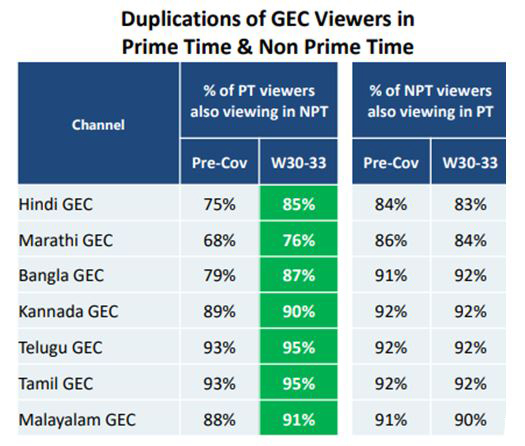
    MUMBAI: As India moves back to normalcy, the share of general entertainment channel (GEC) viewership has started showing signs of recovery. The data provided by TV audience measurement body, Broadcast Audience Research Council (BARC) reveals that in the week 30-33, the total number of Hindi GEC viewers who watches news is 49 per cent, whereas 77 per cent of them watch movies. Movies have definitely impacted GEC viewership, especially in Bangla, Marathi, Kannada and Malayalam.

    The report further says that in Week 33, total TV viewership recorded 1.08 trillion viewing minutes. The TV viewership has shown a consistent growth in the last 12 weeks. It was 22 per cent higher than pre-Covid2019 viewing. Also, the daily average reach is seven per cent higher than pre-Covid2019 time.

    The data highlights that the primetime shows have shown consistent growth in the last 12 weeks with 3 per cent rise in both Hindi and Southern markets. However, non-primetime shows continue to operate at 44 per cent higher than pre-Covid2019 levels.

    As far as the Southern GEC is concerned, the cumulative reach has not been affected during Covid2019.


  • TV ad volume grew by 21% from 2016 to 2019

    TV ad volume grew by 21% from 2016 to 2019

    MUMBAI: The year 2019 was all about NTO and its impact; the transition period and the black-out threatened to bring down TV viewership. But despite all these, TV viewing minutes in India remained stable at 48.4 trillion in 2019, and in the last four years, television viewership has grown by 38 per cent. However, in the last four years the ad volumes has also grown  by 21 per cent from 2016 to 2019 but if compared to last year (2018) 1.64 billion seconds of advertising has fallen to 1.59 billion seconds of advertising in 2019.

    The BARC Yearbook 2019 -What India Watches shows that 634 channels generated 48.4 trillion television viewing minutes and 1.59 billion seconds of advertising. The year had many peak viewing moments, while overall viewership and advertising remained largely stable.

    BARC India chief executive officer Sunil Lulla says, “Viewership has grown 38 per cent over the last four years, and a total of 48.4 trillion viewing minutes were consumed on television in 2019. Each household watches 5 hours, 11 minutes of television every day and as many as 222 million individuals tune in to primetime television at any given minute. And with over a 100 million homes in India yet to get a TV set, growth continues to be ahead of us.”

    He adds, “BARC India now samples from a panel of 185,000 individuals across 44,000 homes and before the year ends, we will be in 55,000 homes. To enable its constituents to understand viewers and their engagement better, BARC India has introduced need-based products and tools that are gaining in popularity.”

    In 2016 India recorded 35 trillion TV viewing minutes which grew to 42.3 trilliom in 2017. In 2018, it further grew to 48.1 trillion and remained stable at 48.4 trillion in 2019. In the last four years GEC witnessed 28 per cent growth in TV viewing minutes from 2016 to 2019, movies grew to 47 per cent, news to 46 per cent, kids to 56 per cent, music to 53 per cent; sports to 89 per cent and niche/others to 52 per cent.

    The major growth driver for increase in TV viewership was Lok Sabha Election Counting Day (23 May) as it registered 59 billion viewing minutes for the news genre, which contributed to 38 per cent of total TV viewership for the day. In 2019, 26,080 movies were aired on TV. The four south Indian languages (Tamil, Telugu, Kannada and Malayalam) contributed to 48 per cent of these unique movie titles.

    The advertising volumes on TV have grown 21 per cent from 2016 to 2019. Increasing share of advertising across most languages is another indicator of the growth of regional television. In 2016 TV generated 1.31 billion seconds of advertising which grew to 1.43 billion seconds in 2017 and 1.64 billion seconds in 2018 but in 2019 it has fallen to 1.59 billion seconds.

    There has been an increase in advertising volume across languages. Apart from Hindi, the share of advertising volume has grown in Bangla, Kannada, Malayalam and Punjabi market over the previous year but the share of ad volumes has shrunk in Tamil, Telugu and English markets.

  • Average time spent on HD channels grew post NTO: BARC India

    Average time spent on HD channels grew post NTO: BARC India

    MUMBAI: It’s taken a while but slowly and steadily the benefits of TRAI’s new tariff order (NTO) is starting to show. Broadcast Audience Research Council (BARC) India data shows that high definition (HD) channels have seen a positive impact and the average time spent (ATS) in the post NTO era.

    In his presentation at the Video and Broadband Summit 2019 organised by Indiantelvision.com on 11 December, BARC chief operating officer Romil Ramgharhia informed:

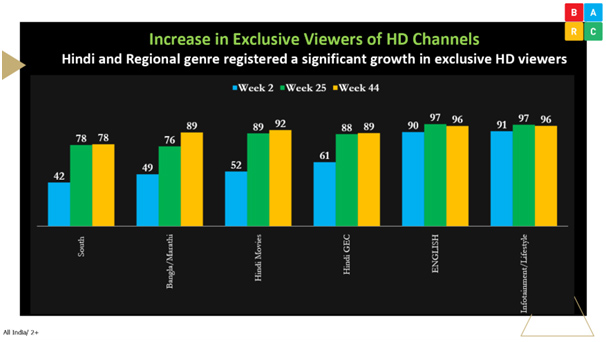
    –  Exclusive viewers for South Indian HD channels grew from 42 per cent in week 2 to 78 per cent in weeks 25 to 44

    –  Exclusive viewers for Bengali and Marathi HD channels saw an increase from 49 per cent in week 2 to 76 per cent in week 25 to 89 per cent in week 44

    –  Exclusive viewers for Hindi movies HD channels saw an increase from 52 per cent in week 2 to 89 per cent in week 25 to 92 per cent in week 44

    –  Exclusive viewers for Hindi GEC HD channels saw an increase from 61 per cent in week 2 to 88 per cent in week 25 to 89 per cent in week 44.

    Average time spent (ATS)  during the NTO dipped down to 3 hours and 39 minutes but post NTO it has risen to 3 hours and 44 minutes.

    An Indian consumer in the pre NTO era, on average, consumed around 3 hours and 40 minutes of TV, in which he used to watch 10 to 15 channels per day and 25 to 30 channels per week. However, in the post NTO era, an Indian consumer watches around 12 unique channels in a day and around 30 unique channels per week. 

    Total TV viewership over the past four years has grown by 45 per cent from 2016 to 2019. 

    Hindi GEC and Hindi movies are the two largest shareholders in terms of viewership consumption. The two had a 76.5 per cent share in 2018 but in 2019 the share has fallen to 75 per cent. “The reason for the dip is because, in the pre-NTO era, the consumer viewed around four flagship channels on Hindi GEC and the share was 23 per cent, but in the post-NTO era, the consumers made a choice of watching two out of four channels which brought the share down to 13 per cent. Similarly, for Hindi movie channels, consumers have chosen around three out of five channels from pre to post-NTO era and the share has dipped from 35 per cent to 23 per cent,” Ramgharia said.

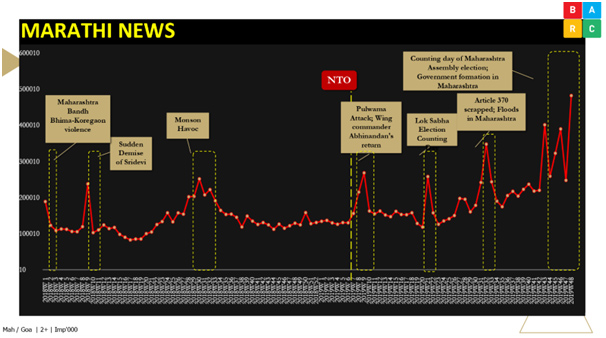
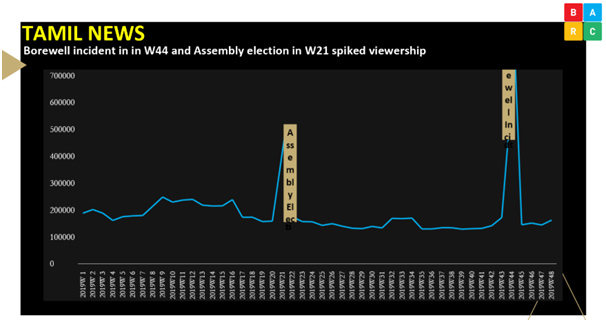
    Both news and sports have increased their share due to big events that took place in 2019. News genre's growth was driven by Pulwama & Balakot attacks, General Elections and Article 370 while sports' growth was driven by ICC World Cup 2019.

    Ramgharia also informed that among regional channels, Marathi and Tamil were popular.

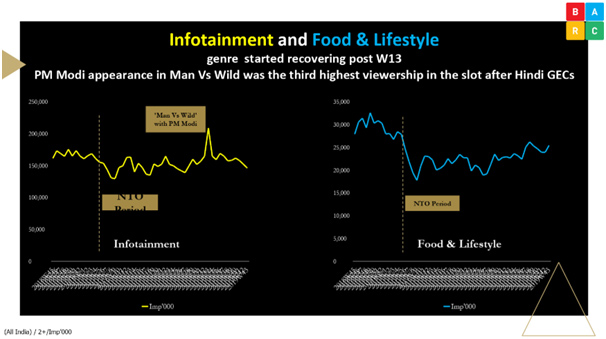
    Post NTO, infotainment is the only niche genre that saw viewership growth. The viewership increased on Discovery when Indian prime minister Narendra Modi appeared on Man vs. Wild. The channel was operating at 6.9 million impressions with 18.4 million unique viewers and 400 million viewing minutes. Even food & lifestyle during the NTO era had a negative impact, but in the post NTO era, its viewership raised up and stabilised. 

    English entertainment channels (EEC) and English movies channels (EMC) saw a negative impact during the NTO era, but in the post NTO era the viewership on EEC and EMC have increased and stabilised. Viewership on kids’ channels increased when the vacation started in the post NTO era and now is in a stabilised position. Channels for music and youth also saw an immediate increase in viewership, unlike others genres in the post NTO era because these channels are free to air and over a period of time the viewership on music and youth channels is stabilising, Ramgarhia added.

    Viewership has grown for IPL by 53 per cent from 2016 to 2019. In 2016, on Sony, it had 1.03 billion impressions, which grew up to 1.25 billion impressions in 2017 on the same channel. In 2018, when NTO was not implemented, IPL had 1.43 billion impressions on Star Sports channel which grew up to 1.58 billion impressions, on the same channel, even during and post NTO era in 2019. Kaun Banega Crorepati’s (KBC) average impressions per episode in 2018 were 5.75 million, which grew up to 6.26 million impressions per episode on an average basis. 

    Ramgarhia also mentioned that there are around 100 mn households without TVs at their homes. So, there is a long way to go for TV and it will work out in a positive manner.

  • Industry gives mixed views on BARC India’s decision to separate pay and FTA viewership

    Industry gives mixed views on BARC India’s decision to separate pay and FTA viewership

    MUMBAI: BARC India’s decision to split its reportage of pay and FTA viewership has received mixed reviews from the industry. While some believe that this will be beneficial to both broadcasters and advertisers in channelising their resources, others believe that it has no meaningful objective.

    Welcoming the move by BARC India, Times Network president – strategy Vivek Srivastava said, “It aids both broadcaster and advertisers to better channelise their resources. Advertisers need audiences who can spend and there is no point paying for audiences who are on the free platform and don't have the propensity to consume. Advertisers wanting premium audiences, typically news and English, can now better optimise the price they pay to different platforms and not waste marketing monies on non-premium audience from free platforms. Consequently, broadcasters will also stop over-relying on one platform just to get numbers and premium content will get its due.”

    From week 27 of 2019, BARC India decided to report viewership from free and pay platform separately. The new variables are offered over and above the current urban and rural cuts that are reported by BARC India. It is made available to all the subscribers for planning and analysis through its proprietary BARC Media Workstation Software and is also published on the website for select genres.

    News Nation Network president – sales & marketing Abhay Ojha is of the view that the decision could be of benefit to all stakeholders. He said, “From a broadcaster’s perspective, we can better optimise our organisational resources towards strategising GRP requirements as per the revenue strategy of the network. Alternatively, a planner in an agency can further zero in on the quality of GRP required, depending upon their brand’s core competence and DPOs will get better clarity on ROI of paid and FTA channels. Therefore, holistically it’s a welcome move.”

    On the other hand, Ojha noted that for Hindi news channels, it hardly mattered which platform was giving viewership, because national Hindi news channels are most widely distributed and are very dynamic, depending on everyday events. He further pointed out, “Most of the news channels are now being taken for frequency builders rather than reach builders, therefore the pie of revenue is mostly leftover after consumption on GEC, movies, niche, vernacular channels, etc.”

    While announcing its move, BARC India CEO Partho Dasgupta had said, “There has been a strong demand from the market for separate reporting of viewership from homes with pay and free connection. We have taken the market feedback in consideration with the changes that have come about in the ecosystem post the implementation of the TRAI tariff order. We believe this move is a step in the right direction to empower the industry in understanding the distinct consumption patterns of this segment and plan more effectively.”

    BARC believes that reporting viewership from pay and free platform separately would enable focussed targeting. Advertisers can plan more effectively by placing insertions on the channels available on their platforms in the respective regions. It will also enable the broadcasters to make more informed decisions related to content and distribution.

    A broadcaster on the condition of anonymity said, “DD Free Dish has a presence across markets both in urban and rural and across demographics. Segregation of free and pay by a single platform will suit a few networks. It has no meaningful objective that will help the advertiser or broadcaster.”

    Dentsu Network, SVP Mayank Bhatnagar said, “From a media planner’s view my audiences are watching a certain set of channels whether they are in pay or FTA platform. This will help us to look at data in a slightly different manner and we will get one more cut now because earlier there was only urban and rural now there are pay and FTA platforms also. It will impact the media planner’s life because they will continue to chase TG which is targeted. From a broadcaster’s point of view, it will give one more dimension in the data cuts to see how they are performing.”

    He further said, “Lot of advertisers are looking at FTA channels and they are performing well. So if I have to do a relative comparison only on the pay platform, it will be easier for me to check which are performing well there and I can do a related shift. But otherwise, it’s not going to make any major changes.”

    With time, the industry will be able to make better estimations as to the effectiveness of this move.

  • Sanjeev Kapoor on FoodFood’s FTA avatar, DD Free Dish & TRAI tariff order impact

    Sanjeev Kapoor on FoodFood’s FTA avatar, DD Free Dish & TRAI tariff order impact

    MUMBAI: With the new tariff order bringing in a major change to India's television distribution, several broadcasters are adopting alternative ways to stay relevant in the ecosystem. Chef Sanjeev Kapoor-promoted FoodFood channel is among those trying to negate the impact of the new regulatory framework by converting it into a free-to-air channel from its current pay model to maintain its reach. Ahead of its 11 July FTA launch, Kapoor interacted with Indiantelevision.com to outline the reasons behind the decision and offered insights into the category his channels operates in.

    What was the objective behind taking this call?

    When the tariff order was released, we were contemplating how to approach this. We realised that we should keep it the way it was and when the dust settles, we will take the call depending upon which way the viewership is moving. We studied and evaluated what the viewership patterns are, how things are moving, what is happening in the market, what is happening to specialty content, what’s the best way to approach it and we realised that for a single channel without bouquet strength the best way is to approach it differently. When there are bouquets, no matter what the order says that this can not be done, the reality is that bouquets for large players are much simpler and easier. Whether it is through Facebook, Youtube, we see that food content consumption has gone up exponentially on digital whether. The only way to bring it at par with what the consumer needs and demands is to increase the reach and that’s why we took this call.

    What were your key observations from three-four months of tariff order implementation?

    So as we know the overall viewership has dipped, that is because the reach is not there because you aren't there. Then, how does the viewer find you? Whether it is an MSO, DTH, small LCO, how do you get discovered? In a-la-carte, when you try to educate a person, it takes time and effort and when a single channel does not have the power to fight that, then it becomes very difficult. Even in my house it took my personal intervention to get Food Food, so it would be difficult for normal viewers. So to break this resistance, one must go the FTA way. We believe it will be better now because if the pressure of paying the broadcaster is not there, hopefully, it will be better. We evaluated Free Dish as well. It format have any specific advantage for a smaller channel. For devotional channels, there is a lesser fee but for specialty channels like us it is not beneficial.

    Do you see consolidation, mergers or more channels being added in the category you are operating in?

    Difficult to say. Bigger broadcasters with 40-50 channels have their own challenges. Some of them are shutting down, some of them are rationalising. In such a case, consolidation is the most obvious choice but really we have not seen that happen yet because these are early days. For people like us, fortunately, it's not something that bothers us too much because we have over 1200 hours of high quality HD content. We have the ability to syndicate, licence and monetise through multiple ways. So we are not too worried.

    Do you have to spend more on content to attract consumers as the new tariff order puts power in their hands to pick and chose?

    I would say that even if the power is given, if the consumer cannot use it how is it going to help. You can be FTA and still not be present as the must-carry rule is no longer there. How do you ensure that? Though digital has come to the rescue but at whose cost? It’s not at the cost of content creators or at the cost of distributors. There used to be a normal camera now there are more digital cameras. There could be transitions. Three years ago when I visited the US, people were talking about cutting the cords and if that is a global phenomenon that has to come. The power of content will stay. We consider that as content creators we distribute content through different platforms and whenever consumers find it convenient to access our content, they will consume it there.

    How do you plan to monetise your content across digital?

    We already do. We have a fairly large plan on digital. So, our overall community including Food Food is over 20 million that across platforms could be Facebook, Twitter, YouTube etc. We use that community to reach out to core Food lovers. We work very closely with brands. We are launching a series on biryanis. We have Dawat Biryani Rice on board as a large partner for that.

    Do you see your revenue more skewed towards digital in the near future?

    I would guess so.

    Do you tweak your programming in terms of going from pay to FTA?

    Our focus does not change. We want to stay focused on who we are. We don’t want to really change the programming too much.

    Do you see a change in nature of your core viewer given that you are a free platform now?

    It’s difficult to say. We want to stay core to our value and we will see if in each market we have enough consumers. We want to work with all the distributors in creating something unique and special for them. So, we don’t want to change the core product. We want to give a few things which no other TV channel can do.