Tag: TV shows

  • Prime time content on news channels needs to evolve

    Prime time content on news channels needs to evolve

    NEW DELHI: What would one expect when editorial heads from some of the premiere News Television channels in the country participate in a panel discussion? Riveting stuff is what comes to mind.


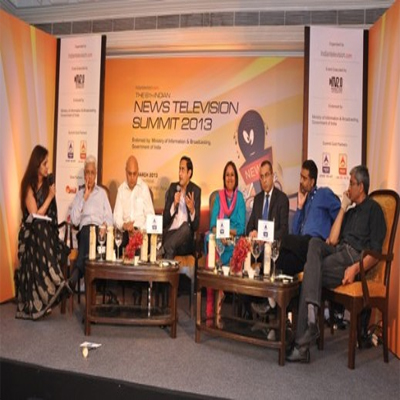
    And that’s what unfolded when Barkha Dutt, Karan Thapar, Vivek Law, Rahul Kanwal, Sanjeev Srivastava, Deepak Chaurasia, Ashutosh, all joined in to discuss the issue of, “Differentiating Prime Time News TV Shows/ Content” at the 6th Indian News Television Summit 2013.


    Session moderator BBC Global News COO India Preet Dhupar kick-started the session with a question to the panellists on prime time content and its impact on the ultimate stakeholders.
        

    CNN-IBN’s Karan Thapar said, “Content during prime time is in a confused mess. It is all about multiplicity of screeching heads. Anchors instigate people to quarrel on their shows and the ultimate product is unsatisfactory. When news is governed by ratings, it becomes an issue. What is really needed is a structure based discussion; focus on current affairs based debate and bifurcation between news and entertainment.”


    Doordarshan’s Sanjeev Srivastava while agreeing with Thapar, added that prime time content has become similar to edit pages of newspapers wherein the thoughts of the editor or the anchor are often reflected. But he also called for a ‘balance between forming opinions and proper dissemination of news.’


    Also agreeing with Thapar, Bloomberg TV India Editor Vivek Law said that the concept of talking heads of channels was not new and it was possible that organisations were revolving business model around it.


    NDTV Group Editor Barkha Dutt struck a cynical note by saying, “TV channels are stuck in a sluggish cycle. There is nothing interesting happening as channels have failed to tap appealing people who can talk sense. I don’t share too much optimism about prime time space.”


    Headlines Today Managing Editor Rahul Kanwal, had a diverse opinion. “Well, I am very proud of what I do and I must state that TV channels have played a stellar role in making politicians accountable and voicing the fact that no one is untouchable.”


    He also talked about the audiences’ demand for masala (adding juiciness) to news packaging.


    The debate between Hindi and English News channels was sparked by IBN 7 Managing Editor Ashutosh who said that English channels were elitist in their approach and embarked on intellectualism whereas Hindi channels had larger and “many layered” audiences to cater to.


    India News Editor-in-Chief Deepak Chaurasia observed, “News channels must understand that people have changed over the years. The environment and approach have also changed. One has to understand this to realise the confused state of affairs during the prime time slot.”


    Chaurasia also stressed on the fact that renowned faces were reluctant to come for interviews and discussions on Hindi channels as compared to English ones. Disagreeing with Chaurasia, Kanwal said that he had interviewed many politicians on his Hindi show.


    Other subjects that were touched upon in brief were budgetary cuts that production teams faced, the need for more reportage by anchors, whose reputations drew eyeballs to the show.


    All the panellists agreed that prime time content should focus more on news which would educate the masses.

  • Younger Americans watching streamed TV shows: Harris

    Younger Americans watching streamed TV shows: Harris

    MUMBAI: Americans‘ television viewing options continue to grow. First cable, and then satellite services, expanded the amount and variety of content Americans could expect to find in their living rooms.

    More recently, DVRs, cable- or satellite-provided on-demand programming, along with digitally streamed programming, have allowed Americans to watch what they want, when they want, wherever they like and on whichever device they choose. But how are all of these possibilities really affecting Americans‘ overall TV viewing habits? And how are they likely to change in the near future?

    A Harris poll shows that over half of Americans (53%) indicate having watched digitally streamed TV programming on any device, and streaming is well on its way to becoming a dominant means of viewership among 18-35 year olds, nearly tying top-ranked live feed TV (as it airs) as the way or among the ways they most often watch TV programming (44 per cent live feed TV, 41 per cent streaming).

    These are some of the results of a poll of 2,343 adults surveyed online from 10 – 15 October, 2012 by Harris Interactive.

    Despite US adults – particularly those 35 and under – clearly seeing streaming as a viable viewing option, our TV screens are far from endangered: when asked to select the way or ways in which they most often watch television programs, roughly nine in ten Americans (89 per cent) point to their TV sets, sans streaming.

    Though they are watching television programming on a TV screen, whether over the air or through cable or satellite providers, American are far from unanimous on how they do so: while over half (56 per cent) identify a live feed as the way, or one of the ways, they most often watch TV programs, roughly three in ten each specify watching recorded (32 per cent) or cable- or satellite-provided on-demand (29 per cent) programming.

    As for streaming, while it may not be overtaking traditional TV viewership methods today, it is by no means an afterthought: a combined three in ten Americans (30 per cent) have the ability to watch streamed programming on their TV sets (19 per cent via set top boxes or game systems, 17 per cent via Internet-compatible TV sets), and two in ten (20 per cent) list streaming – on any device – as among the ways they most often watch TV programs.

    Additionally, there is cause to expect growth in the streaming of TV content: two in ten Americans indicate that they are watching more online/streaming TV content now than a year ago (20 per cent) and that that they expect to be watching more a year from now (19 per cent). And among those not watching more when compared to a year ago, roughly six in ten (59%) indicate that there are factors which could encourage them to watch more online/streaming TV programming; top factors include improved free streaming options (31%), access to programming they currently cannot (or don‘t think they can) get via streaming (20 per cent), not having to watch on a computer screen (19 per cent), access to a sufficiently fast connection (17 per cent) and ease of access (17 per cent).

    Streaming proving a fit for households with children Americans living in households with children appear to be an especially strong market for TV streaming. Those with children in their households are more likely than those without to: own many of the streaming compatible devices asked about: Smartphone (62 per cent among those with children in their households vs. 40% among those without), TV with Internet access (either natively or via a box or game system; 38 per cent with vs. 27 per cent without), Tablet (31 per cent with versus 21 per cent without); have ever watched streamed TV programs (60 per cent with versus 49 per cent without); report watching more (24 per cent with vs. 18 per cent without) or the same amount (44 per cent with versus 36 per cent without) of online or streaming TV content than a year ago; and, anticipate watching more (27 per cent with versus 15 per cent without) online/streaming TV content a year from now.

    Vying for attention Regardless of how Americans watch TV programs, few are only watching: roughly eight in ten (81 per cent) report doing other things while watching TV. More specifically, nearly two-thirds (65 per cent) engage in online activities; over one-third (37 per cent) read a book, magazine or newspaper, with an additional 11 per cent reading a book on an electronic reading device; roughly one-third (35 per cent) text and one-fourth (25 per cent) do other things.

    So What? TV advertising has grown increasingly complex in recent years; gone are the days of simply choosing which programs to support and in which markets. Now advertisers must also consider how viewers will be watching, on what device, and – particularly for time-sensitive advertising – when.

    Harris Interactive Media Practice VP Rhona Wulf said, "This adds challenges to digital media planners and agencies needing to capture and engage audiences," explains. With the 35-and-under age group showing particularly strong streaming and multi-screening, along with those in households with children, "those looking to speak to these markets are under particular pressure to establish multi-platform approaches."

  • ‘We will keep aside Rs 10 bn for organic or inorganic growth opportunities’ : Zeel MD and CEO Punit Goenka

    ‘We will keep aside Rs 10 bn for organic or inorganic growth opportunities’ : Zeel MD and CEO Punit Goenka

    Punit Goenka is in control of the media empire that patriarch Subhash Chandra built assiduously over almost two decades. He is quick to take decisions, is unruffled by temporary ups and downs, and believes in continuity.


    The elder son of Chandra digs deep into the Zee culture, has his own ways of finding solutions and does not hesitate to bet on sports as he takes up the responsibility of shaping Zee‘s broadcasting business.


    “I have learnt a lot from my dad. He is no more hands-on. See, he has not called me for over an hour (during the interview). I have my own style,” says Goenka, a grin on his face.


    Soft-spoken and shy, Goenka is a people‘s man. He backs his senior team, even when certain decisions do not work in the short run.


    In an environment of raunchy reality TV shows, he believes in clean content and explains that Zee TV, the flagship channel, is designed for family viewing.


    Goenka crafts strategies that focus on profitability; he hardly plays to the gallery.


    Under his leadership, Zee ended its 12-year-old rivalry with Star to float a joint venture distribution company named Media Pro Enterprise India. The aim of the JV: to pave the path for consolidation and hasten the need for digitisation in the sector.


    In an interview with Indiantelevision.com‘s Sibabrata Das, Zee Entertainment Enterprises Ltd managing director and CEO Goenka talks about the lack of opportunity in the marketplace to make the right purchase, the need to bet on sports broadcasting and to stick to profitability in a high-cost environment.


    Excerpts:

    Zeel is sitting on a cash pile of Rs 14 billion (as of 30 June 2011). Are you looking at acquisition opportunities?
    There is nothing that is available today that is fitting our criteria; we see no opportunity in the marketplace for us to make the right purchase. Even in the southern states, we are taking the organic route and patiently building our businesses there.


    As a company philosophy, we have decided to keep aside a cash of Rs 10 billion at any stage for organic or inorganic growth opportunities.

    But isn‘t this the right time for consolidation in the industry?
    Every two years we think the time has arrived for the industry to consolidate. But then something happens and there are more launches. Last time, it was the private equity firms; before that, we had the international strategic investors.


    However, for the benefit of the industry, consolidation is the answer. The sector is sized at Rs 300 billion and there are 500 television channels in the country earning an average ARPU (average revenue per user) of $3. That is why we have become an unprofitable industry.

    In a drive to consolidate and digitise the industry, Star India and Zee Group recently ended their 12-year divorce to create a distribution company. Has the joint venture been able to shake up the pay-TV market?
    It has been three months since the merged entity got formally rolling (on 1 July). Although we have started billing as a joint entity, there are old individual contracts that have yet to run their full cycle. We have over 5000 contracts with cable TV networks individually. So the impact will be felt when we start inking new contracts. There will be no major revenue upside in the short run. The deal will have a deeper impact after 18 months of implementation.

    How deep in terms of percentage growth?
    Both Star India and Zeel are seeing single-digit growth in subscription revenue from cable TV networks. Our domestic subscription income from cable rose 16 per cent (Rs 3.88 billion) in FY’11, but that included sports. By pooling together the resources of both the partners, we hope to post strong growth and address various anomalies of the analogue market including piracy.


    A large part of the deal plays out in analogue cable. In case of DTH, both of us are in any case growing independently.

    Given our growth trajectory and contracts, the sports business should break-even in two years. In the worst case scenario, we should be able to turn it around by the middle of FY‘14‘

    How painful has been the integration process?
    We have had to let go 20-25 per cent of the combined workforce. Some of them, however, have been absorbed inside the network.

    Media analysts say Zeel’s share price will get a boost if the sports broadcasting business is hived off and capital raised by offloading equity. Has any investment bank got the mandate to hunt for an investor for the sports business?
    We have no capital-raising plans. Zeel will continue to fund the sports business till it turns around. We have taken a long term call and sports broadcasting is a strategic business for us.

    When do you expect the sports business to turn around?
    Given our growth trajectory and contracts, the sports business should break-even in two years. In the worst case scenario, we should be able to turn it around by the middle of FY’14.

    Zeel‘s sports losses for FY‘11 stood at Rs 2.08 billion on a revenue of Rs 4.4 billion (excluding a one-time revenue gain of Rs 700 million as one-time fee for the pre-mature termination of rights for AIFF). So what will drive this to profitability?
    Subscription revenue will drive the business to profitability while advertising will be event-led.


    Ad revenue is heavily dependent on cricket. And within that segment, it is India cricket. While advertising revenue is cyclical, subscription income is consistent throughout the year.

    Zeel has bagged the eight-year Cricket South Africa (CSA) television rights for $180 million. Considering that the earlier five-year rights went for $75 million, isn’t the new price tag on the higher side?
    The price is in our comfort zone. It is an inflationary rise and has been one of the most valuable boards for us. By having one of the strategic boards under our belt for a longer term, we are under less pressure.

    We get to learn from sources that the Zimbabwe board rights have been retained for $20 million (earlier it had gone for $6 million for four years). But Zeel will be able to give its sports business maximum firepower when it is able to retain the telecast rights for the other three boards – Sri Lanka, Pakistan and West Indies. So will you bid aggressively?
    We have not yet signed with the Zimbabwe board, so I can’t comment on that. The other three boards are up for renewal during FY’12 and FY’13. We have done our calculations and will not bid recklessly for these rights. There are boards outside these which are also coming up for grabs.

    When is the golf channel getting launched ?
    We are awaiting government approval. We are ready to launch the golf channel within 60 days of obtaining the regulatory clearances.

    Will Comcast be a partner for the channel?
    Earlier Taj Television (which Zeel later acquired) had some sort of an agreement with Comcast for the golf channel. We have decided that we will do it ourselves and completely own it.

    When are you launching a full-fledged HD channel in sports?
    We are launching Ten Sports in HD format later this month. This will be a full-fledged HD channel and will have varied content from the other channels. So we will have four sports channels (Ten Cricket, Ten Action+ and Ten Sports already exist) by this month-end. We have acquired a slew of properties across different sports such as football and tennis. This has enabled us to launch three different channels and post strong subscription growth.

    Are there other HD launches planned?
    Zee TV, Zee Cinema and Zee Studio will be launched in HD format soon.

    Zeel has posted a measly 0.5 per cent ad growth in the fiscal first-quarter. Do you see the market improving?
    On the ad front, we have had a flat first quarter and do not expect to post double-digit growth this fiscal. But we will have a high single-digit growth.


    Subscription revenues will continue to have a similar growth trajectory, both on analogue cable and DTH. Our international revenues should stay flat.

    International subscription income actually de-grew two per cent in FY’11. Do you have any plans to fix the international business?
    The problem is with UK and Europe; the wobbly economy there is affecting our subscriber numbers. We have launched a hybrid channel, Zee Café, in the UK to arrest our degrowth in that market. The content, aimed at the South Asian diaspora, includes cricket and regional fiction shows sub-titled in English.


    In the other markets like the US, We are seeing growth.

    Is your localisation strategy working?
    Zee Aflam has seen reasonable growth and has reached break-even status within three years of operations. But operating in free-to-air markets (FTA) means the channel can grow only at limited speed.


    The other experiment we have carried out is in Russia. The audiences there love Bollywood, soaps and dramas. However, it is early days yet.


    We are also planning to launch in 3-4 other markets.

    Zee TV has slipped to fourth position as Sony Entertainment Television rejuvenated on the back of its big-ticket game show Kaun Banega Crorepati (KBC). Will you change the programming strategy and bring in celebrity-backed reality shows?
    There has been a streak of bad launches but it has not convinced us enough to believe that we need to change our content strategy. We are relaunching these slots.


    A large part of a particular channel‘s growth still comes from one show. A reality show may bring in spikes but we will wait to see what happens after that concludes. We will not take to celebrity-based reality shows unless we feel that we have a concept that needs to engage them. We are happy with our homegrown formats.


    Our prime competitor is Star. And as a network, we are in close competition.

    We will be increasing original hours of content on Zee TV from 28 hours to 33 hours per week. There has been some delay in that because we have had a few bad launches and we want to first fix those slots. We have also had a slowdown in the ad market

    Will you increase the programming hours of Zee TV as you fight back to regain market share?
    We will be increasing our original hours of content from 28 to 33 hours per week. There has been some delay in that because we have had a few bad launches and we want to first fix those slots. We have also had a slowdown in the advertising market.

    Zee has kept away from purchasing big movie titles. Will that affect Zee Cinema when Viacom18 launches its movie channel?
    With movie acquisition costs touching the roof, we have reduced the number of big title purchases. But we have maintained our 30 per cent share in the genre due to the extensive reach the channel enjoys; we have also wisely worked on our library content. We control 2800 movies.


    Big titles give rating spikes but they are first run on GECs rather than on movie channels. The Hindi movie channel genre has become cluttered and unprofitable due to high acquisition costs. But we have stayed profitable.

    Star Gold has reduced ad inventory on the channel by 33 per cent and is showing six fresh movies a day. Will you follow suit?
    Such a move has to be compensated with an increase in ad rates. In the current market scenario, this may not be easy. But we are working on reducing the ad time on the channel. And don’t forget that Zee Cinema was the first channel to show five fresh movies a day.
    Sun TV is under attack from the Jayalalithaa government. With the launch of the state-owned Arasu cable, will you make aggressive investments in the Tamil Nadu market?
    With Zee Tamizh, we have a foot in that market. Arasu has got presence in some pockets of the state. It is still early days and we have to wait and see how the market gets impacted. But if we get more distribution, we will get more aggressive.

    Isn’t Zee under attack from Star in the Bengali and Marathi regional language markets?
    The growth of Star has only expanded the market. In the southern region, we have fortified our position in Telugu and Kannada. Going beyond the Marathi and Bengali and the southern belt, there is no distinct language difference and Hindi still rules. Bhojpuri, for instance, has not met with much success yet. The Punjabi market can see growth once TAM (the television ratings agency) starts reporting Punjab as an independent market. Now it is clubbed with Haryana, Chandigarh and Himachal Pradesh; there is no clear weightage in that market.


    Regional news, on the other hand, is easily doable.

    Isn’t the news genre too cluttered?
    The industry can support 6-7 national channels. With so much of fragmentation, the way forward is serious news.


    There should be more stringent norms in this genre as entertainment is also passing as news. We have positioned ourselves as a serious news channel and are seeing decent growth. Unlike other players, we also have a strong pay revenue from our news business.


    It is the regional markets that are getting cluttered. The Andhra market, for instance, has seen too many launches. Some national news broadcasters are also having issue over cost structures.

    Will you launch an English general news and business news channel or you feel the balance sheet of Zee News Ltd has to further strengthen before you go in for these high-cost launches?
    The balance sheet can support these launches. But strategically, we will focus on Hindi and regional news channels. Yes, we have two critical genres left. But we will first fill up the regional space.
    Are you looking at expanding through the franchise route?
    We will take the franchise route only if editorial content is with us. After all, that is what impacts our brand.
    When you started, you were part of the Agrani satellite project. Do you still nurture the ambition of owning a satellite?
    Agrani was a good project but the policies were not supportive. Banks also had no clue how satellite funding works. Owning a satellite doesn’t make sense now; it is more feasible to lease transponder space on a satellite.
  • Anath Mahadevan to remake TV show Ghar Jamai

    Anath Mahadevan to remake TV show Ghar Jamai

    MUMBAI: Undeterred by the failure of films like Khichdi and Mussadilal chale Office Office that were inspired by TV shows, Anant Mahadevan is set to turn the 1978 TV show Ghar Jamai into a film. The

    serial was a sitcom about a cantankerous Punjabi father-in-law at loggerheads with his Tamil live-in son-in-law (ghar jamai).

    “It‘s amazing to see the kind of impact Ghar Jamai had in those days. Yes, we are making it into a feature film. And Maddy (Madhavan) is very excited about it,” Mahadevan said.

    While the TV show had Satish Shah playing the father-in-law and Mahadevan the son-in-law, the film will have Rishi Kapoor reprise the role while Madhavan will essay the character of the son-in-law.

    While the film has been given a contemporary flavour, the story of the father-in-law and his son-in-law will be based out of Canada in the film.

  • Innovation the mantra in a time of increasing fragmentation

    Before embarking on a discussion about the marketing strategies used by Indian TV channels in 2007, it will be worthwhile to see what the picture could be in a few years.

    A recent report says that India will have 700 TV channels by the end of 2009. “Broadcasters will be forced to slash advertising rates and spend heavily on improving technology to ensure their channels are carried into homes, or face the prospect of being swallowed up by rivals,” the report adds.

    In fact, TV advertising was at its peak during the third quarter of 2007, with the food and beverages sector leading with 15 per cent share of overall TV advertising. The medium also saw a 33 per cent increase in volumes during January-September 2007, over the corresponding period the previous year.

    For sure, this predicted crossfire from newly launching TV channels has already brought about a number of changes in the marketing strategies of the channels. Generally speaking, these changes or trends may be summarized as follows:

    1. Increased fragmentation due to more channels.
    2. More money going into mobile marketing (SMS) stealing share from traditional media.
    3. Increased use of online social marketing strategies – Orkut, MySpace.

    SMS voting in TV shows is not a new phenomenon. Based on the premise that if a person can afford a mobile phone, s/he can surely be a potential voter, channels encourage viewers to remotely participate in the shows and support their favourite contestants.

    The numbers speak for themselves. 2005 was a record year when more than 350 million messages and phone calls were zapped on account of television. With the number of singing and dancing and acting competitions on TV channels increasing every month, and adding sms activity by the news channels, the number of messages sent this year is estimated to be in the region of 750 million.

    Speaking of new channels, it is in the dominant general entertainment genre, whose Hindi-language soaps and movies corner about 40 per cent of all TV ad revenues, where the most serious action is.

    One thing, therefore that is certain, is that the Indian television industry is no longer run by a few monopolies. Star India will face new launches from rival Zee Entertainment Enterprises as well as from NDTV, Viacom 18, INX Media and who knows who else.

    The Star Network has shown considerable ingenuity in their marketing initiatives. As Star Network marketing head Prem Kamath said, “In order to target a wider section of audience, we shifted focus to smaller towns and organized ground events. Since cricket has a unifying influence on the large bulk of Indian populace, we used cricket-centric programmes to attract a greater viewership and will build on our strengths next year.”

    Indeed, this year cricket has been among the more widely used means of attracting audiences for a number of channels. For example, INX News has roped in Sourav Ganguly as their brand ambassador. INX Media founder and CEO Indrani Mukerjea says, “Sourav is one of the most loved stars from India’s collective passion, cricket. We are proud that Sourav, too, has been keen to be associated with the INX Network.” INX News will be launching an English news channel NewsX in early 2008.

    In a recent interview, INX Media group director, brand and communications, Anthony Pettifer told indiantelevision.com that their marketing campaigns were chiefly aimed at “creating a buzz and a permanent platform as well as entertaining the target audience”. “Since we started from ground zero, we needed a logo and a motto to carve a niche in the mass market of Hindi GEC. Our original logo ‘9X,’ with the ‘X’ in eye-catching orange, has proved to be hugely successful, while our motto ‘9 times more entertainment’ is in complete accord with the logo. To dramatize our positioning, we made sure that our marketing initiatives incorporated two elements of Indian life – cricket and Bollywood. We strategically planned our channel’s launch with the release of Om Shanti Om and made use of cinema screens as a vehicle for communication. To be a leader from day one, we also organized innovative ground activities in retail malls across Mumbai and Delhi,” he added.

    There was of course Sony Entertainment Television (SET India), which had its spell of cricket action with its telecast of ICC Cricket World Cup in March. That India’s early exit skewered Sony’s plans was of course a beyond everyone’s control.

    Commenting on his channel’s marketing strategies, SET India executive vice-president, sales and revenue management Rohit Gupta says, “Our programming has been tailored to cater to a young target audience belonging to the 15-35 age group. This year, we have been successful in offering a unique content. Amber Dhara, for example, is a first-of-its-kind serial that tells the story of two conjoined sisters; no other TV channels have ever dared to deal with this theme. We are also committed to offering viewers a package of Hindi blockbusters on weekends.” To revive SAB TV’s flagging fortunes, the channel has introduced 10 new shows in the last two months. Moreover, the channel has organized a number of ground events to promote its hugely successful Indian Idol 2007. Asked about the channel’s innovations in the field of marketing, pat replied Gupta, “We pioneered the concept of client servicing in the TV industry.

    Zee TV is confident that newer marketing initiatives will take the channel even higher. Indeed, with ingenious marketing strategies, Zee’s newest scion Zee Next organised a number of innovative on-ground activities. “Our outdoor activities have been a great success. We plan to build on our strengths in accordance with the viewers’ response,” says Zee Next marketing head Tarun Mehra.

    However, media experts opine that newcomers like NDTV Imagine and INX Media are serious contenders as well, and needless to say, with the launch of Zee Next, Zee TV is faced with an unavoidable competition with itself.

    The road ahead may be exciting and promising for those who dare to compete in the Hindi GEC space, but it sure is going to get tougher and rougher than ever before. Marketing will be as much about innovating on the run as about using time tested strategies.

  • ‘Line between credibility and sensationalism is becoming thinner ‘ : Anurradha Prasad – B.A.G Films and Media Limited MD

    ‘Line between credibility and sensationalism is becoming thinner ‘ : Anurradha Prasad – B.A.G Films and Media Limited MD

    B.A.G Films & Media Ltd. managing director Anurradha Prasad has her plate full. Having created a long list of popular TV shows, she now has her eyes fixed on FM radio, TV channels, animation and feature films.

    The company has spun separate subsidiary outfits for each of these activities. The news channels will be housed under B.A.G Newsline Network while the non news broadcasting venture will be under B.A.G Glamour.

    FM Radio is under B.A.G Infotainment and is operating under the Radio Dhamaal brand while animation will be via a joint venture with Sieindesign Co.

    In an interview with Indiantelevision.com’s Sibabrata Das, Prasad talks of the changing face of news television with the growth of tabloidisation, the excitement of FM radio and her plans to create a vertically integrated media empire.

    Excerpts:

    Are TV content companies in India under compulsion to foray into broadcasting space as an effort to scale up their business?
    We can go on doing a service job and generate ratings for the broadcasters. But the fundamental problem is that we have no ownership of those shows. So how do we do a forward and backward integration? We were already doing a 360 degree of content; now we have decided to do a 360 degree of media. If we don’t do it now, then when will we? We have taken the organisation into a position of strength. Now is the time to take the leap.

    Is the decision to have control over your destiny a fallout of B.A.G Films losing flagship shows like Sansani as Star News decided to do it themselves?
    It had nothing to do with Star retrenching our shows. It was actually a two-way process and the pullout happened in May-June. We were actually contemplating on our future course of action nine months back and last December we took a call. Having done content, we had learnt a whole gamut of things and we decided to move from B2B to B2C. The things started unfolding when we bid for FM radio stations and created a new company structure. We did our first placement in January.

    Were you looking at a model like Balaji Telefilms where a broadcaster picks up stake in the company and you venture into TV channels space enjoying an assured content supply?
    That is a good business model as it provides a huge element of security. But we wanted to be on our own. Surely, we run a higher risk. But India today is all about challenges. If we don’t take that up right now, we will have slipped an opportunity.

    You mean to say that this is the right timing?
    Media is attracting huge interest and is going to rule the entire consumer process. The whole distribution rejig is also happening. Cas (conditional access system) is being made mandatory, direct-to-home (DTH) platforms are up. Other media vehicles like mobile TV and internet are emerging . The cost paid for distribution is going to drop.

    We have created tried and proven content. We have already set up an infrastructure and have the resource network in place. What we have to do now, and correctly, is marketing, positioning and distribution. For us, it is a very calculative challenge.

    In the broadcasting space, why did you decide to get into the news and lifestyle genre?
    For the last two years, there has been growth in these genres. And they have been eating into the audience share of the general entertainment channels (GECs).

    Are Hindi news channels growing at the cost of the GECs because of crime shows and tabloidisation of news?
    The drama in the news channels is an important driver for getting eyeballs because GECs are totally focused on women. As the GECs provided no alternative for male and young viewers, they went to news channels.

    Won’t it be tough as you are entering at a time when the news market is getting fragmented among 4-5 players?
    The competition is huge and in the process people are going to any level to grab eyeballs. They are expanding the viewership through non fiction entertainment and are getting only TRP-driven. But in the process, they have never marketed their product or channel; they have sold cheap. The truth is that you can have a large number of eyeballs, but you may not necessarily enjoy fat revenues. People who watch news channels are not necessarily what the advertisers want. The perception you have created is very important. Which is why NDTV may have less viewership than some of the competitors but enjoys more revenues than them.

    Isn’t tabloidisation the winning bet for grabbing audiences in the Hindi news space?
    The non fiction entertainment in Hindi news channels has created a new kind of TV. But there are no isms being followed and the editorial staff is getting edgy in this battle for TRPs. We started tabloidisation in India with the properties (Sansani, etc) that we created for Star News. But even in that space, nobody could question our credibility. That is getting lost, especially in the last two years. And some of the good properties which are getting created outside this, are not being marketed or sold properly.

    How could you establish credibility in this genre which thrives on sensationalism?
    When we did Sansani, it was the most credible crime show. We did research and stood by our stories. We provided all the drama but also reflected the interest of the people; several tantriks who were duping people were exposed. More than programming, it was the helpline that added to the credibility. When others took the crime genre, they never did justice to it.

    As a serious organisation which is in the business of news, you can’t be doing certain things which are not credible. That line between credibility and sensationalism is very thin. And it is becoming thinner because of the growth of this genre.

    Do you see this trend growing?
    The cost of making some of this kind of programming, particularly relating to ghosts, is cheap – and there is an audience for this. But I don’t see this going on and on. It is also a happy India that we are in now.

    We plan to make a combined investment of Rs 4 billion in our broadcasting business

    Will we see opinionated news in your network?
    We will carry the opinion of the people. We should have the guts to say whatever we want to say. Otherwise, why should we be in the news business?

    How much will you be investing in your Hindi news channel?
    We plan to make a combined investment of Rs 4 billion in our broadcasting business. We are launching four channels – two in the news space, one lifestyle and `Bliss’ which will be all about mind, body and soul. For the news venture, we are pumping in Rs 2.5 billion. While the first will be a general Hindi news channel, we are still strategising on the second one. We expect to launch the Hindi news and lifestyle channels in October-November. We are using the Insat satellite and have applied for a teleport licence.

    Are you diluting 25 per cent stake each in the two broadcast companies, B.A.G Newsline Network and B.A.G Glamour, to raise Rs 2 billion?
    I can’t comment on it.

    Are India Bulls promoter Sameer Gehlaut and Kolkata-based High Growth Distributors individually picking up 12.5 per cent in each of the two companies? Have you raised Rs 1 billion each from them?
    We are a listed company. We can’t comment at this stage.

    How different will the lifestyle channel be?
    We are trying to create a new space. It will be a celebrity-driven, aspirational channel.

    For the FM radio business, would you require to raise fresh capital in B.A.G Infotainment?
    Our fund requirement is Rs 480 million. We have offloaded 10 per cent in the subsidiary company to IDBI Bank. B.A.G Films is investing through internal accruals and we have also tied up debt. We are adequately capitalised.

    Are you in talks with foreign investors?
    We will launch our brand and grow the business. We will create value before we decide to go in for a further dilution.

    When will all the 10 stations get launched?
    We have already launched Hissar and Karnal. Patiala is coming up next, followed by Muzaffarpur, Ranchi and then Jalgaon. We should have launched all our stations by August-September.

    What is the strategy behind bidding for the stations in the northern region and the sugar belt of Maharashtra?
    We believe that the towns we have selected will push for the radio revolution that has come so late in India. And the cities we have selected in the northern region falls within one extended stretch of tourist belt. Ranchi is an upcoming capital while Jabalpur is fully Hindi. In Maharashtra, the sugar belt has money.

    Will your stations have a common distinct personality?
    The tagline is `Hila ke rak de.’ This is because the belt we have selected, particularly in the north, is high on energy. We have trained our RJs accordingly. We will be a mass-based station as we have to first get the radio culture in those places.

    What are the plans for the animation business?
    We have entered into a joint venture with Sieindesign Co, a firm which has a presence in the production, distribution and licensing of animation movies and TV series. We will see this segment growing.

    How do you see growth in the parent company which will house the TV and film production business?
    We will continue to do fiction programming for general entertainment channels as we see no friction there with our new lines of broadcasting business. The scope, in fact, will broaden as a slew of new channels are in the process of being launched.

    We have also launched an international show Yeh Vaada Raha for Ary Digital, Dubai available in Pakistan, UAE, USA and UK. This is our first step towards going international. We are also foraying into Bengali feature Films with Ami,Yaseen aur amaar Madhubala. Directed by Budhadeb Dasgupta, it is set for release in October. All these efforts should give us topline and bottomline growth.

  • Rajshri.com to offer episodes of ‘Malgudi Days’ and ‘Fauji’ for download

    Rajshri.com to offer episodes of ‘Malgudi Days’ and ‘Fauji’ for download

    MUMBAI: Rajshri.com, broadband entertainment platform for Indian video content, has announced the online premiere of classic TV shows Malgudi Days and Fauji.

    Additionally, the website will also celebrate Republic Day with an exclusive collection of Republic Day videos, wallpapers and ringtones to foster the spirit of Patriotism.

    One new episode of both Malgudi Days, which is based on R. K. Narayan’s short stories and Fauji, which marks Shahrukh Khan’s debut on screen, will be unveiled everyday on the portal. Viewers will have the option to view streaming episodes for free or also download them at USD 1.99 per episode, informs an official release.

    Besides the regular Hindi version of Fauji, an English subtitled version is also being offered. The TV show Mahabharat, premiered on Rajshri.com a month ago and a new episode continues to be unveiled everyday. In order to increase the consumer base of Mahabharat, Rajshri.com plans to offer the epic with Spanish and French subtitles.

    Rajshri Media managing director Rajjat A. Barjatya said, “We are delighted to give our viewers the opportunity to enjoy classics like Malgudi Days and Fauji online on-demand. Both are cult TV shows and given the success of Mahabharat, we believe there will be tremendous interest among consumers to watch both shows online.

  • 50 mn TV shows, two billion songs sold on iTunes

    50 mn TV shows, two billion songs sold on iTunes

    MUMBAI: Computer major Apple has announced that more than two billion songs, 50 million television episodes and over 1.3 million feature-length films have been purchased and downloaded from its online iTunes Store

     
    Apple founder and CEO Steve Jobs says, “iTunes has crossed another major milestone by selling over two billion songs—with over a billion of them sold in the last year alone—making it by far the world’s most popular music store. By selling 50 million TV shows and over 1.3 million movies to date, iTunes is already the largest online video store in the world as well.”

     
    The iTunes Store now features over four million songs, 250 feature films, 350 television shows and over 100,000 podcasts. iTunes has just added more than 100 movies from Paramount Pictures priced at $9.99. They include School of Rock, The Italian Job, Mean Girls and Zoolander.

  • Disney’s Robert Iger unveils redesigned Disney.com at Consumer Electronics Show

    MUMBAI: The Walt Disney Company president and CEO Robert Iger unveiled the newly redesigned and enhanced Disney.com web site at the 2007 Consumer Electronics Show.

    The site will be launched later this month, informs an official release.

    “We are witnessing an explosion of media and Disney is both reaping the benefits of that explosion and acting as a catalyst by taking a technology-friendly approach,” said Iger, noting that the company was the first to offer movies and TV shows for download on iTunes last year.

    Taking advantage of the growth of broadband and new web tools, Disney.com is an interactive experience that offers personalization and community-building amidst a broad array of Disney entertainment, products and services.

    Disney Xtreme Digital (Disney XD), the broadband centerpiece of the new site, will allow guests to personalize their favorite Disney content as well as watch and share with others videos, including television shows and shorts; chat with friends, listen to music; create playlists; and enjoy an array of games.

    Disney.com guests will also be able to access premium content through Disney XD, such as the upcoming Pirates of the Caribbean Online multiplayer game, which is set to launch in 2007, adds the release.

    “Disney.com is the digital doorway into Disney and both a destination and a portal into a vibrant, rich online entertainment experience for children, parents and people genuinely interested in Disney,” Iger said.


  • Warner, LG look to resolve confusion in HD DVD arena with hybrid offerings

    Warner, LG look to resolve confusion in HD DVD arena with hybrid offerings

    MUMBAI: Right now high definition (HD) DVDs have not taken off in the US due to the prevailing system of two incompatible formats.

    One is blu ray which has the backing of Sony and the other is HD DVD which has the backing of Toshiba. Now however there could be some light at the end of the tunnel.

    Warner Bros. media reports state will introduce a high-definition DVD that can hold films and TV shows in rival and incompatible formats. Warner said that it developed the Total HD Disc.

    Warner Bros. will place both formats of movies on a single disc. This though shows that there is no resolution on a single format.

    Meanwhile LG Electronics is planning to market a dual-format DVD player. Other electronics makers are expected to do the same.

    Warner Bros. has also patented a disc that can hold three versions of a film — one in each of the rival high-def formats and a third that can be viewed on standard-definition players. This eliminates the need for the consumer to upgrade his DVD if he/she does not want HD in the first place. Reports add that from a technological standpoint this could be as groundbeaking as when LP records were introduced in the late 1940’s.