Tag: TV ratings

  • Star Maa topples Sun TV in week 36: BARC

    Star Maa topples Sun TV in week 36: BARC

    Mumbai: Star Maa, the Telugu GEC from Star Network has toppled Tamil GEC Sun TV to emerge as the top channel in the Broadcast Audience Research Council (BARC) India list for week 36 (4-10 September).

    The channel recorded weekly AMAs of 2838.83 as against 2494.98 AMAs in week 35 when it was at the third spot. Hindi GEC Star Plus found itself at the second position with 2817.67 (‘000s) AMA, followed by Sun TV which finished third with 2789.9 AMA.

    The last few weeks have witnessed a tough competition between Sun TV and Star Plus, slugging it out for the top spot in the BARC list of most-viewed channels. Colors, Star Vijay, Star Utsav, Sony SAB, Zee Telugu, Sony Pal, and Zee Kannada grabbed the remaining positions.

    However, in the megacities, Sun TV was able to retain its top position with 510.04 AMA. Star Plus, Colors, Star Vijay, and Sony SAB followed in that order.

    The South market maintained last week’s status with Sun TV leading at 2784.92 AMA. It was followed by Star Maa, Star Vijay, Zee Telugu, and Zee Kannada.

    In Maharashtra/Goa, audiences showed a clear preference for Star Pravah as the channel registered weekly AMAs of 1434.7 (‘000s). With 1068.12 AMA, Star Jalsha led the Bengal market. Tarang, at 417.1 AMA was the most viewed channel in Odisha, Zee Kannada (1470.42) in Karnataka, Star Utsav (256.75) in Rajasthan, and Zee Anmol (361.09) in UP/Uttarakhand.

  • Sun TV tops the charts in week 35: BARC

    Sun TV tops the charts in week 35: BARC

    Mumbai: Tamil GEC Sun TV continues to dominat the list of top ten most viewed channels in week 35 with 2785.23 AMA, according to the Broadcast Audience Research Council (BARC) India. Gaining hold on the second and third positions were Star Plus and Star Maa (Telugu) with weekly AMAs of 2708.94 and 2494.98 respectively, between 28 August and 3 September.

    Sony SAB, Colors, Star Vijay (Tamil), Star Utsav, Zee Telugu, Zee TV, and Zee Kannada followed in that order.

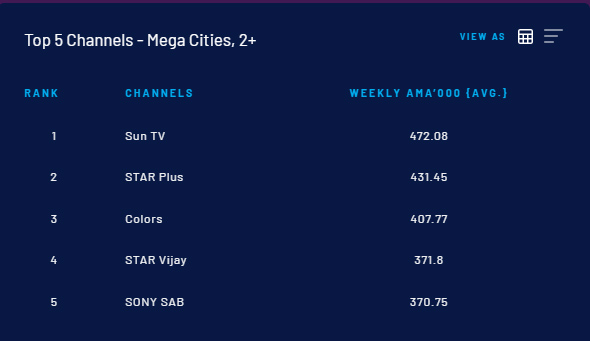
    In the mega cities, Sun TV dominated the charts again, recording a weekly AMA of 472.08 (000s). Star Plus, Colors, Star Vijay, and Sony SAB grabbed the remaining four spots.

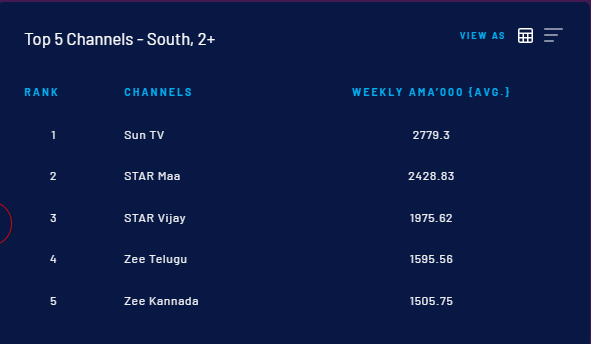
    The South market too was led by Sun TV at 2779.3 AMA. It was followed by Star Maa, Star Vijay, Zee Telugu, and Zee Kannada.

    Star Pravah led the Maharashtra/Goa market with 1457.01AMA. At 1156.05, Star Jalsha was the most viewed channel in West Bengal, Tarang in Odisha (452.8), Zee Kannada in Karnataka (1495.16), Star Utsav in Rajasthan (231.84), and Zee Anmol (330.45) in Uttar Pradesh/Uttarakhand.

  • BARC Week 33 : Regional GECs Sun TV and Star Maa topple Star Plus

    BARC Week 33 : Regional GECs Sun TV and Star Maa topple Star Plus

    Mumbai: Regional GECs Sun TV (Tamil) and Star Maa (Telugu) have toppled long-time leader Star Plus to lead the tally for Barc Week 33 (14 August to 20 August) at the first and second positions. While Sun TV bagged 2651.23 AMA (2710.62 in Week 32), Star Maa’s weekly AMA stood at 2625.34 (2701.4 in Week 32) according to Broadcast Audience Research Council (Barc).

    With 2595.11 (000s) AMA, Star Plus was at the third spot. It was the most viewed channel registering 2747.77 (000s) AMA last week. Clearly, the overall average minute audience saw a sharp dip in week 33.

    Colors, Star Utsav, Sony SAB, Star Vijay, ZEE Kannada, and ZEE Telugu followed in that order. Colors Rishtey replaced ZEE Anmol at the tenth position.

    Colors dominated the Mega Cities with 442.37 (000s) AMA. Sun TV, Star Plus, Sony SAB and Star Vijay grabbed the remaining four spots.

    Sun TV (2644.04 AMA), Star Maa, and Star Vijay were the top three players in the South market, followed by ZEE Kannada and ZEE Telugu.

    Star Pravah led the Maharashtra/Goa market with 1478.59 AMA. At 1068.4, Star Jalsha was the most viewed channel in West Bengal, Tarang in Odisha (422.6), ZEE Kannada in Karnataka (1595.46), Star Utsav in Rajasthan (255.75) and ZEE Anmol (348.98) in UP/Uttarakhand.

  • Star Plus continues to lead the tally in BARC Week 32

    Star Plus continues to lead the tally in BARC Week 32

    Mumbai: As per BARC TV viewership data for Week 32 (7 August to 13 August 2021), Star Plus was the most viewed channel registering an average minute audience of 2747.77 (000s) AMA. The Hindi GEC was at the top position last week as well with 2899.7 (000s) AMA.

    Regional GECs Sun TV and Star Maa continued to battle it out for the next two spots for the third consecutive week. With 2710.62 AMA the Tamil major Sun TV bagged the second position (2690.63 AMA in Week 31). Star Maa (Telugu) finished third at 2701.4 AMA (2719.88 AMA in Week 31).

    Maintaining last week’s status quo at the fourth to eighth positions were Colors, Star Utsav, Sony SAB, Star Vijay, and Zee Telugu. FTA Hindi movie channel Dhinchaak was displaced from the ninth spot by ZEE Kannada this week. Zee Anmol retained the tenth position with 1565.1 (000s) AMA.

    In the Mega Cities Star Plus was toppled from the first spot by Sun TV (452.33 AMA). Colors stood second with 435.74 AMA. Sony SAB and Star Vijay bagged the fourth and fifth place.

    The South market was dominated by Sun TV (2703.77 AMA), Star Maa, Star Vijay, Zee Telugu and Zee Kannada in that order.

    Among the regional markets, Maharashtra/Goa was led by Star Pravah at1359.68 AMA, West Bengal by ZEE Bangla (1029.19 AMA), Odisha by Tarang (429.26 AMA), Karnataka by ZEE Kannada (1593.04 AMA), Rajasthan by Star Utsav (257.52 AMA) and UP/Uttarakhand by Zee Anmol (368.38 AMA).

  • STAR Plus retains top position in BARC Week 31

    STAR Plus retains top position in BARC Week 31

    Mumbai: Retaining its hold on the top position in BARC’s week 31 (31 July – 6 August) viewership ratings, STAR Plus recorded an average minute audience (AMA) of 2899.7. The channel has registered 2940.4 (000s) AMA in week 30.

    STAR Maa and Sun TV exchanged places with the former bagging the second spot this time with 2719.88 AMA (2650.87 in week 30). Sun TV finished third at 2690.63 AMA (2693.6 in week 30).

    The top three channels were followed by COLORS, STAR Utsav, Sony SAB, STAR Vijay, ZEE Telugu, Dhinchaak, and ZEE Anmol in that order. Dhinchaak moved one place up from the tenth position last week, while ZEE Anmol made an entry at the last spot, knocking off Sony Pal which was at the ninth position in week 30.

    In the mega cities, STAR Plus topped the chart with 481.52 (000s) AMA, followed by COLORS, Sun TV, Sony SAB, and STAR Vijay.

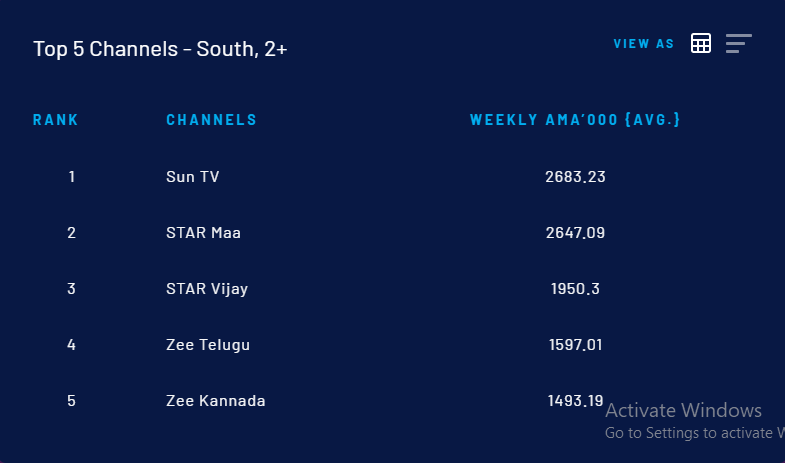
    The South market was dominated by Tamil GEC, Sun TV (2683.23 AMA). STAR Maa (Telugu), STAR Vijay (Tamil), ZEE Telugu, and ZEE Kannada followed.   

    In the regional markets, Maharashtra/Goa showed a clear preference for STAR Pravah which clocked 1460.2 (000s) AMA. STAR Jalsha was the most viewed channel (1032.4) in West Bengal, Tarang (421.88) in Odisha, ZEE Kannada (1479.08) in Karnataka, STAR Utsav (246.6) in Rajasthan, and ZEE Anmol (402.48) in UP/Uttarakhand.

  • MIB constitutes committee to review guidelines on TV rating agencies

    MIB constitutes committee to review guidelines on TV rating agencies

    KOLKATA: Amid the concerns raised over TV ratings system in India, the ministry of information and broadcasting (MIB) has constituted a committee to review guidelines on TV rating agencies. The ministry has published the notification on 4 November.

    In the notification, the ministry has stated that it has taken the decision after detailed deliberations by a parliamentary committee, committee on TRP constituted by MIB and recommendations of the Telecom Regulatory Authority of India (TRAI).

    “Based on the operation of the guidelines for a few years, there is a need to have a fresh look on the guidelines particularly keeping in view the recent recommendations of TRAI, technological advancements/ interventions to address the system and further strengthening of the procedures for a credible and transparent rating system, a Committee is hereby constituted to study different aspects of the TV rating system in India as they have evolved over a period of time,” MIB stated.

    As per MIB order, the committee will be responsible for carrying out an appraisal of the existing system, examine TRAI recommendations, overall industry scenario along with addressing the needs of stakeholders. The committee will be chaired by Prasar Bharati CEO Shashi Shekhar Vempati.

  • Arnab Goswami decries efforts to stop BARC ratings, seeks MIB help

    Arnab Goswami decries efforts to stop BARC ratings, seeks MIB help

    MUMBAI: News Broadcasting Federation (NBF) has sought the urgent intervention of union information and broadcasting minister Prakash Javadekar to prevent vested interests from stopping the publication of TV ratings.

    NBF president Arnab Goswami has said in a letter addressed to the minister that there have been attempts made by some vested interests to put pressure via the ministry to stop the publication of ratings measured by BARC at a time when news channels work round the clock in this national effort against COVID-19.

    Arnab wrote in the letter: “I am informed that some of these vested interests, who are trying to stop ratings in this period, are doing so to protect their commercial interests, and falsely claiming to represent the news broadcasting industry of India.”

    He requested the minister not to allow any such decision or any such communication from MIB or anyone associated with the ministry to BARC. According to him, such a move by vested interests is worrying news broadcasters and taking their attention away from the collective goal of defeating COVID-19, ensuring the lockdown is successful and the country comes through this together.

    He warned the minister that if such a move is implemented, it will destroy the news broadcasting industry in India, which is doing an incredible job at this crucial juncture.

    “You are aware that the efforts of the news channels have been appreciated by one and all, including the prime minister in his recent video conference with owners and editors of some news channels. In order to continue the effort, which in this period involves creation of informative and relevant news content while covering the entire country at a time when communication and transport is not easy, our hundreds of thousands of professionals are working round the clock, and taking this battle on the frontlines to ensure that COVID 19 is defeated,” Arnab wrote to the minister.

    If news channels also face a situation when ratings are stopped, we will be destroyed and our organisations will be at peril, said the NBF president. He reminded the minister that while individual channels or bodies may claim to speak for the news broadcasters, they are only defending their short-term interests.

    He also reminded the minister that news broadcasters are completely dependent on publication of TV ratings to run their business. “We are doing committed public service broadcasting in this period of national emergency,” he stated.

    The latter has been copied to the relevant authorities at BARC for their information as well.

  • TRAI directs BARC to publish TV viewership data on website immediately

    TRAI directs BARC to publish TV viewership data on website immediately

    MUMBAI:  Industry watchdog and regulator, the Telecom Regulatory Authority of India (TRAI), is cracking the whip on TV ratings monitoring body – Broadcast Audience Research Council (BARC). In a sternly worded letter, TRAI has asked BARC to publish ratings and TV viewership data for the week ending 8 February with immediate effect. TRAI’s directive has come in the wake of the latter's decision to release the weekly data only to its subscribers as opposed to publishing it on the website.

    BARC had cited implementation of the new tariff order as the reason for it not sticking to the norm.

    According to a report by news agency Press Trust of India, the sector regulator has asked BARC to furnish compliance by 25 February 2019, "failing which, appropriate action would be initiated" under relevant sections of the TRAI Act.

    "BARC India has modified its Fair and Permissible Usage Policy in February 14, 2019, even after being repeatedly asked by the authority to not stop publishing of rating data and viewership data on its website during the migration to new regulatory framework until and unless explicitly permitted by the authority and are thus, in contravention of the direction of the authority dated December 21, 2018 and January 14, 2019," the TRAI directive read.

    According to TRAI, BARC has ignored its previous directives of publishing ratings and viewership data for television channels. The regulator said that the audience measurement company had argued that disruption due to migration to a new regulatory framework could prevent consumers from gaining access to channels of their choice, thereby running the risk of an inaccurate portrayal of TV consumption trends in the country.

    Industry sources have told Indiantelevision.com that it was, in fact, the broadcasters who were not keen on the weekly data being published on the BARC website. With fluctuations expected during the tariff order implementation, broadcasters were skeptical about how the weekly data would impact their channels and popular shows especially from a public perception point of view.

    TRAI, however, is opposed to the idea of not publishing the data, which, it feels, is a true reflection of the market changes. BARC’s decision to "withhold" the data is not justified, the regulator pointed out.

    TRAI also highlighted that BARC "failed to furnish any cogent reason for not publishing the rating and viewership data" and that "such action on part of BARC India reflects poorly on the creditworthiness of the data published by them."

    "Now…the authority…hereby directs Broadcast Audience Research Council to immediately release and publish viewership data for the week ending February 8, 2019 and weeks subsequent to it, on its website without any further delay and not to stop it in future also without explicit instruction/direction from the authority or Ministry of Information and Broadcasting…," said the TRAI directive.

    BARC was setup  as an industry-funded body following the drawing up of guidelines for TV monitoring agencies by TRAI and the I&B ministry and is requires registration with the latter.

    Recently, TRAI extended the deadline for consumers to select television channels under its new tariff regime till 31 March. Subscribers that don’t opt for new channels would be moved to ‘Best Fit Plans’, which would be developed as per usage pattern, language and channel popularity, the sector regulator said in its statement.

    Earlier, the Indian Society of Advertisers' (ISA) executive council had advised its members to not use the BARC data for media buying, planning and evaluation perspective during the transition period, which it feels will stretch up to six weeks.

  • Industry needs to understand on-ground changes in distribution, not question flux in data, says Partho Dasgupta

    ‘Works at something sometimes somewhere’. That’s the description of the work profile on the Facebook page of Partho Dasgupta, chief executive of Broadcast Audience Research Council of India or BARC India. And, that probably also gives a hint to all about the personality of the man, who sits on a hot seat balancing the delicate (and, may be, at times challenging, some would say) interests of various stakeholders of the organization, including the government.

    When Dasgupta is not busy absorbing the data collated and crunched by his team at BARC India, he is, probably, strategizing along with his core team about the initiatives to be rolled out in a complex and diversified market like India or reading about branding and getting an insight into Indian media through books like ‘Behind a Billion Screens: What Television Tells Us About Modern India’.

    And, when he does get some family time, he would love nothing better than to travel along with his family and follow the F1 races around the world (speed helps me breathe, he says on his FB page) with a single malt whiskey – the older it is the better, his friends chuckle.

    A media industry veteran,  Dasgupta’s stints at various organizations also do give a glimpse at his various areas of interests, which include organizations like the Times of India Group, Future Group, BARC India and also an entrepreneurial jab at a start-up that he mentored. Though he’s a hard taskmaster, as claimed by some of his past and present colleagues, he is also looked up to as a ‘yaroon ka yaar’ or a true friend who’s always around when you need him most.

    On the occasion of BARC India’s second anniversary, Indiantelevision.com engages Dasgupta on a wide range of subjects in an interview. Excerpts:

    How would you describe the journey till now — challenging or a process of evolution?

    Any change is challenging and it’s true for us as well. From the time BARC India started reporting TV viewership, it has been a process of evolution for the industry, including us. The industry evolved when they understood fidelity of BARC India data, which was a true representative of actual viewership behavior. With support of industry, we have grown in both size and experience over the last two years. We have hired the right talent who have successfully reduced client queries and helped in a smooth transition for adopting the data.

    Apart from addressing data needs of our clients, we also made an effort to reach out to the public at large, and sensitize them about BARC India data. We have made headline viewership data available to all through our mobile app and social media platforms. While we have achieved some of the things we had set out for, there is still a lot we aspire to do.

    Going forward, how do you see BARC making progress? What are the timelines and signposts?

    This year we will see our panel expanding from 20,000 to 30,000 reporting homes. Combined with the newly added homes, we will also be seeding some new homes as part of our regular churn policy. We will also stop reporting on all analogue homes across the country with the exception of Tamil Nadu state from 1 July 2017. With the current digitization mandate for TN, hopefully the state’s analogue reporting will also stop soon.  All this may lead to some interim flux, but in the long term will improve robustness of our viewership data. We are also trying to innovate panel expansion by tying up directly with key DTH and digital cable operators to enable return path data (RPD).       

    This year is also crucial for us as we will launch something that hasn’t been attempted in the country as yet — a third party digital viewership measurement. We have set the ball rolling by announcing the umbrella brand EKAM under which our digital products will be offered. We are hoping to roll out the first EKAM product this year.

    Apart from ensuring a stable weekly data service, we have launched THiNK (a monthly insights newsletter), Alpha Club (a report on viewership trends of NCCS A1, A2, A3 of 6 mega cities), and kids genre special report for the benefit of our subscribers. Earlier this year, we successfully rolled out our new universe estimate. We have also set up an independent disciplinary committee to check attempts at panel infiltration. Very soon industry will also be able to access designated independent consultancy firms who would provide strategic consultancy services.

    Unlike some other global audience measurement currencies, BARC India’s impressions method seems a tad complex. How is it explained to clients, data users and the regulator and the government?

    The terminology and methodology for data outputs is in keeping with global standards. BARC India Media Workstation (BMW) software used by subscribers for viewership data is easy to operate and is being used across 27+ countries. We also engage with our clients to understand their needs and that helps us align our services accordingly. We have a strong training team, which trains and provides support to every subscriber, new and existing.

    In fact, last year we launched a BMW certification programme for our subscribers  to enable them to test their knowledge of the software. The results have been very encouraging. We also meet the regulator and government from time to time to update them about the developments.

    While it is endorsed by the industry, BARC India still faces some criticism from certain quarters and smaller TV players about security and its biases towards the biggies who are funding it. Your reactions.

    While we are a joint industry company (JIC), we have never functioned like a monopoly and so we always welcome feedback from subscribers. As far as funding goes, we got the funding without any substantial equity investment from any shareholder. Our operations are built upon a unique debt funded model. So, it would be incorrect to say that “biggies” funded BARC India. We have a common pricing philosophy for all broadcasters, irrespective of whether it is a small or big broadcaster. For transparency, we have also placed it (the subscription methodology) on our website.

    Talking of security, BARC India didn’t hold back any punches while taking action against those involved in panel infiltration and it included some of the big names as well. Yes, there are some issues which our subscribers face. But that is more to do with understanding the data. Our team is working day in and day out to help them. This is normal for any new system and for all measurement companies around the world.    

    Did BARC India and its top management foresee some of the problems and controversies that have beset the organization in recent times? Like the court cases arising out of chastising some users of paid/subscribedBARC data for alleged attempts at data manipulation?

    If acting against defaulters who try to infiltrate our panel homes leads to controversy, we would happily get into it. That’s because we are answerable to our subscribers and it is our responsibility to ensure that the data we release holds value. Panel infiltration is a legacy issue, but BARC India has decided to take it head on. With advertising expenditure on TV in an upward trend, it is very important for us to ensure infiltration activities are rooted out.

    While the defaulters have been crying foul, we have received tremendous support from the industry. Our intent is to always produce a currency which is fair, transparent and representative.

    Was the formation of the disciplinary council, which seems a revamp of the ethics committee, a result of such cases mentioned above?

    The independent six-member disciplinary council, under the leadership of Justice Mukul Mudgal, will further strengthen transparency and credibility of our measurement system. As it is an independent body, cases of infiltration or any such issue can be heard by the committee. This will ensure that both the subscribers and BARCIndia get a fair hearing in matters like these.

    We have our on-ground vigilance team, which keeps a track of any malpractice. The disciplinary council will independently examine vigilance team reports and where culpability is clearly established, it will be empowered to order punitive action appropriate to the level of an offence. This has again been done in keeping with our philosophy of transparency.

    Rolling out digital measurement was announced by you in a Hong Kong conference almost two years back. What has held back the rollout so far?

    Third party digital viewership measurement has never been attempted in India. In fact, some of the products we are launching are a global first. Also, we are a JIC, which takes a 360 degree feedback from all its stakeholders. We had to first understand the industry needs and then design services accordingly. That apart, consumption pattern in India is very different from what exists globally. This only makes the task more challenging. We wanted to come out with a product that is robust and meets everyone’s needs.

    It is important to understand that nowhere in the world have these kind of services been launched in less than at least four to five years. They are still evolving. In fact, we are being extremely ambitious when we say 18-24 months roll out of all products, which will start in a phased manner from 2017 onwards.

    Did the digital measurement rollout get entangled in lack of consensus amongst various stakeholders and plain industry politics?

    Frankly, I do not feel that there has been any unjustifiable delay. We have a digital technical committee, just like for TV. We went to several countries to understand digital measurement in those markets. Also, we had to set up a new digital team from scratch. We have invested a lot of time in understanding the needs of the industry and setting up a team which could give us the best product. We always wanted to come up with a product, which is as strong as our TV measurement. As regards consensus, I guess we are the only JIC in a major country, which has digital publishers, platforms and broadcasters on the same table, taking consensus decisions.

    What lessons have you and the organization learnt in these two years of operation in a complex, but diversified and a big market like India?

    Learning has been a continuous process and we still learn every single day from the market. What we have understood is that nothing here is permanent. Someone might be happy with the data released this week and the same person might be upset the next week as he might feel the data isn’t in his favour. I, frankly, don’t blame them. Our subscribers have been used to seeing data with hardly any variation, for years. Now, when we capture data from more number of panel homes, use better and advanced technology to monitor and measure data, the data is bound to faithfully fluctuate, which arises out of normal human behavior. This does not mean our data is not accurate, but it shows that we are capturing what India is watching.

    To give an example, in months when Indian kids are busy preparing for exams or are giving exams, kids’ genre (ratings) is bound to fall. This picks up again from March onwards when the vacation season kicks in. Our data captures such nuances and changes. Not just this, take, for instance, total TV viewership in the country. Instances of heat waves and power cuts across the country from March onwards leads to a drop in TV viewership — when compared to the October-December period. This has been a trend for long and this education is an ongoing task for us.  

    Personally you have held a view that TV is far from dead despite digital’s impressive march. What gives you so much of conviction?

    Look at advertising expenditures. Yes, digital is growing, but TV remains the most important medium for advertisers to get eyeballs. Talking of statistics, while more people are moving to digital, TV with 64 per cent penetration contributes to almost 45 per cent of ad revenue. Not just this, print, even today, contributes to 30 per cent of ad revenue and this happens only in India. With penetration of TV increasing in the next few years, its contribution to ad revenue will only go up and so, while digital is a significant contributor, it is still a small base and thus would take a while for any such tectonic shift to happen in India.

    India is an under-marketed country with the ad:GDP ratio of 0.38 per cent, while the global averages are 0.7 per cent. Countries like China and Brazil have 0.46 per cent and 1.02 per cent, respectively. Good measurement being one of the drivers, I feel advertising spends will increase in India substantially and all mediums will grow, led by TV and digital.

    How much of growth in TV viewership do you foresee in the short to medium term of one to three years? What will fuel this growth — rise of multi-TV homes in rural areas or simple one-TV homes coming under the measurement radar and, thus, increasing the total number of TV HHs in India?

    As of 2016, India boasts of 183 million TV households, a 19 per cent growth from 2015. Sixteen years ago, one-third of Indian households had TV, but today close to two-thirds of households own TV. These figures will only go up in the coming years, led by rural. Of the 183 million TV households, rural contributes to 99 million homes, but its TV penetration remains at 52 per cent. This leaves huge headroom for growth.

    Multi-TV homes in the country today stands at 3.4 per cent of total TV homes. Increase in TV homes will also be driven by this.

    Our Broadcast India 2016 survey shows a drop of 19 per cent in NCCS D/E. This means that people are moving up the affluence chain. The relative share of NCCS `A’ homes has also come down due to the rise of nuclear families. This has led to growth in NCCS `B’ and `C’ homes, and, thus, increase in TV homes. Such phenomena of nuclear families will increase in the future, leading to further growth in NCCS `B’ and `C’ as well as TV homes. Hence, overall, we still feel there is big headroom for TV growth still.

    BARC India was supposed to have been in talks with DTH operators for return path data (RPD) to boost data generation. What’s the status of that proposal?

    Yes, we are in talks with a number of DTH and MSOs. We should be making some announcement on this front soon. These are complex solutions and some of them will be world firsts.

    What are some other initiatives being planned by BARC in the short term to bring more robustness in its data generation?

    Expansion of panel size will help build higher degree of accuracy in our data. The RPD initiative is also aimed at the same objective. Annual universe updates will allow us to map changes on the ground, and that will reflect in accuracy of the data as well.

    Will the technology and the methodology used be future proof?

    Yes. In fact, the reason we chose to use unique audio watermarking technology in the first place was to ensure that it is future-ready. BARC India system captures data about TV content consumed through any form of distribution — terrestrial, DTH, analogue cable, digital cable and digital.

    Would BARC look at STB-embedded software rather than a separate meter to counter attempts at hacking and manipulations? Sign-ins could be like in Netflix where profiles sign in and tracking/recommendations happen based on profile of user.

    Our tie-ups with DTH operators and MSOs for RPD are an attempt to do this. This will not only increase the number of sample panel homes, but will also make infiltration efforts ineffective. We will innovate more with our meter technology to make it as much hack-proof as possible.

    With the movement towards handset consumption of video growing, what tech is BARC looking at monitoring such trends? When would the rollout happen and who’d fund it?

    EKAM Pulse, the first digital product will be rolled out by this year. EKAM Pulse will allow granular level ad campaign measurement. It will measure reach of ad campaigns at multiple levels of an ad campaign. Some of the metrics it will provide are unique reach, frequency, on-target percentage and demography by geography. The other digital products will be rolled out in a phased manner in the next 18-24 months. All these products will be funded byBARC India.

    Do you see BARC working with clients just as the former TAM is with Tata Sky to offer them viewing solutions?

    Yes.

    With AI coming in, how do you see that being put to viewership enhancement/tracking/recommendation and how do you see BARC reacting/using it, if at all?

    We have already deployed AI at two levels. One at the panel level, which is then extrapolated to know TV viewing habits of TV universe and the other that helps us track any aberration in the viewing pattern of our panel. We use technology in a big way and are looking to move all our applications to the big data environment and accessible through cloud to make us future ready.

    Is BARC contemplating measurement of radio listenership?

    Not as of now. The radio industry should be able to support the cost of measurement to make it viable for any player.

    What would be your message to the industry, players, the regulator and the government on the occasion of BARC India’s second anniversary?

    The industry has been very supportive in the last two years and we hope that it would continue to offer its support. In fact, I would like to take this opportunity to thank all our stakeholders and subscribers.

    One point that I would like to raise is that factors like analogue switch offs in Phase IV (of digitization), TRAI order(s) and seasonal swings will continue to impact TV viewership. However, we would like the industry to understand these on-ground changes before questioning the flux in data. While the MIB mandate is to increase the panel size by 10k each year, till our fourth year of operation, we are aiming at multi-fold increase. We would like the industry to come together and support us to achieve this target.

    Also Read :

    BARC India to halt analogue measurement from July, up overall data collection

    ‘Common standard’ good to measure ‘unbundled’ viewership & ads cost-effectiveness: EKAM

    BARC India gets thumbs up for 2016…but challenges remain

    BARC India suspends three errant channels’ review
  • Cricket World Cup 2015 sets new viewership record

    Cricket World Cup 2015 sets new viewership record

    MUMBAI: The ICC World Cup 2015, till the semifinals stage, garnered 635 million viewers, which makes it the highest viewed event in Indian television.


    The unprecedented 635 million reach signifies that every second Indian tuned in to watch the biggest extravaganza of 50 overs cricket.


    A record 309 million Indians (TAM Panel CS4+ extrapolated to the universe using a standard conversion factor) tuned in to watch India’s semi-final clash with Australia on their televisions, as the two best teams in the world battled for a berth in the World Cup finals. The pivotal game was the most-watched cricket match of the ICC Cricket World Cup 2015, and bettered the blockbuster India versus Pakistan group stage clash in terms of reach. The match rated 15.0 TVR across the Star network including DD and 12.7 TVR on Star Network and 2.3 TVR on DD. (TAM data M15+ ABC)


    This World Cup was truly a ‘Cup for All’ as the tournament was showcased in six different languages – Bengali, Tamil, Malayalam and Kannada, apart from English and Hindi. The regional feed strategy proved successful with Hindi and regional feeds contributing to 77 per cent of the overall viewership. 


    Star India CEO Uday Shankar said, “The ICC Cricket World Cup 2015 has been an epic event in terms of scale, reach and following. With over 600 million viewers, largest aggregation of advertisers ever, and one of the most talked about marketing campaigns, this edition has validated that there is nothing bigger than the World Cup for Indian consumers. Fittingly for an event of such scale, Star India took the game of cricket to the next level redefining the viewer experience. The fans’ unflinching faith and passion for the game has abetted our efforts to make this World Cup bigger and better than ever before.”


    Led by Star India’s disruptive campaign on India’s World Cup journey, the passion and fan following for cricket as a sport scaled new heights. The ‘Mauka’ campaign, which met with tremendous response online and on social media, was inundated with spoofs and iterations making ‘Mauka’ the buzzword during the World Cup. The campaign went viral with over 33 million views online making it amongst the most viewed campaigns ever on digital in India.


    On the back of regional feeds, this edition saw advertising options for brands looking to associate with the World Cup. With many first time World Cup sponsors advertising on this edition, the advertiser count for the ICC Cricket World Cup 2015 has been the highest ever, 50 per cent more than the last edition held in India (2011).


    India was talking cricket online too with the ICC Cricket World Cup 2015 scoring strongly on social media dominating conversations through the tourney; a record 750,000 authors driving 3.6 million conversations with a reach of over 44 billion potential impressions.