Tag: TV Producers

  • TV producers back on sets with safety protocols

    TV producers back on sets with safety protocols

    MUMBAI: After a long hiatus of three months following the nationwide lockdown, the entertainment industry is finally back on track. After resolving the outstanding issues IFTPC (Indian Film and Television Producers Council), FWICE (Federation of Western India Cine Employees) and CINTAA (Cine and TV Artistes’ Association) have agreed to work in unison.

    Among television shows, Colors’ Shakti-Astitva Ke Ehsaas Ki, Choti Sarrdaarni, Barrister Babu and Dangal TV’s Pyar Ki Luka Chuppi have already begun shoots.

    Hats Off Productions founder and Indian Film & Television Producers’ Council (IFTPC) chairman TV wing JD Majethia is ecstatic to start work. In a special interaction with indiantelevision.com Majethia said that it was a long-fought battle that has been won. He played an active role in bringing together television producers, broadcasters and trade associations to resume shooting.

    “It was a long chase because seeking government permission, coordinating with broadcasters and other trade unions was very challenging. Finally, we have come to common terms,” he says.

    He mentions that IFTPC has agreed to provide two sets of insurance coverage i.e., death cover of Rs 25 lakh due to Covid2019 and also hospitalisation cover of Rs 2 lakh uniformly across all hierarchy of the cast and crew. After a detailed discussion with broadcasters a decision was taken to reduce the period of credit for cast and crew from existing 90 days to 30 days for at least the first three months.

    Majethia has resumed the shooting of his show Bhakarwadi in Mira Road almost after 100 days. As per the government directives Majethia had called only 40 people on the set including original cast of Bhojani, Akshay Kelkar, Akshita Mudgal, Paresh Ganatra and few technicians. However, the strength of 100 crew members has now been reduced to 40.  

    As a safety measure, separate lockers have been installed at the entrance. Before the cast and crew members enter the set, they have to remove their footwear and wear the pair of slippers provided by the production house. Majethia has a unique solution to maintain social distancing, he has provided umbrellas that everybody walks around with in the premise. He highlights that there is a designated marked position for everyone, and the actors and crew members will have to sit only in the allocated areas. There is a nurse available on the set who checks everyone’s temperature before letting them in. It is mandatory for actors to wear masks and gloves when not filming a scene. But other crew members have to sport them all day long.

    He explains, “Earlier, people would share gutkha, other nicotine products and smoke on sets. We have introduced a concept called share a sanitiser. Now, exchange of any nicotine products or chewing gum is strictly banned; they are only allowed to share sanitisers. At lunch, the unit was served packed food thus avoiding crowding.”

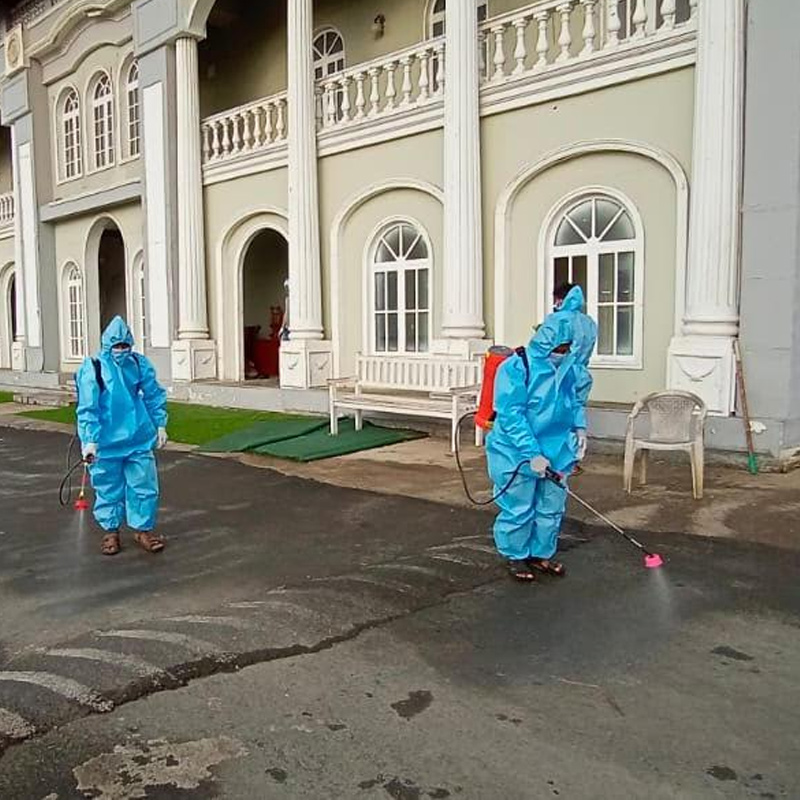
    As far as travelling is concerned, actors are using their private vehicles to travel and crew who are travelling from far have been asked to stay on the set. Also a separate make-up kit has been allotted to each actor. Sanitation and fumigation are done twice a day.

    Sphere Origins founder Sunjoy Waddhwa has resumed shooting for his show Singhalagna in Kolkata. As per the West Bengal government guidelines, all safety measures and protocols are strictly followed. However, he will start shooting in Mumbai only after September.

    Creative Eye Limited MD Dheeraj Kumar explains that the production house is in the planning mode and shooting will be started in the next ten days. He is currently working on a show for Dangal. Preparations involving sanitisation, other SOP measures gathering technicians has been done.

    Rashmi Sharma Telefilms founder Rashmi Sharma shared a glimpse of the shooting for her show Pyaar Ki Luka Chuppi on Instagram. She was among the first few producers to start shooting in Mumbai. The show is filmed at Naigaon.

    Shashi Sumeet Productions’ shows Barrister Babu and Shubharambh have also started shooting.

  • Will TV producers look at IP ownership in the post-Covid2019 world?

    Will TV producers look at IP ownership in the post-Covid2019 world?

    MUMBAI: When a nationwide lockdown was imposed to stem the tide of Covid2019, all film and TV shoots were suspended. Finally, the Maharashtra government gave a green signal for the resumption of film and television shootings in non-containment zones.

    As things are slowly getting back to normalcy it has become important for every production house to hold its intellectual property.

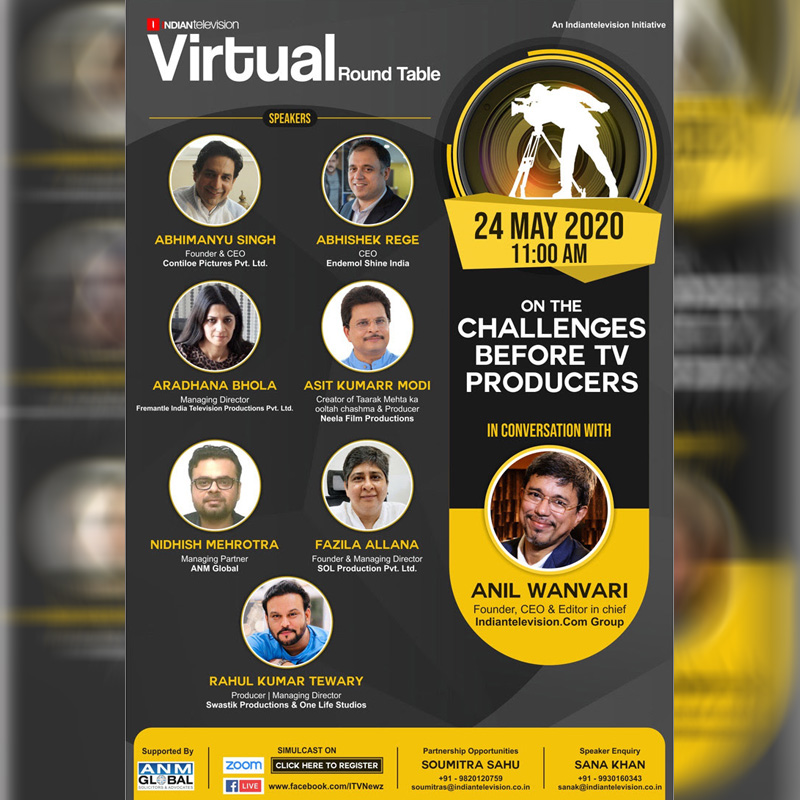
    This was the unanimous view of a virtual round table conference organised by Indiantelevision.com to discuss the challenges faced by TV producers. 

    The panel, moderated by indiantelevision.com founder, CEO and editor-in-chief Anil Wanvari, had Swastik Productions & One Life Studios producer & managing director Rahul Kumar Tewary, SOL Productions founder and managing director Fazila Allana, Contiloe Pictures founder and CEO Abhimanyu Singh, Endemol Shine India CEO Abhishek Rege, Fremantle India Television Productions managing director Aradhana Bhola, Taarak Mehta Ka Ooltah Chashmah producer and Neela Films owner Asit Kumarr Modi, and ANM Global managing partner Nidhish Mehrotra.

    With the whole pandemic situation, some television producers also have the fear of being kicked out of shows. This scenario has put a big question mark on broadcasters who own the intellectual property rights for most TV shows.

    Swastik Productions & One Life Studios producer & managing director Rahul Kumar Tewary says, “Currently broadcasters have been very supportive, but mostly it is discussion rather than action that has happened from broadcasters’ end. However, I am very hopeful that they will come forward and help. Ultimately, they are the owners of the IP.”

    He adds that this lockdown will create opportunities for producers who have trust in their content and IP. This situation will give producers some time to create different business models and IPs. Apart from this, there will be huge financial calculations also.

    Adding to Tewary’s point, Contiloe Pictures founder-CEO Abhimanyu Singh said, “It has been a long discussion among all producers. This is a time where the production community can work along with broadcasters with some co-investment in place to create IPs.”

    Taarak Mehta Ka Ooltah Chashmah producer and Neela Films owner Asit Kumarr Modi thinks it is very important for all producers to own their IPs. With the help of IPs producers can also sustain their business and become a long-time player.

    He adds, “If I don’t own an intellectual property then I am merely a production coordinator and not a producer. Post Covid2019 it will be interesting to see who owns IP. Repeat telecasts are seeing a huge consumption on digital media. IP has its own value, who will own what percentage that producers and broadcasters will have to mutually decide.”

    SOL Productions founder-MD Fazila Allana said: “Despite having our own IP there are certain formats which are created indigenously for the movie market which is not owned by them.”

    She adds that it is a continued struggle. It is more than ever now that the platforms and the channels do not want to give up IPs. Because even they have realised that in this situation, they need a bank to play and they don’t want to pay for it again.

    “The struggle is going to be tougher as everybody is now realising that there is a huge financial problem, so they are alright with producers sharing the cost and therefore own half IP. So, co-investing and co-owning could be a solution for this mid path. I don’t think the broadcasters or OTT players will give 100 per cent IP,” she further explains.

    Adding to what Fazilla Allana said, Fremantle India Television Productions MD Aradhana Bhola believes that OTT players have now realised that there is no boundary to create content. They can do dubbing and subtitling; and consumers are willing to see those contents.

    As we all know that a large part of Indian television comprises reality TV shows like Indian Idol, Bigg Boss, Dance Plus, etc.   While some producers are of the opinion that owning IP will incur them huge costs and financial burden, others think that it could be the way going forward.
     

  • TV producers haunted by rental costs

    TV producers haunted by rental costs

    MUMBAI: The pandemic may have halted production activities, but the costs are mounting, especially the rent, according to ANM Global managing partner Nidhish Mehrotra.

    He was speaking at a virtual round table conference organised by indiantelevision.com that included some of the television eminent producers who came together to discuss the challenges faced by TV producers during the Covid2019 pandemic.

    "I possibly see that currently and post Covid2019, the major concern is of rentals. We are commissioned by the channel and then we produce the show and bring the artists and crew together. We have the privity of contract with broadcasters and artists and crew have the privity of contract with producers. Most of the producers hire studios on rental; very few producers own their intellectual properties (IPs). Rentals are expensive at Rs 15 to 25 lakh per month,” he said.

    He added that nobody had thought of adding pandemic as force majeure clause in the contract globally. If your insurance talks about a pandemic in your contract then you're covered, but if it doesn't mention it, then you are not eligible for the same. And to include force majeure in your insurance cover, one needs to pay a premium price. 

    He mentioned that a couple of lawyers have filed a petition in the supreme court saying that their earning has gone for a toss and that they are unable to pay rentals. But the apex court has denied any intervention in this matter. The supreme court in the hearing clarified that it cannot give any favours to the lawyers as every organisation would come to them. There are people in India whose livelihood is completely dependent on real estate and rentals. 

    The order, passed on 30 April 2020, stated that it depends on the understanding between the licensor and the licensee.

    Mehrotra suggested that if the licensee feels that the licensor can terminate the contract or may reduce the rental fee by 50 per cent, it is essential to immediately make the contract. 

    “Producers are left with no option, either they can pay the rent or they cannot. You can suspend or waive off only when it is written in your contract otherwise you will have to pay the rent,” he concluded.

  • Help each other to bring the industry back on its feet: TV producers

    Help each other to bring the industry back on its feet: TV producers

    MUMBAI: The television producers believe that helping each other to revive the business, as and when the state government allows production to resume, will help the industry get back on its feet. This was the unanimous view of a virtual round table conference organised by indiantelevision.com to discuss the challenges faced by TV producers.  

    The panel, moderated by indiantelevision.com founder, CEO and editor-in-chief Anil Wanvari, had Swastik Productions & One Life Studios producer & managing director Rahul Kumar Tewary, SOL Productions founder and managing director Fazila Allana, Contiloe Pictures founder and CEO Abhimanyu Singh, Endemol Shine India CEO Abhishek Rege, Fremantle India Television Productions managing director Aradhana Bhola, Taarak Mehta Ka Ooltah Chashmah producer Asit Kumarr Modi of Neela Films, and ANM Global managing partner Nidhish Mehrotra.

    It was a two-hour-long animated and insightful discussion that touched upon the issues which are afflicting the production community during this pandemic. Towards the end, there saw a question-and-answer session between the moderator and panellists.

    The majority of panellists agreed that the lockdown has prompted them to think about the future, watch enormous content. And the further extension of the lockdown is adding to their financial stress. The country has been under shutdown for over two months now, the total cases across the nation surpassing the one-lakh mark with around 4000 deaths due to the Covid2019.

    SOL Productions founder and managing director Fazila Allana says that the lockdown has been interesting so far, it gave the producers a time to plan for the future. They are in a wait-and-watch mode.

    Contrary to the Allana’s view, Taarak Mehta Ka Ooltah Chashmah producer Asit Kumarr Modi says: “We were expecting 10-15 days of lockdown, but the situation is getting grimmer with the extension. There is no positivity remaining and I don't have a happy mindset after two months of lockdown.”

    The producers expressed the view that they somehow tried to stretch the fresh content on TV until March, but with the beginning of April every other broadcasting network started showing re-runs of archives and are doing the same even today, except with some error-and-trial work from home shows.

    Many producers had predicted lockdown, shut their offices and stopped shooting before prime minister Narendra Modi announced the official lockdown on 24 March.

    Expressing his concern that prolonged lockdown is taking a toll on businesses, Swastik Productions & One Life Studios producer & MD Rahul Kumar Tewary says: “We can’t be in lockdown forever and the nation's economy needs to be revived. We need to have ways, initiatives, and measures as an alternative to start businesses. It's an evolution and a new way to do business. We need to evolve.”

    Sharing Tewary’s view, Fremantle India Television Productions managing director Aradhana Bhola says: “The lives of the people are important but we need to revive business and try different ways to find the solution. I think this is the time to reset, and need to find ways to do it collectively.” She doesn’t believe that the producers will have a typical set of doing a production from home; rather it will have a hybrid studio setup of producing content remotely.

    And in these testing times, to guide the panellists on the legal front, ANM Global managing partner Nidhish Mehrotra says that nobody had thought of adding pandemic as force majeure clause in the contract globally. He adds that if insurance talks about the pandemic in your contract then you're covered, but if it doesn't mention it, then you are not eligible for the same.

    With over-the-top media having taken the centre stage amid the pandemic, Modi says, “The audience’s behaviour will drastically change after post-Covid2019 situation. And, I am positive that producers will come with more creative shows. We need to create shows which make viewers happy. Both fiction and non-fiction will have their own challenges.”

    Listing out the challenges post-lifting of the lockdown, Contiloe Pictures founder and CEO Abhimanyu Singh explains: “All the stakeholders will have to understand each other’s problem. It has to be a healthy discussion, which helps us find a solution. We will face multiple challenges once the lockdown is lifted, and the budget cut is going to be a collective problem.”

    He adds, “Our biggest challenge as a producer is to ensure the continuity of the shoot. Once you have started the shoot, don’t stop it”. Singh is of the same view of Modi that the viewing patterns of television audiences may change. According to him, AVoD will co-exist with television and SVoD is here to stay as many OTT platforms have proved their mettle.

    The Maharashtra government has listened to the television fraternity’s concerns. Endemol Shine India CEO Abhishek Rege, who was one of the producers who attended the virtual meeting with the chief minister in this regard, said: “The state government has formed teams to do surveys at shooting locations and will also come up with final SOPs.” Rege hopes that by the first week of June the government should come out with a concrete plan and shooting would resume soon.

    The other challenges that were discussed by the producers were pay cuts and shooting locations. According to Rege, there is no specific regulatory body to monitor pay cuts; it’s an individual decision. Similarly, Modi highlights the fact that television producers don’t have a proper shooting infrastructure in India, and “it should be our next focus once the pandemic ends.”

    During this lockdown period, with no work to do, television producers are using their free time to either binge-watch some good content and/or planning the future course of actions or trying to find an alternative way to deal with this situation once the lockdown ends.