Tag: TV advertising

  • TAM Adex: Indian TV advertising takes a breather as brands tighten purse strings in H1 2025

    TAM Adex: Indian TV advertising takes a breather as brands tighten purse strings in H1 2025

    MUMBAI: India’s television advertising market has hit the brakes. Ad volumes per channel tumbled 10 per cent in the first half of 2025 compared with the same period last year, signalling what industry watchers call a “strategic recalibration” in advertiser spending.
    top 10 brandsThe pullback comes as brands reassess their media strategies amid economic uncertainty. Yet some categories are thriving. Food and beverages maintained their dominance with a 22 per cent share of total ad volumes, followed by personal care and hygiene products at 16 per cent.

    The real winners were toilet and floor cleaners, which saw ad spending surge 16 per cent—the highest growth among major categories. E-commerce firms splashed out too, with online shopping platforms boosting their television presence by 48 per cent. Vocational training institutes went on the biggest spree, nearly quadrupling their ad volumes.
     

    Top 10 advertisers

    Hindustan Unilever retained its crown as India’s biggest television advertiser, with Reckitt Benckiser close behind. Together, the top 10 advertisers—dominated by fast-moving consumer goods companies—accounted for 47 per cent of all ad volumes.

    Toilet soaps led categories

    Reckitt’s aggressive push was evident in the brand rankings. Six of the 10 most-advertised brands belonged to the British consumer goods giant, led by Harpic Power Plus toilet cleaner. Dettol soap and antiseptic liquid also featured prominently.

    Top channel genres

    General entertainment channels edged past news networks to capture 31 per cent of ad volumes, reversing last year’s trend. The top five channel genres hoovered up more than 95 per cent of total advertising, underscoring the continued dominance of mainstream television over niche programming.

    Food and beverages

    The data, compiled by TAM AdEx from over 600 television channels, suggests Indian advertisers are becoming more selective about their television investments. With more than 6,600 brands vying for viewer attention, only the biggest spenders are breaking through the clutter.

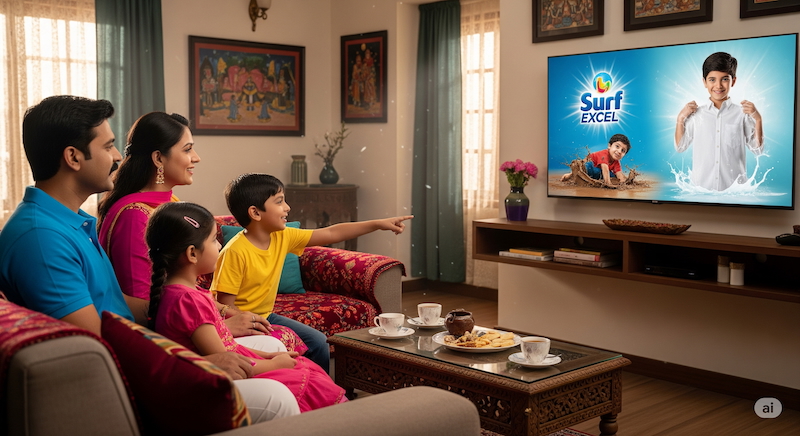
    (The picture featuring the family watching the Surf Excel ad on TV is representational only. No brand infringement is intended)

  • TAM AdEx: Auto sector advertising sees shift in H1 2024 across media platforms

    TAM AdEx: Auto sector advertising sees shift in H1 2024 across media platforms

    Mumbai: According to the latest TAM AdEx half-yearly report for January to June 2024, advertising trends in the Auto sector show a marked shift in media preferences. While TV ad volumes for the Auto industry saw a decline of 14 per cent compared to the same period in 2023, the digital space grew significantly, with a 55 per cent rise in ad impressions. Print media also saw a resurgence, with ad space growing by 25 per cent, demonstrating a renewed interest in this traditional medium.

    Key highlights from the report:

    1.Two-wheelers dominated TV ad volumes, capturing a 39 per cent share in H1 2024, surpassing the Cars category, which held a 37 per cent share.

    2.Print advertising saw a notable 25 per cent increase in ad space, with Honda Shine 100 leading as the top brand, accounting for seven per cent of the ad space.

    3.On radio, the Auto sector’s ad volumes grew by 14 per cent over the previous year, with Cars contributing to 72 per cent of ad volumes. Maruti Suzuki India maintained its top spot with an 18 per cent share.

    4.The digital medium witnessed the most substantial growth, with a 55 per cent increase in ad impressions. Maruti Suzuki India led digital advertising, holding a 26 per cent share, followed by Hyundai Motor India at 14 per cent.

    Top performing brands and categories:

    Honda Shine 100, Maruti Suzuki Brezza and Nissan Magnite were among the leading brands across various platforms.

    The cars category dominated both Radio and Digital platforms, contributing to over 45 per cent of total ad volumes.

    Sales promotions constituted 54 per cent of ad space in print, with discount promotions being the most preferred method.

    Regional trends and insights:

    The north zone led print advertising, contributing 32 per cent of the total ad space, with Delhi and Mumbai as the top cities.

    For Radio, Gujarat emerged as the leading state, capturing 17 per cent of ad volumes.

    Hindi publications dominated print ads, accounting for 41 per cent of ad space, indicating a strong regional focus.

    The Auto sector’s shift towards digital platforms highlights an evolving advertising landscape, where brands are increasingly investing in online engagement. The significant growth in digital impressions suggests a strategic pivot to reach tech-savvy consumers, especially in the Cars and Two-Wheelers segments.

    The rise in print advertising also suggests that despite the digital boom, traditional media holds substantial value, particularly for localized and regional advertising. With news channels leading TV ad volumes and programmatic buying dominating digital transactions, advertisers are leveraging diverse media strategies to maximize reach and engagement.

  • TAM AdEx: TV ads for consumer durables surge, print drops by six per cent in H1 2024

    TAM AdEx: TV ads for consumer durables surge, print drops by six per cent in H1 2024

    Mumbai: TAM AdEx’s latest report for Jan-Jun 2024 reveals significant growth in TV ad volumes for the consumer durables/home appliances category, showing a 2.9 times increase compared to the same period in 2022, and 11 per cent higher than H1 2023. In contrast, print ad space for the category continued its downward trend, falling by six per cent compared to the first half of 2023.

    Godrej & Boyce Mfg Co led the category on TV, holding a 33 per cent share of ad volumes, while Usha International and Voltas joined as exclusive top advertisers in 2024. Print advertising saw TTK Prestige India and Stovekraft maintain their top spots with 41 per cent and 21 per cent share of ad space, respectively. The South Zone dominated print ads, accounting for 33 per cent of ad space, closely followed by the North Zone.

    On Radio, ad volumes dropped 52 per cent in 2024 compared to 2023, but Samsung India Electronics led with 28 per cent of ad volumes. Digital ad impressions grew by five per cent in H1 2024, with Samsung again topping the list at 25 per cent share of impressions. Programmatic advertising accounted for 81 per cent of digital impressions.

    The report highlights that the consumer durables/home appliances category continues to prioritise TV advertising, with prime time being the preferred slot. The news and GEC (general entertainment channels) genres captured 65 per cent of ad volumes.

    In the print sector, Hindi and English publications together contributed over 64 per cent of the ad space. The preference for promotional offers remains strong, comprising 81 per cent of total print ads, with multiple promotions being the most utilised form.

  • MiQ unveils global report on advanced TV advertising

    MiQ unveils global report on advanced TV advertising

    Mumbai: MiQ, the world’s largest independent programmatic media partner for brands and agencies, unveiled its global Advanced TV research report, which surveyed 7,000 consumers and 1,100 decision-makers from brands and agencies across eight countries, including India, the US, UK, Canada, Germany, Australia, China, and Singapore.

    The report reveals that TV viewing habits have become more fragmented globally, with average daily watch time across linear TV and OTT being 2 hours and 53 minutes, and watch time on streaming platforms surpassing linear TV by 22 per cent. Cord trimmers (those who watch OTT and linear), cord cutters (a little linear, mainly OTT), and cord nevers (OTT-only) outnumber those who only watch linear TV three-to-one globally.

    The report highlights the following trends in global TV consumption:

    ●    Consumers subscribe to three streaming services on average
    ●    10 per cent of viewers jump from subscription to subscription based on what they’re watching
    ●    93 per cent of consumers are re-evaluating their subscriptions, and 33 per cent of those are looking at ad-supported platforms.

    With a clear shift towards streaming, marketers need to include connected TV as a key pillar of their advertising strategy. The report also points out that consumers aren’t giving their full attention to just one screen; in fact, 45 per cent of viewers often (or almost always) use a second screen while streaming videos or watching content on TV.

    Viewership insights from India reveal that:

    ●    Attention is split – 56 per cent of consumers use a second screen frequently when streaming videos or watching TV
    ●    Price is more important to consumers than content – 42 per cent of consumers claim that cost is a bigger consideration on streaming platforms than content.
    ●    Ad tolerance is high – 37 per cent of viewers would consider a cheaper ad-supported streaming (AVOD) platform

    Brands and media agencies are optimistic about increasing ad spends on Connected TV with:

    ●    59 per cent of Indian brands and agencies anticipate a rise in their CTV marketing spend over the next 12 to 24 months
    ●    74 per cent of CTV advertisers measure the success of their campaigns through reach/frequency towards the intended target audience

    Commenting on the global report, MiQ global commercial board member and managing director Siddharth Dabhade said, “Consumer and advertiser insights from our report indicate that connected TV advertising is poised for robust growth in India. With the highest ad engagement rate in the world, CTV advertising presents a huge opportunity for brands to make an impact on the biggest screen in the household by taking a data-driven approach to TV planning and activation. Trends like cord-cutting and second-screening are on the rise, which implies that advertisers need to focus on mobile retargeting and competitive conquesting to supplement their CTV strategy.”

    According to the report, only 15 per cent of the respondents who have executed CTV ad campaigns consider themselves a CTV ‘expert’ owing to the cost and creative challenges advertisers face when planning and executing a CTV campaign.

    To gain more insights on CTV advertising in India download the report: https://marketing.wearemiq.com/advanced-tv-report

  • TV ad volumes in May’22 grew two-fold growth vs May’20: TAM AdEx

    TV ad volumes in May’22 grew two-fold growth vs May’20: TAM AdEx

    Mumbai: The total advertising volumes on television grew two-fold in May 2022 compared to the same period in 2020(May 2020), according to the latest report by TAM AdEx.

    The report showed that ad volumes grew by 73 per cent in May’21 compared to May’20 and 100 per cent in May’22 compared to May’20.

    More than 3800 categories, 2415 advertisers and 370 categories advertised in May 2022.

    Reckitt, Hindustan Unilever, Brooke Bond Lipton were the top three advertisers in May 2022. Godrej Consumer Products, Ponds India, Cadburys India, ITC, Coca Cola India, Pepsi Co and Amazon Online India were also among the top ten advertisers. The top ten advertisers contributed to 35 per cent share of ad volumes in May.

    The top advertising categories on TV were toilet soaps and toilet/floor cleaners with Lizol All In 1 being the top brand followed by Dettol Intense Cool Soap.

    Three new categories including aerated soft drinks, tea and retail outlets – jewellers emerged in the top ten category advertisers. Retail outlets – jewellers saw the highest surge in ad volumes with 12x growth followed by paints which saw 7.4x growth in May 2022 as compared to May 2021. 

  • TV advertising embraces digital in Kantar’s Creative Effectiveness Awards 2022

    TV advertising embraces digital in Kantar’s Creative Effectiveness Awards 2022

    Mumbai: Advertisers increased their advertising and media investments in 2021, as lockdown restrictions in many markets started to ease, with further investment in digital platforms. Digital ad spend saw a growth of 30.5 per cent, compared with 19.2 per cent overall, and more media channels became digitalised, according to data-driven insights and consulting company Kantar. The company revealed the results of its Creative Effectiveness Awards, recognising the most impactful ads of last year, as judged by consumers.

    Throughout 2021, Kantar’s Link creative testing platform was used to evaluate more than 13,000 TV, digital, print and outdoor ads in 75 markets. The awards celebrate those which were most impactful in building brands, driving sales and increasing long-term equity. As well as recognising the best creative work of the year, the awards showcase the ‘creative sparks’ – the common themes which set apart the most effective ads, and underline some of the key market trends influencing advertising in 2021.

    An accelerated shift to digital

    “These dynamic trends create significant opportunities for new types of creative expression in advertising, both online and offline. Channel fragmentation means a greater need to understand ad effectiveness than ever. The integration of Behavioural Science techniques, better automation, and faster, more granular insights mean creative testing should be part of every team’s development cycle,” commented Kantar EVP creative and media solutions Jane Ostler. “And of course, the universal principles still hold true; when you combine clear marketing objectives with brilliantly executed creative, we see effectiveness in action.”

    Winning ads reveal the ‘creative sparks’ to ignite effectiveness

    Across the 13,000+ adverts analysed using link, Kantar’s validated ad testing solution, Kantar identified five ‘creative sparks’ that set the most effective executions apart:

    Ad breaks go social:

    The winning TV ads in this year’s awards demonstrate a clear move towards infusing direct references to digital environments and themes. This could be a deliberate attempt to acknowledge the existence of online platforms, which many of us are immersed in for hours each day. Including visual cues from the digital world undoubtedly makes TV ads more compelling and more absorbing to watch.

    In eighth place in the top 10 TV ads of the year, Chupa Chups XXL Flavour Playlist TV spot is one example of this trend in action. “We are delighted to have our work recognised by Kantar. Our goal was to use the launch of our new product as an opportunity to extend the brand’s reach and relevance among young adults,” Perfetti Van Melle senior brand manager Jordi Rosell said. “One of the key things we wanted to capture was the independence, assertiveness, and rebellious spirit of young people. The creative approach was designed to break with tradition, using references to TikTok, gaming and other cultural touchpoints in a way that reflects their lives, while giving prominence to the unique features of the product.”

    Every second counts:

    With winning ads ranging from six to 136 seconds long, the awards show you can effectively tell a story at any ad length. While digital ads are often short to reflect our online attention span, one of the winners in the digital category is a two minutes and 15 seconds long ad for Colombian beer brand BBC, which uses an unusual and distinct graphic style soundtracked by a jazz track that draws viewers in.

    Global campaigns, local heroes:

    Many brands want to build a consistent perception amongst viewers globally, but local understanding is key to creative choices that are effective and support the global brand vision. Diageo brand Johnnie Walker scooped awards for ads in the UK, Mexico and Thailand with effective local executions which contribute to a consistent global strategy.

    Show, don’t tell:

    Even with the myriad of new developments and sophisticated ways to stretch creative boundaries with advancements in visual and audio techniques, our winning ads show that the product demo is still as effective as ever.

    In first place in the TV category, Mitre 10’s “With you all the way” spot is a stand-out example of a product demo that is natural and maintains the flow of the ad. “‘With you all the way’ is a promise of partnership. We’re there to help our customers build confidence in their ability to get the job done right,” Mitre 10 chief marketing officer Jules Lloyd-Jones commented. “With a touch of humour thrown in, the ad creative reflects that promise and centres on our greatest asset – our people. Leaning into that differentiator, the aim was to take us from retailer to trusted project partner for our customers, really inspiring them to love where they live, work and play. We’re so pleased the ad has landed so well with Kiwi customers and we’re honoured to see the campaign recognised internationally in the Creative Effectiveness Awards.”

    Make them smile:

    Laughter has long been a staple in advertising. But the last twenty years have seen a steady decline in the use of humour as a result of the purpose-based marketing boom, and as brands looked to communicate sensitively during the pandemic. Recent analysis from Kantar shows that humour is a powerful tool in creating ads which are expressive, involving and distinct. Award winners from Rappi, Zespri, Amazon and Chromebook show that bringing humour back into advertising pays off.
    On Wed, Apr 27, 2022 at 7:37 PM Anupama Sajeet <anupamas@indiantelevision.co.in> wrote:

  • Users want interactive, social experiences on smartphones during IPL: Study

    Users want interactive, social experiences on smartphones during IPL: Study

    Mumbai: The mobile users now look for more interactive, social experiences on their smartphones during live IPL matches, according to the report titled ‘IPL and the Second Screen’ released by Glance on Tuesday. 70 per cent of IPL viewers use smartphones during the matches, with the majority consuming cricket-themed content parallelly on various platforms, revealed the study.

    Expert commentary, live watch-along, polls and quizzes, contests, cricket games, and fantasy cricket were amongst top choices for content consumption on phones during the matches. Content-led marketing on the second screen emerged as one of the key strategies for brands to cut through the IPL media clutter, the report stated.

    Close to 70 per cent of respondents identified themselves as ‘die-hard fans’ of IPL, and 72 per cent said that they will be watching every IPL match. Findings further revealed that while 69 per cent watch IPL on television, 61 per cent said that they also watch matches on their smartphones. The study found that content themes that are gaining popularity include live reaction videos of celebrities watching matches, behind-the-scenes snippets, unknown facts about favourite players, and expert match analyses.

    The survey further asked these respondents about the types of content they would like to interact with during the IPL matches. 56 per cent said they would like to take part in live watch parties with celebrities, and 53 per cent said they would participate in social media polls and quizzes on the match. 49 per cent opted for cricket games or fantasy cricket on various apps, while an equal percentage of them said they would bet on live matches. For brands and advertisers, this showed that interactive content formats will be one of the biggest engagement drivers to connect with audiences during the IPL.

    The Glance report outlined strategies that brands can leverage to tap into this growing trend of consuming second screen content during the IPL. These included using branded storytelling around cricket, launching customized polls and quizzes, designing watch parties with celebrities, and more, on popular platforms.

    When asked about ads that audiences would not mind engaging with, 54 per cent of respondents chose branded polls and quizzes that test their cricket knowledge, closely followed by ads that involved winning a contest. 48 per cent of users preferred influencer and celebrity-led ads, with an equal percentage voting for ads that lead to good shopping or dine-out deals.

    “IPL is a social phenomenon, both in the offline and the virtual world. People not just love watching cricket, but also love engaging with mobile content that gives them a 360-degree experience of the IPL and allows them to become a part of a community,” said InMobi Group co-founder and president and Glance COO Piyush Shah.“The evolving nature of IPL and the rise of interactive cricket content consumption on second screens, led by smartphones, allows brands to cut through the clutter of IPL, and connect with their audiences in a meaningful and impactful way.”

  • Indian ad industry to grow up to 8% annually on average: Group m forecast

    Indian ad industry to grow up to 8% annually on average: Group m forecast

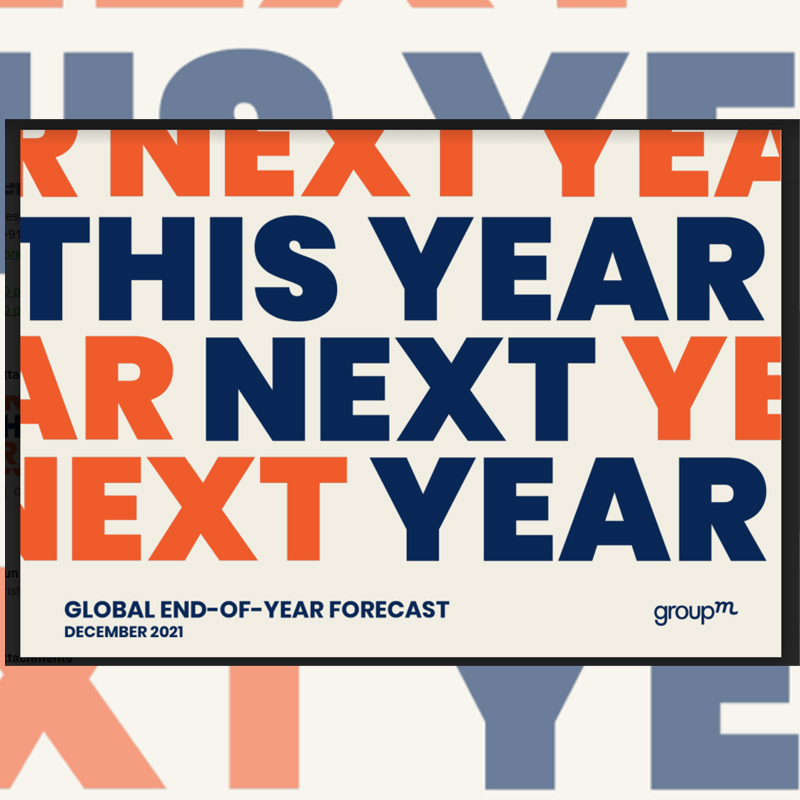
    Mumbai: GroupM has released its ‘This Year, Next Year’ global end-of-year forecast that shows a much faster expansion in the advertising industry than previously anticipated (driven primarily by growth in the US, UK, and China). India is among the top ten markets that are expected to grow between six to eight per cent annually, on average. Digital advertising accounted for 64.4 per cent of all advertising in 2021, up from 60.5 per cent in 2020, even as the big tech firms such as Alphabet, Meta and Amazon accounted for 80-90 per cent of the global total.

    In the top ten advertising markets, including India, growth should get back to the mid-to-high-single digits over the next five years, predicted the global report.  

    Digital advertising is likely to end 2021 on a high, growing by 30.5 per cent, up from June’s forecast of 26 per cent growth, estimates the global agency.

    Television advertising, on the other hand, is forecasted to grow by 11.7 per cent in 2021, up from June’s estimate of 9.3 per cent. Given 2020’s decline of 13.7 per cent, the industry is not expected to return to 2019 levels until 2023. The report predicts that subsequent years will be roughly flat—up 1-2 per cent per year through 2026—for television advertising in most major markets around the world, as the largest advertisers continue to incrementally shift spending.

    Overall, Connected TV+ will account for about 10 per cent of total TV advertising in 2022 ($17 billion of a total of $171 billion) and is expected to double by 2026.

    TV still typically accounts for nearly half of large marketer budgets, incrementally down over time. A superficial read of the data included in ‘This Year, Next Year’ might leave one with the impression that because 64 per cent of the world’s advertising revenue is generated by digital media and 21 per cent goes to TV, that marketers are allocating 64 per cent of their budgets to digital media and 21 per cent to TV, on average. This would be a mistaken interpretation because many advertisers—especially small ones and those whose businesses operate entirely online—often allocate all or nearly all of their budgets to digital media while large businesses typically allocate higher shares of their budgets to television.

    Audio advertising which took off in the pandemic is expected to grow 15.6 per cent in 2021 and 6.4 per cent in 2022. In subsequent years, however, group m assumes a reversion to historical trends: largely flat.

    OOH advertising, which took a beating in most major markets during the pandemic-induced lockdowns, is expected to grow 17.1 per cent in 2021 and 14.9 per cent in 2022. In subsequent years, the report predicts a reversion to historical trends: mid-single-digit growth.

    Many underlying trends appear to be disproportionately concentrated in the US, the UK, and China, which together account for approximately 70 per cent of all the industry’s growth, despite making up about 60 per cent of the total market, says the report.

    Some of the key global factors causing faster-than-expected growth are new small businesses allocating greater resources to nationally oriented digital advertising, China-based marketers capitalizing on low-cost international shipping and using global digital platforms to reach overseas consumers, and app developers or other ‘digital endemic’ businesses rooted in the internet economy, many of which focused on advertising-driven top-line revenue growth

  • Ranveer Singh was most visible celebrity during IPL 14: TAM data

    Ranveer Singh was most visible celebrity during IPL 14: TAM data

    Mumbai: The Indian Premier League (IPL) 14th season saw 19 per cent rise in the share of celebrity-endorsed advertisements over the previous season, according to data provided by TAM Media Research. The study included all live matches for IPL 13 and 14 and excluded pre-mid-post programs. Ranveer Singh was the most visible celebrity with 11 per cent share of ad volumes.

    The total share of celebrity-endorsed ads accounted for 57 per cent of total ad volumes during IPL 14 compared 48 per cent in the previous season. The share of non-celebrity endorsed ads dropped by 17 per cent over the previous season, revealed the data.

    Film actors led the brand endorsements with 47 per cent share of ad volumes, followed by sports persons with 39 per cent share during IPL 14. The overall number of celebrities visible on TV saw a significant increase of 31 per cent compared to the previous season. The number of sports personalities visible on TV grew by 38 per cent. MS Dhoni and Virat Kohli were the top two most visible sports celebrities during IPL 13 and 14. The share of film and TV actress endorsed ads during the tournament was only 14 per cent.

    The top five most visible celebrities during IPL 14 were Ranveer Singh, MS Dhoni, Shahrukh Khan, Jim Sarbh, and Virat Kohli. Jim Sarbh was a new entrant into the top five list while the rest were recurring from the previous season of the tournament. The top five sports celebrities were MS Dhoni, Virat Kohli, Virendra Sehwag, Neeraj Chopra, and Sachin Tendulkar.

    The top five categories and advertisers accounted for 49 per cent and 36 per cent share of celebrity ad volumes, respectively. The top five categories were pan masala, online gaming, digital wallets, ed-tech and BFSI. The top five advertisers were Dreamplug Technologies, Sporta Technologies, K P Pan Foods, Vishnu Packaging, and AMFI.  

    (Source: TAM Sports; figures are based on secondages for TV; commercial ads endorsed by celebrities only; excluding promos and social ads; 60 matches of IPL 14 and IPL 13)