Tag: TV ad volumes

  • TV ad volume for laptop category dips 4 per cent in Jan-August

    TV ad volume for laptop category dips 4 per cent in Jan-August

    Mumbai: The advertising volumes for laptop/notebook category dipped by four per cent in January-August 2021 compared to the same period in 2020, according to TAM Media Research. HP and Lenovo were the only advertisers visible during this period, with Lenovo being the top advertiser, in terms of volumes.

    Lenovo Yoga was the most visible brand on TV with 52 per cent share of ad volumes. Other brands being advertised include HP Envy, HP Spectre 13 X360, HP Pavilion Series.

    The most popular TV channel genre for the laptop brands was the movie channel genre that had a 39 per cent share of ad volumes, followed by news (17 per cent), infotainment (16 per cent), music (15 per cent), GEC (9 per cent), other genres (4 per cent).

    The most preferred programme genre for laptop brands was feature films that accounted for 40 per cent share of ad volumes. This was followed by news bulletins at 12 per cent and film songs at 11 per cent. These three genres accounted for 60 per cent of ad volumes for the category.

    A time band analysis for the category showed that advertisers preferred rolling their ads during the evening primetime between 6 p.m and 10:59 p.m. This time band had 34 per cent share of ad volumes. The afternoon and morning time bands were also popular time bands for laptop ads following the evening primetime, with 20 per cent and 16 per cent of ad volume share, respectively. These three bands account for 70 per cent of ad volumes for the laptop category.

    Laptop ads of a length of less than 20 seconds and between 20-40 seconds dominated airwaves with a 95 per cent share of ad volumes.

    (Figures are based on secondages for TV; commercial ads only; excluding promos and social ads)

  • TV ad volumes for auto industry grew by 34% in H1’21

    TV ad volumes for auto industry grew by 34% in H1’21

    Mumbai: Television ad volumes for the auto industry grew by 34 per cent in the first half of 2021 (January-June) over the same period last year. The ad volumes for the auto sector had plunged by 42 per cent in H1’20 over the same period in 2019, according to data shared by TAM Media Research.

    The auto industry maintained its ninth position in the overall share of TV ad volumes vis-a-vis other sectors. Its share of ad volumes was 4.8 per cent in H1 ’19, 3.2 per cent in H1’20 and 3.1 per cent in H1 ’21. 

    The number of auto advertisers and brands grew by 13 per cent over last year but has yet to recover completely compared to 2019. The number of auto advertisers and brands in H1’19 stood at 110 and 240, respectively. The number of auto advertisers and brands in H1’21 stood at 103 and 193, respectively.

    The auto sector saw consistent growth in ad volumes for the January-February-March quarter growing by 19 per cent, 22 per cent and 23 per cent over the same months last year. The growth rates slowed down during the April-May-June quarter at 11 per cent, 7 per cent, and 16 per cent but still grew compared to the same months in 2020.

    The top auto categories were cars and two-wheelers which had 34 per cent and 43 per cent share of ad volumes, respectively. The top 10 auto advertisers accounted for 72 per cent share of auto industry advertising volumes on TV. These advertisers included TVS Motor, Yamaha Motor India, Tata Motors, Hero Motocorp, Maruti Suzuki India, PCA Automobiles India, Renault India, Nissan Motor, Kia Motors Corporation, and Suzuki Motorcycle India. TVS Motor was the top advertiser with 18 per cent share, whereas it was in a seventh position last year.

    The top genres for auto advertisers were news, movies and GEC which accounted for 75 per cent share of ad volumes. Out of this news alone had 50 per cent share of ad volumes. The most popular programmes for auto advertisers were news bulletins and feature films which accounted for 35 per cent and 17 per cent share of ad volumes, respectively. Auto advertisers were most prominent during the evening primetime, afternoon and morning time bands that accounted for 39 per cent, 18 per cent and 16 per cent share of ad volumes, respectively.

    Auto advertisers most preferred 20-40 second ads followed by <20-second ads. These two ad formats account for 94 per cent of ads visible on TV.  

    (Figures are based on Secondages for TV; commercial ads only; excluding promos and social ads)

  • 3700+ advertisers active on television in Diwali week

    3700+ advertisers active on television in Diwali week

    NEW DELHI: As the ongoing festive season hits a crescendo this Saturday with Diwali, ad volumes on television are witnessing a steady rise. However, in terms of revenues, the industry is still struggling and money in the bank might clock at less than 10-15 per cent of what 2019 achieved, industry insiders have projected. 

    Wavemaker India managing partner Mansi Datta said that the advertising industry has seen demand rising and an almost comeback to similar ad volume levels to last year Diwali. “Festive period of Diwali has seen marketers hoping for a recovery in demand generation. This time frame was also quite a tempting one for advertisers with the presence of the high octane IPL, an equally fiery political scenario with Bihar elections, along with interesting reality format shows. TV, which has registered the quickest recovery, is witnessing demand levels similar to pre-Covid levels.”

    OMD Mudramax EVP and principal partner Navin Kathuria shared a similar overview as he elaborated that the early trends for Diwali point to inventories on television filling up fast. And these are only expected to grow as the festival draws closer. 

    The Media Ant co-founder Samir Chaudhary revealed that the advertiser count for Diwali week is 3700+ on television alone. 

    As per Kathuria, most of the festive categories are active on TV – e-commerce (Amazon, Flipkart, Pepperfry etc), cars, paints, white goods, apparel, retail, a few BFSI subcategories, footwear, and kitchen appliances. “This is in addition to the new emerging categories like edtech, online gaming, hand sanitizers etc. Of course, the regular or non-festive categories of FMCG, personal care, cosmetics, online food delivery, banking, OTC pharma products etc are present, as always,” he added. 

    Despite ad inventories filling up fast and advertiser sentiment turning upbeat even for categories which were otherwise muted during the pandemic-induced lockdown, television is still staggering in contrast to last year. 

    Both Chaudhary and Kathuria pointed out that while it is difficult to peg an exact number to compare, it is going to be difficult for TV ad revenues to pass the preceding year’s count. Kathuria, however, mentioned that it might be possible that the medium might come close to last year’s number. 

    An industry veteran, though, stated that it will be surprising if the numbers come close to 90 per cent of what was witnessed in 2019. 

    The industry is showing great positivity towards out-of-home advertising too, which has started picking up after a quarter of complete silence. 

    Datta elaborated, “OOH is seeing interesting trends with mobility reports showing the movement of people increasing away from home, into shopping areas, especially in upcountry cities. In urban centres, premium locations like airports have also shown a bounce-back of traffic levels. All this and more, has seen a lot of clients revaluating their interest in OOH solutions.” 

    One medium that is still struggling to achieve its pre-Covid glory is print. “Though advertising has increased as compared to the normal months, it is nowhere close to what it should be in the festive period. We are not witnessing multiple jackets, full-page ads, flaps etc which is a norm for publications during Diwali season. This year, though Diwali advertising is seen on print, the clutter is much lower compared to the last few years,” Kathuria noted. 

    Even though print has gained momentum during the last several weeks, in the end the advertising decision-making is led by efficiencies, pointed out Datta. “Hard-working formats are being preferred over big-sized impact formats. We have seen the demand for impactful formats like jackets going down. Our analysis shows that there’s been almost a 60 per cent plus drop in jackets consumption over last year’s Diwali.” 

    As has been the trend for most of the year, industry experts maintained that digital was again the most preferred choice for advertisers in Diwali season as well. Unlike other mediums, the platform is witnessing a better recovery and double-digit growth due to the benefits like real-time measurement and conversion tracking. 

    WATConsult VP – operations (west and south) Manika Juneja explained, “There is a noticeable difference between 2019 and 2020 festive planning & implementation which is primarily driven by consumer behaviour. There has been a surge in the first-time online shoppers from non-primary markets and the ways of offline and online shopping have evolved with propositions like scheduled in-store pickups, contactless delivery, online consultation and more. Brands which hadn’t considered the digital medium earlier are now hopping on the bandwagon at a faster pace for discoverability and consideration. There is a digital touchpoint everywhere for putting consumers’ mind at ease and providing them with an added experience to build trust and generate repeat visits.”

    She continued, “ROI-driven campaigns have now taken precedence and garnered the largest chunk of spends on digital. By its nature, e-commerce as a medium, has been the biggest driver of sales for brands in the new normal. Majority of the brands are strengthening their digital infrastructure to reach out to a larger consumer base. The IPL and festive overlap coupled with a 360-degree shift in consumer content consumption has given an added advantage to OTT platforms along with social and digital media this season.” 

    1702 Digital co-founder Mihir Joshi shared that the agency has witnessed DTC brands increase their spends on branding during the festive season, with as much as a 70 per cent uptick in the number of campaigns being fielded. “We’ve been witnessing an increase in performance marketing spends with our DTC clients. Brands are also coming to terms with this Covid-dominated year and realising that Diwali is the most positive peak of consumer sentiments that we are going to have. Hence, they are not getting cold feet to spend big on digital platforms.”
  • TV ad volumes up; next challenge is lag between inventory & advertisers

    TV ad volumes up; next challenge is lag between inventory & advertisers

    NEW DELHI: Battling through a rough quarter with, television advertising is once again gaining momentum. As per a recent TAM AdEx data, the month of June 2020 witnessed an uptick of 46 per cent in ad volumes as compared to May 2020 and even the advertising duration picked up by 8000 hours as compared to the last month. While this looks like a positive trend indicating a better future for the TV industry, industry insiders feel that the medium has to still battle certain issues to get back to its older glory.

    Grapes Digital COO Shradha Agarwal shares that this increase in ad volumes is also because of the reason that certain slots for the spring-summer category were pre-booked by brands and those took up the ad slots as new programming began on certain genres. 

    “I have one client who had invested around Rs 2 crore for a big-budget campaign on television but before it could go on-air the lockdown happened. Now, as per the advertiser, they could not get their TV campaign cost back but instead got an option to put the campaign on hold, and that can be run later,” she notes. 

    As per mPlan CEO Parag Masteh most of the investments that television is enjoying today is from new investors and certain categories like healthcare and FMCG while big brands have still their marketing budgets slashed below 50 per cent. 

    “The current growth can be attributed to panic buying by certain categories and eventually digital is going to come up as a big challenge for television,” he insists. 

    As per TAM AdEx data, eight out of the top ten categories were from FMCG, including baby foods, vanishing creams, and artificial sweeteners. 

    Makani Creatives MD and co-founder Sameer Makani agrees that digital platforms like OTT will come up as a big challenge to television going ahead, “As brands are shifting their modes of communication from offline to online to broadcast, it may take time for TV ads to follow a smooth road. As digital advertising is cheaper as compared to others, it consumes the maximum share of advertising. 2020 has changed the strategies and approach of every advertiser and marketer and has forced them to increase the frequency of advertising.”

    The Media Ant co-founder Samir Chaudhary doesn’t think that digital will take TV's place anytime soon but as new shows come up, the medium is going to face big issues with the lag in inventories and advertisers eager to invest into television. 

    “As things normalise, other media will start getting their share back, and certainly TV will become stronger. But as ad inventories will go up with new content coming, there is going to be a lag in filling them up as (advertisers’) businesses will take another two to three months time to get back on their feet.” 

    He added that the only solution to this problem is what most channels are doing already, slashing inventory prices and offering discounts to advertisers. 

  • Toilet, floor cleaner brands piggyback on the Swacch Bharat Mission

    Toilet, floor cleaner brands piggyback on the Swacch Bharat Mission

    MUMBAI: Ever since the government launched its ‘Swacch Bharat Mission’, brands have left no stone unturned to make hay while the sun shines.

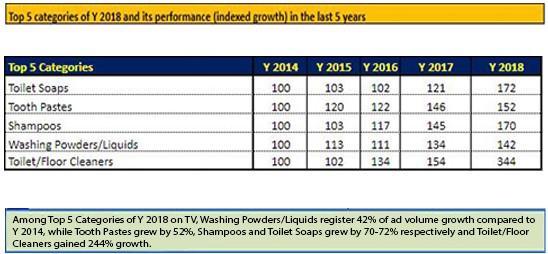
    As per a recent TAM Adex report, the toilet and floor cleaners’ brands have made an incredible spike of 244 per cent in their ad volumes on TV from 2014 to 2018.


    Commenting on the trend, TRA Research CEO N Chandramouli says, “This increase in TAM Adex is a direct reflection of the toilet and floor cleaning brands' smart piggybacking on Swachh Bharat campaign. Incidentally, it has also been used significantly by disinfectant liquid soap brands.”

    However, he cautions such brands to tread carefully with their campaigns, “Brands wait eagerly for such initiatives which will give them a wave to ride on. However, if a brand uses such waves too blatantly, it can also backfire on them as it can seem pushy thereby reducing the buying propensity, the important mix of brand trust and brand desire, of the brand.”

    Bijoor Consults Inc founder and brand guru Harish Bijoor notes, “Swacch Bharat has actually upped the sensitivity to toilets, hygiene, toilet cleaning and more. If you look at the government sector buying more products in this segment as well, you will see a blip!”

    Brand-nomics managing director Viren Razdan believes that the huge multi-level activation campaign of Swacch Bharat Mission has got the new-age Indian and his civic sense and national pride a never-before significance. He says, “It has also sparked off the renewed idea of hygiene which has been used fairly well by these categories. So, while in the past these brands did make their presence felt – it’s just that the new environment has created a fairly receptive mindset and brands are muscling their way  for this new-found attention.”

    He continues, “While earlier brands created their own space to a narrow focussed TG – suddenly the idea has been magnified in scale and width reaching a social issue, the category would obviously respond to the heat.”

    Not just that, toilet soaps, toothpaste, shampoos, and washing powder/liquids also saw a huge spike in their ad volumes on TV, all of them increasing by more than 100 per cent. In fact, the report also showed that in the top 10 sectors to advertise on TV, personal healthcare improved its position by two spots; it was ranked sixth in 2014 and fourth in 2018.