Tag: Tushar Vyas

  • Lets get comfortable with  the ‘Grey’: an invitation to marketers in the age of AI – Inspire, innovate, integrate with MMA Impact’ 2024

    Lets get comfortable with the ‘Grey’: an invitation to marketers in the age of AI – Inspire, innovate, integrate with MMA Impact’ 2024

    Mumbai – MMA Global India’s IMPACT Mumbai event concluded recently, and it was a huge success. The event took place on 24 April in Mumbai and focused on the impact of AI on marketing. It delivered a series of groundbreaking insights that redefined AI-driven marketing strategies and expanded the horizons of traditional marketing frameworks through new partnerships and insightful discussions. The event received industry-wide accolades for the cutting-edge quality of content and the stellar line-up of speakers who provided valuable insights to the attendees.

    MMA

    Key Highlights from MMA IMPACT Mumbai:

    . Kickstarting with an inspiring address by Prasanth Kumar, MMA India Co-Chair & CEO, South Asia, GroupM, this session also featured Tushar Vyas, Chief Strategy Officer, WPP India & President, GroupM South Asia, moderated by Shibani Gharat, Anchor, CNBC – TV18. They dissected the AI adoption lifecycle, providing a clear pathway for marketers to evolve with AI-driven capabilities.

    MMA

    . Parul Bajaj, Managing Director & Partner, Boston Consulting Group, delivered a compelling keynote session on AI-Powered Marketing and Commerce. The session dove deep into how CMOs are thinking about AI, the highest impact AI-led use cases and the most critical factors that will be needed to succeed in this journey.

    Parul

    . A panel featuring Senior Marketers from HDFC Bank, Marico, DSP Mutual Fund, moderated by Devika Sharma, MMA India Board Member; VP and GM – India, InMobi, explored beyond conventional AI applications, showcasing how AI fosters deeper consumer connections and smarter experiences.

    MMA

    . Vijay Iyer, MMA India Board Member; Director, Amazon Ads India, illuminated the shift to Retail Media 2.0, emphasizing its transformative impact on marketing funnels and consumer interaction.

    Vijay Iyer

    . Rohit Bhasin, MMA India Board Member; President and CMO, Kotak Mahindra Bank, articulated the strategic integration of AI in business practices. “AI is not just a technological upgrade; it is a paradigm shift in understanding customer intricacies and delivering on their expectations with unprecedented precision,” commented Bhasin.

    Rohit Bhasin

    . Rajeev Raja, Founder and Soundsmith, BrandMusiq, began his address with enchanting tunes, going on to then delve into the emotional dimensions of AI in sonic branding and highlighting its profound impact on digital consumer engagements.

    Rajeev Raja

    . Experts from Nielsen, ITC, and India Today tackled the evolving metrics of media measurement in a ‘crumbling’ cookieless world, outlining the next steps for data privacy and accuracy with a tinge of humor.

    Experts from Nielsen

    . The session with AI Advisory members from Netcore Cloud, Tata Consumer Products, Microsoft, and JioAds and ReBid broke down real-world AI applications, offering tangible examples that underscore AI’s versatility across market sectors.

    AI Advisory members

    . A pivotal discussion on ethical AI deployment featured Marketing Leaders from Glassbox Ventures, Mondelez, House of Masaba, and Publicis Production, moderated by Pratik Gupta, MMA India Board Member; Founding Partner, Zoo Media, emphasizing the much-debated responsible AI use within marketing frameworks.

    AI deployment

    . Sunita Bangard, MMA India Board Member; Group Head – Consumer Insights and Brand Development, Aditya Birla Group, and leaders from Federal Bank, TATA AIA, Beam Suntory, Raymond, and EY outlined why marketers have a “seat at the table” in the growth of AI. This session have a cutting-edge perspective on the AI-marketer relationship in India – shedding light on how “marketers are evolving to media companies”.

    sunita

    . Leading practitioners of Generative AI from Affle, SAS, Haptik, and Accenture tackled frequently asked questions about GenAI. They provided clarity and actionable insights for marketers looking to adopt these tools, showcasing how AI will augment marketers rather than replace them.

    Moneka Khurana

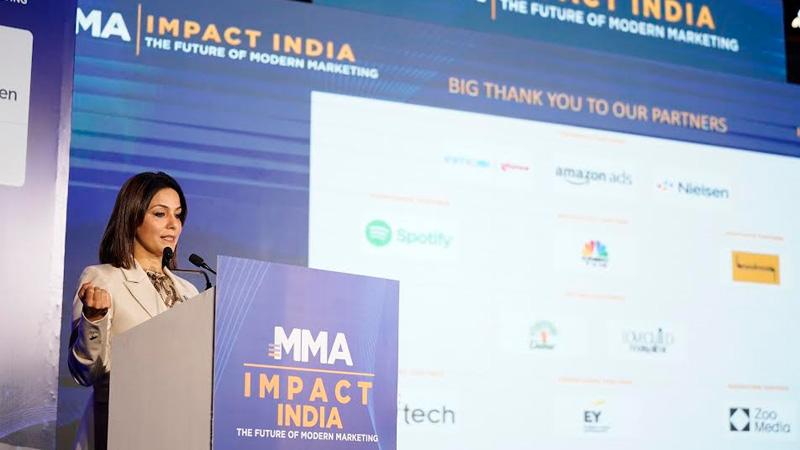
    Moneka Khurana, Country Head & BOD Member, MMA Global India, set a transformative agenda, encouraging the industry to get comfortable with the ‘grey’ .As she said in her opening remarks, “Let’s embrace the grey areas and ambiguity, as it is in these spaces where true innovation and wisdom lie. It might not be easy to do this alone, so the best way is to join hands and walk the path together, enabled through MMA communities and platforms like Impact. As we know, AI will continue to permeate our lives and be our co-pilot, with you being on the driver’s seat. At Impact, we debunk numerous myths, decode hard questions, and bolster confidence to navigate through uncertainties with collective intelligence. This allows us to see ambiguity as a growth opportunity, backed by a curated agenda to address deep-rooted aspects of how marketers can walk the talk and leverage it for business outcomes.”

    AI is fundamentally reshaping the way we approach business. It’s not just enhancing our existing processes; it’s revolutionizing how we envision growth and success. With AI, we can make informed decisions that minimize costs and maximize efficiency. By integrating AI into our core strategies, we unlock unprecedented growth opportunities and move beyond traditional boundaries to discover new potentials in marketing and customer engagement.

    As IMPACT Mumbai 2024 drew to a close, participants left not just with enhanced knowledge but with actionable strategies to harness AI within their marketing frameworks. The day-long conference cooled off with a lavish soiree with drinks, snacks and networking – an exclusive marketer-only gathering of C-suite execs.

  • AI can never match human ingenuity in advertisement: I&B ministry’s Vikram Sahay at MarCon 2023

    AI can never match human ingenuity in advertisement: I&B ministry’s Vikram Sahay at MarCon 2023

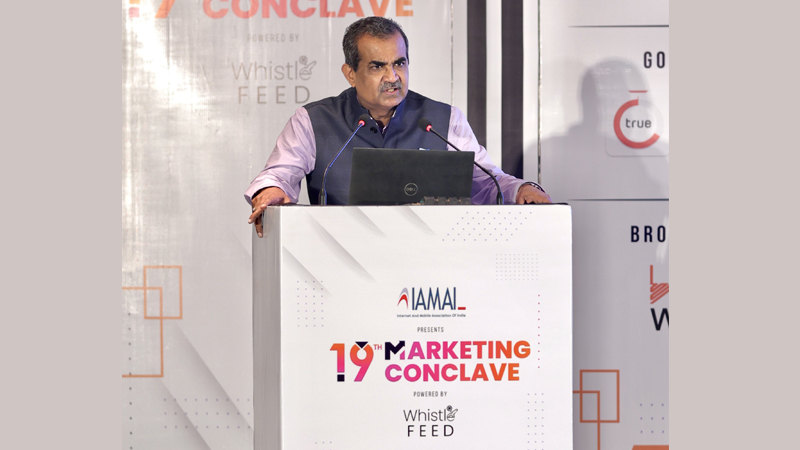
    Mumbai: “Remember that advertisement is all about making a product or a service unique. Even the best of the software like ChatGPT will never offer that uniqueness. So, do not feel discouraged by them as they often compromise the quality of the advertisements,” said Ministry of Information and Broadcasting joint secretary & Government of India Vikram Sahay, while delivering his keynote address at the 19th edition of the Marketing Conclave (MarCon), organised by the Internet and Mobile Association of India (IAMAI) on 22 November 2023 in Mumbai.

    This year MarCon explored, through 30 sessions, across four tracks, the theme of “Tomorrow’s Canvas: Tech and the Art of Marketing”. The conference was co-powered by Whistle Feed.

    Addressing the conference’s theme topic, Sahay delved into the dynamic intersection of technology and marketing, shedding light on innovative strategies to navigate the evolving landscape of digital advertising.

    In his keynote Sahay also dwelt on advertising regulatory practices and underlined the importance of ethical marketing. “Today, we have certain regulatory practices and guidelines that protect us from misleading ads, especially in education and healthcare. We must stay away from such unethical practices,” he said.

    MarCon 2023 brought together on one platform more than 65 industry captains and subject stalwarts to explore the theme subject 360 degrees. Over 350+ agencies, 500+ leading brands and 1500 delegates took part in the conference.

    Speaking on unified measurement for digital platforms, Jio Ads CEO Gulshan Verma explained, “Fundamentally, measurement is the backbone of business, translating into vital components such as your business metrics, engagement metrics, and sales figures. What further adds to this process is the perception of your brand. Introducing unified measurement transforms the landscape, where context makes all the difference. Online and physical touch points make it challenging to analyse or even apply unified measurement. Unification will happen if we are able to link business numbers and other tangibles to arrive at some sort of numeric unification or one scale of measurement for digital platforms.”

    Talking on changing tech allowing new age marketers to connect with ‘BHARAT’, Federal Bank CMO MVS Murthy said, “AI does not have an emotional quotient hence it cannot be sensitive towards human emotions. Only humans can understand the subtle sensitivities of any matter. While targeting Bharat, it’s important we understand and acknowledge these nuances and think regional and vernacular first, it’s a human emotion, we think in our mother tongue and then speak in English or any other language.”

    Among other prominent speakers at the conclave were Group M South Asia president Tushar Vyas; Games 24 x 7 VP Gaurav Verma; Meta ads business director & head Arun Srinivas; Sony Pictures Network Ltd senior VP and Ad revenue head Ranjana Mangla, Physics Wallah marketing head Sanket Narkar and Tata Digital CMO Shoumyan Biswas.

    Results of the second edition of the prestigious Digital Native Brands Awards (DNBA) were announced at a gala ceremony at MarCon. This year there were over 150 entries for DNBA, which were distributed in 19 categories. The Awards celebrate and honour businesses and brands that have harnessed the power of digital technology, epitomize the spirit of digital entrepreneurship, and leverage technology as a core driver of their success. The Best DNB Woman Entrepreneur of The Year Award went to Ghazal Alagh, Honasa Consumer Pvt Ltd (Mamaearth) and the Best Digital Native Brand Entrepreneur Award was bagged by Manish Chowdhary, WOW Skin Science.

  • WPP Commerce 2022 India returns after 3 years to be held in Mumbai

    WPP Commerce 2022 India returns after 3 years to be held in Mumbai

    Mumbai: After a three-year hiatus, WPP has announced that it will host its WPP Commerce event on 16 November 2022, at the St. Regis Mumbai to showcase its holistic e-commerce offering through a series of keynotes and workshops.

    Speaking of the event, WPP India country manager CVL Srinivas said, “In light of the rapid growth of e-commerce, as well as the digitisation of services that resulted from the pandemic, companies have increased their demand for agile, full-service partners that can service their needs for omnichannel commerce and business transformation experts. WPP Commerce will offer deep insights into this ever-evolving commerce landscape. We are looking forward to offering our WPP companies, clients, and partners insights into this ever-evolving landscape at WPP Commerce – we are glad to be back.”

    WPP Commerce will present a host of experts that will offer both deep and broad perspectives on today’s commerce realities and how they drive future trends; the roles of user-interface, user experience, and content in commerce; shopper-targeted and direct-to-consumer marketing; measurement and analytics, as well as consumer insights.

    GroupM South Asia president of growth and transformation Tushar Vyas stated, “WPP Commerce is an amazing platform to understand how market priorities are changing the commerce landscape and taking centre stage for brands. As eCommerce accelerates, customers increasingly buy directly from brands, with social media playing a vital role in this commerce journey. As such, having a fully managed service with omnichannel expertise has become essential. The spotlight of this event will be the acceleration of the eCommerce ecosystem, with technology and innovation being growth drivers for commerce. This year, we look forward to diving deeper into the commerce ecosystem through sessions and workshops led by our WPP agencies, clients, and partners.”

  • Digital media budgets, e-commerce selling surge in 2020: MMA report

    Digital media budgets, e-commerce selling surge in 2020: MMA report

    MUMBAI: The Covid2019 pandemic has triggered a definite shift in the consumer and business landscape. The advertising and marketing industry has had to quickly adapt to the new normal, realigning monies and deploying new tools and tactics to connect with audiences; in this regard, digital ecosystem has been the biggest gainer. In fact, digital media budgets have registered a 34 per cent increase over the past several months, states the Modern Marketer Reckoner report released by GroupM and MMA India.

    The report, which takes a deep dive into the business and media ecosystem of the country, underlines that 23 per cent of business respondents have focused on ecommerce selling this year.

    It further states that 54 percent of businesses in India have been impacted by the pandemic, of which retail, travel and tourism have been hit the hardest. It highlights that almost 90 per cent of people are more careful about how they spend their money in the new normal. 50 per cent of people have delayed big purchases and almost 38 per cent have cut down on day-to-day expenses.

    Most affected by consumers' tightened purse-strings are the discretionary categories – 77 per cent have reduced eating at restaurants, while 55 per cent have cut down on purchasing clothes and fashion accessories. Further, 48 per cent respondents have reduced spending on consumer electronics.

    What has seen a positive impact are the areas related to health and hygiene – 29 per cent are exercising more at home, 24 per cent are consuming more vitamins and supplements, and 23 per cent are spending more on groceries.

    With the onset of the pandemic, people stepped out of their comfort zones, tried something new, picked up diverse skillsets. Among the digital-first timers – 45 per cent streamed movies, 33 per cent used an e-learning app, 28 per cent purchased grocery online, and 22 per cent consulted a doctor online. As work from home became the norm, 43 per cent respondents utilised software to smoothen the workflow.

    This year’s Modern Marketer Reckoner report focuses on two major perspectives – the consumer lens and the marketer lens. The consumer lens focuses on the theme “Nothing Is Certain” and it captures the uncertainty and the changes which happened in 2020 at various levels from a consumer’s point of view. The first half of the report talks from a consumer sentiment perspective and the impact it has had at a socio-cultural level. It also highlights the media consumption perspective, with a special focus on digital and mobile app ecosystem. This looks at the growth in the mobile and digital ecosystem in the last few months and how it has leapfrogged. And lastly, it highlights the shopping perspective, focusing on how the shopping basket has changed for consumers, the shift towards essentials and the huge increase in ecommerce as a mode of shopping.

    The second half of the report – ‘Everything is Possible’ – focuses on providing a modern marketing reckoner to marketers on the key strategic tentpoles they should look at, so as to navigate the ambiguity and the uncertain business and economic landscape. It highlights the strategic pillars of modern marketing which marketers should deploy to not only deal with the current uncertainty but is a reckoner, even beyond. This part focuses on how the way consumer content has been changing and therefore how the content ecosystem is seeing the emergence of new formats and trends. Thus, it showcases and discusses how brand communication has moved from creativity to proliferation and thereby what should brands do to retool their strategies. It also highlights the growing importance of accountability in marketing and why it is more critical at times like this.

    GroupM south Asia CEO Prasanth Kumar said, “The advertising and marketing industry has been encountering some fast changes in the past few years with the advancement in innovation and technology. In this current wave of uncertainty and ambiguity, it becomes even more critical for marketers to measure ROI and therefore, invest in data and technology to do the same. This year with the report we wanted to decipher the changing face of content and influencers, new communication formats and channels, and the ways to build powerful brands.”

    “The reckoner underlines the marketing industry’s certainty when it comes to the rapidly expanding mobile channel,” said MMA MD APAC Rohit Dadwal. “The industry, on the whole, recognises that the modern era of the market is upon us and we need to embrace it. This new age of marketing is going to be built on tools and technology that this report helps to outline along with great examples through the lens of various industry leaders who are the torch bears of this change… helping shape the future for marketers and agencies in India and abroad.”

    GroupM south Asia president Tushar Vyas said, “One of the biggest areas of impact that has emerged is the digital ecosystem. It plays a huge part in the way the business landscape of today has unfolded. We believe that modern marketers will have an advantage if they can apply deep insights to understand the changing landscape. In this period of uncertainty, we need to be more outcome-driven and mobile aligned to usher hope and dynamism into the life of the consumer again. With this report, we wanted to address the huge changes in the industry and talk about the new ways to embed data into every part of the business and decode them to get powerful insights which in turn can help brands communicate better.” 

  • Digital is pushing other mediums towards accountability

    Digital is pushing other mediums towards accountability

    NEW DELHI: In the post-Covid2019 world, measuring the efficacy of advertising spends will become even more critical for companies as they navigate their recovery given the significant pressure of their cash flows and liquidity positions. How can the various M&E segments respond to these enhanced requirements on attribution? How can measurement become timelier and more precise for brands? Addressing these questions at the 21st edition of FICCI Frames, industry members discussed the ‘Attribution at the forefront of the conversation.’

    GroupM South Asia president growth and transformation Tushar Vyas asserted, “We always say that half of the advertising is wasted but we don’t know which half, it’s a problem which keeps resurfacing in a new avatar even in the digital area. One of the reasons is because of the complexities associated with this area. There are issues like brand safety, ad frauds and many markets don’t have a set of common measurement across the various channel of mediums, even tonnes of data are making it more complex."

    This year’s FICCI report released in March stated that in 2019, advertising grew by Rs 4000 crore but Rs 3700 crore were spent on digital and new media while the growth in traditional media was only Rs 300 crore.

    BARC CEO Sunil Lulla shared that the pandemic has shifted the consumption pattern of content across mediums. He said, “I don’t think ROI has always been less important perhaps but what we have today is better measurability than ten years ago. We are still not there where a market has a unified independent measure, like on TV there is an independent measure, on digital, there are many digital providers.”

    “There used to be conversation on digital vs television but the consumer is shifting from one screen to another. In the pandemic, we have seen a steep rise in TV consumption in certain categories such as kids, news and movies. As there was no original content, people started watching repeated content and Doordarshan became the no.1 channel after 1986, and digital was moving in parallel. TV is equally important that’s why July has the same volume as in January. TV is good for building brands, it’s good for targetting an entire family and digital is good for sharp targetting,” he added.

    Due to Covid2019 print and radio took a much bigger hit. “I believe when the economy opens up fully, we could see all these mediums working in a better partnership that can be a big outcome from this period,” Lulla opined.

    The panellists echoed that due to Covid2019 there are higher chances of brands shifting their spends to the digital landscape.

    Vyas said, “Advertisers are going to follow where the consumers are going. It’s all about building an entire connected environment where you’re linking the consumer to commerce.  The focus is shifted more from output to outcome now. Earlier the conversation was about reach and frequency which is now moving to a different level. The conversation today is more about what it is going to do to my business or brand. That’s the change which digital is bringing, which is resulting in that kind of accountability from other mediums as well.”

    Vyas stressed that it’s important to build a first-party data ecosystem and knowing the consumer in-depth from their perspective.

    “As an industry, we need to work together on how we report and agree on the metrics. We need some common practices to build these measurements, and then agree to the standardisation of data, and as time goes by, AI and MI can supplement these data,” he said.

    He also said that agencies will always require the TV medium. Said Vyas: “Parties can’t do without TV because it’s the entertainment and information medium of the household and digital is for the individual.”

  • GroupM and Lifesight launch India’s first online to offline attribution playbook

    GroupM and Lifesight launch India’s first online to offline attribution playbook

    MUMBAI: GroupM India and Lifesight, a location intelligence platform and data company, have co-created a playbook answering key questions advertising clients have on online to offline attribution and outlining ways in which marketers can use intelligence on consumers’ online behaviors to impact offline sales. This is the first-of-its-kind attribution study in India examining the conversion of online ads into offline sales.

    Given that large populations of consumers and businesses are still operating out of physical stores and the fact that India has also witnessed e-commerce brands moving into offline spaces, it is critical to have data to help marketers connect the dots and uncover insights on how the offline consumer behavior is impacted by online advertising.

    GroupM understands that new age consumers' buying journeys are blended and multi-channel. Customers switch quickly and continuously between online and offline realms. Hence, considering behaviors, patterns and journeys are crucial, not just in contextual and personalised advertising but also marketing measurements.

    GroupM South Asia president – growth and transformation Tushar Vyas said, “The importance of omnichannel strategies has grown exponentially, and the lines between online and offline have begun to blur. Given that the consumer journey between online and offline is becoming seamless, it is critical to have the right technology to manage location data and location-based attribution models to provide better insights to clients.”

    Marketing attribution is the science of crediting marketing touchpoints with consumers for actions they take after exposure and consequently allocating advertising budgets according to performance. GroupM and Lifesight have identified six different attribution models for accurate footfall attribution: first touch, last touch, position-based, linear-based, time decay and data-driven.

    Vyas added, “For a marketer to understand what’s working in their campaigns, it is important to attribute the right conversion to its apt source. At GroupM, we understand the constant need to create, invent and reinvent the right measurement frameworks to help our clients address their business problems.” 

    In 300+ campaigns run through Lifesight, with over 200 brands, there were remarkable insights discovered: 

    1) The average costs to drive in consumer footfall is the most for consumer durables and the Auto sector and the least for Quick Service Restaurants (QSR) and Fashion.

    2) Offline attribution works best for auto and QSR since most people would visit a physical store

    3) The retail sector takes the least time (2-3 days) to drive a walk-in from exposure. On average, it takes approximately 6-9 days across verticals to drive store walk-ins

    4) 70 per cent of the initial walk-ins to physical stores happens within the first 8 exposures. Retail takes the least number of exposures while fashion requires the most.

    Lifesight co-founder and CEO Tobin Thomas said, "Marketers today have unlimited options for building, targeting, and delivering a campaign. But even with all these options, one question remains- is my advertising working? With a large number of channels to choose from, it’s imperative to understand how each campaign component performed comparatively. As a result, location attribution has emerged as a powerful solution to stitch together channel, audience, and platform signals to understand reactions to online advertising in the real world.” 

    Thomas added, "Lifesight is leading efforts to take campaign success metrics beyond the click. We are excited that leading a marketing powerhouse like GroupM has joined us at the forefront of online-to-offline attribution.”

  • GroupM announces new leadership structure for South Asia team and Mindshare

    GroupM announces new leadership structure for South Asia team and Mindshare

    MUMBAI: GroupM South Asia announced a restructuring in its leadership, to continue delivering the advantages of global operations and learnings with local expertise and sharp market insights.                      

    Effective immediately, Prasanth Kumar is named chief operating officer, South Asia, and Tushar Vyas is named president growth and transformation, South Asia, the brand new roles in the organisation.

    In addition, Parthasarathy Mandayam is named Mindshare’s CEO for South Asia and Amin Lakhani is named Mindshare’s chief operating officer in South Asia.

    Prasanth Kumar, who was handling the post of Mindshare CEO till now, will now be responsible for operational excellence of GroupM and will lead the teams across OpCos, trading and specialised units.

    Tushar Vyas, who was responsible for the launch of digital media agency business unit (interaction) for GroupM India, in his new role will drive digital transformation and focus on building GroupM capability focusing on digital, data, analytics and content.  

    Speaking on the new appointments, GroupM South Asia CEO Sam Singh said, “Prasanth and Tushar are passionate leaders with high integrity and proven ability to envision and deliver successful outcomes in a challenging environment. As we become a more data-centric organisation, there is a need to drive transformation and build future capabilities with a focus on digital, data, analytics, and content. We must work across GroupM to drive organisational transformation and operational excellence. The new team structure is another step in this direction.”

    He added, “I am also sad to announce that Lakshmi Narasimhan our chief growth officer for GroupM South Asia has decided to step down from his current role effective 31 January 2019, to pursue personal interests. I thank him for his contributions over the years and wish him all the best. We will miss him as we continue to build upon his hard work and passion. Lakshmi was instrumental in building our strong trading community with solid practices”.

    Parthasarathy Mandayam will take over the role of chief executive officer (CEO) of Mindshare, South Asia from Prasanth, effective 1 February 2019.  He has spent 10+ years with Mindshare in various leadership roles – data, insights, analytics, strategy, client leadership and business unit leadership. He will report into Sam Singh, CEO GroupM, South Asia, Prasanth Kumar – COO – GroupM South Asia and Amrita Randhawa, CEO Mindshare Asia Pacific.

    Going forward, Amin Lakhani will take on the role of chief operating officer (COO) for Mindshare South Asia. Amin has over 20 years’ experience in various roles in Mindshare and GroupM and is currently leading client leadership at Mindshare.

    Talking on the latest developments, the new GroupM COO Prasanth Kumar said, “Our industry is an ever-mutating one, so we have to also continue to evolve and adapt. With Maps and Amin now at the helm of Mindshare, we have leaders with a proven track record of consistently achieving clients’ business goals. They will continue cultivating client relationships at the highest level and delivering great results.”

  • Glitch launches its new age content division Flux@The Glitch

    Glitch launches its new age content division Flux@The Glitch

    MUMBAI: Glitch, the Digital first creative agency (an independent brand under GroupM), has launched Flux@The Glitch, a specialized new age content division. Flux is a content development and production hub that works in a unique structure built for the modern creation needs of brands around the world. Saransh Agarwal is being elevated to lead content strategy & business for Flux and will report to Varun Duggirala, Content Chief @The Glitch.

    Flux@The Glitch will have two distinct verticals to service the content requirements of clients.

    Creator Lab will be an unique incubator for content creators, brands and platform partners or in short, Tinder for branded content. Content Studio & Hub will focus on the long term requirements for brands who have an ‘always on’ approach towards content. This can range from micro content, especially for ecommerce models, to long form content that is driven by data and insights.

    Speaking on the launch Content chief @The Glitch, Varun Duggirala said,

    “Over the last 8+ years, we have always relied on a core brand insight driven strategy to build brands across platforms and consumers. It is this very thought process that has helped us create effective branded content as a core part of a brand’s value chain, and we have used that learning to come up with an effective yet fluid system that works for brands, for consumers, for creators and for platforms. The beauty of a fluid model is that it will always be in Flux because the world of content changes every day.”

    GroupM, Chief Strategy Officer, Tushar Vyas added,

    “Flux will be empowering brands by providing powerful meeting point between the consumer and the brand across diverse touchpoints- this brings in a unique layer augmenting GroupM’s capability in consumer insight,  planning and activation. Flux will work closely with GroupM Agencies to deliver effective and engaging content solution for our clients across GroupM in India and beyond.”

    Over the last 8+ years The Glitch has been one of the first movers in the Digital Branded Content space and has created successful branded content campaigns across a vast array of clients encompassing FMCG, Entertainment & OTT, Auto amongst other categories.

  • Content Vs Market debate dominates: CMS Asia 2016

    Content Vs Market debate dominates: CMS Asia 2016

    MUMBAI: Post-lunch panels are always a challenge, but panellists – The 120 Media Collective’s Roopak Saluja, Optimystix Entertainment’s Sanjeev Sharma, GroupM’s Tushar Vyas and Havas Worldwide’s Nirmalya Sen — at the Content Marketing Summit Asia 2016 were up for it as they discussed if media agency partners were ready for the client’s content marketing needs of the hour.

    Without much ado, the panel was quick to address how agencies should go about justifying the content marketing spends to clients who are still fairly rooted in the ATL mindset. “Its a challenge, yes, but the questions are only natural as the brand custodians too are placing their bets on something new. We, as agencies, need to be ready for those tough questions and help brands to look beyond the clicks and page views to really deep analytics like time spent, etc. The fact that a Hindustan Unilever, which is as traditional as they come, placed their bets on the content market is itself laudable,” Saluja said.

    Going a step further in the measurement debate, Saluja stressed the need to educate brands on what numbers really matter and the fact that there is no one measurement metrics that works for all brands. It depends on the brand’s objective in different parts of the purchase cycle. “When you are able to charge on a non-commoditised basis, there will be a huge positive shift in the content marketing business.” Not every brand needs to be on the content marketing format, Saluja added.

    Vyas confessed that the Indian market isn’t there yet when it comes to truly successful content marketing, be it scale or depth. ”Clients more often look for a short-term campaign-based engagement, but content is a longer commitment, and hence harder to crack. But, on the positive side, we have a thriving ecosystem of content in all formats and a hungry bunch of content producers that the digital disruption has produced. Agencies need to be on their toes to spot and make the best use of them,” he said.

    Sharing the perspective of a relatively young agency in the market, Havas Worldwide’s Nirmalya Sen pointed out that being relatively young in the market has helped it to watch and learn from the other media management empires, while being driven by digital at the core. “We dont have division, there is only one Havas, and digital is at its heart. We don’t have a separate PNL from which we make revenue, we work as one, which helps us handle content and resonate the brand’s attitude in it across all platforms and forms of communication.”

    What clearly emerged as the point of debate was — Did content come first in content marketing, or did marketing come first?

    For Suluja, it’s content all the way. “Brands need to under stand that there is a difference between branded content and content marketing. It is not about how many times a reference is made to the brand or how many times the logo pops up in the video or whatever piece of content. For a piece of content to work for a brand, it needs to be engaging to the viewer/ consumer, who is very intelligent and aware. The idea is to not make a long ad film but a truly engaging content.”

    Sen, on the other hand, felt that marketing had a larger role to play in content marketing, and caution needs to be maintained when content can be married to a brand, as a brand has its own attitude, which must come through in the content.

    Sharma was quick to point out that there existed a school of thought in the industry which considers content marketing as another fancy word for advertising. Vyas responded to it saying, “What we are doing to engage consumers is completely different from conventional ads. As we go along, content will have to do with having a conversation with the consumers. The kind of talent and mindset needed is different. There is nothing to sell them but the point is to engage.

    Talent is another challenge to successful content marketing that the panel identified, and each had his own perspective. “It is not possible to in-source everything in today’s environment – partnership is the way. As an agency, we need to be tea-testers as we are integrating multiple talents into our ecosystem,” said Tushar.

    On the other hand, Sen professed the importance of in-house talent. “If we are not sitting under one roof and addressing problems from a brand’s perspective as one unit, it is not going to work.”

    The takeaway from the panel was perhaps Sharma’s line: It is easier to teach content producers about brands than brands about content.”

  • Content Vs Market debate dominates: CMS Asia 2016

    Content Vs Market debate dominates: CMS Asia 2016

    MUMBAI: Post-lunch panels are always a challenge, but panellists – The 120 Media Collective’s Roopak Saluja, Optimystix Entertainment’s Sanjeev Sharma, GroupM’s Tushar Vyas and Havas Worldwide’s Nirmalya Sen — at the Content Marketing Summit Asia 2016 were up for it as they discussed if media agency partners were ready for the client’s content marketing needs of the hour.

    Without much ado, the panel was quick to address how agencies should go about justifying the content marketing spends to clients who are still fairly rooted in the ATL mindset. “Its a challenge, yes, but the questions are only natural as the brand custodians too are placing their bets on something new. We, as agencies, need to be ready for those tough questions and help brands to look beyond the clicks and page views to really deep analytics like time spent, etc. The fact that a Hindustan Unilever, which is as traditional as they come, placed their bets on the content market is itself laudable,” Saluja said.

    Going a step further in the measurement debate, Saluja stressed the need to educate brands on what numbers really matter and the fact that there is no one measurement metrics that works for all brands. It depends on the brand’s objective in different parts of the purchase cycle. “When you are able to charge on a non-commoditised basis, there will be a huge positive shift in the content marketing business.” Not every brand needs to be on the content marketing format, Saluja added.

    Vyas confessed that the Indian market isn’t there yet when it comes to truly successful content marketing, be it scale or depth. ”Clients more often look for a short-term campaign-based engagement, but content is a longer commitment, and hence harder to crack. But, on the positive side, we have a thriving ecosystem of content in all formats and a hungry bunch of content producers that the digital disruption has produced. Agencies need to be on their toes to spot and make the best use of them,” he said.

    Sharing the perspective of a relatively young agency in the market, Havas Worldwide’s Nirmalya Sen pointed out that being relatively young in the market has helped it to watch and learn from the other media management empires, while being driven by digital at the core. “We dont have division, there is only one Havas, and digital is at its heart. We don’t have a separate PNL from which we make revenue, we work as one, which helps us handle content and resonate the brand’s attitude in it across all platforms and forms of communication.”

    What clearly emerged as the point of debate was — Did content come first in content marketing, or did marketing come first?

    For Suluja, it’s content all the way. “Brands need to under stand that there is a difference between branded content and content marketing. It is not about how many times a reference is made to the brand or how many times the logo pops up in the video or whatever piece of content. For a piece of content to work for a brand, it needs to be engaging to the viewer/ consumer, who is very intelligent and aware. The idea is to not make a long ad film but a truly engaging content.”

    Sen, on the other hand, felt that marketing had a larger role to play in content marketing, and caution needs to be maintained when content can be married to a brand, as a brand has its own attitude, which must come through in the content.

    Sharma was quick to point out that there existed a school of thought in the industry which considers content marketing as another fancy word for advertising. Vyas responded to it saying, “What we are doing to engage consumers is completely different from conventional ads. As we go along, content will have to do with having a conversation with the consumers. The kind of talent and mindset needed is different. There is nothing to sell them but the point is to engage.

    Talent is another challenge to successful content marketing that the panel identified, and each had his own perspective. “It is not possible to in-source everything in today’s environment – partnership is the way. As an agency, we need to be tea-testers as we are integrating multiple talents into our ecosystem,” said Tushar.

    On the other hand, Sen professed the importance of in-house talent. “If we are not sitting under one roof and addressing problems from a brand’s perspective as one unit, it is not going to work.”

    The takeaway from the panel was perhaps Sharma’s line: It is easier to teach content producers about brands than brands about content.”