Tag: Trends

  • The digital content boom – trends in 2019

    The digital content boom – trends in 2019

    When is the last time you followed a full show on TV? With the advent of digital streaming platforms, it’s something that is hard to recall for most people. There was a time when having access to digital content in itself was exciting. But in this user-driven world and the dynamics that come with it, we are now way beyond that. The way audiences consume videos is changing at a fast pace, with new technologies and constant innovations being introduced in the same year. With every new invention comes the scope for innovation, and the subsequent need to make this new concept more user-friendly. Some brands have perfected the art of researching resulting in their products to become an instant hit! Others have taken a different route, that of almost dropping a new interface out of thin air and then tweaking it according to ‘what users want’.

    Either way, it’s bound to always be about the users, who just seek something ‘new’ every time they log in an entertainment platform through their phones. Either through content or through experience, users today are looking for something fresh and novel in terms of either content or experience, and are quick to reject contents or platforms that offer none. Considering the same, here’s a look into what you can expect in 2019 from the most favoured form of content consumption:

    Brand videos backed by purpose

    People are more aware than ever before, and they don’t hesitate to voice themselves online. With the rise in the number of mediums to express oneself, you can talk about current issues on your status, an Instagram story, a twitter poll or even a GIF. Videos, have the ability and the capacity to showcase issues more than most other mediums. Brands are noticing the kind of impact videos with a purpose have on their audiences, and there is a large scope for worldwide discussions to arise from the same. Businesses see the scale and impact caused by videos of this kind and aim to define their stance and responsibilities through them. Be it campaigns to save water, or on global warming or the right to vote, video content with current relevance strikes a chord with audiences and is here to not only stay, but to grow.

    Device compatibility a necessity

    Smartphone penetration is increasing at a speed never imagine before and video content accounts for the highest amount of data consumption. Having access to internet data and Wi-Fi almost everywhere we go has facilitated the increased use of mobiles to consume video content. But times have moved beyond when it used to be a thrill just to be able to watch video content on your phone. Now, it is all about making that viewing experience even better, by way of customisation or the norms that define comfort. Platforms such as Instagram’s IGTV have already accommodated and steered this trend, by making it exclusively for vertically-shot videos that are full-screen. Smartphones are also where people are most open to watching ads. According to a survey by data analytics company MoMagic Technologies, 40 percent of Indians prefer to watch video, even advertisement videos on their mobile phones over other platforms.

    Bigger role to play for regional language content

    The surge of digital content in the past few years has opened up many avenues, a major one of which is for vernacular languages to break into the mainstream. This is thanks to the wider reach of online streaming to consumers from regions other than Tier I cities. A 2017 report by KPMG and Google, found that there were 234 million internet users consuming content in Indian languages and 175 million English users in 2016. The report further stated that the period between 2016 and 2021 will see 9 out of 10 new internet users using local languages. Platforms such as Voot and Hoichoi already have a wide user base, leading the way for vernacular languages to be at par with the rest.

    Better content value and storylines

    Gone are the days when the “Big Screen” was seen as graduating from the “Small Screen”. With great storylines compelling audiences to get hooked onto shows on OTT platforms, native content is becoming increasingly popular. Both well-known as well as newcomer actors, directors and icons are getting more and more involved with shows and movies online, a thrill for audience thanks to engaging storylines and better production values. The focus is shifting from the “who” to the “what”, and overall quality is taking precedence. This is something that we can expect to see more of on OTT/streaming platforms in the rest of 2019.

    Virtual Reality (VR) put to better use in marketing

    Out of the many new developments in technology, VR has been talked about more than it has been implemented. The industries that VR is currently used in are limited to those such as gaming and leisure. However, there is great scope for the use of VR to heighten user interest by giving them a sense of control and involvement across industries. Somewhat like a video-game concept of controlling the story with the moves you make, interactive viewing experiences are on the rise. Digital content platforms have already begun using this tactic, the most popular of which has been Netflix’s Bandersnatch. It is an interactive viewing experience, where audiences get to choose the storyline as they watch it. This also means there are several possible endings and storylines, which piques user curiosity and engagement altogether.

    Transcripts and annotations to boost video content

    Almost all TV service providers have subtitles on their English entertainment channels, most without an option. Apart from these, even most video content platforms have their default settings as subtitles/closed captions “On”. As a result, most consumers have gotten into the habit of watching video content, whether movies, shows or music, with subtitles. Not only does this provide clarity in the AV experience, but it also helps online content be found and presented to the ‘right’ audiences. Platforms such as Google and YouTube use algorithms to track keywords, and having descriptions and transcripts embedded into the content helps build solid Search Engine Optimisation. Additionally, closed captions help when one is watching videos in a noisy environment, as well as when they want or need to watch video content on mute. In 2019, we will see brands incline towards having their content aligned for videos with sound and soundless videos alike.
  • Hotstar Trends 2017: Women, small town, cross-language consumption rises

    Hotstar Trends 2017: Women, small town, cross-language consumption rises

    MUMBAI: Want to get a handle on what kind of traction that India’s answer to Amazon and Netflix –  Hotstar from Star India – is getting? Well, the OTT service has come out with an India Watch Report 2018 (IWR 2018) – just as the IPL is around the corner in a bid to pique brands’ and ad agencies’ curiosity and jiggle their memories.

    Says Novi Digital Entertainment (Hotstar)  CEO Ajit Mohan in a preface to the report: “The biggest change (between 2017 and 2016) has been how consumers are responding to the explosion in access to affordable data. Three years ago, most new data users would start with messaging, do text search, move on to social platforms and a few brave ones would watch video on the mobile network. This pyramid has been completely inverted. In a world that does not fear data charges, video is very often the first port of call for new data users. Familiar stories, whether TV shows, movies or sports, unconstrained by any language limitation, are acting as powerful triggers to light up their smartphones and their data connections.”

    The study says that Hotstar was the most downloaded video app for 2017 with a total of 325 downloads per minute totting up to an incredible 170 million downloads cumulatively. Hotstar users gobbled 3 GB data per month as compared to the average user who consumes 1.6 GB a month. Almost 90 per cent users logged on to the Hotstar app on their handsets even as there was a 6X growth in those consuming it on their connected TVs. What were they watching? 96 per cent of them gulped down videos longer than 20 minutes, thus rubbishing the long held notion that OTT users snack on short form content.

    According to IWR 2018, ViVO IPL 2017 saw a jump of 6.6 times in watch time as compared to 2016. And 70 per cent of men who consume video online were on Hotstar watching the T20 journey during its 2017 edition.

    The good news is that women are also coming online in a big way, says Hotstar. Consumption by women from smaller towns (between one and 10 lakh population) grew by three times in 2017, even as that by women in one million plus population towns and in metros doubled. The consumption growth is pretty rapid when it comes to women from places like New Barrackpore (5X), Siliguri (6.5X), Kanchipuram (5X) and Ranchi (4.7X).

    Overall watchtime is growing at an astounding clip, says the IWR in the non-metros.  In cities like Moradabad the growth was 22 times, Allahabad (13X), Hubli (12X) and Sonipat (12X).

    Hotstar notched up some other records, says  IWR 2018 – it crossed a billion minutes of watch time in a single day several times in 2017.

    Viewers cannot seem to be getting enough of the content IWR 2018 says: In 2017, cities like Delhi, Mumbai, and Pune switched off their phones at 2:37 am, 2 am and 2:35 am respectively. In Gurugram, Amritsar and Kolkata, the curfew time came out as 2:08 am, 2:15 am and 2:05 am respectively while for Bengaluru, Chennai and Hyderbad, the cutoff time was 1:59 am, 1:38 am and 1:54 am respectively. Not unexpectedly, the largest share of watchtime came from Mumbai.

    What were Hostar subs watching?

    Unsurprisingly, the nation’s most-watched genre is drama, and while West Bengal and Maharashtra can’t get enough of romance, Tamil Nadu and Delhi revel in comedy! And doing away with set notions that only women watch drama, IWR 2018 says that 50 per cent of watch time for shows such as Yeh Rishta kya Kehlata Hai was accounted for by men. Youngsters too are turning into drama with their tribe accounting for 63 per cent of watchtime of Ishqbaaaz. To add to that, Indian women accounted  for 18 per cent of watchtime of  Bahubaali 2: The Conclusion.

    The report points out that 70 per cent of premium users who watched English shows and movies also viewed other programming genres and languages. 26 per cent of Modern Family watchers tuned into cricket; 26 per cent of Game of Thrones viewers watched Hindi TV shows, and 14 per cent of premier league watchers popped up the app’s Bengali TV shows.

    The Champions Trophy final between India and Pakistan 2017 resulted in it – at 113 million views – emerging as one of the most globally watched online videos in the shortest span, that is eight hours.  That same nail-biting final saw 4.8 million simultaneous viewers making it the event with the highest concurrency seen in APAC.

    And the viewing of one day internationals saw a spurt of five times in 2017 vs 2016.

    Which sports are gaining popularity in India?

    The IWR 2018 says football is India’s second most loved sport and grew massively with watch time for the ISL rising 3.5 times and for the Premier League by 10 times. The Vivo Pro Kabaddi League saw its watch time skyrocketing nine times over 2016.

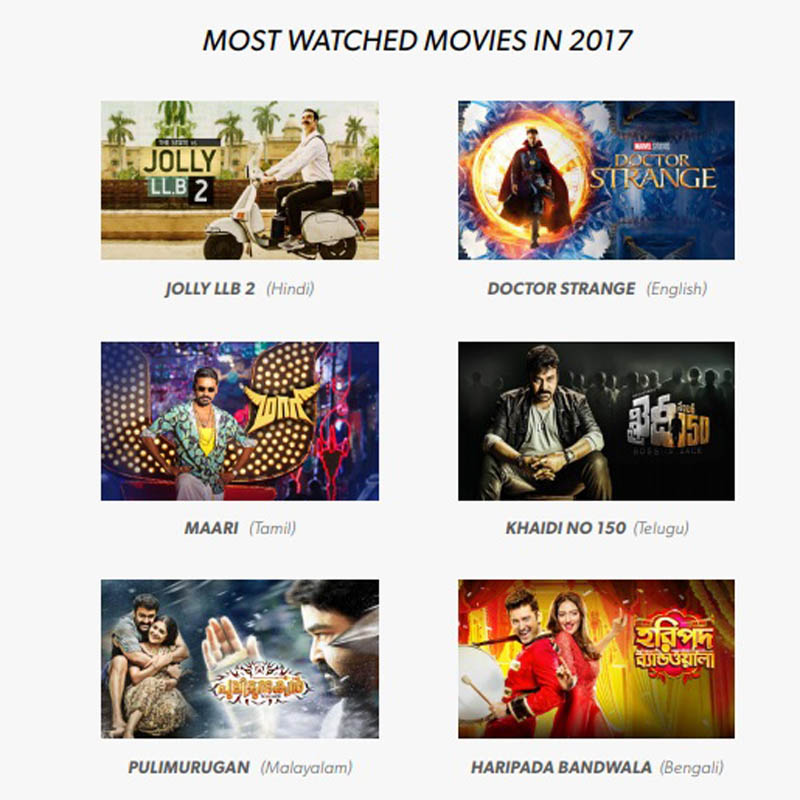
    The crown of the most watched show in 2017, according to IWR 2018, goes to the Rajan Shahi produced Yeh Rishta Kya Kehalata Hai. No surprises in the English show category with Game of Thrones emerging on top, and Big Boss Tamil and Telugu reigning in their respective languages.

    Also Read :

    Video Lighting up Data and Smartphones, Says Hotstar

    Hotstar announces partnership with awesomeness

    Leaving a Job is never easy, Hotstar gives you the best ways to #QuitInStyle

  • Guest Column: M&E industry in India: 5 not-to-be-missed trends

    The Indian M&E industry is growing at 15 per cent CAGR and is expected to double in size over the next five years. Almost all the sub-segments are growing in double digits. The existing ones are those in the middle of a consumption trend like on-demand content or beneficiaries of a regulatory push like digitisation.

    Here are the five biggest trends to watch out for:

    1.OTT

    Personalisation of content and delivery and real time access on multiple devices and platforms to make OTT mainstream. Big data through instant consumer analytics to become indispensable

    2.Digital Content as growth driver

    Growth to be driven by digital content in the internet industry in India as it doubles to $250bn in 5 years. Unprecedented proliferation of digital-first media brands like AIB, TVF, etc. Existing traditional media brands may reorient themselves to being digital-only brands. Repurposing widely popular content of the past on digital for consumption across multiple content formats may be a unique sound strategy.

    3.Immersive content as lead format

    Immersive content (VR/AR) to play an unexpected big role in the future. May become larger than any other format in the years to come.

    4.Technology to disrupt more than just content

    Technology to continue to disrupt the traditional ways of buying and selling advertising as programmatic, geo-targeting, etc becomes the new normal. TV and digital measurement to converge too as marketers look for platform-agnostic strategies.

    5.Convergence of M & E & Technology to undergird everything

    With cheap economics dictating the rationale, cloud-based services to drive content faster from creation to consumption thereby re-defining movement, distribution and management of content. Rapid convergence of media, entertainment and technology is interlinking content creation, distribution and consumption experiences.

    New media – signifying interplay between technology and media – is where the real excitement is. It offers a range of opportunities in content and platforms across gaming, video and music. Other than that, there are consolidation plays in traditional media like C&S distribution, film exhibition etc.

    public://Untitled-3_17.jpg

    (Piyush Sharma, a global tech, media and entrepreneurial leader, created the successful foray of Zee Entertainment in India and globally under the ‘Living’ brand. The views expressed here are of the writer’s and Indiantelevision.com may not subscribe to them.)


  • Spice Mobility historical branding expenses indicate upward trend for FY-2015

    Spice Mobility historical branding expenses indicate upward trend for FY-2015

    BENGALURU: Indian mobile devices company Spice Mobility Limited (Spice -formerly S Mobility Limited) spent 89.9 per cent more towards branding expenses in the year ended 30 June 2014 (FY-2014) at Rs Rs 78.35 crore (3.7 per cent of total income from operations or TIO) as compared to Rs 41.26 crore (2.2 per cent of TIO) in FY-2013.


    For the 15 month period ended 30 June 2013 (15M-2012), the company spent only Rs 9.61 crore (3.5 per cent of TIO), while in the 12 month period ended 31 March 2011 (FY-2011M), the company had also spent Rs 6.51 crore (3.2 per cent of TIO) towards branding.


    Spice has reported a loss of Rs 28.15 crore in FY-2014 as compared to a PAT of Rs 5.48 crore in FY-2013, a loss of Rs 0.97 crore in 15M-2012 and a profit of Rs 10.4 crore in FY-2011M.


    Note: 100,00,000 = 100 Lakhs = 10 million = 1 crore


    Let us look at the branding expenses by the company over an eight quarter period starting Q1-2013 (quarter ended 30 September 2013) until Q4-2014 (quarter ended 30 June 2014). Please refer to the figure below:


    Over this eight quarter period, the lowest branding spend has been in Q3-2013 at Rs 9.21 crore (2.3 per cent of TIO) in Q3-2013 (quarter ended 31 March 2013) in absolute rupee value, while in terms of percentage of TIO, the company’s lowest branding spend at 1.8 per cent (Rs 9.76 crore) in Q1-2013. It may be noted that both these lowest quarterly spends are at par with Spice’s branding spend during 15M-2012 and significantly higher than the branding spend in FY-2011.


    Spice’s highest branding spend during the eight quarter period under consideration in absolute rupee terms has been in Q4-2014 at Rs 24.47 crore (4.5 per cent of TIO), while in terms of percentage of TIO it was in Q3-2014 at 4.6 per cent of TIO or Rs 21.71 crore.

    The figure above shows that on a quarterly basis, with time the linear trend lines depict branding spends in absolute rupees and percentage of TIO diverge. This indicates that the company’s branding spends in absolute rupees can increase further, but the increase in terms of percentage of TIO may be at a lower comparative rate or even flat on an annual basis,  but, brand spends could depend upon the company’s overall performance during the coming quarters and the financial year/s.

  • Sir Martin Sorrell shares 10 trends shaping the global ad business

    Sir Martin Sorrell shares 10 trends shaping the global ad business

    The world’s biggest media conglomerate, which shapes the advertising and marketing of brands globally, has good news for marketing companies even though some nations are going through economic crises.


    WPP’s founder and CEO Sir Martin Sorrell shared his views on the trends impacting the global marketing service industry on his Linkedin blog.


    “As we plan for the future of our business, looking across the 110 countries in which we operate, we try to identify the trends that we think are shaping the global marketing services industry.


    Here’s our top ten:


    1. Power is shifting South, East and South East

    New York is still very much the centre of the world, but power (economic, political and social) is becoming more widely distributed, marching South, East and South East: to Latin America, India, China, Russia, Africa and the Middle East, and Central and Eastern Europe.


    Although growth rates in these markets have slowed, the underlying trends persist as economic development lifts countless millions into lives of greater prosperity, aspiration and consumption.


    2. Supply exceeds demand – except in talent

    Despite the events that followed the collapse of Lehman Brothers in 2008, manufacturing production still generally outstrips consumer demand. This is good news for marketing companies, because manufacturers need to invest in branding in order to differentiate their products from the competition.


    Meanwhile, the war for talent, particularly in traditional Western companies, has only just begun. The squeeze is coming from two directions: declining birth rates and smaller family sizes; and the relentless rise of the web and associated digital technologies.


    Simply, there will be fewer entrants to the jobs market and, when they do enter it, young people expect to work for tech-focused, more networked, less bureaucratic companies. It is hard now; it will be harder in 20 years.


    3. Disintermediation (and a post-digital world)

    An ugly word, with even uglier consequences for those who fail to manage it. It’s the name of the game for web giants like Apple, Google and Amazon, which have removed large chunks of the supply chain (think music retailers, business directories and bookshops) in order to deliver goods and services to consumers more simply and at lower cost.


    Take our “frienemy” Google: our biggest trading partner (as the largest recipient of our clients’ media investment) and one of our main rivals, too. It’s a formidable competitor that has grown very big indeed by – some say – eating everyone else’s lunch, but marketing services businesses have a crucial advantage.


    Google (like Facebook, Twitter, LinkedIn and others) is not a neutral intermediary, but a media owner. Google sells Google, Facebook sells Facebook and Twitter sells Twitter.


    We, however, are independent, meaning we can give disinterested, platform-agnostic advice to clients. You wouldn’t hand your media plan to News Corporation or Viacom and let them tell you where to spend your advertising dollars and pounds, so why hand it to Google and co?


    Taking a broader view of our increasingly tech-based world, words like “digital”, “programmatic” and “data” will soon feel out-dated and obsolete as, enmeshed with so many aspects of our daily lives, network-based technologies, automation and the large-scale analysis of information become the norm.


    The internet has been a tremendous net positive for the advertising and communications services business, allowing us to reach consumers more efficiently, more usefully and often more creatively on behalf of clients. But it won’t be long before those clients stop asking our agencies for a “digital” marketing strategy (many already have). It will simply be an inherent part of what we’re expected to offer.


    4. Changing power dynamics in retail

    For the last 20 years or so the big retailers like Walmart, Tesco and Carrefour have had a lot more power than manufacturers because they deal directly with consumers who are accustomed to visiting their stores.


    This won’t change overnight, but manufacturers can now have direct relationships with consumers via the web and e-commerce platforms in particular. Amazon is the example we all think of in the West, but watch out for Alibaba, the Chinese behemoth due to list on the New York Stock Exchange later this summer in what could be the largest IPO in corporate history (and heading a capitalisation of around $200 billion).


    5. The growing reputation of internal communications


    Once an unloved adjunct to the HR department, internal comms has moved up the food chain and enlightened leaders now see it as critical to business success.


    One of the biggest challenges facing any chairman or CEO is how to communicate strategic and structural change within their own organisations. The prestige has traditionally been attached to external communications, but getting internal constituencies on board is at least as important, and arguably more than half of our business.


    6. Global and local on the up, regional down

    The way our clients structure and organise their businesses is changing. Globalisation continues apace, making the need for a strong corporate centre even more important.


    Increasingly, though, what CEOs want is a nimble, much more networked centre, with direct connections to local markets. This hands greater responsibility and accountability to local managers, and puts pressure on regional management layers that act as a buffer, preventing information from flowing and things from happening.


    7. Finance and procurement have too much clout, but this will change

    Some companies seem to think they can cost-cut their way to growth. This misconception is a post-Lehman phenomenon: corporates still bear the mental scars of the crash, and conservatism rules.


    But there’s hope: the accountants will only hold sway over the chief marketing officers in the short-term. There’s a limit to how much you can cut, but top-line growth (driven by investment in marketing) is infinite, at least until you reach 100% market share.


    8. Bigger government


    Governments are becoming ever more important – as regulators, investors and clients. Following the global financial crisis and ensuing recession, governments have had to step in and assert themselves – just as they did during and after the Great Depression in the 1930s and 1940s. And they’re not going to retreat any time soon.


    Administrations need to communicate public policy to citizens, drive health initiatives, recruit people, promote their countries abroad, encourage tourism and foreign investment, and build their digital government capabilities. All of which require the services of our industry.


    9. Sustainability is no longer “soft”

    The days when companies regarded sustainability as a bit of window-dressing (or, worse, a profit-sapping distraction) are, happily, long gone. Today’s business leaders understand that social responsibility goes hand-in-hand with sustained growth and profitability.


    Business needs permission from society to operate, and virtually every CEO recognises that you ignore stakeholders at your peril – if you’re trying to build brands for the long term.


    10. Merger flops won’t put others off

    Despite the failure of one or two recent high-profile mega-mergers, we expect consolidation to continue – among clients, media owners and marketing services agencies. Bigger companies will have the advantages of scale, technology and investment, while those that remain small will have flexibility and a more entrepreneurial spirit on their side.


    FMCG and pharmaceuticals (driven by companies like 3G and Valeant) are where we anticipate the greatest consolidation, while our own industry is likely to see some activity – with IPG and Havas the subject of constant takeover rumours. At WPP we’ll continue to play our part by focusing on small- and medium-sized strategic acquisitions (31 so far this year, and counting).”


     (These are purely personal views of  WPP’s founder and CEO Sir Martin Sorrell and indiantelevision.com does not subscribe to these views.)