Tag: Travel

  • Cleartrip ropes in Lowe Lintas as its creative agency

    Cleartrip ropes in Lowe Lintas as its creative agency

    Mumbai: Online travel company, Cleartrip has recently appointed Lowe Lintas to manage its creative duties. The Bangalore office of the agency will handle the creative mandate for the brand.

    The scope of the agency will primarily include reinvigorating the brand and crafting a robust communication strategy to navigate the brand in the new industry landscape, said the statement.

    “We are happy to onboard Lowe Lintas as our creative partner. Our approach will be to not only build an innovative portfolio but one that is represented by a brand persona that is memorable and impactful,” said Cleartrip chief business officer Prahlad Krishnamurthi. “We will be closely working with the Lowe Lintas team and expect that their strategic, innovative, and forward-looking approach will contribute immensely to further building the Cleartrip brand and propelling our growth. We look forward to a rewarding and long-standing partnership.”

    Companies in the travel and tourism industry must reposition themselves for the post-pandemic market and adapt to the mindset of a new, cautious breed of consumer. Lowe Lintas will play an integral role in positioning Cleartrip as the go-to travel partner in the minds of these travellers, said the agency in a statement.

    “The last year and a half has really taught us the true meaning of a ‘VUCA’ world,” said Lowe Lintas executive director and branch head – South Sonali Khanna. “In order for impacted industries, like travel & tourism, to get back on track, we need to devise transformational strategies. Lowe Lintas is no stranger to bold new ideas, and we’re delighted to partner with Cleartrip to meet this challenge head-on.”

  • Expo 2020 Dubai ropes in Thomas Cook & SOTC as authorised ticket resellers

    Expo 2020 Dubai ropes in Thomas Cook & SOTC as authorised ticket resellers

    Mumbai: Integrated travel services company, Thomas Cook India, and its group company, SOTC Travel Ltd, have been appointed as authorised ticket resellers for Expo 2020 Dubai, to be held in Dubai from 1 October 2021 to 31 March 2022.

    To ensure Indian’s maximise this opportunity, Thomas Cook India and SOTC have designed a unique portfolio of ready-to-book products and customised experiences, specially curated to appeal to India’s leisure, business and MICE visitors. The one-day tickets and multi-day tickets incorporate unbeatable value with included attractions and shows as well as access to more than 200 pavilions, as per the travel company.

    Thomas Cook India and SOTC have launched technology enabled solutions towards personalisation – enabling travellers to create their own itinerary based on their personal preferences – to best optimise their Expo 2020 visits. 

    Thomas Cook India president & country head – holidays, MICE, Visa, Rajeev Kale said, “We are delighted and honoured to be appointed an Authorised Ticket Reseller for Expo 2020 and have lined up an exciting range of unique products for every traveller – from India’s millennials, couples, families, students, business to MICE travellers. For industry associations, corporates/businesses, Expo 2020 is an ideal space for ideation/R&D/business and networking and our products have been tailor-made to cater to their specific needs too.”

    SOTC Travel president & country head Daniel D’souza said, “Expo 2020 is a vibrant platform, be it to learn, innovate or do business, and our unique product-service portfolio as an Authorised Ticket Reseller promises an extraordinary experience across all age groups and source markets from metros to regional India. Our company’s presence and reach countrywide will give consumers easy access to plan their perfect Expo trip/s with our experts – by visiting our retail stores or via our virtual holiday outlet. Expo 2020, stated to be the world’s greatest show awaits Indians and we look forward to creating a truly memorable experience for Indians.”

    Expo 2020 Dubai VP, market strategy and sales Sumathi Ramanathan said, “Expo 2020 Dubai represents a global celebration of human ingenuity – one that promises an extraordinary experience for visitors of all ages, nationalities and interests – and I am especially delighted with our appointment of Thomas Cook India & SOTC as an Authorised Ticket Reseller to help us in our delivery for this highly viable market. Expo 2020 is ready to welcome the world, and with the support of Thomas Cook and SOTC, we invite Indians to join us and be part of the most diverse World Expo in history, as we build a better future for all.”

    With the theme and purpose of ‘Connecting Minds, Creating the Future’, Expo 2020 aims to be the world’s most impactful global incubator for new ideas, catalysing an exchange of new perspectives and inspiring action to deliver real-life solutions to real-world challenges.

  • Travelxp bets big on OTT content, launches new platform Travelxp RED

    Travelxp bets big on OTT content, launches new platform Travelxp RED

    New Delhi: The OTT boom has taken the world by storm over the last few years and India remains one of its fastest growing markets. The latest entrant is India’s global travel channel, Travelxp, which has now joined the race and announced its new streaming platform- Travelxp Watch.

    Travelxp is available on the App Store and the Google Play Store and is planning to add TV Apps by the end of this month. More than 250 original travel stories, of which 50 per cent are shot in 4K HDR, will be available in English, Hindi as well as in two regional Indian languages – Tamil and Bengali, it said on Wednesday.

    It will be streaming more than 150+ hours of original travel content and hopes to increase the library strength to 1000+ hours of content by the end of FY 2022.

    “We launched the world’s first 4K HDR Channel in 2016, and now the world’s first 4K HDR Travel OTT Platform, with Travelxp Watch. We are delighted to bring the power of 4K HDR to our Indian fanbase,” said Travelxp 4K| HD, founder CEO Prashant Chothani. “The project has been in the works for nearly two years now, we wanted to get it right with regards to the entire customer experience. In a period where travel is going to see a big resurgence, Travelxp is going to be at the heart of supporting the travel recovery with the power of content.”

    The entire product was built by an inhouse team through the entire Covid lockdown.

    “The passion of the team in creating a platform that resembles the simplicity and joy of travel has seen us shoot up to the Top 50 Apps in India for the Travel Category in less than a week since launch, and we have more than 30,000+ Monthly Active Users already,” said Tanay Chothani, who joined Travelxp two years ago to lead all Digital Projects, a major part of which constituted the OTT Platform.

    Chothani highlighted that the content driven commerce model is going to be a big part of Travelxp’s strategy going forward. “The power of video is unparalleled in driving demand and also giving viewers more decision making power. While we showcase the world in the beautiful 4K HDR quality we are known for, we are also going a step further and allowing our users to book and plan their travels, right from the same app,” he added.

    Travelxp’s OTT Platform is available at www.travelxp.com.

  • Domestic travel picks pace amid vaccine roll-out, easing of rules shows survey

    Domestic travel picks pace amid vaccine roll-out, easing of rules shows survey

    MUMBAI: More than a year into the pandemic, restrictions on movement continue across various countries. However, the global appetite for travel remains intact, with an inclination towards domestic travel (51 per cent) exceeding international (18 per cent). A significant fact is that the resumption of travel will start closer to home.

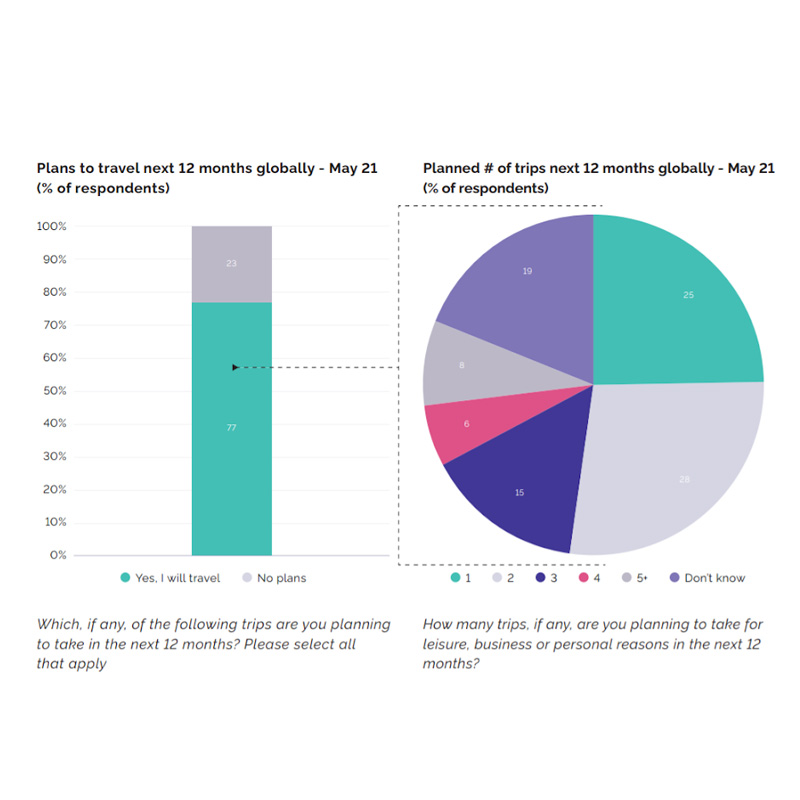
    According to YouGov’s ‘International Travel & Tourism Report 2021: The road back to normality‘ , post-pandemic international travel will begin with familiar destinations, while business travel recovery may take longer. It also showed that 77 per cent of global consumers plan to travel in the next 12 months with 57 per cent planning over two trips. Majority of the travel demand will be led by millennials and Gen X, according to the survey.

    The survey conducted in 25 global markets including India among 1.8 lakh respondents found that there is a gradual fall in the number of people concerned over health risks across the globe since January 2021, in line with the approvals of vaccines and their widespread rollout.

    As the pandemic begins to subside globally and extensive vaccinations buoy up spirits in most parts of the world, what does the road back to normality look like for the travel & tourism sector? Encouragingly for travel companies, the intent to travel domestically for leisure rose sharply at the start of 2021. The recovery of international travel depends on softening of restrictions, found the study which shows that international travel intent in 2020 remained low due to strict restrictions. But as more herd immunity is reached in various parts of the world, it’s reasonable to expect declining health concerns, even if they don’t disappear completely.

    With the European Union all set to roll out its ‘Green Pass’ or Digital Covid certificate to facilitate free movement during these challenging times, there’s a glimmer of hope for the travel industry in 2021. And now with news coming in that European countries, including Switzerland and Germany, are ready to extend the pass to Indians vaccinated by Covishield, there is some respite in store for those pent-up wanderlust emotions lying suppressed for over a year now.

    The road back to normality for the travel industry, however, is going to be a bumpy one. Only one in five consumers globally plan to travel internationally in the next 12 months. The report analyses consumer travel preferences and identifies the emerging opportunities that will prove most lucrative for industry players. As travel attitudes and restrictions shift rapidly, so do travelers’ interests in particular destinations.

    The changes we see in travelers’ consideration of different destinations appear linked to both the seasonal relevancy of the destination, as well as the restrictions that are currently in place to travel to or from the locale.

    Health risks remain the biggest barrier to travel (48 per cent) for global survey respondents, followed by safety (37 per cent) and travel restrictions (35 per cent)- Although, the proportion of those concerned about health risks from travelling has gradually decreased since January, when it stood at 56 per cent, in line with the rollout of the vaccine.

    A clear appetite for travel globally is indicated with more than 77 per cent of the respondents planning trips during the next 12 months and with more than half of this group planning two or more journeys (57 per cent).

    Millennials and Gen X have the confidence and the means

    The youngest generation, Gen Z, has been the hardest hit economically. While they have less concern over health risks, a lack of disposable income is holding them back in terms of their ability to travel freely, the study shows. The oldest generation is on the other side of the coin – with savings due to having spent less in the last year, but more concerns around travel safety. Somewhere in the middle is the audience travel companies are looking for. Millennials and Gen X on average have the combination of confidence to travel, lack of immediate health risks, and the finances to fund trips in the coming months and years.

    The survey indicates that around a third of people globally feel restrictions are preventing them from traveling. Travel restrictions and risks of quarantine have proven to be a more constant dampener than concerns about the virus. Uncertainty over local and national lockdowns as well as international travel will continue to put downward pressure on a fragile recovery.

  • Covid takes its toll on 65-year-old iconic luggage brand

    Mumbai: The pandemic has taken its deathly hold not just on people’s lives but also their livelihoods. Business organisations across different sectors are struggling to wade through the detrimental impact of Covid-19, and many others are facing closure. One such casualty has been the Chennai-based luggage retailer, Witco.

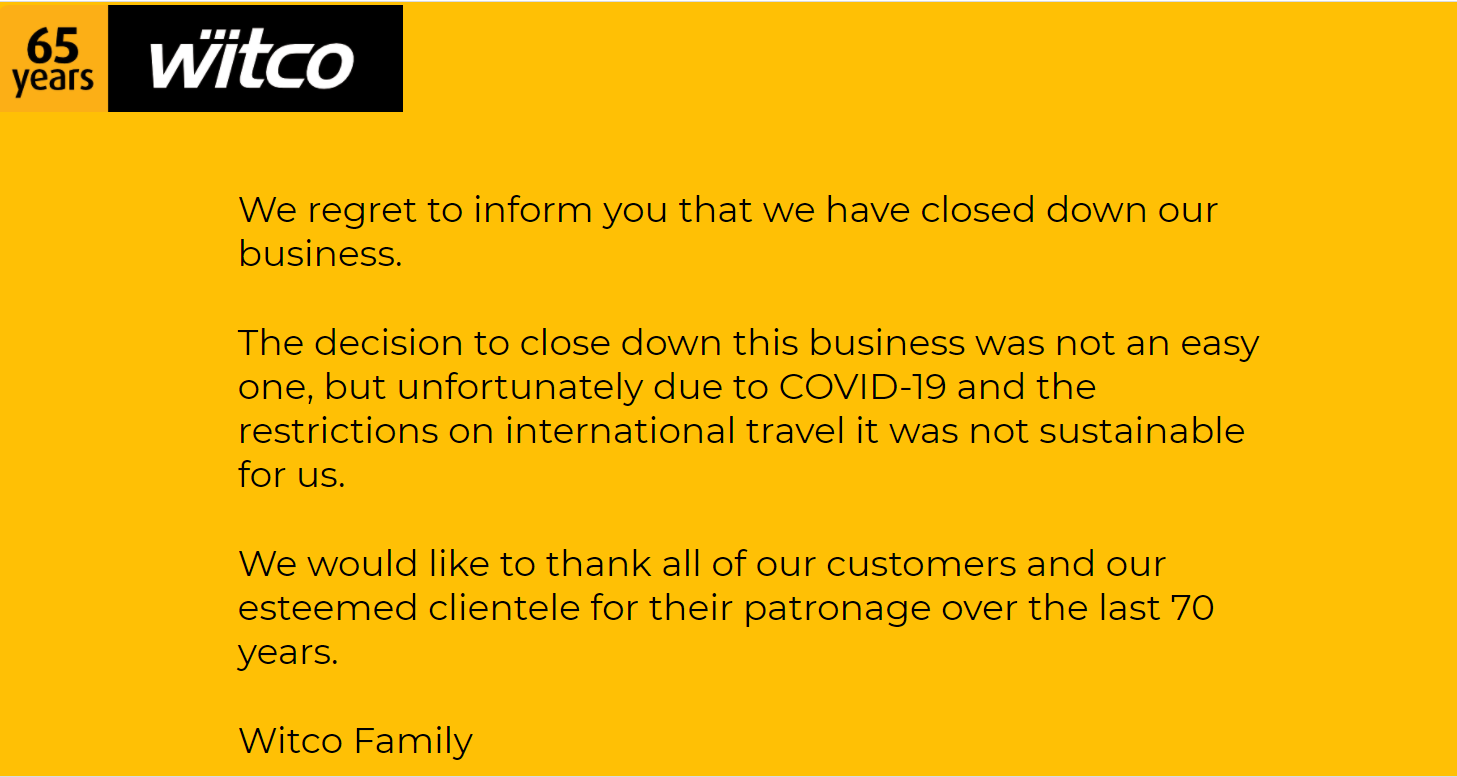
    After running for nearly 65 years, the iconic luggage retail chain has announced its decision to shut shop after it could not recover from the severe downturn caused by the ongoing pandemic. “We regret to inform you that we have closed down our business. The decision to close down this business was not an easy one, but unfortunately due to COVID-19 and the restrictions on international travel it was not sustainable for us,” the company wrote on its website.

    The company’s mainstay was international travel which contributed a significant portion to revenue. “While domestic travel resumed to some level towards the end of last year, International travel did not pick up and this impacted our sales,” the company’s MD VP Harris told Moneycontrol.

    The initial three months of the last financial year were a complete washout because of the lockdown, and the company could recover only 25-30 per cent of business after the economy reopened. “Given our rentals, employee salaries, and other expenses, we would have not been able to survive even if we had done 50 percent of our pre-Covid business,” he added.

    According to Harris, Witco’s downward spiral began with demonetisation, announced by the government in November 2016, which worsened further, after GST impacted its sales. The pandemic and lockdown proved to be the final nail in the coffin for the retail chain. The brand also tried to take the e-commerce route to survive and registered on Amazon and Flipkart but that too did not yield returns, shared Harris.

    Travel & tourism has been one of the worst affected sectors due to the pandemic. The market share for travel-related accessories and equipment has also taken a huge hit. While most sectors are still hopeful of recovery by the end of this financial year, the travel sector remains apprehensive and could take a long time to revive, according to industry experts. Consequently, the outlook for related segments such as luggage, too, remains grim.

    The brand with a strong presence in Chennai also had stores in Trichy, Kozhikode, Bengaluru and Kochi. Witco offered not only travel bags, but also laptop bags, backpacks, school bags, as well as handbags, from renowned brands like Samsonite, Delsey, American Tourister, Nike, Puma, VIP, Skybags, Baggit, Hidesign, Wildcraft and more.

    The sudden closure of the brand has left its decades-old customers dismayed. Several of them reminisced on social media, and shared childhood memories of shopping at the stores before starting the academic year of school and college or for their first trip abroad.

    “This is super sad. Witco was that one stop that you always window shopped and ogled in Forum Mall. It was also the place where we bought the first two large samsonite boxes that every graduate student buys before he goes to the US (and that was 18 years ago!),” shared one of the customers.

    Another tweeted, “This is terrible news. the 65-year-old brand shuts down. I fondly remember trips to Anna Nagar Witco ahead of school reopening to purchase school bags. One such backpack bought in 2002 is still in use.”

  • Thomas Cook’s Abraham Alapatt on looking beyond the pandemic

    Thomas Cook’s Abraham Alapatt on looking beyond the pandemic

    MUMBAI: Travel and tourism were among the first sectors to be hit in 2020, due to the outbreak of the Covid2019 pandemic and the resultant closure of borders. It has also been one of the most affected industries and probably will take the longest to revive, with both leisure and business travel taking the brunt. According to the World Travel and Tourism Council (WTCC), the pandemic is likely to cost the tourism sector almost $22 billion and 50 million jobs. Last year alone, India's hospitality and tourism sector suffered an economic wipe-out estimated to be up to Rs 15 lakh crore. And just when it began to show signs of recovery, the country is witnessing a resurgence in cases, dimming the outlook for the sector.

    Indiantelevision.com’s Anupama Sajeet spoke to Thomas Cook (India) president and group head of marketing Abraham Alapatt about how the travel industry plans to beat Covid 2.0 and assuage consumer fears. Alapatt also talked about the company's roadmap to deal with the large-scale disruption caused by the second wave of the pandemic.

    Edited excerpts:

    On the humongous challenge facing the tourism industry.

    The travel and tourism industry has been one of the hardest hit due to the Covid2019 pandemic. Given the vaccine rollouts, we are now witnessing a growth in positive consumer sentiment and are seeing fear being replaced with cautious optimism. In the short to medium term, the opportunity for tourism will be dominated by a few new keywords — safety and hygiene, clear focus on less crowded, more open space, sunshine-oriented destinations, and as a result possibly more unexplored, undiscovered, destinations and experiences.

    Going forward in the new normal, marketers have talked of the post-pandemic ‘3C’ customer, who is effectively going to be constrained — mentally, physically, and financially and will be connected to what’s happening in their country and the world. The post-pandemic customer is going to be defined by 4Ds, especially for travel:

    · Will Deliberate more on decisions on leisure travel

    · More Discerning about the choice of destinations

    · Demanding/Detail-oriented regarding all aspects of the travel programs

    · Discovery-oriented

    On marketing strategies for the upcoming summer holiday season.

    Summer is one of the primary seasons to travel for families given that most school vacations are during this time. While our marketing strategy in 2020 had been primarily digital, we have now reintroduced print to our mix of promotions. We believe in an omnichannel approach, giving the customer the choice to connect with us digitally, at our outlets, or via our toll-free numbers. Customers have now become more digital-savvy post-2020. We have seen an increase in the web traffic on our sites as well as walk-ins at our stores for final discussions and closures. We will continue to invest digitally and boost our retail network across the country.

    Also, we quickly adapted to the new normal and created products and services in line with the requirements of the Covid2019 era. The consumer wish-list had changed and our teams worked accordingly to create easy to book, practical holidays such as workations, staycations, drivecations, affordable luxury holidays. We focused on quick breaks to counter the stress of work from home and home chores at convenient short drivable distances.

    As international borders reopened, our teams negotiated deals with our vendors/partners to offer customers the best rates at Dubai and Maldives’ luxury and super-luxury resorts. The reopening of borders for additional countries has boosted outbound demand to destinations like Russia, Turkey, Egypt, and Seychelles. We have added the exciting Aurora Borealis/Northern Lights experience in Murmansk and launched our Nepal tours with a special offer. We are seeing growing confidence in international travel and the return of group travel. 

    On Thomas Cook’s roadmap for 2021 and beyond.

    We conducted a survey with over 2500 customers across India’s metros and tier-1 and tier-2 cities to understand key consumer behaviours and trends. Our Holiday Readiness Travel Report – Future of Travel post-Covid2019 revealed key drivers in this new era of travel. Health and safety ranks as the primary concern for 75 per cent of respondents. We took this challenge head-on and put together a three-pronged customer confidence-building program in the form of 'Assured-Insured-Secured', that covers every aspect of physical safety, as well as mental and financial security to give the customer complete peace of mind.

    We also launched the Assured Safe Travel Program and Doctor on Call 24×7 service in partnership with Apollo Clinics; a free-service offering expert guidance and assistance for safe holiday planning via a tie-up with ICMR accredited labs.

    Given the situation, the demand for virtual and contactless sales and services has accelerated. Our survey also revealed that given the prevailing uncertainty, a significant 71 per cent of respondents stated that they require the guidance of a holiday expert and preferred to visit an outlet/Virtual Store/video chat while planning their holidays. We introduced Virtual Holiday Store and our dedicated team of travel experts will be available over video chat to guide customers with contactless and convenient holiday planning. This is in addition to our retail outlets pan India, that are operational where permitted by local authorities.

    (In addition to Thomas Cook, the Thomas Cook India Group operates leading B2C and B2B travel brands including SOTC, Asian Trails, AlliedTPro (ATP), Australian Tours Management (ATM), Desert Adventures, Luxe Asia, Kuoni Hong Kong, TC Travel, Private Safaris East & South Africa and Sterling Holidays.)

  • Ixigo’s Ashish Pratap Singh joins Rehlat

    Ixigo’s Ashish Pratap Singh joins Rehlat

    NEW DELHI: Online travel booking platform Rehlat.com has named Ashish Pratap Singh as its chief marketing officer. He will be leading brand, growth, partnership and alliances at the company that was founded in 2012.

    Singh was last serving as head of digital marketing at ixigo.com, where he spent nearly four years.

    At ixigo, Singh was leading brand, content, creative, acquisition, and attribution initiatives. He was responsible for new user acquisition, growing organic traffic, repeat visits and managing analytics.

    This was Singh’s second stint at ixigo. He was previously associated with the organisation between 2012 and 2014.

    He has over 10 years of industry experience and has worked at multiple brands such as Zopper, Karyaah, and Stellar Information Systems. 

  • How Travelxp plans to conquer the travel space

    How Travelxp plans to conquer the travel space

    MUMBAI: Travelxp wants to travel far and wide. The Mumbai-based lifestyle channel, that has already seen a steady revenue growth for the last few years, now intends to grow by 30-40 per cent in the coming year.

    The network intends to expand to at least 15 more countries by the end of 2019 fiscal, and Latin America is one of them. The channel is already available in English, German, Czech, Slovenian, Serbian, Croatian and Bulgarian, and Travelxp director Nisha Chothani says it will soon be launched in Chinese too by December 2018. The channel caters to the Indian local markets through its Hindi, Tamil and Bengali feeds. The plan also includes launching certain South Indian and Marathi languages as well.

    “Since our plan is to enter Latin America and Russia, we will be launching one of these two languages depending on which country we are in Latin America. Spanish or Portuguese language might be the one and then Russian as well,” said Chothani.

    All shows on the channel are original in-house productions and its content is divided into six main categories – destination, lifestyle, food, culture, nature and heritage. Audience analysis has found that shows about hotels or anything related to spa works well.

    When it comes to the growth of OTT platforms, Chothani feels it is just another medium of consuming content. “So today when we say that TV viewership is dipping, at the same time we see that all these OTT platforms have become a part of the apps on television, and that’s more like having one more channel on TV. So ultimately you are watching it on TV, whether it’s coming through satellite or internet,” she said.

    She added that when it comes to OTT platforms, Netflix and Amazon are also the channels that provide differentiated content and have more content than other players in the market. As far as the preferences of the viewers are concerned, they might consume daily soaps, movies, news or infotainment on digital as well, which is the same that you see on the linear television. “TV is just the medium to transport our content,” she added.

    While producing a show, in order to keep the viewers glued to their channel, it obviously takes a lot of effort for not by the broadcaster but the crew making the show. Chothani said that when they produce any show, five people are required to take up the responsibility as the amount of equipment that is carried by them is difficult for an individual person to handle.

    When it comes to the time and efforts made in making just a show, Chothani said that if it’s just the shooting for the program, it takes minimum 20 days to shoot at the destination. Pre-production and post-production take around four months and later the post edit part also consumes four weeks to set the ball rolling. “By the time we start identifying the destination, designing, what all you need to see in a destination, getting the permissions for the shoot to be done, getting 4K ready, where it takes the longest time, from ingesting a material to rendering an episode and dubbing the same in various regional languages, it is a long process,” she explained.

    Travelxp has had its content work in most countries. “Mauritius now wants to include in different packages, earlier, we were only in one package but now they want us in more than one package because they find people liking this particular genre in travel,” she added.

    The channel is all set to launch its new programme named 10 Days Cyprus. The story revolves around a normal traveller who visits a place in 10 days, shooting all the exciting things about that place, in a bid to make the viewer plan a holiday by watching the show.

  • Year-end travel more affordable in 2017: Oyo

    Year-end travel more affordable in 2017: Oyo

    MUMBAI: Oyo hotels has launched its analysis report which reveals that tariffs in its hotels across top leisure destinations in India are six per cent lower this December than last year. This is in line with the company’s mission of making quality living spaces more affordable for travellers. While hotels in a majority of holiday destinations have become more affordable than before, there are some destinations witnessing higher tariffs due to sustained traveller interest and constraints of quality hotels.

    The data indicates that room tariffs have come down in Darjeeling (29 per cent), Srinagar (23 per cent), Kovalam (22 per cent), Lonavala (16 per cent), and Jaisalmer (15 per cent) due to high demand.

    Hill stations witnessed the greatest drop in tariffs, thanks to the emergence of new guest houses and alternate branded hospitality accommodation. Kasauli and Gangtok tariffs are nearly 30 per cent lower, while Dharamshala (-13 per cent), Lonavala (-16 per cent) and Ooty (-10 per cent) are also showed a drop.

    Oyo has done aggressive capacity addition, making hospitality affordable for the masses. The increase in affordability has led to higher occupancies wherein the start-up has created value for its hotel partners. Despite an aggressive pricing model across the network, Oyo has delivered higher-than-industry occupancy of 80 per cent across its network.

    With hotels in 230-plus cities, Oyo is India’s largest hotel network that has recorded more than five million check-ins till date. Backed by its data science and pricing technology, it also identified the most-expensive and most-affordable localities for budget hotels in top travel destinations.

  • Media and marketing professionals most vacation deprived: Expedia Report 2017

    Media and marketing professionals most vacation deprived: Expedia Report 2017

    MUMBAI: Majority of media and marketing professionals are sleep-starved, according to Expedia’s new edition of Vacation Deprivation Report 2017, stating that they cannot afford to take a holiday. 

    The study was conducted online between 4 September and 15 September 2017 on behalf of Expedia by Northstar Research Partners. The company surveyed 15,081 working adults across 30 countries.

    The report states that 66 per cent respondents of those surveyed from the media and marketing sectors said they don’t take vacations because they cannot afford a holiday or get out of work.

    Millennials are the most vacation-deprived age group and also receive the least vacation time. At 53 per cent, they are also the most likely to shorten their trips due to impending workload.

    Professionals in the government and education sectors are found to be the least vacation deprived.

    The study revealed that after media and marketing sector professionals, about 62 per cent of those in the food and beverage sector said they don’t have enough holidays, followed by agriculture with 56 per cent, transportation and travel with 56 per cent, business and consulting around 55 per cent, and finance and legal at 55 per cent.

    Furthermore, the study said that professionals in government, health, transportation and travel, real estate, business and consulting and manufacturing and technology sectors have not taken a holiday in the last six months.

    Moreover, 35 per cent of professionals in sectors like agriculture, media and marketing, food and beverage, retail and education said they are vacation deprived mainly because they cannot afford to take a holiday. In sectors like finance and legal, however, 28 per cent professionals attribute it to not getting time off from work. 

    Also read: 

    Air India, Jet and Indigo’s oops moment!

    Budget ’17: Rural net will facilitate travel bookings