Tag: travel industry

  • Fastest growth in travel advertising to come from India: Zenith report

    Fastest growth in travel advertising to come from India: Zenith report

    Mumbai: Travel advertising is poised for rapid growth as brands reset their relationships with consumers after the great rupture of 2020, according to Zenith’s Business Intelligence – Travel report. The report, published on Monday, forecasts that travel advertising in 13 key markets, including India, will expand by 24 per cent in 2021, twice as fast as the advertising market as a whole, before 36 per cent growth in 2022. 

    Significantly, Zenith expects the fastest growth in travel advertising to come from India, where travel ad spend will be 31 per cent above the 2019 baseline by 2023. Here, rising disposable incomes mean more people are travelling, and existing travellers are travelling more frequently.

    Zenith forecasts digital ad spend by travel brands to grow by six per cent a year between 2019 and 2023. By 2023 travel brands will be spending 70 per cent of their budgets on digital advertising, an increase from 63 per cent in 2020.

    Travel advertisers spend more on digital advertising than the average brand – 63 per cent in 2020, compared to 58 per cent on average, as per the report. This is not surprising for a category that has been well ahead of the market in digital transformation, conducting 32 per cent of sales by e-commerce in 2021 compared to 20 per cent for retail as a whole.   

    “Travel was one of the earliest sectors to embrace digital as booking went online,” said Zenith global chief strategy officer Ben Lukawski. “Post-Covid, the best-performing brands will complete this transformation by making the total experience digital, from reducing form-filling to contactless entry, removing nearly all possible friction from the experience.”

    Digital travel advertising aims to capture consumers in the early stage of research, through search advertising and display and video ads within relevant content. As travel becomes ever more digital, digital advertising will become even more important for both brand building and conversion. Integrating travel apps with vaccine passports, using them to help consumers navigate local Covid-related rules and bureaucracy, and offering digital concierge services will accelerate the transition of travel towards a seamless digital experience, from initial research to enjoying the destination.

    Furthermore, travel advertisers spend substantially more of their budgets on newspapers, magazines and out-of-home than average (20 per cent in 2020, compared to 13 per cent for the average brand), and substantially less on television (13 per cent compared to an average of 24 per cent), the report observed. Consumers are looking for choice and value, so media that allow brands to display a range of options and some details of pricing are particularly effective. Travel ad spend in print is falling as circulations continue to shrink, but out-of-home is forecast to recover from its slump in 2020 and grow at an average rate of six per cent a year between 2019 and 2023.

    Pent-up demand for travel will drive rapid growth in travel ad spend over the next few years, but it will be a long road back to pre-pandemic spending. Travel ad spend will be still 33 per cent below its 2019 level this year, while the ad market as a whole will be seven per cent ahead, notes the report. It will take until 2023 for travel to exceed 2019 levels of spending when it will reach $19.6 billion.

    Travel advertising was one of the categories hardest hit by Covid-19. The travel ad market lost nearly half its value in 2020 (46 per cent), while the ad market as a whole shrank by just four per cent. Zenith estimates that travel ad spend fell from $18.0 billion in 2019 to $9.7 billion in 2020.  

    As global travel starts to recover, travel brands must rebuild their relationships with consumers as they adapt to the realities of post-Covid travel. Brands will have to refocus their communications on different audiences as they adapt to the decline of business travel as companies coordinate more international business with remote meetings, and address consumers’ concerns about the sustainability of travel, and adapt to the growing demand for low-carbon journeys.

    “As travel begins to recover from the unprecedented drop in demand in 2020, brands are rebuilding their relationships with consumers, using digital technology to guide them at every stage,” said Zenith head of Forecasting Jonathan Barnard. “Online video, in particular, will play a key role in creating emotional connections with consumers, inviting them to take their first step on their digital journey.”

    The robust US ad market is pushing up media prices, which is the main reason why travel adspend will be 13 per cent higher there in 2023 and in 2019. Other mature markets will range from +9 per cent to -9 per cent growth over this period, depending on consumer demand, media inflation, adoption of digital technology, and a myriad of other reasons. In all markets, though, the recovery of travel advertising from the slump in 2020 will be well behind the growth of the market as a whole.

    The thirteen markets included in this report apart from India are Australia, Canada, China, France, Germany, Italy, Poland, Russia, Spain, Switzerland, UK, and the USA, which between them account for 74 per cent of total global ad spend. The report covers domestic and foreign travel for business and leisure.

  • Domestic travel picks pace amid vaccine roll-out, easing of rules shows survey

    Domestic travel picks pace amid vaccine roll-out, easing of rules shows survey

    MUMBAI: More than a year into the pandemic, restrictions on movement continue across various countries. However, the global appetite for travel remains intact, with an inclination towards domestic travel (51 per cent) exceeding international (18 per cent). A significant fact is that the resumption of travel will start closer to home.

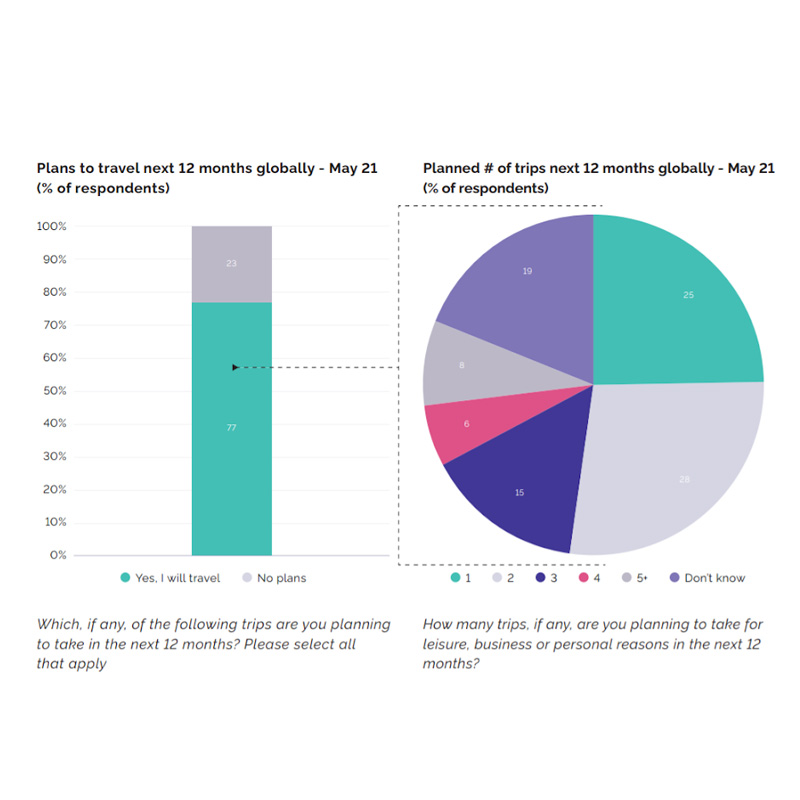
    According to YouGov’s ‘International Travel & Tourism Report 2021: The road back to normality‘ , post-pandemic international travel will begin with familiar destinations, while business travel recovery may take longer. It also showed that 77 per cent of global consumers plan to travel in the next 12 months with 57 per cent planning over two trips. Majority of the travel demand will be led by millennials and Gen X, according to the survey.

    The survey conducted in 25 global markets including India among 1.8 lakh respondents found that there is a gradual fall in the number of people concerned over health risks across the globe since January 2021, in line with the approvals of vaccines and their widespread rollout.

    As the pandemic begins to subside globally and extensive vaccinations buoy up spirits in most parts of the world, what does the road back to normality look like for the travel & tourism sector? Encouragingly for travel companies, the intent to travel domestically for leisure rose sharply at the start of 2021. The recovery of international travel depends on softening of restrictions, found the study which shows that international travel intent in 2020 remained low due to strict restrictions. But as more herd immunity is reached in various parts of the world, it’s reasonable to expect declining health concerns, even if they don’t disappear completely.

    With the European Union all set to roll out its ‘Green Pass’ or Digital Covid certificate to facilitate free movement during these challenging times, there’s a glimmer of hope for the travel industry in 2021. And now with news coming in that European countries, including Switzerland and Germany, are ready to extend the pass to Indians vaccinated by Covishield, there is some respite in store for those pent-up wanderlust emotions lying suppressed for over a year now.

    The road back to normality for the travel industry, however, is going to be a bumpy one. Only one in five consumers globally plan to travel internationally in the next 12 months. The report analyses consumer travel preferences and identifies the emerging opportunities that will prove most lucrative for industry players. As travel attitudes and restrictions shift rapidly, so do travelers’ interests in particular destinations.

    The changes we see in travelers’ consideration of different destinations appear linked to both the seasonal relevancy of the destination, as well as the restrictions that are currently in place to travel to or from the locale.

    Health risks remain the biggest barrier to travel (48 per cent) for global survey respondents, followed by safety (37 per cent) and travel restrictions (35 per cent)- Although, the proportion of those concerned about health risks from travelling has gradually decreased since January, when it stood at 56 per cent, in line with the rollout of the vaccine.

    A clear appetite for travel globally is indicated with more than 77 per cent of the respondents planning trips during the next 12 months and with more than half of this group planning two or more journeys (57 per cent).

    Millennials and Gen X have the confidence and the means

    The youngest generation, Gen Z, has been the hardest hit economically. While they have less concern over health risks, a lack of disposable income is holding them back in terms of their ability to travel freely, the study shows. The oldest generation is on the other side of the coin – with savings due to having spent less in the last year, but more concerns around travel safety. Somewhere in the middle is the audience travel companies are looking for. Millennials and Gen X on average have the combination of confidence to travel, lack of immediate health risks, and the finances to fund trips in the coming months and years.

    The survey indicates that around a third of people globally feel restrictions are preventing them from traveling. Travel restrictions and risks of quarantine have proven to be a more constant dampener than concerns about the virus. Uncertainty over local and national lockdowns as well as international travel will continue to put downward pressure on a fragile recovery.

  • Tangerine Digital launches analytics driven content solution for travel industry

    Tangerine Digital launches analytics driven content solution for travel industry

    MUMBAI: With more and more sectors moving to digital platforms to engage audiences, Tangerine Digital has announced the launch of analytics driven content services to aid travel companies enhance their customer engagement across digital platforms.


    The uniqueness of this offering is backed by analytics that will drive a brand’s content strategy. Tangerine Digital has expanded its existing range of services across the content marketing spectrum from content creation, content management, content aggregation and crowd sourcing services to analytics for content strategy.


    Leisure travellers seek travel inspiration online and want to stay connected and share experiences while traveling too, according to ‘The 2013 Traveler study’ from Google and Ipsos MediaCT on US travelers.


    About 80 per cent of people begun researching online for their next holiday vs. the 62 per cent who took tips from their friends; 42 per cent were more likely to use their smartphone or tablet for travel- or vacation-related information while on a trip. Once at a destination, 58 per cent of leisure travellers rely on online sources to evaluate local activities.


     With this launch, Tangerine Digital will now enable brands in the travel industry in India with travelogues, destination guides and videos, advanced photo shoots, user generated content, expert reviews and ratings, celebrity feeds, travel blogs, itineraries, traveler reviews and hotel description.


     Tangerine Digital CEO Kesavan Kanchi Kandadai said, “Today companies like to be constantly connected with digitally-savvy customers at every step of their travel planning. The travel industry greatly depends on reviews, advices from other travellers and the spread of opinions on digital platforms. Content strategy backed by analytics will allow travel companies to empower their customers with customised and personal experience, driving brand loyalty and ROI. Over the content offering we ensure that all relevant metrics are pulled out from various digital platforms on the content trends that help brands drive engagement.”


    Having an array of clients in several sectors, Tangerine Digital is now aggressively focusing on growing the business in the travel sector. According to a new report by Waggener Edstrom Communications released in January 2014, an astonishing 97 per cent of the Indians surveyed follow their favourite brands on social media. The study also stated that Indian consumers who follow travel and tourism brands spend up to 187 per cent more on these company products per year.