Tag: Trai

  • TRAI likely to appeal against HC order on draft broadcast tariff

    TRAI likely to appeal against HC order on draft broadcast tariff

    MUMBAI: The Telecom Regulatory Authority of India could move the apex court challenging the Madras High Court’s status quo order on draft tariff rules for the broadcast sector that stopped it from issuing any further guidelines.

    The high court recently stayed TRAI’s right to decide TV tariffs. On 23 December, the court ordered that TRAI maintain status quo with regard to any tariff orders or regulations for Rs 54,225 crore Indian television industry. 

    Freezing of TRAI powers to decide television prices meant better programming and variety for the audience, ease of doing business and improved margins for the second largest TV market in the world.

    The order had come on a petition filed by Star India and Vijay TV on the ground that the TRAI orders are in conflict with the Copyright Act 1957. As a result of this court order and pending the full hearing of the case, TRAI would not be able to pass any guideline for issues such as broadcast tariff, broadcast interconnect, and quality of services.

    Also Read:    Maintain status quo on broadcast guidelines, Madras HC tells TRAI

    Also Read:    DAS 4 deadline extended to 31 Mar 

  • Regulations 2016: Of DeMon challenges, changing goalposts & rampant litigation

    Regulations 2016: Of DeMon challenges, changing goalposts & rampant litigation

    The regulatory regime in 2016 not only continued to struggle keeping pace with fast-marching technology (4G is passé, 5G is being talked in some countries), but lack of consensus amongst stakeholders on major issues meant that litigation was rampant, thus leading to changing milestones. It was also about the government trying to enforce censorship via the backdoor and, hence, despite the best of intentions, only average dividends accrued to the media and entertainment sector in India, which is still described as a market with huge potential, but also a challenging place to do business.

    The biggest policy (that ultimately turned into a regulatory challenge) initiative of 2016 — some would say the biggest hiccup — was PM Modi’s demonetisation bomb aimed at unleashing a surgical strike on black money and parallel economy in the country that, according to an earlier government narrative, made the poor poorer and gave a fillip to corruption. Debatable long term gains of such a move, notwithstanding, the media industry immediately felt the heat of cash crunch.

    As collections from the ground dropped for LCOs, it affected the MSOs too, though many big MSOs insisted that making high-value currency notes illegal from November 9, 2016 could act as a catalyst for LCOs to make their business more transparent.

    From an earlier estimate of Rs. 600 crore or Rs. 6 billion loss to the media and advertising segments owing to demonetisation, loss estimates ballooned to almost Rs 300 billion towards the end of the year when most corporate adspends were slashed owing to low on-ground collections. FMCG companies led this trend and are likely to do so the in the last quarter of the 2016-17 financial year too. The cascading effects on all segments made them yelp with pain.

    Demonetisation also made the telecoms and broadcast carriage regulator the Telecom Regulatory Authority of India (TRAI) scurry to issue guidelines to facilitate the government push towards a cashless economy. For example, reduction of the ceiling tariff for the use of unstructured supplementary service data (USSD)-based mobile banking services from Rs 1.50 to Rs.0.50 and amendment to the mobile banking (quality of service) regulations to increase the number of stages from 5 to 8 per USSD session.

    Though the government’s reluctance to interact with the media directly continued throughout the year as government representatives, led by PM Modi, relied more on social media to communicate with the country at large, like many regimes in the past this government too attempted to curb media freedom. The Ministry of Information and Broadcasting (MIB) directive to NDTV India, on suggestions from an inter-ministerial committee, to shutter for a day as a penalty for breaching content code on issues related to national security was one such example.

    The government initially tried to justify the move saying national security was compromised by NDTV India, a Hindi news channel, but ultimately MIB buckled under pressure from a large section of the media frat and populace in general to go in for a face saver and the directive was kept in abeyance. However, the message couldn’t have been louder and clearer to not only the media, but also the critics: don’t underestimate the government’s resolve to crack the whip even though the Constitution grants Indians certain freedom of expression and free media be damned.

    However, it would be unfair to criticise the government for doing nothing except increasingly crack the whip. As part of overall reforms, the government did liberalise FDI norms for several sectors, including the media, in June. Foreign direct investment limits in broadcast carriage services like DTH, cable distribution, teleports, HITS, mobile TV, etc were allowed up till 100 per cent with certain caveats. Norms for FM radio broadcasts too were liberalised.

    Still, foreign or global media players didn’t start pouring money immediately in ops in India. Government data on FDI till September 2016 makes it clear that the media and entertainment sector was not amongst the top 10 sectors where foreign investment flowed in and its share was comparatively small despite liberalised norms and New Delhi’s attempts to further work on ease of doing business in India.

    The MIB did manage to shave off to an extent the time period taken to obtain a licence for uplink or downlink for TV channels and teleports, but failed on many counts to be proactive on developing issues (like controversial appointments in several MIB-controlled media institutions and attempted content regulation by non-authorised organisations), for example. Its reactionary approach complicated matters further.

    Widely criticised for over regulating the telecoms and broadcast & cable sectors, the TRAI stuck to its avowed and stated aim of attempting to create a regulatory regime that would reduce ambiguities and create a level playing field for all stakeholders.

    From trying to deal with issues in a piecemeal fashion (Net Neutrality being one) to smoothening the road ahead for the players via various guidelines and recommendations, TRAI, under chairman RS Sharma, has not shied away from confronting any bull (like Facebook) — some players, however, say it acted like a bull in a China shop.

    Whether it was the issue of Net Neutrality or zero tariffs offered by telcos for certain services or tariffs, interconnect and quality of services in the broadcast carriage sector or pushing MSOs on digital rollout or suggesting free limited data to rural India to give a fillip to the digital economy or cracking the whip on mobile phone call drops, or interoperable boxes for DTH and cable TV services, the TRAI has been trying to walk the tight rope between regulations and industry and political lobbying.

    But it must be agreed that TRAI has done less of flip-flops compared to organisations like the MIB or ministry of telecommunications and stuck on its stated route to regulation. It also has been talking straight. For example, TRAI could not have been more apt when Chairman RS Sharma told indiantelevision.com in a year-end interview that the regulator has to step in only when industry stakeholders fail to resolve issues amongst themselves. Because the industry has consitently been disastrous on managing this and thrives on ambiguities and rampant litigations, the regulator has had to time and again had to step in to remove doubts, even if that means minimalistic regulations, Sharma opined.

    On cue, it seems, towards the fag end of the 2016, Star TV and Vijay TV moved the courts against draft TRAI regulations on tariff, interconnect and quality of services, pleading the regulator could not hold sway in areas where already established domestic and international laws are there. Till further hearing later this month, the Madras High Court directed TRAI to maintain the status quo.

    With the digitisation goalpost shifted to March 2017 it is to be seen whether MIB can push through some ongoing reforms and withstand pressures arising out of demonetisation and from political allies.
  • Regulations 2016: Of DeMon challenges, changing goalposts & rampant litigation

    Regulations 2016: Of DeMon challenges, changing goalposts & rampant litigation

    The regulatory regime in 2016 not only continued to struggle keeping pace with fast-marching technology (4G is passé, 5G is being talked in some countries), but lack of consensus amongst stakeholders on major issues meant that litigation was rampant, thus leading to changing milestones. It was also about the government trying to enforce censorship via the backdoor and, hence, despite the best of intentions, only average dividends accrued to the media and entertainment sector in India, which is still described as a market with huge potential, but also a challenging place to do business.

    The biggest policy (that ultimately turned into a regulatory challenge) initiative of 2016 — some would say the biggest hiccup — was PM Modi’s demonetisation bomb aimed at unleashing a surgical strike on black money and parallel economy in the country that, according to an earlier government narrative, made the poor poorer and gave a fillip to corruption. Debatable long term gains of such a move, notwithstanding, the media industry immediately felt the heat of cash crunch.

    As collections from the ground dropped for LCOs, it affected the MSOs too, though many big MSOs insisted that making high-value currency notes illegal from November 9, 2016 could act as a catalyst for LCOs to make their business more transparent.

    From an earlier estimate of Rs. 600 crore or Rs. 6 billion loss to the media and advertising segments owing to demonetisation, loss estimates ballooned to almost Rs 300 billion towards the end of the year when most corporate adspends were slashed owing to low on-ground collections. FMCG companies led this trend and are likely to do so the in the last quarter of the 2016-17 financial year too. The cascading effects on all segments made them yelp with pain.

    Demonetisation also made the telecoms and broadcast carriage regulator the Telecom Regulatory Authority of India (TRAI) scurry to issue guidelines to facilitate the government push towards a cashless economy. For example, reduction of the ceiling tariff for the use of unstructured supplementary service data (USSD)-based mobile banking services from Rs 1.50 to Rs.0.50 and amendment to the mobile banking (quality of service) regulations to increase the number of stages from 5 to 8 per USSD session.

    Though the government’s reluctance to interact with the media directly continued throughout the year as government representatives, led by PM Modi, relied more on social media to communicate with the country at large, like many regimes in the past this government too attempted to curb media freedom. The Ministry of Information and Broadcasting (MIB) directive to NDTV India, on suggestions from an inter-ministerial committee, to shutter for a day as a penalty for breaching content code on issues related to national security was one such example.

    The government initially tried to justify the move saying national security was compromised by NDTV India, a Hindi news channel, but ultimately MIB buckled under pressure from a large section of the media frat and populace in general to go in for a face saver and the directive was kept in abeyance. However, the message couldn’t have been louder and clearer to not only the media, but also the critics: don’t underestimate the government’s resolve to crack the whip even though the Constitution grants Indians certain freedom of expression and free media be damned.

    However, it would be unfair to criticise the government for doing nothing except increasingly crack the whip. As part of overall reforms, the government did liberalise FDI norms for several sectors, including the media, in June. Foreign direct investment limits in broadcast carriage services like DTH, cable distribution, teleports, HITS, mobile TV, etc were allowed up till 100 per cent with certain caveats. Norms for FM radio broadcasts too were liberalised.

    Still, foreign or global media players didn’t start pouring money immediately in ops in India. Government data on FDI till September 2016 makes it clear that the media and entertainment sector was not amongst the top 10 sectors where foreign investment flowed in and its share was comparatively small despite liberalised norms and New Delhi’s attempts to further work on ease of doing business in India.

    The MIB did manage to shave off to an extent the time period taken to obtain a licence for uplink or downlink for TV channels and teleports, but failed on many counts to be proactive on developing issues (like controversial appointments in several MIB-controlled media institutions and attempted content regulation by non-authorised organisations), for example. Its reactionary approach complicated matters further.

    Widely criticised for over regulating the telecoms and broadcast & cable sectors, the TRAI stuck to its avowed and stated aim of attempting to create a regulatory regime that would reduce ambiguities and create a level playing field for all stakeholders.

    From trying to deal with issues in a piecemeal fashion (Net Neutrality being one) to smoothening the road ahead for the players via various guidelines and recommendations, TRAI, under chairman RS Sharma, has not shied away from confronting any bull (like Facebook) — some players, however, say it acted like a bull in a China shop.

    Whether it was the issue of Net Neutrality or zero tariffs offered by telcos for certain services or tariffs, interconnect and quality of services in the broadcast carriage sector or pushing MSOs on digital rollout or suggesting free limited data to rural India to give a fillip to the digital economy or cracking the whip on mobile phone call drops, or interoperable boxes for DTH and cable TV services, the TRAI has been trying to walk the tight rope between regulations and industry and political lobbying.

    But it must be agreed that TRAI has done less of flip-flops compared to organisations like the MIB or ministry of telecommunications and stuck on its stated route to regulation. It also has been talking straight. For example, TRAI could not have been more apt when Chairman RS Sharma told indiantelevision.com in a year-end interview that the regulator has to step in only when industry stakeholders fail to resolve issues amongst themselves. Because the industry has consitently been disastrous on managing this and thrives on ambiguities and rampant litigations, the regulator has had to time and again had to step in to remove doubts, even if that means minimalistic regulations, Sharma opined.

    On cue, it seems, towards the fag end of the 2016, Star TV and Vijay TV moved the courts against draft TRAI regulations on tariff, interconnect and quality of services, pleading the regulator could not hold sway in areas where already established domestic and international laws are there. Till further hearing later this month, the Madras High Court directed TRAI to maintain the status quo.

    With the digitisation goalpost shifted to March 2017 it is to be seen whether MIB can push through some ongoing reforms and withstand pressures arising out of demonetisation and from political allies.

  • MAM 2016: When marketing, advertising hopped on to Digital India

    MAM 2016: When marketing, advertising hopped on to Digital India

    ‘Live streaming’, ‘Video on demand’, ‘data crunching’, ‘branded content’, ‘geo-targeting’, ‘digital measurement’, ‘native advertising’, ‘programmatic’, ‘digitisation’, ‘demonetisation’….2016 has generated enough buzzwords for the Indian marketer. So much so that it is hard to place one’s finger on that one thing that defined 2016’s marketing trends. Whatever be that theme, 2016 was definitely a year of disruption.

    Certainly it was disruptions galore. Disruption in how the audience consumes content (Hotstar, Netflix anyone?); disruption in how TV is viewed with major push towards digitisation; disruption in what content advertisers pay for (HUL’s Brooke Bond Red Label and the Six Pack Band, Tata Tiago driving TVF’s Tripling); disruption in media planning and buying (Amagi’s Mix); disruption in how we use money (payment banks and e-wallets) and finally disruption in pricing.

    One prime differentiator for brands this year was pricing or even no- pricing! The year started with the popular debate on Net Neutrality sparked by Airtel Zero and Facebook’s internet.org. Both had ambitious plans to provide internet across India at zero cost to preferential consumers. These projects couldn’t take off without blessings from TRAI, but differential pricing was also a major weapon used by OTT players in their race to be India’s primary SVOD service.

    Not to mention Baba Ramdev-pioneered Patanjali Ayurveda that gave global and incumbent Indian FMCG giants sleepless nights with its highly competitive pricing, even taking over other major advertiser by setting aside Rs 300 crore or Rs. 3 billion in ad spends. The nationalistic flavour that dominated the year further added to the brand’s marketing success.

    Patanjali wasn’t the only brand that cashed in on India’s new found nationalism in 2016. Another good example is Bajaj V, Bajaj Automobile’s latest launch in the 150 cc category, a part of steel used in which came from the now-decommissioned Indian navy’s warship INS Vikrant. The long-running and innovative marketing campaign, conceptualised and experimented with long-form content by Leo Burnett, picked up several medals in this year’s awards season.

    Nationalism aside, one of the major disruptors that the Indian marketers had to keep up with in 2016 was the Indian government itself. With some 60-odd policy changes throughout the year across various sectors, with remarkable execution time, the government kept the nation — and the markers — on their toes. Demonetisation of high value currency notes being the latest. While one would expect government and its departments to take several months to act on a single policy change, the PM Modi-led government remained exceptionally pro- active throughout 2016 — some critics dubbed it extremely destructive, but that’s another story — including the Star-Up India initiative that would further pump out a new breed of digital brands by 2017.

    ‘Marketing isn’t magic. There is science to it.’ This famous quote by Hubspot’s social media scientist and award winning marketer Dan Zarrella was felt strongly in 2016. Marketing in India saw a major facelift with increasing stress on technology. Whether it was the rise of messenger apps over social media, FB opening its door to easy and convenient live streaming, chat bots fronting the direct marketing initiatives by new age services, drones becoming the messengers of communication, media agencies putting more emphasis on data procurement and trend mapping through new tools, or AR/VR changing the ball game altogether…. ‘martech’ has taken a leap of faith worth a few decades in just a year. And for once, India wasn’t lagging at the tail end of this disruption. In some cases it was actually in the eye of the storm.

    Social media and technology giant Facebook recently announced India as its second most important market after the US and has in fact invested heavily in several India- only initiatives for both its users and brands. The result is that several brands, which were solely dependent on YouTube for the ‘digital video’ aspect of their marketing mix are now taking Facebook seriously. Although YouTube remains the market leader in digital video ad spends, 2016 Facebook has drawn significant attention from brands thanks to the advanced targeting options and different format options it offers with its video service (360 degree, live video, etc). Given the major setbacks that Facebook faced in this market, first with internet.org and then its mistake with measurement figures, this positive acceptance by brands was a major plus.

    2016 also saw several major Indian brands dabbling in Virtual Reality. Tata Motor’s virtual desk drive through mass distributed Google cardboards is a classic example. While innovations brought freshness in the sector, it has only set the stage for a more substantial use of VR/AR for marketing in 2017.

    When it comes to the start-ups and e-commerce world, the general trend was that of austerity. With cash crunch in the investment world and investors asking to recheck acquisition costs and several start-ups nearing their re-evaluation period, many companies saw themselves moving from GMVs to NPS to measure their value. With their burn rates going down, ecommerce giants couldn’t continue their marketing blitzkrieg as they did in 2015.

    While 2016 remained loyal to the ad spend estimates, third quarter saw a major fall in advertising spends across mediums following marketing budget cuts in major FMCG brands in the aftermath of demonetisation. Advertising was the first sector to be impacted due to this government move. Though the effect was felt across the whole medium, cut in television advertising spends accounted to almost Rs 600 crore (Rs. 6 billion) — some estimates put it as high as 2500 crore or Rs 250 billion. Print and out of home were the second most impacted segments. At the cost of over-generalising, the industry has seen a drop of almost 25 per cent in advertising spends in the current quarter. Advertising is also likely to be the last sector to return to normalcy as long as brands continue to treat it as expenditure and not an investment.

    Though comparatively digital advertising suffered less due to demonetisation, the digital video saw a major setback, while SEO and other forms of digital advertising managed to stay afloat. Nonetheless, it is imperative that most major agencies would revise their advertising forecast for 2016- 2017 estimates factoring in demonetisation.

    It goes without saying that digital became one of the primary mediums of advertising for brands in 2016 with traditional agencies planning major account with the ‘digital first’ as a concept. The rapidly growing digital advertising spends got a major boost as social media planning became a buzzword. Industry experts and senior planners are hopeful that this trend will continue through 2017 with the availability of cheaper and faster data across India. The ongoing dialogue of a cashless economy saw digital brands such as payment banks and e-wallets emerge as a major spender. The government’s push towards cashless transaction of money is most likely to give rise to a new breed of digital brands, which is good news for the digital advertising world.

    However, television continued to be the most preferred medium; especially with brands going after maximum reach and engagement. Television in India proved its efficiency as an advertising medium, thus ruling ad spends. But, major media management agencies such as GroupM and Dentsu Aegis Network are moving towards ‘video planning and buying’. Being platform-agnostic is the way forward.

    Overall, 2016 started with a good pace but slowed down for the advertising world towards the second quarter. The industry took a major hit in the third quarter and is yet to recover from the demon(etisation) bit. While media gurus are bullish on long-term effects of demonetisation, they don’t have high hopes of the industry returning to normalcy anytime before the end of the financial year.

    While the advertising world awaits ‘achhe din’ (a period of prosperity) in 2017, it bid adieu to 2016, the year when marketing and advertising leap-frogged into ‘Digital India’.

  • MAM 2016: When marketing, advertising hopped on to Digital India

    MAM 2016: When marketing, advertising hopped on to Digital India

    ‘Live streaming’, ‘Video on demand’, ‘data crunching’, ‘branded content’, ‘geo-targeting’, ‘digital measurement’, ‘native advertising’, ‘programmatic’, ‘digitisation’, ‘demonetisation’….2016 has generated enough buzzwords for the Indian marketer. So much so that it is hard to place one’s finger on that one thing that defined 2016’s marketing trends. Whatever be that theme, 2016 was definitely a year of disruption.

    Certainly it was disruptions galore. Disruption in how the audience consumes content (Hotstar, Netflix anyone?); disruption in how TV is viewed with major push towards digitisation; disruption in what content advertisers pay for (HUL’s Brooke Bond Red Label and the Six Pack Band, Tata Tiago driving TVF’s Tripling); disruption in media planning and buying (Amagi’s Mix); disruption in how we use money (payment banks and e-wallets) and finally disruption in pricing.

    One prime differentiator for brands this year was pricing or even no- pricing! The year started with the popular debate on Net Neutrality sparked by Airtel Zero and Facebook’s internet.org. Both had ambitious plans to provide internet across India at zero cost to preferential consumers. These projects couldn’t take off without blessings from TRAI, but differential pricing was also a major weapon used by OTT players in their race to be India’s primary SVOD service.

    Not to mention Baba Ramdev-pioneered Patanjali Ayurveda that gave global and incumbent Indian FMCG giants sleepless nights with its highly competitive pricing, even taking over other major advertiser by setting aside Rs 300 crore or Rs. 3 billion in ad spends. The nationalistic flavour that dominated the year further added to the brand’s marketing success.

    Patanjali wasn’t the only brand that cashed in on India’s new found nationalism in 2016. Another good example is Bajaj V, Bajaj Automobile’s latest launch in the 150 cc category, a part of steel used in which came from the now-decommissioned Indian navy’s warship INS Vikrant. The long-running and innovative marketing campaign, conceptualised and experimented with long-form content by Leo Burnett, picked up several medals in this year’s awards season.

    Nationalism aside, one of the major disruptors that the Indian marketers had to keep up with in 2016 was the Indian government itself. With some 60-odd policy changes throughout the year across various sectors, with remarkable execution time, the government kept the nation — and the markers — on their toes. Demonetisation of high value currency notes being the latest. While one would expect government and its departments to take several months to act on a single policy change, the PM Modi-led government remained exceptionally pro- active throughout 2016 — some critics dubbed it extremely destructive, but that’s another story — including the Star-Up India initiative that would further pump out a new breed of digital brands by 2017.

    ‘Marketing isn’t magic. There is science to it.’ This famous quote by Hubspot’s social media scientist and award winning marketer Dan Zarrella was felt strongly in 2016. Marketing in India saw a major facelift with increasing stress on technology. Whether it was the rise of messenger apps over social media, FB opening its door to easy and convenient live streaming, chat bots fronting the direct marketing initiatives by new age services, drones becoming the messengers of communication, media agencies putting more emphasis on data procurement and trend mapping through new tools, or AR/VR changing the ball game altogether…. ‘martech’ has taken a leap of faith worth a few decades in just a year. And for once, India wasn’t lagging at the tail end of this disruption. In some cases it was actually in the eye of the storm.

    Social media and technology giant Facebook recently announced India as its second most important market after the US and has in fact invested heavily in several India- only initiatives for both its users and brands. The result is that several brands, which were solely dependent on YouTube for the ‘digital video’ aspect of their marketing mix are now taking Facebook seriously. Although YouTube remains the market leader in digital video ad spends, 2016 Facebook has drawn significant attention from brands thanks to the advanced targeting options and different format options it offers with its video service (360 degree, live video, etc). Given the major setbacks that Facebook faced in this market, first with internet.org and then its mistake with measurement figures, this positive acceptance by brands was a major plus.

    2016 also saw several major Indian brands dabbling in Virtual Reality. Tata Motor’s virtual desk drive through mass distributed Google cardboards is a classic example. While innovations brought freshness in the sector, it has only set the stage for a more substantial use of VR/AR for marketing in 2017.

    When it comes to the start-ups and e-commerce world, the general trend was that of austerity. With cash crunch in the investment world and investors asking to recheck acquisition costs and several start-ups nearing their re-evaluation period, many companies saw themselves moving from GMVs to NPS to measure their value. With their burn rates going down, ecommerce giants couldn’t continue their marketing blitzkrieg as they did in 2015.

    While 2016 remained loyal to the ad spend estimates, third quarter saw a major fall in advertising spends across mediums following marketing budget cuts in major FMCG brands in the aftermath of demonetisation. Advertising was the first sector to be impacted due to this government move. Though the effect was felt across the whole medium, cut in television advertising spends accounted to almost Rs 600 crore (Rs. 6 billion) — some estimates put it as high as 2500 crore or Rs 250 billion. Print and out of home were the second most impacted segments. At the cost of over-generalising, the industry has seen a drop of almost 25 per cent in advertising spends in the current quarter. Advertising is also likely to be the last sector to return to normalcy as long as brands continue to treat it as expenditure and not an investment.

    Though comparatively digital advertising suffered less due to demonetisation, the digital video saw a major setback, while SEO and other forms of digital advertising managed to stay afloat. Nonetheless, it is imperative that most major agencies would revise their advertising forecast for 2016- 2017 estimates factoring in demonetisation.

    It goes without saying that digital became one of the primary mediums of advertising for brands in 2016 with traditional agencies planning major account with the ‘digital first’ as a concept. The rapidly growing digital advertising spends got a major boost as social media planning became a buzzword. Industry experts and senior planners are hopeful that this trend will continue through 2017 with the availability of cheaper and faster data across India. The ongoing dialogue of a cashless economy saw digital brands such as payment banks and e-wallets emerge as a major spender. The government’s push towards cashless transaction of money is most likely to give rise to a new breed of digital brands, which is good news for the digital advertising world.

    However, television continued to be the most preferred medium; especially with brands going after maximum reach and engagement. Television in India proved its efficiency as an advertising medium, thus ruling ad spends. But, major media management agencies such as GroupM and Dentsu Aegis Network are moving towards ‘video planning and buying’. Being platform-agnostic is the way forward.

    Overall, 2016 started with a good pace but slowed down for the advertising world towards the second quarter. The industry took a major hit in the third quarter and is yet to recover from the demon(etisation) bit. While media gurus are bullish on long-term effects of demonetisation, they don’t have high hopes of the industry returning to normalcy anytime before the end of the financial year.

    While the advertising world awaits ‘achhe din’ (a period of prosperity) in 2017, it bid adieu to 2016, the year when marketing and advertising leap-frogged into ‘Digital India’.

  • Flag Telecom founder to establish Indian Ocean subsea cable

    Flag Telecom founder to establish Indian Ocean subsea cable

    MUMBAI: A new subsea cable will connect Singapore to Mumbai on India’s west coast. Apart from this one, cable entrepreneur Sunil Tagare recently announced another new subsea cable project, designed to connect Marseille to New York directly.

    Without giving funding details, Tagare, in LinkedIn posts, stated that his company Sing-India-Sing Cable would bypass India’s Reference Interconnection Offer (RIO) rules. It would land in an open cable station in Mumbai where the RIO charges would be zero and any carrier would be able to access the cable landing station, he added.

    On the Mumbai-Singapore cable, Tagare said that he would sell only full fibre pairs, but on the Marseille-New York cable you could buy a full, half or a quarter fibre pair and have complete control over upgrades and your equipment.

    And, Tagare, who has a record in cable projects, stated that Open India would also be an internet exchange where customers could freely choose the carriers and create real competition on the ground.

    In 1989, Tagare began the privately financed Fiber Optic Link Around the Global (Flag), which Verizon sold to Reliance Communications; now called as Global Cloud Xchange. Tagare, who quit Flag Telecom in 1996, later founded Project Oxygen cable project unrelated to the current Google operation of a similar name. He later established BuySellBandwidth capacity trading business.

    Tagare’s NY project will be called Brexit-1, he declared. It would connect over a dozen cables landing in Marseille from the Middle East, India and Asia to New York bypassing the United Kingdom, he added.

    It would be the lowest latency cable between Marseille and New York, he professed, adding, with the chaos around Brexit, it was virtually impossible to know how it would shake out over the next few years. The best bet right now was to avoid the UK totally.

    Brexit-1 cable has been designed to run through the Straits of Gibraltar, a decision that has set off a discussion online. Tagare said that route diversity was a critical element of network planning. Almost half a dozen cables already traversed the Straits of Gibraltar. Burying the cable would also enhance security.

    In his blog, Tagare stated:

    “The first cable will be a direct cable linking Mumbai, India to Tuas, Singapore called Sing-India-Sing. The second cable is called Brexit-1.

    I believe that India represents the biggest opportunity for new submarine cable deployment. The only reason it has lagged behind the rest of the world is the arcane RIO (Reference Interconnection Offer) regulations that enabled carriers to charge atrocious access charges. This was reflected in IP Transit rates more than an order of magnitude higher than those in Europe and the US — thereby significantly hurting businesses in India.

    So, recently, TRAI won a court case filed by Tata Communications and Bharti Airtel which now will force the carriers to drop their RIO charges by 90%. And TRAI is not done. It wants to pursue this further and get the carriers to drop the RIO charges by 98%.

    But as anyone who has done business in India knows, RIO is just one problem faced by customers. Basically, it is almost impossible to move between carriers for lack of Internet Exchanges. So you end up with having no choice from a practical perspective.

    It is quite possible you may not need a full fiber pair to India right now but if the price you are paying for a full fiber pair is equivalent to a handful of 100G circuits today, what difference does it make? The minimum speed per fiber pair will be 10 Tbps.”

    Also read:

  • Flag Telecom founder to establish Indian Ocean subsea cable

    Flag Telecom founder to establish Indian Ocean subsea cable

    MUMBAI: A new subsea cable will connect Singapore to Mumbai on India’s west coast. Apart from this one, cable entrepreneur Sunil Tagare recently announced another new subsea cable project, designed to connect Marseille to New York directly.

    Without giving funding details, Tagare, in LinkedIn posts, stated that his company Sing-India-Sing Cable would bypass India’s Reference Interconnection Offer (RIO) rules. It would land in an open cable station in Mumbai where the RIO charges would be zero and any carrier would be able to access the cable landing station, he added.

    On the Mumbai-Singapore cable, Tagare said that he would sell only full fibre pairs, but on the Marseille-New York cable you could buy a full, half or a quarter fibre pair and have complete control over upgrades and your equipment.

    And, Tagare, who has a record in cable projects, stated that Open India would also be an internet exchange where customers could freely choose the carriers and create real competition on the ground.

    In 1989, Tagare began the privately financed Fiber Optic Link Around the Global (Flag), which Verizon sold to Reliance Communications; now called as Global Cloud Xchange. Tagare, who quit Flag Telecom in 1996, later founded Project Oxygen cable project unrelated to the current Google operation of a similar name. He later established BuySellBandwidth capacity trading business.

    Tagare’s NY project will be called Brexit-1, he declared. It would connect over a dozen cables landing in Marseille from the Middle East, India and Asia to New York bypassing the United Kingdom, he added.

    It would be the lowest latency cable between Marseille and New York, he professed, adding, with the chaos around Brexit, it was virtually impossible to know how it would shake out over the next few years. The best bet right now was to avoid the UK totally.

    Brexit-1 cable has been designed to run through the Straits of Gibraltar, a decision that has set off a discussion online. Tagare said that route diversity was a critical element of network planning. Almost half a dozen cables already traversed the Straits of Gibraltar. Burying the cable would also enhance security.

    In his blog, Tagare stated:

    “The first cable will be a direct cable linking Mumbai, India to Tuas, Singapore called Sing-India-Sing. The second cable is called Brexit-1.

    I believe that India represents the biggest opportunity for new submarine cable deployment. The only reason it has lagged behind the rest of the world is the arcane RIO (Reference Interconnection Offer) regulations that enabled carriers to charge atrocious access charges. This was reflected in IP Transit rates more than an order of magnitude higher than those in Europe and the US — thereby significantly hurting businesses in India.

    So, recently, TRAI won a court case filed by Tata Communications and Bharti Airtel which now will force the carriers to drop their RIO charges by 90%. And TRAI is not done. It wants to pursue this further and get the carriers to drop the RIO charges by 98%.

    But as anyone who has done business in India knows, RIO is just one problem faced by customers. Basically, it is almost impossible to move between carriers for lack of Internet Exchanges. So you end up with having no choice from a practical perspective.

    It is quite possible you may not need a full fiber pair to India right now but if the price you are paying for a full fiber pair is equivalent to a handful of 100G circuits today, what difference does it make? The minimum speed per fiber pair will be 10 Tbps.”

    Also read:

  • MSO flat fee a hurdle, says CTMA while backing TRAI & WB’s underground cable

    MSO flat fee a hurdle, says CTMA while backing TRAI & WB’s underground cable

    MUMBAI: The West Bengal government is preparing to build an underground network of cable TV lines in an attempt to keep the city clean, a state minister has said. Urban development minister Firhad Hakim said, in New Town, they had done it and would start soon in Bidhannagar. In Kolkata, they would as early as possible start a pilot project for underground laying of cable TV lines.

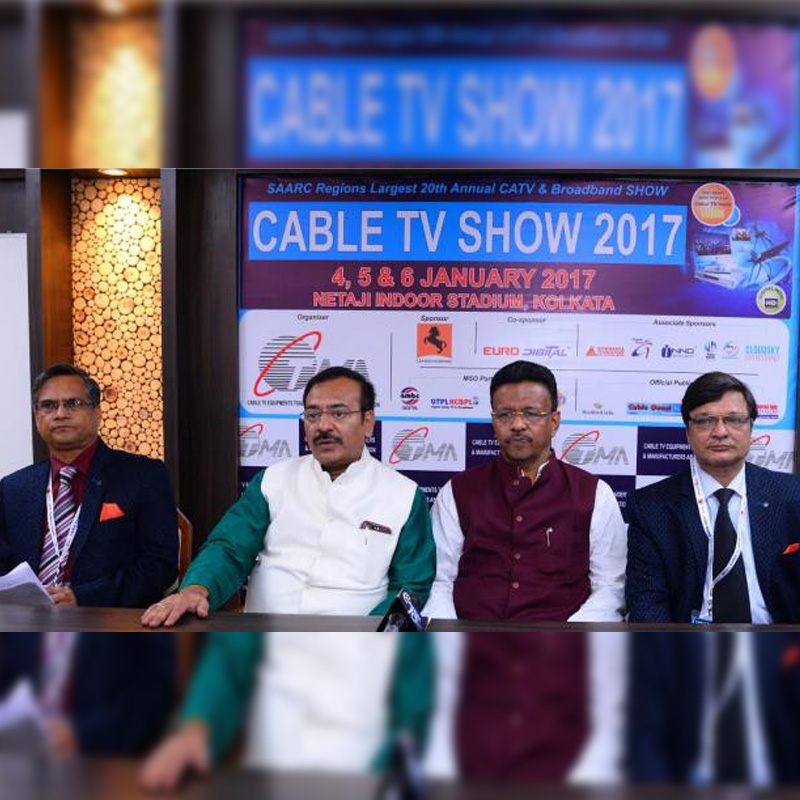
    It was part of a plan by the chief minister Mamata Banerjee who wants the city to look more beautiful without wires, Hakim said while inaugurating a three-day Cable TV Show 2017 from 4 January 4 — the 20th annual show arranged by the Kolkata-based Cable TV Equipment Traders & Manufacturers Association (CTMA).

    Over 10,000 cable operators, manufacturers, traders, channel partners, broadcasters, distributors, and multi-system operators (MSOs) from India and abroad are participating in the show.

    CTMA secretary K K Binani said the plan would minimise possibilities of outside disturbances in connectivity as sometimes wires get damaged during calamities. The industry body said that flat licence fees for multi-system operators had become an entry barrier for small entrepreneurs.

    Cable TV Show 2017 Kolkata, one of the biggest shows on satellite and cable television & broadband in India, was flagged off at the Netaji Indoor Stadium. Hakim inaugurated the event in the presence of minister-in-charge, housing & youth affairs, West Bengal, Aroop Biswas. There are 20 pavilions and 70 stalls erected this year for showcasing a wide range of state-of-the-art products and services related to the cable industry.

    CTMA treasurer & chairman -exhibition Pawan Jajodia said, with the steady digitization of cable television sector and the Digital India campaign, the scope and importance of Cable Television (CATV) had increased manifold. The CATV sector had come a long way to become an organised sector and one that was an important player in promoting digitalisation through the spread of broadband Internet services.

    This event has been sponsored by Darkhorse, and Euro Digital is the co-sponsor. Aishwarya Technologies, Inno Instrument, Globetek Infoway, RailTel, Meghbala, Cloudsky Broadband are associate sponsors.

    Binani said that digitisation of delivery of Cable TV service through set-top box was now in its final and crucial lap as the whole of India would be covered in Phase IV by 31 March 2017. The digital-delivery-enabled networks were now ready to be taken to the next level of delivering value-added services such as broadband internet service, movies on demand, games, pay per view channels, and education etc.

    Binani added that cable TV sector was ready for some sweeping transformation under regulatory intervention. The draft tariff order under consultation by TRAI would bring the addressable services from all delivery platforms such as HITS, MSO, DTH and IPTV under common regulation. The viewer might pay for only the channels that he wished to view/subscribe. Pay channel broadcasters would have to announce a genre and MRP for each of the channels. They must provide channels on terms universal to all delivery platforms. This would make the entry of new entrants feasible. Carriage fee was also proposed to be regulated, Binani said.

    CTMA president Rajesh Doshi said that digitisation has been a game-changer that has transformed the cable sector. The number of licenses issued for downlinking satellite channels into the country crossed 850 channels and the viewer was spoiled for choice with most of the MSOs providing 400 plus channels covering a wide genre and languages. The Cable TV networks in India were ready to play a significant role in helping Internet penetration across India, Doshi added.

  • MSO flat fee a hurdle, says CTMA while backing TRAI & WB’s underground cable

    MSO flat fee a hurdle, says CTMA while backing TRAI & WB’s underground cable

    MUMBAI: The West Bengal government is preparing to build an underground network of cable TV lines in an attempt to keep the city clean, a state minister has said. Urban development minister Firhad Hakim said, in New Town, they had done it and would start soon in Bidhannagar. In Kolkata, they would as early as possible start a pilot project for underground laying of cable TV lines.

    It was part of a plan by the chief minister Mamata Banerjee who wants the city to look more beautiful without wires, Hakim said while inaugurating a three-day Cable TV Show 2017 from 4 January 4 — the 20th annual show arranged by the Kolkata-based Cable TV Equipment Traders & Manufacturers Association (CTMA).

    Over 10,000 cable operators, manufacturers, traders, channel partners, broadcasters, distributors, and multi-system operators (MSOs) from India and abroad are participating in the show.

    CTMA secretary K K Binani said the plan would minimise possibilities of outside disturbances in connectivity as sometimes wires get damaged during calamities. The industry body said that flat licence fees for multi-system operators had become an entry barrier for small entrepreneurs.

    Cable TV Show 2017 Kolkata, one of the biggest shows on satellite and cable television & broadband in India, was flagged off at the Netaji Indoor Stadium. Hakim inaugurated the event in the presence of minister-in-charge, housing & youth affairs, West Bengal, Aroop Biswas. There are 20 pavilions and 70 stalls erected this year for showcasing a wide range of state-of-the-art products and services related to the cable industry.

    CTMA treasurer & chairman -exhibition Pawan Jajodia said, with the steady digitization of cable television sector and the Digital India campaign, the scope and importance of Cable Television (CATV) had increased manifold. The CATV sector had come a long way to become an organised sector and one that was an important player in promoting digitalisation through the spread of broadband Internet services.

    This event has been sponsored by Darkhorse, and Euro Digital is the co-sponsor. Aishwarya Technologies, Inno Instrument, Globetek Infoway, RailTel, Meghbala, Cloudsky Broadband are associate sponsors.

    Binani said that digitisation of delivery of Cable TV service through set-top box was now in its final and crucial lap as the whole of India would be covered in Phase IV by 31 March 2017. The digital-delivery-enabled networks were now ready to be taken to the next level of delivering value-added services such as broadband internet service, movies on demand, games, pay per view channels, and education etc.

    Binani added that cable TV sector was ready for some sweeping transformation under regulatory intervention. The draft tariff order under consultation by TRAI would bring the addressable services from all delivery platforms such as HITS, MSO, DTH and IPTV under common regulation. The viewer might pay for only the channels that he wished to view/subscribe. Pay channel broadcasters would have to announce a genre and MRP for each of the channels. They must provide channels on terms universal to all delivery platforms. This would make the entry of new entrants feasible. Carriage fee was also proposed to be regulated, Binani said.

    CTMA president Rajesh Doshi said that digitisation has been a game-changer that has transformed the cable sector. The number of licenses issued for downlinking satellite channels into the country crossed 850 channels and the viewer was spoiled for choice with most of the MSOs providing 400 plus channels covering a wide genre and languages. The Cable TV networks in India were ready to play a significant role in helping Internet penetration across India, Doshi added.

  • TRAI to meet b’casters, MSOs, DTH ops, telcos on ’17 roadmap

    TRAI to meet b’casters, MSOs, DTH ops, telcos on ’17 roadmap

    NEW DELHI: As promised by TRAI chairman RS Sharma, the regulator is getting pro-active. It has scheduled meetings with top executives of telecom, broadcasting, DTH and MSO companies over the next one week starting 6 January, 2017 to seek their opinion on issues to be taken up during 2017.

    The first of these high-level meetings would take place Friday when TRAI Chairman and other officials would interact with CEOs of all telecom companies, including Bharti, Vodafone and Reliance Jio, to discuss and identify important issues that need to be taken up during the year, PTI reported.

    A similar meeting is slated with top executives of cable, broadcasting, MSO and DTH companies on January 10, 2017, PTI quoted TRAI sources as saying.

    “We have invited the CEOs of all telecom companies, including Bharti Airtel, Vodafone, Idea Cellular, Reliance Jio and others for a discussion on January 6. Similarly, we have invited top executives of broadcasting companies, MSOs, and DTH companies on January 10,” the PTI report quoted sources as saying.

    TRAI’s latest initiatives are in line with what Chairman RS Sharma had told indiantelevision.com in a year-end interview middle of December 2016 on charting a roadmap for 2017.

    “What we plan to do in 2017 is something interesting. While there will be always issues that will need TRAI’s urgent attention — for example, the government may ask for advice on spectrum prices — we are trying to create a calendar for the next year…. highlighting the works that need to be taken up in 2017 and which will act as a roadmap,” Sharma had told indiantelevision.com.

    Asked about the issues likely to be taken up by TRAI in2017, in consultation with the industry, Sharma had indicated it could involve data and consumer protection, Internet of Things (IoT), digital terrestrial broadcasting and other issues related to emerging technologies.

    ALSO READ

    “There would be a lot on TRAI’s plate in 2017” – RS Sharma