Tag: Trai

  • Dish TV-Videocon d2h merger date postponed

    Dish TV-Videocon d2h merger date postponed

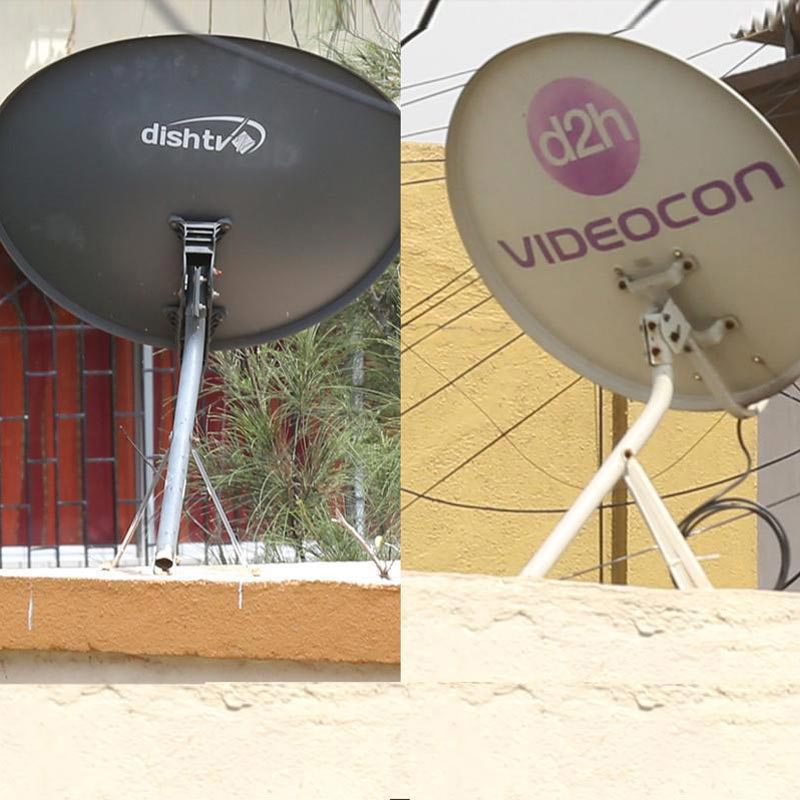
    MUMBAI: The official date for the amalgamation of Videocon d2h into Dish TV has been moved ahead from the earlier decided 27 December 2017.

    In a release to the Bombay Stock Exchange, Dish TV said that the company would be unable to file the relevant intimation forms with the authorities, such as the Registrar of Companies and the Ministry of Corporate Affairs, by 27 December. The new date will be notified soon, the release added.

    A week ago, Dish TV and Videocon d2h were given the final nod by the Ministry of Information and Broadcasting to merge and create the world’s second-largest DTH company with 29 million customers. It was in November 2016 that the companies first announced their decision.

    The combined entity is expected to provide better after sales, distribution, and technology services.

    For the quarter ended 30 September 2017, Videocon d2h posted profit after tax (PAT) of Rs 168 million and an addition of 0.21 million subscribers. Dish TV’s PAT for the quarter was Rs 689 million and its subscriber base increased by 0.188 million.

    Also read:

    MIB clears path for Dish TV Videocon

    Dish TV reports improved operating profits for second quarter

    Recalibrating India’s DTH sector after Airtel DTH-Warburg Pincus deal

  • TRAI seeks better accessibility for persons with disabilities

    TRAI seeks better accessibility for persons with disabilities

    MUMBAI: The Telecom Regulatory Authority of India (TRAI) has turned the spotlight on one of India’s ignored sections of the society–persons with disabilities (PwD). The regulator is prodding companies to make information and communication technology more accessible to differently abled people. It notes that such people are unable to use the services either because they lack the necessary accessibility features or are incompatible for usage by them.

    The TRAI has released a consultation paper seeking the broadcast sector’s views on identifying and eradicating areas that are pain points for them and where policies are required to be frame so that PwDs don’t feel discriminated. Aids and assistive devices have been made for them but a similar change in services and content is yet to take place. The TRAI states that the law must also consider the various segments within PwDs.

    From 2.13 per cent of the population in 2001, the number of PwDs in India grew to 2.21 per cent, which is 2.68 crore of the total. The consultation paper points out that though set-top boxes (STBs) have been made accessible to them, there is a lack of content that can justify its usage. Certain additions need to be made for the visually impaired such that they can access STBs via audio. The functions they need to access without vision include channel/programme selection, display of programme information, setup options, closed captioning control and display options, video description control, current configuration information, playback controls, and input source selection.

    Similarly, people with visual impairment cannot see screens and find it difficult to navigate the keypad and menu of a TV remote. Buttons on a remote are also not designed while keeping in mind people who are unable to use their limbs or flex their fingers. Special measures, such as giving captions for those who can’t hear and audio descriptions for the blind, need to be taken.

    One section of the Rights of Persons with Disabilities (RPWD) Act 2016 states that government and local authorities must work to ensure that those with hearing impairment can enjoy TV content via subtitles or sign language. The Accessible India campaign aims to ensure that at least 25 per cent of TV shows on government channels are suited for PwDs.

    The TRAI suggests actions such as creating well-designed remote controls with legible buttons, a wireless connection between a television and the viewer’s hearing aid as ways to help them.

    India’s corporate social responsibility (CSR) laws have a provision to help PwDs. Broadcast companies that are required to undertake CSR have a fine way to spend the minimum requirement of at least 2 per cent of the average net profits in the immediate three preceding financial years. This can include developing applications, devices and services for their benefit.

    The US FCC mandates that devices used for watching TV must be accessible to PwDs and a similar case is for the UK as well.

    Also read:

    Trai paper seeks to streamline uplinking, downlinking norms

    TRAI’s final recommendations on net neutrality likely by September

    TRAI open house to discuss ease of doing broadcast biz

  • Recalibrating India’s DTH sector after Airtel DTH-Warburg Pincus deal

    Recalibrating India’s DTH sector after Airtel DTH-Warburg Pincus deal

    MUMBAI: For long, investors have given India’s DTH sector a pass-by saying the TV distribution sector (read cable TV) is rickety and has been digitised in a hurry to meet government mandates without too much thought and planning of the back end. Often times, DTH players have been bundled with the cable TV lot and considered a not-a-very-attractive investment.

    That was until last week.  The announcement that Warburg Pincus was picking up 20 per cent stake in Airtel Digital TV (DTH) -with around 14 million subscribers – for a staggering $350 million at a valuation of $1.75 billion or Rs 11,204-odd crore should surely come as a shot in the arm for those distributing TV and running DTH platforms.

    Right now, there are six of them: Tata Sky, Dish-Videocond2h, Airtel Digital TV, Sun Direct, DD Free Dish, and the floundering-now-waiting-to-be-resuscitated Reliance Big TV.

    Most of them have been burning cash. Folks have been saying there are too many DTH operators in India. They have pointed towards the UK that has one, the US that has just two.  And questions have been asked if India has too many vanity plays in both television and distribution.

    A senior investment analyst unwilling to be identified says last week’s Warbug Pincus vote of confidence in DTH highlights how upbeat the sector looks as an investment destination and how different it is from India’s cable TV scattered majors.

    It also raises questions around whether the Videocon management could have got a better deal when it decided to merge Videocon d2h with DishTV.  Was Videocon d2h a tad undervalued? After all, the difference in EBITDA between Airtel and Videocon d2h alone runs into Rs 170-odd  crore only. For FY 2016-17, Videocon d2h had an EBITDA of Rs 1018.1 crore as against Airtel DTH’s Rs 1222 crore. For fiscal 2017-18, Videocon d2h’s half yearly EBITDA stood at Rs 529.5 crore as against Airtel’s Rs 681.7 crore. Dish TV’s EBITDA for FY 2016-17 was Rs 972.8 crore, while it’s half yearly EBITDA for fiscal 2017-18 was  Rs 417.3 million.

    At the time of the merger, the combined entity’s valuation was placed at $2.7 billion for around 27 million subscribers of Dish TV and Videocon d2h. Combined the two would account for 16 per cent of the total 175 million hoseholds in India with around 2.80 million HD household and a combined proforma  EBITDA of  Rs 1826.2 crore. Going by the Airtel-Warburg numbers, the value of Dish TV-Videocon d2h should have been closer to $4 billion.

    Another senior industry observer opines that the Airtel-Warburg Pincus deal has opened up investors’ eyes all over the world about the growth potential in India’s DTH vertical.  The deal is probably one of the first-ever major large-ticket private equity placement deals in Indian DTH.

    What has changed in the past one year? And what is exciting investors to look at the sector differently?

    FreeDish to go away

    Indications are that the DD Free Dish threat is dissipating with the implementation of the new policy that the government has put in place with no renewals of slots taking place for private players. Industry professionals point out that the government is seeking to enhance the reach of its own channels on Free Dish.

    “It had deviated from its mandate–which was to reach out to all the rural areas where there are no transmitters and make the government’s voice reach those people. DD National was hurt because they gave slots to private GEC channels. The national channel’s viewership and revenue have since plummeted,” says one of them. “From Rs 1,400 crore in ad revenue, the figures came down to Rs 500-600 crore, out of which Rs 400 crore is from government enforced spending on the pubcaster. Its ad revenue is a measley Rs 200 crore and no private producer wants to produce for DD as it does not have the reach. With DD FreeDish likely to stop trading in bandwidth and not airing GECs, a window of opportunity for private DTH players to offer another option to rural and smaller town audiences will open.”

    Cord cutting – a hyped-up phenomenon

    Another senior industry researcher says that the phenomenon of cord-cutting has been hyped up by new entrants in the OTT space such as Netflix and their backers from the analyst community and investors in both the US and India.

    “Comparing the US and India is absolutely fraught with disaster. Even in cord cutting,” she says. “India has a very deep urban population and a very deep rural populace. The TV in the living room is still the centre piece of Indian homes; it is also moving into the bedroom. There will be no cord cutting; we will have both in India, the Netflixes as well as TV subscriptions.  Jio, too, has expanded the consumption of mobile bandwidth and nowhere is it posing a threat of cord cutting.”

    The impact of TRAI’s tariff order, GST and introduction of transparency

    The DTH industry has an estimated 90 million subscribers; the net figure is 65 million and the active is 52-55 million. The net sub number includes those subs who have been suspended for up to 120 days for non-payment; whereas actives are those who have subscribed and paid to for between zero and 30 days.

    Industry veterans point out that DTH operators are better placed to implement the TRAI’s new tariff regime which has been held up in courts.  One of them points out that the higher content costs that they have been paying to broadcasters will simply go away. “Our infrastructure allows us to permit millions of subscribers to unsubscribe online very easily and watch the channels and the shows they want to,,” says he. “Because of transparency our costs will go down with the execution of the tariff order.”

    Cable TV content costs, however, he points out are set to go up as under declarations of sub numbers to the tune of 50-60 per cent by LCOs to MSOs have been rampant. “After digitisation and GST, every connection is being reported to the MSO as everybody in the chain has to pay taxes. With this, the broadcaster will understand how many subscribers are actually there and he will charge transparently per sub basis. Based on that the fixed deals will happen,” he says.

    That should be good news for industry observers and naysayers who have been waiting like Godot for India’s TV content and distribution to unlock its true potential and value.

    Also Read:

    Warburg Pincus to buy 20% in Airtel’s DTH arm

    Reliance Big DTH to take FTA route under new management?

    STB import duty doubled to 20%

  • MIB recants, says only explicit condom ads banned during the day

    MIB recants, says only explicit condom ads banned during the day

    MUMBAI: After stirring the hornet’s nest on the contentious issue of restricting condom ads to only water-shedding hours, the Ministry of Information and Broadcasting (MIB) has clarified that such ads can be aired on TV during daytime. 

    In an advisory earlier this month, the MIB had asked all TV channels to air condom advertisements only between 10pm to 6am to avoid exposure of such material to children.

    But in a clarification dated 21 December 2017, the ministry said the ban on condom advertisements during daytime applies only to commercials that have sexually explicit content.

    In a release, the ministry quoted that “advertisements that do not sexually objectify women and are aimed at informing citizens regarding devices/products/medical interventions to ensure safe sex are not covered under the said advisory.”

    The ministry had earlier stated that it had taken note of objections regarding condom ads that are “targeted at a particular age group” being aired on some channels that are considered as ‘indecent especially for children.’ It used Rule 7 (7) and Rule 7 (8) of the Cable TV Networks Rules, 1994 to tell broadcasters to refrain from telecasting ads of condoms that could be considered inappropriate/indecent for viewing by children. 

    The relaxation on the issue came after the Rajasthan high court issued a notice to the Centre challenging an advisory of the MIB barring TV channels from showing condom ads during prime time.

    The petition underlined the fact that condom ads don’t violate Rule 7 of the Cable Television Network Rules, 1994 which apply to anything which endangers the safety of children or create in them any interest in unhealthy practices or shows them begging or in an undignified or indecent manner. 

    The Advertising Standards Council of India (ASCI) had approached the ministry earlier this month for guidance after several people complained regarding the inappropriate nature of the condom ads being telecast during primetime viewing on most channels. 

    Also Read:

    I&B tightens up on condom ads on TV

    ‘Sanskari’ India wants condom ads off primetime

    MIB categorises all non-Hindi and non-Eng TV channels as regional

  • Trai paper seeks to streamline uplinking, downlinking norms

    Trai paper seeks to streamline uplinking, downlinking norms

    MUMBAI: Following a prod from the ministry of information and broadcasting (MIB) additional secretary Jayashree Mukherjee, the Telecom Regulatory Authority of India (TRAI) on 19 December issued an industry consultation paper which seeks to update guidelines related to uplinking, downlinking, of TV channels and the setting up of teleports.

    Mukherjee had sought the TRAI’s recommendations on these issues keeping in mind changes in technology, market scenarios and lessons learnt over the past six years since the guidelines were passed.  

    In its paper, Trai has asked stakeholders, such as broadcasters, if there was any need to redefine news and current affairs TV channels and non-news and current affairs TV channels more specifically.

    Pointing at a possible hike in the net-worth requirement of Rs 5 crore for obtaining a licence for uplinking or downlinking of TV channels, and an increase in process fees for applicants, the paper states that non-serious players were able to obtain licenses, which were either traded or leased to a different entity.

    “To  ensure  that  only  serious  players,  who  are  interested  in  the business of satellite TV channels, apply for obtaining license for  uplinking  or downlinking of TV channels, one way could be to increase the entry barriers. The other way could be to eliminate the incentives, which encourage trading and/or sub-leasing of licenses. Further, sub-leasing or trading of channels can also be controlled by putting in place certain checks, which discourage such practices,” the release stated.

    The paper argues that an increase in entry barriers for uplinking of TV channels from India may encourage diversion of such business opportunities to outside India. Moreover, Trai has raised the question of auctioning satellite TV channels as a complete package similar to FM radio channels. Or if industry thinks that it is possible to auction individual legs of satellite TV broadcasting – uplinking space spectrum, transponder capacity?

    And it has opened up an issue which has been a sore point for the industry: if it is advisable to restrict the use of foreign satellites for satellite TV broadcasting or uplinking of satellite TV channels to be downlinked in India from foreign soil? And also whether it is possible to auction channels without restricting the use of foreign satellites and uplinking of signals of TV channels from foreign soils. The paper appeals to stakeholders if there could be a better way to grant a licence for a TV satellite channel then what is presently followed in order to simply the procedure.

    Other issues the TRAI is seeking industry’s input on is whether encryption of all satellite TV signals – whether free to air or pay TV and what timeline should be given to licensed broadcasters to launch their channels from the date of issue of a licence and the penalties that should be levied on them in case they fail to restore their disrupted channels within a specified period. The consultation paper also approaches sensitive issues such as terms of  the tradeability of licences by a licencee.  

    On the teleport side, the TRAI is seeking to get industry’s understanding of what a teleport should be defined as in a new digital era, the licensing norms, fee structures for processing a licence, if there is a need to restrict the number of teleports in India, and their location like say in a park.

    The industry watchdog has requested that industry sends in its inputs by 18 January 2018.

    Also Read: TRAI sees merit in using satcom for broadband delivery

    TRAI’s Consultation Paper on VoIP can affect mobile TV, IPTV

    MSOs move Madras HC seeking relief on inter-connect pacts


  • Jio continues leading broadband subs addition while wireline internet loses subs in Oct

    Jio continues leading broadband subs addition while wireline internet loses subs in Oct

    BENGALURU: Mukesh Dhirubhai Ambani’s Reliance Infocomm Limited (Jio) closed the month with 145.96 million wireless broadband subscribers having added 7.34 million subscribers during October 2017. Since 1 January 2017, the new telecom behemoth has added 129.91 million subscribers between 1 January 2017 and 31 October 2017 according to data released by the Telecom Regulatory Authority of India (Trai). In terms of growth, however, Jio had to accede to third place–it grew by 5.30 percent as compared to 7.69 percent growth by the Sunil Mittal-led Bharti Airtel Limited and 5.31 percent growth by Vodafone in October 2017.

    India’s wireline broadband internet subscriber base has been declining over the past few months. Overall, the number of wired broadband internet subscriber base declined by 0.33 percent month-on-month in October 2017 to 17.98 million from 18.04 million. Among the top-five wired broadband service providers, the three private players gained subscribers while the public sector service providers lost them.

    Overall broadband internet service providers

    The top-five service providers (across wired, mobile wireless and fixed wireless, such as Wi-fi, Wi-Max, point-to-point, radio, and V-Sat) constituted 92.17 percent share of the total broadband subscribers at the end of October 2017. These service providers were Jio (145.96 million), Bharti Airtel (66.92 million), Vodafone (48.42 million), Idea Cellular (31.03 million), and BSNL (21.21 million).

    Top-five wireless broadband internet service providers

    In October 2017, the wireless broadband internet subscriber base in India grew by 15.34 million. Jio numbers have been mentioned above. Airtel reported the second largest addition of wireless subscribers in the month with 4.63 million additions to reach a subscriber base of 64.8 million. Vodafone added 2.44 million subscribers in the month under review and reached a subscriber base of 48.41 million followed by Idea Cellular which added 1.42 million subscribers with a subscriber base of 31.03 million as on 31 October. Anil Dhirubhai Ambani-led Reliance Communications Limited (RCom) had a stable wireless broadband subscriber base in October 2017 of 8.98 million.

    According to Trai data, as on 31 October 2017, the top-five wireless broadband service providers were Jio (145.96 million), Bharti Airtel (64.80 million), Vodafone (48.41 million), Idea Cellular (31.03 million), and Reliance Communications (8.98 million).

    Top-five wireline broadband internet service providers

    As on 31 October 2017, the top-five wired broadband service providers were BSNL (9.48 million), Airtel (2.13 million), Atria Convergence Technologies or ACT(1.26 million), MTNL (0.94 million), and Hathway Cable & Datacom (0.68 million). As mentioned above, Airtel, ACT and Hathway gained 0.01 million, 0.02 million and 0.01 million subscribers, respectively, in October 2017 while BSNL and MTNL lost 0.06 million and 0.1 million subscribers, respectively.

    Other broadband internet service providers

    MSOs and (LCOs) or cable video service providers also offer wired broadband internet services in the country. These cable service providers have a number of subsidiaries and alliances, hence broadband numbers are split as applicable. The consolidated subscription numbers of these entities could be larger than the numbers of some of the wired internet services providers mentioned above. However, it must be noted that some of these MSOs and LCOs could have lost subscribers in October 2017 considering that the top-five wired broadband internet services providers have lost only 0.03 million of the 0.06 million wireline internet subscribers in during the month.

  • MSOs move Madras HC seeking relief on inter-connect pacts

    MSOs move Madras HC seeking relief on inter-connect pacts

    MUMBAI: The All India Digital Cable Federation (AIDCF) had filed a petition in the Madras High Court few days back pleading a directive to broadcasters to maintain a status quo on renegotiating agreements between TV channels and MSOs till a final judicial call was taken on TRAI’s new tariff regime announced in 2016.

    The tariff order, along with guidelines on quality of services, was stayed by the Supreme Court pending a final directive from the Madras High Court.

    Pleading that renegotiating inter-connect agreements on expiry at this point of time could lead to losses to the MSOs and subscribers, in general, the apex body of digital MSOs in India has sought judicial relief.

    Telecoms and broadcast regulator TRAI, Star India and its affiliate Vijay TV have been made respondents in the case that, according to industry sources, has not yet been listed for an initial hearing at Tamil Nadu’s top court.

    Madras HC, which was hearing a case pertaining to TRAI’s validity to have jurisdiction over matters relating to copyrights, is yet to announce its final verdict. The petition was filed by Star India and Vijay TV in late 2016, which effectively put a stop to the implementation of a new tariff regime announced by TRAI in October 2016 for the broadcast sector and distribution platforms.

    Apart from the tariff order, originally issued on 10 October 2016, the regulator had also issued the DAS interconnect regulations and the standards of quality of service and consumer protection regulations. These guidelines, after being debated and allowed by Chennai and Delhi courts initially were finally stayed by the Supreme Court earlier this year till Madras High Court disposed off the Star India-Vijay TV case questioning TRAI’s jurisdiction over certain matters relating to copyrights and freedom to carry on business.

    ALSO READ:

    http://www.indiantelevision.com/regulators/high-court/orders-reserved-by-madras-hc-on-trai-jurisdiction-case-170731

    http://www.indiantelevision.com/regulators/trai/star-vijay-tv-amend-plea-trai-asked-by-madras-hc-to-file-response-170317

    http://www.indiantelevision.com/regulators/trai/trai-qos-implementation-stayed-by-delhi-hc-awaiting-madras-hc-verdict-170830

    http://www.indiantelevision.com/regulators/trai/star-trai-case-hearing-in-madras-high-court-starts-170627

  • TRAI sees merit in using satcom for broadband delivery

    TRAI sees merit in using satcom for broadband delivery

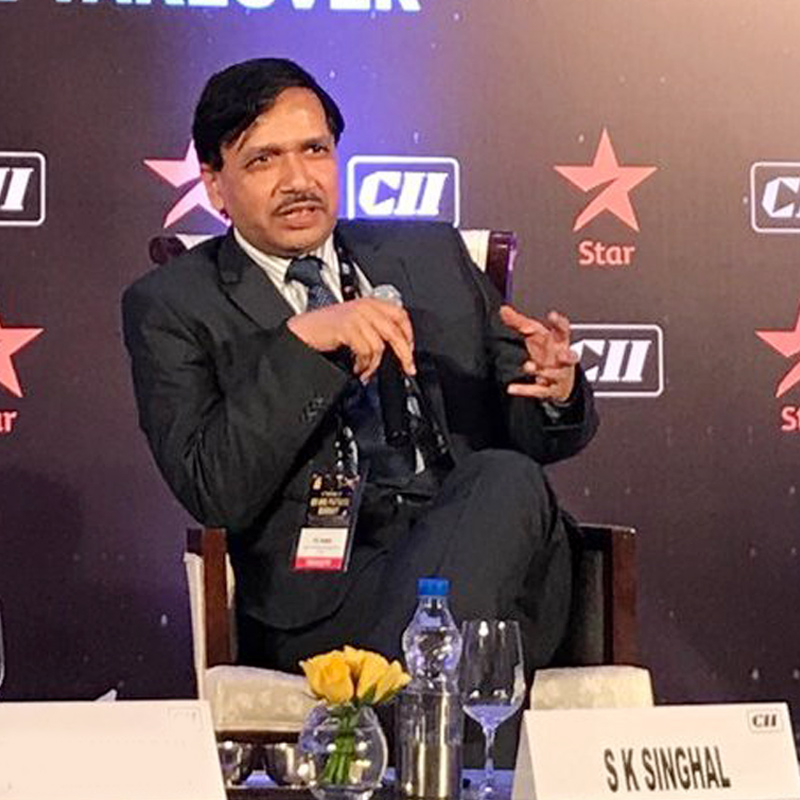
    NEW DELHI: India needs to create digital platforms, pushed by government policies and private sector entrepreneurship, which are specific to India and address its specific needs, telecom and broadcast regulator TRAI advisor SK Singhal said on Wednesday, adding that affordable broadband and allied services like television form the backbone of NTP 2018.

    “We need to create policies (including those pertaining to the digital world) that address our specific needs,” Singhal said at the CII Big Picture Summit 2017, adding that optimal usage of capacity created by cable networks is a must to deliver broadband services to every corner of India as envisioned by PM Modi.

    Singhal, along with Broadcast Engineering Consultant India Ltd (BECIL) CMD George Kuruvilla were speaking on the theme of `Connected India is Digital India’ and how for digital India to be truly implemented broadband access had to be made affordable, including all mediums of delivery like satellite communications (satcom) and cable.

    Pointing out that a stronger ‘collaboration’ is needed between operators of cable networks and those who use the pipe to deliver services, Singhal said that TRAI has already recommended to the government to use cable networks’ broadband delivery potential to fulfil the goals of the New Telecom Policy 2018.

    However, he officially admitted that to fully realise the digital potential of cable networks, some “policy hiccups” also need to be ironed out along with proper guidance in entrepreneurial skills of people who operate such networks.

    Economic Times, in September, had quoted telecoms minister Manoj Sinha as saying that the NTP 2018, expected by March 2018, will focus on providing affordable internet access to 1.3 billion Indians and facilitate domestic manufacturing to curb dependence on imports. He had added that NTP will address sector issues and make them future-proof with the onset of disruptive technologies such as fifth-generation (5G) and AI.

    Dwelling further on building broadband capacity and fully “unleash the potential” of cable networks, Singhal said set top boxes too need to be unbundled or made interoperable. TRAI has an interaction going on with all stakeholders on the issue and some field tests have also been conducted on interoperable boxes.

    Asked how the draft space policy, presently being reviewed by various stakeholders, could facilitate increased use of satellite communications to give a fillip to delivery of broadband services, Singhal skirted a direct answer as space related policies were handled by ministries of telecoms and space (department of space falls within the ambit of prime minister’s office).

    ALSO READ: MIB, TRAI allay industry fears on sat capacity leasing & content regulations

    Prasar Bharati, Dish TV, Star, Zee and BES bat for KU-band open-sky policy

    ISRO stresses on indigenization; TRAI for Open Sky policy

  • Govt extends support to M&E sector in fighting digital piracy

    Govt extends support to M&E sector in fighting digital piracy

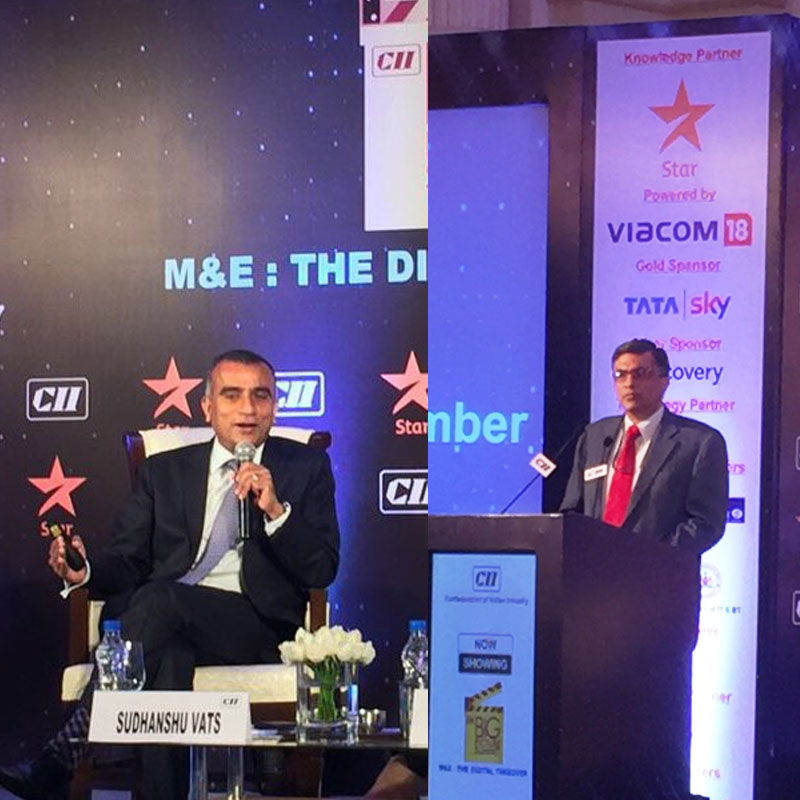
    NEW DELHI: The government of India yesterday stressed that it stood alongside the media and entertainment (M&E) industry in fighting digital piracy to safeguard loss of revenue and ease norms for doing business, while CII entertainment committee head and Viacom18 group CEO Sudhanshu Vats, on behalf of the industry, admitted that automation could result in loss of jobs leading to challenging times, but said the core of the industry will be ‘automation-proof’.

    “The government will stand with you on the issue of digital piracy,” department of industrial policy & promotion (DIPP) joint secretary Rajiv Aggarwal told the audience on Tuesday at the CII-organised Big Picture Summit here, adding that they were exploring a national anti-piracy regulation or regime and there was no need to get further into enacting complicated laws but finding solutions based on global experiences.

    Digital or online piracy is not only a big global challenge for the M&E industry, but has awakened stakeholders in India too who are feeling the heat of heavy loss of revenue due to rampant piracy of Indian content worldwide.

    Pointing out that the Indian government is alive to the issue of digital piracy and the potential of the M&E industry in being able to generate revenues and employment in the country, Aggarwal said that they were looking at how global and some local bodies (like PIPCU of the UK, TIPCU in Telangana and Maharashtra’s online anti-piracy unit) were addressing this challenge.

    Dwelling further on this issue, he exhorted the industry stakeholders to give feedback that will help India in forming a strong case and point of view for submission at WIPO where discussions are on to formulate standards for a global broadcast treaty.

    This year’s Big Picture Summit, an annual two-day conference on issues related to M&E industry, has been themed `The Digital Takeover’, which lays emphasis on the creeping digitisation in general and of delivery services like cable, HITS and OTT, and an impending automation (egged on by the likes of AI) of the various industry sectors.

    TRAI non-committal on exploring auctioning of TV licences

    SK Gupta, telecom regulatory authority of India (TRAI) secretary, which is the telecoms and broadcast regulator, while dwelling on various issues of the recently issued recommendations on net neutrality said the organisation’s efforts have always laid emphasis on consumer interest, while creating a level playing field for all players.

    Incidentally, at a time when the FCC has dismantled net neutrality norms in the US, put in place by the Obama regime earlier, favouring walled gardens of content and premium tiered pricing of various services, India’s TRAI has upheld net neutrality stating that all content should be made available to all distribution platforms on a non-discriminatory basis, apart from other level playing initiatives.

    Later, asked by journalists on the sidelines whether TRAI was exploring a consultation paper on auctioning of TV licences or permissions on the advice of the ministry of information and broadcasting (MIB), Gupta said he at least was not aware of any such move. He was non-committal when pressed on the issue.

    Asian Age newspaper a week back had reported that the government was exploring auctioning of television channel frequencies on the lines of telecoms spectrum, coal blocks and FM radio licences. Reason: bid to increase government revenues as presently permission to uplink and/or downlink TV channels cost a fixed amount with the applicant fulfilling certain set out financial norms, apart from getting clearances for satellite space and internal security. The newspaper report had added that MIB had sought advice from TRAI in this regard. What the report did not clarify was whether the auctioning was of TV licences pertained to DTT (digital terrestrial transmission) or satellite-delivered TV channels later distributed by cable and online.

    M&E industry holds key to creating future-proof, dynamic workforce: Vats

    Earlier in the morning, setting the agenda for the two-day conference, CII entertainment committee head and Viacom18 group CEO Sudhanshu Vats in his opening address said that the theme of ‘Digital Takeover’ was a topic that had “loads of nuances” that needed to be addressed in a proper perspective.

    “In my honest assessment, this is an extremely provocative theme – and one that can mean different things to different people. I can imagine some of my colleagues from the broadcast sector feeling upset. I can also imagine what some of my younger colleagues, who are already social media influencers thinking – this theme is passé, the takeover was complete a few years ago. I don’t want to pick a side at this stage and I’m certain that no definitive side can be picked,” Vats said, adding that he hoped the theme would help delegates form their own distinctive understanding of the future of the Indian industry in general.

    Pointing out that digital takeover could mean greater automation and fewer human jobs, a trend that could is likely to play out slowly in India because of availability of cheap labour, Vats said the Indian M&E sector directly employs between 1.1-1.2 million Indians and in the next five years one million more jobs would be added, thereby playing a role in “assuaging the challenge”. He added: “If we achieve breakout growth, that number can also touch five million. However, I would like to draw your attention not to the number of jobs but to their quality.”

    Explaining that skills, like creativity, story-telling, emotional intelligence and cognitive ability, in M&E sector were most ‘non-routine’ jobs, Vats said, “These are also the skills that can be transferred to other sectors, making us a part of the solution. Of course, we too will face our share of the burden. Some roles will be automated, and the media organisation might look very different in 2027, but our core will still be automation-proof.”

    Vats also pointed out that the private sector needed to be more ‘creator-friendly’ or ‘freelancer-friendly’, which also meant that the M&E sector could hold the key to “creating a future-proof, agile, dynamic workforce” that can take its skills and drive impact across industries even as the government continued to create a better business environment.

     ALSO READ:

    M&E industry to hit Rs8 trillion revenue by 2022: report
     

  • TRAI orders broadcasters to remove analogue RIOs from website

    TRAI orders broadcasters to remove analogue RIOs from website

    MUMBAI: The Telecom Regulatory Authority of India (TRAI) has ordered cable TV service providers to stop displaying any reference interconnect offers(RIO) for analogue platforms.

    Broadcasters have been warned not to show any analogue RIO on its site and also refrain from making direct or indirect offers to allow their TV signals to be shown on analogue cable TV networks. MSOs have been told not to entertain any unencrypted signals on their cable TV networks.

    The TRAI has taken note of some broadcasters who have been avoiding this and continue to display analogue RIOs. “TRAI has written letters to such broadcasters individually whose analogue RIOs were found on websites,” it said.

    The necessity of the order is because 31 March 2018 is the last date for implementing Phase IV of the digital addressable cable TV systems (DAS) after which only digital encrypted signals can be carried in the country. Carrying unencrypted signals after this date will be a violation of Section 4A of the Cable Television Network (regulation) Act 1995.