Tag: Trai

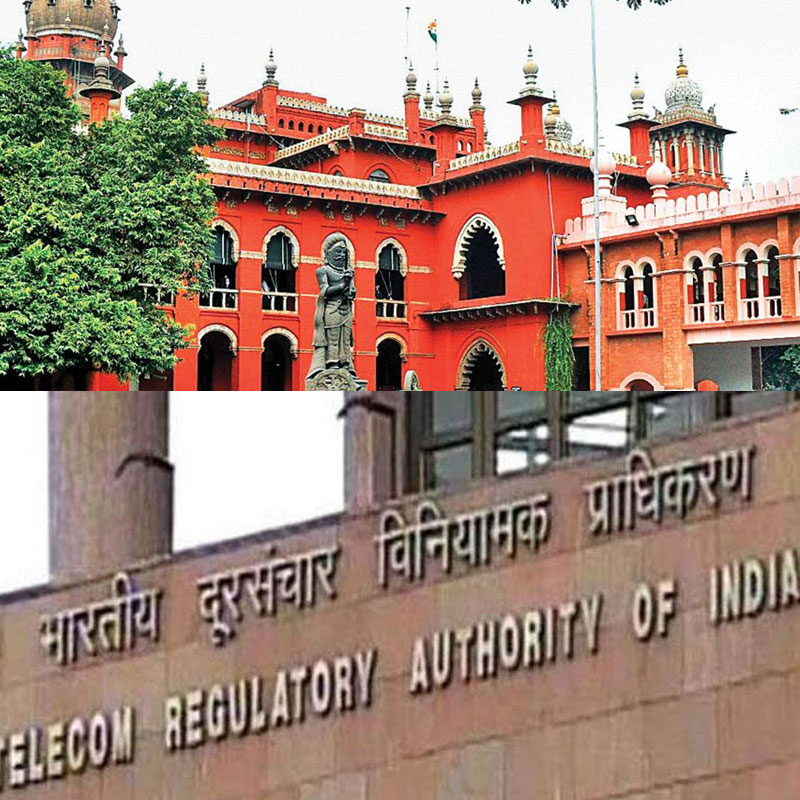
  • Madras HC TRAI-Star case: All parties keep options open

    Madras HC TRAI-Star case: All parties keep options open

    MUMBAI: Even as till late evening yesterday all those connected with the case filed by Star India and Vijay TV against regulator TRAI in Madras High Court kept waiting for the full text of the court order, options for future course of action were kept open, including whether the high court should be asked to clarify on some observations.

    As the high court, by keeping its final verdict on hold, has given two weeks time to petitioners to consider appealing in the Supreme Court, which is already in summer vacation mode with just the vacation bench active, TRAI also cannot go ahead and get its tariff order implemented immediately.

    Justice MM Sundresh, who was assigned to hear the Star TV and Vijay TV vs. TRAI case after another bench had given a split verdict, concurred with the view of Madras HC chief justice Indira Banerjee who, through an order dated 3 March 2018, had held that the TRAI Act confers upon the regulator sufficient jurisdiction to notify the said tariff order and interconnection regulation.

    However, the judge also, reportedly, struck down some other aspects of the tariff order, including an important part that capped at 15 per cent the discounts that could be offered by TV channels.  

    That all stakeholders in this court drama are keeping their cards close to the chest can be gauged from the fact the only organisation to come out with an official statement welcoming the Madras HC order, AIDCF (All India Digital Cable Federation), too had nothing to offer on a time frame for implementation of TRAI tariff order. Efforts made to elicit responses from Star India, TRAI, Indian Broadcasting Foundation or even individual media industry players drew a blank. The common refrain was: we haven’t read the actual order, so can’t comment.

    Still, after talking to various people in the industry a possible scenario that emerges hinges around petitioners going back to the Madras HC seeking clarifications on some of the observations of the court, which may take some time. After those clarifications come through, it would be decided whether to exercise the option of appealing in the Supreme Court, especially because a major pivot of the case is the copyright of TV channels over the content it generates and whether TRAI has any jurisdiction over such copyright issues.

    With the present TRAI Chairman RS Sharma’s tenure ending in a few months time, he would ideally like to see the tariff order, issued during his tenure, implemented before his superannuation.

    Also Read:

    Third Madras high court judge gives TRAI tariff order thumbs up

    Madras HC gives split verdict in Star India versus TRAI case

    MSOs move Madras HC seeking relief on inter-connect pacts

    Orders reserved by Madras HC on TRAI jurisdiction case

  • Third Madras high court judge gives TRAI tariff order thumbs up

    Third Madras high court judge gives TRAI tariff order thumbs up

    MUMBAI: The long-awaited judgment of the Madras High Court on the TRAI tariff order has been pronounced.

    Sources indicate that almost all the proposals mentioned in the order have being given the go- ahead –  the only exception being the capping of discounts to 15 per cent.

    The decision was announced by the third judge in the Madras High Court earlier today – an order is supposed to come later this evening.

    Reacting to the judgement, AIDCF hailed it as “significant for the cable TV broadcasting and distribution sector’. AIDCF president Rajan Gupta said, “We are elated to note that Honorable Mr. Justice M.M. Sundresh has concurred that TRAI is within its jurisdiction in notifying the tariff order and interconnection regulations of 2017. This new regulatory framework will benefit the entire sector and especially the consumers by improving transparency, enhancing subscriber choice and removing discrimination in provision of content.”

    He further added: “We hope that this present judgment, combined with the earlier view of Honorable Ms. Chief Justice Indira Banerjee, is taken in the right spirit by the stakeholders and any further unnecessary litigation is avoided so that the TRAI can move forward and continue working towards its vision of creating a transparent and non-discriminatory regulatory framework governing the sector.”

    Earlier in March 2018,  a two member bench of the Madras High Court had delivered a split verdict in Star Vijay’s litigation against its passage as content pricing should be left to the discretion of the broadcasting.

    While chief justice Indira Banerjee, heading the first bench, had ruled in favour of TRAI, the second judge — justice M Sundar – had ruled otherwise. The matter was then referred to a third judge who had been given a month to give his directive. The third judge’s decision came earlier today.

    Sources indicate that the third judge has also suspended the decision for the next two weeks, giving Star India a  chance to appeal against it in the Supreme Court.

    The TRAI order had the following highlights…

    The role of the broadcaster

    Under this, broadcasters will have to first declare their channels as a pay channel or a free to air channel, on an a  la carte basis, and in one of the following seven genres: devotional, general entertainment, infotainment, kids, movies, news and current affairs and sports. The TRAI has defined a ceiling on the maximum retail price (MRP) for each of the genres: devotional (Rs 3), general entertainment (Rs 12), infotainment (Rs 9), kids (Rs 7), movies (Rs 10), news and current affairs (Rs 5) and sports (Rs 19).

    Each pay channel has to have a MRP  that can vary depending on the region, but which cannot be changed before the expiry of six months of it being declared. These rates will be platform agnostic – that is, uniform across the platforms (cable TV, DTH, HITS and IPTV) across a relevant geographical market, and will have to be declared on each broadcaster’s website and be transparently available to the TRAI, TV distributors and consumers.

    The pay channels of a network or its subsidiary or holding company or subsidiary of the holding company can be packaged into a bouquet. This can be done while taking the precaution that the bouquet’s MRP is not less than 85 per cent of the sum of the MRPs of the a la carte pay channels forming a part of the bouquet. Similar conditions of holding prices for six months and in geographical areas also apply to bouquets.

    The TRAI has introduced a category called a premium channel. Broadcasters are free to notify any channel as premium channel in their reference interconnect order (RIO). There shall be no price cap on maximum retail price notified by broadcasters for customers. For HD channels, the regulatory authority has, however, stated the price cannot be more than three times the MRP of the corresponding channel transmitted in SD. For those HD channels that do not have a corresponding SD channel, the benchmark will be the ceiling on the MRP of the genre it is in. These independent HD channels will have a price ceiling of three times the ceiling of the MRP of the genre.

    The television distributor’s role

    On the television distributor side, the TRAI has made them responsible to provide all channels on a la carte basis and it has also  proposed to formalize  a minimum subscription fee of Rs 130 per month per set top box from a subscriber for 100 SD channels.  Now if an HD channel is included in this, it will be equal to 2 SD channels.

    The TRAI has stated that TV distributors cannot change the bouquets formed by broadcasters or its price, but they can form bouquets themselves of pay channels of different broadcasters provided that their price is not less than 85 per cent of the sum of the MRPs of the pay channels forming part of the bouquet. Free to air, HD and SD variants of the same channel and premium channels are not permitted to be included in these bouquets.

    The authority says that the composition of the 100 channel basic tier should be left to the subscriber’s volition. It can consist of FTA, pay, premium channels, broadcast bouquets or even television distributor package bouquets. But it has to have the government mandated channels and at least five channels of each of the seven genres. If the subscriber opts for pay TV or premium or HD channels or broadcast or TV distributor bouquets, he will have to pay the retail price for these separately.

    Subscribers wanting channels beyond the basic tier can opt for other channels by paying the TV distributor Rs 20 – excluding taxes-  for each slab of 25 channels and the broadcaster the MRP of each channel.

    The TV distributors also have another responsibility. The electronic programming guide on the network must display the details of all channels and their MRP genre wise for easy navigation. Broadcasters who are relying on TV distributors to collect and remit the pay channel revenues will provide a 20 per cent distribution fee to them, which the latter can share with the LCOs who are actually doing the collection. Additionally, TV channels can also offer a maximum 15 per cent MRP discount to TV distributors to encourage them. Parameters for discounts will be disclosed by broadcasters in the RIOs that will be transparent and uniform for all distributors of television channels.

    More to follow…Keep reading Indiantelevision.com

    Also Read:

    Madras HC gives split verdict in Star India versus TRAI case

    TRAI-Star case back to Madras HC with SC rider

    SC could take up TRAI-Star case on tariff regulations

  • Comment: 3 areas that new MIB minister Rathore needs to target

    Comment: 3 areas that new MIB minister Rathore needs to target

    In a recent reshuffle of his cabinet colleagues and their portfolios initiated by PM Modi, a surprise move was not Ministry of Information and Broadcasting (MIB) minister Smriti Irani’s removal, but handing the independent charge of the portfolio to her till-now junior, Rajyavardhan Rathore.

    There is some merit in giving Rathore full responsibility of MIB, which was conceptualised by the nation’s founding fathers to be the government interface with the media and public, in general. That MIB could have lost its relevance in this digital age – an issue being debated in certain quarters – is another story altogether for some other time. Why Rathore at the helm of MIB seems just what the doctor advised?

    First, he is young and suave. Second, he comes with a good pedigree of being an army officer and an Olympic medalist. Third, he’s comparatively young and has built a youth and people-friendly image, apart from his work as independent charge holder at Ministry of Youth Affairs and Sports – his latest initiative on Twitter, #HumFitTohIndiaFit , aimed at encouraging fitness by inviting celebs is already a hit on social media.

    As Rathore has served as a junior MIB minister long enough to get to know the complex issues that come with the terrain, it is expected that he is best suited to address the challenges being faced by the media industry. But for that, he needs to aim at the following three areas and hit the bull’s eye.

    Content Regulation

    The previous MIB minister waded into controversies because of her largely perceived unpopular move to create a panel in April this year to explore regulations for online media/news portals and online content. It did not help her or the government’s cause as this announcement, though being hinted at for several months, came close on the heels of a widely protested move to cancel the accreditation of journalists if found peddling fake news, while the government did not define clearly what constituted a fake news. Though the order was rescinded at the behest of the PM’s Office, the online content committee lingers on directionless and with nobody willing to father the baby presently. That this move antagonised not just online journalists, but also social media players (many of whom are backed and funded by government’s sympathisers) and video-on- demand portals is a story in itself.

    Rathore knows media in India enjoys certain constitutional freedoms, including the right to exercise freedom of speech and expression. Therefore, any move targeted at “regulating” such content shall only be interpreted as silencing criticism. That the online committee is packed with government officials with minuscule industry representation and zero presence of online media raises questions on government’s motives.

    What’s more, doubts have also been raised on the jurisdictional propriety of MIB to create such a committee in the first place. The government allocation of business rules that determine the remit of various government agencies clearly highlights that for all “policy matters relating to information technology; electronics; and Internet” only Ministry of Electronics and IT (MeITY) is competent to make decisions. The ambit of MIB is limited only to “the enunciation and implementation of the law relating to radio and television broadcasting in India by private Indian companies or Indian nationals”.

    With multiple laws applicable on online content, there seems to be no need of any additional regulation for online content, though MeITY could think otherwise, but it’s for it to take a call. Still, a self-regulating mechanism that places uniform standards over user-generated content platforms and video-on-demand portals is the need of the day. This shall also be in line with Rathore’s views expressed after assuming full charge at MIB where he stressed upon self-regulation as the only means of regulating media.

    As the final authority at MIB now, Rathore needs to walk the talk on online content regulation and, probably, let the committee set up by his predecessor die a natural death.

    Online content aside, in the world of traditional broadcasting there is a need to strengthen the already established self-regulatory mechanisms such as the Broadcasting Content Complaints Council (BCCC) of the IBF and a similar self-regulatory set-up of the NBA India.

    Ease of Doing Business

    It would be an understatement to say that the past year has been a difficult period for the Indian media and entertainment (M&E) sector what with after-effects of demonetisation of high-value currency notes and a new tax regime of GST rolled out last year. The story remains the same for ease of doing business in the sector as well.

    On this aspect, Rathore could focus on the recommendations made by Telecom Regulatory Authority of India (TRAI) on`Ease of Doing Business in Broadcasting Sector’ and implement them in letter and spirit.

    A unilateral decision by the previous leadership of MIB to impose a processing fee of Rs 100,000 per day/channel on temporary live uplinking of events (such as sports) and the same amount for seeking minor amendments (like change in name, logo, etc) has been causing heart burns.

    What was the rationale behind such moves to review processing fees? Allegedly non-revision for several years and that such a move could bring in some revenue for the government. But, should a government use licensing/permission fee as means of revenue maximisation? Probably, no.

    Another issue that demands attention from Rathore is the denial of permissions by DoS to satellite TV channels using private satellite capacity, especially foreign. Here, the newly appointed minister shall have to display his trademark leadership and try to resolve the concerns of his constituents (TV channels, DTH operators, teleport operators, etc) vis-a-vis DoS.

    Building an Investment Friendly Environment

    In the recently held global Asia Media Summit 2018 in New Delhi, PM Narendra Modi said that Asia has emerged as a promising region for media businesses and offers opportunities for international cooperation. This statement highlights his government’s push for increasing investment inflow across sectors of the Indian economy – including creative industries such as M&E.

    In this respect, Rathore will have to hit the road running — which he has done — and look at all the factors impeding investments in the sectors under him. This could necessitate reviewing licensing conditions and guidelines, which many in the industry believe hamper investments.

    Can Rathore bite the bullet and recreate the magic that he unveiled one fine day years back to get India the first Olympic medal in an individual event? Certainly, he can. Keep tuned in for the next episode.

    Also Read :

    MIB clears TV channel applications; Rathore calls for stakeholder meets

    Comment: India’s NTP 2018 gets digital makeover but needs complimentary policies

    Comment: MIB’s botched whip on fake news akin to testing waters

    M&E to add 1 mn jobs in 5 years: Sudhanshu Vats

  • Amit Khare appointed as new MIB secretary

    Amit Khare appointed as new MIB secretary

    MUMBAI: Jharkhand state development commissioner and a whistle-blower civil servant Amit Khare has been named as the new secretary of the Ministry of Information and Broadcasting (MIB). He will take over from NK Sinha who is due to superannuate on 31 May 2018 after a comparatively quiet stint of approximately nine months at a high profile ministry that has constantly remained in the news after finance minister Arun Jaitley gave up the MIB portfolio in 2016 to concentrate on India’s economy.

    The announcement regarding MIB and Khare came on Friday as part of a big bureaucratic reshuffle initiated by the government that is now gearing up for general elections either late this year or first half next year as its five-year term in New Delhi officially comes to an end in May 2019.

    Khare is a 1985 batch Indian Administrative Service officer and is presently serving in Jharkhand. Considered an upright civil servant, he is credited for unearthing the multi-million dollar fodder scam two decades ago in Bihar for which some powerful politicians, including former Bihar chief minister Lalu Yadav, and senior officials have been handed jail sentences of varied time periods.

    Meanwhile, media industry observers hoped that with Khare’s arrival next month and junior minister Rajyavardhan Rathore entrusted with independent charge of MIB last week, some freshness and action would also arrive at the ministry, which has been under fire in recent months for not only taking controversial policy decisions (one of them relating to regulation of fake news being rolled back after PM’s Office intervened), but also angering its own foot soldiers or the Indian Information Service officials by arbitrary transfer postings and allegedly bungling on a film award event where the president of the country was to be present.

    A senior TV executive on condition of anonymity said both Rathore and Khare would hopefully end power games within MIB and actually work to live up to PM Modi’s claims of easing norms for doing business in India; especially as the media industry has been straining to get some helping hand from the government in difficult economic times when the sector is still in the process of recovering from after-effects of demonetisation of high value currency notes in 2016 and a new tax regime of goods and services tax of 2017.   

    Rathore’s senior Smriti Irani, a former TV actress who was handed the dual charge of MIB along with textiles ministry almost a year back, has somehow been in the news for wrong reasons and was divested of the portfolio last week when the Prime Minister initiated a reshuffle of his cabinet colleagues.

    Broadcast industry has been complaining of arbitrary policy decisions being taken by MIB under Irani, including attempts at creating artificial entry-level barriers by insisting on TV channels shift to Indian satellites from foreign ones and hiking administrative processing fees many folds. Industry organisation Indian Broadcasting Foundation recently petitioned the PM’s Office drawing attention to the likely ill-effects on the industry if certain norms regarding uplinking and downlinking, being debated at MIB and regulatory body TRAI, came into force.

    Media reports have also indicated that in the last nine months inaction had come to such a head at MIB that inter-departmental power games had stalled a decision on over 100 applications for new TV channels, apart from other sundry issues. So, media industry stakeholders expect a breath of fresh air to blow in the corridors of New Delhi’s Shastri Bhawan, which houses the MIB along with some other ministries, with Rathore-Khare duo taking charge.

    Earlier this week, Vikram Sahay was appointed as a joint secretary in the MIB.

    ALSO READ:

    Smriti Irani moved out of MIB as Rajyavardhan Singh Rathore gets independent charge

    MIB moves to regulate online media: various organisations join issue   

    PMO directs MIB to withdraw guidelines on fake news

    Time to have rules ensuring no one player dominates media: Smriti Irani

    Smriti Irani exhorts DD to leverage reach better

  • Comment: India’s NTP 2018 gets digital makeover but needs complimentary policies

    Comment: India’s NTP 2018 gets digital makeover but needs complimentary policies

    Criticism notwithstanding, Indian bureaucratic mandarins—babus as they are referred to in local lingo—do come up with draft policies that are contemporaneous, and at times when it’s least expected. The new digital avatar of the National Telecoms Policy 2018, slated to be operational later this year, could turn out to be just one such initiative—only if the political masters muster enough courage to push through with the proposed legislation and the will to follow up with complementary policies.

    Though surprises are the new norms with this government led by the maverick PM Modi—remember the late evening ‘Mitron’ address to the nation by the premier few years back announcing high denomination currency notes were being made illegal—it caught many napping when the Department of Telecommunications (DoT) posted on its website the draft of the much-awaited National Telecommunications Policy 2018 very late in the evening on Labour Day. So, what?

    The first surprise element was that the NTP 2018 had been rechristened National Digital Communications Policy 2018 (NDCP). The aim: put the draft in public domain to seek comments from key stakeholders and citizens, at large. But true to the government style—keeping things fluid—the deadline for comments is yet to be announced.

    The renaming of the policy was welcomed by the industry as it converges with the overarching Digital India vision of the present government; hiccups along the way to implementation, notwithstanding. However, such tweaks in the suggestions made by the telecoms and broadcast carriage regulator TRAI goes not only beyond just the nomenclature but also attempts to actualise provisions of the policy.

    What’s also important that while the government wants synergies between various organisations and ministries, it gives a thumb down to a TRAI proposal to make it—or any such other body—a converged regulator.

    A Truly Digital Communications Policy

    For quite some time, it was being felt by the government and industry alike that a specific road map is required to guide India’s successful movement into the emerging digital realm—to truly address the issue of convergence in the telecoms and broadcast services. To spark rapid all-round deployment of digital capable technologies, it is necessary all available mechanisms be looked at in a comprehensive manner; basically, shifting the focus from just wired and wireless telephony and broadband and expanding the horizons to areas such as satellite communications and broadcast carriage services.

    The industry had been demanding that already existing infrastructure assets in sectors such as broadcast and power be utilised to efficiently achieve a demanding goal of laying down high speed fibre infrastructure across India. Thus, a digital-centric telecommunications policy was required to address the crucial aspect of infrastructure sharing and integration.

    Furthermore, to firmly strengthen India’s position in the digital sphere, it is necessary that the web-hosting ecosystem, including data storage, be strengthened by implementing norms and standards that are in conformity with international best practices. This gains importance with increasing reports and instances of data breaches and leaks. Also, core principles such as separation of content/applications and infrastructure/carriage layer underlying network neutrality need to be crystallised and affirmed through statutory and policy provisions.

    The present draft NTP 2018—or isn’t it better to call it from now on NDCP 2018? —has taken into account many concerns and challenges and seems like an earnest effort on the part of the government to ensure that India’s broadband and digital sectors are backed by sound policy norms and principles.

    Has DoT Planned Well for India’s Digital Future?

    The DoT has gone ahead and staked its claim to the entire swathe of telecommunications technologies and the methodologies through which government’s digital goals can be rapidly deployed, e-governance included. Now, this could turn out to be an asset as also a weakness, given inter-departmental politics and power play.

    DoT has called for an overhaul of India’s archaic satcom policy in line with international standards and also advocated for greater participation by private players in commercial satellite operations — a vision that needs to be matched with some liberalisation at Department of Space (DoS) and India’s space agency ISRO, both of which report directly to the Prime Minister’s Office. To spearhead the contribution of private satcom industry in providing broadband to far flung districts, there’s specific mention of opening Ka-band for private use and also for utilisation of high through-put (HTS) satellites.

    With a view to reducing burden of laying down fresh wireline fibre infrastructure, there’s clear mention of recommendation for “leveraging existing assets of the broadcasting and power sector to improve connectivity, affordability and sustainability”. This could reduce the tendency of telecom industry to overbuild fibre and brings the vast amounts of broadband-capable digital cable infra created under Ministry of Information and Broadcasting (MIB)’s mandate of digitising cable networks across the country and within the purview of Digital India programme.

    DoT has also realised the need to formulate a coherent approach to reap the benefit of technological convergence. It has specifically called for statutory amendments to the vintage Telegraph Act, 1885 for “enabling infrastructure convergence of IT, telecom and broadcasting sectors”. This highlights the department wants to create a defined policy structure for seamless use of all broadband capable infrastructure, irrespective of differences amongst sectors. It also reflects clear intent of DoT to focus only on convergence of infrastructure, rather than convergence of applications/media running on this layer.

    Therefore, DoT has focused sharply (and some may say appropriately) only on enabling carriage services and the surrounding digital ecosystem rather than delve into other unrelated areas such as media.  No wonder it has called for separation of infrastructure/carriage layer from applications/content layer. Moreover, it has called for recognising the need to uphold the core principles of network neutrality by “amending the licence agreements to incorporate the principles of non-discriminatory treatment of content, along with appropriate exclusions and exceptions as necessary”.

    Furthermore, the DoT has gone a step ahead and acknowledged the primacy of principles and objectives contained in the National IPR Policy related to telecommunications and sought implementation to kick start development of indigenous IPRs.

    The Road to the Final Draft

    Though the industry, by and large, has welcomed the draft policy as it gears itself to fulfil the call for the now highly debatable “USD 100 billion” in investments, there are a few asks that still need to be fulfilled. The investment aspect itself is ambitious given the present health of the telecoms sector where a big downside of the business is the pink slips presently being handed out by telcos, big and small.

    Another important aspect would be to simplify and streamline all departmental procedures such as windowing of satellite frequencies by the WPC, a part of the DoT, which has been a bottleneck in improving ease of doing business in satcom and broadcasting sectors.

    Given that the DoT has already referred to National IPR Policy for the purpose of all IPRs, including patents, trademarks and copyrights, related to telecommunications, it is vital that it settles the debate between carriage and content industries once and for all and pursues the goal of harmonisation of telecom policy construct with the applicable domestic and international IPR regimes.

    The key would be to now take all the constructive inputs from the industry and iron out the remaining creases to create an effective implementation framework to turn India into a truly digitally empowered society.

    While we debate the National Digital Communications Policy 2018, it would be worthwhile to go back into history and attempt reading the Communications Convergence Bill that was introduced in Parliament in 2001. A real visionary piece of draft legislation, the policy was considered so futuristic at that point of time that a joint parliamentary committee red flagged it at 70-odd places, which effectively sounded the death knell for the proposed legislation that was aimed at promoting and developing the entire communications sector—encompassing the broadcasting, telecom and multimedia sectors—keeping in view emerging convergence of techs and services. Drafted by eminent jurist Fali S Nariman-headed panel, the draft still remains as one of the finest pieces of convergence regulations that never saw the light of the day.

    In the end, one cannot but agree with lawyer-researcher at India’s Centre for Internet and Society Anubha Sinha’s observations. Writing for The Wire, an online news venture, Sinha highlighted: “While the policy [NTP 2018/NDCP 2018] is broad and forward-looking, the true intent and meaning of the listed steps will only be understood when complementary legislative and granular policy actions to support these strategies are crystallised. That will make all the difference.”

    Also Read :

    DoT addresses broadband issues in policy out for public consultation

    Zee, Star, NBA oppose converged regulator for broadcast and telecoms

    TRAI releases paper on National Telecom Policy 2018
  • Spectrum auction: TRAI consulting international agencies

    Spectrum auction: TRAI consulting international agencies

    MUMBAI: The Telecom Regulatory Authority of India (TRAI) is in the midst of consulting various international agencies and experts and hopes to finalise its recommendation on spectrum auction “soon”, chairman R S Sharma has said.

    Sharma said that a review meeting on the telecom auction was held in the TRAI last week. “There is a lot of work being done. We are consulting international agencies, consultants as well as experts and we will come out with our recommendations soon,” Sharma told PTI.

    But he declined to give a specific timeframe for the finalisation of recommendations on the issue. The government is planning to hold the largest-ever spectrum auction of 3,000 MHz radiowaves in the upcoming sale. It has sought recommendations from Trai on the applicable reserve price and related issues for auction of spectrum in the frequency bands 700 MHz, 800 MHz, 900 MHz, 1,800 MHz and 2,100 MHz, 2,300 MHz, 2,500 MHz, 3,300-3,400 MHz and 3,400-3,600 MHz.

    Trai is also expected to give its opinion on timing of the proposed spectrum auction.

    In the previous auction held in 2016, the government had put a total of 2,354.55 MHz of mobile airwaves for sale in the bands of 700 MHz, 800 MHz, 900 MHz, 1,800 MHz, 2,100 MHz and 2,300 MHz, cumulatively valued at Rs 5.63 trillion at base price.

    However, nearly 60 per cent of the radiowaves, including premium 4G bands, remained unsold in that auction. In the five-day auction in 2016, seven telecom companies made commitment of Rs 65,789 crore for buying 964.80 MHz of spectrum across multiple frequency bands.

    The apex industry association COAI is of the view that operators are not ready for the next round of spectrum auction at this point given the deep financial stress and ongoing consolidation in the sector.


  • Tata Sky, Airtel DTH gain market share in 2017

    Tata Sky, Airtel DTH gain market share in 2017

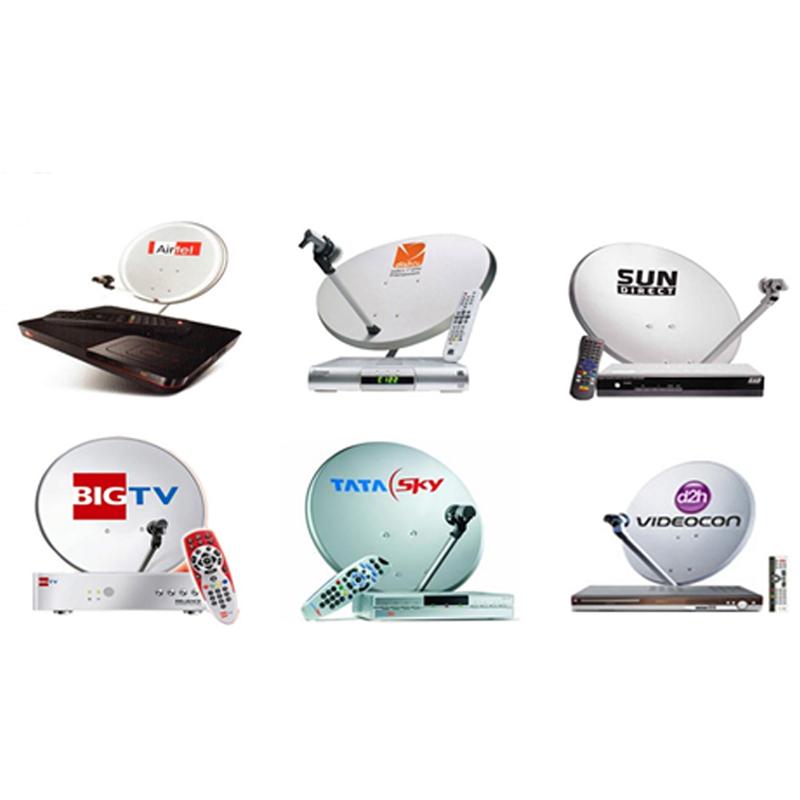
    BENGALURU: Tata Sky and Airtel Digital TV (Airtel DTH) have reason to rejoice as they saw market share rise in calendar year 2017 as compared to a year ago. Both saw an increase by one per cent each at the end of December 2017 as compared to at the end of December 2016 according to Telecom Regulatory Authority of India (TRAI) data.

    Tata Sky had 24 per cent market share at the end of 2017 (CY-2017) as compared to 23 per cent at the end of 2016 (CY-2016), while Airtel DTH had 21 per cent share as compared to 23 per cent during the same period. Hence, the market share of Tata Sky and Dish TV, which lost one per cent market share in 2017, was the same. The other player that lost market share was Videocon d2h – its market share fell by a percentage point to 19 per cent in 2017 as compared to 20 per cent in 2016. 

    We had mentioned earlier that the share of the three major players whose numbers are available in the public  domain –(in order of number of subscribers – Dish TV, Airtel DTH and Videocon d2h) has been declining –  from about 65 per cent to 64 per cent in the Jun-Sep17 quarter to an even lower 63 per cent in the Oct- Dec 2017 quarter. 

    Please refer to the market shares of the six private DTH players at the end of 2017 and 2016 according to TRAI data:

    public://pic_1.jpg

    According to TRAI data, the overall private DTH active subscriber base grew by 4.19 million or 0.419 crore (7.8 per cent) in CY-2017 to 67.56 million or 6.756 crore from 62.65 million or 6.256 crore in CY- 2016. Comparatively, in 2016, the overall private DTH active subscriber base grew by 6.67 million or 0.667 crore (11.9 per cent) from 55.98 million or 5.598 crore in CY- 2015.

    As also mentioned by us earlier, quarterly data released by TRAI indicates that the industry added net 2.25 million or 0.225 crore subscribers for the quarter ended 31 December 2017 (Oct-Dec17 quarter), hence the final quarter of CY-2017 accounted for about 46 per cent of the net subscribers added during the year. The Oct-Dec17 quarter had the highest quarter-on-quarter pay-TV DTH subscriber growth in CY- 2017 at 3.45 per cent.

    We’d said that CY-2017 saw muted pay-TV DTH subscriber growth. Those numbers were based on the results declared by the above mentioned three private DTH players.

    It must also be mentioned that the government’s FreeDish DTH service is the largest DTH player by far in terms of subscribers with an estimated 22 million or 2.2 crore subscribers in 2016 as per the KPMG-FICCI Indian Media and Entertainment Industry Report 2017 (KPMG-FICCI M&E Report 2017) titled Media for the Masse: The Future Unfolds. It must however be noted that an exact number for registered or active subscribers is not available since this is a free DTH service. Also, the merger of Videocon d2h with Dish TV has created the largest private television carriage player in India and quite likely the second largest in the world, be it cable, internet television or DTH or any other.

  • Tata Sky coughs up Rs 561 crore as licence fee for FY 2017-18

    Tata Sky coughs up Rs 561 crore as licence fee for FY 2017-18

    MUMBAI: Direct-to-home operator Tata Sky has paid Rs 561 crore as licence fee to the government for 2017-18 financial year, according to a statement released by the company.

    The company paid a total of Rs 2,200 crore in the last fiscal year ended on 31 March 2018. This amount includes GST, state entertainment taxes and some other taxes.

    Commenting on the development, TataSky MD & CEO Harit Nagpal said: “With the payment made today, we have paid licence fee, past and current as per specified rates, regardless of pending litigations between the government and the platforms.”

    The Ministry of Information & Broadcasting (I&B) rules mandate DTH operators to pay 10 per cent of their gross revenue as their annual fee to the government. DTH operators, however, contend that the MIB should charge licence fee based on adjusted gross revenue left after paying several taxes and others.

    In 2014, the DTH operator had paid Rs 383 crore to the government as licence fee for the previous fiscal and arrears.

    In the same year, the MIB had sent notices asking them to pay licence fee totalling Rs 2,066 crore within 15 days. DTH operators had challenged the licence fee demand in the Telecom Disputes Settlement and Appellate Tribunal (TDSAT) in 2014.

    Tata Sky, a joint venture between Tata Sons and 21st Century Fox, has presence across 1.5 lakh towns with over 18 million connections.

    The Telecom Regulatory Authority of India (TRAI) has in its recommendations to the MIB said that the DTH licence period should be increased to 20 years while the licence fee should be charged as 8 per cent of adjusted gross revenue (AGR) where AGR is calculated taxes paid to the government.

    Also Read :

    Tata Sky brings Netflix content for customers

    Dish TV-Videocon d2h to bank on economies of scale


  • Feb-18: Mobile broadband numbers increase as wired internet subscribers decline

    Feb-18: Mobile broadband numbers increase as wired internet subscribers decline

    BENGALURU: The total number of broadband internet connections have increased by about eight per cent in the calendar year 2018 (year started 1 January 2018, CY-2018) until 28 February 2018 (Feb-18) as per Telecom Regulatory Authority of India (TRAI) data. The period under review in this paper is the period between 1 January 2018 and 28 February 2018. CY-2017 closed with 362.87 million (36.287 crore) broadband connections as on 31 December 2017. The total number of broadband connections in Feb-18 was 392.06 million (39.206 crore). Broadband internet growth in the country was driven by mobile (phones and dongles) internet services which had about 8.5 per cent subscriber growth and closed February 2018 with 373.94 million (37.384 crore) subscribers. TRAI defines broadband internet speed as download speeds equal to or exceeding 512 kbps. TRAI data has been rounded off to the nearest 10,000, hence the accuracy of this report is limited to that extent.

    During the period under consideration, wired internet subscriber numbers declined 0.8 per cent to 17.72 million (1.772 crore) from the 17.86 million (1.786 crore) subscribers reported at the end of December 2017 or as at 1 January 2018. Fixed wireless (WiFi, Wi-Max, point-to-point radio and VSAT) subscriber numbers also declined 9.1 per cent during the period to 0.4 million (0.04 crore) from 0.44 million (0.044 crore).

    Among the top five internet players, Indian telecom major Bharti Airtel (Airtel) showed the highest growth rate during the period under review at about 13 per cent. However, in absolute numbers, it was Mukesh Ambani’s biggest startup in the world – Reliance Jio Infocomm or Jio that added the most number of subscribers in the two months of the current year at 17.04 million or 1.704 crore. During the period, Airtel added 9.15 million (0.915 crore) broadband internet subscribers.

    The top five service providers in India as on 28 February 2018 constituted 94.99 per cent market share of the total broadband subscribers. These service providers were Jio (177.13 million, 17.713 crore), Airtel (80.24 million 8.024 crore), Vodafone (55.54 million, 5.554 crore), Idea Cellular or Idea (38.52 million, 3.852 crore) and BSNL (21.00 million, 2.1 crore).

    While the first five players saw a growth of subscribers during the period under review, the government-owned BSNL or Bharat Sanchar Nigam Limited has been losing them. BSNL had 21.95 (2.195 million) broadband subscribers and lost about 0.95 million (0.095 crore) subscribers or de-grew by over four per cent.

    Top five wireless broadband internet players

    As mentioned above, broadband wireless aka mobile internet players have been the broadband internet subscriber numbers’ growth drivers. As on 28 February 2018, the top five wireless broadband service providers were Jio (177.13 million, 17.713 crore), Airtel (78.07 million, 7.807 crore), Vodafone (55.54 million, 5.554 crore), Idea (38.52 million 3.852 crore) and BSNL (11.71 million, 1.171 crore).

    Here also, Airtel has reported the largest growth in percentage terms – it grew by about 13 per cent, while Jio had the highest growth in absolute numbers – Jio grew by 17.04 million (1.704 crore) during the first two months of 2018. BSNL has been bleeding wireless broadband internet players during this period. It lost about 0.86 million (0.086 crore) subscribers or de-grew by approximately nine per cent.

    Top five wired broadband internet players

    As has also been mentioned above, wired internet subscriber numbers have declined during the first two months of 2018. As on 28 February 2018, the top five wired broadband service providers were BSNL (9.30 million, 0.93 crore), Airtel (2.17 million, 0.217 crore), Atria

    Convergence Technologies or ACT (1.30 million, 0.13 crore), MTNL (0.88 million, 0.088 crore) and Hathway Cable & Datacom (0.75 million, 0.075 crore).

    The top five wired internet players in the made up over 81 per cent of the total wired internet subscribers in India. Their share has grown during the period under consideration despite a slight drop in share in Jan-18. Except for BSNL and the other government-owned player Mahanagar Telecom Nigam Limited or MTNL, the other three players among the top five have grown the number of wired broadband internet subscribers. BSNL lost about 80,000 subscribers while MTNL lost about 30,000 subscribers during Jan-Feb 2018. The other three players among the top five have added about 60,000 subscribers (added about 20,000 subscribers each) during the period under review.

    Among the other wired broadband internet players, besides the five mentioned above, are television multi system operators (MSOs) and local cable TV operators (LCOs). The numbers provided by TRAI indicate that while during the period under review, the top five wired broadband internet players lost about 50,000 subscribers, the total number of wired broadband internet subscribers fell by about 0.14 million or 140,000. This means that the other players have lost about 90,000 subscribers.

    Also Read :

    Jio continues leading broadband subs addition while wireline internet loses subs in Oct

     TRAI bats for converged regulator & renaming of NTP’18

    SC could take up TRAI-Star case on tariff regulations

  • TRAI extends submission date for consultation on landing page norms

    TRAI extends submission date for consultation on landing page norms

    MUMBAI: The Telecom Regulatory Authority of India (TRAI) has extended the date of submission for comments on its consultation paper regarding landing page norms. The new dates for comments and counter comments are 4 May and 11 May respectively.

    The regulator had issued the consultation paper on 4 April seeking comments and counter comments by 20 April and 27 April respectively. It also mentioned that no further request for extension would be entertained.

    In November 2017, TRAI had issued orders to television distributors to refrain from placing registered satellite TV channels that had subscribed to a TV ratings agency, on the boot-up screen or landing channel. Two days ago, it assured the Telecom Disputes Settlement Appellate Tribunal (TDSAT) that it would withdraw the order and discuss the matter with stakeholders before proceeding on the issue.

    The TRAI diktat, incidentally, had come after a clutch of news broadcasters had made allegations against a fellow TV channel of making use of the boot-up page to manipulate audience ratings and sampling of the product by viewers.

    The landing or the bootup page is what a viewer sees first when a TV set and the connected set-top box are switched on. This page on the screen remains for a certain period of time after which the EPG or the electronic programming guide of the distribution service provider comes up. The landing page, considered hot real estate, usually carries paid advertisements of a TV channel programme or messages (like audience measurement data relating to a particular TV channel or even initial sampling of a new channel). The commercial use of the landing page results in sizable revenue for distribution platforms.

    Also Read :

    TRAI initiates consultation on landing page issue

    TRAI assures TDSAT on withdrawal of landing page order

    TRAI tightens landing-page norms