Tag: Trai

  • TRAI adamant on 23 August deadline in Kolkata, blackout to follow

    TRAI adamant on 23 August deadline in Kolkata, blackout to follow

    KOLKATA: With the Telecom Regulatory Authority of India (TRAI) strictly adhering to the 23 August deadline for collection of the customer application forms (CAFs) to help in the implementation of Digital Addressable Cable TV Systems (DAS), 50 per cent of the 30 lakh cable television consumers of the Kolkata metropolis area, might see their television sets going blank.

    Till 3:00 pm on Friday, CAFs for around 45 per cent of the cable consumers had been completed, a TRAI official told indiantelevisioin.com. “By midnight we expect the details of around 50 per cent consumers,” the official added.

    However top placed industry sources said that a 14 member team from the TRAI office is likely to come to Kolkata on 26 August (Monday), to decide the fate of the customers who have not yet filled the forms with required details. “This simply proves that MSOs will not be asked to disconnect the TV subscribers,” he said.

    It should be noted that the broadcasting regulator had set a deadline of 23 August for cable TV viewers here for filling up the CAFs including choice of channels in the subscriber management system some 40 days ago and failing which services would be stopped, it notified not once but many a times, added the TRAI official. “In fact we had two meetings with MSOs in the last one month,” he further stated.

    “In this weekend the MSOs and operators will work harder and try to feed in as much details as they can,” said people associated with the cable industry.

    Manthan Broadband Services which has more than 6.5 lakh to seven lakh subscribers has managed to collect around 35 per cent of its CAFs. “We will abide by the law. South Kolkata has done well as compared to North and Central Kolkata in terms of form submission,” said Manthan Broadband Services director Sudip Ghosh.

    “However, we expect to receive more such details on coming Saturday and Sunday,” added Ghosh.
    While SitiCable which has set up around 11.5 lakh digital addressable systems here has achived 60 per cent collection of forms and is optimistic of reaching the 70 per cent mark by midnight.

    SitiCable director (Kolkata) Suresh Sethia informed that the MSOs have received a new format from TRAI and the MSOs have been asked to send the details to the regulator on an everyday basis. “Details like number of boxes switched off, number of boxes reactivated and CAFs received,” should be filed everyday said Sethia.

    While a Hathway Cable and Datacom official stated till 3:00 pm, they had received details of more than 57 per cent customers and will be looking at 80 per cent by tonight. “We will act as per the instruction of TRAI,” he said.

    TRAI member R K Arnold who was in Kolkata recently said: “We are not going to extend the deadline beyond 23 August. In this if subscriber details including channel preference is not done, his connection is liable to be disconnected.”

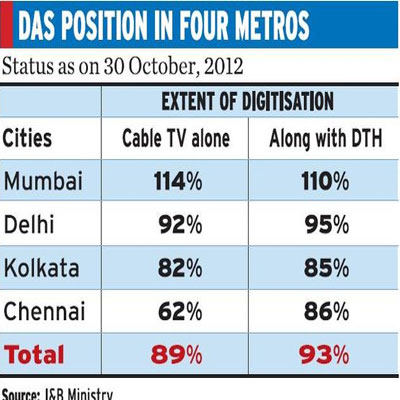
    Kolkata remains to be the last metro where DAS is yet to be implemented.

    Will TRAI ask the MSOs in Kolkata to disconnect the non complying subscribers from 24 August, if the subscriber data is not updated?

    If TRAI wanted the MSOs to switch off the TV connections, it would have informed the players by now but it seems that people will get some breathing space for some hours to complete the mandate, said an analyst.

    Even if the TV screens go blank, it can be connected in two hours to three hours, after the customers send all the details via their cable operators, concluded a MSO.

  • TRAI agrees to raise FDI limits as demanded by News Channels & FM Radio

    TRAI agrees to raise FDI limits as demanded by News Channels & FM Radio

    NEW DELHI: In the recommendation issued by the Telecom Regulatory Authority of India today, the foreign direct investment for FM Radio should be increased to 49 per cent, and for teleports, DTH, HITS, mobile and cable television networks to 100 per cent.

    In the recommendations issued just a day after it was asked by the government to speed-up its views, TRAI also conceded a long-standing demand of news and current affairs television channels by recommending that they should be permitted 49 per cent FDI.

    The TRAI recommendations in essence stuck to its earlier Consultation Paper on the subject issued on 30 July.

    The final recommendations have been issued after an open house and the responses of 24 stakeholders on the Consultation Paper.

    However, TRAI said that in the cases of both FM Radio and news channels where the existing limit is 26 per cent, the clearance would be through the Foreign Investments Promotion Board.

    In the case of teleports, DTH, HITS, mobile and cable television networks where the limit was 74 per cent, TRAI said that it can be raised to 100 per cent of which 49 per cent would be automatic and the rest would be through FIPB.

    No change had been recommended in the case of downlinking of TV Channels and uplinking of general entertainment (non-news) channels where the upper limit is 100 per cent through FIPB.

    The Authority recommended that with the enhancement of FDI limits in respective segments of broadcasting sector, the other security/terms in the foreign investment policy and other license/permission conditions in the respective segments of the broadcasting sector should continue to apply.

    TRAI said the government should ensure that the process of FIPB approval is streamlined and the requests for FDI are processed in a time bound manner.

    The Information and Broadcasting Ministry had on 11 December 2007 sought a comprehensive set of recommendations from the Authority on FDI in the different segments of the broadcasting sector. The Authority gave its recommendations on 26
    April 2008.

    In 2009, the Department of Industrial Policy and Promotion (DIPP) modified the methodology of assessment of foreign investment in Indian companies. In view of this, the MIB on 30 September 2009 once again made a reference to TRAI to revisit the recommendations on FDI in the broadcasting sector.

    The Authority gave its recommendations on 30 June 2010. Based on the views expressed by the government, these recommendations were partially revised on 3 June 2011. In line with the last recommendations of TRAI, the FDI limits and approval route for various segments of the broadcasting sector were revised by the government on 20 September 2012.

    MIB sent a reference to the Authority on 12 July 2013, indicating that the government is re-examining the current FDI policy with a view to easing FDI inflow and liberalising the limits/caps. In this context, MIB requested the Authority to examine the FDI limits of various segments in the broadcasting sector and to furnish its recommendations.

    In its recommendations, the Authority said it recognised the growing convergence between the broadcasting and telecom sectors and has been broadly guided by the principles of ensuring a level-playing field between competing technologies and maintaining consistency in policy across both sectors.

    TRAI says that in its reference, the Ministry had indicated it was re-examining the current FDI policy and liberalising the limits/caps with a view to easing FDI inflow. In this context MIB has requested the Authority to examine the FDI limits of various segments in the broadcasting sector and to furnish its recommendations.

    The government is contemplating enhancement in the FDI limit for telecom services to 100 per cent with FDI up to 49 per cent through the automatic route and FDI beyond 49 per cent through FIPB. Carrying the same logic forward, and keeping in mind the fact that the ongoing digitisation of the cable TV services in the country would give a big impetus to the convergence of the broadcasting and telecom infrastructures, the same limits and route ought to be made applicable to the carriage services in the broadcasting sector.

    For downlinking of TV channels, no distinction has been made between the two categories while prescribing the FDI limits. This is because the ingredients of content can only be controlled at the uplinking end. Hence, 100 per cent FDI is allowed in downlinking of channels in India. However, FIPB approval is required. Further, in case of channels uplinked from a foreign land, additional conditions have been mandated for permitting downlinking in the Policy Guidelines for downlinking of Television Channels dated 11 November 2005.

    While granting permissions for uplinking of channels from within the country as well as for downlinking of all channels uplinked from within the country or abroad, the I&B Ministry takes security clearance from the Home Ministry. Since content can be sensitive in nature, it is appropriate to have checks and balances at different stages viz. to screen for any potential hazard from a national perspective. In view of these considerations, the status quo ought to be maintained regarding the route for approval of any FDI.

    For uplinking of TV channels of the non-news and current affairs category, 100 per cent FDI is permitted through the FIPB route. The status quo may continue.

    For uplinking of TV channels of news and current affairs category, the existing FDI limit is 26 per cent through the FIPB route. An increase in the FDI limit for news & current affairs channels will enable access to more resources for these channels at competitive rates. These resources can be applied for upgrading news gathering infrastructure and quality of presentation. It could also reduce the dependence of TV channels on advertisement revenue. Therefore, the FDI limit for news & current affairs channels in the uplinking guidelines may be increased from 26 per cent to 49 per cent through the FIPB route.

    There are existing provisions in the uplinking guidelines to safeguard management and editorial control in news creation. These include: i) requirement to employ resident Indians in key positions (CEO of the applicant company, 3/4th of the Directors on the Board of Directors, all key executives and editorial staff), ii) the largest Indian shareholder should hold at least 51 per cent of the total equity, iii) reporting requirements when any person who is not a resident Indian is employed/ engaged etc. If the FDI limit in uplinking of TV channels of the news and current affairs category is enhanced to 49 per cent, then as per provision at ii) above the remaining Indian shareholding (51 per cent) would have to be with a single Indian shareholder. The more general issue, on which stakeholders may wish to make suggestions, is whether or not any changes are at all required in these conditions. In fact, a better way to ensure that content deemed undesirable or subversive in nature is not broadcast through TV channels is by having proper content monitoring and regulation through a content code, instead of using FDI limits as the tool for this purpose.

    The government has announced the Phase III of expansion of FM radio. In this phase it is envisaged that 839 new private FM radio stations will come up, expanding the coverage of private FM radio stations from 87 cities to 313 cities. The auction of frequencies for FM radio is likely to be taken up by the government shortly. Easy availability of capital to operators through multiple sources at competitive rates would ensure better participation in the auction by the operators.

    The phase III policy also expands the sphere of activities that can be taken up by the FM radio operators. These include carriage of information pertaining to sporting events, live commentaries of sporting events of a local nature, traffic and weather, cultural events and festivals, examinations, results, admissions, career counselling and employment opportunities, public announcements pertaining to civic amenities like electricity, water supply, natural calamities, health alerts as provided by the local administration etc. For building up of infrastructure for such services, additional investments will be required. Keeping in view all these aspects, the FDI limits may be enhanced from 26 per cent to 49 per cent through FIPB route for the FM radio sector.

    In the past, FDI limits for FM radio have been fixed on the same lines as that for TV news channels, on the rationale that FM radio and news and current affairs channels are of a similar nature from the sensitivity point of view. Enhancing the limit to 49 per cent through the FIPB route will also ensure that the FDI policy for FM radio will remain aligned to the FDI policy for uplinking of the news and current affairs channels, which is also being considered for enhancement to 49 per cent through the FIPB route.

    The Phase III policy of the government for FM Radio also prescribes a similar condition for safeguard of managerial control of radio channels as in the guidelines for uplinking of news and current affairs channels. If the FDI limit for FM radio is enhanced to 49 per cent, then, as in the case of news and current affairs channels, the remaining Indian shareholding (51 per cent) has to be with a single Indian shareholder.

    Click here for TRAI-FDI-Recommendation

  • WB UDM Firhad Hakim pleads TRAI to extend deadline for CAFs

    WB UDM Firhad Hakim pleads TRAI to extend deadline for CAFs

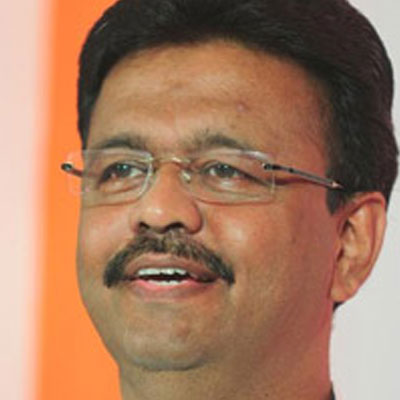
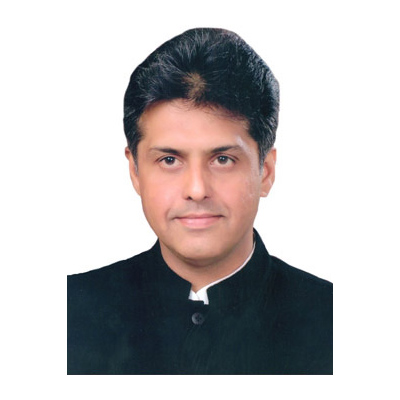
    KOLKATA: First it was Information and Broadcasting Minister Manish Tewari who appealed to the Telecom Regulatory Authority of India (TRAI) to delay implementation of ad cap for news channels till the completion of digitisation, and now it is the West Bengal Urban Development Minister Firhad Hakim who has appealed to the regulator to extend the deadline for customer application forms (CAFs) submission.

    Firhad Hakim has appealed to the regulator to extend the deadline for implementation of SMS rollout

    The request has come after TRAI confirmed last week that it will strictly adhere to the 23 August cut-off-date. “If subscriber details including channel preference is not done within this deadline, the operator’s connection is liable to be disconnected,” informed TRAI member R K Arnold.

    “After interacting with both the local cable operators (LCOs) and multi system operators (MSOs) at the ground level, we found that most of them are not aware about the registration work which they are mandated to do. TRAI before taking such decisions must spread awareness. I have spoken to the chief secretary to extend the deadline,” said Hakim exclusively to indiantelevision.com today.

    Hakim also said that TRAI must have an elaborate publicity campaign to inform the operators on the procedures involved. “How can TRAI ask the operators to disconnect its services without updating the operators about the whole process of CAFs,” he questions.

    Cable Operators Digitalisation Committee of the Association of Cable Operators convener Swapan Chowdhury informed, “So far only 30-35 per cent of cable consumers in the Kolkata Metropolitan Area have completed the form. It is not possible to meet the 23 August deadline.”

    TRAI officials who were in Kolkata last week said, “If not done within the set deadline, we will take action according to law,” said Arnold.

    Kolkata remains to be the last metro where DAS is yet to be implemented. Manthan Broadband Services director Sudip Ghosh when contacted said, “We will abide by the law and we are working towards meeting the deadline day and night.”

    While Hathway Cable managing director and CEO Jagdish Kumar G Pillai said the company is focused towards meeting the deadline.

    A MSO on the condition of anonymity said, “In the digitisation process, installation of set top boxes and offering of the channels account to more than 85-90 per cent of the work and remaining 10 per cent is clerical job which is letting the consumers to choose the channels. The LCOs have all the details of the customers, and now they just need to go and ask the customers to choose the package they want to go for. All this process will hardly take 10 minutes.”

    Can the cable operators breathe a sigh of relief after the appeal made by Hakim for the extension of deadline? Doesn’t seem like it is too easy to please TRAI, but they can only hope.

  • I&B Ministry asks TRAI and PCI to accelerate views on the proposed FDI limits

    I&B Ministry asks TRAI and PCI to accelerate views on the proposed FDI limits

    NEW DELHI: In the light of the current scenario of demands for growth in the media sector escalating, Information and Broadcasting Ministry has asked the Telecom Regulatory Authority of India to speed up its comments on the reference made earlier regarding foreign investment limits in the broadcasting sector.

    In its communication to TRAI, the Ministry has sought comments regarding the paper prepared by the Finance Ministry relating to revision in existing FDI caps in the broadcasting sector. The paper had been forwarded to TRAI seeking its recommendations under Section 11(1)(a)(ii) and (iv) of the TRAI Act, 1997, which pertains to the terms and conditions of license to a service provider and measures to facilitate competition and promote efficiency in the operation of telecommunication services to facilitate growth in such services.

    In a similar separate communication, the ministry has requested the Press Council of India (PCI) to further its advice on the existing sectoral caps of FDI in print media under Section 13 of PCI Act 1978. The advice has been sought in view of the communication received from the Finance Ministry which aims to review policy of sectoral caps of FDI in print media. Section 13 authorises PCI to express its opinion in regard to any matter referred to it by the Central Government.

    The paper proposes to raise the existing FDI cap of 26 per cent which is through FIPB route to 49 per cent through automatic route in the news sector. In the non-news sector, the existing FDI cap is 100 per cent through FIPB route which has been proposed to be 100 per cent through automatic route without the requirement of FIPB’s approval.

    In a consultation paper issued in July following the ministry’s note of the same month, TRAI had reiterated its earlier proposal for increasing the foreign direct investment for FM Radio to 49 per cent, and said the FDI for teleports, DTH, HITS, mobile and cable television networks must be raised to 100 per cent.

    TRAI also conceded a long-standing demand of news and current affairs television channels by recommending that they should be permitted 49 per cent FDI.

    However, TRAI had said that in the cases of both FM Radio and news channels where the existing limit is 26 per cent, the clearance would be through the Foreign Investments Promotion Board.

    In the case of teleports, DTH, HITS, mobile and cable television networks where the limit was 74 per cent, TRAI said that it can be raised to 100 per cent of which 49 per cent would be automatic and the rest would be through FIPB.

    No change had been recommended in the case of downlinking of TV Channels and uplinking of general entertainment (non-news) channels where the upper limit is 100 per cent through FIPB.
    TRAI had earlier given recommendations on the same subject in April 2008 and again on 30 June last year following ministerial references, on the basis of which changes had been carried out. The last such change was on 20 September 2012.

  • NBA welcomes Tewaris proposal to delay ad cap

    NBA welcomes Tewaris proposal to delay ad cap

    NEW DELHI: The News Broadcasters Association (NBA) is a happy lot and why shouldn’t it be? After all its demands are being heard and openly expressed in public meetings by the Information and Broadcasting Minister Manish Tewari himself. As reported earlier by Indiantelevision.com (Tewari reaffirms his support for extension of ad cap implementation) the minister has come out in support of the news channels who for long have been asking for an extension to the implementation of the 12 minute ad cap.


    Welcoming his recent statement that news channels should get an extension on the 12 minute ad cap “at least till the final phase of digitisation is complete”, the NBA said that the industry is in a dire financial condition, like many other sectors of the Indian economy, with ad revenues being slow, carriage fees continuing to be burdensome and credible subscription revenues being out of sight.


    Reinstating its earlier argument on the need for delay in implementation of ad cap, NBA today said that a forced curb on advertising will have a catastrophic impact on revenues of news broadcasters forcing many to take drastic steps that would have an unavoidable and adverse impact on quality of service and jobs.


    The association has estimated that if the ad cap were indeed implemented at this stage, the revenue loss across news channels would be in excess of Rs 500 crore, forcing cuts of at least that amount in costs, if channels have to survive.


    The NBA agreed with the minister that the 12 minute cap on advertisements per clock hour be kept in abeyance and such restrictions “kick in only when the benefits of digitisation are apparent so that broadcasting companies can make good their advertising losses with subscription fee.”


    It also urged that the burdensome and crippling nature of carriage fees which have no business to exist in a truly digitised environment is also addressed urgently.


    NBA requested the minister and the Telecom Regulatory Authority of India (TRAI) to come out with a final notification keeping the ad cap for news channels in abeyance as above in the next 10 days as any delays beyond that will have an irreparable impact on the industry.


    Now with the I&B minister himself coming out in open to support the news channels, will TRAI melt and give in to the demands of the news channels is something which is worth a wait.

  • Kolkata MSOs racing against time to meet DAS deadline

    Kolkata MSOs racing against time to meet DAS deadline

    KOLKATA: Multi System Operators (MSOs) and local cable operators (LCOs) in Kolkata are busy collecting the consumer application forms (CAF) and feeding in details for the complete implementation of the Digital Addressable System (DAS).

    “There’s a huge increase in workload, and everything has to be collected quicker and reported quicker,” says a Kolkata headquartered MSO. While a LOC says: “It’s very tiring to go home and get called back in again, and go home and get called back in again for clarifications and further clarifications.”

    With the Telecom Regulatory Authority of India (TRAI) confirming last week that it will strictly adhere to the 23 August deadline for implementation of subscriber management system (SMS) rollout in Kolkata, the MSOs and cable operators are collecting the know your client (KYC) form details and subscribers’ choice of channels swiftly and are racing against time to feed the data into their systems day and night.

    So far 30-35 per cent of the subscriber management system (SMS) data of cable consumers in Kolkata is completed as per the TRAI data.

    SitiCable which controls a substantial share of cable TV users in Kolkata said the call centers would update the details overnight. “We will work overnight and plan to achieve as much of the work before the deadline,” said SitiCable (Kolkata) director Suresh Sethia.

    SitiCable has set up around 11.5 lakh digital addressable systems (DAS) here.

    While for Manthan Broadband Services there are no holidays and Sundays. “We have 6.5 lakh to seven lakh subscribers. The CAF rate was around 25 per cent for us last week,” said Manthan Broadband Services director Sudip Ghosh.

    “The operators connected with Manthan are working 10 times faster than before,” added Ghosh.
    While Manthan Broadband Services director Gurmeet Singh, said: “With the regulation, we have to collect 100 per cent details. We have no other choice than asking the operators to work and achieve the target.”

    DEN Networks CEO SN Sharma said the CAF collection rate for it’s close to three lakh STBs in Kolkata is nearly 40 per cent-45 per cent.

    “Before the deadline, we aim to achieve 85 per cent -90 per cent work,” said Sharma with assurance.

    “The operators are so lethargic that the customers have not yet got the forms and we are getting calls from frantic TV viewers now,” said a MSO. “We have asked them to download the form from the website and fill it up, scan and mail it to us if possible so that their TV screens do not go blank,” he added.

    With just five days in hand to meet the switch-off date, other MSOs and LCOs said that they have deployed more personnel on shift and temporary basis.

    “Consumer Application Form (CAF) collection rate is expected to be around 70 per cent-75 per cent altogether in Kolkata by 23 August,” assumes Sethia.

    “Achieving 100 per cent target by 23 August is next to impossible. Kolkata will miss the deadline,” said Association of Cable Operators, Cable Operators Digitalisation Committee convener Swapan Chowdhury. “But the cable TV industry people are toiling hard now,” he expounded.

    On the other hand industry sources on the condition of anonymity said it is not possible to give authentic data in just five days. “Filling up more than 18 lakh CAFs is not a matter of joke. The LCO may tick mark the preference of the users themselves,” he said. “For not providing genuine information, the MSOs may face dreadful consequences,” he hinted.

    If around 5,000 local cable operators and 14 MSOs, which provide service in DAS areas do not abide by the deadline of submitting the CAFs, TRAI may file a case against any MSO, concluded a source.

    With the clock ticking and TRAI not willing to give any leeway, the MSOs and LCOs have their work cut out.

  • Tewari reaffirms his support for extension of ad cap implementation

    Tewari reaffirms his support for extension of ad cap implementation

    NEW DELHI: The news channels have found a big supporter to push their demand for an extension in the implementation of ad cap. And this comes from none other than Information and Broadcasting Minister Manish Tewari himself. In a statement made today, the minister has reinstated his support for the news channels and asked the Telecom Regulatory Authority of India (TRAI) to extend the time frame for news channels to implement the 12 minute ad-cap.


    “TRAI can give the news channels an extension at least till the final phase of digitisation is complete,” said Tewari who was addressing a symposium on News Media Education in India organised by CMS Academy at the India International Centre in New Delhi.


    “The regulator can seriously look into some of the issues which the news channels have raised and see if they can give them a road map which is synchronous with digitisation, so that we can have a seamless implementation of both digitisation and the statutory remit.”

    Tewari questions if we have freedom of the press or freedom of the owner of the press


    Tewari commented that apart from protecting consumer interest, TRAI should also look at the industry situation so that downsizing does not become the rule rather than the exception. He said manufacturing Set Top Boxes (STBs) “is not rocket science” and digitisation has been a “huge missed opportunity” for the medium and small scale industry. He said Indian industry should utilise the opportunity of providing STBs for third and fourth phase of digitisation.


    The minister in his address not only spoke in the favour of the news channels but also took a dig at the current media scenario. Commenting on last week’s lay off by a television news channel and the legal recourse against the Wage Board recommendations for the print media by one of the promoters he said, “Media is a business today.”


    Tewari also said that there was a need to reflect on whether it is a business as defined under the Indian constitution or any other activity – a “question germane to the media.” He was referring to over 300 job cuts that include some of the well known names, in a news channel last week.


    The minister said the rights of the citizens and the rights of the media barons “fall in different tracks with the twain not destined to meet.”


    Describing the question as a classic chicken and egg situation, Tewari commented that the “Conundrum bedevilling the media landscape today in India is – Do we have freedom of the press or freedom of the owner of the press?” He hoped media professionals would “introspect” on the issue.


    Commenting on the challenges faced by the print, broadcasting and new media (internet) he said, “The challenges are unique, distinct and require different treatment.” He further stated that it was time for the print media, which has more or less tried to keep rates low over the years, to “reflect and rationalise tariffs.”


    He said the heavily advertisement-dependent model of newspapers was “not the way forward” and called for “serious introspection” in the print media on how far the advertisement model can sustain them.


    On the broadcasting sector, he said of the 798-odd channels, 415 are news channels, and they too are “hugely” dependant on advertisements for revenue. “This has led to addiction of sensationalism, manufactured anger and media trials,” the minister added. The situation leads to violation of privacy and that the issue needs to be addressed.


    Tewari also said his ministry had sent a proposal to the law ministry to incorporate provisions against paid news in the Press and Registration of Books (PRB) Act, providing for penal provisions. He said it was proposed that paid news would be made an offence which would have provisions of penalty and suspension of license.


    He said the media industry should consider holding a common exam for journalists, on the lines of that conducted by the Bar Council, after which they could be given licence to pursue the profession.


    “A good starting point would be that rather than prescribing a curriculum which is then standardised across institutions, possibly the media industry could think about at least having a common exam.”


    Tewari said there were good institutions to train journalists, but there were also “fly-by-night” operators in the media education sector “Professionals from diverse fields would not resent the idea of a common exam.”


    Press Council of India Chairperson Justice (Retd) Markandey Katju had earlier raised the demand for minimum qualifications for journalists.

  • Postpone 12-minute ad cap deadline to Dec 2014: I&B minister Manish Tewari

    Postpone 12-minute ad cap deadline to Dec 2014: I&B minister Manish Tewari

    MUMBAI: He could well be labeled the messiah of the broadcasting industry if his suggestion is heeded. Minister of Information & Broadcasting Manish Tewari has recommended that the 12 minute per clock hour advertising cap deadline be moved ahead to December 2014 from 1 October 2013 suggested by the Telecom Regulatory Authority of India. (TRAI)


    “The final phase of India’s cable TV digitization is likely to be over by September 2014,” he is reported to have said. “And the broadcast industry would be in a position to generate a substantial dividend from the digitized cable TV ecosystem which could well compensate them for the loss of air time revenues on account of the reduction in advertising air time. We, at the I&B, have hence suggested to the TRAI that ad air time reduction should follow the completion of digitization.”


    TRAI had in May 2013 mandated that general entertainment TV channels (GECs) and news TV channels should reduce their advertising air time per hour to 16 minutes and 20 minutes respectively from 1 July 2013 and to 12 minutes by 1 October 2013. The reason: GECs were booking and telecasting around 18-20 of ads per hour while for news channels the figure was 25-30 minutes. The advertising clutter was resulting in a poor viewing experience for TV watchers; hence TRAI had ordered the broadcast ecosystem to cut back around a year ago, but had delayed enacting the order until to May 2013.


    Broadcasters – specially news TV channels – had immediately protested this move, saying it could impact their financial viability. The news channels had also asked the Telecom Disputes Appellate Tribunal (TDSAT) to intervene a month or so ago after the headless body found itself a chief.


    However, both GECs and news channels had – for the large part – complied with the TRAI ad cap mandate and reduced their air time to 16 minutes and 20 minutes from 1 July 2013. The major Indian GECs had managed to increase their advertising air-time rates between 12-30 per cent, but news channels have said this has been difficult for them. They have also complained that high cable TV carriage fees have been a drain on their resources.


    The ball is now in TRAI’s court. Will it concur with the minister and his ministry’s recommendation? Will it do so for only the news TV channels or for all genres? Will the other genres of TV channels accept the largesse being doled out to the news channels alone? Will they also join the chorus and implore the government to help them out too? Questions that beg answers!

  • Broadcasters delighted; want I&B minister to push through ad cap delay

    Broadcasters delighted; want I&B minister to push through ad cap delay

    MUMBAI: With just a little more than two months left for the 12 minute per clock hour advertising cap to be implemented, the broadcast industry is applauding Minister of Information & Broadcasting Manish Tewari’s recommendation. The minister has reportedly stated that the ad cap deadline should be moved ahead to December 2014 from 1 October 2013 as suggested by the Telecom Regulatory Authority of India (TRAI).


    Times Television Network MD and CEO Sunil Lulla feels that the recommendation is in sync with reality. “From a news broadcasters’ point of view, we have put forward similar thoughts many a times with concerned bodies. Considering the difference between cost of production and the revenue generated, it would be better if news broadcasters’ were allowed to self regulate. We hope that the request is heard,” he anticipates.


    Similarly, a senior official from the News Broadcasting Association (NBA) agrees and adds, “Look at the cost for each broadcaster;  if he has to increase eight minutes of content per hour that is close to three hours of more content a day. Where will a broadcaster get so much money from when his ad revenue is going down? Even producers are going to demand more money as to produce a minute of content takes up a good one hour. There are 10,000 things that need to be done depending on the final decision…”


    The NBA official further elaborates, “As broadcasters we don’t know what to do. Everyone is saying different things, so who do we believe? What if a channel actually starts implementing changes and then they extend the date, it’ll be in a mess.”


     “We are happy that he’s understood our problem which is a genuine one and we hope that he will be able to convince TRAI. And we need take a decision soon,” say both the broadcasters.


    But what about other channels/genres? “One shoe for all is what I believe rather than two which might create confusion,” Lulla clarifies.


    To put forward advertisers’ viewpoint on the issue, Advertising Agencies Association of India (AAAI) president Arvind Sharma elucidates, “AAAI has always supported the thought implementing the ad cap after we know what is the full impact of digitisation is known.”


    However, when we contacted a senior official from TRAI, he told us that they too haven’t received any official “recommendation” from the ministry about postponing the deadline, but have only read about it in new reports.


    In May 2013, TRAI had mandated that general entertainment TV channels (GECs) and news channels should reduce their advertising air time per hour from16 minutes and 20 minutes respectively to 12 minutes by 1 October 2013. The reason given by the authority was that the advertising clutter was resulting in a poor viewing experience for TV watchers.


    Industry is hoping the minister follows up his suggestion with a formal appeal to the TRAI. “The bullet has left the gun…,” says an official from the Indian Broadcasting Foundation who was caught in surprise by the minister’s statement that TRAI should posptone the ad cap until cable TV digitsation is completed in September 2014.


    “We haven’t received any communication from the ministry regarding this. And if we go by the communication we have received in the past few days, there seems to be a conflict,” he says sounding puzzled.


    In the past too, there have been many ups and downs in the broadcasting industry. The whole ratings tamasha which went on for a fortnight was resolved when the three stakeholders – Indian Broadcasting Foundation (IBF), Advertising Agencies Association of India (AAAI) and Indian Society of Advertisers (ISA) – finally came up with a solution of providing the television viewership in thousands (TVT) to media and public.


    We at Indiantelevision.com can only hope that the recommendation doesn’t boil down to another controversy, but has a happy ending. However, one does wonder why the statement was made. Do up-coming elections have anything to do with it? Let’s just wait and watch…

  • Prasar Bharati spectrum issue may go to TRAI for final decision

    Prasar Bharati spectrum issue may go to TRAI for final decision

    NEW DELHI: An internal panel of the Department of Telecom (DoT) has recommended that the note from the Information and Broadcasting Ministry seeking exemption from auction for spectrum to be allocated to Prasar Bharti be referred to the Telecom Regulatory Authority of India (TRAI).


    Prasar Bharati said “Spectrum to Prasar Bharti would be allocated on rates fixed by Government of India.”


    Meanwhile, a committee has been set up to examine the conditions for allotment of airwaves through routes other than auction, according to Minister of State for Communications and Information Technology Milind Deora.


    The DoT panel will examine various issues related to allotment and pricing of spectrum, “Including conditions which need to be satisfied in order to adopt auction as the preferred/sole mode of allotment of spectrum, conditions and types of spectrum for which administrative allotment of spectrum should be adopted as the norm,” Deora said in Parliament earlier this week.


    Telecom minister Kapil Sibal had earlier said that adopting auction route every time for allocating spectrum “does not make sense” and that the cabinet would decide on the issue based on the committee’s report.


    It is also learnt that the DoT may seek sector regulator TRAI’s views on the process to be adopted for allocation of spectrum to telecom operators without auction, following the draft recommendation in this regard by its internal committee.


    The last spectrum allocation through administrative process for mobile telephony was done in 2009. But later it was put on hold following series of controversial reports regarding spectrum allocation made in 2008 for 122 2G telecom licenses. Later, the Supreme Court in its judgment on February 2, 2012 cancelled these licenses and asked government to allocate the freed spectrum through auction.


    DoT formed an internal committee to look into conditions where auction cannot be always suitable for spectrum allocation. This is especially in cases like allocation of small amount of airwaves to telecom operators who were earlier allocated 4.4 megahertz of frequencies to bring them in sync with new rules of five Mhz spectrum allocation, or for duration in between their license period of 20 years.


    DoT’s Committee on Allotment/Assignment and Pricing of Spectrum, in its draft report, is learnt to have suggested that the department seek recommendation of TRAI on the matter of spectrum assignment and allocation meant for commercial use without auction. The committee in its report said the reference to TRAI be made on “terms of reference of the committee – conditions which need to be satisfied in order to adopt auction as the preferred or sole mode of allotment/assignment of spectrum for the services.” The committee, however, has suggested that airwaves frequencies allocated to organisations for internal use need not be referred to the sector regulator.