Tag: Trai

  • TRAI issues data related to activation, deactivation and complaints of VAS

    TRAI issues data related to activation, deactivation and complaints of VAS

    MUMBAI: The Telecom Regulatory Authority of India (TRAI) has issued data related to activation, deactivation and complaints of Value Added Services (VAS) w.e.f.1 January 2014 to 30 September 2014.


    The regulator has taken several measures to protect the interest of consumers from time to time to prohibit activation of value added services without the explicit consent of consumers. TRAI has also issued directions which prohibit activation of value added services without the explicit consent of the consumers and also prescribed the manner in which the explicit consent is to be obtained.


    TRAI has also made it simpler for the customers to deactivate the VAS through a common toll- free number (155223) accessible through SMS or call across all operators. If any value added service is activated without the consent of a consumer, he may request the service provider for deactivation of such service on toll free Number 155223.


    Activation of VAS is continuously monitored by TRAI. The details of total Value Added Services activated, deactivated and complaints received during the year 2014 are given as per Annexure-I.


    The directions issued on VAS from time to time are also available on the TRAI’s website www.trai.gov.in.

  • No MSO carrying more than 386 TV channels in first quarter of fiscal 2014-15: TRAI

    No MSO carrying more than 386 TV channels in first quarter of fiscal 2014-15: TRAI

    NEW DELHI: The maximum number of TV channels being carried by any reporting multi-system operator in the first quarter ending June 2014 of the current fiscal is 386, according to a report by the Telecom Regulatory Authority of India.

     In conventional analogue form, the maximum number of channels being carried by any reporting MSO is 100.

     There were a total of 186 pay channels as reported by broadcasters for which the wholesale channels rates have been taken on record.

     During the quarter ending June 2014, the distribution of “Fox Sports News” channel was discontinued by the broadcaster.

     Apart from All India Radio, there are 243 private FM Radio stations in operation at the quarter ending June, 2014, according to information supplied by the Information and Broadcasting Ministry.

     TRAI said no new DTH license was issued during the quarter ending June 2014.

     At present apart from the Freedish DTH service of Doordarshan, there are six private DTH Operators. All the six private DTH Operators are offering pay DTH services.

     The total number of registered subscribers and active subscribers being served by these six private DTH operators, as reported to TRAI, are 67.57 million and 38.24 million respectively as on 30 June 2014.

     The total number of Internet subscribers has increased from 251.59 million at the end of Mar-14 to 259.14 million at the end of Jun-14 there has been a quarterly growth of 3.00 per cent. Out of which wired internet subscribers are 18.55 million and wireless internet subscribers are 240.60 million.

     Number of broadband internet subscribers increased from 60.87 million at the end of March to 68.83 million at the end of June with quarter growth of 13.07 per cent.

     The number of narrowband internet subscribers has slightly declined from 190.72 million at the end of March to 190.31 million at the end of June with quarterly growth of -0.21 per cent.

     The license fee increased from Rs 3286 crore for the QE March to Rs 3503 crore for the QE June. The quarterly and the year-on-year (Y-O-Y) growth rates of license fee are 6.62% and 13.30 per cent, respectively in this quarter.

     Access services contributed 78.48  per cent of the total Adjusted Gross Revenue of telecom services. In access services, gross revenue, adjusted gross revenue (AGR), license fee and spectrum usage charges increased by 4.64 per cent, 7.81 per cent, 7.62 per cent and 8.61 per cent,  respectively, whereas Pass Through Charges decreased by 2.96 per cent in QE June.


    The Monthly Average Revenue per User (ARPU) for Access Services based on AGR increased from Rs 115.28 in QE March to Rs122.39 in QE June.

     Monthly Average Revenue Per User (ARPU) for GSM service increased by 4.84%, from Rs113 in QE March to Rs 119 in QE June, whereas Y-O-Y increase of 6.72%.

     Prepaid ARPU for GSM service per month increased from Rs 99 in QE March to Rs 104 in QE June, and Postpaid ARPU per month increased from Rs 453 in QE March to Rs 469 in QE June.

     On an all India average, the overall MOU per subscriber per month for GSM service increased by 0.42% from 389 in QE March to Rs 390 in QE June.

    Prepaid MOU per subscriber for GSM service increased from 365 in QE March to 366 in QE June and postpaid MOUs increased from Rs 957 in QE March to Rs 961 in QE June.

     The Monthly ARPU for CDMA full mobility service increased by 6.22%, from Rs 105 in QE March to Rs 112 in QE June. ARPU for CDMA has increased by 13.4% on Y-O-Y basis in this


  • TRAI asked to rework on spectrum auction policy by Telecom Commission

    TRAI asked to rework on spectrum auction policy by Telecom Commission

    NEW DELHI: The Telecom Commission is understood to have asked the Telecom Regulatory Authority of India to rework its policy with regard to spectrum auction.

     
    The directive follows study by an internal committee of the Department of Telecommunications (DoT), which rejected the regulator’s recommendation to conduct the next round of auction after keeping enough spectrum.
     

    TRAI in its recommendations had said the government should release enough spectrum before the next round of auction which is slated to take place before March 2015. TRAI has the support of major telecom operators such as Bharti Airtel, Vodafone, Idea Cellular and Reliance Communications.
     

    The DoT internal committee has said it is not clear when additional spectrum will be vacated by the Defence Ministry. The DoT committee feels that there is no point in stalling the sale of what is already available
     

    In its recommendation, TRAI said the Defence Ministry should vacate the spectrum in the 2,100 MHz band. In addition, TRAI proposed that Bharatiya Sanchar Nigam Limited should surrender 1.2 MHz spectrum in the 900 MHz band.
     

    The amount of spectrum being put up for auction early next year is less than the 2G spectrum currently being used by mobile operators whose licenses are due for renewal and this may lead to problems, observers in the telecom industry said.


  • 900 MHz spectrum expected to sell for four times the reserve price: HSBC Research

    900 MHz spectrum expected to sell for four times the reserve price: HSBC Research

    NEW DELHI: Government proceeds are expected to be $ 9 billion from the upcoming spectrum auctions, 20 per cent higher than the government’s own estimates, according to a study by HSBC Telecom and Media Global Research.


    The research also says that it is possible that in a few markets the cost for 5 MHz of 900 band may exceed the 3G prices as well.  


    The estimates are 1.4 times higher than the reserve price recommended by the Telecom Regulatory Authority of India (TRAI) for 900 MHz spectrum band. For 1,800 MHz band, the estimates are 1.2 times of the reserve price suggested by TRAI, the report adds.


    Demand for data spectrum is likely to be a key driver in the upcoming spectrum auctions, if one goes by earlier auctions. At present, the two top players who are better placed to add more spectrums – Idea and RCOM – are likely to be more defensive, according to the study.

    It further noted that there is uncertainty for both investors and operators whenever there is talk of spectrum auction.


    The spectrum auction earlier this year saw an unexpected contest for 1,800 MHz spectrum as the entry of pure 4G players forced incumbent operators to add 4G spectrum selectively, stated the research paper.


    Moreover, it added that the most interesting trend has been robust data revenue growth (data revenue growth in FY14 was 90 per cent year on year for the top three players).


    “While this is positive, it raises the need for additional capacity spectrum (incumbent telcos are already talking about congestion particularly in metro markets with 20 per cent to 30 per cent of their BTS). Operators have so far been highlighting the need to add data footprint but in the markets where they have 5MHz of spectrum, and it will be important for them to get to 10MHz sooner than later (over the next couple of years) to accommodate data growth,” the research revealed.


    The study has found that ‘doubling of spectrum will more than double the throughput for telcos and in turn allow them to benefit from lower per unit costs as well with doubling of spectrum.’ 

    The need for capacity spectrum, the study said, is likely to drive prices up for spectrum in the upcoming auctions.  


    While both Bharti and Idea face auctions in some of their key markets, the latter has more exposure in the upcoming auctions versus Bharti. The study says this implies that telco Idea is likely to focus more in retaining spectrum in existing markets.


    On the other hand, the top two players Bharti and Vodafone could look at adding more spectrum in the 900 band, according to the report. HSBC was positive on Bharti with a target price (TP) of Rs 481 and Neutral on Idea Cellular with a TP of Rs 172. The key downside risk for Bharti will be losing spectrum in the 900 MHz band.  The key upside risk for Idea will be the release of additional data spectrum and the key downside risk will be losing spectrum in the 900 band. The study is somewhat negative on RCOM with TP of Rs 100 and the key upside risk for them will be ability to benefit from spectrum trading. 

  • “The news industry is fighting amongst itself”: Rajat Sharma

    “The news industry is fighting amongst itself”: Rajat Sharma

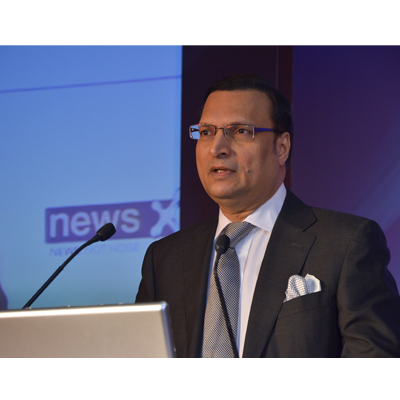
    NOIDA:  He is one of the most well known faces of the Indian media industry. Rajat Sharma, the host of popular talk show, Aap Ki Adalat, has added responsibilities on his shoulders. He is not only the chairman and editor in chief of India TV, but also represents the industry as the new president of the News Broadcasters Association as well as the vice president of strategic affairs of the Indian Broadcasting Foundation (IBF).

    Sharma, who was addressing the 7th Indian News Television Summit 2014 organised by indiantelevision.com as a keynote speaker highlighted the evolution of the news industry as well as listed the three biggest challenges that lie ahead.

    He began by saying that three years ago the news channel industry was very different from what it is today. “There has been a change in perception in the way news is seen,” Sharma said adding that news no longer is considered to be negative.

    Substantiating the evolution in terms of changing perception, Sharma gave the example of the 26/11 terror attack when reporters did 24X7 reportage and were blamed for aiding the terrorists and their handlers in Pakistan. “News channels also suffered commercial losses during the attacks as ad breaks were restricted,” he informed. According to Sharma, while news channels earlier were perceived as being a platform that telecasted frivolous events to garner eyeballs, things today have changed. “News is back,” he announced.

    He pointed out that the space has seen drastic changes.  “The society has evolved and the media has played a great role in it especially during events like the Lokpal Bill, the Delhi gang rape and the tirade against corruption,” he said.

     “Today even if Shah Rukh Khan or Salman Khan want to promote their films or emerging sports like Kabaddi wants to garner attention, news channels have a role to play in that as well,” he opined.

    Sharma while praising the social commitments of the news industry said that the space as a whole is not healthy. “The biggest problem for the industry is its revenue model,” he said while pointing out that though this year the balance sheets of the industry looks good due to elections, but, as a whole, the model is not sustainable.

    Listing the three main challenges for the genre, Sharma said that carriage fee was the biggest concern. “A few years ago, people expected news channels to be a loss making property since carriage fees were high and when broadcasters spoke to the multi system operators (MSOs) they said it was a problem of demand and supply. When digitisation kickstarted, we thought that consumers will get better quality channels and carriage fees will disappear. For the MSOs, it is the carriage fee from the news channels that helps them sustain, since they pay the GEC’s huge sums for getting their programming on their platform,” he said.

    He informed that the industry had 20-25 meetings with the previous TRAI chairman to discuss the issue of carriage fees.  While it was expected that digitisation would bring down carriage fees, something unexpected happened. Two days before the former TRAI chairman could retire he signed the ad cap. “When we were trying to improve the content and trying to solve one issue we were burdened with another one.”

    “Ad cap ensured we received 50 per cent less advertising. Death was certain now for the news channels,” he added.

    While the then Union Minister Ambika Soni said she will look into the matter, the broadcasters decided to fight the case in TDSAT. “News channels have managed to get a stay and therefore are surviving,” he said while giving the example of the newspaper industry, which has no such restriction. “We want the same for the broadcasting industry,” he opined.

    He also mentioned that the industry needs a better rating system and the TAM currency will be replaced by BARC India, which is an incorruptible agency.  “Therefore today the biggest challenge for the industry is the ad cap, the rating system and carriage fees,” he informed.

    In his closing remarks he said the whole industry including the IBF and the NBA should work together to resolve these issues. “The news industry as a whole cannot fight the MSOs as we are fighting amongst ourselves. While, we come together during a board room meeting, once we are out there will be one or two who would go against the same,” he lamented. 
  • TRAI to host open house meet on broadband issues and how this can be speeded

    TRAI to host open house meet on broadband issues and how this can be speeded

    NEW DELHI: An Open House Discussion (OHD) will be held next week on how broadband can be delivered quickly and what the stakeholders or the government needs to do for this. The OHD is being organised in the capital on 30 October by the Telecom Regulatory Authority of India (TRAI) on a Consultation Paper issued earlier by it on this subject.


    It had earlier sought comments by 14 October and counter-comments by 21 October on the questions raised by it. In the paper, TRAI had asked what immediate measures were required to promote wireline technologies in access networks and how the cost per line for various wireline technologies can be minimised.


    It also wanted to know the impediments to the deployment of wireless technologies in the access network. Referring to its recommendations on Microwave backhaul, it asked whether there were any other issues which needed to be addressed to ensure availability of sufficient Microwave backhaul capacity for the growth of broadband in the country.


    The pricing of Domestic Leased Circuits (DLC) was reviewed in July 2014 and the Regulator wanted to know if there were any other issues which can improve availability of DLC. It sought the specific reasons that Internet Service Providers are proactively not connecting with NIXI, the National Internet Exchange of India.


    It asked if the hosting of content within the country help in reduction of the cost of broadband to a subscriber. It also wondered if public sector units were ideal choices for implementing the National Optical Fibre Network (NOFN) project.


    It also wanted to know if it is possible to piggyback on the existing private sector access networks so as to minimize costs in reaching remote rural locations. In this connection, it sought views on the major issues in obtaining right of way for laying optical fibre.


    TRAI wondered if the Government should consider framing guidelines to mandate compulsory deployment of duct space for fibre/telecommunications cables and space for telecommunication towers in all major physical infrastructure construction projects such as building or upgrading highways, inter-city metros, railways or sewer networks.


    What were the impediments to the provision of Broadband by Cable operators, the regulator asked and whether there were any regulatory issues in providing internet facility through Wi-Fi Hotspots.


    TRAI, which recently gave its views on spectrum and also sought some clarifications from the Department of Telecom, asked how much spectrum would be required in the immediate future and in the long term to meet the target of broadband penetration.


  • TRAI  seeks clarifications with regard to spectrum allotted to Defence

    TRAI seeks clarifications with regard to spectrum allotted to Defence

    NEW DELHI: The Telecom Regulatory Authority of India (TRAI) has asked the Department of Telecom (DoT) to clarify whether discussions with Defence to release one block of 5 MHz is for the same block which has been already auctioned in five out of 22 LSAs or the discussion would result in release of one more block of spectrum, thus, making two blocks of spectrum available
    for auction.
     
    The letter from TRAI Secretary Sudhir Gupta follows a letter received from the WPC Wing asking TRAI to provide recommendations on: (a) Applicable reserve price for 2100 MHz, 2300 MHz and 2500 MHz bands for all the service areas in both the cases, that is, spectrum available in entire service area and spectrum partially available in any service area; (b) Auction of the right to use of spectrum in a band with varying validity periods (less than 20 years) so that expiry of validity period of right to use of spectrum in a band in a service area occurs at same time.
     
    TRAI has asked the DoT to provide information/ clarifications relating to the 2100 MHz band.
     
    The WPC has informed that at present no vacant spectrum is available with the DoT in 2100 MHz band and discussions with Defence are underway for release of one block of 5 MHz of spectrum. In its recommendations on ‘Valuation of Reserve Price of Spectrum: Licenses Expiring in 2015-16’ dated 15 October, TRAI had mentioned that the DoT has assigned the fifth block of 5 MHz in the 2100 MHz band in 5 LSAs and in the remaining 17 LSAs, the spectrum is available with the DoT.
     
    The Authority in its recommendations also recommended that entire 2X60 MHz in the 2100 MHz band should be made available for commercial use. If required, Defence may be assigned spectrum in the 1900 MHz band (1910-1920/1980-1990 MHz). It was further recommended
    that this matter is of utmost importance, therefore it must be taken up at the highest level and the vacant 3G slots should be put to auction along with the spectrum in 900 and 1800 MHz bands.
     
    In the letter, Gupta says TRAI will not be in a position to go ahead with the consultation process in the absence of full information with regard to total availability of the spectrum in the 2100 MHz band. Therefore, DoT is requested to indicate the decision regarding the above at the earliest.
     
    With regard to 2300 MHz band, the auction was conducted in June 2010 and two blocks across the 22 service areas were sold. However, even after four and half years of assignment of spectrum, no Telecom Service Provider has actually done any worthwhile rollout.
     
    Therefore, the Authority would like to know if in spite of such poor utilisation of earlier auctioned spectrum even after more than four years, the DoT believes that there will be takers for this spectrum at this point of time.
     
    TRAI had in a letter on 8 March 2013 informed DoT that in ten service areas, the guard band available between the spectrum assigned to different BWA spectrum holders is just 2.5 MHz, and this may result in severe interference in asynchronous TOO networks. TSPs have also suggested that the solution to the problem of interference in such a scenario can either be achieved by use of similar frame configuration (for uplinking and downlinking) or rearranging the assigned frequencies, so as to have a wider guard band.
     
    According to the present proposal of DoT, in 6 more LSAs, the guard band between different
    TSPs will reduce to 2.5 MHz.
     
    TRAI has also said that DoT may like to inform whether any study in this regard has been conducted to examine the concerns expressed by TSPs; and if so, DoT’s decision on this issue.
     
    Referring to the 2500 MHz band, TRAI says this band is very important and unique in the sense that it provides a substantial amount of spectrum (190 MHz) that has been allocated on a primary basis in all three International Telecommunications Union regions for terrestrial mobile communication. As per ITU-R recommendations there are three recommended frequency arrangements in this band. Most countries have followed an approach aligned with ITU Option I band plan (C1). The frequency spots in 2500 MHz band as shown in the annexure to the DoT letter are at variance with the Option I band plan of ITU which may result in the non-optimal use of the spectrum for all time to come. The decision on harmonisation of this band is pending for an inordinately long time.
     
    TRAI says there is urgent need to decide the issue so that this band can be used optimally for commercial as well as strategic purposes.
     
    According to current trends, the 700 MHz/800 MHz spectrum band known as the digital dividend frequencies and these bands are the ideal complement to 1800 MHz and 2600 MHz spectrum band using carrier aggregation techniques for LTE and LTE advanced technologies. The Authority in its recommendations of 15 October 2014 has recommended that the Government should announce the roadmap for auction of 700 MHz band before conduct of the upcoming auctions. The DoT may decide whether it wants to go ahead with the auction of spectrum in 2500 MHz band before conducting the auction in 700 MHz band.
     
    The letter says that DoT may also please confirm that it would like to go for auction without harmonising the band, in spite of the aforementioned implications.
     
    Referring to the validity period of right to use spectrum, TRAI has requested DoT to inform the ‘effective date’ of spectrum assignment for both administratively-assigned spectrum and auction-assigned spectrum for all TSPs in each of the service areas. It has also been noted that rollout obligation of TSPs is linked with the spectrum assignment that has been allocated for 20 years. Changes in the validity period will disturb the rollout obligations linked with the various spectrum auctions since 2010. DoT may indicate how rollout obligations are going to be ensured, going forward.


  • TRAI’s Khullar lashes out at DoT for delay in giving spectrum to Airtel and Vodafone

    TRAI’s Khullar lashes out at DoT for delay in giving spectrum to Airtel and Vodafone

    NEW DEHI: The Telecom Regulatory Authority of India (TRAI) has lashed out at the Department of Telecom (DoT), noting that it is “unable to understand the reasons for the inordinate delay in the assignment of spectrum despite the clear provision in the notice inviting applications fo the assignment of spectrum and after the payment has been made by the licencees.


    In a letter by TRAI chairman Rahul Khullar to Telecom secretary Rakesh Garg, it has been stated that the Authority is seriously concerned that this delay on the part of WPC in assigning spectrum in the 1800 MHz band may lead to a partial breakdown of services offered by  Airtel and  Vodafone especially in Delhi, the national capital.

    This will inconvenience consumers greatly. Both these operators have around 20 million subscribers in Delhi which constitute around 45 per cent of the total subscriber base of Delhi Licence Service Area. It is apprehended that in December 2014, there will be a serious deterioration in the quality of service to these subscribers because of call drops, network congestions etc.
     
    The Authority has suggested that the DoT should immediately call a meeting of both Telecom Service Providers and arrive at a feasible solution so that consumers’ inconvenience can be avoided.
     
    At the outset, Khullar said in the three metros of Delhi, Mumbai and Kolkata, the first two CMTS/UAS licences given in 1994 are due to expire on 29/30 November 2014. These “expiry” licensees were holding spectrum in the 900 MHz and 1800 MHz band which was put to auction in the February 2014 auctions. Except Loop which did not participate in the auctions, other “expiry” licensees.  and Vodafone were successful in re-acquiring spectrum in these LSAs.
     
    In the Delhi LSA, Airtel and Vodafone, which were both having 8MHz in 900 MHz, could re-acquire only 6 and 5 MHz of 900 MHz band respectively in the auctions. Moreover, the spot frequencies now assigned to them are almost entirely different from the earlier different from the earlier assignment.  To make up for the shortfall int eh 900 MHz band, these TSPs have acquired additional spectrum in the 1800 MHz band, but it will require sufficient time to build a new network in the 1800 MHz spectrum.  In addition, in the Delhi LSA, Idea has acquired 5 MHz in the 900 MHz band, which has to be assigned to it after getting it vacated from these two TSPs.
     
    As reported by these TSPs, this whole exercise of change over of frequencies will need to be carried out in two stages. First, these TSPs will have to build a new network of 1800 MHz spectrum by putting new BTSs and augmenting the capacity of the existing ones. In the second stage, they will have to reduce their holding in the
    900 MHz band in steps and carry out swapping of spectrum andreleasing spectrum to the new entrant (Idea). Both of them will berequired to do rigorous planning and work in tandem. The above change  over  will be  a huge challenge  as all these changes are to be carried out on a live network catering to millions of subscribers and any lapse may result in service interruption and serious deterioration in quality of service.
     
    Anticipating the above challenges in mind, the Authority, in its recommendations on ‘Auction of Spectrum’ dated 23 April 2012 had recommended that the 900 MHz spectrum be auctioned at least 18 months in advance so as to enable the winning bidders to be ready with the deployment plans. According to the NIA of 12 December 2013 for the auctions of February 2014 in case of bidders whose licenses were about to expire in 2014, the effective date of spectrum assignment in 1800 MHz band, will be the preferred date of allotment of spectrum indicated by the successful bidders which in no case shall be later than date of expiry of existing licenses in the respective service area.
     
    Khullar noted that media reports had reported and Vodafone and Airtel had told the Authority that there has been inordinate delay in the assignment of spectrum in the 1800 MHz band. Vodafone says it has been assigned spectrum only on 10 October 2014, that is, after almost 8 months from the February 2014 auctions despite a number of representations to the WPC.
     
    In its representation of 16 October, Vodafone has indicated that it would require at least one week for the deployment of new frequencies assigned in the 1800 MHz band and 9 weeks for freeing up the excess 3MHz in the 900 MHz band in a progressive manner.  Subsequently, it would require another three weeks’ time for swapping of its frequencies in the 900 MHz band with Airtel.
     
    However, only seven weeks are left before the expiry of licences, Khullar noted.


  • TRAI brings out detailed paper on spectrum auctions

    TRAI brings out detailed paper on spectrum auctions

    NEW DELHI: The government should immediately take back the unused 900 MHz from the Bharatiya Sanchar Nigam Limited (BSNL) and from the Defence Ministry the unused spectrum in the 1800 MHz band, the Telecom Regulatory Authority of India (TRAI) has said.

    In its recommendations on “Valuation and Reserve Price of Spectrum: Licences expiring in  2015-16”, TRAI has also asked the Department of Telecom (DoT) to have a fresh look at the implementation of E-GSM band.

    The entire 2×60 MHz in the 2100 MHz  band should be made available for commercial use.
     
    The government should announce the roadmap for the auction of spectrum in 700 MHz band. This   should be done before the   conduct of  the   upcoming auctions in 900/1800 MHz band.
     
    The MHz spectrum in 900 MHz band should be taken back from  BSNL from all the   Licence Service Area (LSAs), where licences expire in 2015-16 except in Punjab. In lieu, BSNL should be assigned 1.2  MHz in the  1800 MHz band only  in  those LSAs where its spectrum holding in  that band is  less  than 3.8  MHz in  this   band that is, in Gujarat, Rajasthan and West Bengal.
     
    Unused spectrum in the Defence band should not be kept idle. In the LSAs, where spectrum assigned to Defence  in  the 1800 MHz band is  more than 20 MHz, DoT should coordinate with  Defence  for the vacation of spectrum held by Defence in excess of 20 MHz.
     
    A dialogue needs to be held at the  level of the  Finance Minister, the  Minister of Communications and IT and  the  Defence  Minister to ensure the  availability of additional spectrum for commercial use.
     
    At the outset, TRAI said the DoT had in April 2014 communicated that some of the Telecom Service Providers’ (TSPs)  licences are due to expire during December 2015  and early 2016 and sought TRAI’s recommendations on  the applicable reserve price for  all  the service areas for  auction of   spectrum in 900  MHz   and  1800  MHz   bands. After getting further information from DoT on certain points, TRAI had issued a consultation paper and received responses apart from an Open House Discussion.
     
    The Authority has highlighted that the upcoming auction is critical for the Telecom Service Providers (TSPs) whose licences are due to expire in 2015-16. In  the 900 MHz  band, only  the spectrum held by  them is av ailable for  the  auction.
     
    These licensees will have to win back this spectrum to ensure business continuity in a LSA; if they  don’t, it places the  large  investment made in  the LSAs in jeopardy. The  continuity of services to millions of customers is also  at stake. In   this    backdrop, the   authority has  emphasised  the   need  to   make available additional spectrum before conducting the  auction.
     
    TRAI now wants that the auction should be carried only after  a clear roadmap is  available for vacating spectrum in  2100 MHz  band from Defence  and in  900 MHz  band from BSNL.
     
    The   forthcoming auction  should  be  scheduled  after   the   issues  related  to supply constraints are   resolved. Auctions in  the  800 MHz,  900 MHz,  1800 MHz and 2100 MHz band conducted simultaneously.
     
    Auctions should not be held in Maharashtra and West Bengal for 1800 MHz spectrum at this stage as spectrum is  available in very  few districts in these LSAs.
     
    The authority has reiterated its recommendation that the  frequency rearrangement in the  same band, from  within the  assignments made to the  licensees, should be permitted amongst all  licensees irrespective of  whether the   spectrum is liberalised or not. However,  the  use of spectrum shall be liberalised only if the entire spectrum holding of a licensee in a particular band is liberalised.
     
    All efforts should be  made to make available spectrum in  contiguous form. In its recommendations, the authority demonstrated how  such contiguity can  be achieved in 7  LSAs in  the  900  MHz band. Nevertheless, the  entire available spectrum should be put to auction.

    Spectrum should be  put to  auction in a block size of 2×200 KHz in both the 900 and 1800 MHz bands.
     
    In  the 900 MHz band, the bidders should be required to  bid  for a minimum of
    2×3.6 MHz in those LSAs where spectrum being put to  auction is  10 MHz or more and 2×2.4 MHz in the  remaining  LSAs.
     
    Fresh valuation of  1800 MHz  spectrum for  all LSAs  is the  preferred way  to determine value and reserve price  of 1800 MHz  spectrum (and  for  900  MHz spectrum also)  for the  forthcoming auction.
     
    The  average expected valuation of 1800 MHz spectrum of each LSA should not be lower than the  price realized in February 2014 auction in that LSA.
     
    The value of  900 MHz  spectrum in each LSA  is  subject to  condition  that average expected value in  LSA should not   be  more than  twice  the  value of
    1800 MHz spectrum in that LSA.
     
    The reserve price for  1800 MHz spectrum in Rajasthan LSA should be fixed  at a discount of 30%  on  the reserve price calculated due to availability of partial spectrum (as was done in  the February 2014 auctions).
     
    The   forthcoming auction  should  be scheduled after the issues related to supply constraints are  resolved. Auctions in  the 800 MHz, 900 MHz, 1800 MHz and 2100 MHz band conducted simultaneously.

    Spectrum should be  put to  auction in a block  sjze  of 2×200 KHz in  both the
    900 and 1800 MHz bands.

    In  the 900 MHz band, the bidders should be required to  bid  for a minimum of 2×3.6 MHz in those LSAs where spectrum being put to  auction is  10 MHz or more and 2×2.4 MHz in the  remaining  LSAs.
     
    Fresh valuation of  1800 MHz  spectrum for  all LSAs  is the preferred way to determine value and reserve price of 1800 MHz  spectrum (and for 900  MHz spectrum also)  for the  forthcoming auction.

    The  average expected valuation of 1800 MHz spectrum of each LSA should not be lower  than the  price realized in February 2014 auction in that LSA.
     
    The value of  900 MHz  spectrum in each LSA  is  subject to  condition  that average expected value in  LSA should not   be  more than  twice  the  value of 1800 MHz spectrum in that LSA.
     
    The reserve price for  1800 MHz spectrum in Rajasthan LSA should be fixed  at a discount of 30%  on  the reserve price  calculated due to availability of partial spectrum (as was  done in  the February 2014 auctions)
     
    To  accelerate the pace of investment, and to give  a fillip  to  the  penetration  of telecom services, the   reserve price   for  North   East LSA has been fixed   at a discount of 50%  on  the  reserve price  calculated.
     
    The Recommended reserve prices for 1800 MHz and 900 MHz spectrum are  as tabulated  below.
     
    RECOMMENDED RESERVE PRICE (PER MHz)
     
    (Rs  in crore)


    Orissa    c    23    47
    *Reserve Price   not   recommended as spectrum is available in very few districts of LSA.
     
    @ 900 MHz spectrum is not available j  not likely to be available in  Delhi, Mumbai, Kolkata and J&K  LSAs.  Hence, the reserve price has not been g1ven.


  • Q2-2015: ZEEL reports 7 per cent growth in ad revenue

    Q2-2015: ZEEL reports 7 per cent growth in ad revenue

    BENGALURU: The Subhash Chandra led content and broadcast player Zee Entertainment Enterprises Limited (ZEEL) reported a 7.3 per cent hike in advertising revenue in Q2-2015 at Rs 625.94 crore versus the Rs 583.30 crore in the corresponding quarter of last year and a negligible 0.6 per cent more than the Rs 622.10 crore in Q1-2015. The company’s ad revenue in HY-2015 reported at Rs 1248.04 crore is 12.1 per cent more than the Rs 1133.37 crore in HY-2015.

    Note: 100,00,000 = 100 Lakhs = 10 million = 1 crore.

    According to the company, due to mandatory accounting changes necessitated by change in content aggregator regulation by TRAI, the current quarter’s subscription and TIO figures can’t be compared with the figures of last year.  

    ZEEL’s subscription figures stood at Rs 424.45 crore in Q2-2015 with domestic subscriptions of Rs.337.3 crore and international subscription figure at Rs 87.2 crore. Subscription figures for Q1-2015 was Rs 412.13 crore while Rs 458.12 crore for Q1-2014. HY-2015 subscription revenue has been reported at Rs 836.58 crore versus Rs 882.19 crore in HY-2014.

    The company reported PAT at Rs 227 crore (20.3 per cent of Total Operating Revenue or TIO) in Q2-2015 which is 7.8 per cent more than the Rs 210.57 crore (19.4 per cent of TIO) in Q1-2015 crore and 3.9 per cent less than the Rs 236.31 (21.5 per cent of TIO) crore in Q2-2014. HY-2015 PAT at Rs 460.18 crore (21.2 per cent of TIO) was 5.3 per cent more than the Rs 437.04 crore (21.2 per cent of TIO) in HY-2014.

    Let us look at the other Q2-2015 and HY-2014 reported by ZEEL

    The company reported other sales and services income (other income) of Rs 67.43 crore in Q2-2015, which is 3.24 times the Rs  20.83 crore in Q1-2015 and 12.7 per cent more than the Rs 59.86 crore in Q2-2014. Other income announced by the company for HY-2015 at Rs 88.26 crore was 11.8 per cent more than the Rs 78.97 crore in HY-2014.
    ZEEL’s TIO in Q2-2015 is at Rs 1117.82 crore versus Rs 1085.70 crore in Q1-2015 and Rs 1101.28 crore in Q2-2014. In HY-2015, the company reported Rs 2172.88 crore TIO and Rs 2074.53 crore for HY-2014.

    The company’s Total expenditure (TE) for Q2-2015 at Rs 810.75 crore was 1.8 per cent more than the Rs 796.10 crore in Q1-2015 and 1.4 per cent more than the Rs 799.89 crore in Q2-2014. For HY-2015 TE was 5.8 per cent more at Rs 1576.21 crore as compared to the Rs 1490.31 crore in HY-2014.

    Q-o-q, the company’s operating cost went up 8.4 per cent to Rs 470.03 crore in Q2-2014 from Rs 434.02 crore. The operating cost for this quarter was 6.7 per cent lower than the Rs 504.11 crore in Q2-2014. HY-2015 operating cost is 4.5 per cent lower at Rs 873.68 crore versus Rs 914.87 crore in HY-2014.

    Employee Benefit Expense (EBE) for Q2-2015 announced at Rs 107.96 crore was 3.4 per cent less than the Rs 111.71 crore in Q1-2014 and 8.8 per cent more than the Rs 99.19 crore in Q2-2014. EBE for HY-2015 at Rs 219.67 crore was 12.8 per cent more than the Rs 194.82 crore in HY-2014.

    ZEEL chairman Subhash Chandra said, “We expect the media industry to benefit from the improvement in the overall economic environment.  TV spends are likely to improve and we expect television media industry to grow faster than the recent past.”

    Commenting on the second quarter earnings,  ZEEL managing director and CEO Punit Goenka said, “It has been a mixed quarter as far as television advertising is concerned. Even though overall economic sentiment was positive during the quarter, it translated into increased advertising spends only during the fag end of the quarter.  Our expectation is that advertising spends will continue to increase during the rest of the year. Our performance in the quarter reflects the industry wise trends.”

     “On the subscription front, the transition of distribution of channels from MediaPro to Taj Television is now complete, and we continue to grow in high single digits,” he added.


    Click here for Financial Statements