Tag: Trai

  • CCI to await TRAI report even as Parliamentary Committee studies net neutrality

    CCI to await TRAI report even as Parliamentary Committee studies net neutrality

    NEW DELHI: Even as a Parliamentary Committee is meeting to discuss the net neutrality issue, Competition Commission of India (CCI) chairman Ashok Chawla has said net neutrality is a policy issue and Telecom Regularity Authority of India (TRAI) should first take a stand on it.


    Chawla said CCI would look into the matter when it will come to it. “It has not come to us. We will see when it comes. This is a policy issue. The regulator has to decide first. Based on whatever happens in terms of behaviour as in conformity and non-conformity of policy, we will see and in any case if they are going to interact with us they are welcome,” Chawla told reporters on the sidelines of an annual day function of the CCI.


    TRAI has already touched upon net neutrality in its Consultation Paper on over the top (OTT) services.


    Meanwhile, Parliamentary Ministry sources said that the Committee may hold more than one meeting on the issue, and will then place its report in the next session of Parliament. Representatives of some telecom companies are understood to have presented their views on the issue.


    CCI orders a probe only if there is prima-facie evidence of a violation of competition norms.


    The development comes at a time when some telecom operators have entered into tie-ups for offering free access to certain mobile apps and websites. Such activities have raised concerns on net neutrality. The last refers to equal treatment for all Internet traffic.


    Last month, Bharti Airtel launched Airtel Zero, an open marketing platform that allowed customers to access many mobile applications for free, with the data charges being paid by startups and large companies.


    Over the past few months, operators such as Reliance Communications and Uninor have partnered Internet companies such as Facebook, WhatsApp and Wikipedia to offer free usage to consumers.


    Such moves are being seen as being opposed to net neutrality, particularly to the extent that they affect communication OTT services like Viber, free calls on WhatsApp etc. 

  • IBF, NBA, MSO Alliance get more representation in DAS Task Force

    IBF, NBA, MSO Alliance get more representation in DAS Task Force

    NEW DELHI: New members have been taken on board of the Task Force for Digital Addressable System (DAS) Phases III and IV headed by the Additional Secretary in the Information and Broadcasting Ministry.


    These include one additional member each from Indian Broadcasting Foundation (IBF), and News Broadcasters Association (NBA).


    In addition, the new members include Noida Technology Software Park as members representing HITS operator; Ortel Communications; and a representative each from four national MSOs – Den, Siticable, Hathway and IMCL – who were also members of the MSO Alliance; and the All India Digital Cable Federation.


    The Government on 12 September last year had reconstituted the Task Force. This followed a revision of deadlines for the two final phases of DAS.


    The other members of the Task Force are Telecom Regulatory Authority of India (TRAI) principal advisor for broadcast and cable satellite, I&B Ministry joint secretary (Broadcasting), one other representative from the MSO Alliance, five independent MSOs one each from north, south, east, west and north east regions, five registered LCO associations one each from north, south, east, west and north east regions, representatives from the Indian Broadcasting Foundation, News Broadcasters Association, Association of Regional Television Broadcasters of India, DTH Association, FICCI, CII, ASSOCHAM, CEAMA, Department of Telecommunications, Department of Electronics and Information Technology, DG: Doordarshan, DG: All India Radio, BECIL, BIS, five prominent consumer organisations one each from north, south, east, west and north east regions and 33 state level nodal officers one each from the states/union territories governments.


    The task force is aimed to act as an interface between the government and the industry in matters related to implementation of DAS in the cable TV sector and monitor the implementation of DAS. It also will have to analyze the roadblocks that may come in the way of digitization and suggest measures. 

  • CASBAA advocates for consumer access to lawful content on Internet

    CASBAA advocates for consumer access to lawful content on Internet

    MUMBAI: The net neutrality debate is still on in India. The Cable and Satellite Broadcasting Association of Asia (CASBAA), which is a non-profit trade association, has said that the Telecom Regulatory Authority of India’s (TRAI) consultation paper on ‘Regulatory Framework for Over the Top (OTT) services’ focuses to a large degree on OTT applications that are used as communications services.


    Opining on the issue of net neutrality, CASBAA said that consumers should have access to all lawful content on the Internet and that they should be able to use whatever lawful services and devices they wish whether from India or overseas.


    “Consumers should have guaranteed right to accurate, comparable and relevant information about the management practices of the operator from which they choose to buy Internet service, and about the full costs and conditions of the service they purchase. Legitimate network management measures, including data caps and bandwidth limitations, are inevitable, in current situations of limited network capacity, but they should be clearly specified and understood. Consumers who want to buy better service should be able to easily migrate to another provider,” said the industry body, which comprises 110 companies dedicated to the promotion of multi-channel television via cable, satellite, broadband and wireless video networks across the Asia- Pacific region.


    “Our focus is somewhat different – we are concerned with development of high-capacity broadband networks capable of delivering large quantities of high-quality video content to consumers. India’s development path is likely to follow the trajectory set by other large and diverse societies, and we should therefore anticipate that the future principal use of the broadband networks will be to provide video, which consumers will use to watch at the time of their choosing on many different kinds of devices. In much of the developed world, the Internet has in fact become a TV network with some other uses, and Indian policy should be made with that in view,” CASBAA said in its response.


    Presenting a few facts and projections, CASBAA noted that:


    • IP video traffic made up two-thirds of global Internet traffic in 2013; the percentage will rise to around 80 per cent by 2018. For the Asia-Pacific region alone, the corresponding numbers are 63 per cent in 2013 and 75 per cent by 2018.


    • Even with respect to mobile networks (leaving out fixed line connections), the latest forecast is that nearly three-fourths (72 per cent) of the world’s mobile data traffic will be video by 2019. Video was already 55 per cent of mobile traffic in 2014.


    • A key means of accommodating this level of mobile traffic growth will be offload of traffic from mobile devices to the fixed network by means of Wi-Fi devices and femtocells. By next year (2016) half of all mobile data traffic will be offloaded by these means, each month. Indian mobile network operators will have to invest to develop such options, or risk network overload.


    CASBAA suggested that Indian telecom service providers needed to make heavy investments in the coming years. “Our industry wants and needs to be able to reach consumers with service offers that meet them where they want to be; that means a different future – the content industry will be moving online, and that means having networks that are capable of accommodating demand. We do not believe the TRAI or the government should adopt policies that result in reducing or rationing of funds for network investment. Advocates of ‘networks for all, open to all’ sometimes tend to forget that capable networks are costly, and they will not build themselves,” it said.


    The non-profit body does not believe in government’s role in financing such networks is appropriate, both because governments have shown themselves to be incapable of moving with sufficient alacrity and flexibility to accommodate dynamic market demand/technological change, and because governments need to devote taxpayers’ scarce resources to building networks to be used primarily for entertainment. “The private sector could and should mobilize the necessary resources to make these investments, as long as government policy recognizes and facilitates that resource mobilization,” opined CASBAA.


    Like India’s broadband networks, the online content industry is only at an embryonic stage of development. Market actors are just beginning to frame consumer offerings to see which can succeed in the Indian context. 


    The body, in its response, also raised a few concerns:


    • TRAI and the government must avoid seeing the online content industry as another facet of the mature television content supply industry, ripe for extension of the same regulatory approaches governing the “traditional” TV industry. This would be a colossal mistake, especially at this new stage of development of online content supply in India. Over- regulation will constrain development of newer business models, which could be of great benefit to consumers and to India’s overall economic development. Stated differently, in India’s specific circumstances, submission of online content suppliers to the entire panoply of regulations (rate regulation, “must provide,” interoperability, interconnection regulation, etc.) that have evolved in the cable and satellite sectors would kill innovation. 


    • Even as the Indian industry develops legitimate content supply options, CASBAA sees a strong likelihood that the consumption of pirated content – already a substantial factor in the market – will continue to grow. “There are numerous actors, big and small, in the Internet economy who see other people’s content as attractive underpinnings for services for which the goal is simply sales of bandwidth or attraction of “eyeballs” – where more is better. Further development of the online pirate economy will sap legitimate content production of its energies. Government policies must support protection of intellectual property and promotion of a fair return on creative investment.


    CASBAA also feels that consumers should not be expected to pay for their network services at rates that subsidize service to the heaviest users. “If a consumer doesn’t want to buy Netflix, for example, he/she should not have to pay Internet service rates set to provide Netflix – like bandwidth. Differential consumer pricing should be recognized as an essential element in meeting the needs of vastly different groups of consumers,” the association said.


    CASBAA further feels that TRAI may define the parameters for a basic level of Internet service, setting minimum bandwidth and speed standards, and the types of services that must be supplied in a completely nondiscriminatory manner at the basic service level. “We do not see the advisability of including entertainment- oriented services in this basic service level. Leaving them out of the regulatory net will allow more scope for experimentation and innovation, to meet the needs of different consumer groups,” it said.


    According to CASBAA, Internet consumers can be offered the opportunity to purchase superior service levels (above the basic service). Those who do not buy superior service will find it difficult to access high-bandwidth entertainment applications; this should be expected, as long as consumers have clear and accurate disclosure of any prioritization being applied.

  • Digital India fails to impact growth of broadband subscribers

    Digital India fails to impact growth of broadband subscribers

    NEW DELHI: At a time when the government is working on programmes like Digital India, there has been an increase of a meager 1.88 per cent in the number of broadband subscribers between February and March this year.


    According to a Telecom Regulatory Authority of India (TRAI) report, the number rose from 97.37 million at the end of February to 99.20 million.


    As in previous months, the largest increase was in the mobile devices users (phones and dongles) segment from 81.48 million to 83.24 million, showing an increase of 2.17 per cent.


    The increase in fixed wire subscribers (Wi-Fi, Wi-Max, Point to Point Radio and VSAT) was from 440,000 to a little above that figure. The rise in wired subscribers was from 15.45 million to 15.45 million to 15.52 million.


    The top five service providers constituted 83.39 per cent market share of total broadband subscribers at the end of March. These service providers were Bharti Airtel (22.01 million), Vodafone (19.37 million), BSNL (18.88 million), Idea Cellular Ltd (14.52 million) and Reliance Communications Group (7.94 million).


    Some wireless service providers exclude incidental data users from their subscriber base, based on minimum usage decided by them.


    As on 31 March, the top five Wired Broadband Service providers were BSNL (9.96 million), Bharti Airtel (1.43 million), MTNL (1.14 million), Atria Convergence Technologies (0.67 million) and YOU Broadband (0.44 million).


    The top five Wireless Broadband Service providers were Bharti Airtel (20.58 million), Vodafone (19.37 million), Idea Cellular (14.52 million), BSNL (8.92 million) and Reliance Communications Group (7.83 million).

  • TRAI to wait for final SC verdict before implementing tariff orders for C&S

    TRAI to wait for final SC verdict before implementing tariff orders for C&S

    NEW DELHI: The Telecom Regulatory Authority of India (TRAI) has said that amendments to its tariff orders issued on 1 October, 2004 and 21 July, 2010, which had been set aside by the Telecom Disputes Settlement and Arbitration Tribunal (TDSAT) earlier this month, would be subject to the outcome of the appeal filed by the regulator before the Supreme Court.


    The two amendments made by the TRAI to its tariff orders that aimed at preventing broadcasters from giving their channels directly to subscribers and putting commercial subscribers at par with ordinary subscribers were struck down by TDSAT on 9 March.


    TDSAT chairman Aftab Alam and member Kuldip Singh said the two amendments were “quite unsustainable and we are thus constrained to set aside the impugned amendment orders.”


    The amendments referred to the Telecommunication (Broadcasting and Cable) Services (Second) Tariff (Twelfth Amendment) Order 2014 dated 16 July, 2014 and the Telecommunications (Broadcasting and Cable) Services (Fourth) (Addressable Systems) Tariff (Fourth Amendment) Order 2014 dated 18 July, 2014 by which similar amendments were made in the Telecommunication (Broadcasting and Cable) Services(Second) Tariff Order 2004 dated 1 October, 2004 (relating to non-addressable or analogue systems) and the Telecommunication (Broadcasting and Cable) Services (Fourth) (Addressable Systems) Tariff Order 2010 dated 21 July, 2010 (relating to addressable systems) respectively.


    The Indian Broadcasting Foundation (IBF) and the Federation of Hotels and Restaurant Association of India had challenged the amendments as the commercial subscriber had been put at par with the ordinary subscriber and the tariff orders treat as equal groups of subscribers that are inherently unequal and are also so recognized in their different definitions in the tariff orders.


    In a press note today, TRAI said it had filed an appeal before the apex court and decided to hold its orders in abeyance ‘after duly considering the matter.’


    TRAI had issued the tariff orders – “The Telecommunication (Broadcasting and Cable) Services (Second) Tariff (Seventh Amendment) Order 2006″ dated21 November, 2006and the Telecommunication (Broadcasting and Cable) Services (Third) (CAS areas) Tariff (First Amendment) Order2006” dated 21 November applicable to commercial cable subscribers in the non-addressablesystem (non-CAS) and the CAS systems, respectively.


    Following an appeal, the Supreme Court had on 16 April, 2014 directed TRAI to look into the matter de-novo and within three months re-determine the tariff after hearing all the stakeholders’ contentions.


    The orders set aside by TDSAT on 9 March were the result of this re-examination.

  • TRAI issues dos & don’ts for MSOs and LCOs

    TRAI issues dos & don’ts for MSOs and LCOs

    MUMBAI: With industry not yet bearing the full fruits of digital addressable systems (DAS) rollout in phase I and phase II areas, the Telecom Regulatory Authority of India (TRAI) today issued a few dos and don’ts, which it believes will help give a broad operational framework to local cable operators (LCOs) and multisystem operators (MSO).


    The dos and don’ts have been issued on three levels: first, in respect of subscribers and customers of digital addressable cable TV; second, for LCOs providing cable TV services through DAS and thirdly for MSOs providing cable TV services through DAS.


    A brief overview of the same follows:


    (A) Dos & Don’ts for MSOs & LCOs in respect of Subscribers/Customers of DAS:


    DOs


    1. Representatives should carry a valid ID when visiting customers/subscribers premises.


    2. Ensure that the customer seeking cable TV connection through DAS is given a Customer Application Form (CAF)


    3. Handover a copy of the completed CAF along with the Manual of Practice (MOP) to the subscriber.


    4. Share a surrender application form with customer on request.


    5. Explain the T&C for providing STB to the customer along with tariff options.

    6. Ensure that all details are explained to the customers in detail.


    7. Provide with a bill and payment receipt to every subscriber.


    8. Send acknowledgement of receipt of payment electronically to the subscriber.


    9. Ensure that the subscriber is informed about his current status of his account.


    10. Reduce subscription charges if any channel is subscribed to be a subscriber becomes unavailable on the network of the MSO.


    11. Publish & prominently display the toll-free consumer care number and contact number of the Nodal Officer for redressal of consumer grievances.


    12. Set up a web-based complaint handling/monitoring system.


    13. Conduct periodic consumer awareness programmes about Quality of Service (QoS) Regulation provisions for subscribers.


    DON’Ts


    1. Activate STB before entering the details of customer and his choice of channels.


    2. Discontinue any channel to a subscriber, if the subscriber paid subscription amount for that channel in advance and that channel is available on your platform.


    (B) Dos & Don’ts for LCOs providing cable TV services through DAS


    DOs


    1. Register with Head Post Office before offering cable TV services.


    2. Renew registration with Head Post Office every year.


    3. Enter into an agreement with the MSO whose signal you will carry.


    4. Keep a copy of agreement with you.


    5. Give the completed CAF to the MSO for processing and retain one with yourself.


    6. Provide complete details of payment made by each subscriber to your MSO within the agreed time frame.


    7. Give the respected surrender application form to the MSO for processing.


    DON’Ts


    1. Transmit cable TV service without valid registration as this is illegal.


    2. Transmit cable TV signals to subscribers without proper written interconnection agreement with the MSO.


    3. Discontinue the transmission of cable signal without giving 21 days notice to the MSO, clearly specifying the reasons for the proposed discontinuation.


    4. Change the MSO of the subscriber, till the subscriber request so by filling a surrender application form for the existing MSO’s connection and a new CAF for the new MSO’s connection. The new STB should be activated only after entry of the details, as provided in new CAF, into the SMS of the new MSO.


    (C) Dos & Don’ts for MSOs providing cable TV services through DAS


    DOs


    1. Register with the Ministry of Information & Broadcasting (MIB) as an MSO.


    2. Enter into an agreement with LCO, if you are providing the cable TV service to subscribers through one or more LCOs.


    3. Ensure a copy of the agreement is handed to the LCO within 15 days from date of signing and receipt is duly acknowledged.


    4. Ensure that the T&C of the agreement conform to the TRAI regulations.


    5. Ensure that the agreement explicitly mentions the date of coming into force and the date of expiry.


    6. Ensure the agreement mentions the list of responsibilities of the MSO and the LCO, respectively, the revenue share agreed, and the procedure for uploading the consumer complaints, received by your linked LCOs, in the complaint handling/ monitoring system.


    7. Ensure that the interconnection agreement contains explicit provisions for settlement of disputes.


    8. Provide access to the relevant data in the Subscriber Management System (SMS) to all of your linked LCOs for the purposes of settlement of revenue shares in accordance with the agreement.


    9. Educate your linked LCOs about the various schemes you are offering for procuring a set-top-box (STB) by a subscriber and also the channel(s)/ bouquet(s) available on your network.


    10. Provide adequate number of spare STBs to all of your linked LCOs to meet the timelines set in the Quality of Service Regulations of TRAI, to avoid long disruptions in service to any subscriber due to malfunctioning STB.


    11. Ensure that prior notice of 15 days is provided through local newspapers and through scrolls on TV Screen to inform subscribers who are likely to be affected due to the disconnection. Such notice should be published in two leading local newspapers of the State in which affected LCOs are providing the services, out of which one notice should be published in a newspaper in the local language.


    12. Ensure that sufficient number of Customer Application Forms (CAFs) and Manual of Practice is available with your linked LCOs for distribution to the customers at the time of providing connection.


    DON’Ts


    1)Provide cable TV services without valid registration as MSO as this is illegal.


    2)Provide cable TV signals to LCOs without a written interconnection agreement as this is illegal.


    3)Give pre-activated STB to any LCO or to any customer.


    4)Disconnect the signals of TV channels of your linked LCO(s) without giving 21 days notice to such LCO(s) and clearly specifying the reasons for disconnection.

  • Star India roots for OTT services; says premature to work on regulatory regime

    Star India roots for OTT services; says premature to work on regulatory regime

    NEW DELHI: With the burgeoning of Over The Top (OTT) services in the Indian ecosystem, the Telecom Regulatory Authority of India (TRAI) is looking at creating a regulatory framework to keep a check on them.


    However, media and entertainment major Star India is of the opinion that TRAI should not create ‘artificial distortions’ by creating regulatory frameworks for OTT services, as there is no any evidence of market failure, abuse of dominance, monopolistic practices, or anti-consumer and anti-competitive behavior.


    Responding to TRAI’s Consultation Paper on the subject, Star India said that no case has been made out in the Paper of anti-competitive practices. “No regulatory impact assessment has been done, there is no ‘consumer problem’ as such that has been defined, no cost benefit analysis has been conducted, no qualitative or quantitative aspects have been highlighted of the problem at hand, and so the Paper is actually deficient.”


    Star India also said that Internet based services are already covered by substantive legislative frameworks like the Copyright Act, the Information Technology Act 2008 combined with the Competition Act. These legislations not only set out the commercial and technical parameters for conducting business but also set the legal boundaries for conduct in a market based environment. “Hence, there appears to be no need for a separate regulatory framework or licensing regime, which seeks to erode or over ride the existing laws or create artificial regulatory constructs, which result in market distortions. In fact, this was the exact argument telecom operators had earlier made while stating their case for not regulating mobile value added services (MVAS), which in essence is quite similar to Internet-based services,” said News Corp’s Indian arm.


    Writing on behalf of the broadcaster, Star India vice chairman of legal and regulatory issues Pulak Bagchi said, “The very fact that OTT services have found technological solutions to increase efficiencies means that we should do everything in our ability to promote their growth, not curtail them. Licensing almost always tends to create a privileged club on the basis of restricting access, which is against the very ethos of this revolution.”


    Bagchi went on to add that lawful interception is a cost and technology issue. “The government only has to license these technologies from those who own or hold the IP for such technologies. Given that functions like lawful interception, ensuring privacy al are sovereign functions, costs towards the need to be shared by licensee telcos and the government. For this purpose, the AGR payments made by telcos should be deemed to include their contribution towards this end,” he said.


    The Indian government and law enforcement agencies access data stored by Internet platforms when deemed legally necessary. Any additional regulations carry grave risk of breaching user privacy and would also require constitutional review – especially since the Government is still working on a proposed Privacy Bill.


    Existing legal formulations can also be updated to incorporate necessary technology wherewithal for lawful interception and privacy. License conditions for telcos and ISPs can also be amended to provision for these issues.


    The government and courts also have the power to block access to websites on the grounds of national security and public order. It has taken similar steps in the past and has been widely reported by the media. The transparency reports periodically published by major Internet companies suggest that the Indian government routinely requests for user data and blocking of user accounts.Between July 2014 and December 2014, Indian authorities had 5,473 requests for data, covering 7,281 user accounts from Facebook and the company had a compliance rate of 44.69 per cent. Google had a compliance rate of 61 per cent with respect to the requests made by different government agencies across.


    The broadcaster further said there was multiple evidence to suggest that the so-called “communication OTT services” are capable of being lawfully intercepted with the right kind of technology being deployed for the purpose by law enforcement agencies.


    ThedramaticinnovationintheInternetspaceisprovidingenormousbenefitsto consumers through lower costs, multiple choices and universal access to information and this is sufficient evidence to put on hold any proposed regulatory intervention.


    Referring to a question about the growth of OTT impacting the traditional revenue stream of TSPs, Star India said, “There seems to be almost a suggestion that it is the duty of the regulator to guarantee the revenues of the TSPs. All that the OTTs have done is to remove inefficiencies in the value chain delivering better value to the consumers and instead of looking at it from the consumers’ point of view, there seems to be an inclination to try and protect incumbent and in many cases, outdated revenue streams of the TSPs. The only thing that OTTs have done is to create a level playing field for all and the incumbents are more than welcome to evolve their current business models to participate in this.However, we fail to recognize any obligation on the part of the regulator, society or the government to protect traditional revenue streams at the cost of burgeoning inefficiencies.”


    It further said that communicationOTT should be welcomed if it can serve the same purpose as that of traditional telecom services in a far less expensive and efficient manner, resulting in relative affordability, greater value and added ease to the consumers. If communication OTT services are less reliant on network capacity or capability because of their low data usage and higher tolerance for latency, it should be encouraged rather than be called in for questioning whether they are impacting traditional revenues of TSPs.


    The broadcaster said that TRAI should keep consumer interests in mind rather than being weighed down by perceived challenges to incumbent telcos or losses accruing to them because of so called decrease in messaging and voice services. Consumers have not been shown to be impacted so as to requiring OTTs to be licensed or registered.


    Furthermore, OTT services help in driving up data usage/consumption and resultant revenues for telcos/ISPs, and with greater broadband penetration there will be a rise in volumes and increased revenues from data usage shall more than set off any loss to telcos on account of traditional services like SMS and calls. Further, OTT services also pay at the back end for connectivity and hosting services to the ISP’s /TSP’s backbone.


    At the outset, Star India agrees that it was too early for a regulatory framework for OTT services. “It is correct that the Internet ecosystem is still in an embryonic stage of evolution with limited penetration in India (19.19 per cent of Indian population has access to Internet and India’s share of world Internet users is at an abysmal 8.33 per cent). High speed broadband continues to be a pipe dream. Consumer propositions and business models around the Internet in India are still in a state of flux.


    Summing up, Star India said that OTT services are at a nascent stage in India and any intervention is likely to throttle innovation or investments in this space with the biggest casualty being start-ups.OTT already has enough bottlenecks and barriers: In any event there are structural bottlenecks and barriers to OTT usage viz. poor networks, low penetration of plastic money, limited customisation etc. Intervention would result in creating further entry barriers thereby stifling competition, hence are best avoided; intervention shall skew level playing fields in negotiations between telcos/ISPs on one hand and OTT service providers on the other, telcos clearly have a higher hand in negotiations always.


    OTTservicesarenotinfrastructureproviders; OTT makes money from its content or service offering – owned or licensed (be it ads or subs) while telcos/ is monetize public property viz. spectrum licensed to it by the government.


    Star India said any intervention that adversely impacts OTT services could impinge on freedom of speech and expression and hence be deemed unconstitutional.


    OTT apps are not completely substitutable to communication services as they are not interoperable – i.e devices that communicate through such apps, require installations of the same, unlike communication services, which can talk across networks regardless of underpinning technologies (GSM, CDMA, 3G, 4G, etc), therefore TSPs cannot allege that they are losing out to OTT.


    Star India noted, “We have already seen how the VAS industry had an untimely demise owing to revenue sharing conflicts. Any regulatory intervention that mandates payments by OTTs to TSPs shall result in a similar destruction for the former.”


    In reply to one of the questions, Star India said that OTTs are paying for network usage, streaming and technology costs. Just the fact that they have found a more efficient way of utilizing the pipes does not mean that they should be penalized for the same.


    OTT players should not be asked to pay for use of the TSP’s network over and above data charges paid by consumers. “We are of the view that the real question that needs to be considered is whether the TSPs should pay the OTTs a share of data revenue for significantly driving data consumption, which is borne out by the manifold increase in telco data revenues. We believe that it is too early to have a regulatory framework around the relationship between TSPs and OTTs given the nascency of the ecosystem. Given the fact that numerous OTT services have created a strong consumer proposition for the Internet, thereby driving penetration, it is equally likely that TSPs incentivise / compensate OTT services that are responsible for driving u p data consumption by sharing a percentage of their data revenues. Given the rapidly evolving business practices, we believe overarching regulations would only stifle innovative partnership models and be detrimental to the consumer and the business community at this stage.”


    According to Star India, TSPs should not differentiate on the quality of service based on an economic arrangement with OTT players. However, it is too early to put constraints on any partnership arrangements between TSPs and OTT players that can result in tangible benefits to consumers.


    Internet-based services and apps do not pay for telecom operators for using the network, and it should remain the same going forward. Forcing Internet-based services to pay extra for using a particular network negatively impact consumers and harm the Indian digital ecosystem. As mentioned in the above answer, data revenues of Indian telecom operators is already on an upswing and is slated to increase rapidly over the next few years, hence the argument for creating a new revenue source is not justified.


    Charging users extra for specific apps or services will overburden them, which in turn will lead to them not using the services at all. It is also akin to breaking up the Internet into pieces, which is fundamentally against what Net Neutrality stands for. Also, the Internet depends on interconnectivity and the users being able to have seamless experience – differential pricing will destroy the very basic tenets of the Internet.


    In its covering note Star India said that it realised that the issue was of far reaching consequences and would have a huge impact in the industry going forward.
  • Ad Cap: 140 channels fail to follow TRAI directive in Feb 2015

    Ad Cap: 140 channels fail to follow TRAI directive in Feb 2015

    NEW DELHI: Failing to follow the 12-minute ad cap directive laid down by the Telecom Regulatory Authority of India (TRAI), as many as 101 general entertainment television channels and 39 news channels aired more than 12 minutes of advertisements per hour between 23 February and 1 March this year. Of these, six news channels aired more than 20 minutes of ads per hour. 


    Apart from these 140 channels, the other channels followed the directive of 12 minutes of ad cap per hour, according to TRAI.


    The directive restricting the ad cap to 12 minutes an hour by TRAI is already under challenge in the Delhi High Court, where TRAI has given a commitment that it will not take any coercive action against the channels till the outcome of the case.


    However, the channels had, after consultations with TRAI and government officials, agreed to the ad cap of 12 minutes from October 2013.


    According to a chart placed on its website by TRAI, the average duration per hour of Advertisements (Commercial & Self promotional) in Pay Non-news channels during peak hours (7 – 10 pm) for the period 23 February to 1 March went up to more than 20 minutes per hour in as many as six cases.


    TRAI had on 22 March, 2013 passed a regulation mandating broadcasters to restrict the duration of advertisements on their channels to a maximum of 12 minutes in any given clock-hour as prescribed in the existing rules, alleging that most TV channels are in ‘brazen breach’ of the existing rules on advertising time.


    In order to monitor and ensure compliance of these regulations, broadcasters were also mandated to report the duration of advertisements carried on their channels to the TRAI on a quarterly basis in a prescribed proforma.


    TRAI issued the Standards of Quality of Service (Duration of Advertisements in Television Channels) (Amendment) Regulations 2013, and said this was being done as the regulations set out in the Cable Television Networks Rules 1994 were being violated.


    TRAI said it had studied the issue of duration of advertisements being carried in TV channels and the data obtained from the Information and Broadcasting Ministry and that collected from the broadcasters before coming to its decision.


    The duration of advertisements being carried in TV channels is closely related to the quality of viewing experience of the consumers, which is akin to the quality of service being offered by the service providers to the consumers, and the regulation has been issued to ensure the quality of service and protect the interests of the consumers.


    The amended regulation clearly defines TRAI’s power to intervene to protect the interests of the subscribers or for ensuring compliance of the provisions of these regulations. It says that through an order of 9 January, 2004, the Central Government under Section 11(1)(d) of TRAI Act entrusted some additional functions to TRAI including the function to recommend the parameters for regulating maximum time for advertisements in pay channels as well as other channels. TRAI says the advertisements carried on by the broadcaster in their programme are a quality of service issue as they interfere with the uninterrupted broadcast of a programme and intrusion of advertisements during the telecast of a programme adversely affects the viewing experience of the consumer.


    The principal regulations were issued on 14 May, 2012 but had met with severe criticism from the television channels and their representative bodies. The regulations were challenged by some of the broadcasters in the Telecom Disputes Settlement and Appellate Tribunal (TDSAT) and thereafter TRAI issued an amended Regulation on 27 August on which responses were called for and open house consultations also held.


    TRAI has also said that ‘it is important to note that the provisions in these regulations do not attempt to disturb the time limit fixed by the government regarding duration of advertisement i.e. 12 minutes per hour. As discussed earlier, TRAI is responsible to ensure that quality of service to consumer is not compromised and hence these regulations.’


    Click here for the full list of channels, which telecast over 12 minutes per hour of self-promotional or other advertisements during prime time

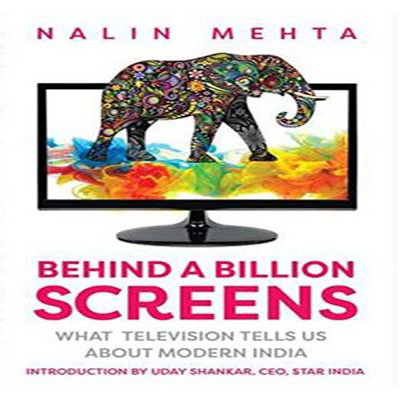
  • Nalin Mehta’s ‘Behind a Billion Screens’ examines Indian TV industry

    Nalin Mehta’s ‘Behind a Billion Screens’ examines Indian TV industry

    MUMBAI: India is a country where television forms the most important part of one’s life. Everybody watches television, everybody has an opinion on it and everybody thinks they know exactly what is wrong with it. 


    It’s a topic that often raises a lot of heat and smoke but too little light. Throwing some light on this trend of television is author and journalist Nalin Mehta’s new book ‘Behind a Billion Screens.’


    The book closely examines how television works in India, how TV channels make their money or not, how this is changing and what this means for the cacophony that appears on our screens.


    The book, which was initially going to be a joint effort by Star India CEO Uday Shankar and Mehta, was later written independently by the latter.
    The book answers key questions like:


    • Who owns Indian television? Just how much is it controlled by politicians, corporations and real estate companies? What are the patterns of control nationally and across regional languages? How does India compare with other countries and why does this matter?


    • What explains television’s terrible crisis of content? Is there really no market for intelligence in India and is dumped down content the only thing that audiences want? Why do channels keep behaving like Bollywood producers of the 1980s who kept churning out the same old tired formula films till a new multiplex-savvy breed of film-makers started challenging old orthodoxies? Is there a talent problem or management problem or a crisis of business models?


    • What is wrong with current government controlling system on television and why this ‘terrible-backend’ needs to change? Indian television continues to be controlled by outdated regulations, even as it is mired in public battles for greater regulation, as called for by Justice Katju. Studying the role of the Ministry of Information and Broadcasting, Telecom Regulatory Authority of India (TRAI), state governments and the judiciary, this book answers just how much control the state still has on broadcasting, why its jugaad nature of regulation is now unsustainable and why a major change is needed.


    • Does self-regulation work? How did self-regulatory bodies governing television come into being and what has been their factual record? Has self-regulation made any difference to programming or is it simply a chimera only designed to keep government out?How does India compare to other countries?
    • Does public broadcasting still matter, what exactly is wrong with Prasar Bharti and how can it be fixed?


    • Is television becoming irrelevant in the digital age? How is television shape-shifting in response to mobiles and the net, how are companies changing their businesses and programming, where is India going and how different is India from the rest of the world.


    The book highlights how India’s $15 billion media and entertainment industry – including television, print, radio, digital media – is growing at roughly 14 per cent a year. This, by some accounts, is impressive, benefitting immensely from the tailwinds of GDP growth of the last decade. But the stark fact is that even at $15 billion, India’s entire media taken together is just about one fourth the size of Google ($59 billion in revenues) – a fourteen-year-old company that is younger than most major Indian TV channels.


    “Let us not even go that far. If the entire Indian media was a company, it would rank seventh or eighth in India! Media is a globally growing industry but our participation in that ecosystem is zero and India is hardly factored into the global thought process of technology or content,” the book points out.


    Mehta, in the book, highlights how India is drunk on its own volumes: the largest number of newspapers in circulation, the second largest number of television viewers and millions of digital consumers. Digital, in particular, is an indictment of our creative and strategic limitations.


    “We have over 700 million mobile screens and yet we do not have a relatively unique content proposition for the medium. So, our ability to convert that into corresponding value is disappointing. Both in business and creative terms, the Indian media and entertainment sector still remains much smaller than it should be in a country of 1.2 billion people,” the book says.


    Even at these volumes, the reach as a percentage of population is not spectacular. India has 100 million households with no television, their time spent on it is abysmally low when compared to global standards; some 350 million people read the newspaper – but that tells us how many do not read!


    Mehta points out that in television, India needs a lot more content and this will come not only by scaling up production but through a fundamental transformation of the ecosystem. Resources, talent and every related facet have to evolve dramatically. For example, the production infrastructure in Mumbai, studio space, access to talent is creaking and unable to keep pace with the demand.


    Despite all the gloom and doom, India’s media and entertainment sector has consistently delivered impressive growth rates for the past few years. But, this is not a sector whose value is measured just by the size of its financial contribution. Media and entertainment remains central to defining the direction of India’s social and economic path; its work remains key to the imagination and inspiration of a billion Indians every day; and its health will be central to the ethos and values of the society we collectively shape.


    Mehta, through the book, says that with Narendra Modi’s new government in place, since May 2014, there is a renewed focus on reassessing things and trying to improve them. 

    “We need to make the case, for example, digitisation is not just about putting boxes and laying cables. It entails a fundamental transformation of the way we look at media and there is an opportunity for Indian media and content to move from just being a provider of entertainment content to being a creative industry, like the IT sector, for example, that plays a much larger role in the overall economic vision for the country,” Mehta opines in the book.


    He further writes that the media has been more than just a silent victim. Too often, the news media has focused on what is sensational rather than what is important. Too often, the point of news seems to be to reduce the extraordinary diversity of the country to the most banal, a contest between extremes that canonly be resolved through a shouting match on live television. With singular dominant narratives, the trend seems to be to create heroes on a particular day only to label them as thugs and crooks the next.


    Until recently, for a long time the media–government equation seemed like a broken relationship, and one that has had dire consequences for both the industry as well as the government. The failure to establish credibility and importance meant the industry perennially stayed on the back foot, defending itself against every new wave of regulation aimed only at curtailing its wings further. In return, governments were not able to leverage either the impact that mass media can have in India or harness the power of media as an economic engine that can create jobs and wealth.


    The book, in order to put things in perspective, says, “As a $15 billion industry, we employ over six million people. This can be so much more significant and meaningful. According to official estimates, about fifteen million people are entering the job market every year while the country is generating only about three million new jobs a year. This means that we are adding, as filmmaker Shekhar Kapur eloquently put it, a city of unemployed people as big as Delhi every year. And yet, the lens often used to look at this industry is largely one of glamour and propaganda and the biggest debate is on how to control and contain it.”


    There are 161 million cable and satellite homes but the measured universe so far is much smaller. “I do not know how many subscribers I have with a particular MSO and the MSO doesn’t know how many households his LCO delivers the signals to. The same is true in advertising too. The country’s premier media agencies can’t even seem to agree on a fact as basic as the size of the advertising market. One leading agency recently estimated the total market size to be Rs 35,000 crore, while the other, equally illustrious, estimated it to be Rs 29,000 crore. A variance of no less than 20 per cent! The ambiguity in data for other sectors of the media and entertainment industry is no less. Numbers are supposed to be the foundations of rational business decisions but how can we make decisions when professionals in the business of numbers can’t get their numbers straight?”


    Reacting on the book, Shankar said, “Nalin is probably the best media academic in India…this book is a seminal contribution to the evolving debate about the role of the Indian media.”


    Author and India Today Group consulting editor Rajdeep Sardesai added, “Excellent… an incisive and much needed study of how television is changing in India.”
    Times Now editor in chief Arnab Goswami said, “Fantastic… Nalin has beautifully pieced together the real, untold story behind the sound bytes.