Tag: Trai

  • Govt respects free discourse & social media via internet: Ravi Shankar Prasad

    Govt respects free discourse & social media via internet: Ravi Shankar Prasad

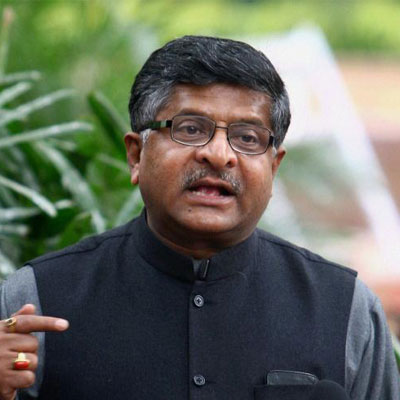
    NEW DELHI: Communications and Information Technology Minister Ravi Shankar Prasad has said the government fully respects the freedom of expression and discourse on social media and interned adding that “Our government is committed towards digital inclusion.”

    Welcoming the Telecom Regulatory Authority of India’s (TRAI) decision on discriminatory pricing, he said, “We very much appreciate this decision of TRAI whereby differential tariff in case of data services has been rejected. The view of our government from the beginning has been very clear, which I have also articulated in the Parliament, that is, internet is one of the finest creations of human mind and it should not become the monopoly of few.”

    “Differential pricing on data, whether it is Free Basics or any other mode, is plainly not acceptable,” the minister said, adding that the internet “must be available without discrimination.”

    Prasad said that the government was expanding Digital India into every “nook and corner of the country, and taking extraordinary steps to empower the people through technology, to create a knowledge economy, the very concept,” in order to bring about digital inclusion.

  • Indian Broadcasting Foundation cheers TRAI’s decision on differential pricing

    Indian Broadcasting Foundation cheers TRAI’s decision on differential pricing

    MUMBAI: The Indian Broadcasting Foundation (IBF) has welcomed the Telecom Regulatory Authority of India’s (TRAI) decision to rule out differential pricing.

    “The broadcasting industry is appreciative of TRAI’s decision to rule out differential pricing. IBF has earlier opposed differential pricing terming it to be ‘non-competitive,” said IBF secretary general Girish Srivastava.

    In its response to the consultation paper, IBF had clearly stated that such discriminatory entry barriers would lead to “reduced scope of consumer choice, inducing artificial scarcity.”

    “In our opinion, TRAI’s regulation on prohibiting differential pricing constitutes a milestone as it was against the basic principle of Internet access as no private player should have the power and right to decide which information can be accessed and which is less easily available,” Srivastava added.

    As was reported earlier by Indiantelevision.com, major broadcasters like Star India, Sony Pictures Networks India and Zee Network submitted their comments to TRAI in favour of net neutrality citing the drawbacks of differential pricing for telecom services.

  • Indian Broadcasting Foundation cheers TRAI’s decision on differential pricing

    Indian Broadcasting Foundation cheers TRAI’s decision on differential pricing

    MUMBAI: The Indian Broadcasting Foundation (IBF) has welcomed the Telecom Regulatory Authority of India’s (TRAI) decision to rule out differential pricing.

    “The broadcasting industry is appreciative of TRAI’s decision to rule out differential pricing. IBF has earlier opposed differential pricing terming it to be ‘non-competitive,” said IBF secretary general Girish Srivastava.

    In its response to the consultation paper, IBF had clearly stated that such discriminatory entry barriers would lead to “reduced scope of consumer choice, inducing artificial scarcity.”

    “In our opinion, TRAI’s regulation on prohibiting differential pricing constitutes a milestone as it was against the basic principle of Internet access as no private player should have the power and right to decide which information can be accessed and which is less easily available,” Srivastava added.

    As was reported earlier by Indiantelevision.com, major broadcasters like Star India, Sony Pictures Networks India and Zee Network submitted their comments to TRAI in favour of net neutrality citing the drawbacks of differential pricing for telecom services.

  • Facebook’s Mark Zuckerberg disappointed with TRAI’s decision favouring net neutrality

    Facebook’s Mark Zuckerberg disappointed with TRAI’s decision favouring net neutrality

    MUMBAI: Everyone in the world should have access to the Internet says Facebook founder Mark Zuckerberg.

    Voicing his disappointment over Indian regulator – the Telecom Regulatory Authority of India’s (TRAI) decision, which upheld net neutrality and ruled against differential pricing of data services, Zuckerberg took to his social networking website and said, “Today India’s telecom regulator decided to restrict programs that provide free access to data. This restricts one of Internet.org’s initiatives, Free Basics, as well as programs by other organizations that provide free access to data.”

    With an aim to provide basic internet services to all, Zuckerberg launched Internet.org with many different initiatives — including extending networks through solar-powered planes, satellites and lasers, providing free data access through Free Basics, reducing data use through apps, and empowering local entrepreneurs through Express Wi-Fi.

    “While we’re disappointed with today’s decision, I want to personally communicate that we are committed to keep working to break down barriers to connectivity in India and around the world. Internet.org has many initiatives, and we will keep working until everyone has access to the internet,” he added.

    He added that with Internet.org, more than 19 million people in 38 countries have been connected through its different programs.

    “Connecting India is an important goal we won’t give up on, because more than a billion people in India don’t have access to the internet. We know that connecting them can help lift people out of poverty, create millions of jobs and spread education opportunities. We care about these people, and that’s why we’re so committed to connecting them,” he voiced.

    Zuckerberg said that Facebook’s mission was to make the world more open and connected. “That mission continues, and so does our commitment to India,” he said.

    It may be recalled that Facebook faced a lot of flak recently when it asked its users to support Free Basics via a poll. Free Basics has been criticised over grounds that it curbed people’s freedom to access the internet of their choice.

  • Facebook’s Mark Zuckerberg disappointed with TRAI’s decision favouring net neutrality

    Facebook’s Mark Zuckerberg disappointed with TRAI’s decision favouring net neutrality

    MUMBAI: Everyone in the world should have access to the Internet says Facebook founder Mark Zuckerberg.

    Voicing his disappointment over Indian regulator – the Telecom Regulatory Authority of India’s (TRAI) decision, which upheld net neutrality and ruled against differential pricing of data services, Zuckerberg took to his social networking website and said, “Today India’s telecom regulator decided to restrict programs that provide free access to data. This restricts one of Internet.org’s initiatives, Free Basics, as well as programs by other organizations that provide free access to data.”

    With an aim to provide basic internet services to all, Zuckerberg launched Internet.org with many different initiatives — including extending networks through solar-powered planes, satellites and lasers, providing free data access through Free Basics, reducing data use through apps, and empowering local entrepreneurs through Express Wi-Fi.

    “While we’re disappointed with today’s decision, I want to personally communicate that we are committed to keep working to break down barriers to connectivity in India and around the world. Internet.org has many initiatives, and we will keep working until everyone has access to the internet,” he added.

    He added that with Internet.org, more than 19 million people in 38 countries have been connected through its different programs.

    “Connecting India is an important goal we won’t give up on, because more than a billion people in India don’t have access to the internet. We know that connecting them can help lift people out of poverty, create millions of jobs and spread education opportunities. We care about these people, and that’s why we’re so committed to connecting them,” he voiced.

    Zuckerberg said that Facebook’s mission was to make the world more open and connected. “That mission continues, and so does our commitment to India,” he said.

    It may be recalled that Facebook faced a lot of flak recently when it asked its users to support Free Basics via a poll. Free Basics has been criticised over grounds that it curbed people’s freedom to access the internet of their choice.

  • TRAI rules against differential pricing for telecom services; imposes penalty of Rs 50,000 per day for offenders

    TRAI rules against differential pricing for telecom services; imposes penalty of Rs 50,000 per day for offenders

    NEW DELHI: In what is clearly a major win for crusaders of net neutrality, the Telecom Regulatory Authority of India (TRAI) has ruled against differential pricing and said no service provider will enter into any arrangement or contract that has the effect of discriminatory tariffs for data services.

    TRAI reserved the right to either ask a service provider to withdraw any discriminatory tariff or impose a penalty of Rs 50,000 per day (subject to a maximum of Rs 50 lakh) for discriminatory tariffs charged by service providers. The decision of the Authority as to whether a service provider is in contravention of this regulation will be final and binding. 

    ‘The Prohibition of Discriminatory Tariffs for Data Services Regulations 2016,’ issued today comes into effect immediately and will be reviewed every two years.

    TRAI said allowing service providers to charge differently for data could compromise the entire architecture of the internet. “Prohibition of discriminatory tariff is necessary to ensure that service providers continue to fulfill obligations in keeping internet open and non-discriminatory,” TRAI said.

    The Regulation has been issued after reviewing the responses received by the regulator to its Consultation Paper on Differential Pricing for Data Services issued on 9 December last year. As was reported earlier by Indiantelevision.com, major broadcasters like Star India, Sony Pictures Networks India and Zee Network submitted their comments to TRAI in favour of net neutrality citing the drawbacks of differential pricing for telecom services.

    TRAI said the paper was issued because two key principles of tariff regulation – non-discrimination and transparency were getting impacted from such practices and required consultation. 

    While almost all the broadcasters opposed differential rates, the telecom and internet service providers felt that this was necessary particularly in view of the deluge of over the top (OTT) services expected to come in.

    The general economic concept of ‘price differentiation’ covers all practices where a seller of goods or provider services charges different prices from different consumers, either for exactly the same goods or service or for slightly different versions of the same goods or service. The ‘service’ being referred to in the context of differential pricing of data services is the units of data or bits that a person consumes in order to access the internet. This understanding is also qualified by the fact that the current regulation refers to a particular category of price differentiation – that is content-specific. 

    While ruling out differential pricing in such cases, TRAI put a proviso: “Provided that this regulation shall not apply to tariffs for data services over closed electronic communications networks, unless such tariffs are offered or charged by the service provider for the purpose of evading the prohibition in this regulation.”

    It also said, “A service provider may reduce tariff for accessing or providing emergency services, or at times of grave public emergency, provided that such tariff shall be reported to the Authority within seven working days from the date of implementation of the reduced tariff and the decision of the Authority as to whether such reduced tariff qualifies under this regulation shall be final and binding.”

    The penalties will be imposed only after the service provider has been given a reasonable opportunity of representing against the contravention of the regulation. The amount payable by way of financial disincentive under these regulations will be remitted to such head of account as may be specified by TRAI.

    The regulator also said, “Nothing contained in these regulations shall affect any packs, plans or vouchers with unexpired validity subscribed by a consumer before the date of commencement of these regulations, provided that no such pack, plan or voucher shall be valid beyond a period of six months from the date of commencement of these regulations.”

    Explaining the rationale for the paper, TRAI said, “Some practices have come to the notice of the Authority wherein differential tariffs were offered based on the content, websites, applications, platforms.”

    It also said the appropriate regulatory response on the issue of differential pricing must necessarily be grounded in a sound understanding of the basic architecture of the internet. Any proposed changes in business models and commercial practices must also be seen in the context of the need to preserve the unique architecture of the Internet as a global communication network.

    The Internet and Mobile Association of India (IAMAI) welcomed the Regulation as a bold and fair move. It said net neutrality would be ensured with TRAI explicitly clarifying its stand in a very clear and transparent ruling about differential tariffs and agreements. The association had taken a ‘no exception standpoint’ against differential pricing.

    “This ruling vindicates the associations stand on the issue. The internet Start-up eco-system and the internet user community are delighted,” IAMAI said. 

    IAMAI has also welcomed the move that TRAI will be the ultimate authority to decide the cases of violations of this ruling and that the decision of the authority will be final and binding. 

    However, the association voiced a concern on the exceptions as to how this will pan out. The association hoped that the exceptions to the rule will not be misused by the TSPs. The exception states “…regulation shall not apply to tariffs for data services over closed electronic communications networks…”

    Meanwhile, the campaigner change.org claimed a massive victory and said “History has been created!” It said nearly 3.75 lakh Change.org users had supported Net Neutrality. 

    The nationwide campaign that unfolded over almost a year was started by Sandeep Pillai, a techie from Kollam in Kerala.
  • TRAI rules against differential pricing for telecom services; imposes penalty of Rs 50,000 per day for offenders

    TRAI rules against differential pricing for telecom services; imposes penalty of Rs 50,000 per day for offenders

    NEW DELHI: In what is clearly a major win for crusaders of net neutrality, the Telecom Regulatory Authority of India (TRAI) has ruled against differential pricing and said no service provider will enter into any arrangement or contract that has the effect of discriminatory tariffs for data services.

    TRAI reserved the right to either ask a service provider to withdraw any discriminatory tariff or impose a penalty of Rs 50,000 per day (subject to a maximum of Rs 50 lakh) for discriminatory tariffs charged by service providers. The decision of the Authority as to whether a service provider is in contravention of this regulation will be final and binding. 

    ‘The Prohibition of Discriminatory Tariffs for Data Services Regulations 2016,’ issued today comes into effect immediately and will be reviewed every two years.

    TRAI said allowing service providers to charge differently for data could compromise the entire architecture of the internet. “Prohibition of discriminatory tariff is necessary to ensure that service providers continue to fulfill obligations in keeping internet open and non-discriminatory,” TRAI said.

    The Regulation has been issued after reviewing the responses received by the regulator to its Consultation Paper on Differential Pricing for Data Services issued on 9 December last year. As was reported earlier by Indiantelevision.com, major broadcasters like Star India, Sony Pictures Networks India and Zee Network submitted their comments to TRAI in favour of net neutrality citing the drawbacks of differential pricing for telecom services.

    TRAI said the paper was issued because two key principles of tariff regulation – non-discrimination and transparency were getting impacted from such practices and required consultation. 

    While almost all the broadcasters opposed differential rates, the telecom and internet service providers felt that this was necessary particularly in view of the deluge of over the top (OTT) services expected to come in.

    The general economic concept of ‘price differentiation’ covers all practices where a seller of goods or provider services charges different prices from different consumers, either for exactly the same goods or service or for slightly different versions of the same goods or service. The ‘service’ being referred to in the context of differential pricing of data services is the units of data or bits that a person consumes in order to access the internet. This understanding is also qualified by the fact that the current regulation refers to a particular category of price differentiation – that is content-specific. 

    While ruling out differential pricing in such cases, TRAI put a proviso: “Provided that this regulation shall not apply to tariffs for data services over closed electronic communications networks, unless such tariffs are offered or charged by the service provider for the purpose of evading the prohibition in this regulation.”

    It also said, “A service provider may reduce tariff for accessing or providing emergency services, or at times of grave public emergency, provided that such tariff shall be reported to the Authority within seven working days from the date of implementation of the reduced tariff and the decision of the Authority as to whether such reduced tariff qualifies under this regulation shall be final and binding.”

    The penalties will be imposed only after the service provider has been given a reasonable opportunity of representing against the contravention of the regulation. The amount payable by way of financial disincentive under these regulations will be remitted to such head of account as may be specified by TRAI.

    The regulator also said, “Nothing contained in these regulations shall affect any packs, plans or vouchers with unexpired validity subscribed by a consumer before the date of commencement of these regulations, provided that no such pack, plan or voucher shall be valid beyond a period of six months from the date of commencement of these regulations.”

    Explaining the rationale for the paper, TRAI said, “Some practices have come to the notice of the Authority wherein differential tariffs were offered based on the content, websites, applications, platforms.”

    It also said the appropriate regulatory response on the issue of differential pricing must necessarily be grounded in a sound understanding of the basic architecture of the internet. Any proposed changes in business models and commercial practices must also be seen in the context of the need to preserve the unique architecture of the Internet as a global communication network.

    The Internet and Mobile Association of India (IAMAI) welcomed the Regulation as a bold and fair move. It said net neutrality would be ensured with TRAI explicitly clarifying its stand in a very clear and transparent ruling about differential tariffs and agreements. The association had taken a ‘no exception standpoint’ against differential pricing.

    “This ruling vindicates the associations stand on the issue. The internet Start-up eco-system and the internet user community are delighted,” IAMAI said. 

    IAMAI has also welcomed the move that TRAI will be the ultimate authority to decide the cases of violations of this ruling and that the decision of the authority will be final and binding. 

    However, the association voiced a concern on the exceptions as to how this will pan out. The association hoped that the exceptions to the rule will not be misused by the TSPs. The exception states “…regulation shall not apply to tariffs for data services over closed electronic communications networks…”

    Meanwhile, the campaigner change.org claimed a massive victory and said “History has been created!” It said nearly 3.75 lakh Change.org users had supported Net Neutrality. 

    The nationwide campaign that unfolded over almost a year was started by Sandeep Pillai, a techie from Kollam in Kerala.

  • TRAI advises TV distribution platforms to use e-CAF to increase efficiency

    TRAI advises TV distribution platforms to use e-CAF to increase efficiency

    MUMBAI: As a proactive measure for enabling the use of digital technologies towards bringing efficiencies in providing and managing services to the subscribers, the Telecom Regulatory Authority of India (TRAI) has asked distribution platform operators (DPOs) like direct to home (DTH), multi-system operators (MSOs), Headend-In-The-Sky (HITS) and IPTV companies providing TV broadcast services to use Electronic Customer Application Form (e-CAF). 

    The CAF is required to be filled up by customers mandatorily before subscribing to TV services. The information captured in the CAF is then transferred to the Subscriber Management System (SMS) of the DPO for managing the services availed by the subscriber.

    The authority said that presently, use of CAF in paper format is prevalent and manual process is followed for updating information in the SMS, which involves processing millions of physical CAFs and their storage creates operational difficulties.

    “The e-CAF can be easily accessed and integrated with the SMS of the DPO eliminating the manual feeding of information and also provides customers a simpler method for subscribing to services; improve customer relationship, and management of their subscription and services. The e-CAF will bring efficiencies in the process of providing and managing services to the subscribers,” TRAI said in an advisory. 

    It went on to add that the adoption of e-CAF is an environment friendly measure and is likely to benefit all stakeholders.

  • TRAI advises TV distribution platforms to use e-CAF to increase efficiency

    TRAI advises TV distribution platforms to use e-CAF to increase efficiency

    MUMBAI: As a proactive measure for enabling the use of digital technologies towards bringing efficiencies in providing and managing services to the subscribers, the Telecom Regulatory Authority of India (TRAI) has asked distribution platform operators (DPOs) like direct to home (DTH), multi-system operators (MSOs), Headend-In-The-Sky (HITS) and IPTV companies providing TV broadcast services to use Electronic Customer Application Form (e-CAF). 

    The CAF is required to be filled up by customers mandatorily before subscribing to TV services. The information captured in the CAF is then transferred to the Subscriber Management System (SMS) of the DPO for managing the services availed by the subscriber.

    The authority said that presently, use of CAF in paper format is prevalent and manual process is followed for updating information in the SMS, which involves processing millions of physical CAFs and their storage creates operational difficulties.

    “The e-CAF can be easily accessed and integrated with the SMS of the DPO eliminating the manual feeding of information and also provides customers a simpler method for subscribing to services; improve customer relationship, and management of their subscription and services. The e-CAF will bring efficiencies in the process of providing and managing services to the subscribers,” TRAI said in an advisory. 

    It went on to add that the adoption of e-CAF is an environment friendly measure and is likely to benefit all stakeholders.

  • 2014-15: MIB earns Rs 836.52 crore from DTH; revenue from FM drops to Rs 80.3 crore

    2014-15: MIB earns Rs 836.52 crore from DTH; revenue from FM drops to Rs 80.3 crore

    MUMBAI: The Ministry of Information and Broadcasting (MIB) earned revenue of Rs 836.52 crore from the direct-to-home (DTH) sector for the year 2014-15. This was a considerable increase from the Rs 395.43 crore that the MIB earned from the sector in the previous year (2013-14). For the year 2012-13, the revenue from the sector stood at Rs 308.66 crore.

    Apart from Doordarshan’s free-to- air DD Direct Plus, there are six private DTH players in India namely Dish TV, Tata Sky, Sun Direct TV, Reliance Big TV, Airtel Digital TV and Videocon d2h.

    On the other hand, the revenue that the MIB earned from the auction of FM Radio dropped considerably in 2014-15 to Rs 80.30 crore from Rs 102.21 crore in 2013-14. In 2012-13, the revenue from the sector stood at Rs 61.27 crore. 

    The FM Phase-I Policy, which was approved by the Government in July, 1999, met with the limited success and saw a total number of 21 channels are operational in 12 cities under this scheme.

    On the other hand, the improved FM Phase-II Policy was notified in July, 2005 after considering the recommendations of Dr.Amit Mitra Committee and Telecom Regulatory Authority of India (TRAI). FM Policy Phase-II has been well received by all stake holders. It has resulted in huge growth in FM radio industry. However, many cities still remained uncovered by the private FM radio broadcasting.

    With the huge success of Phase II, FM Phase III Policy extended FM radio services to about 227 new cities, in addition to the present 86 cities, with a total of 839 new FM radio channels in 294 cities, Phase-III policy will result in coverage of all cities with a population of one lakh and above with private FM radio channels. The government has earned revenue by auction of FM channels to the private service providers.