Tag: Tra

  • And the e-commerce war continues…

    And the e-commerce war continues…

    MUMBAI: The day began with one of the most interesting ad wars on the front pages of leading newspapers of recent times and ended, on one hand with Flipkart apologising to its customers even after clocking $100 million in 10 hours while on the other hand Snapdeal, making a crore per minute, scoring its highest sale in a single day.


    Even though the fight for the market share between e-retailers has been going on for some time now, the day 6 October seems to have made history in the e-commerce space with discounts and deals never heard of and the impossible to miss marketing by the e-commerce sites. The day signals the start of a marketing war that is set to intensify in the months to come.


    In a bid to differentiate itself, Flipkart launched the ‘big billion day’ sale along with a matching television ad campaign for the past two weeks. It was projected as the mother of all flash sales, with the aim of surpassing the turnovers of multiple day sales in a single day. Though it did not turn out the way it was supposed to.


    The sale not only affected the home-grown brand Flipkart, it also impacted its competitors like Amazon and Snapdeal majorly along with Indian retailers like Future group. The Confederation of All India Traders (CAIT) has also launched a probe into the sites and the government may also launch a separate policy for the sector soon.


    According to Trust Research Advisory (TRA) CEO N Chandramouli the Big Billion day sale was merely a catalyst to a situation that has already been simmering for a while. “It is essential that the government looks into the matter as with the absence of legislative measures the online retailers exist in a state of anarchy,” he says.


    Talking about the Big billion day fiasco, Chandramouli reckons, “The Big Billion day fiasco definitely has coloured the perception of people negatively. If this has not awoken all the e-commerce brands to ensuring they tighten their systems before embarking on such an offer day, then there will still be trouble.”


    “On the other hand, this fiasco must have also strengthened the resolve of competing brands to prove that they will stand true to their promises, ensuring that their promise to the consumers is always met,” he adds.


    Chandramouli feels that mature players like Amazon were the gainers in this fiasco backed by their years of experience and learning. “Everyone other than Flipkart has benefitted from this fiasco. The competition is being trusted more and Flipkart’s stranglehold is being broken, the consumer has got some good deals and they benefit too,” he points out.


    Team Pumpkin business head Swati Nathani has a different view. She says, “We did see complete social media backlash for Flipkart on 6 October and assumed that the e-commerce giant will definitely not achieve the targets set by itself. However, at the end of the day, we did see Flipkart breaking all records and emerging as a clear winner. Despite that, the co founders sent an apology note to all the customers. In our opinion, Flipkart has gained more than it has lost after the fiasco.”


    When it came to ads, none of the e-tailers were behind. With Flipkart’s ‘Big Billion Day’ sale ads flooding the pages of major Indian newspapers, Amazon’s response alluded to India’s recent successes in space with its “Mission to Mars” campaign, while Snapdeal tried to play it cool with a pitch that ran with the tagline ‘For others it’s a big day. For us, today is no different’.


    The statistics show that a combination of #Flipkart and #BigBillionDay received approximately 57,600 mentions versus 15,000 mentions for #CheckSnapdealToday. #Flipkart and #BigBillionDay collectively received approximately 2,137 million impressions across Twitter, while #CheckSnapDeal received around 859 million impressions. Emotions favoured Snapdeal where it received only seven per cent negative sentiment mentions compared to 23 per cent for Flipkart. The conclusion could be that while Flipkart got the numbers, Snapdeal, even with the smaller numbers it could manage, kept customers happy.


    And now, even after the dust has settled on the 6 October fiasco, the ad wars continue.  As Amazon now comes up with its latest Diwali Dhamaka sale, Snapdeal continues with its trending #CheckSnapdealToday tagline. Full page back to back ads can be viewed in leading newspapers like the Times of India.


    Even as customers continue to shop with sites offering astonishing discounts, the retailers and the government have started expressing concerns over huge discounts being offered by e-commerce firms.


    While Chandramouli believes that there are only two possibilities in such cases, firstly that the offer is coming from manufacturers or the e-tailers are absorbing the losses of the discounts.


    “Either way, it is not sustainable. If the objective is to pulling in new e-buyers by offering them unheard of discounts, it will help, but it only builds the entire market, not loyalty to any particular brand,” he opines.


    Nathani reveals that the current focus of e-commerce players is more to gain the market share in customer mindsets rather than profitability. “Jabong has incurred a net loss of Rs 293 crore in the last fiscal year. So we would say that the e-tailers will even sell products at a loss to ensure that customers keep returning to them. Customers, therefore, are at the best spot right now in terms of advantages,” she says.


    But even with the losses, the discounts do not stop. “E-commerce is a rapidly growing sector and often due to the absence of a physical manifestation of the store, online advertisers tend to promise in superlatives,” says Chandramouli.


    Adding to the same, Nathani reckons, “Customers expectations have definitely risen in terms of discounts. For eg Snapdeal offered iPhone 5S for Rs 24,999 in its newspaper ad and now, this price has become benchmark for the customers who are looking out to buy the phone.”


    According to the pre-dominant consumer sentiment, Flipkart which holds 50 per cent market share in the Indian market may have to now work harder to get its back after the fiasco.


    Though, she clearly believes that In terms of numbers and reach, Flipkart is the clear winner currently.  “But with the constantly evolving strategies, they see Snapdeal getting closer to the top spot soon.”


    But with Diwali coming near, it would now be interesting to see how the #bigbillionday fiasco will or will not affect the sales of the portals and how prepared they are to give their customers a good time. But till they #happyshopping.
     

  • Samsung is India’s Most Trusted Brand; Sony ranks 2nd, Tata is 3rd

    Samsung is India’s Most Trusted Brand; Sony ranks 2nd, Tata is 3rd

    MUMBAI: India’s much anticipated and most rigorous brand evaluation, The Brand Trust Report, India Study, a comparison of the trust held in brands, has been released for 2014. Samsung has emerged as India’s Most Trusted brand this year. Sony ranks as India’s 2nd Most Trusted Brand followed by Tata which has ranked 3rd this year. In 2013, the three brands had ranked second, third and fifth respectively. LG, ranks 4th in this year’s list, followed by the three year leader, Nokia, at 5th place. Hewlett Packard move up fourteen ranks over last year to become India’s 6th Most Trusted Brand and Hero leaps seventy-nine ranks to become India’s 7th Most Trusted. Honda is at rank 8th, followed by Reliance at 9th. Mahindra betters its last year rank by sixty-nine places to get ranked as India’s 10th Most Trusted brand.

    The Brand Trust Report, the fourth in its series, is the result of a comprehensive primary research conducted on the proprietary 61-Attribute Trust Matrix of TRA (formerly known as Trust Research Advisory). This year’s study involved 15000 hours of fieldwork covering 2500 consumer-influencers across 16 cities in India and generated 5 million datapoints and 20000 unique brands from which the top 1200 brands have been listed in this year’s report. These brands have been classified into 284 different categories as against 213 categories in 2013. The 244-page report is available for Rs. 14000/-.

    N. Chandramouli, CEO, TRA, said on the occasion of the report’s launch, “Samsung has grown steadily in trust ranks over the last four years – 5th in 2011, 4th in 2012, 2nd in 2013 and has reached India’s Most Trusted rank this year. When a brand focuses on its trust with intensity, apart from trust the brand gains in market-share, product premium and acceptance of new products as an automatic by-product. Samsung’s strategy of focusing on the core intangibles of its brand is evident from its climb to leadership in BTR 2014.”

    An analysis of the 100 Most Trusted Brands in 2014 revealed that most brands were represented from Diversified with 11, Consumer Electronics with 10, Bath/Beauty with 9, Mobiles with 8, 4-Wheelers, Telephony, and 2-Wheelers with 4 each, and Personal Technology, Sportswear and Aerated Drinks with 3 brands each.

     “Among the top 100 Most Trusted brands, 75 were net gainers while 25 took a fall. The gainers gained an average of 86.23 ranks, while those that fell took a dip of 27.16 ranks on average, showing that the average gain among the top hundred beats the average loss in ranks by 317%. A connected surmise


    could be drawn that in the year that was slow for many, brands took the opportunity to focus more on their trust intangibles, scoring points in the process. For long term sustainability and success, it is important that brands have a long term investment in trust”, Chandramouli added.

  • Samsung Mobiles is India’s Most Attractive Brand, Sony takes 2nd place

    Samsung Mobiles is India’s Most Attractive Brand, Sony takes 2nd place

    MUMBAI: The latest report from TRA (Trust Research Advisory) – India’s leading brand insights company – titled India’s Most Attractive Brands 2013 (MAB 2013) was released.


    Samsung Mobiles emerged as India’s Most Attractive Brand in 2013. India’s second Most Attractive brand is the consumer durables leader Sony, followed by Nokia as the third most attractive across all categories.


    India’s top three Most Attractive brands are very close together with just two per cent separating them. Following at fourth place is LG, the South Korean consumer electronics leader with eight per cent attractiveness score lag from the previous. Placed at India’s fifth Most Attractive brand is India’s home-grown conglomerate – Tata – trailing its predecessor by 11 per cent. The results are based on a primary survey conducted with 2,505 consumer-influencers across 16 cities based on TRA’s proprietary matrix of 36 Brand Attractiveness Traits.


    Launching the report, TRA (a Comniscient Group company) CEO N. Chandramouli observed, “The force of attractiveness is a primal force that affects all of us with the same intensity – whether it be attraction with other humans, objects, places or brands. As a brand insights company, TRA spent years understanding the basics of attractiveness by delving into several subjects ranging from philosophy to physiology, religion and communication, and have developed a robust proprietary matrix for deciphering the complex subject of Brand Attractiveness.”


    At the All India level, Lux, the bath/beauty brand from the HUL stable is India’s sixth Most Attractive brand nearly 48 per cent behind Tata in Attractiveness Quotient. The next four brands are within single-digit gaps of each other with Maruti Suzuki ranked seventh, Godrej ranked eighth, Bajaj ranked ninth, and Dell the Technology leader, ranked India’s tenth Most Attractive brand. India’s top 10 attractive brands include two mobile phone brands, two consumer electronics brands, and three from the diversified category, one each from FMCG, Automobile and Technology categories.


    Elaborating on the usefulness of TRA’s matrix, Chandramouli added, “Brands spend billions in advertisements trying to be attractive to consumers, but at best such approaches range between ad-hoc and haphazard. TRA’s Brand Attractiveness matrix will give brands a scientific tool and methodologies to improve their Attractiveness Quotient with their consumers, helping brands deploy their resources more efficiently and target their messages more accurately.”
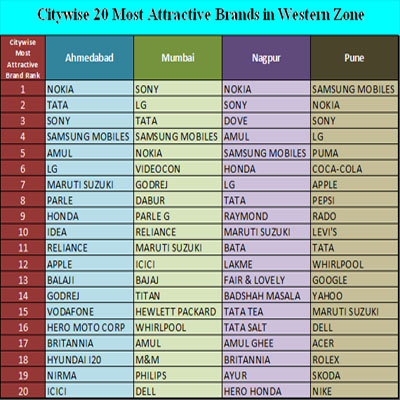
    In Western India, the Attractiveness Quotients are quite different from national scores with Sony being ranked as West Zone’s Most Attractive brand. This is followed by LG at second place, Tata at third, and Samsung Mobiles as Western India’s fourth Most Attractive brand.  Mumbai’s choices for the top three attractive brands were Sony, LG and Tata respectively.

  • Google remains India’s most trusted internet brand for 3rd time

    Google remains India’s most trusted internet brand for 3rd time

    MUMBAI: Google remains India‘s Most Trusted for the third year in a row but the gap with the second ranked Facebook is a miniscule 3 per cent, according to brand trust research agency Trust Research Advisory (TRA).

    An analysis of the All India Most Trusted ranks shows that Google (All India rank 44) fell 13 ranks and Facebook (All India rank 48) gained 17 ranks to bridge the gap, says TRA.

    Yahoo still stood as the third Most Trusted Internet brand despite its 62 rank fall in All India Brand Trust rank.

    Google‘s Orkut, steadied at 4th rank despite a significant fall in daily visitors from India. Ebay follows as India‘s fifth Most Trusted Internet brand with a very small difference in BTI from the previous. The top six of last year are repeated in the same order this year as well.

    TRA noted that the number of brands represented in the Internet category this year has gone up from just 14 in 2012 to 25 this year showing a direct increase in the trust internet based exchanges have begun to garner.

    The Brand Trust Report, India Study – 2013, is the third in its series researched and published by TRA. This year‘s research was conducted in 16 cities generating 19000 unique brands across 211 categories. Trust Research Advisory is a part of the Comniscient Group, a group of India‘s largest non-advertising based communication businesses.

    TRA CEO N. Chandramouli said, “Two reasons online brands rely significantly on trust more than any other. Firstly, the exchanges are without any physical interface, and secondly, the online world is cluttered with choices that make loyalty ephemeral. With most of the new brands entering the Most Trusted list this year being from Online Shopping or Internet Services, there will be no stopping this sub-category from seeing accelerated growth over the next 12 months.”

    The leaders in the various sub-categories are Naukri leading in Internet Services, Youtube in Online Sharing, Ebay in Online Shopping, Google in Internet Tools and Facebook in Social Networking.

    A study of the number of brands in each sub-categories shows that Internet Tools is represented by nine brands, Online Shopping by eight brands, Social Networking by four brands and Online sharing and Online Services by two brands each.

  • Zee TV is the most trusted Hindi GEC brand

    BENGALURU: Zee TV, despite a slide in its ranking, was ahead of all Hindi GECs in the third edition of The Brand Trust Report India Study 2013, a study of India‘s most trusted brands by the Trust Research Advisory (TRA).

    Zee TV fell six notches to 231 from last year’s 225. Star Plus saw a huge gain in ranking at 287 from 584 last year, but was still behind Zee TV.

    Tata Sky (DTH) moved up 156 places to rank 51 from last year’s ranking of 207. DISH TV (DTH) was ranked within the top 500 for the first time in 2013 with a ranking of 180.

    In entertainment, the most trusted brands are PVR (Cinema-Display) and Eros (Cinema-Other). The Times of India followed by DNA leads the Media – Print category.

    TRA says it expanded the scope of its study to 16 cities for the 2013 report with more than 13,000 hours of fieldwork which resulted in 3 million data points and 19,000 unique brands of which about 1,100 brands across 211 categories find mention.

    The top two contenders for Media-TV are Aaj Tak and ABP News (Hindi). Aaj Tak moved up 47 places to 121 in 2013 from 168 in 2012. ABP News (Hindi) entered the 500 most trusted brands list at 214. NDTV saw a fall of 41 places to 221 as compared to last year’s rank of 180. Discovery too saw a steep fall of 73 places to 278 as compared to last year’s 205 rank.

    For last year’s edition, TRA claims a readership of around 10,000 from about 400 copies of the 1000 copies published, each priced at Rs 10,000. This year TRA expects a readership of around 25,000, with the number of copies to be published undecided as of now. The price for the 2013 report has been enhanced by 40 percent to Rs 14,000 each. The target audience for the report is the brands who use the report in various ways, including improving upon the 61 attributes divided across 10 brand behaviors, the foundation of which lies on three fundamental layers of trust says TRA.

  • Trai issues additional QoS instructions

    Trai issues additional QoS instructions

    NEW DELHI: Indian broadcast regulator today came out with more details on quality of service (QoS) to be observed by MSOs and local cable operators in CAS-notified areas.

    The Telecom Regulatory Authority of India (Trai) has said the reporting (in the prescribed format) of QoS by approved MSOs and local cable ops shall be done on or before the expiry of 15 days from the end of the quarters and shall pertain to the quarters ending with 31 March, 30 June, 30 September and 31 December of each calendar year.

    Further, in the case of Chennai, the first reporting shall be for the quarter ending December 2006 and in case of notified areas of Mumbai, Delhi and Kolkata, it shall be for the quarter ending 31 March, 2007.

    Trai had issued Regulation specifying standards of Quality of Service to be observed by the MSOs and cable operators in CAS notified areas of Chennai, Mumbai, Delhi and Kolkata on 23 August 2006.

    This regulation provided that Trai, for the purpose of monitoring, can prescribe formats and demand reports from service providers on observance of QoS standards.

    Further, in MSOs who are permitted to provide cable service in CAS notified areas under the Cable Amendment Rules of 2006 would be obliged to maintain quality of standards as may be determined by the regulator.

    A full text of the general directive is available on the regulator’s website.