Tag: Tony Fernandes

  • “To make in India, but to benchmark it in the world:” Fareed Zakaria

    “To make in India, but to benchmark it in the world:” Fareed Zakaria

    MUMBAI: With PM Narendra Modi inaugurating the Make in India Week 2016 on 13 February, the second day of the week started with the CNN Asia Business Forum 2016. With seven sessions lined back to back, the forum enthralled delegates with a series of dynamic dialogues. The interactive discussion briefly explored new ideas, growing technology, secrets of leadership and the challenges Asia faces plus the tactics.

    Gracing the forum with their presence were eminent personalities like Finance Minister of India Arun Jaitley, Cisco executive chairman John Chambers, GE president and CEO South Asia Banmali Agrawala, Mahindra Group chairman Anand Mahindra, Aditya Birla Group chairman Kumar Managalam Birla, Emerson Electric Co. president Edward Monser, Google India and South East Asia MD Rajan Anandan, Snapdeal co-founder and CEO Kunal Bhal, Vinnova director general Charlotte Brogren, DJI director of strategic partnerships Michael Perry, AirAsia group CEO Tony Fernandes, Kerry Logistic Network chairman George Yeo and US Ambassador to India Richard Verma.

    The sessions were moderated by CNN’s business anchors Fareed Zakaria, Richard Quest and CNN Asia Pacific editor Andrew Stevens.

    With a mission to make the viewers understand about the world around us, Zakaria addressed the ‘State of the World’ by providing a snapshot of the global geopolitics.

    “The world is in a mess almost everywhere you look but you certainly have to start with the Middle East to understand how the people are anxious and uncertain about things,” Zakaria said.

    With countries like Lybia or Syria facing crisis in the current scenario against to what it was 40 years back, Zakaria strongly believes that the states system, which was built back during the World War I is essentially collapsing. “The states at that time were ruled by highly repressive dictators who knew law and order very well. But what has happened 10 years back is that these dictatorships have one by one have proved to be more and more fragile,” he says.

    The one characteristic that remains common and extremely important is that in these nations, the dictator left and what was noticed later on is the fact that there was no state or administrative institution to maintain political order. Going further, he explains that underneath the state it was noticed that there was no civic society or organisation to maintain social order and underneath that what you discover is that there is no nation.

    Zakaria points out, “People have retreated to identities that make them unavoidably hostile to one another. When order collapses you look for something that gives you security and stability and that security does not come in the Middle East from your national identity. These nations were created recently. It’s coming from much older identities like Siaa, Sunni, Arabians, etc, who are 1000 – 2000 year old identities. They have created an inbuilt sectoring of religious conflicts that persist and is going to take some time to be sorted out.”

    US engine has become the largest engine for producing liquid hydrocarbon in the world. The unbalanced supply and demand are the two engines that rightly explain the crisis. Zakaria explains, “The one engine in the US, which saw a growth from $1 million – $10 million in 10 years and the other engine being the declining demand in China.”

    Zakaria sheds light on how Europe faced crisis and how in the past 25 years the European Union has solved every economical challenge. “Every time the people thought the European Union is going to collapse, it endured, deepened and strengthened itself. Those were economic challenges but now they are facing political challenges about national identity and that proves to be harder to solve,” adds the CNN anchor.

    “If you look at the western hemisphere, the US is still probably the most powerful economy today. It’s growing fast at a pace twice as Europe and four times faster than Japan and is growing past many emerging markets like Brazil or South Africa. What is happening in Asia is an export dominated growth and a move that is shifting more to domestic consumption. For these countries, the decline of all has been an avoid depressing,” he says.

    The challenge that India has to face is how it deals with the issues and the opportunities from the global perspective. One of the discussions shed light on how India is doing compared to China, Turkey, Vietnam or Indonesia and that comparison is the key issue for India to recognise that there is a global competition for investment, for tropical, for talent and how does India solves this key issue.

    “When Manmohan Singh announced reforms for India in early 1990s, he compared it with South Korea. At that time, the GDP for the two countries were same but later South Korea became bigger by contributing 13 times more to the GDP than India. But India has potential to grow and has done well from then to now. Today South Korea’s per capita GDP is 20 times that of India’s. So the world moves on and India is doing extremely well but it needs to look around and make sure it does as well as what the rest nations are doing,” concluded Zakaria.

  • “To make in India, but to benchmark it in the world:” Fareed Zakaria

    “To make in India, but to benchmark it in the world:” Fareed Zakaria

    MUMBAI: With PM Narendra Modi inaugurating the Make in India Week 2016 on 13 February, the second day of the week started with the CNN Asia Business Forum 2016. With seven sessions lined back to back, the forum enthralled delegates with a series of dynamic dialogues. The interactive discussion briefly explored new ideas, growing technology, secrets of leadership and the challenges Asia faces plus the tactics.

    Gracing the forum with their presence were eminent personalities like Finance Minister of India Arun Jaitley, Cisco executive chairman John Chambers, GE president and CEO South Asia Banmali Agrawala, Mahindra Group chairman Anand Mahindra, Aditya Birla Group chairman Kumar Managalam Birla, Emerson Electric Co. president Edward Monser, Google India and South East Asia MD Rajan Anandan, Snapdeal co-founder and CEO Kunal Bhal, Vinnova director general Charlotte Brogren, DJI director of strategic partnerships Michael Perry, AirAsia group CEO Tony Fernandes, Kerry Logistic Network chairman George Yeo and US Ambassador to India Richard Verma.

    The sessions were moderated by CNN’s business anchors Fareed Zakaria, Richard Quest and CNN Asia Pacific editor Andrew Stevens.

    With a mission to make the viewers understand about the world around us, Zakaria addressed the ‘State of the World’ by providing a snapshot of the global geopolitics.

    “The world is in a mess almost everywhere you look but you certainly have to start with the Middle East to understand how the people are anxious and uncertain about things,” Zakaria said.

    With countries like Lybia or Syria facing crisis in the current scenario against to what it was 40 years back, Zakaria strongly believes that the states system, which was built back during the World War I is essentially collapsing. “The states at that time were ruled by highly repressive dictators who knew law and order very well. But what has happened 10 years back is that these dictatorships have one by one have proved to be more and more fragile,” he says.

    The one characteristic that remains common and extremely important is that in these nations, the dictator left and what was noticed later on is the fact that there was no state or administrative institution to maintain political order. Going further, he explains that underneath the state it was noticed that there was no civic society or organisation to maintain social order and underneath that what you discover is that there is no nation.

    Zakaria points out, “People have retreated to identities that make them unavoidably hostile to one another. When order collapses you look for something that gives you security and stability and that security does not come in the Middle East from your national identity. These nations were created recently. It’s coming from much older identities like Siaa, Sunni, Arabians, etc, who are 1000 – 2000 year old identities. They have created an inbuilt sectoring of religious conflicts that persist and is going to take some time to be sorted out.”

    US engine has become the largest engine for producing liquid hydrocarbon in the world. The unbalanced supply and demand are the two engines that rightly explain the crisis. Zakaria explains, “The one engine in the US, which saw a growth from $1 million – $10 million in 10 years and the other engine being the declining demand in China.”

    Zakaria sheds light on how Europe faced crisis and how in the past 25 years the European Union has solved every economical challenge. “Every time the people thought the European Union is going to collapse, it endured, deepened and strengthened itself. Those were economic challenges but now they are facing political challenges about national identity and that proves to be harder to solve,” adds the CNN anchor.

    “If you look at the western hemisphere, the US is still probably the most powerful economy today. It’s growing fast at a pace twice as Europe and four times faster than Japan and is growing past many emerging markets like Brazil or South Africa. What is happening in Asia is an export dominated growth and a move that is shifting more to domestic consumption. For these countries, the decline of all has been an avoid depressing,” he says.

    The challenge that India has to face is how it deals with the issues and the opportunities from the global perspective. One of the discussions shed light on how India is doing compared to China, Turkey, Vietnam or Indonesia and that comparison is the key issue for India to recognise that there is a global competition for investment, for tropical, for talent and how does India solves this key issue.

    “When Manmohan Singh announced reforms for India in early 1990s, he compared it with South Korea. At that time, the GDP for the two countries were same but later South Korea became bigger by contributing 13 times more to the GDP than India. But India has potential to grow and has done well from then to now. Today South Korea’s per capita GDP is 20 times that of India’s. So the world moves on and India is doing extremely well but it needs to look around and make sure it does as well as what the rest nations are doing,” concluded Zakaria.

  • Why unconventional advertising is on the rise

    Why unconventional advertising is on the rise

    MUMBAI: In May last year, what started as a wager between Virgin Atlantic boss Sir Richard Branson and Air Asia owner Tony Fernandes, ended up with Branson serving drinks on an Air Asia flight, sporting lipstick and a red skirt.


    The British billionaire had laid a bet with Fernandes that if his Grand Prix team finished ahead of Fernandes’ team, Fernandes would work as a flight attendant on-board Virgin Atlantic and vice-versa. With the Virgin team losing, Branson had to fulfil his part of the deal.


    Not only did the stunt garner world-wide publicity, it helped raise over $300,000 for the charity, Starlight Foundation, supported by both Virgin Australia and Air Asia.


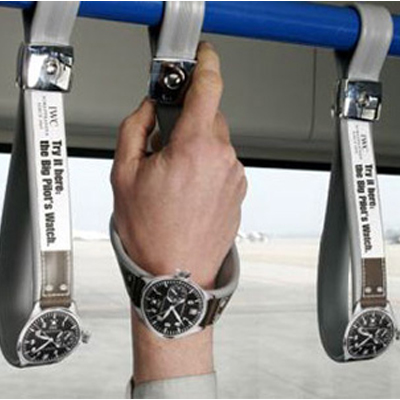
    In Germany, Big Pilot’s Watches were attached to the hanging straps of buses ferrying passengers between the airport and airplane to encourage them to try them on.


    Closer home, Jet Airways came up with a print ad seven years ago saying, “We’ve Changed”. No sooner, rival Kingfisher Airlines came up with an ad above the Jet one saying, “We made them change!”


    All instances go to show that marketers are increasingly adopting unconventional means of advertising. And why not, for given the plethora of options, consumers’ attention spans are only heading south. In such a scenario, advertisers are compelled to come up with ‘out-of-the-box’ ways to get their brands noticed.


    Newly-appointed regional head of Posterscope APAC, Haresh Nayak, puts it as: “The ultimate goal of the advertiser is to sell things, but the necessary preliminary goal is to get the attention of the public. Advertisers will go to great lengths to get this attention, as the pay-off for a truly successful advertising campaign can be enormous.”


    Of the many triggers for unconventional advertising, Madison Media Sigma COO Vanita Keswani enlists some. “The need to target a niche audience and to avoid spill-over from mass media. The need for a lead brand in a competitive category to add unconventional to conventional to beat the clutter. The need for a small brand which does not have adequate monies to compete in traditional media,” she says.


    Big Cinemas’ marketing and sales head Shirish Srivastava adds, “Advertisers and marketers have to use unconventional methods to target consumers at the opportune time and sell them the service at the Zero Moment of Truth. This is where non-traditional, out of the box, clutter-breaking ideas and media come into play. For instance, look at the way in-cinema advertising has evolved in the wake of a rise in multiplexes.”


    For example, the HDFC Life ad in cinemas a couple of years ago was played right after the national anthem and this helped the brand get the attention it wanted. Similarly, Piramal Healthcare’s ad for its iSure ovulation kit was plastered across doors, mirrors and hand dryers of washrooms at Big cinemas. This was followed by a feedback camp with two promoters stationed at cinema exits, gathering feedback from women about the activation.


    Says Amit Sinha of Piramal Healthcare, “Washroom advertising is effective as it gives you a one-on-one moment of impact for a range of products like i-Sure in the intimate space, while ensuring it is gender-targeted and thus very relevant. We are glad to have chosen BIG Cinemas as one of our media vehicles on this one, since the brand provided us a significant reach to connect with our customers, at the right time.”


    Unconventional advertising is often referred to as guerrilla marketing and consists of creative, low-cost marketing methods used by businesses to temporarily promote their products or services. According to Srivastava, “Brands need to search for these convenience factors, create communication, create POS and convenient touch-points to generate business. Like traditional paan shops which have now become mini convenience shops where so many more products are available.”


    Nayak recalls an innovation which encouraged immediate action on the part of consumers. The bespoke ad for Skoda Rapid, which was played in theatres, had a patron appear on the screen, take a test drive and return back to his/her seat to continue watching the movie. It created a lot of buzz on YouTube and facebook. HDFC Ergo did the same thing to promote car insurance through mobile.


    Sometimes, unconventional media channels are to be found within the traditional ones. For instance, HD and DTH on TV or catching consumers at relevant touch-points like out of home screens or multiplexes or activations or stunts.


    Coming to which is better, unconventional or traditional advertising? Media experts say that the biggest risk in unconventional advertising is that the insurgent stunts can flop and ultimately become a PR nightmare. However, smaller businesses don’t run as much risk as most people would just write it off as another failed stunt. There are other risks in unconventional advertising too like misrepresentation of brand image, vague communication creating false rumours about the brand and so on. As Keswani says: “There are risks of not having measurement metrics like traditional media, but then brands need to derive learnings through their own internal research and create measurement criteria for success.”

  • Winners announced of the first Formats Asia Awards

    Winners announced of the first Formats Asia Awards

    MUMBAI: Formats Asia has concluded another successful event. This year Formats Asia was held during the CASBAA Convention, and saw intense and insightful discussions that dug deep into the issues and matters that are affecting the industry most. The event also celebrated the announcement of the winners of the first Formats Asia Awards.


    The Apprentice Asia (Sony SPE) took the top spot for the ‘Best Use of a Global Format in Asia’ award. It is an engaging show that pits aspiring young Asian entrepreneurs against each other in “the world’s toughest job interview” for a chance to work for Malaysian entrepreneur Tony Fernandes.


    In the ‘Best Original Asian Format’ category, the award went to The Challenger Muay Thai (Imagine Group). The series pits 16 world-class fighters against each other to win the ultimate title of Muaythai World Champion and $ 100,000 in prize money.


    Rounding off the awards in the ‘Best Non-Entertainment Format in Asia’ category was Jobs Around The World (MediaCorp TV). In this the entertaining duo, Bryan Wong and Kym Ng take viewers out of their comfort zone in an educational and cultural exploration of interesting, unusual and often surprising jobs across Asia.


    Formats Asia 2013 ended on a high with a plethora of issues discussed. The programme examined recent developments in China, explored relationships with sponsors and advertisers, investigated types of programming that work well in Asia, and focused on the emergence of drama and factual formats.


    Formats Asia founder and Lightning International CEO James Ross said, “I’m absolutely thrilled at this year’s event. We had some great discussions and debates, we saw a lot of examples of how formats are being localised within Asia, and we celebrated with our first Formats Asia Awards winners. The industry in Asia is really picking up, and judging by the sentiments coming from the sessions, we’ve got a lot of opportunities to capture for our partners, and the entire industry has plenty of business to capitalise on.”


    He added, “Overall, this year’s event focused on the need for creating great content, since ultimately, good material will always capture the imagination and attention of viewers. Broadcasters in Asia are also increasingly realising how formats can make their job easier. Formats are not just great ideas from popular brands. They are a complete “how-to-do-it” package, a proven blueprint that encapsulates the intelligence, insights and experience learned and gained by previous producers.”
     

  • Volkswagen drives AXN’s ‘The Apprentice Asia’

    Volkswagen drives AXN’s ‘The Apprentice Asia’

    MUMBAI: Volkswagen Malaysia has announced that it is the ‘Official Car‘ of AXN‘s local production, ‘The Apprentice Asia‘ premiering on 24 May at 9 pm.

    Volkswagen adds that its The Apprentice Asia‘s quest to identify the best talent aligns with its core focus on its human capital efforts both in Germany and throughout the world, which have resulted in the company being recognised as a preferred employer.

    In The Apprentice Asia, 12 candidates are picked from the cream of the crop across Asia. Representing seven countries across the region, they are an ambitious lot driven by their thirst for success and their common desire to work for Asia‘s aviation tycoon, Tony Fernandes. Filmed in Singapore and Kuala Lumpur, the series also stars Tony‘s advisors – Tune Hotels Group CEO Mark Lankester and Expedia Asia CEO Kathleen Tan. They play a role by being on the ground to observe each team complete their task, and their opinions influence who Tony hires at the end of the day.

    Volkswagen Group Malaysia MD Zeno Kerschbaumer said, “‘The Apprentice Asia‘ gives us an opportunity to feature the character of our products for a fitting partnership that encourages competition. Our cars offer fun driving and a sense of competition through the use of technologies like TSI and DSG so, The Apprentice Asia is a right fit for the brand”.

    Volkswagen has cemented the relationship by providing three of its models – Passat, Sharan and Touareg – to support and provide mobility requirements for contestants and the show‘s advisors throughout the 11 episodes.

    “This partnership will also inspire and drive the show‘s contestants to give their best in quality, innovation and leadership. Much like our business, we believe that healthy competition will unearth talent and skills; and we are confident that our brand will contribute towards producing the next successful and potentially iconic entrepreneur in Asia. We are proud to extend this relationship to AXN,” he added.

  • AXN evolves marketing strategy for a bigger audience connect

    MUMBAI: As the English GEC space grows with new players coming in, AXN is evolving its marketing efforts.

    The focus is to expand the consumer connect with AXN‘s most popular international shows. “We have changed our media mix to interesting one-on-one interactions with our key stakeholders. We have linked all such activities with our key properties and targeted them differently with each programme,” AXN business head Sunil Punjabi said.

    The first initiative was the Supernatural Tweet-up event. “We launched season eight with a tweet-up event in four key metros and followed up a sustenance activity after two months with another six cities activation. This activation has had good response and we received queries from smaller cities like Chandigarh, Nashik, Nagpur, Indore, Jaipur among others to reach them,” Punjabi averred.

    As ‘Top Chef’ has a larger appeal beyond the six metros, AXN decided to market the property not only in the four metros but also towns like Pune and Hyderabad, among others.

    Another property is ‘The Voice’ and the fourth season has Shakira and Usher as judges. “We decided to use this as a peg for our next promotion activity. We launched the ‘Find yourself in LA’ on the sets of Voice where Shakira would be judging the battle rounds. Through this activation, we have connected to approximately 700 contestants across advertising agencies, clients and distribution,” Punjabi averred.

    The Thrillionaire campaign that AXN kicked off in October is being run across the year. As AXN is celebrating its 15th year in India, the channel launched the ‘15 years of Thrill Campaign’ in October. This campaign will culminate this year. “So far the response to this activity across the year has been great and we hope to keep engaging with our viewers consistently,” Punjabi stated.

    What is interesting is that AXN has partnered with Hindi films. The thinking, Punjabi said, was to Indianise the look of the channel. “We associated with relevant on-brand movie tie-ups like Special 26 with the launch of ‘Leverage’. ‘Leverage’ is all about the ‘Dons of the Cons’ and so was ‘Special 26’. With the right character fit, we have launched ‘Leverage’ on the channel with Akshay Kumar in Special 26.”

    AXN will air two original productions, ‘Apprentice Asia’ and ‘Hannibal’, this year. “Our first set of activation for ‘Apprentice Asia’ happened during the call for entry phase. Statistically, India had a strong response. Two of the 10 contestant for ‘Apprentice Asia’ are Indians. Also, the host Tony Fernandes made news in the form of the Tata-Air Asia JV being formed for a low cost airline. Tony has successfully turned around the airline in Asia and has interest in multiple business including a soccer and F1 team,” said Punjabi.

  • AirAsia renews MotoGP sponsorship with Dorna

    MUMBAI: Dorna Sports, the commercial rights holder of MotoGP, has renewed partnership with AirAsia for the next two years.

    The renewed agreement places the airline in the position of title sponsor for the Japanese GP in 2012 and 2013, and the Australian GP in 2012 with an option for the title sponsorship of the same GP in the 2013 campaign.

    AirAsia CEO Tony Fernandes said, “Our close relationship with MotoGP is further strengthened through the signing of this agreement. Our airline believes in MotoGP because it allows us to expand our brand awareness and also helps us reach a young audience who are going to use our broad range of services.”