Tag: TOI

  • Vice Media partners with Times of India group for multiscreen &  Viceland rollout

    Vice Media partners with Times of India group for multiscreen & Viceland rollout

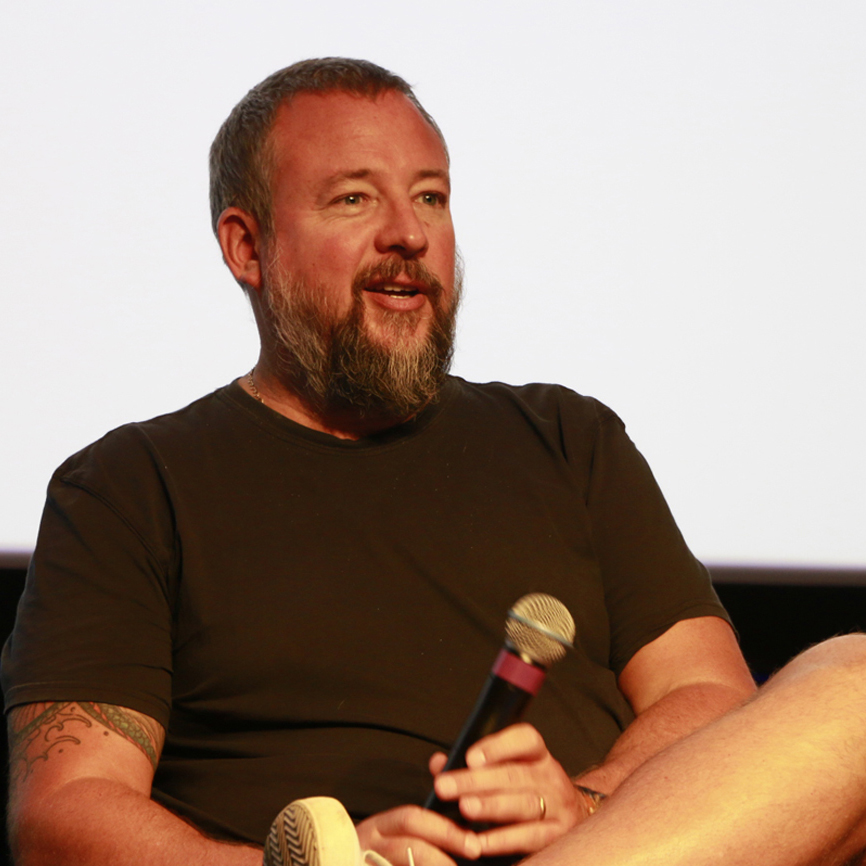
    MUMBAI: So iconic youth brand Vice Media CEO Shane Smith is making good his commitment to enter the Indian market.

    Shane had told Indiantelevision.com in April this year that “India is one of the most important markets for Vice. What we needed was platform, capital, navigation of bureaucracy, waters of media. We went into China and it took us longer than it should have. For India we said if we went in our own, it would take a long time to get to the scale we needed to be. So we took our time looking at a bunch of joint venture partners.”

    Amongst them was Star India, Reliance and The Times of India group. And Smith and his team have finally decided on Vice’s Indian partner: it is the Times of India group, which runs TimesNow, ET Now, MagicBricks Now, Movies Now, Zoom and RomedyNow,

    Additionally, the prowess of the Vijay-Ajay Nair run OML also impressed him and Vice executive vice-president international & corporate development James Rosenstock. OML, has over the past year reportedly – according to sources in investor circles – also come into the Times of India fold with Paul Aiello and Rajesh Kamat of Emerald Media (and formerly CA Media), divesting their holding in favour of arguably India’s largest media firm.

    Vice Media is partnering with the Times of India group to launch and distribute its Viceland channel in India, apart from producing digital and online, mobile, and TV content. Shane made the announcement at the Cannes Lions Festival earlier today.

    The plan is to set up new production facilities – new studios in Mumbai – and to hire scores of journalists, film makers, editors et al to roll out the signature Vice content for the Indian market. Additionally, a core management team is to be put in place to keep a tab on content creation, keeping the local sensibilities in mind.

    What is not clear at the time of writing what OML’s role, if any, is going to be in Viceland and in content creation for Vice’s India foray. .

    But what’s exciting Shane and his company, which has attracted investment to the tune of $700 million from 21st Century Fox and Disney, is the rollout of 4G services in India.

    “The hottest thing is going to be growth of 4G in India, the mobile for young people. It’s not there now, but India has the youngest population. Cheaper smart phones from China and India. So we want to get in build our audience, make our mistakes. So that when traction hits, we are there,” says Shane.

    Details of the joint venture were not available at the time of writing. Shane says that the Indian foray is the company’s largest investment in a country overseas.

    According to media reports, the joint venture will also spawn Vice Media’s in-house creative agency as Virtue India, which will help deliver native and branded content to its swathe of advertising partners. Shane says that the creative agency is an important pivot of his India play. “It will help us offset some of our risk. Existing brands and new brands want us to produce content for them. We discuss brand strategy with them and speak and understand their language,” he explains. “And they love what we do.”

    Shane announced a clutch of other partnerships during the Cannes Lions Festival which would see the debut of Viceland across 51 different territories and countries worldwide.

    For West Asia and North Africa, Vice has signed on The Moby Group as its partner even as it is set to open local production offices in Jordan, Iran, Lebanon, Oman, Saudi Arabia and Qatar. It has got into bed with Econet Media in sub-Saharan Africa to roll out Viceland into 17 countries including Ghana, Rwanda, Nigeria, Uganda and Sierra Leone by end-2017.

    It has lined up SBS Australia as its cohort for a free to air service for Aussie viewers, while Kiwis in New Zealand will be able to tune into Viceland as part of the basic tier on Sky. Vice Media has charged Singapore-based Multi Channels Asia with rolling out the channel into 18 territories in south east Asia with programming being developed by its in-house creative teams. The company’s home base – as is well known – is Canada and it has inked an agreement with GroupeV Media to launch Viceland in the French speaking part of the country.

    Shane and the Vice team sure know how to do things with a big bang. Now, the challenge for them will be to make the global push work and deliver both to the top line and the bottom line.


  • Vice Media partners with Times of India group for multiscreen &  Viceland rollout

    Vice Media partners with Times of India group for multiscreen & Viceland rollout

    MUMBAI: So iconic youth brand Vice Media CEO Shane Smith is making good his commitment to enter the Indian market.

    Shane had told Indiantelevision.com in April this year that “India is one of the most important markets for Vice. What we needed was platform, capital, navigation of bureaucracy, waters of media. We went into China and it took us longer than it should have. For India we said if we went in our own, it would take a long time to get to the scale we needed to be. So we took our time looking at a bunch of joint venture partners.”

    Amongst them was Star India, Reliance and The Times of India group. And Smith and his team have finally decided on Vice’s Indian partner: it is the Times of India group, which runs TimesNow, ET Now, MagicBricks Now, Movies Now, Zoom and RomedyNow,

    Additionally, the prowess of the Vijay-Ajay Nair run OML also impressed him and Vice executive vice-president international & corporate development James Rosenstock. OML, has over the past year reportedly – according to sources in investor circles – also come into the Times of India fold with Paul Aiello and Rajesh Kamat of Emerald Media (and formerly CA Media), divesting their holding in favour of arguably India’s largest media firm.

    Vice Media is partnering with the Times of India group to launch and distribute its Viceland channel in India, apart from producing digital and online, mobile, and TV content. Shane made the announcement at the Cannes Lions Festival earlier today.

    The plan is to set up new production facilities – new studios in Mumbai – and to hire scores of journalists, film makers, editors et al to roll out the signature Vice content for the Indian market. Additionally, a core management team is to be put in place to keep a tab on content creation, keeping the local sensibilities in mind.

    What is not clear at the time of writing what OML’s role, if any, is going to be in Viceland and in content creation for Vice’s India foray. .

    But what’s exciting Shane and his company, which has attracted investment to the tune of $700 million from 21st Century Fox and Disney, is the rollout of 4G services in India.

    “The hottest thing is going to be growth of 4G in India, the mobile for young people. It’s not there now, but India has the youngest population. Cheaper smart phones from China and India. So we want to get in build our audience, make our mistakes. So that when traction hits, we are there,” says Shane.

    Details of the joint venture were not available at the time of writing. Shane says that the Indian foray is the company’s largest investment in a country overseas.

    According to media reports, the joint venture will also spawn Vice Media’s in-house creative agency as Virtue India, which will help deliver native and branded content to its swathe of advertising partners. Shane says that the creative agency is an important pivot of his India play. “It will help us offset some of our risk. Existing brands and new brands want us to produce content for them. We discuss brand strategy with them and speak and understand their language,” he explains. “And they love what we do.”

    Shane announced a clutch of other partnerships during the Cannes Lions Festival which would see the debut of Viceland across 51 different territories and countries worldwide.

    For West Asia and North Africa, Vice has signed on The Moby Group as its partner even as it is set to open local production offices in Jordan, Iran, Lebanon, Oman, Saudi Arabia and Qatar. It has got into bed with Econet Media in sub-Saharan Africa to roll out Viceland into 17 countries including Ghana, Rwanda, Nigeria, Uganda and Sierra Leone by end-2017.

    It has lined up SBS Australia as its cohort for a free to air service for Aussie viewers, while Kiwis in New Zealand will be able to tune into Viceland as part of the basic tier on Sky. Vice Media has charged Singapore-based Multi Channels Asia with rolling out the channel into 18 territories in south east Asia with programming being developed by its in-house creative teams. The company’s home base – as is well known – is Canada and it has inked an agreement with GroupeV Media to launch Viceland in the French speaking part of the country.

    Shane and the Vice team sure know how to do things with a big bang. Now, the challenge for them will be to make the global push work and deliver both to the top line and the bottom line.

  • ICICI Prudential launches “Whats Your Number” Campaign.

    ICICI Prudential launches “Whats Your Number” Campaign.

    MUMBAI: ICICI Prudential Mutual Fund has launched a new campaign ‘Whats your number’. ICICI claims that it has designed the campaign to fulfil the target audience’s goals and dreams within a time frame. The brand says that everyone has goals or dreams in their life, be it buying a house, creating a corpus for their retirement or for their child’s higher education. All these goals or dreams have a number. This number is the financial value of their goal or dream. The ad focuses on the finite time people have to achieve their dreams.

    ‘Whats your number’ is a print ad that asks a question to the consumer “What’s Your Number?” The visual of “Starting SIP Amount/Month” helps the consumer understand that he can start with a small amount which will not burden his current lifestyle. Further in a period of ’20 years’ he can accumulate a sizeable amount.

    The creative gives an example across three amounts viz. Rs.1 Crore, Rs.3 Crore and Rs.5 Crore. This helps the consumer gain a wider perspective of how much he would need to invest now, in order to reach a higher amount in the future. It is also very important for the consumer to note that he needs to TOP-UP his SIP annually and it is through this SIP TOP-UP he would be able to achieve his number and thereby his life-goal or dream.

    The lead medium for this campaign is print with all editions of TOI and ET, and has a regional boost through Maharashtra Times, Vijay Karnataka and NavBharat Times. This campaign has further been amplified on-ground through collaterals, one-pager and a SIP TOP-UP calculator and on digital media through display advertising, search marketing, email marketing and social media.

    www.iciciprumf.com features this campaign on its home-page which links to a SIP TOP-UP calculator that gives the customer the power to calculate his number and gain a deeper understanding of how he could go about achieving it. In order to seed the thought further, the campaign will also go live on our customer experience touch-points such as IVR, SIP Renewal Forms etc.

  • ICICI Prudential launches “Whats Your Number” Campaign.

    ICICI Prudential launches “Whats Your Number” Campaign.

    MUMBAI: ICICI Prudential Mutual Fund has launched a new campaign ‘Whats your number’. ICICI claims that it has designed the campaign to fulfil the target audience’s goals and dreams within a time frame. The brand says that everyone has goals or dreams in their life, be it buying a house, creating a corpus for their retirement or for their child’s higher education. All these goals or dreams have a number. This number is the financial value of their goal or dream. The ad focuses on the finite time people have to achieve their dreams.

    ‘Whats your number’ is a print ad that asks a question to the consumer “What’s Your Number?” The visual of “Starting SIP Amount/Month” helps the consumer understand that he can start with a small amount which will not burden his current lifestyle. Further in a period of ’20 years’ he can accumulate a sizeable amount.

    The creative gives an example across three amounts viz. Rs.1 Crore, Rs.3 Crore and Rs.5 Crore. This helps the consumer gain a wider perspective of how much he would need to invest now, in order to reach a higher amount in the future. It is also very important for the consumer to note that he needs to TOP-UP his SIP annually and it is through this SIP TOP-UP he would be able to achieve his number and thereby his life-goal or dream.

    The lead medium for this campaign is print with all editions of TOI and ET, and has a regional boost through Maharashtra Times, Vijay Karnataka and NavBharat Times. This campaign has further been amplified on-ground through collaterals, one-pager and a SIP TOP-UP calculator and on digital media through display advertising, search marketing, email marketing and social media.

    www.iciciprumf.com features this campaign on its home-page which links to a SIP TOP-UP calculator that gives the customer the power to calculate his number and gain a deeper understanding of how he could go about achieving it. In order to seed the thought further, the campaign will also go live on our customer experience touch-points such as IVR, SIP Renewal Forms etc.

  • Hitachi launches global brand campaign

    Hitachi launches global brand campaign

    MUMBAI: The Hitachi Group has launched a global brand campaign that is aligned with the management’s vision based on the 2018 Mid-term Management Plan created during the current fiscal year. The new campaign will be rolled out simultaneously in 19 countries including India through various media. Under the campaign, Hitachi has launched a new logo and a tagline defining the agenda ‘the future is open to suggestions.’ The goal of this campaign is to build the brand through collaborative creation with customers and partners.

    The brand claims that it wishes to bring thinkers and doers together through this campaign to combat societal problems in regards to agriculture, infrastructure, water management and to support government initiatives; Make in India and Smart Cities. The aspiration to launch the campaign is to improve people’s quality of life and leave a better future of next generation.

    For three years starting in 2013, concurrently with the 2015 Mid-term Management Plan, Hitachi has been rolling out the Global Brand Campaign, in which it communicates a unified message throughout the world.

    Hitachi says that these activities, which are a first for Hitachi, increase the presence of Hitachi as a global brand, while at the same time support the growth of the Social Innovation Business through tie-ins with businesses in various regions.

    The brand claims that the goal of the 2018 Mid-term Management Plan, which was created during the current fiscal year, is to make maximum use of IT and OT (operational technologies), two of Hitachi’s core strengths, and to promote the further growth of the Social Innovation Business, while at the same time accelerating collaborative creation with customers as an innovation partner.

    Presently, the Global Brand Campaign is running onthe print platform like TOI and ET. Television TVCs’ are also planned for the beginning of August. The campaign has been designed by Dentsu Inc. (Overall strategy) and DentsuBos (Actual production). The creative team behind the campaign is Sebastien Rivest (Executive Vice President, General Manager & Chief Creative Officer, DentsuBos), Camille Forget (Art Director, DentsuBos) and Layton Wu (Copywriter, DentsuBos). Layton Wu is the copywriter for the campaign.

    “Aligned with Hitachi’s vision based on its ‘2018 Mid-term Management Plan’, the roll out of Hitachi’s new ‘Global Brand Campaign’ is a step forward to promote and propel the growth of Hitachi’s Social Innovation Business. In sync with the Social Innovation Business, a global campaign logo has been created along with the campaign copy “THE FUTURE IS OPEN TO SUGGESTIONS.” said DentsuBos EVP, GM and CCO Sebastien Rivest.

    TV commercials and internet advertising provide an exciting means of expressing the ideas achieved through collaborative creation to resolve social issues. They also claim that the intent is to increase the value of the Hitachi brand by broadly communicating, to customers and partners throughout the world,

    On May 18, as part of the campaign, Hitachi renovated the ‘Social Innovation Hub’ an internet site that aggregates information related to the Hitachi Group’s activities throughout the world. By further enhancing the transmission of information related to Hitachi’s Social Innovation Business, the company will put in place an environment that further accelerates collaborative creations with customers and partners around the globe.

  • Hitachi launches global brand campaign

    Hitachi launches global brand campaign

    MUMBAI: The Hitachi Group has launched a global brand campaign that is aligned with the management’s vision based on the 2018 Mid-term Management Plan created during the current fiscal year. The new campaign will be rolled out simultaneously in 19 countries including India through various media. Under the campaign, Hitachi has launched a new logo and a tagline defining the agenda ‘the future is open to suggestions.’ The goal of this campaign is to build the brand through collaborative creation with customers and partners.

    The brand claims that it wishes to bring thinkers and doers together through this campaign to combat societal problems in regards to agriculture, infrastructure, water management and to support government initiatives; Make in India and Smart Cities. The aspiration to launch the campaign is to improve people’s quality of life and leave a better future of next generation.

    For three years starting in 2013, concurrently with the 2015 Mid-term Management Plan, Hitachi has been rolling out the Global Brand Campaign, in which it communicates a unified message throughout the world.

    Hitachi says that these activities, which are a first for Hitachi, increase the presence of Hitachi as a global brand, while at the same time support the growth of the Social Innovation Business through tie-ins with businesses in various regions.

    The brand claims that the goal of the 2018 Mid-term Management Plan, which was created during the current fiscal year, is to make maximum use of IT and OT (operational technologies), two of Hitachi’s core strengths, and to promote the further growth of the Social Innovation Business, while at the same time accelerating collaborative creation with customers as an innovation partner.

    Presently, the Global Brand Campaign is running onthe print platform like TOI and ET. Television TVCs’ are also planned for the beginning of August. The campaign has been designed by Dentsu Inc. (Overall strategy) and DentsuBos (Actual production). The creative team behind the campaign is Sebastien Rivest (Executive Vice President, General Manager & Chief Creative Officer, DentsuBos), Camille Forget (Art Director, DentsuBos) and Layton Wu (Copywriter, DentsuBos). Layton Wu is the copywriter for the campaign.

    “Aligned with Hitachi’s vision based on its ‘2018 Mid-term Management Plan’, the roll out of Hitachi’s new ‘Global Brand Campaign’ is a step forward to promote and propel the growth of Hitachi’s Social Innovation Business. In sync with the Social Innovation Business, a global campaign logo has been created along with the campaign copy “THE FUTURE IS OPEN TO SUGGESTIONS.” said DentsuBos EVP, GM and CCO Sebastien Rivest.

    TV commercials and internet advertising provide an exciting means of expressing the ideas achieved through collaborative creation to resolve social issues. They also claim that the intent is to increase the value of the Hitachi brand by broadly communicating, to customers and partners throughout the world,

    On May 18, as part of the campaign, Hitachi renovated the ‘Social Innovation Hub’ an internet site that aggregates information related to the Hitachi Group’s activities throughout the world. By further enhancing the transmission of information related to Hitachi’s Social Innovation Business, the company will put in place an environment that further accelerates collaborative creations with customers and partners around the globe.

  • ASCI upholds complaints against Balaji Telefilms, Viacom 18, Patanjali, Coca Cola, Facebook, Amazon.in, TOI

    ASCI upholds complaints against Balaji Telefilms, Viacom 18, Patanjali, Coca Cola, Facebook, Amazon.in, TOI

    MUMBAI: In January 2016, ASCI’s Consumer Complaints Council (CCC) upheld complaints against 51 out of 102 advertisements. Out of 51 advertisements against which complaints were upheld, 13 belonged to the education category, 12 to the food & beverages category, followed by 11 in the healthcare category, 6 in the eCommerce category and 9 advertisements from other categories.

    Balaji Telefilms The suggestive scenes in the movie promo showing “two men and women on the beach” are indecent, vulgar and repulsive, which, in the light of generally prevailing standards of decency and proprietary, will cause grave and widespread offence to general public.  

    Viacom18 Media Private Limited (Bigg Boss 9) The TV promo advertisement, depicting the protagonists wearing shoes in a temple is likely to cause grave and widespread offence.

    Patanjali Ayurved Limited (Youvan Gold Plus): The claims on pack of Youvan Gold Plus, ‘An authentic powder booster Ayurvedic Medicine useful in physical & sexual weakness which improves libido, vigour & vitality, sexual power. Keeps you always healthy, energetic & gives you total satisfaction of married life’, were not substantiated and imply that the product is meant for enhancement of sexual pleasure, which is in breach of the law as it violates the Drugs & Magic Remedies Act.

    Patanjali Ayurved Ltd. (Patanjali Pure Cow’s Ghee): The reference to ‘Keratin’ content in Cow’s milk in the advertisement was found to be an error. The word Keratin was used instead of ‘Carotene’ and the claim ‘Scientific fact: Cow’s milk contains Keratin’ was incorrect.

    Patanjali Ayurved Ltd. (Patanjali Atta Noodles): The claim in the advertisement, ‘Oil Free’ was not substantiated and is misleading by implication.

    Coca-Cola India Pvt. Ltd. (Coca-Cola Zero): The disclaimer in the advertisement of Coca-Cola Zero was not as per the size stipulated in the ASCI Guidelines for Supers. It was concluded that disclaimer in the advertisement is not clearly legible.  The advertisement contravened the ASCI Guidelines on Supers. 

    Facebook India (Facebook Free Basics): The claim in the advertisement, ‘Free Basics is at risk of being banned’ was considered to be misleading by exaggeration. Further, the claim in the advertisement, ‘Through a trial of Free Basics by Facebook, Ganesh learnt new farming techniques that doubled his crop yield’, the farmer’s interview / testimonial is not an adequate substantiation for the claim quantifying doubling of crop yield directly attributable to the Free Basics trial by the farmer. Also, it was not conclusively proven what the crop yields were prior to Ganesh using internet and post using Free Basics trial.  Using an individual testimonial without any claim support data, while reaching out to consumers at large, was considered to be misleading by implication and exaggeration. Also, in the absence of any disclaimer to that effect, the reference to the claim in the advertisement, ‘benefits of Free Internet’ was misleading by ambiguity.

    Amazon.in: The discrepancy between the specification declared on the Amazon.com web-site for AdraxxCrosman Roof Prism Binoculars, and the specification mentioned on the product visual led to the conclusion that the advertisement is misleading.

    The Times of India: The claim in the advertisement, ‘Presenting India’s most challenging school quiz.’ was not substantiated by providing comparative data versus other contests of similar nature to support how this quiz is better in the challenge level and the claim of the ‘Most’ challenging quiz.

  • ASCI upholds complaints against Balaji Telefilms, Viacom 18, Patanjali, Coca Cola, Facebook, Amazon.in, TOI

    ASCI upholds complaints against Balaji Telefilms, Viacom 18, Patanjali, Coca Cola, Facebook, Amazon.in, TOI

    MUMBAI: In January 2016, ASCI’s Consumer Complaints Council (CCC) upheld complaints against 51 out of 102 advertisements. Out of 51 advertisements against which complaints were upheld, 13 belonged to the education category, 12 to the food & beverages category, followed by 11 in the healthcare category, 6 in the eCommerce category and 9 advertisements from other categories.

    Balaji Telefilms The suggestive scenes in the movie promo showing “two men and women on the beach” are indecent, vulgar and repulsive, which, in the light of generally prevailing standards of decency and proprietary, will cause grave and widespread offence to general public.  

    Viacom18 Media Private Limited (Bigg Boss 9) The TV promo advertisement, depicting the protagonists wearing shoes in a temple is likely to cause grave and widespread offence.

    Patanjali Ayurved Limited (Youvan Gold Plus): The claims on pack of Youvan Gold Plus, ‘An authentic powder booster Ayurvedic Medicine useful in physical & sexual weakness which improves libido, vigour & vitality, sexual power. Keeps you always healthy, energetic & gives you total satisfaction of married life’, were not substantiated and imply that the product is meant for enhancement of sexual pleasure, which is in breach of the law as it violates the Drugs & Magic Remedies Act.

    Patanjali Ayurved Ltd. (Patanjali Pure Cow’s Ghee): The reference to ‘Keratin’ content in Cow’s milk in the advertisement was found to be an error. The word Keratin was used instead of ‘Carotene’ and the claim ‘Scientific fact: Cow’s milk contains Keratin’ was incorrect.

    Patanjali Ayurved Ltd. (Patanjali Atta Noodles): The claim in the advertisement, ‘Oil Free’ was not substantiated and is misleading by implication.

    Coca-Cola India Pvt. Ltd. (Coca-Cola Zero): The disclaimer in the advertisement of Coca-Cola Zero was not as per the size stipulated in the ASCI Guidelines for Supers. It was concluded that disclaimer in the advertisement is not clearly legible.  The advertisement contravened the ASCI Guidelines on Supers. 

    Facebook India (Facebook Free Basics): The claim in the advertisement, ‘Free Basics is at risk of being banned’ was considered to be misleading by exaggeration. Further, the claim in the advertisement, ‘Through a trial of Free Basics by Facebook, Ganesh learnt new farming techniques that doubled his crop yield’, the farmer’s interview / testimonial is not an adequate substantiation for the claim quantifying doubling of crop yield directly attributable to the Free Basics trial by the farmer. Also, it was not conclusively proven what the crop yields were prior to Ganesh using internet and post using Free Basics trial.  Using an individual testimonial without any claim support data, while reaching out to consumers at large, was considered to be misleading by implication and exaggeration. Also, in the absence of any disclaimer to that effect, the reference to the claim in the advertisement, ‘benefits of Free Internet’ was misleading by ambiguity.

    Amazon.in: The discrepancy between the specification declared on the Amazon.com web-site for AdraxxCrosman Roof Prism Binoculars, and the specification mentioned on the product visual led to the conclusion that the advertisement is misleading.

    The Times of India: The claim in the advertisement, ‘Presenting India’s most challenging school quiz.’ was not substantiated by providing comparative data versus other contests of similar nature to support how this quiz is better in the challenge level and the claim of the ‘Most’ challenging quiz.

  • Trick or Treat: Bring out the troll in you

    Trick or Treat: Bring out the troll in you

    With just couple of hours to go before people dress up to trick or treat for Halloween, one thing that comes to mind is the Pepsi versus Coca Cola war.

    So, what is new between the two cola giants taking on each other, which they have been doing for years now? Well, it is the response which the campaign by Pepsi generated.

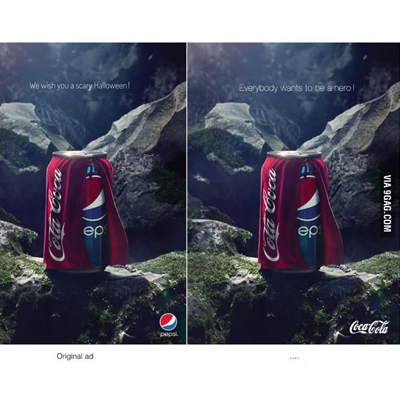
    Last year, Pepsi released a campaign during Halloween wherein a Pepsi can wore a red cape with “Cola Coca” written on it and with a tagline saying, “Have a scary Halloween”. Of course, the campaign went viral, but what was more interesting was the response from one of the avid Coca Cola fan.

    The new tagline read, “Eveybody wants to be a superhero”, hinting that the red cape was that of the Superman.

    Ambush advertising is nothing new, but it takes a lot of wit and guts for the players to take a jab at each other and take it in their stride as well. And not to forget, to make it worth a while for the costumers as well.

    The objectives of ambush marketing are twofold: to get maximum returns on the marketing buck and to undermine the branding efforts of the rivals by stealing the attention, increasing the clutter and confusing the viewers.

    Who can forget the Pepsi’s ‘Nothing official about it’ campaign during the 1996 cricket World Cup that introduced the concept of ambush marketing in India.

    Indiantelevision.com takes a look at a few memorable advertising wars between brands in India.

    Kingfisher vs. Jet Airways

    In April 2007, Jet Airways had an image makeover and had released an outdoor campaign that stated, ‘We have changed.’ Soon, Kingfisher placed a hoarding above that which read, ‘We made them change’.

    Samsung vs. Nokia

    It was in 2012, in a packed theatre in New Delhi, as scores of excited movie buffs sat to watch an exclusive premier of SRK-starrer Ra.One for mobile phone maker Nokia’s premium users at PVR Select City Walk mall, what took everyone by surprise were the advertisements that had been running for the previous few minutes were of Samsung mobile.

    HUL vs. P&G

    Hindustan Unilever’s shampoo brand “Dove” and Procter & Gamble’s shampoo brand “Pantene” caught it out in 2010. P&G launched its intriguing ad campaign for Pantene with the tagline “A mystery shampoo. Eighty per cent women said it is better than anything else.” A few days later and before P&G could announce the launch the new Pantene, Hindustan Unilever ambushed the campaign by placing an adjacent hoarding with the tagline “There is no mystery. Dove is the No. 1 shampoo.”

    The Hindu vs. Times of India

    For its Chennai edition, Times of India in late 2011, launched a ‘Wake Up!’ campaign, provoking the readers (mainly targeted at Chennai readers) to shift from the newspaper that puts them to sleep with its boring and dreary news (indirectly pointing out at the Hindu). Soon afterwards, The Hindu hit back with the tag line ‘Stay Ahead of the Times’, telling the readers to move out of the Bollywood and Page 3 gossips and take up the news that is relevant to current affairs of the country and the world.

    Flipkart vs. Snapdeal

     The latest to enter the bandwagon is none other than the highly-competitive e-commerce sector. On 6 October, Flipkart announced its ‘The Big Billion Sale’ as a jacket ad in the Times of India, announcing, ‘Today Don’t Look Anywhere Else, India’s Greatest Ever Sale is here’. But the thunder was stolen on the page immediately following with a Snapdeal ad announcing, ‘For Others it is a Big Day. For us, today is no different’.

  • Now wake up and smell the newspaper!

    Now wake up and smell the newspaper!

    MUMBAI: Forget about smelling the coffee in the morning; newspapers have taken over than role as well.


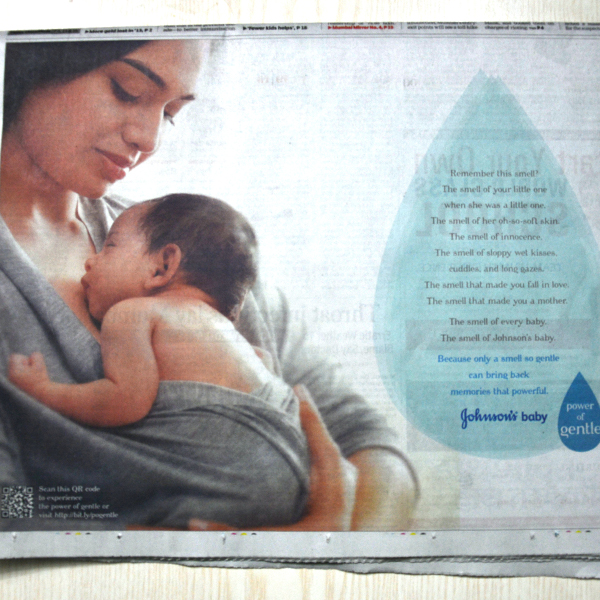
    Grab a copy of today’s TOI and sniff it… A familiar smell fills your nostrils; that of Johnson’s baby…


    The front page advertisement reads: “Because only a smell so gentle can bring back memories that powerful.”


    The innovation brings back childhood memories with just one whiff but it isn’t the only one. According to sensory branding experts, the best known brand smell in the world is that of J&J’s Baby Powder.


    Similar ads or ‘smellvertisements’ have been in existence for long except that they’ve hitherto been the domain of perfume and cologne brands and appeared only in magazines.


    “Using smell in branding is a tool that only a few marketers use, yet smell is extremely powerful in affecting emotions and triggering memories, In fact, it is the only human sense that completely bypasses rational parts of the brain and connects directly with the Limbic system, a part of our reptilian brains that evokes immediate instinctive feelings. So when we smell, we do not think, we simply feel – instinctively and strongly,” says PipalMajik CEO CD Mitra.


    Newspapers have joined the fray only recently, with examples ranging from a Sunday Times edition smelling of Bru Gold coffee to five editions of a daily bringing you the coffee variant of Hide & Seek Biscuits to mangoes being delivered at your doorstep last summer. Technology has played an important role in replacing run-of-the-mill ads with innovations that have become talking points for both consumers and advertisers.


    According to Draftfcb Ulka NCD KS Chakravarthy (Chax), innovations bring the attention back to a familiar brand by doing something unexpected and novel. “In J&J’s case, the smell of J&J – especially the baby powder – is, to a vast majority of people, inextricably linked to the way babies smell. So it is a good way to re-emphasise the pre-eminence of J&J in the baby care area in an emotionally powerful, evocative way,” he says.


    Havas Worldwide managing partner and chief creative officer Satbir Singh feels that though smell innovations aren’t new, today, no one expects to actually read the front page of a newspaper. “Print innovations have become a norm today. From full front page ads to verticals, there are many ways in which advertisers can catch the attention of their TG,” he says, adding that with so many brands available and most of them talking in the same manner to their TG, it becomes important for brands to come up with such innovations.


    Parle marketing general manager Parveen Kulkarni says they were the first ones to do so when Hide & Seek Coffee was launched. “One needs to do something different to stand out otherwise one can easily get lost in the numerous advertisements today in the print medium,” he says. “Word-of-mouth is still the best form of marketing and for new entrants, innovations act as leverage.”


    The print medium gives a lot more scope to marketers and agencies to come up with innovations believes Godrej Appliances executive vice president (marketing and sales) Kamal Nandi. But he is quick to add that there is potential in other mediums as well although there are limitations in each. “The only difference between print and electronic innovation is that, it makes the interaction more personal,” he says.


    While marketers are quite happy with innovations, everyone agrees there needs to be a strategic objective behind them and they need to add more value to the brand than the premium the marketer pays for it. They also need to bring alive a unique aspect of a brand instead of just drawing attention to a me-too attribute. Readers meanwhile can continue to enjoy the innovations…