Tag: Times Television Network

  • Total number of private TV channels in the country goes up to 821

    Total number of private TV channels in the country goes up to 821

    NEW DELHI: The number of permitted satellite television channels has jumped to 821 by November-end from 798 in July following streamlining of clearance procedures by the Information and Broadcasting Ministry.


    These include 404 news and current affairs channels and 417 general entertainment channels.


    The statistics show that 693 channels (including 382 news channels) are permitted to uplink and downlink from within the country, while 93 (including 16 news channels) are uplinked from overseas and downlinked into India and 35 (including six news channels) are uplinked from India for beaming overseas and not in the country.


    Some of the new entrants over the past few months have been the GEC Epic TV, Bengali Orange TV. Luck TV; the non-news  Sairam TV; Bhojpuri Cinema TV, the non-news Tamil Meenakshi TV; the non-news Blue TV in Hindi, English, Punjabi and regional languages; the news Janam TV, INE Live, and Kalinga TV in scheduled languages.


    This apart, Times Television Network (TTN) has also got three new licences: Times Now 2, Times Now 3 and ET Now 2.


    The biggest gainer is the Star Network with Star Cricket Asia, Star Sports Highlights, Star Sports HD3, Star Sports HD4, Star Sports HD2, Star Sports HD1, Star Sports 3, Star Sports 4, Star Sports 2 and Star Sports 1 in all permitted languages under the Constitution.


    The year 2014 has thus seen the clearance to more than 25 channels.


    To expedite the process which had remained stagnant after March-end, the Information and Broadcasting Ministry now holds the Open House meetings with stakeholders two times every month instead of once.


    The Ministry also placed on its website the names of the companies which own these channels, the language, and the date when permission was granted.  


  • Broadcasters want tariff to be left to market forces

    Broadcasters want tariff to be left to market forces

    MUMBAI: The Telecom Regulatory Authority of India’s (TRAI) latest tariff order that will come into effect from 1 January 2015 has already got a few stakeholders’ views on it. To be called the Telecommunication (Broadcasting and cable) services (seventh) (non-addressable systems) Tariff Order, 2014 (draft), it will be applicable to broadcasting and cable services provided to cable subscribers throughout India through non addressable systems.


    Tariff


    The main point that the stakeholders who have given their comments agree on is not having any regulation on wholesale tariff and there should be complete forbearance from the Authority. “The presence of a  plethora  of players in the market  clearly  indicates  that there exists enough competition  in  the  market  and  no  monopolistic  practices  or  unfair  trade practices can be practiced in such a scenario,” is the view of agent The One Alliance (A MSM and Discovery JV, which has now parted ways).


    NDTV and Star India also have similar views on tariff. “Given TRAI’s own finding that TV channels fulfill only ‘esteem needs’ of consumers and are as such non-essential, there is all the more no reason whatsoever for regulating channel prices,” is Star’s opinion. The same is shared by The One Alliance.


    If in case TRAI decides that complete forbearance cannot be allowed, then Star India says that it can consider regulating prices at retail level only. The One Alliance on the other hand feels that TRAI needs to keep its nose out of even retail tariff since it will affect the consumer and the entire distribution chain. “The MSOs under the guise of regulated retail pricing would either further renegotiate with the broadcasters or fill their bandwidth with lesser priced channels,” it says.


    According to The One Alliance, in case the TRAI feels that it should control wholesale rate then only it has to consider inflation rate while if it leaves to market forces, it won’t have to do the same.


    The agent also feels that pricing on the basis of genre is illogical since the Ministry of Information and Broadcasting (MIB) recognises only two categories: News and Current Affairs and Non News and Current Affairs while TRAI seeks to differentiate the non-news category into many genres. “Movie channels like Max and Star Gold also show live sports which is another genre with a different price cap,” it states.


    On the issue of HD and 3D channels, The One Alliance feels that since these are niche channels and require high technology, it should not be subjected to any tariff restrictions whereas Star India feels that they should be kept out since they anyway cannot be transmitted in an analogue regime.


    While TRAI says that broadcasters must give all channels in bouquets as well as a-la-carte, Star India says that there shouldn’t be any mandate that channels have to compulsorily be given on a-la-carte. At the same time, the obligation that old bouquets must be offered as per 2007, needs to go away specially after the coming into force of the deaggregation paper.


    Carriage


    Carriage fee is the biggest burden on broadcasters which everyone has askedthe regulator to include in its order. The News Broadcasters Association (NBA) and Times Television Network have just asked for carriage fees to be included as a crucial element.


    The One Alliance on the other hand states that the authority has ‘blatantly ignored’ the issue of carriage fee even after its own view in a 21 July 2010 report which states, “The Authority is of the view that all carriage and placement fee transactions should be a part of inter connection agreements between the broadcasters and MSO/LCOs in the case of pay channels, or separately formalised as carriage and placement fee agreements in the case of FTA channels, and these should be filed with the TRAI. Such filings of carriage and placement fees will enable the authority to monitor carriage and placement fee transactions regularly and regulate the same through interventions where considered necessary.”


    NDTV says that if there is a price control on how much broadcasters can charge MSOs for content, MSOs should also be told how much they can charge broadcasters for carriage and placement. “The charges paid by MCCS have increased by 300 per cent over the years. It is estimated that the carriage and placement fee paid by broadcasters is between Rs 1200 crore to Rs 1500 crore,” reads NDTV’s reply.


    Declaration and reporting


    The fact that MSOs and LCOs have not been asked to provide any reporting requirement is a question raised by them. Broadcasters urge TRAI to ensure that MSOs and LCOs do not under-declare their subscribers.


    “We strongly believe and submit that the inter-connect regulations must allow for Broadcasters to conduct surprise audits and surveys with their respective technical teams to prevent under-reporting of subscriber base,” states The One Alliance.


    Star India opines that strict financial disincentives should be prescribed for illegal transmission, area transgression, under declaration, piracy or any other illegality or non compliance. “Operators who have been found to be violating rules should not be given the protection of the Must Provide or regulated Tariffs.”


    Both The One Alliance and Star India feel that details on advertising need not be declared as they don’t have any relation to tariff or other issues.


    While TRAI says that a new channel launch needs 30 day prior intimation, The One Alliance feels that a seven day notice is sufficient.
  • ET Now brings the 2nd India Economic Conclave

    ET Now brings the 2nd India Economic Conclave

    MUMBAI:  ET Now is back with the second edition of India Economic Conclave aptly themed, “India: The Giant Awakens”. The conclave will be held on 6 December 2014 at the Taj Palace Hotel, New Delhi, 11 am onwards. The event will bring together the leaders of Indian industry, policy makers, institutional investors and civil society leaders. The deliberations will pave the way for a constructive discussion on how the government and industry can seize India’s unique moment in history.

    Union Finance Minister Arun Jaitley will inaugurate the event and deliver the keynote address. Key ministers including Railway Minister Suresh Prabhu, Industry Minister Nirmala Sitharaman and Power Minister Piyush Goyal will be addressing the day-long conclave.

    Times Television Network managing director and CEO MK Anand said, “The domestic and global sentiment over India’s economy has undergone a sea change, which gives us confidence for new beginnings. As a catalyst of positive change, ET NOW feels that this is the opportune time to bring together various stake holders to deliberate and agree on ways so that the potential of the nation can be realized.”

    ET Now managing editor R.Sridharan added, “Buoyed by the success of the first edition of India Economic Conclave, we are delighted to bring it back bigger and with a far more optimistic outlook. The conclave theme aptly captures the prevailing mood in the economy and we believe this unique thought leadership platform will provide breakthrough ideas and solutions for both the government and industry.”

  • Omar Qureshi bids adieu to Zoom

    Omar Qureshi bids adieu to Zoom

    MUMBAI: Times Television Network (TTN) has announced the official departure of Zoom TV’s editor in chief and creative head Omar Qureshi. He was part of Zoom for over six years and had played a role in building its unique properties. Qureshi also hosted Zooming with Omar which was a movie review based show.


    Speaking on the move, Zoom vice president and product head Sunder Venketraman said, “Omar has constantly driven the team to showcase compelling Bollywood content for our audience. His contribution has been exemplary and we wish him luck and all the very best in his future endeavors.”


    Recently the channel celebrated a decade of its existence. The channel conducts entertainment news, features, countdowns, music, trends, celebrity interviews and reviews. The Bollywood channel is available across 58 countries worldwide besides heavy presence in the social media space on platforms like facebook and twitter making it a one stop shop for everything related to Bollywood.


  • Anup Vishwanathan joins TTN as marketing head English Entertainment cluster

    Anup Vishwanathan joins TTN as marketing head English Entertainment cluster

    MUMBAI:  As the Times Television Network (TTN) strengthens its senior management team, it has announced the appointment of Anup Vishwanathan as the marketing head of the English Entertainment cluster which includes channels such as Movies Now and Romedy Now.


    Speaking on his new role Vishwanathan said he was really happy to be an integral part of the TTN team. “I have had some wonderful clients and colleagues who have enriched me with knowledge and experience with every interaction I have had with them. That’s going to stand in good stead for me. And finally, I have managed to sync my work and my passion- which has always been movies,” he added.


    He will join TTN from 24 November 2014. Based in Mumbai, he will work closely with the business and leadership teams at TTN and will report directly to TTN senior vice-president and head of English Entertainment cluster Vivek Srivastava.


    Srivastava commented, “Anup’s expertise in working with a cross section of brands, along with his deep understanding of media businesses will add great value to our business. I would like to welcome him on-board and I look forward to having a wonderful working experience.”


    Vishwanathan moves to TTN after a stint at Leo Burnett which started in 2006. He has worked on brands like HDFC Life, Tata Capital, McDonalds, Sony Entertainment Television, Sony Pix, AXN. At Sony Entertainment Television, he has worked on the reality show Kaun Banega Crorepati. He is also the winner recipient of Leo Burnett Global Star Reacher award.


  • Sharlton Menezes gets elevated as Zee Studio and Zee Café content head

    Sharlton Menezes gets elevated as Zee Studio and Zee Café content head

    MUMBAI:  Zee Studio, which recently saw a revamp, has now seen a big appointment at the top executive level of the channel.  Zee Studio and Zee Café’s Sharlton Menezes who is the AVP and head of marketing has now been entrusted with an additional portfolio.  Menezes has now been promoted as the content head for both the channel. In his new role, he will be responsible for content strategy, acquisition along with marketing for both the channels.

    He replaces Sonal Khanduja who was heading programming and acquisitions for the two channels for nearly 10 years. Khanduja has now joined Times Television Network as programming head for the English cluster (Movies Now and Romedy Now). Khanduja took charge today.

    Menezes had joined Zee Entertainment in 2008 as senior marketing manager.  He holds a Masters in Management Studies degree from University of Mumbai. While Zee Café is an English GEC, Zee studio is the English movie channel from the Zee stable.


  • Smarter data and innovations in news selling should go hand in hand

    Smarter data and innovations in news selling should go hand in hand

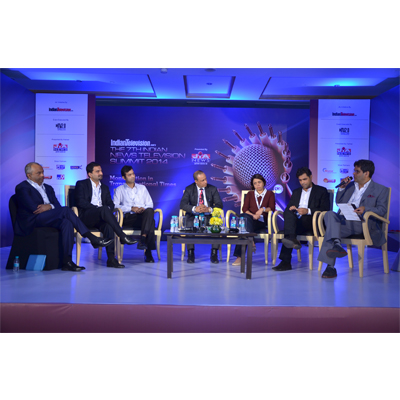
    MUMBAI: At the Seventh Indian News Television Summit, a panel comprising Zee Sangam national sales head Harsha Vardhan Dwivedi, IndiaTV senior VP and country head ad sales Sudipto Chowdhuri, CNN IBN and IBN 7 national revenue head Vishal Bhatnagar, Times Television Network senior VP business head branded content Hemant Arora, GroupM south Asia CEO CVL Srinivas and IPG Mediabrands Initiatives CEO Anamika Mehta discussed the various means for ‘Innovation in news selling’.


    The session moderated by Provocateur Advisory principal Paritosh Joshi revolved around how media agencies can increase brands’ ROI from news channels.


    Joshi began by saying that one expects the sales and strategy team in a news channel to show more interesting numbers but what one gets is a rehash of an existing standard rating currency. According to Arora, the right clients, revenue and ROI comes when he and his team turns the big data into smart data. 


     “It is not just about the data but one has to be able to effectively show how it can impact the marketing objectives. But the matrix system that is currently in use does not really allow sellers and buyers to go beyond it. Eventually it comes down to CPR, slot rates etc and the value that is being offered. Times Now, for example, does not need to be a news channel, it is part of life. It’s the hue we create with our brand and then we pass on the benefit to the brand which wants to be a part of the ecosystem,” said Arora.


    Dwivedi then speaking about the revenue of regional channels said that of the total business that regional channels have been making, only 40 per cent comes from corporate and thus, 60 per cent is supported by government and SMEs. “If it was not for the government and SME, the regional channels would not have been able to survive,” he said adding that two years ago there were 14 news channels in Bihar, Jharkhand and Uttarakhand, while today out of that only four are operating while others have shut down.


    Joshi, addressing Mehta, recalled the days when he sold ad inventories. “Those days, agencies worked towards “de-selling brands”, because they had a personal grouse against a particular brand or they simply ignored them and therefore, sometimes broadcasters did approach the client directly to bring them on to their media plan. Now, how healthy is the entire ecosystem?” he questioned.


    Mehta agreed to the fact that personal biases could exist in the industry. Credibility of content is what matters and we don’t often see channels coming to us and sharing insights beyond just a channel share, rating etc. She illustrated her point by giving an example. “We have brands like Dettol, which as a pure FMCG typically would be on the GEC platform, Hindi movies and not on a English news channel. However, taking from the national agenda of the Prime Minister which is Swatch India, we tied the brand with it in terms of sanitation,” she said. Integrating the brand and creating custom solutions gave far greater ROI.


    Bhatnagar joined the conversation and said that the most important thing is how well one understands the product. “There is a huge responsibility on us to understand what business we are in. Are we in the business of just farming inventory and off loading the inventory?” he asked. He then mentioned that today a lot innovation depends on the kind of discussion news channels have with the agencies or clients. “For example, we tried to do something innovative with Microsoft during elections. And Microsoft of all things wanted to talk about analytics which on news channels does initially snicker people. But then we sat down with the agency, Lodestar, and discussed the various possibilities before pitching for it,” he added. The initiative got Microsoft a lot of feedback globally in terms of how to engage with audiences.


    According to Chowdhuri innovation has to be like the topping on a pizza but it can’t be the pizza. “Some news channels may  have done deals like 20 L bands a day for 365 days a year into two years adding up to Rs 5 crore. So, while your content is on screen, the advertisement too comes on screen. Hence, if you have ‘X’ million viewership for a programme then you have the same number of viewers for the ad as well,” he said.


    Srinivasan had the last word in the discussion when he was asked if agencies and news channels were ahead of time when it comes to digital. “I think we are a bit late because while digital might be eight per cent of the total adex in India, it occupies 80 per cent of the time with conversation with clients. Today every campaign that is conceptualised, you end up spending a little on digital but the whole thought of promoting and creating the buzz is steeped towards digital. There are huge opportunities to win from digital,” he concluded.

  • Colors elevates Manisha Sharma; Prashant Bhatt to move out

    Colors elevates Manisha Sharma; Prashant Bhatt to move out

    MUMBAI: The Hindi general entertainment channel (GEC), Colors, has been witnessing many exists lately.


    Late last month, came the news of the channel’s commercial and digital head Vivek Srivastava quitting and moving to Times Television Network to head the English Entertainment channels.


    Now, highly reliable sources within the industry have confirmed to indiantelevision.com that Prashant Bhatt, who heads the weekday programming head, has been asked to put down his papers. Meanwhile, the current non-fiction head Manisha Sharma has been awarded extra responsibilities of the entire programming department of the channel.


    In the year 2012, Colors had split its programming unit into two separate teams to bring more focus on content for weekdays and weekends.


    The official spokespersons of the channel were unavailable for comment.


    With inputs from tellychakkar.com

  • TTN ropes in Vivek Srivastava to head English Entertainment cluster

    TTN ropes in Vivek Srivastava to head English Entertainment cluster

    MUMBAI: Times Television Network (TTN) has got on-board Colors commercial and digital head Vivek Srivastava to fill in the place left vacant since April this year when Ajay Trigunayat moved on from the network.


    In his new role, Srivastava will be senior VP and heading the English Entertainment Cluster (Movies Now and Romedy Now). He will take charge from today (1 October 2014) and report to TTN MD and CEO MK Anand.


    Srivastava had put down his papers two months back at Colors, confirms sources close to the development.


    Speaking on the announcement, Anand said: “Vivek’s experience in the broadcast sector combined with our aggressive approach to drive growth for the network will add great value to our business. The experience and calibre he brings to the table, we believe, will set new benchmarks for our channels.”


    Commenting on his new role, Srivastava said: “I look forward to being a part of such a dynamic and motivated environment at the TTN. I’ll be working closely with the team at TTN to drive high viewership performance across the English Entertainment Cluster. I look forward to an enriching experience.”


    He had been with Colors since its inception in January 2008. He started as a research head for the channel and was later part of its international team before taking up the mantle of digital strategy.


    Moreover, last year, he was given additional responsibility of Colors’ commercial business. Prior to that, he was with TAM Media Research, where he last served as director of the S Group. He has also worked with IMRB International.

  • IDOS 2014: News broadcasters still struggling to make money

    IDOS 2014: News broadcasters still struggling to make money

    GOA: The news television industry has been witnessing losses for several years now. To throw some light on what are the hurdles and what needs to be kept in mind while forming regulations, NDTV vice chairperson KVL Narayan Rao, Times Television Network MD and CEO MK Anand and BBC World News India COO Naveen Jhunjhunwala took the stage at IDOS 2014 for the session ‘News Television- a specialised beast’ that was moderated by Castle Media founder Vynsley Fernandes.


    The session took off with a keynote from industry veteran Rao, who spoke of the issues facing the most competitive news industry. “News has always been a high cost, low return industry and since 20 years, there has been an unholy dependence on advertising revenue in an environment that doesn’t seem to be changing,” he said while adding that one needs to consider the importance of news in such a landscape. “Not a single news operator in this country is making money,” he stressed.


    The recent extension to digitisation has also not gone down well with Rao, who just this week stepped down as the president of the News Broadcasters Association. “Digitisation was to finish by this year but has been extended till 2015 and 2016. To say the least, I am very disappointed with this decision,” he said.


    As far as regulations are concerned, he says that content should always be kept separate from carriage. “The business environment that we are operating in is one where we pay a large amount of money as carriage fees. For most news broadcasters, one third of operating cost goes as carriage fees while 90 per cent of revenue is generated from advertising and in some cases 100 per cent. All news broadcasters today pay a large amount as carriage fees and it is a terrible burden that we find impossible to bear,” said he. All the stakeholders must see the way the news channels operate and not look at regulations in isolation.


    News channels during primetime end up showing only panel discussions because of the lack of resources. The western countries have subscription revenue of up to 60 to 70 per cent. All these issues were meant to change after digitisation with subscription revenues kicking in and carriage fees eventually coming down. However, Rao hopes that the new government helmed by Narendra Modi would do all it can in its new ‘Digital India’ plan.


    He spoke of the statement by the Editors’ Guild regarding denial of access to journalists by government and increasing number of significant government authorities taking to social media to give information. He says that this serious issue needs to be addressed since news is not about press releases but rather about ‘ferreting information out’.


    Adding to the issues faced by the industry was Anand. He said that the last six months have seen a loss of collective bargaining due to the deaggregation paper by the Telecom Regulatory Authority of India (TRAI). “The paper has hit news broadcasters and unless one diversifies into entertainment, it is difficult to survive,” he said. In order to make money, the idea is generally to go heavy on branding and marketing and create an aura around the channel. The lopsided ad sales revenue also adds to the woes.


    Jhunjhunwala said that the BBC has been broadcasting news for decades and the technological advancements have allowed it to make it smoother and more cost effective.


    The ad cap has also hit them hard by restricting advertising air time to 12 minutes per hour. Here, the panel agreed that there are times when channels go live for hours without showing any ads and there is no provision to make up for the lost time. Fernandes questioned that in such a scenario, could there be alternative sources of revenue that can be put into use.  Rao said that now, to monetise news one needs to generate revenue through different streams such as sponsorships and associations. “But how can you not have subscriber revenue?” he questioned.


    Fernandes then questioned if there should be a limit on the number of channels that exist to which Rao said that the government should not curtail the number of channels because it is a free market. However, he feels the politicians and political parties should not be allowed to be in news.


    Anand said that the regulator could think about regulating carriage fees with some focus on news channels. He also pointed out that a decade ago, ad spots on news channels were sacrosanct but today it is being sold at one third the rate.


    Jhunjhunwala said that the government could look at raising the FDI limit on news to bring in more investment. There were talks of raising it to 49 per cent but no one has addressed the issue.


    Rao finally concluded by saying that though the digitisation deadline has been extended it will hopefully iron out things.