Tag: Times of India

  • The Advertising Club has announced that Emvies 2022 will take place on 25 March

    The Advertising Club has announced that Emvies 2022 will take place on 25 March

    Mumbai: The Advertising Club (TAC) has announced that the latest edition of the Emvies will take place on 25 March at Taj Land’s End from 6.30 p.m onwards. The event is presented by Google, powered by Colors and in association with Times of India. 

    The Emvies are coveted media awards that focus on innovation, strategy, research and seamless integration. The awards are back after a hiatus during the pandemic. With over 1000 entries this year, the best minds in media and advertising will compete for recognition at the awards.

    The event will be attended by top-notch professionals from the media, advertising and marketing fraternity. The campaigns that go on to win an ‘Emvie’, the trophy is presented to both the media agency and the client.

    “It’s been a long break and we at TAC are eagerly waiting to see some of the great work that has been done in the last year and hope to recognise and reward the best of the best in each category,” said The Advertising Club president Partha Sinha. “We have a special recognition ‘The Young EMVIE of the Year’, in honour of Pradeep Guha, a stalwart and legend in the world of media and entertainment. With Google being our presenting sponsor this year, it’s befitting that we’re looking for innovation at the heart of everything. We are excited and ready to get the ball rolling in earnest, move the inertia of the last two years into a juggernaut of momentum and host perhaps THE grandest Emvies to date. All the best to every participant, may the best work win!”

    This year the Envies return with a new look and logo that has been designed by Digitas.

    “We are delighted to be partnering with The Advertising Club on the most prestigious and highly anticipated media awards,” said Google Asia Pacific vice president marketing – India Southeast Asia and South Asia Sapna Chadha. “At Google, we incorporate innovation and creative strategy in everything we do and we’re eager to see what the young creative minds of India have produced in the past year. It is our absolute pleasure to be a part of this legacy and hope to see some great work being recognised.”

  • Media icon & film producer Pradeep Guha no more

    Media icon & film producer Pradeep Guha no more

    Mumbai: Media and entertainment industry veteran Pradeep Guha has passed away on Saturday. He was in his late 60s.

    Guha was battling advanced liver cancer and was admitted at Kokilaben Ambani Hospital in Mumbai. He is survived by his wife Papia and son Sanket.

    Guha was the managing director at 9X Media. Previously, he was chief executive officer at ZEE Telefilms. He was also associated with Times of India for nearly three decades. He produced the Bollywood film ‘Fiza’.

    Many veterans of the M&E industry paid tribute to Guha on social media.

    “Brevity, clarity, speed characterised Pradeep Guha. Like his simple signature, that was but a tick mark, as if it meant ‘just go ahead and do it’. Aim high, set quality standards, inspire the team and just do it was the simple strategy he employed. The legendary media man who put India on the Global Media map in many ways is no more,” said Times Network, managing director and chief executive officer, MK Anand.

    “His professional achievements are multifarious – dominance in print media, advertising excellence, beauty queens, mega format ground events, the list goes on. He was one of the earliest of the current generation of high flyers who burst on to the Indian corporate landscape in the late 80’s and blazed through the 90’s. The young turk who kept rising,” he added.

  • TOI Bangalore makes way for good times with an 80-page issue

    TOI Bangalore makes way for good times with an 80-page issue

    Mumbai: One of the most palpable ways to tell if things are coming back to normal is to begin the day with a newspaper whose mere heft bears a piece of positive news.

    In the wake of a devastating second wave and amidst concerns about a third one, it’s how businesses strive to make the present worthwhile that inspires and injects new hope in all of the economy. It’s an effective stimulant on the consumer side too. When readers see a thicker paper filled with brand advertisements, they are more motivated to come out of the inertia of consumption and begin to feel a sense of comfort with the status quo.

    A bearer of this sweet news was Saturday’s Times of India Bangalore 80-page edition filled with ads from consumer-facing brands who want to usher in a wave of normalcy without waiting for the situation to fix itself.

    According to TOI, the edition featured as many as 125 advertisers. The paper drew brands from across the categories of consumer durables, retail, luxury, real estate, BFSI, apparel, digital, automobile, and more signaling that they are ready as ever to make the ‘New Normal’ not just a survival story, but a story of growth.

    “This uplifting edition could not have been accomplished without the combined efforts of the Times of India Bangalore team whose unwavering belief in change translated into this bumper issue,” the organisation said in a statement.

  • Law college apologises for Suits vs Jolly LLB 2 ad

    Law college apologises for Suits vs Jolly LLB 2 ad

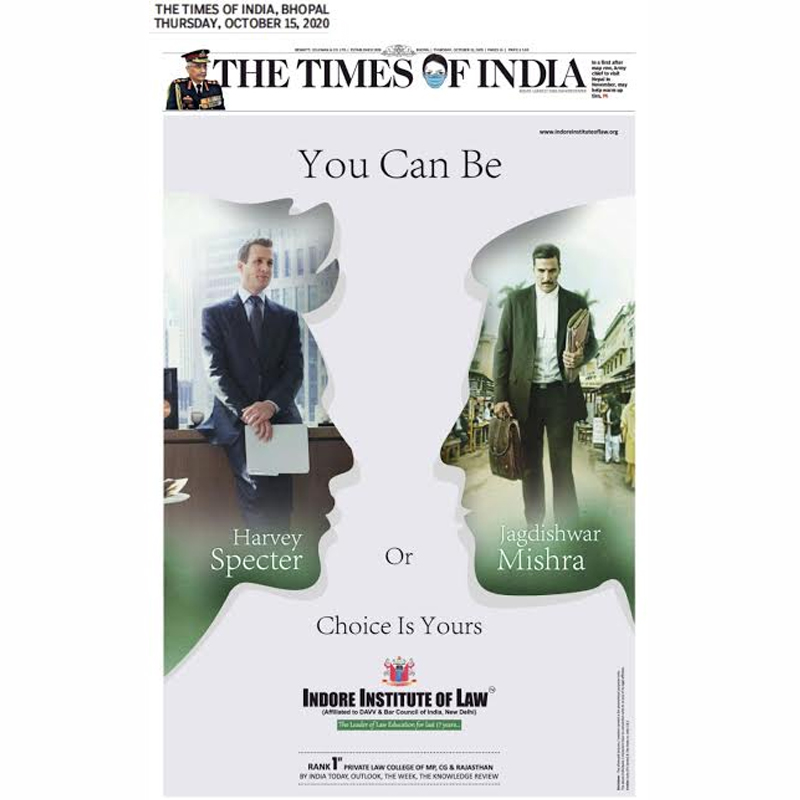
    NEW DELHI: Last week, readers came across a curious ad on the front page of The Times of India’s Bhopal edition. The print advert by Indore Institute of Law drew a comparison between two fictional characters Harvey Specter from American TV series Suits and Akshay Kumar from Jolly LLB. It bore the caption that an aspiring lawyer could be either – “Choice is yours.”

    The picture started doing the rounds on social media platforms and netizens were quick to slam the college’s perceived elitist stance behind the ad. Others accused the institute of denigrating the “dignity of Indian lawyers.” Social media pundits also questioned whether the college had obtained permission from the original creators before running the campaign. A fair few wondered why the institute chose fictional characters instead of its own alumni or famous practitioners of law in the real world.

    The overall impression in certain sections of social media was that the ad was in poor taste and problematic; and not the inspired idea that the advertisers imagined it to be.

    Facing flak, the law college later issued an apology saying, “We assure everyone that it was absolutely not our intention to offend anyone or defame any section of the legal profession.”

    But the damage was already done and the ad-makers were brutally trolled for their creative sense.

    Please find our clarification regarding our advertisement published on 15/10/2020. We would like to make clear the…

    Posted by Indore Institute of Law on Thursday, 15 October 2020

    Being a Law Institute, the college should have known better than to draw such a superfluous comparison, besides flagrantly violating the Intellectual Property and Trademark code on top of that. As per rules, no agency or brand can use any celebrity or work of any other firm without their approval, and if it has done so then the company has to pay the penalty under the Copyright Act. However, if the ad is published on social media, not many will raise the question of ethics.

    Using others’ IP in an advertisement is not uncommon, but this case has come into the limelight because the brand chose the ATL medium. Had the flyer had been limited to social media, it probably wouldn't have caused such a ruckus.

    ASCI secretary-general Manisha Kapoor shared that the council has not received any complaint in this regard as of now.

    Explaining the due process of dealing with violations, Kapoor said: “The advertiser will be asked to furnish the required permissions and an independent consumer complaints council will duly examine the objections and the advertiser’s response, and ascertain if the ASCI code has been violated. The advertiser will be asked to modify or withdraw the advertisement in question if it is found violating the ASCI code.”

    ASCI seeks to ensure that advertisements conform to its code for self-regulation, which requires advertisements to be legal, decent, honest, and truthful and not hazardous or harmful while observing fairness in competition. The code also describes that the ad should not be derogatory to competition without any plagiarism. It should not use indiscriminately for the promotion of products, hazardous or harmful to society or to individuals.

  • Partha Sinha & the art of monetisation at The ToI

    Partha Sinha & the art of monetisation at The ToI

    NEW DELHI: As the government imposed strict lockdown restrictions for close to three months, the print industry was one of the worst-hit. If various reports are to be believed, they lost around 60-80 per cent of their revenues. A lot of them shut down editions, most of them let go of their employees, shaved salaries, and almost all of them dealt with a painful period where their resources just bled.

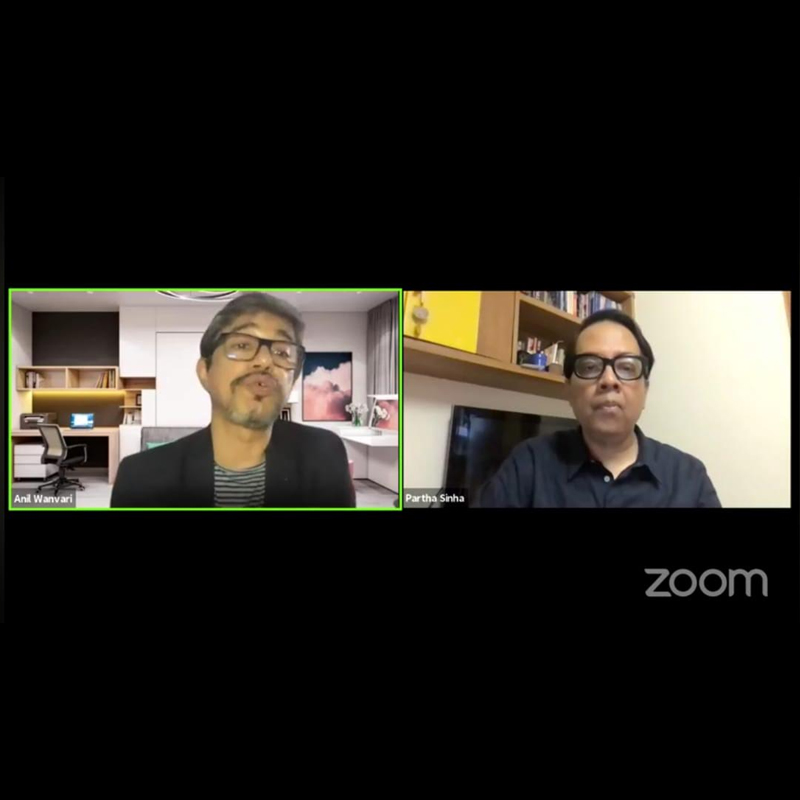
    However, as the world starts getting back to normal and a new world order sets in, the print industry is looking forward to a better tomorrow, lined up with new opportunities and relevancy, Bennet Coleman & Co Ltd (BCCL)  president–responses Partha Sinha shared in a virtual fireside chat with Indiantelevision.com founder, CEO, and editor-in-chief Anil Wanvari. On Monday evening, the duo sat across screens to discuss the impact of Covid2019 on print and the way ahead for the industry. 

    Sinha noted that the print industry has already reached a 70 per cent recovery in terms of the number of copies being delivered. “I think in some markets it has gone up to 90 per cent because, in the south or states like Kolkata, there was never a massive problem of circulation. Cities like Delhi, Mumbai, and a few more in the north were hit badly and I guess it has revived now, not just for us but for all the players.”

    He indicated that it is a good sign for the industry and debugs the myth that print will shut down. “For three to four months, our main concern was consumer demand that was severely impacted. But coming out of it so quickly is absolutely brilliant.”

    So, was it a knee-jerk reaction on the part of the industry to shut down some of the editions and let go of a number of employees, or as some of the unions say, an excuse, Wanvari questioned. 

    “I don’t think it was a knee-jerk reaction or an excuse. Even it was not for Covid2019 and something else would have happened, you would have got a consultant like McKinsey or BCG and asked them to optimise, right? This optimisation tells you if there is any cost reduction required and how can you improve profitability. Honestly speaking, as much as it's being talked about but it's quite a routine activity. Every organisation has optimised; when you find a new revenue opportunity, you hire people and if you find a revenue opportunity drying up, you optimise. I think this is a regular organization life cycle,” Sinha cleared the air. 

    So, what does the future of print seems like to him as digital and other mediums take centre stage? 

    Sinha insisted that there can’t be any substitute for the content that print generates and therefore the medium will stay here, but it might take just a slightly different role going ahead.  

    “I want to debug the myth that digital can replace or surpass print, or TV is a challenge to print. What is happening with both these mediums is that they are creating fragmented opinions, which lack credibility for the source and even for the brands. The news on television is so polarised, that it is sickening now. And obviously, if fake news becomes the business model, the credibility is hampered. Therefore, no amount of user-generated content or no amount of hair pulling on the camera will be able to substitute the credibility that print offers. Journalism will always remain about how deep you go, how sincere you are  and whether you are you're taking all the points of views,” Sinha elaborated. 

    He added that the role of print, going ahead, will move on from being a medium of discovery of product to being involved in its purchase by the customer too because of the credibility associated with the medium. He cited the instance of a real estate developer Casa Gold out of Chennai. It sold 120 apartments during the peak of Covid over four days. The Times of India Chennai response team managed everything from the webinar, to virtual expo, to get the potential buyers to take part in the virtual display of the advertisements to front page jackets of the physical newspapers.

    Sinha revealed that print media plays a big role in cultural marketing. "Cultural marketing works by creating truth and opinion and rallying people around the truth and opinion or finding emergent truth and opinion in society and making it bigger,” he explained. “Many branded efforts have almost become culture: Lead India, Teach India, Lead India led to Anna Hazare and the birth of AAP. Print can create a better narrative than any other medium. Another example is organ donation which has been driven by the Times of India.. The Times of India is the only way to create a culture with the affluent.

    “With so much fragmentation, there is a lack of credibility in the domain now. Due to fake news being so prevalent, print has started playing a significant role in building credibility and a path to purchase. The advantage of the printed word is it doesn't come with a picture. Therefore, you are forced to use your brain, you're forced to use your opinion. And that's how culture gets created. The beauty of culture creation is that eventually  brands will pay a premium to be closer to culture. Everything else is just a matter of discount because that's why the most popular method of advertising on the internet is programmatic led,” he shared. 

    He highlighted that cultural authority is the biggest asset a brand can ever own, because with that comes credibility. “These are the things that print media have to start thinking about, some like the New York Times has already done so,” he pointed out.

    Further, to help the brands gain the maximum out of the exposure and credibility that print offers Bennet and Coleman has come up with a pricing engine, which is based on artificial intelligence and machine learning. It can make an umpteen number of parameters and churn out a very specific notation for the time, helping the brands understand the right channels and the right strategy to advertise. “We are backing culture creation with data and analytics and have huge amount of data analysis,” he revealed.

    Sinha highlighted that all the assets of the Times of India group are brought into play while offering solutions to clients, whether its digital or TV or print or the social handles of these. “Thanks to the fact that we have all these assets, we can bring in 20 of our group assets or 30 of them,” he disclosed. “Let me also tell you we are open to look at assets outside the group to provide solutions to clients.”

    Times have indeed changed things at The Times. As many clients and marketers say, the change has happened for the better. 
  • The Times Of India’s #WantMyPaper Campaign Calls For Reclaiming Right To Knowledge With The Daily Newspaper

    The Times Of India’s #WantMyPaper Campaign Calls For Reclaiming Right To Knowledge With The Daily Newspaper

    New Delhi: Newspapers have established themselves as a crucial part of every Indian’s daily quota of information. Due to their strong editorial policies and fact-checking mechanisms newspapers help quell misinformation, thereby generating an exchequer of trust and accountability with their readership. Keeping this in mind, India’s largest media house, The Times Group has launched the ‘Want My Paper’ campaign to empower Indians to reclaim news authenticity by availing the trustworthy daily newspaper.

    To combat the rise in fake news generation and distribution, and to provide greater insights about a variety of topics, ToI’s ‘Want My Paper’ Campaign asks the Indian audience to reclaim their right to legitimate and thoughtfully crafted information, and support expert journalism which is axial to maintain the nation’s democratic decorum.

    Over the 179 years of its illustrious history, the Times of India has established itself as India’s most-read English daily, upholding the trademark values that have helped weave newspapers into the cultural fabric of the country. Not only do newspapers help establish accountability through incisive reportage, they also propagate information heterogeneity. Unlike with digital media, newspapers do not ration news categories for people by placing filters, they place daily information spanning multiple genres directly in the hands of the readers, providing them the opportunity to be informed without virtual barriers or preference-based censorship.

    Additionally, their non-intrusive nature leaves no room for unwanted data-mining, provides greater contextuality and drives a seamless experience by obliterating pop-ups and banners.

    Times Of India, director- Sanjeev Bhargava said, “Newspapers are the guardians of democracy – they keep the public well informed about the important goings on, and help shape public opinion on key ongoing issues of national interest. With growing scientific evidence that newspapers are safe, and that there’s really no risk of catching an infection from them, our #WantMyPaper campaign is aimed at nudging our ardent readers about what they’re missing out without their trusted newspaper in their hands.”

    India’s most-read English daily in the country, the Times Of India has been the source of the most authentic and reliable news, offering latest and unparalleled views, honest facts, incisive reportage and more, over its illustrious 179 years of legacy. As normalcy returns to the country, the celebrated and widely group aspires to be a positive change agent and a window to limitless opportunities for its ardent readers.

    Follow Tellychakkar for the consumer facing news & entertainment

  • Lalit Agrawal moves on from OMD India, joins ZEEL

    Lalit Agrawal moves on from OMD India, joins ZEEL

    MUMBAI: Senior media professional Lalit Agrawal joined Zee Entertainment Enterprises Limited (ZEEL) in April after ending nearly a decade-old stint with OMD India. He has joined as vice president – sales planning and strategy, as updated on his LinkedIn profile. 

    Prior to that, Agrawal was serving as senior vice president in OMD India. He has worked across the media vertical including Times of India, Star India, Mediacom, and Group M. 

  • TOI, Dainik Bhaskar launch initiative to counter fake news menace

    TOI, Dainik Bhaskar launch initiative to counter fake news menace

    MUMBAI: The Times of India Group, along with the Dainik Bhaskar Group, has launched an initiative titled, Kaun Banega, Kaun Banayega, which is a series of films to highlight the fake news malaise in India and educate readers on the importance of reading the newspaper.

    Two films out of the seven-video series got a  positive response from social media with over 2.9 million views. The campaign ended at a whopping 4.3 million views across all seven films.

    Link – https://www.youtube.com/watch?v=32CT7MP4dLw

    Link – https://www.youtube.com/watch?v=ONlcMHlxqLE

    Check out the rest of the videos here: https://www.youtube.com/channel/UChSOe-xjiMuV42jphH7jD5Q/videos

    Commenting on the initiative, BCCL president – revenue Sivakumar Sundaram said, “Fake news is a modern-day malaise brought on by social media. It ranges from the silly to grave ‘forwards’ having repercussions that affect the social, economic and cultural fabric of nations. As gatekeepers of the truth and as a leading newspaper company, The Times of India takes on the responsibility of educating people on the need to follow real news and not forwards. This is being done in an engaging and humorous manner through a series of films titled, Kaun Banega, Kaun Banayega. We are happy to partner with the Dainik Bhaskar Group to jointly drive this initiative.”

    Newspapers have historically been considered as the most credible source of news. Multiple studies across time have revealed that consumers consider what appears in print to be the truth. Even in today’s digital age, sensible people wait for the newspaper the next morning to verify the news they get as forwards. This is because newspaper brands follow a stringent process of verifying news and sources before it gets printed. A large team of journalists work endlessly to deliver authentic news to the best of their ability.

    Dainik Bhaskar Group promoter director said, “Sharing a common responsibility,  two of the largest media houses in the country have decided to come together to spread awareness on the menace of fake news. We will continue to work together on this issue and others of citizen and national importance.”

    Jack in the Box Worldwide managing partner Axon Alex (in the picture) said, “Fake news perpetuated through forwards is more dangerous today than ever before. While the problem is being talked about in a serious tone, we deliberately took another approach to drive the relevance and importance of the printed newspaper in delivering the truth. We wanted to shine the spotlight on regular people using the quiz show format where such forwards are the last thing you should rely on and those who do, look very silly to both the host Cyrus Broacha and the viewer. The question at the end of every film –  “Where do you get your news from?” is for the viewer to introspect on. Their answer decides if they are just as silly or well informed. So, ‘Where do you get your news from?”

  • Times of India & Healthians celebrate National Health Check-up Day with free health check-ups on

    Times of India & Healthians celebrate National Health Check-up Day with free health check-ups on

    MUMBAI: To celebrate India’s first National Health Check-up Day, instituted by the Times of India in association with Healthians, people across seven major Indian cities got free health check-ups to educate them about the importance of periodic check-ups.

    As a part of the observations, TOI and Healthians instated a total of 11 checkup camps across seven major locations – Delhi, Gurgaon, Pune, Bangalore, Mumbai, Thane, and Noida. The activity looked to impact and enable more than 500 families to consider preventive healthcare measures.

    As of now, only 9.6 per cent of the overall healthcare expenditure goes towards preventive healthcare. The National Health Check-up Day is a constituent of the Healthy India Fit India (HiFi) movement organised, a joint undertaking by TOI and Healthians, that aims to encourage people to adopt preventive healthcare as a lifestyle choice to help them avoid significant repercussions to their health and wallets.

    Speaking on the initiative, Healthians founder and CEO Deepak Sahni said, "The idea of dedicating a day for health stemmed from the behavior of millennials, both men and women in the age group of 29-40 years. They are so busy in their careers and improving the quality of their lives, that health is often ignored. It’s only when they cross a certain life stage, or when someone close suffers a health problem they realise what they have lost in terms of health. We want people to realise that before it’s too late, their health needs their attention to be able to avoid illnesses.”

    The HiFi initiative was commenced with a pilot campaign that saw over 3 lakh people from across the country pledging to undertake health check-ups on 1 December, signifying its impact on raising awareness about healthcare.

    Multiple celebrities including famous Indian boxers Mary Kom and Vijender Singh, cricketer Sushma Verma, Table Tennis player Manika Batra, Bollywood actresses Sameera Reddy, Chavvi Mittal, and Nisha Rawal had also pledged to undertake health check-ups to celebrate the National Health Checkup Day.

    Times Internet COO Puneet Gupt said, “We firmly believe in supporting causes with initiatives that truly matter. Observing an annual National Health Day is a part of our mission to help India grow stronger by enabling every Indian to pledge for a healthier version of themselves through preventive health checkups. We are excited to partner with Healthians to be a part of this journey to call for a healthier and happier India.”

  • J Walter Thompson creates #LostVotes campaign for Times of India

    J Walter Thompson creates #LostVotes campaign for Times of India

    MUMBAI: J Walter Thompson has conceptualised and created a nationwide campaign ‘Lost Votes’, which calls for policy and electoral reforms to bring in the vote of Indian migrants, for Times of India (TOI).

    Elaborating the idea behind the campaign, JWT mentioned in a statement that considering today’s India’s countless population is on the move for work or education, or marriage, the right to vote should also move along just like the mobile phone numbers, PAN and Aadhar details, and bank accounts. The basic concept is to turn these lost votes into votes that count because they can shape the destiny of our nation.

    Commenting on the campaign, TOI brand director Sanjeev Bhargava said, “We are the largest democracy in the world. But are we the most robust? To strengthen our democracy, it is important that the right to vote and the facility to vote both be made available to the entire voting population.”

    J Walter Thompson chief creative officer Senthil Kumar said, “The idea of the film is to evoke the voice of the lost vote. A voice that amplifies the angst and echoes the emotion of over 20 crore Indians losing their vote. To play the voice of the lost votes on loud speakers and yet feel the voice being drowned by the distance, lost in the middle class multitudes out there. Losing your right to vote is like that fading homing signal. It’s like missing the last train home and losing the hope of making a difference in your hometown from your distant work station. Mera haq kahin pe kho gaya.”

    J Walter Thompson national creative director Sambit Mohanty added, “When we started working on the ‘Lost Votes’ campaign, I knew the film had to be poignant and soul-stirring. It needed to capture that ineffable feeling of being a stranger in a strange land. One who has to deal with the pain of not just losing touch with his roots but also not mattering in the larger scheme of things, because he/she is unable to vote (despite having the right to.) Whether you’re a face in the crowd or the crowd itself, nobody is immune from this pain. The ‘Lost’ poster-frame is meant to be symbolic of this feeling of becoming insignificant.”