Tag: Times Group

  • Network18 denies asset sales to Times Group in BSE filing

    Network18 denies asset sales to Times Group in BSE filing

    MUMBAI: Network 18 has dismissed media reports of its asset sales to Times Group, calling the story “false and malicious,” in its latest Bombay Stock Exchange (BSE) filing.

    “We refer to your email…seeking clarification on news item ‘Network18 denies reports on assets sale to Times Group,” Network18 said in its statement to BSE.

    “We reiterate that the report of a sale of Company's news assets is false and malicious,” the statement added.

    The said article appeared in Livemint on 29 November. The article had quoted an earlier Bloomberg report that said Bennett Coleman and Co, or Times Group, is looking to hire advisers for due diligence on the news properties of the Mukesh Ambani-owned company (Network18), where options range from an outright exit to a stake sale. Talks, however, may not translate into a deal, as more suitors may emerge, it added.

    Earlier in November, there were media reports that Reliance was in talks with Japan’s Sony Corp for a stake sale in Network18 Media and Investments Ltd.

    Network18 has vehemently denied these media reports.

    “Reliance Industries firmly denies (the) story. The story is baseless and false,” a company spokesperson said on 2 December.

  • How Dangal TV is ruling the heartland

    How Dangal TV is ruling the heartland

    MUMBAI: Nearly a decade after it was launched, Dangal TV has emerged as one of the most-watched channels in India across genres, thanks to a well-thought-out strategy of curating selective old shows and producing originals on Indian history and mythology, apart from the usual soap-operas.

    The Hindi GEC Channel Dangal TV, part of Enterr10 TV Network, has consistently topped the weekly list across genres of channels in 2019 (Source: BARC) and is a delight for media agencies and advertisers the media plan.

    Dangal has emerged as an undisputed leader in the rural Hindi-speaking market (HSM), while maintaining a decent hold in urban areas as well.

    Joy Chakraborthy, CEO, Enterr10tv, says, "It’s not just by luck that we have consistently topped the list of most popular channel in India."

    To what extent has the FTA model helped Dangal?

    Dangal was launched as a free-to-air (FTA) channel in 2009. However, since TRAI’s 2019 new tariff order (NTO) that mandates that customers select the channels and bouquets they want to subscribe and broadcasters announce the MRP of the same, Dangal has emerged as the undisputed leader in all genres of channels.

    KPMG India partner and head, media and entertainment Girish Menon says: “The top FTA GEC channels, especially on the DD Freedish platform, have commanded a high viewership share post the NTO regime, especially in the rural markets. The primary reason for the same has been the flanking channels of the top 4 broadcasters turning pay after the transition to the NTO regime, and the removal of these channels from the DD Freedish platform; which in itself has access to 30 million HHs.”

    Industry experts say that Dangal has an edge over its competitors as it is an FTA channel, a great advantage in a price sensitive market like India. Interestingly, Dangal is often the only FTA channel in the weekly BARC list of Top 10 channels by viewership. 

    Chakraborthy, however, is dismissive of those who credit Dangal’s success solely to its FTA strategy.

    “Look, after the NTO order, every media network had the option to remain in FTA space or to become paid channel. If FTA is our only mantra for success, tell me why Dangal is often the only FTA channel in the list of top 10 channels. Dangal is not the No.1 free channel. It’s the top channel across genres,” quips Chakraborthy, showing us the viewership chart for Dangal TV in 2019.

    Chakraborthy, who joined Enterr10 TV Network in March and has over 25 years of experience in M&E industry, working with Times Group, Star India, Zee, Network18 and TV Today Network, is also clear that he wants Dangal to remain free of cost: “I have no intention to convert Dangal to a paid channel. We will remain FTA channel.”

    How is Dangal making money without subscription revenue?

    Chakraborthy, who calls himself an all-in-all revenue guy, says advertising is its only source of revenue. “ROI is at the heart of all our operations. Before we commission a new show or syndicate one, we do a detailed research and check on advertising potential.”

    He points out that while advertisers have multiple options to reach consumers in metro cities, like, TV, print, OTT, etc…Dangal provides companies access to millions of consumers in the Hindi heartland where these other mediums are comparatively weak or not cost effective. It is this market where Dangal TV simply cannot be ignored and this brings advertisers.

    But, has not ad revenue declined with the GDP falling to a six-year low of 5% in August 2019?

    Chakraborthy says that while ad revenue in some mediums may have shown a decline, TV has remained mostly unaffected. On GECs, FMCG goods are the primary source of revenue and their demand has not dampened despite slowing economy. “FMCG advertisers are our bread and butter and they are doing well and pumping in monies on television. Up to 80 per cent of our ad revenue is coming from FMCG firms. Dangal’s objective is to get all potential advertisers on board without compromising in rates and values.”

    The strategy behind mythological/historical fiction shows

    Industry experts believe Dangal is successful as it has carved out a niche space for itself in the crowded Indian broadcast market. The channel has been able to maintain its distinct identity by carefully curating old shows and producing originals in the genre of Indian history, spirituality and mythology; Mahima Shanidev Ki, Ramayan, Dwarkadheesh Bhagwaan Shree Krishna, Sikandar vs porus, Chandragupta Maurya, Veer Shivaji, to name just a few.

    Dangal TV is clear about its identity and upfront about its strategy. Its website clearly defines its endeavour as an attempt to meet the “demand(s) of entertainment and information to make audience feel connected to our (Indian) ancient history and mythology.”

    The key to success for the top FTA GECs is to focus on fresh programming, with a judicious mix of shows across genres such as daily soaps, mythological and socially relevant programming, Menon says.

    That Dangal’s success is in large part owing to the unique programming line-up of mythological entertainment shows is clear from the fact that in week 19 of 2019, when Dangal TV topped the list for most popular channel across genres, its most popular show was Mahima Shanidev Ki, followed by Ramayana.

    Dangal’s brilliance lies in the fact that it was the first to realise and move in the space for a Hindi entertainment channel, focusing primarily on shows about Indian history and mythology, apart from the usual run-of-the-mill crime thriller, horror shows and family dramas.

    This space was consistently ignored by programming heads for nearly three decades despite the success of shows like Ramayana and Mahabaratha in the late eighties.

    Chakraborthy agrees: “Mythological shows are sure-shot winners. Metro cities are often oblivious to the fact that India is a deeply religious country. In addition, mythological shows can be watched with families. TV watching in India is still a family experience and parents would rather have their children watch Ramayana than Narcos or Breaking Bad.”

    Strategy behind acquiring old shows

    Dangal ratings, undoubtedly, have also been helped by successfully monetising already aired shows. Shows like Chandragupta Maurya, Bhagwaan Shree Krishna ran on Imagine TV before the channel shut abruptly in April 2012 and already aired titles like Bandini, Ramayana, Mahima Shanidev Ki, have done exceptionally well on Dangal.

    “We go through a lot of historical data before acquiring the license for any show. There are many reasons behind the success of any show. We look at shows that did not do well and analyse why it happened. Perhaps, it was a good show on a bad distribution landscape, or had too tough a competitor, or was probably on the wrong channel. We analyse such shows, acquire them at a fraction of cost, and then re-telecast them at a strategic time-slot to maximise ROI. Results are for all to see.”

    While Chakraborthy is honest in giving credit to these old shows for Dangal success, he is also quick to point out that Dangal is not just airing old shows.

    “At Dangal, I see my greatest challenge to bust the perception that we are only airing old shows. We produced Nagin, which is doing exceptionally well, Darr ki Dastak, a horror show and ‘CIF’, a crime investigation show. We have also commissioned other shows which are ready for telecast, but our current shows are doing so well that we have no time slot left for running these new shows,” Chakraborthy clarifies.

    Going forward

    Chakraborthy has a clear road map for Dangal’s future growth. While there is a rush in TV channels to tie-up with OTT platforms, Dangal’s first priority is to consolidate, maintain and further strengthen its leadership position on television which directly helps in monetisation through advertising.

    “The OTT and web plans are part of the strategy and will be shared in due course.”

    Enterr10 network is fortunate to have a visionary promoter in Manish Singhal, who has identified the right mix of people.

    In the last few months, the network has recruited Priyanka Datta as business head, Amartya Ray as head – revenue planning, sales strategy, research and operations, and Neeta Thakre.

    The Hindi GEC is a Rs 9000 crore market. If Dangal can maintain its dominant hold in this segment, like it has done so far in 2019, then surely, it will have the biggest pie of this crucial market.  

  • Times Internet announces elevation of Puneet Gupt as its COO

    Times Internet announces elevation of Puneet Gupt as its COO

    MUMBAI: India’s leading digital products company, Times Internet announced the elevation of Puneet Gupt as the COO of Times Internet,with immediate effect.

    Puneet has been associated with the Times Group for over ten years and and since 2011, he has been head of Times Internet’s vast and diverse News business. Under his leadership, the company has been able to reinforce the #1 position of TOI, reach the #1 position in languages and launched products like eTimes, GadgetsNow and NewsPoint to address emerging opportunities. Puneet has played a critical role in Times Internet’s News business registering a stunning 6.5X growth and enabled the company to become the world’s #1 premium digital publisher.

    Announcing Puneet’s elevation Gautam Sinha, CEO of Times Internet said, “Puneet has been an invaluable asset to Times Internet. He is audacious, customer-obsessed and has rich experience in starting, growing and scaling up digital businesses. Puneet will be working closely with me to drive our ambitious growth agenda. He will lead our efforts in making Times Internet the go-to digital destination for every Indian’s information, entertainment and transaction needs.”

    Puneet added, “Times Internet is a company that dares you to think big, and empowers you to make your dreams a reality. I look forward to amplify our growth by identifying and building category defining digital products that become the benchmark in quality and value proposition for our customers.”

    It’s turning out to be quite an eventful year for Times Internet. The company partnered with Tencent to invest in Gaana, acquired and re-launched a video OTT platform MX Play, as well as launched popular gaming platforms like BaaziNow & CricPlay. The company’s dining out platform, Dineout acquired restaurant management software firm Torqus last month.

    With 40+ digital products, Times Internet reaches 400+ million people every month. Most of its digital products are market leaders across news, sports, music, video and more in India.

  • The era of regional music dawns in India

    The era of regional music dawns in India

    MUMBAI: From Guru Randhawa dominating music charts or DJs belting out Zingaat , one thing’s for sure – the wave of regional music has well and truly arrived in India. No wonder, making headway into the Indian regional market seems to be every broadcasters latest target.

    The overall music genre on Indian television has been an under-indexed genre (in terms of advertising revenues) for a very long time. The genre commands a mere three to four per cent of the total TV advertising revenue against a six to seven per cent it contributes to the total TV viewership impressions. While ITV network recently launched a Punjabi music channel, the regional music space in general is yet to pick up pace in terms of its business.

    Times Music COO Mandar Thakur says the regional space is massive and growing, attributing 20-23 per cent odd share to it. He adds that audiences prefer Punjabi, Telegu, Tamil, Bhojpuri, Bengali and Oriya music. “Some languages are developing like Marathi etc.,” he said.

    Commenting on the same, Travelxp CEO Prashant Chothani, who has Bengali, Bhojpuri and Marathi music channels under his company’s umbrella, says “South music channels are also strong, wherein if you see in North, Bengali and Marathi languages are very prominent. As you know, we have a Bhojpuri music channel as well, so the Bhojpuri audience is scattered everywhere like in Mumbai, Punjab, Gujarat and all over India.”

    According to the media reports, Network18, COO, Avinash Kaul said that regional is dominating the entire space. “We have around 270 regional channels out of 500 channels overall in BARC. The regional viewership is higher than the Hindi viewership and has a market share of 47 per cent. General entertainment channels (GEC) being the biggest attraction, regional GECs have 30 per cent more viewership than Hindi GECs. If we take a look at the advertisers, the regional market has seen an increase of 20 per cent in the last two years and around 3500 advertisers are exclusive to the regional market.”

    When it comes to the preference of Indian audiences towards regional music over Hindi music channels, choices and topicality matter a great deal.

    Chothani feels one cannot compare two markets. He says, “If you look at Bengali and ask whether or not Bengali music channel is doing well in comparison to GEC, the answer is yes. Is the Marathi music channel doing well in comparison to Marathi gec? The answer is yes.”
    According to him if the regional and film industry is active, the local culture will be intact.

    He further adds, “For example, there is no Guajarati music channel, we know that it took time to start, it has just been a while that it started to make movies, but there are no known singers in Guajarati market. Moreover, audiences have a mindset; they consume more of Hindi music rather than Gujarati music, whereas in other regional markets such as Bengali, they want to consume content of their language, so in HSM market there are 3-4 languages where there is an affinity that I want to consume content of my language in preference to Hindi.”  

    Given the influence of digital platforms these days, Thakur says everything works on a smart phone and competes with it. “It’s about the future of music TV v/s Internet / mobile streaming of video: not about regional channels v/s the smart phone”.

    Chothani feels linear TV is where you push your content to the consumers, whereas OTT is a place where audience will pull content. “A consumer goes to the app and finds the content, but how does he come to know about it? You will see traction on digital once you have consumed that content on television. If you go by BARC data, linear tv content consumption is also increasing. If both OTT and TV consumption is growing, it is good for the business,” he says

    Talking about the sustainability of the music genre, Sri Adhikari Brothers (SAB) group CEO Manav Dhanda, who has ‘Mailboli’, a Marathi music channel under his company’s umbrella, has said in the past that his regional channels are growing at 18-19 per cent and HSM is growing at about 14-15 per cent. “I don’t see sustainability to be a problem in the genre. It is about being a serious player. Rather, this is a low entry and high yield genre.”

    The regional music industry has been under-indexed in terms of advertising revenues.
    “The 10-sec ad rate falls in the range of Rs 100 to 1000 Rs. It depends on the popularity of channel. Regional music channel is actually very under priced, if you look at advertising rates, they are severely under priced,” a media expert informs us.

    The regional music space does seem to have a wide scope for growth. But, considering the influence of digital platforms these days, it would be interesting to observe how music channels in general will compete in a tricky market place. 

    Also Read:

    Is it the end of the road for anime in India?

    ‘Bigg Boss’ holds appeal across languages: Viacom18’s Ravish Kumar

    Will launch two OTTs before end of this year: Discovery India’s Karan Bajaj

  • NBA, Times Studio partner to promote basketball

    NBA, Times Studio partner to promote basketball

    MUMBAI: Times Studio, a digital video content company of Times Group and The National Basketball Association (NBA) today announced a partnership to deliver game highlights and produce original programming for fans in India through Times Internet Limited (TIL) platforms that reach more than 45 million unique visitors each month.

    As part of the deal, Times Studio will deliver short-form videos focusing on on-court storylines, player profiles, and the history of the NBA, and will also produce original localised content exploring basketball culture in India and teaching the game to new fans. Additionally, Times Studio will launch NBA-dedicated sections on MensXP.com and Indiatimes.com, featuring extensive coverage of the NBA by Times’ editorial team.

    “We are excited to partner with the Times Studio to bring original, localised NBA content to our growing fanbase in India,” said NBA India senior director of content and media distribution Mairu Gupta.“The Times Group has a proven track record of developing and producing engaging content that resonates with audiences, making them an ideal partner to help us further connect with our fans.”

    “We are thrilled to partner with the NBA to create and deliver impactful stories of the game for our young audiences across these two digital platforms,” said Times Studio CEO Rajesh Bahl. “This partnership will feed the fans’ growing demand for the game and expose our existing audience to the world of the NBA.”

    Also Read:

    Social media most significant for snackable content: NBA India MD

    NBA to broadcast primetime games in India for the first time 

    NBA, Perform announce multi-year digital media deal

  • Time to have rules ensuring no one player dominates media: Smriti Irani

    Time to have rules ensuring no one player dominates media: Smriti Irani

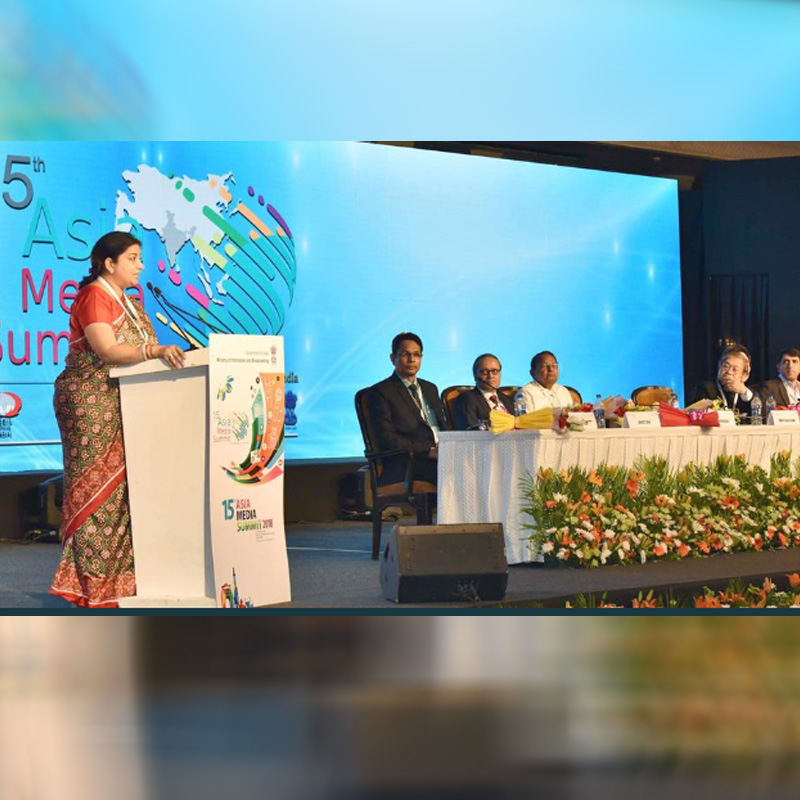
    NEW DELHI: Minister for Information & Broadcasting Smriti Zubin Irani yesterday said that the time has come to put laws, ethics and rules into place that will help in balancing the media industry so that no one dominant player can rule the roost. She, however, did not elaborate what those parameters should or could be.

    Speaking at the 15th Asia Media Summit (AMS) 2018 yesterday, she, however, hinted at her version of what good content could be, throwing oblique references to the growing digital-spurred edgy content in Indian media, including television.

    Pointing out that India will have around 969 million internet users by 2021 and that the media industry looks upon the digital world “not only as a challenge but also as an opportunity”, Irani asked, “How do we attract, retain and develop talent, which frees good content from the trappings of revenue needs and brings about a balance in media institutions?” 

    She hoped that the media event would deliberate on ways to “delve and deliberate on Asia values”, and the need for good stories to be told.

    Dwelling on the need for regulations to ensure level playing field for all, the minister referred to an address made by media baron Vineet Jain, group MD of Times Group, before her at the media conference to drive home a point that present laws may be inadequate to deal with the changing landscape of the Indian media.

    Jain, during his address to the delegates at AMS 2018, had said, “But for Indian media to realise its full potential, regulatory reforms are needed across the board – to make it easier to do business, remove anomalies in the system, and above all, ensure a fair marketplace that benefits the consumer.”

    Carrying forward, Irani said the India media is getting more consumer-centric because of the opportunities (and challenges) that the digital ecosystem is offering stakeholders, apart from the overall evolution of the industry.

    Giving a perspective of the expanding Indian media industry, Irani said India was one of the fastest growing advertising market that is expected to touch $10.59 billion by the end of 2018, while the mobile spend was estimated to grow to $1.55 billion in the current year. “We have a vibrant media industry, which has a direct established impact of Rs 1.35 lakh crore and indirect and induced benefits of Rs 4.5 lakh crore, with close to 4 million people associated with it,” she added.

    The three-day 15th Asia Media Summit is being hosted by the Ministry of Information and Broadcasting jointly with the Indian Institute of Mass Communication (IIMC), and Broadcast Engineering Consultants India Limited (BECIL) in New Delhi. The theme of this year’s summit is ‘Telling Our Stories – Asia and More’, which would encourage regional and bilateral dialogue and cooperation to respond to challenges to the broadcasting sector in the region.

    The minster expressed hope that the event will throw up new ideas so that pathways to strengthen media institutions for a better mankind could be explored.

    Addressing the inaugural session, Minister of Information from Bangladesh Hasanul Haq Inu outlined six complex challenges the world faces today: poverty, gender disparity, terrorism, ICT revolution, climate change and uneven globalisation. Expressing concern at cybercrimes, he stressed upon the need to fight a war against cyber-criminals to keep the media safe and expanding.

    This is the first time that the Asia Media Summit is being held in India. Over 220 foreign delegates representing 39 countries (SAARC, ASEAN, East Asia, Africa, Oceania, Europe, Syria, Uzbekistan, USA, China) and senior officials of the government and members of Indian media industry are participating in the event.

    Also Read:

    MIB moves to regulate online media: various organisations join issue   

    Online media professionals write to Smriti Irani expressing regulation concerns

    TRAI seeks to regulate online streaming platforms

  • Rahul Kansal joins Network18 as group brand advisor

    Rahul Kansal joins Network18 as group brand advisor

    MUMBAI: Network18 announced the appointment of Rahul Kansal as brand advisor for the group.

    Kansal joins Network18 from Future Consumer Ltd. Prior to that, at Times Group, he was the force behind campaigns like ‘Aman ki Asha’, ‘Teach India’ and ‘Lead India’ among others.

    Many of these initiatives have received widespread acclaim, including India’s first-ever Grand Prix at Cannes. In his new role, he will mentor the array of brands within the network and develop innovative properties to strengthen their positioning and connect with the consumers. He will report to Network18, CEO – news and group editor-in-chief Rahul Joshi.

    At Times Group, he was responsible for the financial health, editorial strategy and marketing for the Group’s newspapers: The Times of India, Mirror, Maharashtra Times, Navbharat Times and some smaller regional and English publications. During his tenure of 15 years at the company, The Times of India emerged as the world’s largest-circulated English newspaper.

    Rahul has been an advertising and marketing professional for 38 years.  He graduated from SRCC, Delhi University in 1977, and after an MBA from IIM Calcutta in 1979 worked with some of India’s leading ad agencies such as JWT, O&M, and Mudra DDB before joining The Times Group.

    Also Read:

    Network18 appoints Avinash Kaul as COO

    Deshpande appointed Network18’s non-exec director

    Network18 Launches CNBCTV18.com

  • TDSAT ‘reserves’ order on landing-page case

    TDSAT ‘reserves’ order on landing-page case

    NEW DELHI: Telecoms and disputes tribunal TDSAT on Thursday reserved its order—the judge will pronounce the verdict later—on a case filed by a few multi-system operators (MSO) on sector regulator Telecom Regulatory Authority of India’s (TRAI) decision to ban the use of boot-up or landing page for anything else other than promotion of the distribution platform’s services.

    TDSAT, after hearing all sides, including TRAI, will now give a direction later. The arguments, amongst other issues, revolved around the fact whether all laid down norms and procedures were followed by the regulator before passing an order on the landing page matter on 8 December 2017.

    “In order to protect the interest of service providers and consumers, and orderly growth of the sector, [TRAI] directs all broadcasters and distributors of TV channels to restrain from placing any registered satellite TV channel, on the landing page LCN or landing channel or boot-up screen within 15 days from the date of issuance of this direction,” the regulator had stated in its order, asserting it was well within its right and powers to do so.

    Soon after this directive was issued, a clutch of MSOs and TV channels, including Fastway (operating in Punjab and Haryana states), DEN Networks and the Times group, moved the TDSAT challenging the regulator’s diktat.

    The landing or the boot-up page is what a viewer sees first when a TV set and the connected set-top box are switched on. This page on the screen remains for a certain period of time after which the EPG or the electronic programming guide of the distribution service provider comes up. The landing page, considered hot real estate, usually carries paid advertisements of a TV channel programme or messages (like audience-measurement data relating to a particular TV channel or even initial sampling of a new channel). The commercial use of the landing page results in sizeable revenue for distribution platforms.

    Asked about the legality of the whole issue, lawyer Abhishek Malhotra, a partner in Bharucha & Partners, a law firm specialising in media sector-related cases, said, “The legal position on transparency required to be followed by TRAI under Section 11(4) of the Act is very clear and has been reiterated by the Supreme Court. It seems likely that non-observance by TRAI of this basic condition could result in the matter being remanded back before the merits of the matter are taken up.”

    While passing the directive on use of the landing page, TRAI had said it had received a number of representations from stakeholders stating the practice of placing a registered TV channel—whose audience data was recently released—on the landing page had the potential to influence TV-audience measurements.

    The genesis of this TRAI order is connected to the rousing debut of an English news channel last year, which got high viewership ratings from the audience-measurement agency and the data was questioned by a section of the competition on the grounds that some unethical practices were followed. It had then resulted in a public spat.

    Also Read :

    TRAI tightens landing-page norms

    Republic TV curiosity factor wanes, NBA channels data absent in week 21

    Republic TV, TRAI, NBA and the case of multiple LCNs

    News channel controversy: BARC India fires riposte to NBA

    “Dual LCNs is not the best thing to do” — Chrome Data CEO Pankaj Krishna


  • Times Bridge appoints two Twitter execs to leadership roles

    Times Bridge appoints two Twitter execs to leadership roles

    MUMBAI: Times Bridge has added two more Twitter seasoned professionals to its roster. The global investments arm of The Times Group has appointed Viral Jani and Margot Ling-former executives at the microblogging site-to its leadership team. Jani has been appointed senior vice president of investment operations while Ling has been appointed as head of greater China investments and partnerships.

    Both appointments are effective immediately. 

    “The mission of Times Bridge is to bring the world’s best ideas to India and to share India’s best insights with the world,” said Times Bridge CEO Rishi Jaitly, who previously served as Twitter’s vice president, Asia Pacific and Middle East. “Viral and Margot are proven, mission-driven leaders who will help us build on recent momentum to scale the pan-India success of our investment portfolio and meet the demand for Times Bridge’s platform in China and beyond.”

    Viral Jani, a graduate of MICA in Ahmedabad, has worked in a variety of functions across technology and media firms. Until recently, Jani led strategy, television and entertainment partnerships for Twitter across India working with key strategic partners to drive innovation and monetisation. Previously, he was Head of Strategy and Social Media for The Times Network. Jani will be based in Mumbai and lead the India success of Times Bridge’s growing investment portfolio, which includes Airbnb, Coursera, Houzz, MUBI, Thrive, Uber, Vice and others.

    “India is a meeting point for the world’s great ideas and a microcosm of the world’s markets, presenting unique challenges and opportunities for all entrepreneurs,” said Jani. “At Times Bridge, I look forward to setting a new standard for what it means for big ideas, from our investment portfolio and beyond, to immerse across India.”

    Margot Ling, before leading strategy and partnerships for Twitter across Greater China, helped global companies such as Dolby, News Corp and Edipresse structure deals in Mainland China. Ling will be based in Hong Kong and work with entrepreneurs and executives across Greater China to help them realize their India opportunity.

    “China and India are not only the world’s fastest-growing economies but also two of the world’s most celebrated, ancient civilisations,” said Ling. “At Times Bridge, I look forward to building a bridge between India and China and, in so doing, setting a new standard for what it means for ideas to travel between cultures.”

  • Delhi HC refuses to entertain injunction sought by Times group against Republic TV

    MUMBAI: The Delhi High Court today refused to entertain an injunction sought by the Times Group in a case filed by it against Republic TV on issues related to IPR on audio tapes aired by the latter. The court has set dates for further hearing in the case. This is according to information shared with indiantelevision.com by sources close to Republic TV. 

    Reacting to the development, a Republic TV spokesperson told Indiantelevision.com that while the court has set a date for hearing on the same matter six weeks from now, it has also urged the Times of India group to refrain from reporting on the matter.

    We reached out to Times TV Network CEO MK Anand for his organisation’s point of view but there was no response till the time of writing this report.

    The court had yesterday allegedly refused to put a stay on BARC’s  ratings of Republic TV from being published as requested by the India Today group.

    Earlier, the court had asked the Times group as to why the Sunanda Pushkar and Lalu Prasad audio tapes were not used despite them being in the possession of Times Now.

    Keep tuned in for more on this saga

    Also Read:

    Delhi HC notice to Arnab Goswami on ‘theft’ suit by Times group 

    Being a ‘cry baby’ won’t help Times Group, says Republic TV’s Arnab Goswami

    IPR case: HC issues summons to Republic TV, hearing on 26 May