Tag: Tik Tok

  • Media Distillery pours AI power into search with game-changing discovery suite

    Media Distillery pours AI power into search with game-changing discovery suite

    MUMBAI: Ever felt like finding the right show to watch is harder than choosing what to eat for dinner? Media Distillery has heard the struggle and is uncorking a revolutionary solution, its new Search and Discovery Suite. Designed to make finding content as effortless as a Tik tok scroll, this AI-powered suite ensures viewers spend less time searching and more time watching.

    The video streaming industry has long battled with decision fatigue, with research showing that consumers spend over 10 minutes deciding what to watch often giving up entirely. Media Distillery’s latest suite tackles this head-on, using cutting-edge AI, Large Language Models (LLMs), Visual Language Models (VLMs), and semantic search to help viewers discover exactly what they’re looking for sometimes before they even know it.

    “2025 is the year of search and discovery,” said Media Distillery CEO and co-founder Roland Sars. “With so much content available, viewers can’t always see the forest for the trees. Our AI-powered suite ensures they never miss out on great content again.”

    Instead of the usual ‘because you watched xyz’ recommendations, the Search and Discovery Suite uses AI to dynamically generate suggestions across multiple sources. Say a viewer searches for the Academy Awards the tool doesn’t just show Oscar-winning films, but also TV shows featuring the winners, red carpet highlights, interviews, and more.

    A pilot test with a major cable operator delivered impressive results, with 75 per cent of viewers discovering sports content they wouldn’t have found otherwise, while 65 per cent received more relevant sports recommendations directly on the platform, reducing their need to search elsewhere. This AI-powered intelligence goes beyond on-demand content, enabling broadcasters, live TV providers, and OTT platforms to unlock the full potential of their catalogues and enhance viewer engagement.  

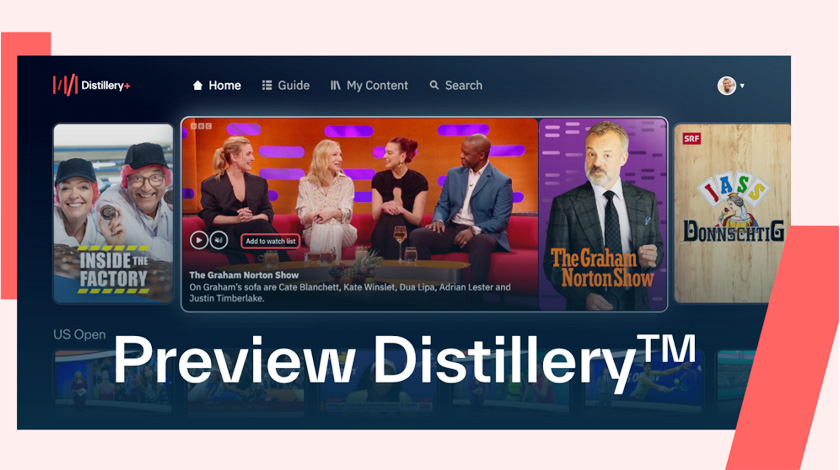
    Media Distillery’s Search and Discovery Suite complements its Preview Distillery solution, offering a seamless content discovery experience. By integrating real-time broadcast content analysis, the suite enables broadcasters, operators, and OTT services to boost engagement and monetisation while keeping viewers glued to their screens.

    So, if you’re tired of endless scrolling, Media Distillery’s latest innovation ensures your next binge-worthy show is just a smart search away.

  • Short-form video app, Tiki will grow its users to 60 mn in 2022, says CEO Ian Goh

    Short-form video app, Tiki will grow its users to 60 mn in 2022, says CEO Ian Goh

    Mumbai: The growing insatiable hunger for online videos will augment the long-term growth of short-form video market and likely increase the monetization opportunity for the industry to worth $19 billion by 2030, according to a recent report by global consulting firm Bain & Company.

    Similarly, Resheer, the management consulting firm’s report highlighted that India has approximately 640 million internet users and 550 million smartphone users spending nearly 1.3 trillion hours online. Smartphone users also spend about 4.8 hours per day on their devices, with an hour spent watching videos on average. This is second to China, which also has a huge consumer-base for smartphones and internet users. The report added that India is currently witnessing 300 million users of short video apps; it could rise to 600 million by 2025.

    While discussing the short-form video app Tiki’s CEO Ian Goh about the market opportunities of short-form video, he believes that visibility and recognition are the biggest challenges that creators are facing currently. He adds, “To grow the community, they need to support one another.”

    After the government’s imposition of a ban on the Chinese app TikTok, it has been observed that other Indian short-video apps have grabbed almost 97 percent of the former’s user base and considerably expanded the addressable market for short video apps, thanks to aggressive marketing strategies & user acquisition. 

    The Redseer also shared that the Indian apps have successfully retained 67 per cent of the TikTok subscribers by acquiring influencers and have added another 30-35 per cent of new users in the past year.

    Singapore-based DOL Technology’s Tiki, which was launched in 2021, is a “glocalised” platform that aims to redefine the standard for short video creation & sharing. It has millions of monthly active users in India. Since the last few months of operations, Tiki has become a platform where people come for the content but stay for the community. Tiki aims to cultivate an environment of “authentic entertainment, peer-to-peer support, and community.” 

    The platform’s vision is to help India’s talented content creators make a living doing what they love. Until today, Tiki has successfully on-boarded thousands of verified creators who produce great content for Indian users. Tiki also allows users to become verified Tiki creators through an easy-in-app application verification process. 

    In its quest to become the most preferred short-video app in the country, Tiki is developing two competitive mega-genres: Show-Yourself and Short Series, and sub-genres under them. The Show-Yourself genre includes lip syncing, dancing, music, dubbing, dress-up, etc., while short series feature melodrama (romance, friendship, family, patriotism, mystery, horror, action, etc.) and comedy (sketch comedy, spoofs, parodies, pranks, standup, epic fails, etc.).

    Tiki operates on three broad models:

    1. Content First Platform—Aids in the journey of true content creators.

    2. Real Original Content: Supports locally made, original, high-quality content that honours Indian values and cultures and that is also entertaining, inspiring, and educational.

    3. Community: Tiki’s platform for fostering relationships between creators and fans.

    The short-video app is focusing on the right kinds of tools, effects, filters, and video-editing capabilities to help create better content and retain top creators on the platform. In addition to that, the app is also trying to build stronger communities to promote Indian artists and creators.

    Indiantelevision.com caught up with Tiki’s CEO Ian Goh to find out more. He is an entrepreneur with a passion for building and launching tech ventures across Asia.

    He previously launched OYO’s business in Malaysia both on the demand (revenue/sales) as well as supply-side and extended it to other Southeast Asia (SEA) markets. He was also a pioneer in oBike-a Global Dock-less Bicycle Sharing startup for the Asia Pacific Region & Rush-a Scooter and Powerbank sharing startup.

    Goh grew up in a city in Borneo, Malaysia and pursued his education in Singapore and pursued his business degree at the University of Melbourne. He currently resides in Singapore.

    Edited Excerpts:

    On the trends being seen in the content creator economy in the country

    Ian: According to a recent report by RedSeer, short-video apps are expected to double their monthly active user base to 600 million by 2025 and to 850-900 million users by 2030. Today, everybody is a content creator, and people from tier two and three cities are also joining the league, aspiring to become professional creators.

    With a plethora of creators, the originality of content is lost under the pile of crawler content. Visibility and recognition are the biggest challenges for creators. Therefore, if they need their communities to grow, they need to support one another. They form their own communities, doing social good and trying to get recognised by a larger audience.

    On the idea of Tiki

    Ian: I have always been passionate about short videos. While there are other short video apps in India, we wanted to bring something that could help the creator economy and build a community of true talent. We found a gap in India in terms of the short-video creator economy. There are creators in every corner of the country, and many times, creators are left without a platform that appreciates them.

    Local creators also deserve a better platform for exposure. Therefore, we created an app that is “Made in India” for the real Indian content creators. We are the pioneers of promoting original content creators, which makes us stand out in the cluttered zone.

    On the Tiktok ban benefited Indian short video apps

    Ian: The sudden ban on TikTok created a void for Indian creators. It was a golden opportunity for many platforms to venture into the Indian market, but the creators were not well served. So, while the ban may have benefited Indian short video apps, it is difficult to say that it benefited Indian creators. Creators are still facing many obstacles: the growth of talented creators; plagiarised content; and no creator community.

    On Tiki’s USP vis-a-vis competition

    Ian: Today, online creators have the advantage of pursuing what they love and monetizing through their talents. But they desire more than easy money. They want their originality to be honoured and to earn their own fame with their talents. Tiki is a platform that fulfils the creators’ demands. We are the creators’ first platform.

    We prioritise 100 per cent original content. Every piece of content that goes on Tiki cannot be copied from anywhere else. No one can copy others’ content and put it on Tiki. We also focus on the power of community and have created a community of real talent who meet up with each other and support one another to become a star. Our monetisation model is fair and open. We bank on a fan economy, where a user can give stars to the creator.

    On Tiki’s 3-pillars that aim to empower the content creator community
    Ian: Tiki empowers its creators based on three broad pillars: Fame as a Service, Star Monetisation, and Creator-oriented Community.
    Fame as a Service: Based on Maslow’s Hierarchy of Needs, self-actualisation and esteem are at the top. Tiki translates that as fame for creators on the platform and even outside. Humans are always seeking to accumulate social capital. Tiki has designed a creator ecosystem in which everyone can be verified to join. Anyone can rise through the ranks to become a White V creator, then a Gray V, and finally a Blue V top influencer on Tiki.
    Tiki innovated and continues to manage the ecosystem so that the truly talented can break through. Tiki helps its verified creators along their hero journey by providing 100 percent of its traffic, constantly updating functions and stickers, and helpful managers, all in order for creators to fully express their creativity, be famous, and popular. Tiki calls it Fame as a Service (FaaS).

    Star Monetisation: Instead of the traditional black box model of paying creators, Tiki innovated a performance-based mechanism that is transparent and fair to the talented ones.

    Creator-oriented Community – It’s never only about getting famous and making money. Creators are also here to make friends and socialise with others. Now they’ve formed over 500 family guilds on Tiki. Some are holding panels to share video shooting skills, others are organising offline meetups for a shared interest or a charitable event. Every month, the Tiki community organises over 1000 offline meetups and 20,000 online meetups.

    For instance, three family guilds had offline cleanups and tree planting on Earth Day. Tiki sponsors verified meetups for creators to entertain and learn within the community. Tiki provides creators with a safe and family-like community to explore more opportunities and benefits with their peers.

    On Tiki’s monetisation model
    Ian: At Tiki, we don’t follow the traditional black box model of paying creators; we’ve innovated a performance-based mechanism that is transparent and fair to the talented ones. The money they earn is only defined by the stars they gain from users. Star is a feature Tiki designed for users to send to their favourite creators or content.
    Different from the “like” culture, which has been inflated and even abused on many other platforms, Star on Tiki can be viewed as a thoughtful and sincere vote from a user to a creator. Star can be earned via short videos, profile pages, and live broadcasting. Further, we would like to explore the fan economy, social commerce, and brand collaboration as monetisation models for our creators.

    On efforts to create an environment of authentic entertainment, peer-to-peer support, and community

    Ian: We are a “Make in India for India” platform that focuses on improving the Indian creator economy. We aim to create a platform where local talents are appreciated for their originality. For this, we have generated software that can detect the copied content. We have an experienced local team headed by Abhishek Dutta to do creator verification to make sure all verified creators are real and upload original content.

    On Tiki’s plan to reach 60 million users by the end of the year

    Ian: Tiki started with only 120 content creators in the beginning but now boasts of having over four lakh content creators on board in a matter of 1.5 years in India. Our aim is not to scale up to 120 million users overnight. We focus a lot on time spent on the app and the retention rate of users.

    The industry average for time spent on short-form video apps is 20 minutes. People spend close to 22 minutes on Tiki every day. Therefore, by the end of 2022, we intend to reach 60 million users. We will continue to empower local creators and bridge the online and offline gap via community meetups.

    On the strategy that ensures that only original content is on Tiki

    Ian: Short video platforms are in abundance in India, and many of them do not emphasise the originality of the content. Different from the flood of crawler content on other platforms, Tiki stands strong for locally made, original, high-quality content that honours Indian values and cultures and is also entertaining, inspiring, and educational. Tiki manages to do it with its in-house developed creator verification system and strict content moderation standards.

    On the content that works on Tiki

    Ian: Our insight tells us that crawler content, vulgar content, non-original content, and even indecent content are prevailing on many other platforms. That’s where we want to position Tiki differently.

    Tiki discovered and developed two competitive mega-categories: ‘Show-Yourself’, and ‘Short Series.’ The ‘Show-Yourself’ genre is all about showcasing one’s talent. It includes lip syncing, dancing, music, dubbing, fashion, etc. While the ‘ShortWhile Short Series’ category features bite-sized video stories, sub-genres include: melodrama (romantics, friendship, family, patriotism, mystery, horror, action, etc.) and comedy (sketch comedy, spoofs, parodies, pranks, standup, epic fails, etc.). All the content on Tiki is original and created by real local creators in India.

    On the whitespace of tier two, and three cities

    Ian: India is on the cusp of the golden age of short-form video platforms. The size of the short video market is expected to grow from 240 million to 650 million in 2025 as many tier two and three cities’ users are embarking on the journey of content creation. Instagram has become too saturated to grow an easy follower base. Many short video creators can amass five million Tiki followers but only 20,000 on Instagram. With our real creator ecosystem, we believe many new talents will be discovered through Tiki.

    On whether a shakeout is imminent given the competition

    Ian: There is healthy competition in the creator space, and we have to stick to our USPs to support the creators. The shakeout would happen to those that do not add value to the stakeholders.

    On the potential Tiki sees in social commerce and branded content

    Ian: According to EY India, social commerce currently accounts for one per cent to 1.5 per cent of overall e-commerce. The share of social commerce is expected to go up to six per cent by 2025. Social commerce is not a competitor to e-commerce but an important extension of it. Tiki sees potential in social commerce in the near future, but first it’s about building a healthy creator-user ecosystem.

    On fundraising plans

    Ian: Yes, we are open to funding and looking for investors who share the same vision and cherish the same values as us—creators deserve a better platform to thrive through their talents. Investing in Tiki is investing in the creator economy.

    On the challenge of scaling up rapidly

    Ian: There are many short video apps in India claiming to be number one in the market. However, we believe that the challenge is not about its speed or scale but whether it’s sustainable or not. We want our creator and content ecosystem to grow consistently, benefiting our creators. We want to be a powerhouse for the Indian creator economy.

    Therefore, our challenge is to scale up while remaining sustainable. We will stick to our creator first principle, providing our creators with monetisation channels and helping them grow and thrive.

  • GUEST COLUMN: What’s new in Web 3.0 for content?

    GUEST COLUMN: What’s new in Web 3.0 for content?

    Mumbai: The very genesis of the internet was to be decentralised, and that’s partly true even today. You can send an email from your Gmail to an Outlook address or you can have your own domain and server to send an email to anyone. The ability to host, ring-fence, and interact independently has always existed but along the way, large corporations came in to organise the internet and make it available to people in an easy scalable manner.

    This was the beginning of what we now know as Web 2.0. Users thus explored these spaces and started building communities. Email and social media platforms made it easy to interact with people using a common space. Users can easily jump on to the bandwagon of Facebook, Gmail, Twitter, or Instagram, and more recently to Tik Tok and a plethora of newer short video platforms. And inevitably, people milling around a common space gave way to the proverbial soapboxes that we all love to like, share, comment on and become ardent followers of.

    The Evolution of the Content World

    Meanwhile, in the content world, the internet moved from solely being a marketing tool to being the home of all content consumption. Content creation moved from being the job of actors, studios, production houses, and writers to casual commentators and regular people who explored their creative side. Today, we have platforms like TikTok, Instagram, Spotify, and Youtube that give professionals and amateur creators a path to reach their audiences.

    In 2020 alone, Instagram recorded an estimated two billion users and $24 billion in revenue, while Tik Tok had an estimated one billion users and $1.9bn in revenue. The sheer number of users, signals that the momentum that we have built up around these companies has a life of its own. As things stand, the internet still needs centralised players to allow for discovery. We have spent the last two decades discovering and recognising different platforms to listen to music, watch a video, or share photos. And that is not about to change anytime soon.

    Embracing Web 3.0

    If Web 3.0 is to bring about a wave of change, it is the application of blockchain technology in enabling transactions and in the actual value of the material. This development is especially interesting in the content space. It seems benign from the outside because we are already transacting at a price for content: whether via direct subscriptions or via ad-subsidized models that appear free to users.

    Users and brands, however, pay centralised platforms for the content, not the original producer of the content. This is largely because it is the platforms that take on the trials of hosting, security, and content distribution, all of which are expensive propositions. These platforms do share a part of their earnings from ads and subscriptions with creators, but this share tends to be small and at predetermined prices where creators have little or no say.

    When you look at how the content industry is progressing, we have legitimate jobs like “Instagram Influencers” and “Tik Tokkers” who have an enviable set of audiences that follow the original content they created day on day to entertain, inform and influence purchase.

    Predictably there is a huge spike in “Influencer Management” companies that offer brands access to collaborate with influencers. As per an online report, there were more than 240 Influencer companies that were set up in 2021, and the Influencer Marketing Industry is set to grow to approximately $13.8 billion in 2021, up from 9.7 billion last year.

    The Future of Blockchain Technology

    The growth of influencer marketing will soon make it impossible for even these companies to keep up in basic terms of running a business. Blockchain is a perfect solution to help ensure the right creators are paid and transparent validation of the value of the content created.

    For instance, TikTok is planning to introduce Ghost Kitchens to give users the ability to order a recipe that went viral (remember the Dalgona coffee phase?), fulfilled by Tik Tok and paid for by the user. Their intention is to share the proceeds of the orders for that dish with its Tik Tok creator. One way for TikTok to actually ensure that the right creator gets paid for the recipe is by using blockchain technology to trace the true (first) owner of the recipe on the platform. The value of that token can be gathered with how much it was shared (indexed) so it can influence the price of the recipe created to be produced.

    In the same vein, video platforms can use blockchain technology to allow access to content in an almost peer-to-peer manner. Such platforms could payout tokens to users allowing other users to access their computing resources. And these tokens could be reused within the platform or exchanged for currency at a value determined by the market.

    In this kind of world, content creators can get paid directly by their consumers, and discovery platforms can transition to new business models, relieved of some of the stress of security, hosting, and distribution. We are seeing small but significant moves towards using blockchain technology in content monetisation and the industry is sitting up and noticing it. The amount of capital flowing into web3.0 and blockchain-based companies is off the charts. However, there are several challenges to making this technology commercially viable, and the jury is out on how well it will scale.

    There is no doubt that these are interesting times for the media sector, and blockchain will certainly have its part to play. But it will take a while before it becomes completely mainstream, if ever.

    (Kavita Shenoy is the founder and CEO of Voiro, a Bengaluru-based ad-tech start-up. The views expressed in this column are personal and Indiantelevision.com may not subscribe to them.”

  • Netflix is testing TikTok-inspired short clip feature for kids

    Netflix is testing TikTok-inspired short clip feature for kids

    Mumbai: Netflix Inc is testing out a TikTok-inspired ‘Kids Clips’ feature to attract younger viewers to its platform and help them discover programming.

    It will feature new short videos or ‘clips’ from the existing library of kids’ programs and movies on a daily basis on its current as well as future offerings. An added feature limiting access to only 10-20 clips at a time will also be introduced subsequently.

    The kids’ feed will resemble ‘Fast Laughs’ – the feature showing funny clips from different series, films and stand-up specials on Netflix that was introduced earlier this year. However, unlike vertically aligned videos on Fast Laughs, here they will be available for viewing horizontally.

    The Kids Clips feature will be piloted in markets like the US, Latin America, Canada, Australia, and Ireland this week.

  • India tops global Instagram installs in October: Report

    India tops global Instagram installs in October: Report

    Mumbai: India has topped the charts in recording the largest number of installs of social media application – Instagram, according to the latest report by Sensor Tower. As many as 39 per cent of the total app downloads were from India, followed by Brazil at six per cent.

    The social media app was the second most downloaded non-gaming app worldwide, while the short video platform Tik Tok remained at the top with more than 57 million installs for October 2021.

    The countries with the largest number of installs were from Douyin in China at 17 per cent, followed by the US at 11 per cent, reports Sensor Tower. The app was, however, banned in India by the government, along with 58 other mobile applications which were developed by Chinese firms on account of national security.

    Apart from Tik Tok and Instagram, other apps including Facebook, WhatsApp, and Telegram rounded out the top five most installed non-gaming apps worldwide for the month as per the data.

  • Khaby Lame and Dream11 come together for a fun video

    Khaby Lame and Dream11 come together for a fun video

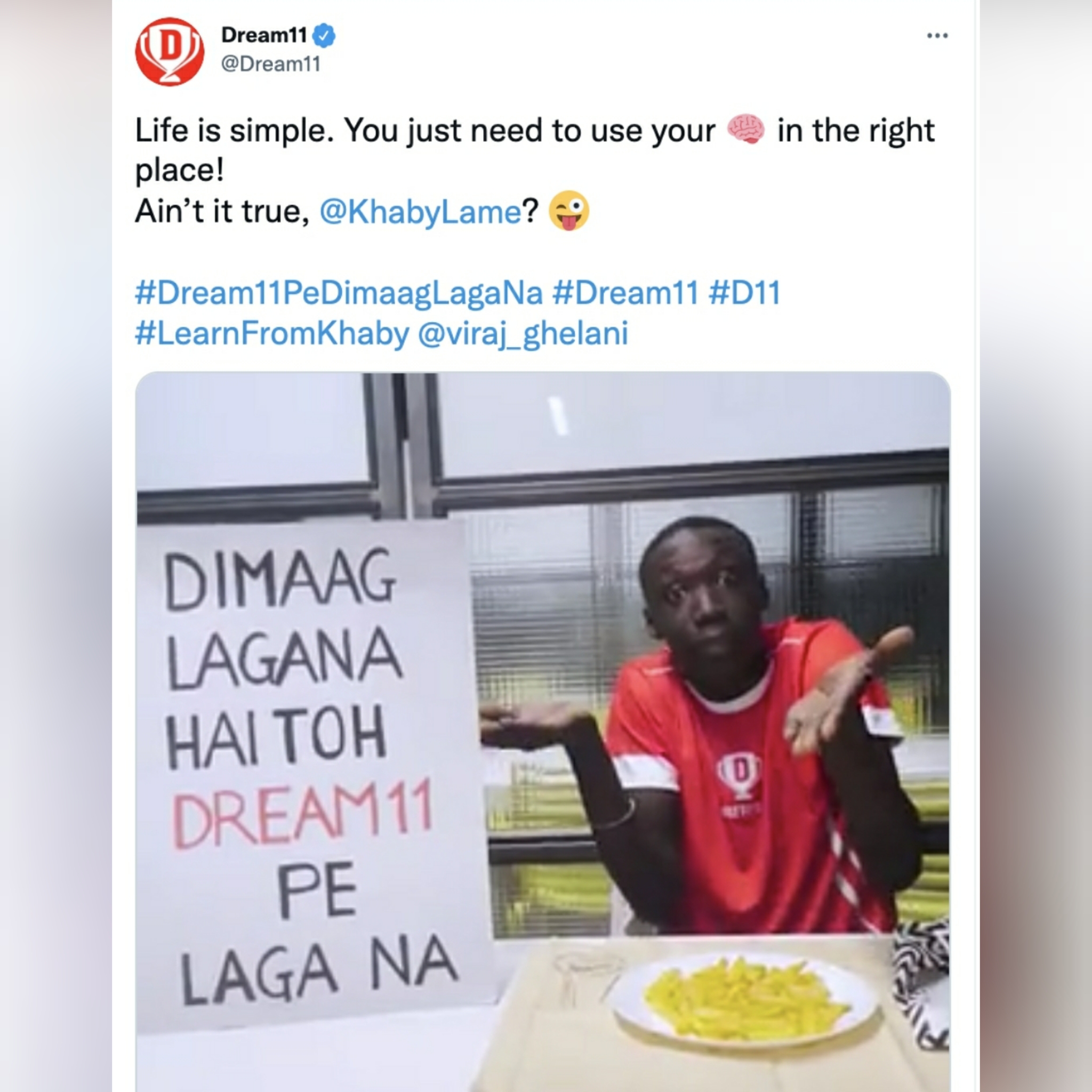
    Mumbai: International social media sensation Khaby Lame joined hands with fantasy sports platform Dream11, marking his first-ever association with an Indian brand. The Senegalese-born Tik Toker created a short video skit with Indian content-creator, Viraj Ghelani, wherein his trademark style, Lame called upon people to accomplish day-to-day tasks in a straightforward manner and instead, use their brains to play on Dream11.  

    The homegrown Indian brand has been one of the top IPL sponsors since 2019, and for the 2021 edition, it launched multi-media campaigns under #Dream11PeDimaagLagaNa and #TeamHaiTohMazaaHai.

    In the video, Ghelani is seen sitting with a friend who is eating french fries with toothpicks. Ghelani isn’t amused and calls Lame to simplify this. In his signature style, Lame picks up a fry with his fingers and eats it to express how not to unnecessarily complicate a task.

    Wearing a Dream11 jersey, Lame then points to a placard that says ‘Dimaag Lagana Hai Toh Dream11 Pe Laga Na’ echoing the brand’s message to instead use one’s intellectual might for picking a team on Dream11.


    The 21-year-old Tik Toker became an internet sensation with his relatable content of pointing at obvious solutions instead of using hacks. Lame is the second most followed TikToker in the world, with over 110 million followers. 

  • Facebook’s billion-dollar push to woo content creators

    Facebook’s billion-dollar push to woo content creators

    New Delhi: As its rival TikTok continues to rise up the charts, the social media giant Facebook has announced that it is all set to invest over $1 billion to reward creators for creating content on Facebook and Instagram by the end of 2022.

    The announcement is part of the US giant’s big-term plans to up its game against YouTube and TikTok which have been setting new records. The Chinese video sharing app has thrived despite the government bans, and recently became the first non-Facebook mobile app to surpass three billion downloads since 2018 when it became available globally.

    According to mobile analytics firm Sensor Tower, the milestone makes TikTok the fifth nongame app to cross the threshold, following WhatsApp, Messenger, Facebook and Instagram- all owned by Facebook. The US social media giant is now gearing up to compete with its rival’s spectacular rise.

    “From artists to style experts and budding entertainers, creators drive so much of the passion and creativity we see across our apps. By the end of 2022, we plan to invest over $1 billion in programs that give you new ways to earn money for the content you create on Facebook and Instagram,” Facebook CEO Mark Zuckerberg said in a FB post. “We want to build the best platforms for millions of creators to make a living. Investing in creators isn’t new for us, but I’m excited to expand this work over time.” 

    The company said the idea is to reward creators, especially those just starting out. The investment will include new bonus programs that pay eligible creators for hitting certain milestones when they use FB’s creative and monetisation tools. The company will also provide seed funding for creators to produce their content. “Our goal is to help as many creators as possible find sustainable, long-term success on our apps,” it said.

    Some programs are already available to select creators by invitation but the platform will now launch a dedicated place for bonuses within the Instagram app soon and later in the Facebook app. Instagram’s bonus programs will include incentives to use Reels,a feature developed post rise of TikTok.

    “This investment brings together our many programs and initiatives across the company that support the creator community and enable them to earn a sustainable income on our apps. It complements our growing suite of monetisation tools,” said the company.

  • Triller announces Tik Tok’s Raj Mishra as head of operations – India

    Triller announces Tik Tok’s Raj Mishra as head of operations – India

    NEW DELHI: US-based photo and video sharing app Triller has announced the appointment of former TikTok executive Raj Mishra as country manager and head of operations for India. Over the past 13 years, Raj has built a strong track record of driving significant growth in globally complex business environments.

    Mishra's specialisations include driving aggressive strategies for sales & marketing, business growth (Top & Bottomline), and P&L management for brands that aim for success in the ever-evolving social media landscape in India. 

    In his new role at Triller, he will be leading and furthering the development of its products, operations, and overall business goals, it added.

    Earlier, Mishra spearheaded the transition from Musical.ly to TikTok and was instrumental in driving growth for ByteDance in India by creating the local team, liaising with business partners & the creator community in India, and identifying and incubating talent with the potential to help the company gain popularity on the app. In 2019, he decided to take up a new challenge within Bytedance & was responsible for one of their newly launched suite of products, Helo.

    Commenting on Raj joining the team, Triller CEO Mike Lu said, “We are thrilled to have Raj join our team and head the India operations. His valuable experience of working in the creators’ app space in India is a definite advantage for us and we are keen to explore his expertise to help us scale heights in the Indian ecosystem. His vast skillset and glocal understanding of Triller was deeply exciting to us and we are confident of his abilities to further, accelerate the company’s growth trajectory in India to become the topmost app of choice for artists all across the country.” 

    On his move to Triller, Raj mentioned that the opportunity that Triller offers to artists is incredible and the significant milestones that the app has managed to make in such a short period with zero marketing spends, indicate its massive growth potential in India.

    "With the world’s second-largest internet market consumer base, India’s artists and creators have found a safe space for creative expression in Triller and a democratic stage to reach out to a global audience. I am incredibly honored to be taking over the mantle in India and amplifying Triller’s presence in the country. My key purpose is to provide value to the community by strategically driving Triller as the go-to platform for millions to showcase and distribute their talent derivatives while building their social currencies," he added.

    Triller has big expansion plans in India, has over 100 employees in the country.

  • TikTok ban forces influencers to shift to homegrown short-form video apps

    TikTok ban forces influencers to shift to homegrown short-form video apps

    New Delhi: On Monday, thousands had a career in making videos and overnight they are jobless, adding to the existing recession in the country. TikTok was not just a source of entertainment for many but also a way to earn their daily bread and butter. Right after the ban, the app became unavailable for download on Apple’s App Store and Google Play Store in India. 

    TikTok, which has amassed more than 200 million users in India, identifies Asia’s third-largest economy as its biggest overseas market. Over the years, the platform has become a favourite amongst brands for influencer marketing. 

    Mirum India director of business development- Srikant Subramanian said that the budgets on influencer marketing will continue to remain. The marketers realise that influencers are the ones who are creating meaningful relationships for their brands with consumers and using those influencers would be key for their endeavours.

    “The next few months will be critical from an analytics POV. We will start to see the movement of audiences and behaviour of content consumption on existing large channels. Basis that, the brands will need to change strategies when that happens. In the short term, depending on the channel, brands will continue to do what they are doing now,” Subramanian adds.

    Zirca Digital Solutions CEO and director Neena Dasgupta is of the opinion that the platform’s rise has been phenomenal and what is interesting is that not only did people adapt to its format rather quickly but people stuck to the platform. 

    “In its absence, this huge number of users will migrate to other platforms and everything from digital marketing budgets to consumer engagement strategies will need to be rejigged. The marketing spends – particularly on influencers – were on the rise and the ban will lead to the reallocation of these budgets. So, the influencer marketing system is in for a change. For new platforms similar to TikTok it is going to be an opportunity to acquire and for existing platforms, it could be an opportunity to adapt as well as acquire."

    TikTok, which was blocked in India for a week last year but was accessible to users who had already installed the app on their smartphones, said last year in a court filing that it was losing more than $500,000 a day. According to reports, ByteDance had planned to invest $1 billion in India to expand the reach of TikTok, a plan that now appears to have been derailed.

    As per the Indian government’s statements, the ban of TikTok and 58 other Chinese apps is in response to the alleged possibility of data theft and security breach of Indian nationals, due to the ongoing geopolitical Indo-China tension.

    According to Dasgupta, Data security has been a long-pending agenda for the government. “I would not be surprised if this is accompanied by further bans irrespective of the source of the apps. The need of the hour are policies that can safeguard internet users and their privacy and we are yet to see these policies and how they are implemented.”

    Marcom Avenue director Divanshi Gupta says that India is working on undertaking various campaigns and projects that will make the country self-reliant regarding Chinese companies in power and mobile technology. “The country is home to multiple brands working on a three-pronged strategy (restart, restore and resurgence) to boost in-house technology and innovation while uplifting manufacturing in the national state,” she says.

    However, Gupta says that the decision to ban Chinese apps may not be directly classified as an "economic sanction" as China is a massive investor in the Indian business diaspora. It is more because of the national security threat and data theft.

    Content creator Ankush Bahuguna, who makes several videos on social media platforms including TikTok, says that due to the ban on the app, he will have one less platform to expand his universe and to engage with the audience. 

    "I think it is going to have a huge impact on creators who were making content exclusively on TikTok. The shift to a new platform means starting from scratch and I can't imagine how difficult it must be for so many people. I think it will be nice if other content creators could step in and help out TikTokers build themselves back on other platforms because I've seen a lot of TikTokers create very entertaining content and they deserve to stay relevant regardless of what happens to one app," he says. 

    RJ Sukriti Chaturvedi, popular content creator on Tiktok, Instagram, Facebook and Youtube who is known for her quirky and funny videos on social media platform says that if a breach of privacy has been conducted on the app, then it’s best that users shift to some other platform which ensures security. “It’s a piece of sad news for content creators who rose to fame through TikTok but there are other platforms too like Instagram or Youtube which can also add value for content creators.”

    The short-form video app also became advertisers’ new darling, mainly due to the access it gives to advertisers to creators and consumers. 

    “TikTok will suffer but Bytedance is a trooper,” Subramanian mentions. “They will find a way to make revenue. A lot depends on the regulation bit. Overall advertisers will be fine, they will split the audience and hence mostly split the revenue in the long term. It all depends on how long the void remains. I suspect many new apps will launch, and some existing ones like Hike could take advantage and then add some new features – especially since the markets are the same.”

    TikTok ban in India has already forced its users to look for alternatives. TikTok creators are requesting their fans to follow them on other social media platforms including Instagram and YouTube. Many influencers are also welcoming the latest move by the government. Whether it is Mitron, Chingari or Bolo Indya, the Indian rivals of the Chinese video-sharing app are hoping to grow their presence in the country and expand their user base by attracting several TikTokers to their platforms.

    “This would help Indian UGC platforms to garner content creators at a much higher pace and organically. Cost of creator acquisition will tend to reduce drastically due to this. This shall also enable a lower cost of consumer acquisition as many creators would be bringing in their follower base (to some extent) on to the Indian UGCs which they finally opt for creating videos going forward. For example, we have seen over one lakh new content creators join Bolo indya in last 24 hours at zero cost, and more than five lakh videos being created by them in last 24 hours, enabling them to go viral on Bolo Indya in least possible team, much quicker than other Indian UGCs,” shares Bolo Indya founder Varun Saxena.

    Saxena adds that since Monday, the platform has witnessed 10x surge in traction. “However, this has increased to 30x and we have hardly seen any downtime (apart from little speed issues for a few minutes) as compared to some of the other Indian UGCs which went down for hours today. We have taken requisite measures both on application server and database server sides and we are now ready to handle 80x surge in traffic from here.”

  • We place highest importance on user privacy & integrity: TikTok India head Nikhil Gandhi

    We place highest importance on user privacy & integrity: TikTok India head Nikhil Gandhi

    NEW DELHI: On Monday, the government of India banned  59 Chinese apps in the country. A day later, one of the most popular short video applications TikTok has been taken down from both Apple App store and Google Play store. 

    In an official statement, Tik Tok India head Nikhil Gandhi said, "The government of India has issued an interim order for the blocking of 59 apps, including TikTok and we are in the process of complying with it. We have been invited to meet with concerned government stakeholders for an opportunity to respond and submit clarifications. TikTok continues to comply with all data privacy and security requirements under Indian law and has not shared any information of our users in India with any foreign government, including the Chinese government." 

    Adding, "Further if we are requested to in the future we would not do so.We place the highest importance on user privacy and integrity. TikTok has democratised the internet by making it available in 14 Indian languages, with hundreds of millions of users, artists, story-tellers, educators and performers depending on it for their livelihood, many of whom are first time internet users." 

    Users who have the TikTok app downloaded can still use the app and post videos but officially the platform is now banned in the country.

    TikTok had nearly 119 million active users in India and was among the top 10 apps on Google Play store and Apple App store.