Tag: #TheNewDynamic

  • Netflix’s Monika Shergill talks about crafting stories for every mood on OTT

    Netflix’s Monika Shergill talks about crafting stories for every mood on OTT

    New Delhi: The OTT platforms have taken the world by storm. If there is one key trend that has completely revolutionised the way content is now being created across mediums, it is definitely these new-age platforms. And leading the way is OTT giant Netflix which currently boasts of over 209 million subscribers worldwide.

    From originals, sit-coms, documentaries, adapted formats to movies, the platform offers something for every kind of viewer. It will also be completing ten years in original programming soon, globally.

    “In all these years, we have tried to offer all kinds of stories on our platform – stories that feel real, and have universal emotions. We have had powerful novel based series, and multiple seasons each told in a fresh way,” says Netflix India, vice president, content, Monika Shergill at the fifth edition of The Content Hub 2021, which concluded recently.

    The three-day mega event organised virtually by Indiantelevision.com brought content makers from the world of television, films and OTT on one platform to delve upon the evolving media and entertainment industry. Indiantelevision.com’s founder and CEO Anil Wanvari got into an engaging fireside chat with Shergill about Netflix’s journey of creating content for the Indian masses.

    “Netflix is creating stories for every mood,” highlights Shergill. “As a streaming service, we are designed very uniquely. Everyone’s version of Netflix is different. You can experiment according to your taste, and try new content anytime you want. The way Netflix is designed, it is to really reflect as many lives as we can, mood within moods, genres, creating an ocean of stories and unlocking its full potential.”

    The French series, Lupin which was released on the platform in January remained among its Top 10 shows across most countries for weeks. It recently released Taapsee Pannu starrer Haseen Dillruba, and Kriti Sanon’s Mimi, and is gearing up for the release of the much-awaited fifth season of Spanish drama Money Heist. Then, there is the American teen romantic comedy, The Kissing Booth 3 in August.

    Haseen Dillruba has been trending ever since it was released. Ray (an anthology based on the works of Satyajit Ray) also spiked audience’s interest. Money Heist remained in Top 10 for 117 days last year,” Shergill says joyously. “What we are beginning to do is to create programming catering to different tastes. One story cannot work for everyone and we understand that everyone has different tastes, which we must cater to. Viewing of Kids content has increased by 100 per cent, and also the documentaries and films in different languages.”

    The final season of Money Heist is now set to launch in two instalments of five episodes each on 3 September and 3 December.

    The platform had announced as many as 41 titles early this year, and has a huge pipeline of new series, shares Shergill. “Finding Anamika will mark Madhuri Dixit’s debut on OTT. Then we will have another web-series, Yeh Kaali Kaali Ankhein in August which is a dark romantic series, bound to surprise everyone. R Madhavan will be seen in the comedy series, Decoupled. So, yes, we programme for every mood and taste,” adds Netflix India’s top executive, “Family dramas are also close to our hearts, and they appeal to the widest set of audiences.”

    According to Shergill, the platform has also made its mark as a global platform that has been successfully bringing best of stories from the world to India and vice-versa. “At a time when people cannot travel physically, we are taking them to different places through our stories. We are glad we are able to do it. All we want to do is entertain, and we promise that we have something for everyone. And, we deliver it to them in a responsible way,” she sums up.

    The fifth edition of the Content Hub 2021 was co-presented by IN10 Media Network and ZEE5, and co-powered by Applause Entertainment and Tipping Point, the digital content unit of Viacom 18 Studios. PTC Network was the supporting partner.

  • “The idea whose time had come”: Hansal Mehta on making financial thriller ‘Scam 1992’

    “The idea whose time had come”: Hansal Mehta on making financial thriller ‘Scam 1992’

    New Delhi: When the ten-part series Scam 1992 hit SonyLIV platform last October, it captured the imaginations of millions of young Indians in no time. The financial thriller chronicling the life of Gujarat-based stock broker Harshad Mehta, and his involvement in the 1992 Indian Stock Market Scam soon became the most-viewed series on the platform.

    On the last day of fifth edition of the Content Hub 2021 -TV, Film, Digital Video, and Beyond’ – the makers and writers of ‘Scam 1992: The Harshad Mehta Story’ got into a freewheeling conversation with Indiantelevision.com founder and CEO Anil Wanvari and showrunner-writer Alok Sharma to discuss the making of one of the most successful digital series on an Indian platform during the pandemic.

    “Harshal Mehta’s meteoric rise and sudden downfall had captured the imagination of millions, especially Gujaratis in the 90s. I was fascinated by his journey ever since I read Sucheta Dalal’s book in 2003-04, and wanted to tell the story. But that was the era of six-pack abs and shirtless songs, and I couldn’t even consider making it, until years later, when Samir Nair (Applause Entertainment) pitched the story to me and I jumped at it,” recalls director-producer Hansal Mehta, “It was the idea whose time had come.”

    The series went LIVE on the SonyLIV platform in October, 2020 when the first wave of the pandemic had begun to ebb away. The show was lauded for its tight screenplay and sparse writing by a team led by Sumit Purohit, Saurabh Dey, Vaibhav Vishal and Karan Vyas.

    The protagonist played by Pratik Gandhi hit it off with the audience with his one-liners, so whether it was ‘Risk hai to, Ishq hai’ which went on to become the tag-line of the series, or ‘Success kya hai, failure ke baad ka chapter’. These were also some of the lines that Hansal Mehta wanted to scrap out of the script believing them to be too filmy.

    “I found these lines to be too naïve and filmy at first. Par writers ka kamaal hai, wo kaise dikhate hain. Pratik (Gandhi) delivered those dialogues with such conviction and belief, that the audience connected with them. Wo daur filmi bhi tha,” smiles Mehta. Such one-liners were also used by stock brokers then, he adds.

    “It was also a casting feat,” quips co-director Jai Mehta. “Pratik (Gandhi) lent authenticity to the dialogues. Both of us had met several brokers on Dalal Street to get those nuances, and gestures right. It was unreal. Also, most actors in the series, including Gandhi understood finer nuances of the language, as they had done Gujarati theatre or stage plays early in their career.”

    Harshad Mehta’ character in the series represented the angry young man, the writers say, drawing inspiration from Amitabh Bachchan of the 70s. All through the series, he is seen, relying on his family for support.

    Delving into the writing process for a financial thriller, replete with several technical terms, filmmaker-writer Sumit Purohit says, the team made a conscious attempt not to dumb down the script to make it look simple. “We wanted to ensure that it looks authentic- whether it was the way the stock brokers were talking, or bankers discussing the financial transactions. It’s like science fiction. It’s not necessary that people understand the terms, for as long as they are emotionally invested with the characters,” he elaborates.
    Saurav Dey concurs, “That’s exactly the brief we got. We could tell the story as it is, and don’t have to spoon-feed the audience. They can use their judgment and draw inferences.”

    The story also carried a deep political undercurrent, with several scenes raising questions over alleged involvement of political leaders during that time. When asked about treading the fine line, Dey says, “We wanted to be responsible about what we show on screen. So, we retained only those parts, which we could substantiate with evidence. Rest was speculation, and we steered clear of that, or it would have irresponsible filmmaking.”

    The team began with the simple idea of telling a human story. “It was a volatile time, and we showed as much as we could do within the limits of the current time. We focussed on the bigger picture, and did not want that it should get impacted by any kind of outrage,” shares the ace director, who won the National Film Award for directing 2013 movie Shahid.

    However, for this series, Mehta says, he acted more like a motivator, than a writer. “I see my job as that of a motivator, who brings a pool of talent together, and ensures they move in a single direction. The biggest thing in long-form writing is patience and discipline, and the team had that,” he shares.

    Also, like his previous movies – Shahid or Omerta, the series Scam 1992 also did not have a lead actor who shared physical resemblance with the lead character in real-life. “My approach is driven by instincts and trust. That’s how I get writers and actors on-board. The physical likeness is not as important as it is to convey the spirit of the character on screen,” he opines.
    The ace-director also credits his association with Applause Entertainment, CEO Sameer Nair, who he says, ‘gave him the freedom to choose and trusted his choices.”

    Among those choices, were also several famed actors from the 90s, including Mamik Singh aka ‘Rattan’ from the iconic movie – Jo Jeeta Wahi Sikandar who played the Citibank chief Rao in the series. The series also had Anant Mahadevan, playing RBI Governor, S Venkitaramanan and Satish Kaushik as the foul-mouthed stock market kingpin Manu Mundra. “It was a masterstroke,” says Mehta emphatically.

    Another crucial element was planning the locations for the series, set in the 90s – ‘Bombay’ that most members of the team had not seen. “We went through books, pictures and did our research to recreate that era. We even got the original CBI office opened for a few scenes we shot there. It has been lying closed for over two decades,” recalls Jai Mehta.

    After the success of Scam:1992, Hansal Mehta is now back on the sets for his next – a crime thriller based on a true incident.

    The fifth edition of the Content Hub 2021 was co-presented by IN10 Media Network and ZEE5, and co-powered by Applause Entertainment and Tipping Point, the digital content unit of Viacom18 Studios. PTC Network was the supporting partner.

  • Content Hub 2021: How OTTs met the burgeoning demand for content in 2020

    Content Hub 2021: How OTTs met the burgeoning demand for content in 2020

    Mumbai: Any talk of content in a post-pandemic world is incomplete without deliberating on the impact it has had on the OTT industry and vice versa.

    The fifth edition of the ‘Content Hub 2021 – TV, Film, Digital Video, and Beyond’ organised by Indiantelevision.com brought together the heads of three of the country’s leading OTT platforms – Viacom 18 Digital Ventures, COO – Gourav Rakshit, ZEE5 India, chief business officer – Manish Kalra, and SonyLIV, head of originals – Saugata Mukherjee – and renowned content producers – BBC Studios India’s general manager (production), Sameer Gogate and Juggernaut Productions’ COO (OTT), Samar Khan, to throw light on the evolving phenomenon. Kurate Digital Consulting, founding partner, Uday Sodhi moderated the discussion.

    The impact of the pandemic on the OTT industry is not lost on anyone. As the lockdown-induced demand for new content skyrocketed, people were motivated to sample OTT platforms. As a result, the evolution of consumers in terms of OTT adoption which would have otherwise taken at least a couple of years to happen, transpired within the course of a few months.

    The more noteworthy aspect of it, however, was that people were now willing to pay for content. According to industry experts, this marked a huge milestone as far as consumer behaviour is concerned, more so in the Indian market which was hitherto believed to be largely AVOD-driven for OTT players.

    Viacom’s Gourav Rakshit called it the second “tipping moment” for the industry, next only to cheap data. The development was extremely positive, but it came along with a big challenge of retaining consumers by providing them new, relevant and engaging content, which meant bringing quick and drastic changes in content strategies. The growth in consumer appetite for content was thus accompanied by a proportional rise in the risk-taking ability of OTT players.

    “If we didn’t genuinely think that everyone is just a mouse-click away from joining OTT, we would have never put a property like Bigg Boss on digital alone,” asserted Rakshit.

    “Despite the production troubles and scarcity of right content, the demand gave us the confidence to take big bets. For the first time we decided to bring a blockbuster like Radhe on TVOD. Although we were quite sceptical of TVOD as a model and about Indians paying for a one-time rental, the results were pleasantly surprising. 30 per cent of our Radhe consumption happened on TVOD. In the process, we kind of ‘forcefully’ moved our content strategy to movies and regional,” added Kalra.

    SonyLIV’s Saugata Mukherjee agreed that the pandemic was a huge learning curve for the industry, and the changes (VOD consumption, consumer willingness to pay, OTT movies, and long-format shows) affected by it are here to stay. “Starting out with half-a-million subscribers on 18 June, today we have crossed six million. The pandemic has really expedited OTT adoption, and we have managed to keep pace with it by dropping new shows every month despite the difficult production scenario. There have been a few good shows like ‘Maharani’ and we also had ‘Scam’ walking away with all the glory. Both were well received across segments, signifying that the right kind of story will have takers everywhere.”

    With the requirement of content growing every day, content producers found themselves in a tough position having to deal with the challenge of coming up with fresh story ideas at a mind boggling rate. “So many stories were being told that it became quite challenging for us to find the next big idea. Moreover, with every success the bar kept getting higher,” stated Juggernaut Productions’ Samar Khan.

    Gogate of BBC Studios shared a slightly different perspective. “While I don’t think there is scarcity of ideas and talent, the way we tell stories needs constant reinventing. This effectively means that the ‘premiumness’ of content in terms of writing and making, not the cost, has to get better. The second big challenge is to keep resetting the mix in accordance with the predicted demand scenario for at least six months hence. The game has become far more dynamic than what it used to be,” added Gogate.

    Talking about how the content mix on their respective platforms is changing, Kalra’s shares an interesting finding from ZEE5’s research which reveals that viewers look at OTT as a ‘buffet’. “What people watch at any given point of time is a function of their mood, and hence it is important for us to cater to all taste clusters,” he said.

    As regards the ‘buffet menu’, the panelists agreed that there is currently an overdose of ‘high-concept’ and crime shows on OTT platforms making them slightly metro and male-skewed. There’s not enough content to service the staggering demand for tentpole premium dramas suited for family viewing. Both Gogate and Khan shared the opinion that comedy, being a difficult genre, is most underserviced at present.

    Crystal gazing at the next 18 months, Kalra remarked that, “already 65 per cent of our consumption is happening on connected TV, so most of the demand is going to come from the family-viewing space. Big-screen viewing, tier two and three audiences, and regional content will be on the rise.” As believers in the potential of regional content, Rakshit and Mukherjee also agreed that the authentic and relevant stories and characters that they are looking for will come from the tier two and three, regional markets.

    “Regional scripted as a genre hasn’t taken off yet, but there is a lot of work happening on it. It could well be the next frontier in the coming six to eight months. Regional markets have a lot of talent and stories, but they are essentially individual-driven. If we can get the discipline of the big companies to percolate into these markets through collaborations, things will change overnight,” said Gogate. 

    Coming to the big question around the comparative demand for series and films and whether OTT theatricals can become a phenomenon, trends so far have shown that the demand for series is far higher. However, with an exception of Samar Khan who believes that the direct-to-digital release wave was a function of theatres remaining closed and a significant chunk of the audience will go back to them when the situation normalises, others on the panel were more hopeful about it.

    Contending that “movie-making and film distribution will not be the same again”, SonyLIV’s Mukherjee noted, “While theatres will always be around, there’s going to be some demarcation as far as the medium is concerned. A lot of scripts which didn’t find a theatre or platform to showcase will possibly come to OTT. This, in itself, is a big market opening up. Theatrical experience will become somewhat limited to the slightly bigger spectacle movies, with the more midlist category films looking for a direct-to-digital release.”

    Mukherjee and Gogate also held that being quite a young industry, the ‘OTT movie making’ grammar is still evolving, as is the grammar around making eight-hour long form series. The answers to these questions will emerge as and when more and more content starts getting made specifically and exclusively for the OTT platforms. 

    Adding to the conversation, Kalra shared that Zee5 witnessed considerable demand for regional theatricals coming from the tier two and three markets. “Although theatres shutting down had the greatest impact, producers have surely developed an appetite for risk-taking. What remains to be seen is whether the phenomenon will continue as ‘direct-to-digital’ or ‘delayed-from-theatrical’. That is something we will learn in the process.”

    Last but not the least, talking of government regulation the panelists maintained that it hasn’t disrupted life and work for them in any significant manner yet. The impact will become clear only when the first 10-15 cases arise. That being said, Rakshit opined that “one of the positive rub-offs of it is that dissent gets centralised and doesn’t run into unnecessary PILs and courts all over the country which is just negative for the industry. On that note, it’s actually quite welcome.”

    The fifth edition of Content Hub 2021- ‘TV, Film, Digital Video, and Beyond’ was co-presented by IN10 Media Network and ZEE5, and co-powered by Applause Entertainment and Tipping Point, the digital content unit of Viacom18 Studios. PTC Network is the supporting partner. 

  • Content Hub 2021: Content marketing – the most efficient tool for brand building

    Content Hub 2021: Content marketing – the most efficient tool for brand building

    Mumbai: With five shows running across platforms, two delivered, and another five lined up for 2021, TVF president Vijay Koshy is looking forward to an exciting second half of the year!

    At the fifth edition of the ‘Content Hub 2021 – TV, Film, Digital Video, and Beyond’ being organised by Indiantelevision.com, Koshy along with his colleague and Aspirant’s director Apoorv Singh Karki and Unacademy, senior director – brand, Sonal Mishra spoke about the craft and business of creating branded content. The session titled, ‘Content marketing – the most efficient tool for brand building’ was moderated by IndianTelevision Dot Com Group, founder & CEO, Anil Wanvari.

    Keeping ‘Aspirants’ – TVF’s original web series produced in association with Unacademy – as the point of discussion, the session began with Sonal Mishra being quizzed about the brand’s involvement on the creative front. The series or ‘digital original’, as Wanvari prefers to call it, traces the journey of three UPSC aspirants and their friendship against all odds.  Mishra shared that it took almost a year for the idea to crystallise in a way such that it relates to the target segment. “As a consumer-first company, our strength lies in the connection we build with the ‘learners’, so we have to remain focused on their realities and mindsets,” said Mishra.

    The panelists unanimously agreed on consumer insight being the most important element in any form of branded content. “All stories exist out there in the real world. Depending on the segment being addressed, the insights and storytelling vary. Therefore, we must be observant at all times,” remarked Mishra. Adding to her point, Apoorv Singh Karki shared that the series writer Deepesh Sumitra spent nearly eight months with UPSC aspirants in Delhi’s Rajendra Nagar (the hub of UPSC preparation) before coming up with the script which was finalised only after about eight or nine iterations.

    “At the end of the day our biggest client is the audience. We have stayed true to them while creating content that is engaging. ‘Aspirants’ spoke about essential life lessons with UPSC as the backdrop which is why it resonated with learners across segments,” said Koshy.

    Commenting further on how difficult it was to ensure that brand integrations do not turn into intrusions, Karki stated, “One has to develop the skill of finding a common ground for thematic and seamless integrations. While we cannot diverge drastically from the brief, such complexities can be handled through mutual understanding. As one of our finest clients, Unacademy understands us as creators.”

    TVF’s association with Unacademy began in 2018, and two of its most successful ‘digital originals’ – ‘Kota Factory’ and ‘Aspirants’ – were sponsored by the brand. With nearly 12.9 million views and an IMDB rating of 9.7, ‘Aspirants’ garnered both mass as well as critical acclaim. Going beyond numbers, the series played a crucial role in building brand salience for Unacademy.

    According to Koshy, the significance and success of branded content lies in the area of brand building. “Because digital is an ‘over measurable’ medium, people tend to get lost in the numbers – downloads, views, conversions. Everyone wants to see ROIs, but what about the good old brand building,” he exclaimed. “Performance marketing is non-negotiable as it builds the user base for brands, but even after spending huge sums of money, the efficiencies begin to fall after a period of time. This is where branded content comes in because, ultimately, stories are the best way to get your message across.”

    Urging brands across categories to come forward and experiment in the ‘happening’ space, he said, “Until 2019 there was a lot of ‘window shopping’ going on, but branded content is serious business today; even more so after the pandemic. We have onboard partners such as Philips Grooming and a medical brand Pristine Healthcare that were once unwilling to explore the space.”

    The last part of the session dealt with the ‘tough question’ regarding the ownership of IP. Gladly fielding the query, Koshy said that the issue needs to be discussed more because not only does it define branded content, but also forms the basis of what differentiates it from advertising. “Advertising is something that brands create depending on their requirement and push it out in the market after identifying the best possible media options. The audience is not actively seeking it; given an option, they will almost always skip an ad. However, with our kind of offering, viewers keep coming back to the platform on a daily, weekly or monthly basis wanting to consume more content. So it is best that the IP stays with us.”

    The fifth edition of Content Hub 2021- ‘TV, Film, Digital Video, and Beyond’ is being organised by Indiantelevision.com from 28-30 July, 2021. The three-day summit is co-presented by IN10 Media Network and ZEE5, and co-powered by Applause Entertainment and Tipping Point, the digital content unit of Viacom18 Studios. PTC Network is the supporting partner. 

    Centred on the theme – ‘The New Dynamic’, The Content Hub 20201 will witness insightful sessions with industry stakeholders deliberating on how the new forces are transforming the way content is created and stories are told. It will also delve upon the impact of these changes on the business models for the world of films, TV and OTT.   

    For more details, visit: https://www.thecontenthub.in/

  • Content Hub 2021: Viacom18 Studios’ Ajit Andhare talks about creating cinematic experience on OTT

    Content Hub 2021: Viacom18 Studios’ Ajit Andhare talks about creating cinematic experience on OTT

    New Delhi: As theatres remain shut all through the pandemic, audiences were left with no option, but to turn to the OTT platforms for entertainment. The transition compelled major studios, and production companies to take a relook at their strategies and gear up for the big digital revolution that began transforming the world of content.

    For Viacom18 Studios, the transition to digital began much earlier, and it helped the film studio to brace the impact of the pandemic. “It was a conflicting and contrasting experience for us. As the big screen went dark and gloomy, things got exciting on the OTT front. Since, we had already set up our digital content brand – Tipping Point, we were well-poised to tackle this period,” says Viacom18 Studios, COO, Ajit Andhare at the fifth edition of The Content Hub 2021 on Thursday.

    The three-day mega event being organised by Indiantelevision.com began virtually on 28 July, bringing content makers from the world of television, films and OTT on one platform to delve upon the evolving media and entertainment industry. Film critic and radio presenter Stutee Ghosh got into an engaging fireside chat with Andhare about the process of creating cinematic experience for OTT.
    As theatres remained shut, the studio began enhancing its output through Tipping Point, which included ‘Ray’- a four-part anthology series based on stories of filmmaker Satyajit Ray for Netflix. Much before, the studio had worked on ‘Jamtara’- a story about a small district in Jharkhand – the phishing capital.

    According to Andhare, the selection of stories was never dictated by a set formula, but purely led by instincts – something that he adheres to even today. “As a studio, we have never been volume driven. It’s hard to get good storytelling that way. Stories that excite us have stayed with us for several years, before we began working on them,” says the studio’s top executive.

    As a strategy, Tipping Point began with its focus on originals, however, as the demand for content skyrocketed, it led the brand towards new territories and it started working on bringing adaptations on screen, from across the world.

    “But the approach has always been to look out for distinct ideas, and stories. We don’t want to get caught in a certain formula or method. All our films reflect that, and that’s what people are expecting on the digital front too. That’s the value we want to bring to our brand – to do something that has not been done before. Ray is a great example,” shares Andhare.

    Digital is the top choice of medium for different, and eclectic content, that may be too risky to be taken to the big screen for theatrical business, because of the huge runaway costs involved. The medium has also opened up vast opportunities to tell different stories.

    When asked about the lessons learnt over the last year, Andhare says optimistically, “One big learning is that, the basics of great series are absolutely the same. We were awed by US premium drama series, and wonder whether we have that capability. The last few years have showed, that we are not lacking in any way. Look at The Family Man. In terms of craft, we aren’t behind. We just did not have enough opportunities for distribution. We have that hurdle removed by digital now. The intensity and engagement that we are able to produce now is as good as anywhere in the world.”

    However, another factor that’s lacking, according to the leading content maker, is ‘scale’. India’s digital platforms are yet to see big output like the iconic series – Game of Thrones, or Outlander. “It’s an exciting area, and so many stories are to be told,” says Andhare emphatically, “The Indian OTT system is yet to wake up. That’s the next level for us. A spectacle is not only for theatres or big screens. If combined with dense storytelling, it can work in digital too. I’m really excited about that opportunity.”

    On the finance front, Andhare is quite content with the current business model adopted by the studio, which continues to create original content, and then licenses it out to different platforms.

    “For content makers, that is the only model. For years, the Indian content industry has been like a carpenter, called home to put nails whenever required. Unlike other countries, IPs have normally belonged to broadcasters in India. It doesn’t happen elsewhere. The content makers have their own ecosystem. In fact, in the UK, individual creators have their own IPs. We are much behind, but we have begun investing in good content and seeing better investment. This is the only business model which will work, the world over. It is a win-win situation for both studios and platforms,” he adds.

    When asked about the future of content, especially movies, the top executive is quick to answer. “Both (theatres and OTT) will continue. It is just a matter of time,” he quips in.

    “The question is about value,” he elaborates. “Does theatre have value? Any evidence of recent box office release will tell you that it does. People absolutely love to go to theatres. It’s an out-of-home experience that people will continue to want. It is not about a story, but an experience. So, this value will surge after the pandemic. But, OTT has brought in ease of distribution. Digital is great for driving content, and allowing content creators to experiment.”

    Centred on the theme – ‘The New Dynamic’, the three-day event will witness several such insightful sessions with industry stakeholders deliberating on how the new forces are transforming the way content is created and stories are told. It will also delve upon the impact of these changes on the business models for the world of films, TV and OTT.

    The fifth edition of Content Hub 2021 is co-presented by IN10 Media Network and ZEE5, and co-powered by Applause Entertainment and   the digital content unit of Viacom18 Studios. PTC Network is the supporting partner.

    For more details, visit: https://www.thecontenthub.in/

  • Content Hub 2021: Television – A Twist in the Tale

    Content Hub 2021: Television – A Twist in the Tale

    Mumbai: At the fifth edition of the ‘Content Hub 2021 – TV, Film, Digital Video, and Beyond’ being organised by Indiantelevision.com, veteran producers from the media and entertainment industry delved into the state of television programming in the context of growing competition from OTT platforms.

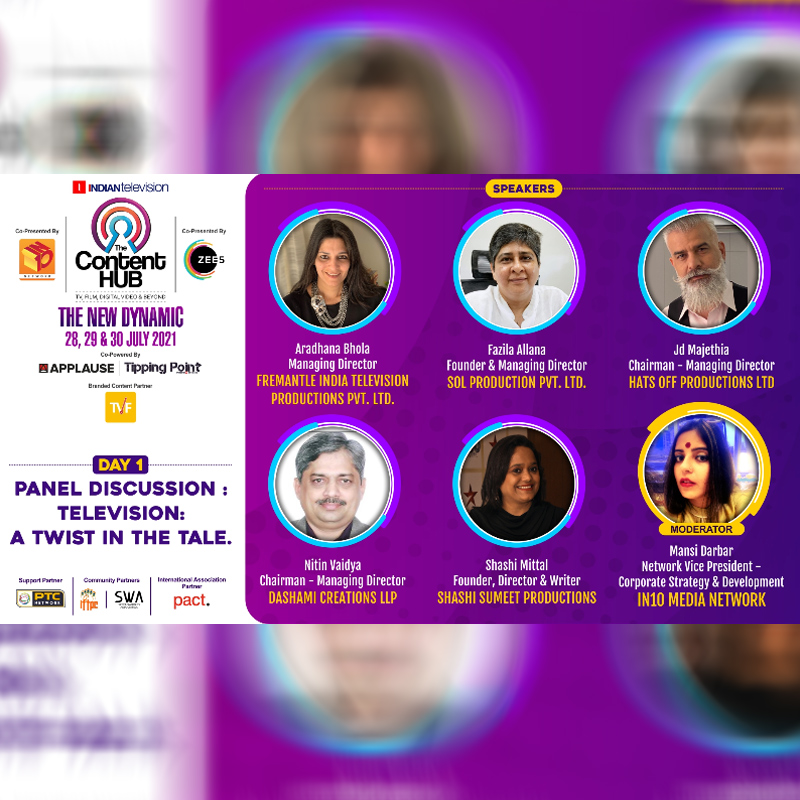
    Deliberating on the topic ‘Television – A Twist in the Tale’ were FremantleMedia, managing director – Aradhana Bhola, Sol Productions, founder and MD – Fazila Allana, Hats Off Productions, chairman and MD – JD Majethia, Dashami Creations, chairman and MD – Nitin Vaidya and Shashi Sumeet Productions, founder, director and writer – Shashi Mittal. The virtual session was moderated by IN10 Media Network, network vice president – corporate strategy and development, Mansi Darbar.

    Ever since the meteoric rise of OTT platforms, there have been apprehensions regarding the imminent cannibalisation of TV audiences. While industry watchers and experts have been debating it for long, the content creators seem confident about the two formats coexisting with each other. In fact, they are also excited about the possibilities that OTT opens up for them, especially in terms of experimenting with content and also the economics of it.

    Allaying apprehensions around the TV-OTT battle, Fazila Allana stated that even though there seems to be some differentiation of content, at present all the major OTT players are getting major traction from the catch-up TV. Likening their original programming to ‘exotic weekend dinners’, she added, “Most viewers log on to OTT platforms for staples or ‘daal chawal’ i.e. daily soaps. So, even if TV were to become obsolete as a medium of distribution, the content will not change drastically.”

    Agreeing with Fazila, Sol Production’s Aradhana Bhola remarked, “Given the socio- economic and cultural diversity in India, we have so many different consumption patterns that as content creators we are happy to be having a new platform for telling more and different stories. While some stories are better suited for a two or three-hour movie format, others are fit for a short series or a daily soap, but whatever the delivery mechanism, it is content, and ‘great content’ that matters.”

    Dashami Creations’ Nitin Vaidya concurred on the fact that audience choice is determined by economic conditions, and cultural and social values, but unlike Bhola, he cites them as factors that limit the scope of OTT in India. That being said he does agree that, “OTT has brought along with it disruptive subjects, narratives and scale, and this is where the challenge for TV lies. If the television industry doesn’t innovate and keeps on offering the same regressive content, it will lose its audience to other platforms.”

    JD Majethia believes that the familiarity and affordability of television gives it an edge over other mediums, yet “creative content will decide what survives in the long run”. Citing his ongoing show ‘Wagle ki Duniya’ as an example, he said, “We coined the term TWEB Series for it, because it is a particularly challenging format where each episode is a different story.”

    Talking of innovation, while TV programming has often been accused of being regressive and recycling the same content, Majethia contented that “stories and plot have broadly remained unchanged; it’s the storytelling which makes all the difference. The problem is that people think of TV as a perishable commodity. If the content is enjoyable, it’s relevant. We must also not forget the fact that TV is still a growing medium in India. So, when it comes to recycling or adapting content, we have to consider the segment, market, time slot and several other factors to determine relevance.”

    Chiming in, Shashi Mittal said, “The Indian market offers viewers with so many different types of mindsets that there’s room for all. What’s progressive for me could be regressive for my kids. It is these perceptions that we are in effect catering to.” “Ultimately, through every story told, we are addressing emotions and aspirations,” added Fazila Allana.

    Discussing the scope that television offers for creativity and experimentation, the panellists agreed that although the intention to innovate is ubiquitous among broadcasters and producers, ‘Thursday Ratings’ run the show. “…audience evolution is a slow process, and until they evolve, you have to give them what they want,” Allana explained. However, not all is gloomy. Despite the constraints there’s still enough headroom for innovation in television, Majethia’s ‘TWEB series’ being one such example.

    While it’s true that content producers find the OTT proposition to be more attractive, is it lucrative too? Web series or daily soap? Where are the monies? The resounding answer to this question from our panelists was that it’s a ‘volume game’, and despite all the criticism notwithstanding, daily soaps are the biggest drivers of volume.

    “OTT and TV have many lessons to learn from each other. Television channels can, for instance, think about serials with a limited number of episodes. Many TV viewers who don’t opt for OTT due to economic constraints could well be interested in short series format. Such time-bound storytelling will be in the interest of all – the audience, advertisers, channels and content creators,” said Nitin Vaidya.

    JD Majethia had a slightly differing opinion in this regard. According to him, a series on a big OTT platform may be more lucrative for production houses than a daily soap on television that runs for six to eight months. “TV shows are successful only if they are long running”, he remarked adding that with Covid changing the dynamics rapidly, the uncertainty will only grow further. “If you can match the strength of your ideas with that of the platform – movies, OTT or TV – you are home,” surmised a more hopeful Aradhana Bhola.

    Centred on the theme – ‘The New Dynamic’, the three-day event will witness several such insightful sessions with industry stakeholders deliberating on how the new forces are transforming the way content is created and stories are told. It will also delve upon the impact of these changes on the business models for the world of films, TV and OTT.

    The fifth edition of Content Hub 2021 is co-presented by IN10 Media Network and ZEE5, and co-powered by Applause Entertainment and Tipping Point, the digital content unit of Viacom18 Studios. PTC Network is the supporting partner.

    For more details, visit: https://www.thecontenthub.in/

  • Content evolves, but the heart of storytelling remains the same: Boman Irani

    Content evolves, but the heart of storytelling remains the same: Boman Irani

    New Delhi: Almost two decades after making his debut in the Hindi film industry, renowned actor Boman Irani is now all set to don the writer’s cap for his first movie as writer-director. “Writing is the way to go,” says Irani emphatically, as he begins to share his vision of filmmaking on the first day of the Content Hub 2021.

    The three-day mega event being organised by Indiantelevision.com began on Wednesday, with a series of insightful sessions with producers, writers and directors, and brand representatives, who shared their thoughts on the evolving media and entertainment industry.

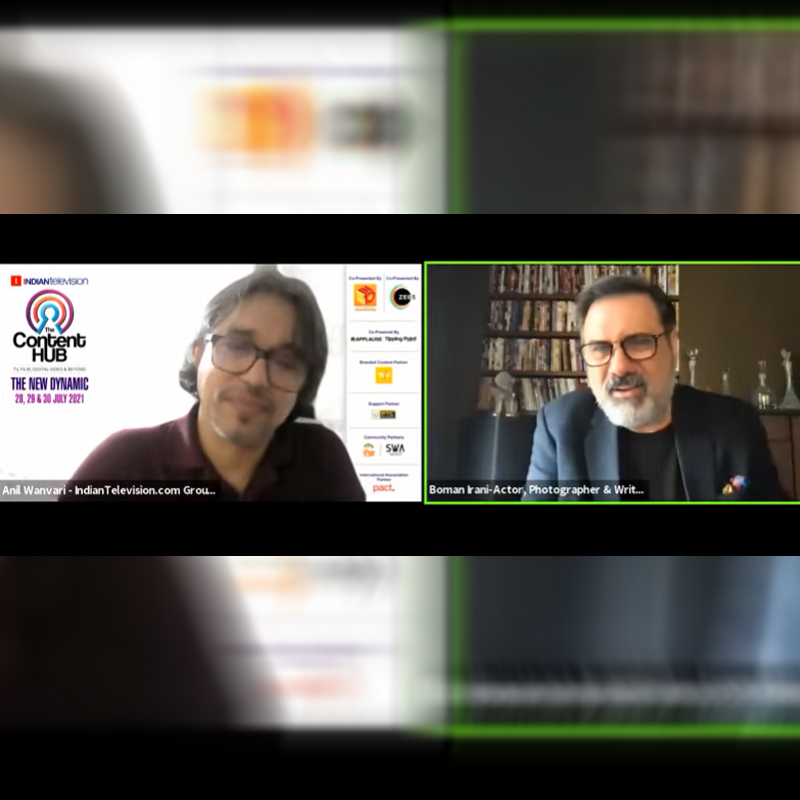
    In a fireside chat with Indiantelevision Group founder and CEO, Anil Wanvari, Irani shared his thoughts on the new-age of content, and how it has influenced the craft of film-making. “We are on the threshold of a big bang of OTT. There has been an evolution. However, the storytelling, the heart of it, kind of remains the same, with a certain amount of originality,” says the noted actor, who won the audiences’ hearts with his portrayal of Viru Sahastrbuddhe in 3 Idiots.

    According to Irani, the content may evolve, but it will continue to be created by the same age-old principles of writing. “It will always boil down to good writing,” he smiles.

    Irani forayed into films in 2003 after spending years doing theatre – from where he drew most of his knowledge as an actor. Unlike movies, where actors are mostly focussed on their scenes, a theatre teaches one to look at the entire visual piece. “You can only make an impact as an actor, if you know the piece that you are working on. What is it saying? If you don’t empathise with the entire piece, then by the time your scene comes, you realise nobody is really paying attention. That’s what theatre does. It teaches you to be there for all the scenes,” he adds.

    After delivering some of the finest performances in movies like Munnabhai MBBS, 3 Idiots, Main Hoon Na, the noted actor is now also devoting a lot of his time to honing his skills as a writer, and helping other budding writers. He is also gearing up to debut as a writer-director with his first script that has been in the making for the last eight years.

    “It looked beautiful in the first 24 hours, but then I realised something was missing. I had met a playwright in New York, who made me realise that I had got a whole bunch of lovely scenes together, but needed a structure. I needed to weave all those scenes together in the form of a necklace and present it to the audience. I made him my guru,” shares Irani. The playwright he was referring to was Alexander Dinelaris, one of the four screenwriters who won the Academy Award for Best Original Screenplay for the 2014 film Birdman.

    The lockdown provided an opportunity to share his learnings gained over the years, with budding writers through virtual sessions, and that led to his special initiative- Spiral Bound. A series of virtual webinars and workshops, where he engages with budding writers and together, they dissect scenes and movies to understand the art of writing a perfect script.

    The initiative that started with four members is now running into its second year, and the team of 400-500 has already completed as many as 375 sessions. Apart from budding writers, there are cinematographers, and production designers who have also expressed keen interest and joined the sessions.

    According to Irani, it takes a robust technique to be a good writer. “It has taken me eight years to understand the power of technique and science. We write with the heart. But everybody has a heart, and a mind, and many people can come up with concepts. But how can you take that concept to a producer and narrate it for two hours. That requires technique. It frees you to think better,” he shares.

    The new age of content has already made content creators realise the tremendous need to evolve. But that transformation hinges on the most crucial element – a well-written script!

    “Now, the scripts will have to be written with a certain amount of momentum, and the entire onus is on the writer. So, if you really want to create content, you need to have writers who have technique in their DNA, who are writing from their heart. Writing is the way to go!” the actor signs off.

    The Content Hub 2021 is co-presented by IN10 Media Network and ZEE5, and co-powered by Applause Entertainment and Tipping Point, the digital content unit of Viacom18 Studios. PTC Network is the supporting partner.

    Centred on the theme – ‘The New Dynamic’, the three-day event will witness insightful sessions with industry stakeholders deliberating on how the new forces are transforming the way content is created and stories are told. It will also delve upon the impact of these changes on the business models for the world of films, TV and OTT.

    For more details, visit: https://www.thecontenthub.in/