Tag: The Washington Post

  • ElevenLabs secures $180 million to make AI voices the gold standard of digital speech

    ElevenLabs secures $180 million to make AI voices the gold standard of digital speech

    MUMBAI: The future of digital interaction just got a whole lot smoother—and way less robotic! AI audio pioneer ElevenLabs has secured a blockbuster $180 million in Series C funding, proving once again that the future of communication isn’t just about typing but talking.

    Co-founded in 2022 by childhood friends Piotr Dąbkowski and Mati Staniszewski, this Poland-born startup is on a mission to make AI voices sound less like a dull GPS and more like your most charismatic friend spilling the latest gossip. With its tech already powering AI assistants, media giants, and even voice actors, ElevenLabs is set to redefine how the world hears AI.

    The funding round was co-led by a16z and Iconiq Growth, with fresh backing from NEA, World Innovation Lab (WiL), Valor, Endeavor Catalyst Fund, and Lunate. ElevenLabs’ existing heavy-hitter investors—Sequoia Capital, Salesforce Ventures, and Smash Capital—doubled down on their bets. Oh, and let’s not forget the industry giants joining the party, including Deutsche Telekom, LG Technology Ventures, HubSpot Ventures, and NTT DOCOMO Ventures. The latest round sends ElevenLabs’ valuation skyrocketing to $3.3 billion—triple what it was a year ago. Not bad for a company that launched just two years ago!

    ElevenLabs has come a long way since debuting in January 2023. The company has spent the past two years refining its AI models, releasing game-changing products, and making digital speech more expressive and lifelike. And the results? Users have already generated over 1,000 years’ worth of AI-generated audio—a number that speaks volumes (literally).

    Among its biggest innovations:

    . Conversational AI: No more robotic call centres—this tool powers real-time, natural speech for AI agents.

    .  Voice design: Need a custom AI voice? Generate one from text descriptions.

    .  Sound effects model: AI-generated sound effects bring immersive audio storytelling to the next level.

    .  ElevenReader app: Turns ebooks, PDFs, and articles into listenable content on-the-go.

    .  Flash model: The speed demon of AI voice tech, boasting an ultra-fast 75ms latency.

    .  Voice library payouts: A marketplace where voice actors and users have already earned $2M for their AI-generated voices.

    .  Dubbing studio: Supports 32 languages, making global content sound local while preserving original voices.

    Who’s using ElevenLabs? Pretty much everyone. From big-name tech firms to media giants, ElevenLabs is the industry’s AI voice darling. Its solutions are trusted by Nvidia, Perplexity, Synthesia, Espn, Aston Martin F1, The Washington Post, Chess.com, Time, and HarperCollins, to name a few. More impressively, over 60 per cent of Fortune 500 companies have employees using ElevenLabs tools. That’s some serious corporate clout.

    ElevenLabs isn’t just about high-tech innovation; it’s also changing lives. Through its ‘Impact Program’, the company has partnered with 80+ organisations to bring AI voices to individuals with speech impairments. The result? Over 1,000 people with ALS and other conditions have regained their voices. And in the cultural space, ElevenLabs has helped bring AI-generated plays to life at Centre Pompidou in Paris.

    The company is also going global—literally. ElevenLabs has expanded into Poland and India, setting up an R&D hub in Warsaw and investing in Indic language development. Expect an even stronger focus on regional accents, dialects, and personalised AI speech in the near future.

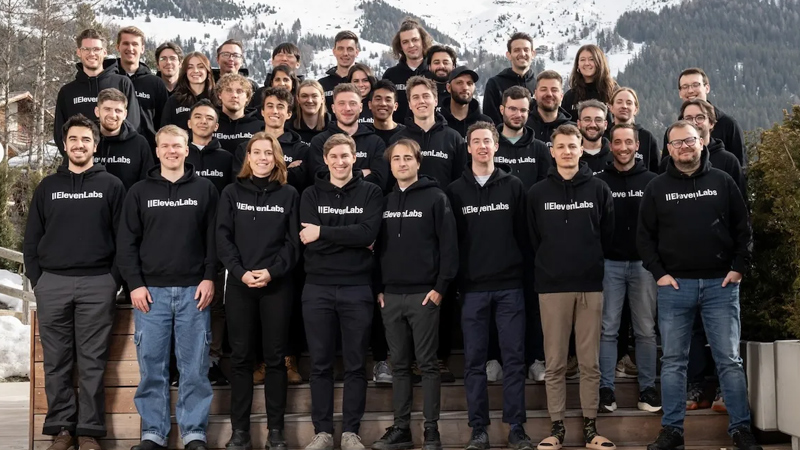
    The company isn’t stopping at just making AI voices sound human—it wants to fundamentally redefine digital speech. CTO Dąbkowski, recently named a Time Magazine AI Top 100 Innovator, is leading research to push AI-generated audio into new frontiers. With its team growing from 30 to 120 employees and hubs in London, New York, and Warsaw, ElevenLabs is set to build the most comprehensive AI audio platform in the world.

    The fresh $180 million investment will go towards:

    .  Expanding AI research into more expressive, nuanced, and controllable voice models.

    .   Developing new tools for businesses, creators, and developers.

    .  Strengthening AI safety, ensuring ethical and responsible deployment of AI-generated voices.

    .  Bringing AI voice tech to mobile, making audio AI more accessible.

    .   Supporting all languages, accents, and dialects—because AI should sound like everyone, not just an English-speaking robot.

    “Speech is how we naturally communicate. This funding moves us closer to a world where digital interactions happen by voice—fluid, natural, and as effortless as a conversation,” said CEO Staniszewski.

    “Voice is becoming a key part of how we interact with technology, and ElevenLabs is making it work at scale. We’re thrilled to continue to support their work in building the next generation of AI,” said a16z general partner & head of growth fund, David George.

    “We believe ElevenLabs is redefining the way we connect with digital environments, placing voice at the very heart of these transformative interactions. We are thrilled to partner with such an innovative team and contribute to their extraordinary journey to help reshape the future of voice technology,” said Iconiq Growth general partner Seth Pierrepont.

    As AI-generated speech continues to evolve, one thing is clear: the keyboard is no longer king—the mic is taking over. Thanks to ElevenLabs, digital conversations are stepping out of the uncanny valley and into a world where AI doesn’t just talk—it converses, charms, and maybe even tells better jokes than your best friend.

  • discovery+ announces coverage of Blue Origin’s space launch

    discovery+ announces coverage of Blue Origin’s space launch

    Mumbai: discovery+ India on Friday has announced the coverage of Blue Origin founder Jeff Bezos’ first flight to space made on 20 July. 

    The show, ‘Jeff Bezos In Space: Blue Origin Takes Flight’ is anchored by The Washington Post’s Libby Casey and Discovery’s Chris Jacobs. It also features on-the-ground analysis from The Washington Post’s space industry reporter Christian Davenport and commentaries from astronaut Leland Melvin, Dr Ellen Stofan – the Smithsonian’s Undersecretary for Science and Research, and a team of experts from the Smithsonian Air & Space Museum.

    ‘Jeff Bezos in Space: Blue Origin Takes Flight’ highlights the morning’s event, along with interviews from after the launch, behind-the-scenes material and background stories of Blue Origins and Jeff Bezos. 

    “We are delighted to be joining forces with The Washington Post to once again cover the next major chapter in space advancement,” said Science channel, executive vice president of multiplatform programming, factual & head of content, Scott Lewers. “With no on-site public viewing areas in the vicinity of the launch site, this premiere continues discovery+ mission to bring the world to our viewers.”

    “The Washington Post has made a distinct investment in live coverage of major news events, drawing in tens of millions of viewers to its programs featuring the latest developments alongside real-time analysis and commentary from our top journalists,” added The Washington Post’s director of editorial video, Micah Gelman. “After the success of our joint coverage of SpaceX’s first crewed mission last summer, we are thrilled to be partnering with Discovery and Science Channels once again to bring this historic launch to the eyes of Americans nationwide as the appetite for space tourism intensifies.”

  • Five news organizations and US government settle privacy suit

    MUMBAI: Can a journalist be forced to reveal his sources? A journalist holds the right to refuse to reveal his source, but in this connection he should be willing to face a trail. A court battle, which featured news organisations and the US government, and its climax have proved that protecting the source can be a costly affair.

    Five news organisations namely ABC News, The Associated Press, The Los Angeles Times, The New York Times and The Washington Post has agreed to join forces with the US government towards the settlement on invasion of privacy with the former scientist at Los Alamos National Laboratory, Wen Ho Lee who was falsely accused of being a Chinese spy.

    The US government is paying $1,645,000 and the five news organizations are paying $750,000 to avoid contempt sanctions against their reporters, who refused to disclose the sources of their stories about the espionage investigation. 

    The reporters of the five media organisations were not named in the suit as defendants, but had been held in contempt by the court for refusing to testify and had been ordered to pay fines of $500 per day for refusing to name their sources.

    Lee brought his case against the government and the five news media organisation in 1999,when the federal investigators accused him of giving nuclear secrets to China. He spent nine months in solitary confinement awaiting trial.

    Lee contended that the government had violated privacy laws by telling reporters about his employment history, finances, travels and polygraph tests.