Tag: The Q

  • The Q partners with Mzaalo to target young audience

    The Q partners with Mzaalo to target young audience

    Mumbai: QYOU Media has announced that Hindi language channel The Q will become available on Mzaalo, a blockchain-based online video streaming app.

    The Q will offer Mzaalo users an array of content targeting young Indian audiences who can earn rewards based upon viewership that can be spent on merchandise, digital goods, games, and charitable giving, said the statement.

    “Mzaalo, in tandem with their underlying technology from Xfinite, has created a best-in-class next-gen platform that could not be more perfectly matched to the content and target audience for The Q,” said QYOU Media chief executive officer Curt Marvis. “We know that our digital and social media content creators design programming for young India that often relies on finding distribution platforms that leverage the technology that will drive content consumption in the future. Mzaalo and Xfinite provide exactly that kind of platform and we are thrilled to become a partner to develop and distribute innovative influencer and brand experiences on the blockchain for their communities and ecosystem.”

    The Q channel is available in over 122 million TV households and to over 676 million users via OTT, mobile, and app-based platforms in India. Mzaalo has over 25 content partners offering 12,000 films, which includes Bollywood films and regional cinema, original shows, music videos and more.

    “We are committed to providing Mzaalo users the most exciting and engaging content,” said Mzaalo chief operating officer Vikram Tanna. “Our content gamification engine coupled with 600+ rewards partners and celebrity experiences enable us to deliver real value for our users. The Q is establishing a new type of brand with interactive and fun content that engages the new generation of social viewers.   This collaboration brings together the best of content, interactivity, and gamification, and is perfectly suited for both.”

  • How short video apps took media brands to masses in 2021

    How short video apps took media brands to masses in 2021

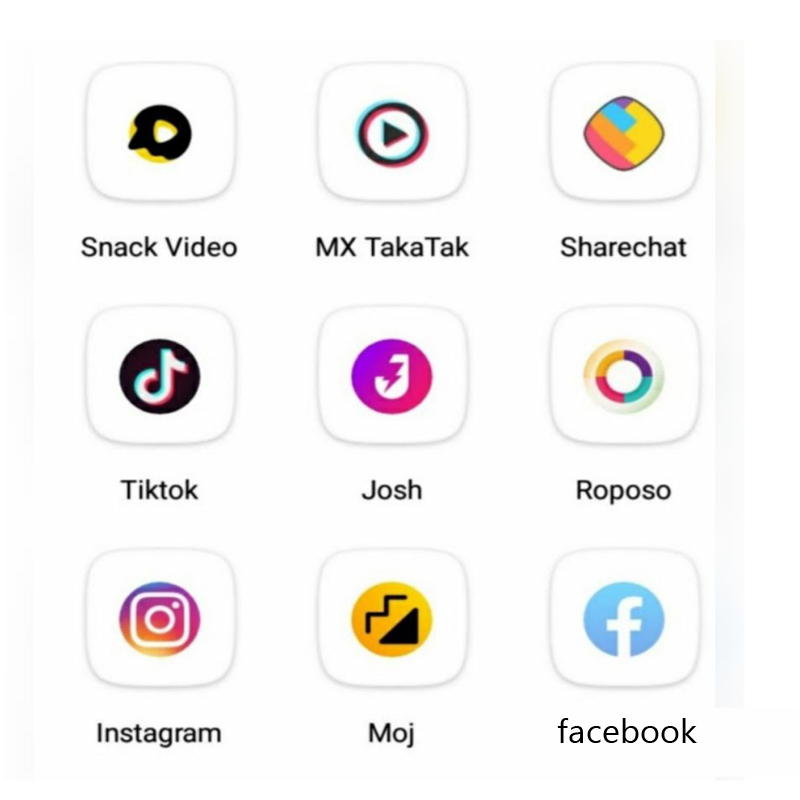
    Mumbai: “It came, it saw, it conquered…” the statement perfectly describes the meteoric rise of ByteDance-owned short video app TikTok in India. Such was the momentum created by it that by December 2020 – that just six months after TikTok was banned – the market was flooded by its Indian counterparts with Dailyhunt’s Josh leading the pack. Roposo, MXTakaTak, Chingari, Moj and others followed. 

    According to consulting firm RedSeer by April-June this year, the short-form video user base at 40-45 million creators hailing mostly from smaller towns and cities, was back to nearly 100 per cent of pre-TikTok ban, with strong loyalty to Indian apps. Monthly average users were up 1.2 times, while time spent on the apps was about 0.4 times higher.

    2021 was the time for short video app owners to tap into the goldmines that they were now sitting on. For players in the ecosystem partnerships and monetisation emerged as the key theme for the year, as all kinds of media brands like TV channels, OTT platforms and music labels latched on to the opportunity. Short-video apps were their window to ‘Bharat’.

    “Short video and entertainment platforms have seen one of the highest increases in monthly active users (MAUs) and the engagement time spent during the second wave of Covid-19. The changes in people’s emotions, platforms and emerging trends led to this growth. 

    With content offerings in 14 Indian languages, Josh boasts of 124 million Monthly Active Users (MAUs) and 60 million Daily Active Users (DAUs) coming from across 19000 pin codes in the country.

    Commenting on how the country’s dynamic digital landscape driven by ‘Bharat’ has affected partnerships and collaborations for him, Josh head of creator and content ecosystem Sunder Venketraman, says, “Tier-2 and tier-3 cities have widely been considered a niche market in terms of content, despite holding a majority of the country’s actual population. While initially it was the telcos, FMCG and handset manufacturers that targeted these markets, there has been growing interest from every major category from auto, retail, e-commerce, OTT and financial services.”

    With regard to media brands in particular, he adds, “At Josh we operate at the intersection of video and vernacular which presents a unique opportunity for media brands to reach out to a vast majority of the country’s audiences, given the growing popularity of vernacular content.”

    To promote season 15 of the popular show ‘Bigg Boss’ Josh collaborated with Voot in producing a rap song and a hashtag #BIGGBOSSS15ASLIFAN, resulting in 250 million + video views, 10,000 + UGC videos and 17 million + likes. Zee Bangla’s ‘Uma’ was promoted with a challenge around the show’s main theme Cricket. Female users on Josh were asked to balance a ball on the Cricket bat for 10 seconds. The collaboration resulted in over eight million + views, 140 + UGC videos and 630,000 + likes.

    The app also collaborated with Shemaroo, SVF Entertainment (Bengali film, television and OTT content production house), Pitaara TV (Punjabi movies channel, and recently launched OTT platform Chaupal), ALTBalaji (‘Cartel’), and ten leading music labels including Saregama. “This is revealing of how short-video apps are now a viable route for music labels to reach new audiences, and how new and upcoming artists can use platforms such as ours to reach out to niche audiences organically,” notes Venketraman.

    ALTBalaji’s senior vice-president – marketing and revenue Divya Dixit believes that such collaborations open up multiple gateways to reach out to the youth and the masses with the right message. “Short video and entertainment platforms saw one of the highest increases in MAUs, and ‘time spent’ during the second wave of Covid-19. Their tremendous growth in terms of number of content creators, brands, as well as ads on these apps, was led by changes in people’s emotions, choice of media platforms and other emerging trends,” she observes.

    A large part of ALTBalaji’s organic reach comes from short-video apps. The platform has carried out various promotional activities with the likes of Josh (‘Cartel’ and ‘Girgit’), ‘Chingari, Roposo, Moj (‘Pavitra Rishta) and Firework.

    Sharing the impact of these campaigns, Dixit states, “Our collaboration with MOJ for ‘Pavitra Rishta’ and Josh for shows like ‘Cartel’ and ‘Girgit’ helped in generating eyeballs for various show assets like songs, trailers, and dialogues that were amplified by the creators on their respective platforms via UGC push. It gave us reach in the hinterland markets, thus indirectly impacting the engagement numbers.”

    The Q COO Krishna Menon notes that while the pandemic made entertainment a bit of a challenge for most broadcasting houses and digital production houses as well, short video apps proved to be a boon for creators. “These creators are mostly the GenZ/millennials. Not only have they taken engagement on the platform higher, but are today setting day-to-day trends for people. Because The Q’s basic DNA is to work with the best of digital creators, short video platforms become like a strategic alliance for us as a source of content.”

    A recent example was the channel’s partnership with Chingari wherein it carried out digital auditions for its recently launched show ‘Jurm Ka Chehra’. Close to a million entries were received through the collaboration.  The Q runs multiple VOD platforms on Snap where the best of linear programming is cut into VOD episodes and made available for viewing. Some of the prominent platforms include ‘Daraawni Kahaaniyaan’ which has grown from few thousands to one million subscribers in the last year itself, ‘Khaao Gali’ and ‘Comedy Centre’.

    Elaborating on the significance of short video format for the Q, Menon shares, “Most broadcasting houses have their own digital storefronts. We haven’t created one for us because we want to go with those in the market. They are an additional source of revenue for us, and of entertainment for people.”

    Chingari started its collaboration journey with promoting all OTT content and moved on to launching exclusive trailers on the app, promoting web series/ music albums to now launching its own IPs.

    The app’s co-founder & COO, Deepak Salvi says, “We saw a huge surge in the time spent and engagement by users on the app during the pandemic and this is exactly what is needed by brands to promote themselves and their content. Knowing that a large population of the audience that belongs to their TG is spending time on Chingari, media companies like TV channels, OTT platforms, music labels and even production houses started associating with us for the promotion of their latest content.”

    Some of Chingari’s latest brand associations include Shemaroo Entertainment Ltd, Alt Balaji, Hoichoi, and Radio City.

    Due to the growing accessibility and affordability of the internet and the digital boost experienced in 2020-21, people in the tier 2 and 3 towns are now not only consuming content but are also very actively creating it. Salvi shares, “One of the main focus points for Chingari therefore is to create a very strong network of creators and consumers in the tier 2 and 3 cities. We are trying to reach out to the remotest areas of India by conducting events, partnering with regional content creators, OTT platforms, and music labels.”
  • OACT 2021: Bringing the digital ecosystem to linear TV

    OACT 2021: Bringing the digital ecosystem to linear TV

    Mumbai: “We see linear TV more like virtual linear TV because it is so easy to plug and play and join the digital ecosystem,” said The Q India, chief executive officer Simran Hoon at the OTT Advertising and Connected TV Summit 2021’ organised virtually this year. “Today, delivery is not important, remarks Hoon, everything is platform agnostic.”

    Technologies like free ad-supported streaming television (FAST) have become ubiquitous in the North American market with players like Pluto, Roku, and Samsung+ seeing their revenues double year on year. The FAST industry revenues grew from $2.1 billion to $4.2 billion in a year and the trend is happening in India as well where connected TV users are at 5-7 million growing fast to touch 40 million in 2025, according to a report by E&Y.

    Hoon is a media professional with 27 years of experience in ad sales with some of the biggest TV networks including Sony, Star, Zee, and Viacom18. She joined most of these media companies when they were at the launch phase and has worked across functions in the broadcast media industry. Now, she is leading the Hindi general entertainment channel The Q in India.

    Speaking at the two-day event organised by Indiantelevision.com, and co-powered by mediasmart, an Affle company and summit partner – The Q, Hoon shared her views on ‘Driving new synergies between linear TV and digital ecosystem.

    The Q India is pioneering unique TV initiatives by driving synergies with the digital ecosystem. The channel recently announced a syndication deal with the OTT platform MX Player to bring their popular web series “Aashram” to TV viewers. The channel had earlier partnered with short video platform Chingari to hold the auditions for its crime series “Crime Aur Kanoon”.

    Bringing “Aashram” to TV required the broadcaster to convert nine one-hour episodes into 18-episode length series after editing the content to make it more appropriate for TV audiences, said Hoon. The channel is also in talks to bring another OTT series to TV in November and “Aashram 2” in December.

    Its main proposition has been to bring the best of digital content to TV. According to Hoon, there is a vast young free audience on TV that has been migrating to digital because they are not being served on TV. The soap opera fare that is broadcast by traditional free-to-air channels is not catching the fancy of these audiences where the mean age is 28 years old. The Q India brought youth media creators, starting from content creators and influencers on YouTube, and amplified their reach by bringing their content to the TV.

    “A YouTube creator with 10-12 million audience reach, can be exposed to a whole new audience on TV. That’s the biggest kick for influencers and the value proposition of The Q,” noted Hoon.

    Last year, the channel was rated by the Broadcast Audience Research Council (BARC) India and crossed the 45 GRP mark over a span of 19 weeks.

    “The Q reaches to Tier II, III young family audiences that are watching the channel’s content across platforms, whether it be connected TV, OTT, or linear TV,” said Hoon. “We are available in 100 million homes, but there are still 210 million TV households to go. 70 million households are yet to buy a TV. Even though India is a smartphone market, today there are smart TVs that are selling cheaper than smartphones. We want to be omnipresent because we believe great content pulls viewers and hence advertisers, creating a virtuous cycle.”

    The channel is available on DTH providers like Tata Sky and D2H and also on the big Cable operators such as GTPL Hathway. It has partnered with connected TV manufacturers such as Samsung TV+ and Mi India. According to Hoon, the channel is available on 700 personal machines.

    The Q India is a part of the North American media company QYOU Media that was co-founded by Curt Marvis and Sunder Aaron. The company has also roped in TV veteran Andy Kaplan to be chairman of The Q India. It has three big verticals – its broadcast channel, an influencer marketing company Chtrbox, and its distribution arm.

    “Chtrbox is one of the largest influencer marketing companies in India with 3.50 lakh influencers in its network. We have started doing integrated sales, where brands also look at influencers and their YouTube channels when buying advertising on The Q India TV channel. Chtrbox uses AI to match the brand and the influencer depending on the region or target audience the brand is looking at,” explained Hoon.

    This is much harder to do than it seems, from a technology perspective, maintained Hoon. The channel is still experimenting with this approach and expects to see giant strides being made in this space in the next six to nine months. “Today, it is so easy to be digitally connected to your TV. The opportunity to be more targeted and programmatic on virtual TV will drive more advertising dollars compared to linear TV,” said Hoon.

  • OACT2021: What are the opportunities for OTT & CTV advertising

    OACT2021: What are the opportunities for OTT & CTV advertising

    Mumbai: Is it the right time for monetisation of OTT from a business perspective for advertisers?

    This set the ball rolling for the panel discussion on – ‘The opportunities for OTT and CTV Advertising’ on the first day of the OTT Advertising and Connected TV Summit being organised by Indiantelevision.com. The two-day event is co-powered by mediasmart, an Affle company and summit partner – The Q. 

    The panel was led by Patanjali Ayurved COO-media and communications Anita Nayyar, Airtel VP-media Archana Aggarwal, Pyxis One CEO- APAC Neel Pandya, Samsung Ads India & South East Asia – senior director Prabhvir Sahmey and moderated by EY partner and national leader – advisory markets Monesh Dange. 

    Responding to the question, Nayyar highlighted that the time is perfect for monetisation for OTT platforms, as the content has never been more important than now in the pre-, post-, and during the Covid-19 time. “For advertisers, ROI is very important. The clichéd conversion will always stay as it is. But as of now, the industry is at an evolving stage that is clearly a top of funnel scenario with reach, awareness, engagement -all that’s happening. But whether we can attribute that directly to a bottom-funnel is not very clear at this point of time,” she added.

    On whether the digital boom in content was bound to happen or it happened due to the time available on hand due to the Covid-19 era, Airtel’s Archana Aggarwal noted that the start of the revolution was with the crash in data prices and affordability of smartphones and people using a lot of mobile internet. “Obviously, Covid accelerated it due to the dearth of new content on linear Television and no new movies being released in theatres, etc. But it was a matter of time that people would start consuming a lot of content on OTT,” she said.

    Talking about how majority of the premium content available on OTTs is behind the paywall, Aggarwal said, “What is it that the OTTs want to monetise- Do they want to monetise through advertisements or through subscription? That is something which OTT players need to think through – how to find the right balance between the two.”

    Neel Pandya of Pyxis One added another insight on the OTT boom by commenting that it takes just twenty-one days for a person to build a habit and they were talking about 1.5 years of watching digital content. “So it’s a very strong habit which consumers have built and it’s not going to go easily,” said Pandya. “Obviously it’s not an artificial boom completely, but it has gone 5X from what the acceleration would have been in normal circumstances.” 

    From Samsung Ads’ perspective, Prabhvir Sahmey said, “We are relatively a new business and also a unique proposition where we are bringing the advertising opportunity directly on the device itself, it’s not running on the back of a content.”

    He added, “It’s still at a very nascent stage, in fact we are in a testing category. We will try to plug the gap in measurability, and develop a multi-device solution for advertisers.”

    Taking the discussion further, Pandya said it is high time that OTT as a platform starts attracting ad spends, attracting avenues. “It is growing globally really fast. The only new thing we need to attract new users is measurement. OTT needs to bring more customised solutions for brands and take some bold decisions,” he added.

    Nayyar shared insights on the current dynamics of OTT and how it is similar to what happened a couple of decades back on television from one Doordarshan to multiple TV channels when the satellite boom materialised. “So it is important for OTT players to put some skin in the game collectively as an industry with accountability and measurement if they want to scale up monetisation,” she added.

    Talking about Patanjali and its investment in OTT, Nayyar said that Patanjali is working to upgrade the brand and make it more premium by targeting the youth. “OTT is a very important medium to influence youth. The first deal we went with was Dance Plus on Disney Hotstar,” she added. 

    While Airtel has been advertising on OTT as well as connected TV for a long time now, and have been experimenting with it. “We are looking at on-target reach & duplication of audience. It’s important for us to look at what kind of audience the platforms are giving us. We have evolved from being broad-based to being more targeted, focused on a set of audiences,” shared Aggarwal.

    Transparency, when it comes to the results of the campaign, is a very critical factor, was agreed by everyone.

    Prabhvir Sahmey of Samsung Ads said the elephant in the room for every publisher is revenue ad risk and that has to be addressed. “Everybody knows there is significant overlap at the end-user behavior,” he added.

    With acceleration to OTTs, the question of whether television is going to disappear was met with a unanimous ‘No.’ The panelists agreed that TV as a screen or as a medium is not going anywhere. At the most, it may evolve to connected TVs, rather than remain as a device of one-way linear transmission.

    For more information: https://indiantelevision.com/events/oact-summit-2021/

  • OACT2021: Understanding the world of OTT and CTV Advertising

    OACT2021: Understanding the world of OTT and CTV Advertising

    Mumbai: The first session on day one of the OTT Advertising & Connected TV Summit 2021 saw Kurate Digital Consulting founder partner Uday Sodhi nudging the panel led by Madison VP-Digital products/performance Chintan Soni, ALTBalaji SVP – revenue and marketing Divya Dixit, Affle – co-founder, head- Agency Relation, chief of staff Madan Sanglikar, and MX Player and MX Takatak SVP head of revenue Viraj Jit Singh to share their understanding of the world of OTT & CTV advertising.

    The two-day event being organised by Indiantelevision.com is co-powered by mediasmart, an Affle company and summit partner – The Q. 

    As the panellists addressed the fundamental question around synergies and distinctions between OTT and CTV on the buying and selling side of the business, the overarching insight that emerged was that the imminent CTV revolution is being powered by two engines – the OTT platforms and OEMs which bring together the software or the content and advertising solutions and the hardware or the affordability and technology, respectively, along with their individual contribution to the ad inventories.

    Currently, there are about 500 million OTT users (including YouTube) in India. OTT platforms have played a crucial role in driving the content ecosystem with unique narratives. The pandemic further accelerated the rate, scale and quality of the content being delivered, as well as the mainstreaming of the medium. This has led to viewers looking for an enhanced experience of OTT offerings on smart TVs, most of which are more affordable than smartphones today.

    According to Madison’s Q2 report, smart TV shipment grew by almost 65 per cent, claiming an 80 per cent share of the total TV shipments; their massive adoption being fuelled by starting price points as low as Rs 15,000.

    Although the panel unanimously believed that both OTT and CTV will coexist in the future, some changes are inevitable. Divya Dixit observed that going forward “two parallel narratives of individualistic and inclusive viewing will emerge in the OTT space, with the growth in the latter driving certain genres of content.” In the context of evolving commerce, she stated, “As OTT platforms and OEMs grow their partnerships, they will evolve new business models, perhaps working on revenue sharing for content or on active marketing push, together.”

    Sharing his understanding of viewership trends Viraj Jit Singh of MX Player and MX TakaTak said, “The last five years have seen a huge transition in user behaviour and experiences as they moved from linear to on-demand viewing, but what we are seeing now is a shift back to TV as the screen for consumption of OTT content due to the large screen experience it offers. So platforms like us are working on tech as well as programming to ensure that we have enough to offer a CTV consumer in the near future.”

    From an advertising perspective, Singh shared that there’s significant demand for CTV, however, despite the reverse migration, he hasn’t come across any advertiser asking for separate measurement for CTV and OTT campaign impact yet. “We are still in the early days of CTV advertising and monetisation, though the expectation is that it will pick up from where mobile is today. The two platforms are different in terms of user behaviour such as time spent, length of viewing sessions, daypart and more importantly reach, with CTV targeting more than one person at any given time. Hence CTV advertising rates are higher, and also because marketers have a perception of the CTV audience being more premium than their mobile counterparts,” he said.

    According to Madison’s Chintan Soni, CTV advertising is nearly 2-2.5 times more expensive than purely mobile-based advertising, however as the pool size grows, efficiencies will be better.

    There are 20-22 million MAU on CTV, and the segment is growing faster than HD which is at 40-44 million as per Madison’s monthly report. Soni believes that by 2024 these figures will be comparable.

    Speaking in the context of advertising, and whether CTV will evolve its own ad ecosystem, he added, “Owing to its precision targeting capabilities and the immersive experience of the big screen CTV will be the ‘Next Big Unlock’. There will be a paradigm shift in the video advertising market wherein the KPIs and measurement will have to be changed. We cannot be measuring on regular metrics like CTR and VTR for CTV. A reach-frequency matrix or awareness/consideration score will be more apt for this platform.”

    Affle’s Madan Sanglikar asserted that the combining of TV and mobile metrics will lead to much higher levels of measurability. Commenting on the nuances of CTV advertising and what it brings to the table, he said, “While all aspects of digital targeting are available with CTV, the next step is to interact with the user. Almost all studies done so far have indicated that people engage with more than one device at any given time, and this is to the benefit of advertisers. Even though the current ecosystem is dominated by app-first advertising, one of the ways is to re-target the ad to the mobile handset so that the user can engage with it after having viewed it on the big screen where they are less likely to click/swipe it away. This translates into the advantage of a larger approach coupled with an interactive experience.”

    For more information: https://indiantelevision.com/events/oact-summit-2021/

  • The Q to premiere MX original show ‘Aashram’ on TV

    The Q to premiere MX original show ‘Aashram’ on TV

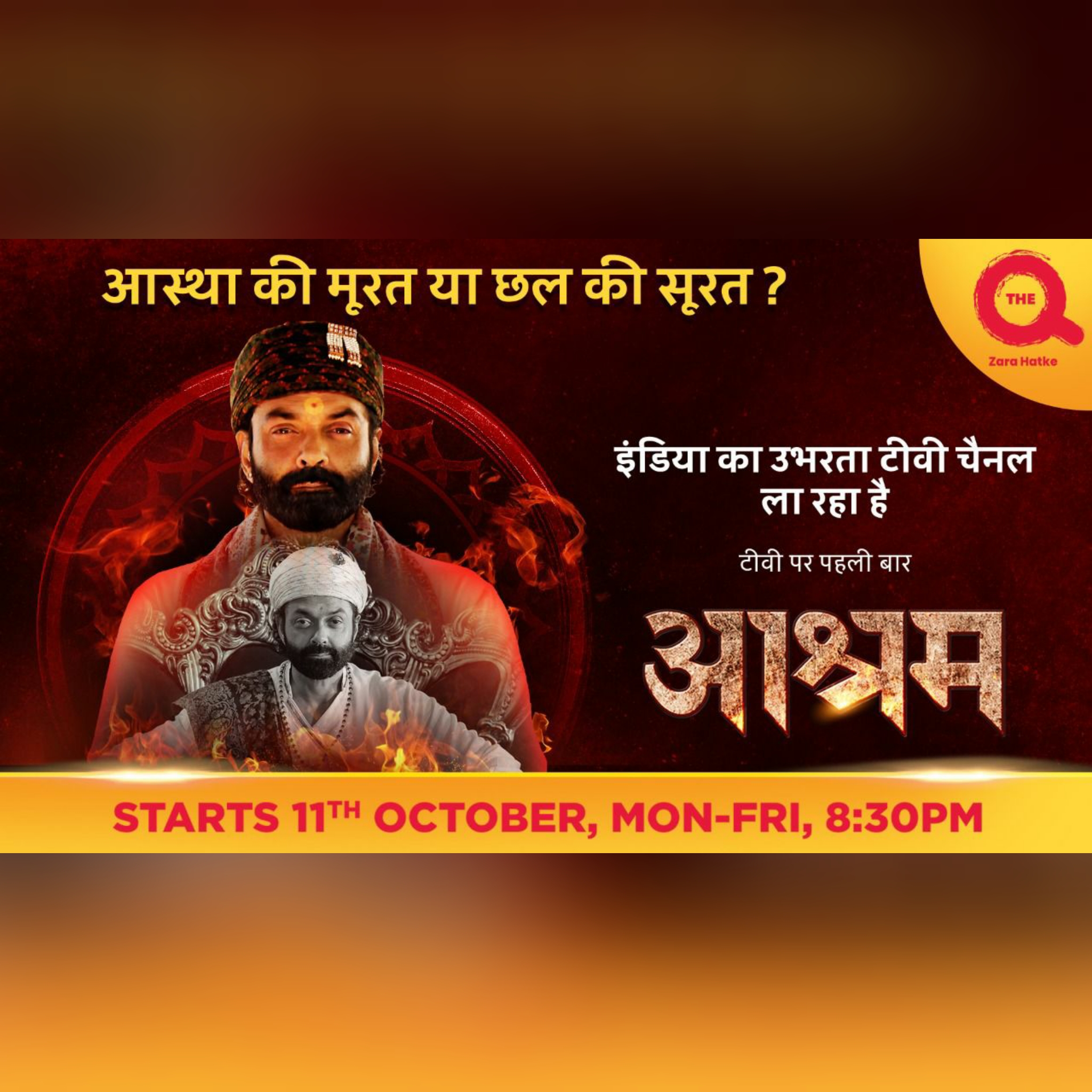
    Mumbai: The Q has partnered with MX Player to bring its critically and commercially successful original series “Aashram” to television. The first season of the show will air on 11 October at 8:30 p.m from Monday to Friday followed by the second season.

    Directed by Prakash Jha, the crime thriller features Bobby Deol, Tridha Choudhury, Aditi Sudhir Pohankar and Anupriya Goenka in the lead roles.

    “Great content does wonders irrespective of its platform. Having understood the pulse of our viewers, we at The Q continue to make efforts in bringing content that is strong, and unique with a compelling and relevant plot and storyline,” said The Q chief executive officer Simran Hoon. “Airing Aashram on TV is in sync with our strategy to bring the best from digital to TV.  We will continue to pioneer such initiatives to help strengthen The Q’s position in the industry while being the preferred entertainment destination for viewers across India.”

    Inspired by true events, “Aashram” was launched in 2020 and revolves around the story of Baba Nirala, an actual conman who ensures that his devotees or followers devote their wealth to him and stay attached to his aashram.

    “Aashram unfolds a great story and given its relevance in today’s day and age, it is sure to strike the right chord with our viewers,” said The Q programming head Tanya Shukla. “Television is a medium that brings families together and by bringing a high-end limited series on television, we aim to provide our viewers with the most engaging form of entertainment. We will continue bringing such compelling stories from the digital world for our discerning viewers.”

  • FTA market rides growth wave amid pandemic

    FTA market rides growth wave amid pandemic

    Mumbai: Riding high on the launch of new channels, the advertising volumes and values of free-to-air (FTA) has grown by 25 to 30 per cent and is estimated to have a share of 25 to 30 per cent of the Rs 30,000 crore of total TV AdEx. This growth coupled with changes in viewership post the pandemic has charted the growth story of the FTA market during the pandemic.

    Out of the 901 licensed private satellite TV channels, 574 are free to air, according to the Telecom Regulatory Authority of India (TRAI). The launch of new channels including Shemaroo MarathiBana, ShemarooTV, Dangal Kannada, Ishara TV, Sun Marathi, Filamchi, Azaad, Dhinchaak, Colors Cineplex Bollywood, Asianet Movies, Filamchi Bhojpuri have grown the advertising share of free TV.

    “The first half of the year has been really good for FTA. The viewership had been very consistent in the early stages of 2021, with the demand peaking in the period before the second wave,” said MediaCom national director Srinivas Rao.

    According to Enterr10 Media Network chief business officer Shrutish Maharaj the FTA genre has grown by 25-30 per cent both in terms of volumes and value. “Had the pandemic and some policy changes not hit the industry, the organic growth had the potential to be much better,” Maharaj added. FTA space has also seen a lot of action with multiple launches in Uttar Pradesh, Bihar, Maharashtra, West Bengal, Punjab etc.

    Earlier only the big broadcasters were able to invest in original programming. However, that has changed over recent time, with a host of original programmes creating a vibrancy on FTA channels. “This is changing because FTA channels are no longer catering only to rural markets where viewers were playing catch-up. They now have significant penetration in urban markets as well,” said Maharaj. Some channels even look at a ratio of 40:60 of original programming to acquired content to be an ideal mix. 

    Traditionally, FTA channels tend to perform well in rural markets and have been mainly supported by FMCG advertisers who may contribute up to 70 per cent of the ad volumes. The reliance on FMCG spends is also believed to have constrained the growth of the FTA channels, as the category is mature.

    Though the FMCG is still the largest spending category on FTA, the dependence of FTA on FMCG has reduced considerably with categories like services, healthcare, education, manufacturing and construction, telecom, media contributing significantly. There has been the advent of new categories and a few others have recorded phenomenal growth.

    Some of these advertisers who came onboard include Amazon, Myntra, Flipkart, BYJU’S, Google, Facebook, indicating a shift towards the FTA audience which is discerning and dependable to drive the next phase of growth for them.

    Since the core audience of FTA channels is mainly from the heartland, most broadcasters try to place their channels on DD Free Dish, the free DTH platform by Prasar Bharati. At a one-time cost of Rs 2,000, any viewer may watch up to 160 channels distributed on the platform at no recurring cost. It is estimated that there are 50 million DD Free Dish set-top-boxes in the country.

    The advantage of being available on DD Free Dish is significant. Hindi general entertainment channel (GEC) The Q grew its client list by six times after launching on the free DTH platform, according to The Q chief executive officer Simran Hoon. “The Q has also not faced any problem of discounted ad rates like other FTA players post launching on DD Free Dish,” she added.

    Depending on the market that FTA channel caters to, viewership may increase up to 50 gross rating points (GRPs) by solely being distributed on the platform.

    “This is because DD Free Dish audience accounts for 30 per cent of the Hindi-speaking market,” pointed out Shemaroo TV, chief operating officer – broadcast business, Sandeep Gupta. “A channel can definitely survive just by being on DD Free Dish and not any other individual platform. It has a significant share of the audience in the core heartland markets such as Uttar Pradesh, Uttarakhand, Madhya Pradesh, Chhattisgarh, Bihar, and Jharkhand.”

    The availability of channels on DD Free Dish also improves the performance of the channel in rural markets drastically, highlight media experts. However, the biggest issue is that the base size of DD Free Dish is low, leading to scale still being low. Hence, the advertiser interest in FTA channels available on DD Free Dish would depend on the markets the brand is targeting,” said MediaCom’s Rao.

    At the end of the third annual e-auction that concluded in February, broadcasters bid as high as Rs 16.5 crore to be on DD Free Dish and Prasar Bharati made Rs 731.34 crore from the sale of 57 MPEG-2 slots.

  • The Q’s client list has grown 6 times since its launch on DD Free Dish: CEO Simran Hoon

    The Q’s client list has grown 6 times since its launch on DD Free Dish: CEO Simran Hoon

    Mumbai: Since its launch in December 2017, growing the channel’s distribution has been a top priority for The Q. Realising the potential of small-town India for which television is still either the only or main source of entertainment, the media start-up hopped on to DD Free Dish in March-April and the numbers thereafter are a testimony to the plan’s success.

    Earlier this year, the Company issued a statement declaring that it has “reached its 2021 goal of distribution to 100 Million TV Households as a result of launching on both DD Free Dish and Dish TV in April. The Q India has gone live to 50 million additional TV homes in the month of April.”

    As regards GRPs – the vital metric used to project revenue growth – The Q recorded the highest-ever GRP of 53 in Barc Week 21 (June) in addition to an eight-week average of 46.23, indicating it’s heading into the big league of channels. Buoyed by the growth the ‘start-up’ is gradually expanding into a full-fledged network. It has also ventured into content production with the first TV original ‘Jurm Ka Chehra’ launching in September.  

    While the figures speak for themselves, Indiantelevision.com decided to decode the recent developments on the creative, business, and organisational front in a candid interaction with The Q CEO- Simran Hoon who joined the Company in April. With over two decades of experience in the industry having worked for leading brands including Viacom18, ZEEL, STAR, and SET, Hoon is responsible for driving The Q’s overall growth and vision. The marathoner and animal lover CEO charts the brand’s trajectory post coming on to DD Free Dish.

    Programming for a Changing Audience

    From VOD to DTH and now DD Free Dish, the path trodden by The Q has been quite unlike any other in the Hindi GEC space. Yet, says Hoon the “journey became more interesting April onwards, since launching on DD Free Dish.” Previously, the channel’s programming was targeted at an urban audience, but with the footprint expanding into the hinterland, the content evolved into a more massy and family-inclusive tone. “The moment we came on to DD Free Dish we had to address the big households in Tier 1 and 2 towns without antagonising the urban viewer who obviously has a lot in common with the smaller towns; the differentiation is more pronounced in the minds of the marketers.”

    The change has translated into a preponderance of shows such as ‘Yo-Yo Yogesh’ and ‘Baklol’ over the likes of ‘Tantra by Vikram Bhatt’ and ‘Living in Trends’ (LIT) in the content mix.

    Through all the experimenting with family-oriented shows and now with content production, the channel has been able to successfully uphold its brand ethos of ‘Zara Hat Ke’ and having a ‘social element’ in all its programming. While other players in the FTA space are running repeat content consisting mostly of family dramas that are over a year old, The Q has no plans of going the ‘saas-bahu way’ which according to Hoon is suited for an older audience. “Though finally family-inclusive, we have stuck to our core TG of 15 to 35-year-olds and the promise of offering them more fun, differentiated and easy kind of programming. Our content is carefully curated to suit all age groups,” she shares adding that comedy is a big genre on the channel now.

    Since its launch as an independent advertiser and influencer-marketing-supported Hindi youth entertainment channel, The Q has been redefining TV to mean ‘social’ by delivering digital programming to the medium. For the unorthodox FTA player, the description of ‘Connected TV’ entails not just a connection to the internet, but to the network of people as well. Going forward, even as the Company steps up original production, it will ensure a social connect for all its content. Sharing an example, Hoon reveals, “The casting for our upcoming crime show ‘Jurm Ka Chehra’ was done on ‘Chingari’ (the short video app). In the future, the audience will see a lot of stuff where we bring social to TV.”

    The Advertising Windfall

    Hoon shares that as a brand offering fresh (on TV) content, The Q has not faced the problem of discounted ad rates like other FTA players, and now, with the steady growth in viewership post launching on DD Free Dish, there has been an increase in advertiser onboarding, awareness and acceptance of the channel.

    From around five clients in the first quarter of CY 2021, the numbers have grown six times to include 30 advertisers in the current list. “The mainstay of the FTA channels is FMCG, but we have a lot more e-commerce, pharma, and digital payment companies coming in, even as our client list continues to grow further,” shares Hoon.

    In order to service the increasing demand, the Company hired Ashish Kotekar as head of ad sales for South & West regions in May, and Pankaj Rai for North & East in August. The channel also has plans to go regional, but for now, the focus will be on the HSM.

    Recently, The Q and Chtrbox (an influencer marketing platform acquired by The Q in June) announced the launch of an integrated marketing platform BharatBox which will deliver integrated advertising solutions across linear and digital platforms to marketers, thus maintaining the channel’s ‘social DNA’ even on the business front. “It’s a unique proposition where we will be offering to brands integrated advertising solutions that synergise the reach of social media influencers with The Q’s TV reach.  BharatBox will reach out to tier 2 and 3 towns,” Hoon elaborates.

    Future-ready

    Moving ahead from content and business, The Q has a lot of action happening on the organisational front as well. In addition to Krishna Menon’s elevation as the COO in May, and the new hires for ad sales, the Company appointed Sujata Samant as head of marketing this month. It is pertinent to note here that The Q has not launched any extensive marketing campaigns till now. Further, a distribution consultant and HR head were brought on board recently.

    Hoon credits Tanya Shukla, the programming head, for bringing the brand to where it stands today in that context. Shukla has been in the role for a year now. Giving an understanding of the Company’s overall vision, Hoon remarks, “We are in the process of maturing from a small operating company, a start-up that we still are, to a full-fledged organisation. More people are starting off in different roles and departments even as we speak right now. The recognition that The Q has got has been a little overwhelming for us, but with the right elements in place, we are ready to be seen as a ‘network for the future.”

  • The Q set to bring new show ‘Jurm Ka Chehra’

    The Q set to bring new show ‘Jurm Ka Chehra’

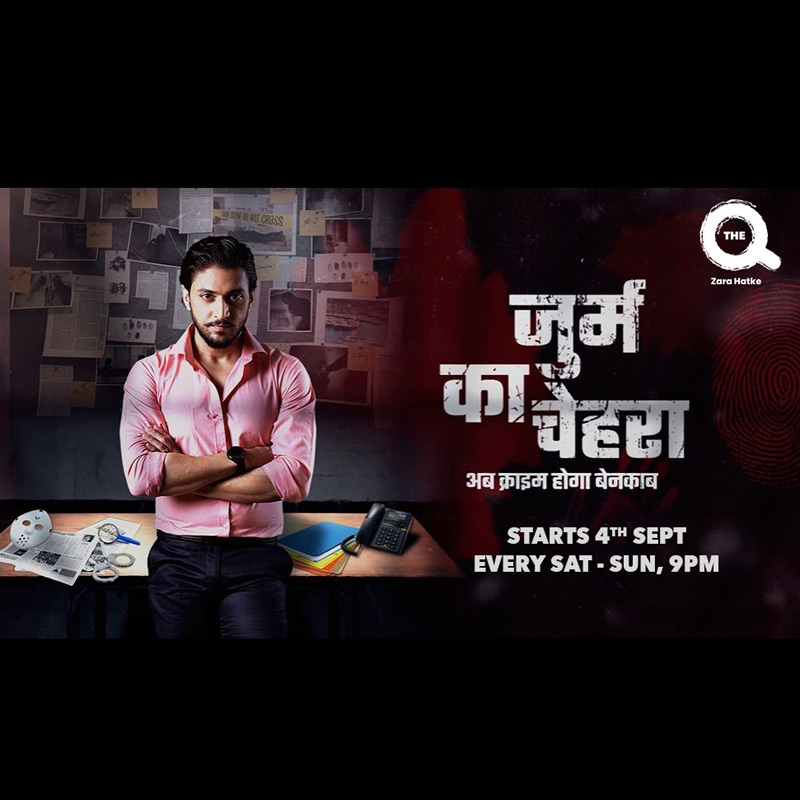
    Mumbai: Hindi general entertainment channel, The Q has announced the launch of its first crime fiction show “Jurm Ka Chehra”. The show will premiere on 4 September at 9 p.m and will subsequently air on weekends at the same time.

    The channel held a virtual audition for the show on the short video platform Chingari. Chingari users were asked to send in their auditions to The Q in the form of showreels and monologues directly on the platform. The auditions were held over 20 days with an age no bar approach. “Over 47,000 users participated for a role in the show garnering over a billion impressions,” the channel said in a statement.

    The show will be hosted by Kinshuk Vaidya and will feature Chingari users ‘The Girish’ from Nanded, ‘Rubulrox’ from Assam, ‘Pornima Garg’ from Lucknow, and ‘Rajesh Singhal’ from Rajasthan.

    “The Q has constantly leveraged the strength and reach of the digital ecosystem to keep audiences entertained and engaged at all times irrespective of platform. We have always ensured, we have a Zara Hatke approach to everything we do,” said The Q, chief operating officer, Krishna Menon. “The digital space is evolving and it is home to very talented creators who are truly deserving. We have constantly explored new means of engaging with this ecosystem and have brought stories to The Q that are unique, and compelling. Our association with Chingari is in line with our vision and we are excited about the response we have received on this direct outreach.”

    “You never know where the next big creator will be spotted. He or she just needs to be identified. Collaborations are always a refreshing manner to bring out talent from diverse walks of life, irrespective of the platform. We are proud of our association with The Q and feel privileged to offer such opportunities to our creators that can do justice to their talent and help them become rightfully famous. We look forward to creating many such refreshing properties for our creators,” said Chingari, co-founder and chief operating officer, Deepak Salvi.

    “Jurm Ka Chehra” will create awareness about modern age crimes in society ranging from common day-to-day identifiable situations to more complex situations such as cybercrimes, and online frauds, said the channel.

  • The Q appoints Sujata Samant as head of marketing

    The Q appoints Sujata Samant as head of marketing

    Mumbai: Homegrown Hindi GEC, The Q has strengthened its leadership team with the appointment of Sujata Samant as head of marketing. Samant joins the channel with immediate effect and she will report to the chief operating officer, Krishna Menon.

    In her role at The Q, Samant will be responsible for driving the channel’s marketing and communications strategies spanning strategic partnerships, branding, marketing campaigns, and corporate communications, the channel said in a statement on Monday.

    Welcoming Samant on board, Krishna Menon said, “Sujata has had a fantastic track record and I am confident that her experience in building entertainment brands with a constant rigor for innovation will lead our business to further heights and set new benchmarks in the Hindi television space.”

    A content marketing and brand champion, Samantcome with 14 years of industry experience. She has been instrumental in building media and entertainment brands such as ZEE TV,  ZEE Cinema, and Movies Now. Prior to joining The Q, Samant was associated with ZEE TV.

    “Owing to its differentiated content offering, The Q has already witnessed incredible growth within a short span of time. Although a young channel, The Q currently enjoys a strong position in its category unlike any other,” said Samant on her appointment.