Tag: The Indian Express

  • Ritesh Gupta takes charge of ad sales at OLX India

    Ritesh Gupta takes charge of ad sales at OLX India

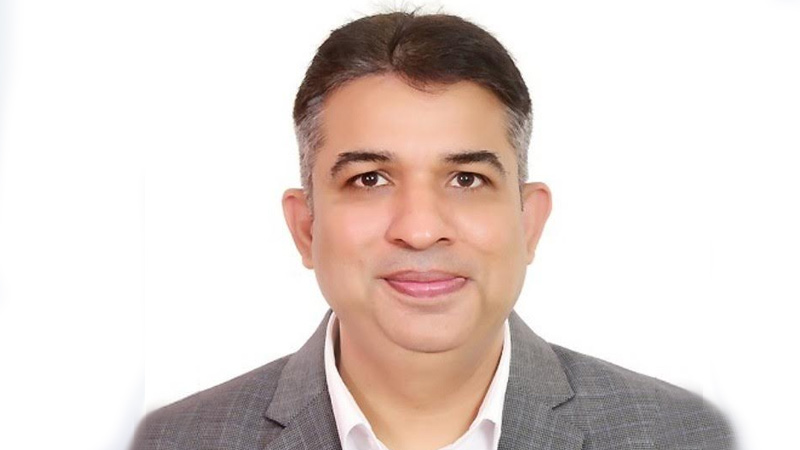
    MUMBAI: After nearly two decades of steering digital revenue growth across India’s top media and auto-tech brands, Ritesh Gupta has taken on a new challenge as head of ad sales (direct) and partnerships at OLX India.

    At CarDekho, where he spent over seven years, Gupta was instrumental in scaling the new auto business to contribute over 20 per cent of company revenue. He also built strong alliances with top automotive brands such as Toyota, Hero, Hyundai, TVS, Honda Cars, and Ather, while spearheading digital innovations like AI voice bots, AR/VR tools, and chatbots to enhance engagement.

    His diverse career spans leadership roles at The Indian Express, ABP Group, Connecting Dots Asia, Hindustan Times, Nielsen Digital, Business Standard, and The Times of India, where he honed his expertise in digital transformation, strategic partnerships, and sales excellence.

    In his new role at OLX India, Gupta will focus on strengthening the company’s advertising ecosystem through direct brand collaborations, strategic alliances, and innovative monetisation models.

    With his rich cross-industry experience and a flair for innovation, Gupta’s appointment marks a strong step forward in OLX India’s mission to accelerate growth in the evolving ad and partnerships landscape.


  • Sanmarg CMD Vivek Gupta assumes INS presidency for 2025–26

    Sanmarg CMD Vivek Gupta assumes INS presidency for 2025–26

    MUMBAI: Vivek Gupta has turned the page, and this time, it’s for the entire Indian newspaper industry. The managing director and chief group editor of Kolkata-based Hindi daily Sanmarg has been elected president of the Indian Newspaper Society (INS) for 2025–26, taking over from MV Shreyams Kumar of Mathrubhumi.

    The 86th annual general meeting, held on 25 September via video conferencing, also saw Karan Rajendra Darda of Lokmat elected deputy president, Tanmay Maheshwari of Amar Ujala as vice president, and Anant Nath of Grihshobhika as honorary treasurer. Mary Paul continues as the society’s secretary-general.

    INS, the apex body for newspaper, magazine, and periodical publishers in India, has been a barometer of the industry’s pulse for decades. Shreyams Kumar, in his presidential address, praised the resilience of India’s newspaper ecosystem, particularly in a rapidly digitalising world.

    Gupta, a former Rajya Sabha MP and current MLA from Jorasanko, expressed his humility and pride. “It is an honour to be among the few from Bengal in INS’s 86-year history to hold this prestigious position. This recognition belongs to the entire Sanmarg family, my colleagues, and well-wishers. I look forward to strengthening the newspaper industry, fostering innovation, and upholding credible journalism,” he said.

    The INS executive committee for 2025–26 reads like a who’s who of Indian publishing, including industry stalwarts like S Balasubramanian Adityan (Daily Thanthi), Vijay Kumar Chopra (Punjab Kesari), Viveck Goenka (The Indian Express), Mahendra Mohan Gupta (Dainik Jagran), and Mohit Jain (Economic Times).

    With India’s print industry still brimming with potential, Gupta’s leadership comes at a crucial time to balance tradition with modernity. As the sector navigates the hybrid world of print, digital, video, and social media, industry voices like INS will be pivotal in charting the future.


  • Network18 logs out the competition with digital dominance drive

    Network18 logs out the competition with digital dominance drive

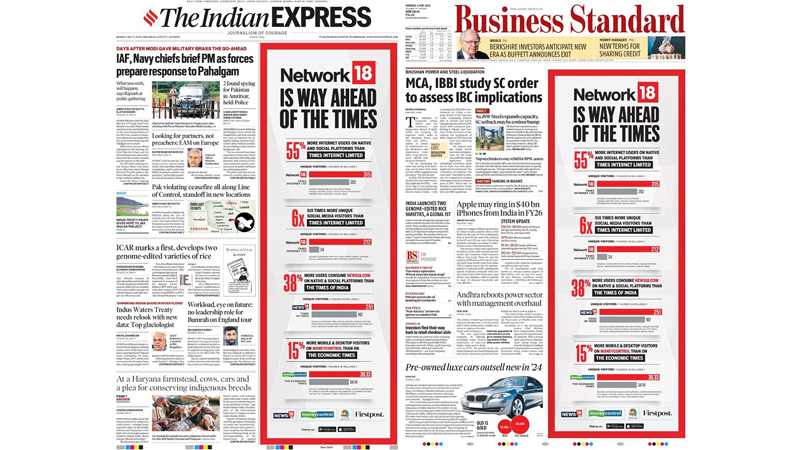
    MUMBAI: Clicks, clout, and Comscore cred Network18 is spelling it all out in black and white. The media group has taken its digital victory lap to print with a bold ad campaign in The Indian Express and Business Standard, calling time on Times Internet’s top spot.

    Armed with March 2025 data from Comscore, the ads proclaim a sweeping lead: Network18 clocked 315 million unique digital visitors 55 per cent more than Times Internet’s 202 million. And on social media, the gap turns into a chasm, with 212 million unique users tuning in to Network18 content nearly six times more than Times Internet’s 34 million.

    The bragfest doesn’t stop there. News18.com, the group’s flagship news platform, also takes centre stage, claiming 251 million unique visitors 38 per cent more than The Times of India, which drew 182 million. That’s a lot of extra eyeballs for what’s often seen as the underdog in the English news race.

    Meanwhile, in the world of bulls, bears, and breaking business scoops, Moneycontrol has emerged as the Street’s top tip. With 39.33 million unique visitors across desktop and mobile, it’s outpacing The Economic Times (34.14 million) by 15 per cent. The message? If you’re looking for your next market move, Moneycontrol might already be a few steps ahead.

    With the campaign splashed across major dailies, Network18 seems to be saying: the scoreboard’s up, and the numbers don’t lie.

  • Moneycontrol asserts supremacy in a print campaign

    Moneycontrol asserts supremacy in a print campaign

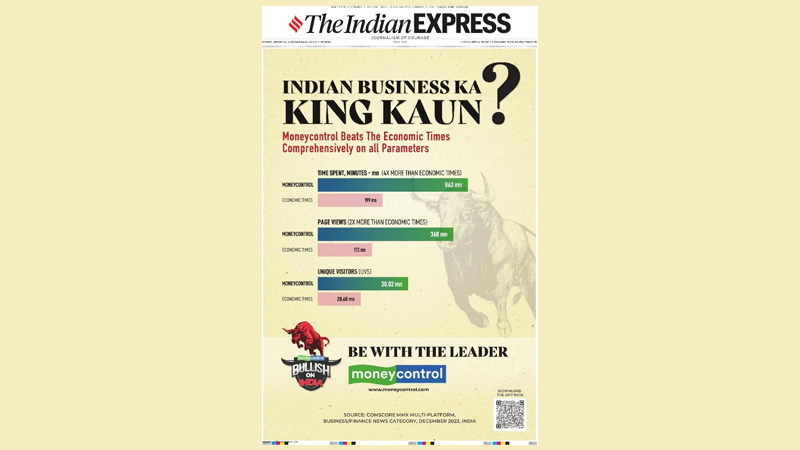
    Mumbai: Moneycontrol has claimed to have beaten the legacy leader on all parameters, in a front page advertisement issued in the Indian Express on 29 January.

    The platform has launched a 360 degree ‘Indian Business ka King Kaun’ campaign and announced its leadership. The campaign will also go live on trade media, social and TV.

    According to the latest viewership data from Comscore, which measures digital readership, with 30.02 million unique viewers, Moneycontrol grew by 9 percent in December 2023 to forge ahead of its major competitor (28.6 million) in readership size and monthly traffic.

    Moneycontrol consolidated and extended its lead over the key competitor in page views and time spent. These are the two key metrics of digital reader engagement and sustainable competitive advantage.

    The platform garnered 368 million page views in December – more than double the page views of the No 2 in this category. (173 million).

    Moneycontrol’s complete dominance in this domain was also evident in time spent. The 863 million minutes Moneycontrol readers spent reading its pages in December was four times more than that spent on its key competitor (199 million minutes).

  • Financial Express managing editor Sunil Jain succumbs to Covid

    Financial Express managing editor Sunil Jain succumbs to Covid

    New Delhi: The ferocious second wave of Covid-19 continues to take a heavy toll on the news industry. Sunil Jain, managing editor of Financial Express passed away on Saturday after battling with post-Covid complications. He was 58. 

    “My brother, Sunil Jain, passed away this evening after post-Covid complications. He suffered a cardiac arrest earlier in the day but was revived, and finally passed after another cardiac arrest around 8.30 p.m. The doctors and all medical staff at AIIMS did their best and more. I thank you for standing by us in this dark hour,” his sister Sandhya Jain said in a statement. 

    A senior journalist with over three decades of experience, Jain started his journalistic career as a reporter in India Today magazine in 1991 and went on to become the magazine’s business editor. He then moved on to head the business and economy coverage for The Indian Express. Six years later, he joined Business Standard. He returned to the Express Group in 2010 as assistant editor of The Financial Express. 

    His sudden demise has left the news media world in a state of shock, with several friends, colleagues, and prominent personages expressing their grief over demise on social media. “Your Express family will miss you,” said The Indian Express’ executive editor Anant Goenka.

    President Ramnath Kovind took to Twitter to condole the senior journalist’s demise. “Sunil Jain was an editor known for his candour and forthright views. It was a treat to read his columns. After his untimely demise, his absence will be deeply felt in the world of journalism. My condolences to his family and friends,” he said in a tweet.

    “You left us too soon, Sunil Jain. I will miss reading your columns and hearing your frank as well as insightful views on diverse matters. You leave behind an inspiring range of work. Journalism is poorer today, with your sad demise. Condolences to family and friends. Om Shanti” said Prime minister Narendra Modi in a tweet.

    Several  Union ministers including the minister of Information and Broadcasting, Prakash Javadekar, Finance minister Nirmala Sitharaman, and Railways minister Piyush Goyal also paid tributes. 

    Hundreds of journalists have lost their lives in the catastrophe that has ravaged the country. India now accounts for half of all global new infections. On Saturday, India recorded 3.26 lakh Covid-19 cases and lost 3,890 lives that pushed the death toll to 2.6 lakhs. 

  • Network 18 announces the team behind its first newspaper – Firstpost

    Network 18 announces the team behind its first newspaper – Firstpost

    Network18 will be launching its very first weekly newspaper – Firstpost. Expected to see the launch on Republic Day – 26th January, 2019, the newspaper will mark the media conglomerate’s foray in the newspaper domain.

    The Network appointed Praveen Swami as the Group Consulting Editor a few months ago. Along with BV Rao, the Editor of Firstpost, he will lead the editorial team of Firstpost newspaper. Rahul Kansal, Network18’s brand advisor will also be seen in the role of Business Head of the newspaper. A veteran of media marketing, Rahul was earlier the Executive President of Bennett Coleman, serving as the business head of The Times of India.  Praveen Swami has earlier held key editorial positions at The Indian Express, The Hindu, and The Daily Telegraph, London. B.V. Rao comes with an extensive experience of 33 years where he has led newsrooms across various brands, formats and platforms.

    A roster of some of the biggest Indian and international columnists will write for the paper; anchored by a talented team of journalists, cherry-picked from India’s leading newsrooms.

  • Multiple unregistered cable operators: A case of ignorance or mutual offence?

    Multiple unregistered cable operators: A case of ignorance or mutual offence?

    MUMBAI: More than 50 per cent of cable operators in the Pune district are found to be operating without the necessary registration. A special drive conducted by the Pune district entertainment department discovered that 500 out of the 960 cable operators in Pune do not possess postal registration, which is mandatory as per norms set by the Telecom Regulatory Authority of India (TRAI).


    “It has come to light that more than half of the existing cable operators are operating without following the TRAI guidelines. The operators were given two months to register themselves with the head post-office. But after regular inspection, it was found that the operators continued to evade registering with the post offices and notices have been issued to these operators. The issue has been pending for the past two years,” an official was quoted as saying by The Indian Express.


    Tax evasion can be one of the biggest reason behind this irregularity in registration. “These cable operators extract tax from people and do not deposit the same to the department. With the TRAI rules, we are getting to know about the evasions and the entertainment department has been asked to meet the target and get all the registrations,” added the official.


    However, when contacted by Indiantelevision.com, a senior official in the cable fraternity was loathe to accept the quoted number of operators, who were operating without the necessary registration. “What we came to know so far is that the operators of few fringe areas, which merely has a subscriber base of 25 – 50 may not have registered. It’s impossible that the number is so high. Moreover, what we are looking to find out is if those operators were charged entertainment tax. Our sources tell us that these operators have been paying entertainment tax. If that is true, then a pertinent question to ask the authorities is how taxes were charged to illegal operators.”    


    For city areas the tax per consumer is Rs 24 while the rural areas pay Rs 15.


    According to TRAI guidelines, it is mandatory for cable operators providing services via digital addressable systems (DAS) to register with the head post office before offering services. Cable operators are also required to enter into inter-connection agreements with multi-system operators (MSOs) whose signal they carry.


    While the issue has come to light in Pune as of now, it is a matter of major concern as to how many other cities and districts have a similar problem. Given the vast length and breadth of the country, the task at hand is onerous to say the least.

  • Print or digital; what redefines a traditional paradigm?

    Print or digital; what redefines a traditional paradigm?

    MUMBAI: While circulation of newspapers is still in the positive and print continues to have the lion’s share of the ad spend pie; digital is gaining ground rapidly. So is there a reason for fear amongst print players?


    Discussing this was a panel comprising The Indian Express Group wholetime director Anant Goenka, Mid-Day editor Sachin Kalbag, BBC Online editor Nidheesh Tyagi, Danik Bhaskar Group SVP – sales, market development and brand marketing Vinay Maheshwari and Percept Allied Media CEO Shripad Kulkarni. The panel was moderated by MXM editor-in-chief and CEO Pradyuman Maheshwari.


    Goenka recalled that when he started handling the digital side of The Indian Express Group, the important factor was to stick to the funda of ABCD – Astrology, Bollywood, Cricket and Devotion. He went on to say that politics became the hot topic interest on the Internet, thanks to the issues related to Narendra Modi, elections and Arvind Kejriwal. He believes that Internet, gives them an opportunity to reach out to a wider range of audience where print can’t be reached at this point of time.


    Goenka believes that it is a very complimentary medium. “It is clearly about finding a way to create content that works for both mediums (digital and print). Content has to be exclusively for each medium. Both mediums in India are comfortable and are here to stay,” he said.


    According to Danik Bhaskar’s Maheshwari, both the mediums always do not have the same set of audience. He opines that print and digital are going to co-exist and for long. He believes that newspapers act as an advantage for any consumer. “It reaches people at 7 am in the morning at their doorsteps and people are fresh to read it. In tier II and III cities, literacy, income and readership is on a rise. On top of all this, affordability is also on the rise. The reach that print delivers today is worth mentioning,” he said, adding that regional languages papers are also consumed well.


    Kalbag said that what digital is doing right now is putting a lot of strength to what print delivers in the morning. “Where you break big stories in print, it is a big worry for any journalist and editor for how to do justice post 8 am for internet. To viralise it on social media platforms is the best way to reach out to the whole world.” He asserted that social media platforms have become curated platforms where all print news is curated in the best manner for each of the digital platform.


    “What works for Twitter may not necessarily work for Facebook or Pintrest and vice-a-versa. So each of these platforms need to have a perfect tactic or strategy to put all of the content together and every journalist and editor should know how to do justice to each of the platforms,” said Kalbag.


    Kulkarni had a different opinion altogether. He believes that the industry is definitely witnessing a change, thanks to digital platforms entering into the market. “We have spoken about India and Bharat but for the first time, digital has had a heavy impact. Look at all the generations, from old generation like me to a new generation like my daughter. I still prefer newspapers and she prefers reading it online. This is the change and more changes are yet to come.”


    To conclude, most of the parties believed that print and digital are equally important for different set of audiences and both are here to stay for a very long time.


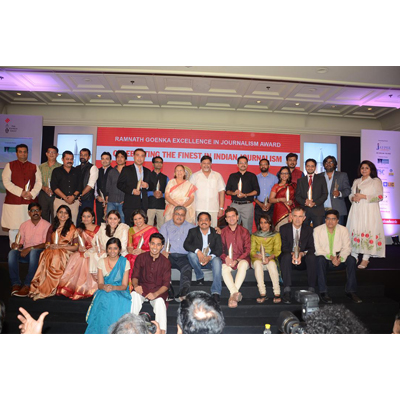
  • Journalists felicitated at Ramnath Goenka Excellence in Journalism Awards

    Journalists felicitated at Ramnath Goenka Excellence in Journalism Awards

    MUMBAI: The seventh edition of the Ramnath Goenka Excellence in Journalism Awards, instituted by The Express Group in memory of its founder was held on 9 September 2014. Lok Sabha speaker Sumitra Mahajan was the chief guest at the function. She presented the awards for outstanding journalist work done in 2011 and 2012. The winners were chosen by an eminent jury from nominations in 15 categories.


    Mahajan presented the awards to 59 journalists from broadcast and print media under different categories. The Journalist of the Year for 2012 went to Sreenivasan Jain of NDTV 24X7. CNN-IBN bagged five awards and NDTV 24X7 received three.


    From the broadcast segment, Jajati Karan from CNN-IBN and Geeta Datta from News-X won the award for investigative journalism. Smita Nair from CNN-IBN won the award for reporting on politics and government for the year 2011. Vimal Mohan from NDTV India won the award for sports journalism for his report on how lack of facilities stands in the way of Olympics dreams.


    Surbhi Khyati of The Indian Express won the award for Investigative Reporting (print) for 2011 for her series exposing the corruption in the National Rural Health Mission in Uttar Pradesh. The Investigative Reporting (print) award for 2012 went to Mehul Srivastava, Andrew Macaskill and Adi Narayan of Bloomberg News for their story on how malnutrition affects India’s children. Nidhi Verma of Reuters won an award for Business and Economic Journalism (print) for her series on Iran’s oil exports to India.


    Speaking at the awards, Mahajan said, “The media is considered the fourth pillar of democracy and we expect as much responsibility and transparency from it as from the other three pillars. A free press and a fearless press are in the interests of both society and the nation.”


    “In a fast-changing world, journalists must provide the people with information to make them both aware and strong. The dissemination of information is the most powerful tool in strengthening the awareness of people,” she added.


    Mahajan also said that the parliamentary proceedings were not always given adequate coverage and had observed on several occasions, high level and important debates were not highlighted by the media. In fact, at times, the reporting, she said, was distorted. “I laud the media for highlighting issues of corruption and nepotism but along with this I want that the media should also focus on interesting and important debates that take place in Parliament. If the media does not give this adequate coverage then we can’t reap the benefits of democracy,” she said.


    The Indian Express Group chairman Viveck Goenka said, “2011 and 2012, for which the awards were being given, were pivotal years for the country which saw the birth of an anti-corruption movement, its steady evolution and often devolution into a political party.”


    Goenka stressed the importance of institutions in facilitating good journalism. “In our frantic count of how many followers we have on social media and amid the pressure to collapse an argument into 20 seconds we tend to forget that good journalism needs a good ecosystem of individuals and institutions,” he added.


    The awards pay tribute to journalists from print and broadcast who maintain the highest standards of their profession even in the face of political and economic pressures, who produce work that underline the values of good journalism — excellence and enterprise, courage and fairness.


    To view the entire winner list please click here

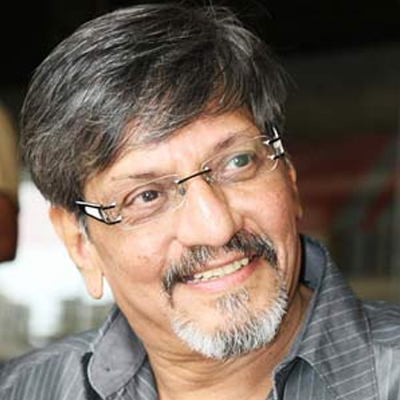
  • Amol Palekar to head CMS Vatavaran Environment Filmfest Jury

    Amol Palekar to head CMS Vatavaran Environment Filmfest Jury

    NEW DELHI: Eminent actor, director and producer Amol Palekar will head the jury for the coveted 7th CMS Vatavaran Awards in national and international categories.


    The Award Jury is meeting from today for three days at the ITC Maurya, New Delhi.


    The jury comprises 14 eminent personalities from widely divergent sectors and streams, that is filmmaking, conservation, research and media will be headed by Amol Palekar


    The jury members include World Bank New Delhi senior environmental specialist, Dr Anupam Joshi; Indira Gandhi National Centre for Arts (IGNCA) member secretary (Chief Executive Officer) Dipali Khanna; author, columnist, birder Ranjit Lal; filmmaker, Vichitra Nirmiti, Pune Sumitra Bhave; film critic and senior columnist The Indian Express Shubhra Gupta; The Hindu, New Delhi features editor Ziya Us Salam.


    CMS Vatavaran received a total of 541 entries out of which 86 Indian and International films have been nominated in 11 categories. The Awards will be conferred on 2 February 2014 during the 7th CMS VATAVARAN 2014 International Environment & Wildlife Film Festival and Forum which is scheduled from 30 January to 3 February 2014 at IGNCA Lawns, New Delhi.


    Vatavaran is India’s only International Environment & Wildlife Film Festival and Forum organised as initiative of Centre for Media Studies, New Delhi. The festival is not just a film festival celebrating the cinematic art of films but focuses more on using the films as a tool and catalyst for creating impact. The festival has an International recognition and till date 39 festivals have been organised in 26 cities of India ever since its maiden run in 2002.