Tag: The Free Press Journal

  • Veteran journalist, Padma Bhushan awardee TJS George passes away

    Veteran journalist, Padma Bhushan awardee TJS George passes away

    MUMBAI: TJS George, veteran journalist, author and columnist known for his incisive writing and uncompromising editorial independence, passed away on Friday (October 3, 2025) due to age-related complications. He was 97.

    A Padma Bhushan awardee, George was among the most respected figures in Indian English journalism, known for his sharp political analysis and fearless commentary.

    Born on May 7, 1928, in Kerala, George was the fourth child of Thayil Thomas Jacob, a magistrate, and Chachiamma Jacob. He graduated with honours in English Literature from Madras Christian College before beginning his journalistic career in the 1950s with The Free Press Journal in Mumbai.

    Over the decades, he held senior editorial roles at The Searchlight, The Free Press Journal and the Far Eastern Economic Review, and later became the founding editor of Asiaweek in Hong Kong. In India, he served as editorial adviser to The New Indian Express, where his widely read weekly column, Point of View, ran for 25 years until June 2022.

    George was known for his unwavering stand against corruption, social injustice, and communal intolerance. His columns often questioned power and highlighted issues of public concern with clarity and conviction.

    An accomplished author, George wrote several biographies and political works, including Lee Kuan Yew’s Singapore, The Life and Times of Nargis, Krishna Menon: A Biography, and The Dismantling of India: In 35 Portraits:  a collection of essays on politicians, artists, activists, and public figures.

    In recognition of his contributions to journalism and literature, he received several awards including the Padma Bhushan (2011), Rajyotsava Award (2007), Vakkom Moulavi Memorial Award (2024), and Kesari Media Award (2017), among others.

    Through a career spanning more than seven decades, TJS George remained a steadfast voice of reason and integrity in Indian journalism: a writer who never hesitated to speak truth to power. His legacy continues to inspire generations of journalists and readers alike.
  • Sehgal outlines Prasar Bharati’s future at IAA industry meet in Mumbai

    Sehgal outlines Prasar Bharati’s future at IAA industry meet in Mumbai

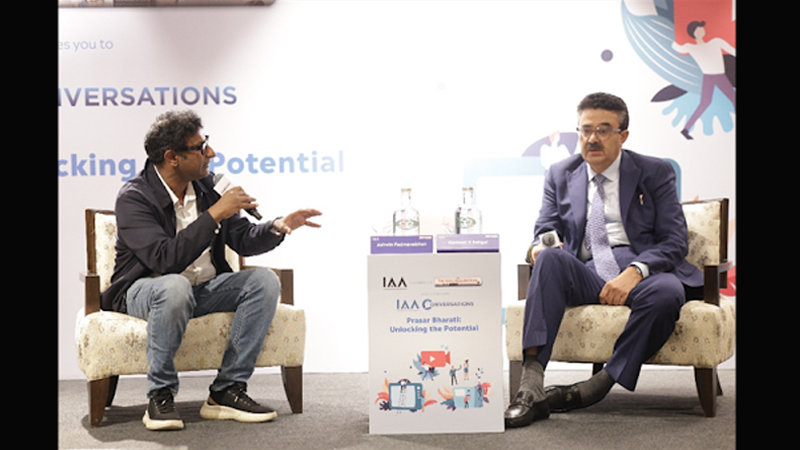
    MUMBAI: From Agra expressways to All India Radio, Navneet Sehgal’s media journey has had one goal, reaching Bharat, better. At the latest edition of IAA Conversations, hosted by the India Chapter of the International Advertising Association (IAA) in partnership with The Free Press Journal, the spotlight fell on Prasar Bharati, chairman Navneet Kumar Sehgal in an engaging tête-à-tête with Groupm COO for South Asia Ashwin Padmanabhan.

    Held at Mumbai’s Taj Lands End, the session welcomed a full house of brand custodians, agency leaders, and media professionals, reflecting the industry’s growing interest in public service media’s evolution.

    IAA India chapter president Abhishek Karnani kicked off the evening by reaffirming the IAA’s 2025 focus “Conversations, Skilling, and Artificial Intelligence” as tools to futureproof the communication ecosystem.

    Described as a legacy administrator with a media mission, Sehgal spoke candidly about navigating the dual identity of Prasar Bharati, a half-government, half-autonomous behemoth with unmatched rural reach and new-age ambitions.

    “With over 1000 transmitters, 36 plus TV channels, and 58 radio stations, our footprint is vast. But our challenge now is agility and relevance,” Sehgal said.

    Some of the initiatives he outlined include, Building a robust OTT platform that unifies live TV, radio, e-commerce, and digital-first content. Launching direct-to-mobile TV broadcasting that bypasses internet requirements. Investing in creator and youth ecosystems through initiatives like Waves, a content summit kickstarted by the prime minister.

    Ashwin Padmanabhan noted that under Sehgal’s leadership, Prasar Bharati had become remarkably collaborative, inviting participation from advertisers, influencers, and platforms alike.

    “This is not a closed-door legacy broadcaster anymore,” he said. “It’s a space where creators can experiment, and brands can build authentic Tier 2 and Tier 3 engagement.”

    Sehgal recounted a memorable storytelling project with Big FM and Nilesh Mishra that used emotion, not explanation, to communicate government schemes. “A good ad commercial or social moves people to act. That’s the power of public storytelling,” he said.

    He emphasised that while public service media often carries the weight of bureaucracy, its evolution must be people-first. “We are not just public. We are people-first. And to stay people-first, we must constantly innovate.”

    The evening closed on a high note, with warm appreciation from the audience, which included advertising veterans, brand marketers, and digital leaders. Special thanks were extended to the IAA team, including Rahul and Heta, for curating a conversation that was more than just a fireside chat, it was a call to reimagine public media for a new India.

    As Sehgal quipped with a smile, “Legacy is not a burden, it’s the launchpad.”

  • IAA’s ‘Voice of Change’ third edition summit to be held at Google HQ in Gurgaon

    IAA’s ‘Voice of Change’ third edition summit to be held at Google HQ in Gurgaon

    Mumbai: The International Advertising Association’s India Chapter (IAA) is hosting the third edition of its Voice of Change summit on 11 November at the Google office in Gurugram. Through this event, the IAA is championing the mindful portrayal of gender across all forms of content. Google India & Youtube are the presenting partners, while UNICEF the Knowledge Partner and TVS are the Associate Partner for this event.

    Content shapes consumers’ mindsets. And because it is consumed across geographies, demographics, and platforms, it is important to sensitise people to the way gender is portrayed. The third edition of the IAA: Voice of Change summit is set to be an inspiring day of debates, discussions, and dialogues for policymakers, advertisers, brand custodians, content creators, and communication specialists to recognise their power in driving balanced and inclusive portrayals of gender roles in media for enduring change.

    Through discussions with a diverse range of content creators from advertising/digital/film backgrounds, the event will shed light on the power of imagery and narrative in shaping perception of gender roles.

    Former Minister of Information and Broadcasting (MIB), government of India & actor Smriti Irani and actor Taapsee Pannu are among the speakers who will be part of the half-day event.

    The Free Press Journal, IAA India Chapter & president, Abhishek Karnani said, “Among the various initiatives undertaken by the IAA in the country, we have been pushing the needle around gender-sensitive communication across platforms. The ‘Voice of Change’ movement is our flagship property in this space. Through this event this year, we will push the cause across the industry with a diverse list of speakers covering advertising, marketing and media.”

    IAA Women Empowerment Committee chairperson, Nina Elavia Jaipuria added, “Content is a mirror to society. As content creation gets democratised and viewership grows, it is imperative to create awareness and sensitize creators towards a positive, inclusive and gender equitable portrayal in their narratives. At the third edition of the IAA ‘Voice of Change’ summit, we have Smriti Irani, as a keynote speaker & also joining us is actor Taapsee Pannu, who is known for pushing gender stereotype in the roles she has played. Along with them is an illustrious panel of speakers from the advertising, marketing and media community, we continue to actively challenge stereotypes across the content industry to drive enduring change.”

    IAA Women Empowerment Committee co-chair, Megha Tata, further stated, “The first edition of Voice of Change focussed on advertising. The second year added TV & OTT content. This year we are adding Digital content to the conversation. We know that the level of content being consumed is at an all-time high on digital and social platforms and it is important that gender stereotyping is addressed on digital and social content also. I’d like to thank UNICEF and Google for partnering with us in helping make a much-needed shift in the perceptions of gender.”

  • Cartoonist & ‘Common Man’ creator RK Laxman passes away

    Cartoonist & ‘Common Man’ creator RK Laxman passes away

    NEW DELHI: Eminent cartoonist R K Laxman, who highlighted the woes of society through his cartoons featuring the Common Man, died of multi-organ failure. He was 93.


    A recipient of both the Padma Bhushan and the Padma Vibhushan, Laxman was spending a retired life in Pune, away from the hustle and bustle of Mumbai where he had for almost fifty years in ‘The Times of India’ ‘lived’ through his cartoons the woes of the common man in the cartoon series ‘You said it’.


    He had commenced the daily cartoon strip, in 1951 and was forced to stop it only after a partial paralysis just over a decade earlier.


    Laxman started his career as a part-time cartoonist, working mostly for local newspapers and magazines. While a college student, he illustrated his elder brother RK Narayan’s stories in The Hindu. His first full-time job was as a political cartoonist for the The Free Press Journal in Mumbai. Later, he joined The Times of India, and became famous for the Common Man character.


    Laxman was born in Mysore on 15 August, 1921. His father was a headmaster and Laxman was the youngest of six sons; Laxman was engrossed by the illustrations in magazines such as The Strand Magazine, Punch, Bystander, Wide World and Tit-Bits, even before he could read. Another early influence on Laxman were the cartoons of the world-renowned British cartoonist, Sir David Low (whose signature he misread as “cow” for a long time) that appeared now and then in The Hindu.


    Laxman was the captain of his local “Rough and Tough and Jolly” cricket team and his antics inspired the stories “Dodu the money maker” and “The Regal Cricket Club” written by his brother, Narayan. Laxman’s idyllic childhood was shaken for a while when his father suffered a paralytic stroke and died around a year later, but the elders at home bore most of the increased responsibility, while Laxman continued with his schooling.


    After high school, Laxman applied to the J. J. School of Art, Bombay hoping to concentrate on his lifelong interests of drawing and painting, but was rejected. He finally graduated with a Bachelor of Arts from the University of Mysore. In the meantime he continued his freelance artistic activities and contributed cartoons to Swarajyaand an animated film based on the mythological character, Narada.


    Laxman’s earliest work was for newspapers and magazines such as Swarajya and Blitz. While still at the Maharaja College of Mysore, he began to illustrate his elder brother RK Narayan’s stories in The Hindu, and he drew political cartoons for the local newspapers and for the Swatantra. Laxman also drew cartoons, for the Kannada humour magazine, Koravanji, founded by Dr M Shivaram, who himself was an eminent humourist in Kannada. He encouraged Laxman quite a lot. His “common man” character featured in his pocket cartoons is portrayed as a witness to the making of democracy.


    He also created a popular mascot for the Asian Paints group called Gattu in 1954 Laxman has also penned a few novels. His cartoons have appeared in Hindi films such as Mr. & Mrs. 55 and a Tamil film Kamaraj. His creations also include the sketches drawn for the television adaptation of Malgudi Days, which was written by his elder brother and directed by Shankar Nag. Laxman also drew caricatures of friends for private purposes.


    Laxman’s Common Man inspired a TV show — RK Laxman Ki Duniya with comedian Atul Parchure essaying the common man on Sab TV, while Vandana Pathak was seen as his wife.


    In September 2003, Laxman suffered a stroke, which left him paralysed on his left side. He partly recovered from its effects.