Tag: The Content Hub

  • The Content Hub: Thinking digital

    The Content Hub: Thinking digital

    MUMBAI: Digital has become the core of any strategy today. And highlighting the same were the digital content creators at indiantelevision.com’s ‘The Content Hub,’ where the makers shared their valuable insights on the success stories and how they manage making money in this competitive market.


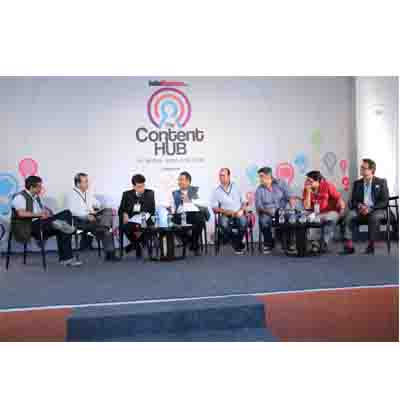
    Sharing their views were Viral Fever and TVF Media Labs founder and CEO Arunabh Kumar, Rajshri Entertainment MD and CEO Rajjat Barjatya, Viacom18 Media – MTV and MTV Indies EVP and business head Aditya Swami, Qyuki Digital Media co-founder and MD Samir Bangara, Zenga Group MD and CTO Shabir Momin, YouTube head of content operations India Satya Raghavan and Multi Screen Media EVP and head – digital business Uday Sodhi.


    Moderated by CNBC-TV18 editor, storyboard Anant Rangaswami, the discussion began with Rangaswami raising the point of how each digital creator makes money differently in the business.


    According to Sodhi, while ‘digital only’ may not be the viable way of going about it right now, for popular sports it will turn around. “Look at television or any other entertainment, sports is a critical part where money goes from advertisers and from an eyeballs perspective. Why the same pattern is not followed on digital? It will happen, but how it grows and how much money it takes, only time will tell,” opined Sodhi.  


    Rangaswami believes it is an interesting curve and content can make money on digital. Agreeing to him, Kumar shared that in the financial year 2012-13, also the first year of TVF online network, its total turnover was equal to one day of shooting cost of an MTV promo and this financial year its total turnover is the cost of one promo of MTV. “The growth has been really phenomenal. Once upon a time, we were doing 10-15 thousand views on YouTube and the brands feature were also very less. That time there was this whole idea that a brand or a client could own a piece of content after giving you money. But cut to now, we have shows on MTV or our channel or AIB and you can see a lot of brands being open to that.”


    For Kumar, it is a pretty much age old television model where for example Cadbury takes a lot of money for KBC, because it is watched by a lot of people.


    According to Bangara, the big opportunity is the content marketing opportunity. “If advertisers and brands let creators do what they need to without putting restrictions, then it will work much better. Because audiences online are very different than audiences consuming content on the traditional platforms.”


    The traditional media players believe that production value equals quality. “In the online space, production value is not directly proportionate to popularity. The concept drives engagement and therefore you don’t need expensive budgets to ride your films on digital platforms,” said Bangara.


    Rangaswami further delved to find out whether is it easier to sell branded content on digital than on television? Contradicting his statement, Swamy feels that the future of TV is TV and from a reach and growth perspective, there is huge growth and spread still on television. “On branded content, the way we make this work is that it is the combination of bringing the screens together.  If you go to see TV and digital separately, the challenge will be much harder. But a lot of branded content that we do, we bundle the whole thing. For example, take the premium content like ‘Coke Studio’ series that we produce, we produce it as a broadcaster, give it legs on television and it kind of survives on beyond TV as well.”


    Going forward, Rangaswami highlighted the different needs of monetisation of content. Barjatya revealed that Rajshri has 20,000 hours of content that it has aggregated with Mukta Arts. “That brings in the revenue. But we also do a lot of experimentations. We have a channel in the entertainment space, bollywood news space, hollywood news space, television space, channels in kids, food and devotional space. These I think will grow going forward.”


    But, according to Barjatya, money still needs to keep coming in and that can come only through blockbuster movies, which the company has acquired over the last couple of years.


    According to Raghavan brands are experimenting, content creators are experimenting and the entire ecosystem is experimenting. He pointed out that the difference the industry is noticing in the last few years is that advertisers are ready to put their money on content because they believe that the creator of the content or the participant will be able to create the content and distribute it as well. “Till now what was happening was that they wanted to own the delivery itself which is why a lot of brands created good stuff but later fell off the clip. Now, they are trusting a lot on the creators. That’s where the point of money floating to content creators and to networks is multiplying.”


    Further adding to this, Momin felt that success on the digital platforms is not counted only by achieving the million views mark. “People get onto the digital platforms for multiple reasons. A movie production house comes to the digital platform not to make money or for ad sales but they are now looking at increasing their eyeballs reach.” He believes that there are other serious players who are trying to make this as a profession. “Branded content is becoming content and that will always be there because they are the ones who are pumping in a lot of their money but if you look at the industry overall , it is the rate of creating content which is growing,” said Momin. 

  • The Content Hub: Broadcasters need to encourage new concepts

    The Content Hub: Broadcasters need to encourage new concepts

    MUMBAI: While the common consensus was that there is a lull in the content that we see on television today, a few freelance scriptwriters present at The Content Hub claimed that this was not due to a dearth of good writers. According to them, there, in fact, is a lack of good producers.

    Indiantelevision organized a three-day initiative that  brought together writers, creators, producers, artistes and broadcast executives to discuss, understand, educate and engage those involved in the content creation process – both for TV and digital.

    Putting forth the creator’s perspective, Balaji Telefilms creative director Nivedita Basu said, “Well, we need to be in the realms of what the Indian audience wants. When you talk about pushing the envelope so drastically, we need to be careful of not venturing too differently.”

    Basu, who has been working with Balaji since the late 90s, feels that the saas-bahu sagas are the ones that bring in the money. “I am a huge fan of daily soaps but I am ready to experiment with new concepts as long as the audience relates to it,” she said.

    A budding screenplay writer, Ilashree Goswami, on the other hand, feels that there is not enough support from the producers when it comes to fresh concepts. She stated, “There is a misconception that we lack good writers. Producers and channels need to support and encourage writers with fresh concepts.”  

    The Format People CCO and partner Justin Scroggie provided a different perspective when he said, “Broadcasters need to see if shows sell. Creators need to be clear about what kind of show it is, in terms of genre.”  

    Speaking on how channels can help in making a show popular, Basu explained, “Promotions matter a lot too. Kudos to Sony for promoting Itna Karo Na Mujhe Pyaar so well. I hope this show turns the channel around and becomes the next Bade Acche Lagte Hain.  We, as producers, also can’t experiment if the channel is not supportive.”


  • The Content Hub: Talent shows and drama series drive the global format business

    The Content Hub: Talent shows and drama series drive the global format business

    MUMBAI: “Format business is a major industry.  Today, the production value of format business is well over 20 billion euros,” said The Format People CCO & partner Justin Scroggie during his keynote at ‘The Content Hub’ organised by indiantelevision.com.

    It is unquestionable that television formats have indeed become essential components in the international television market. Largely licensed by television networks, TV formats describe the overall concept of a show and its premises. Investors around the world are now looking at television as an attractive business.

     “Over the past nine years, American Idol has generated US $8 billion on its own,” he said.

    Scroggie also discussed about the major global trends and television formats in the international landscape as part of his keynote presentation. According to him, the original drivers for the format business are game shows. “Game shows are flexible, relatively short, scalable in terms of cost and renewable. They are repeatable and above all, they are adaptable in various cultures,” he opined while highlighting that despite all this, game shows are struggling these days.

    So why is this happening? “Everybody is looking for the next big game show breakout and nobody is finding it,”Scroggie explained.  Citing the example of the popular game show Who wants to be a Millionaire, Scroggie said that big money prizes are not delivering the kind of drama as the audience is too familiar with it now.

    In addition, with the advent of reality and talent programmes, game shows are not delivering the same level of drama, strong characters and emotional connect which the audiences are expecting. According to Scroggie, talent and reality shows are driving the international format business.

    “Got Talent entered the Guinness book of world record as the world’s most successful reality television format. It has been adapted in 63 countries,” he informed. There are many successful talent show formats like ‘Strictly Come Dancing’ and ‘Masterchef’ that have been adapted globally.  “However trends don’t happen in every country at the same time,”Scroggie added. While Canada does not have many talent shows, China currently has more than 90 talent shows on air.  

    At this point, Scroggie also said that talent shows are also getting saturated.  “Having learnt the grammar of making international talent programmes, more and more countries are making their own versions so that they don’t need to buy international formats,” he explained.  

    Scroggie believes that the fastest growing area of format business is scripted formats which include drama series that can be adapted and remade in other countries. Homeland, for example, one of the highly successfully television shows in the US, is actually an Israeli format.

     
    “The best dramas are those that travel and have something about them. They can be adapted into the story and emotions of any country,” he said.

    Scroggie also spoke about telenovelas, such as ‘Everest’ on Star Plus that drive scripted formats. He believes that today we can find quality drama content written by top talent starring A-listers.  Serialised dramas like family, crime and politics also work.

    In the last part of his keynote, Scroggie explained how the barriers between viewers and shows are breaking down. “Television is a passive medium and the audience wants to interact with the people they see on screens,” he added.  Scoggie feels that web series is picking up and is easy to watch.  While social experiments are popular, they are also risky as they involve real people in a live and reality drama.

    Scroggie, whose organisation deals in format creation, consultancy on formats, branding and in-house training also delved on why UK is a leader in format sales.

    “UK broadcasters are only allowed to keep 15 per cent of the rights on the show. The creators of the shows retain 85 per cent. This has created a huge incentive for producers to sell their formats to broadcasters,” he stated.   

    While UK, US, Netherlands, Israel and Brazil are doing well in the format business, Scroggie feels that Turkey and China are potential countries to also look out for in the future.

     “With your help, let’s add India to the list,” he concluded.


  • The Content Hub: Education in comedy doesn’t exist in India

    The Content Hub: Education in comedy doesn’t exist in India

    MUMBAI: With the soaps and dramas ruling the Indian television screens, comedy to some extent has taken a backseat. A session on ‘Comedy Fix’  moderated by Indiantelevision.com’s founder, CEO and editor in chief Anil Wanvari and panellists Neela Telefilms director Asit Modi, Optimystix Entertainment producer Vipul D Shah and All India Bakchod (AIB) co-founder and member Tanmay Bhat sought to find if the TV industry is seeing a dearth of writing talent.

    Modi said that in the field of comedy there is not only shortage of writers but producers as well. “Our industry is not ready for new writers. We have a closed mindset when it comes to new writers and tend to only work with a particular set of experienced ones. We don’t give an opportunity to explore,” he said.

    Bhat went on to reason why new writers are not accepted by the industry and what today’s writing lacks. According to him the current state of television writing is very generic. “Right from actors to producers to writers, I have seen ‘just-get-it-done’ kind of attitude where originality doesn’t matter but copy pasting does.  In my early days, when I used to meet television writers  one common thing that I noticed amongst them was that they all had a set pattern of writing in a number of shows,” he elaborated.  

    All the panellists felt that in today’s time everything is scripted and agreed that the attitude towards writing is very poor which needs to be changed.

    Shah highlighted right from the beginning there were no new writers created for TV but the ones making the films ended up writing for the small screen too. According to him, it is difficult to get innovative story writers because it is demanding. “Today, television writing, whether fiction or non-fiction, has a set of dos and don’ts because a channel can demand a change in the plot anytime and we as writers have to be also on our toes to fix it.”

    He went on to say that western formats can never be adopted in India. “Our humour is completely different from the genre abroad. We can’t present dirty comedy here because it will never be accepted. So, to bring the humour, which can be accepted by Indian audiences, we have to create our own talent, which is again very difficult.”

    According to Modi, whose Taarek Mehta Ka Ooltah Chashmah has been running successfully for more than six years, writing a daily comedy is not only a challenge but a task. It is not only the writer’s responsibility to make the show going but the entire teams. “You not only need a good writer but a good performer also. And after getting a good performer/actor, one needs a good producer who can bridge the gap.”

    Showing the silver lining in the cloud, Bhat said that thankfully now humour has started getting the respect it deserves. According to him, comedy education doesn’t exist in India. “We compare ourselves to the shows in the US. But we also have to look at the kind of education and training they have gone through. All writer/comedians one sees in their shows have all gone through a certain level of training. This doesn’t exist in India.”

    The panellists agree that Indian television has always accepted family comedies and this is what will continue in the future as well. From shows like Dekh Bhai Dekh to Khichdi to Sarabhai vs. Sarabhai, they all have catered to the masses.  

    Is there fatigue coming in comedy? “No, not at all,” said both Modi and Shah. “There will be always space for comedy. Shows like Comedy Nights with Kapil, Comedy Circus, are making everyone laugh today. And everyone loves to laugh, so comedy is and will always be audience’s first choice,” added Modi.

    Wanvari further delved to find out that apart from family comedies if there is a room for sitcoms on television? “It will change, because comedy has just started its journey.  I am seeing a lot of scope as more comedy channels are being launched. In comedy more than the story, character development is important. So once the characters are developed, the task will be simple,” said Modi.

    According to Shah, whose Comedy Circus ran for seven and half years, a show never feels the fatigue. “Yes, at times a few episodes works and a few don’t. Comedy sometimes backfires as well. But overall as a genre, there is no fatigue coming in,” he further said.

    Coming from a digital background, Bhat feels that television needs to start catering to the youth a lot more. “They are still catering to the families and not the youth. So, young people will stop watching television at some point of time unless channels keep re-inventing.”

    As for Bhat, re-invention should start from the writers’ room. “I don’t see enough young people picked up from the colleges and groomed. It is essential to grab someone at 16 and groom them to get good comedy in place. Any college kid would want to write for television but there are no platforms.”

  • Why ‘Satyamev Jayate’ chose the Sunday morning slot

    Why ‘Satyamev Jayate’ chose the Sunday morning slot

    MUMBAI: The much popular social awareness show on Star Plus ‘Satyamev Jayate’ (SMJ) not just had the backing of a star presence but also had broadcaster Star’s faith in it.  So much so that Star Plus was willing to give the show a primetime slot.


    Speaking at indiantelevision.com’s The Content Hub, SMJ director Satyajit Bhatkal revealed the detail about SMJ’s original positioning. “We had the option of choosing any slot. In fact Star wanted us to take primetime on Friday, Saturday or Sunday,” he said.


    The idea behind this was to fish when the fish is in the pond, the tactic that fiction shows depend on. But denying this offer, it went ahead with the Sunday morning slot. “We were assured that Sunday morning was a graveyard hour where viewers don’t come,” said Bhatkal.


    SMJ wanted a clear space and appointment viewing for itself when a person isn’t surfing between channels. “We wanted the viewers to take the trouble to wake up and sit in front of the TV, preferably with family, with the specific objective of watching SMJ which is also a limited offering,” he added.


    He was also aware that their unusual way of pushing the show was a nightmare for both the promotion and sales team but according to Bhatkal, it has succeeded in bringing viewers which is visible both by ratings as well as social media.


  • The Content Hub: Segmented channels predict good future for themselves

    The Content Hub: Segmented channels predict good future for themselves

    MUMBAI: The Indian television industry is undergoing a sea change in terms of the content that is being created, both on television and online, long as well as short format. With an increasing need for dynamic creators and scriptwriters, Indiantelevision.com’s first edition of The Content Hub aims to bring together writers, creators, producers, artistes and broadcast executives to discuss with those involved in the content creation process.


    Opening the session was Indiantelevision.com founder, CEO and editor in chief Anil Wanvari, who spoke about how current Indian shows run for more than 1000 episodes while the audience and time spent on digital is shooting up. “We need to create engaging content by rethinking whether we need a time shift, seasonal shows, social programmes or younger producers,” said Wanvari.


    The first session dealt with the risk taking broadcasters of the industry in which Madison World chairman Sam Balsara spoke to Epic Television Networks CEO Mahesh Samat and Reliance Broadcast Network Tarun Katial.


    Balsara started off the session by asking the two about their attempts to disrupt content in the traditional general entertainment channel (GEC) space. Samat said that over the years, the GECs have seen a very few changes and it is only in the last two or three years, due to some impact of digitisation, there has been a little shift.  He compared the current television industry scenario to the film industry where earlier only one type of movies were produced due to single screens and now due to proliferation of multiplexes there is a variety.


    Balsara said that every GEC has the type of content that Epic is trying to segment into its channel. “I am told that people watch shows, not channels?” he questioned. To this Samat took up the example of the US where in the last 25 years all the channels that have come up are segmented. To this, Katial said that the top three GECs could afford to do general content while channels beyond that have to think differently. “Truly there are only three GECs in India- Star Plus, Zee TV and Colors while Sony is largely crime and similar to that is Life OK. Sab is segmented for comedy and so is Big Magic. A lot of our growth has come from geography segmentation,” said Katial.


    Balsara pointed out that the time where people in India will pay to watch good content is still very distant, so what will be a viable model? Katial said that he doesn’t feel there is space for niche segmented content because the investment needs to be if not more then as much as what a Hindi GEC can put with also a good amount of distribution cost. “Abroad, large GECs are terrestrial and free to air. Here to create content that needs to fill three hours daily can hamper the economics and to reach 50-60 GRPs you have to play the lowest common denominator game. When you segment and get to 15-20 GRPs, no Madison will pay you the ER,” he pointed out.


    Balsara with his years of experience said that ad revenue is limited due to limited viewership because while segmented channels ask for lakhs of rupees, GECs have a CPRP of about Rs 20000 to Rs 25000. “Why would a brand buy something at five times the cost if it is available at one fifth the price?” he questioned.


    The way forward according to Katial is actually the viewership but if original content needs to be created then high investment is needed. “Channels such as FoodFood and Discovery have content with limited cost and limited distribution (restricted to urban areas) but for original content the P&L gets to Rs 300 crore,” said Katial. Answering Balsara’s question of high a-la-carte rates of channels, Samat said that a certain amount of reach and GRPs are needed before the channel can be made affordable.


    “10 years ago people laughed at DTH and look at how things are now. So subscription isn’t far off. If you make the right content with limited episodes, syndication will get you money,” highlighted Samat. He added that current long format shows don’t allow syndication.


    Balsara highlighted the language difference between English and Hindi wherein English papers command high ad revenue while English channels are almost inconsequential. To this Katial said that English papers create influence while English channels sell products. “The English viewer is hooked to other screens but not set for standard TV viewing format,” he stated.


    With several growing mediums, Balsara asked if today content is created with only TV in mind to which Samat said, “We are developing content ‘forever’ that can make money even afterwards. More than screens, we should now look at longevity.”


    In response to Balsara’s question of adapting several international formats Katial said that there is no shame in legally doing so since it has a success track record. “When you put Rs 1 crore or Rs 2 crore behind such shows, every management wants to see it has worked before and so do advertisers,” he said. Samat said that the option of creating or adapting a format lies totally on the economics of the channel.

  • The Content Hub: Broadcasters are averse to experimenting with content

    The Content Hub: Broadcasters are averse to experimenting with content

    MUMBAI: The first edition of Indiantelevision.com’s The Content Hub saw a full panel of broadcasters, producers and writers discussing how to change the dynamics of TV content. Moderated by Bodhi Tree Multimedia director Sukesh Motwani, the panel consisted of Doordarshan ADG West Mukesh Sharma, Zee TV business head Pradeep Hejmadi, Cinevistaas producer Siddharth Malhotra, Shashi Sumeet Productions co founder Sumeet H Mittal, Satyamev Jayate director Satyajit Bhatkal, Viacom18 head of content regional network Sanjay Upadhyay and writer Purnendu Shekhar.


    Motwani started off by asking whether the only model of monetising was through having daily soaps with the 23 minute per episode limitation? Upadhyay responded to this saying that some efforts have been made to break away tried to break away. “For instance, Viacom18, we have attempted to do this with our regional shows with one hour shows run twice a week,” he said. “What we found with this is that the audience’s addiction level isn’t as good as a daily because they are so used to dailies. At the same time, economics do play a big role.”


    Motwani further queried if broadcasters could experiment with hour long episodes during weekdays while restricting certain genres to only weekend? Hejmadi  pointed out that it isn’t easy to do dailies, as people generally think. “There is a need for change, yes. But the manner of migrating the audience is also needed. Some people have tried that but even then there is a thought process that broadcasters don’t encourage innovation,” he said.


    On the other hand Malhotra said that when the 9pm-10 pm time band became successful, the economics improved and after that no one even tried to experiment with hour long episodes. Upadhyay clarified that though the broadcaster makes an effort, the pressure on them is heavy. Shekhar lamented that broadcasters are scared of losing loyal audiences by introducing short stories that conclude in four episodes from Monday to Thursday.


    In most shows, the characters drive the shows and shows are scripted accordingly. Hejmadi pointed out that it takes to build characters and promote them amongst viewers to develop stickiness, hence having limited episode shows – like say which run from Monday to Friday does not really work, thanks to the attention deficit among Indian veiwers.  even suggested that producers should comHee with their own research insights that they should show broadcasters.


    Public broadcaster Doordarshan, on the other hand,  tends to look at art, culture and of course  literature for inspiration. Sharma said that this was mainly due to them having a different mandate. “For us the universe isn’t between 7pm to 11pm. We also do events such as every second Sunday is a ‘mothers’ day’ where we bring mothers and daughters to talk about them and this makes good money. But we don’t interfere with producer whether or not a show makes money.”


    As to Motwani’s question of whether there can be different shows for ‘India’ and ‘Bharat’, Upadhyay said, “Honestly, we don’t try hard enough because we don’t have patience. We shift goal posts depending on hits.”


    With a few shows having big names backing them such as Saraswatichandra and Everest, he also went on to say, “The noise that comes out of big shows may amortise costs in a shorter time.”


    While format shows are slowly losing audiences in India, the TV community needs to look at other metrics than simple TVTs and TRPs,  opined Satyemev Jayate director Bhatkal. “We chose the graveyard slot – Sunday morning  – when no one is really watching television to do the show,”he said. “We wanted to reach those viewers who don’t generally watch television, we wanted to encourage appointment viewing. People who would take the trouble  to switch on their sets at that early hour. And we apparently did, if we look at the buzz that SMJ generated online. And this is what sellers of channels also need to do, show the media buyers and planners the  volumes of social media data. In six episodes, we had billions of impressions and we were trending worldwide,” he said.

  • “You should never underestimate the power of good writing”: Namit Sharma

    “You should never underestimate the power of good writing”: Namit Sharma

    MUMBAI: Utilising his 15 years of experience across genres, he has created great programming for Zee TV. From broadcasting to content generation, it’s an amalgamation of several aspects.


    Here we are talking about Zee TV’s programming head Namit Sharma who with his creative thoughts has bought some best ideas to the table. For ‘The Content Hub’, indiantelevision.com had a quick chat to get his views on today’s story-telling and the power of story writers.


    According to Sharma, our stories are universal and emotion driven. “Of course”, comes a prompt reply from Sharma when asked whether Indian content has the ability to travel international. “It all depends on who’s selling it and who’s buying it.”


    He cites the example of MIPCOM, the global market for entertainment content across all platforms. “At MIPCOM, there are Latin American companies selling Telenovelas which get bought by Indian companies. The difference between what we do here and what they do there is, they market them better,” he says.


    According to him, the channel’s current offering Jamai Raja can easily travel internationally. On the contrary, he feels that a concept like Satrangai Sasural won’t be accepted abroad because it is culturally very sensitive.


    Finding good script writers is difficult in every genre and one needs to keep building talent pool that they want to work with.


    “We will never arrive at a time when we say ‘Oh! We are happy with the amount of good writing talent we have’. We will always be hungry for more. We will always keep on looking and creating,” he emphasises.


    He believes that one should never underestimate the power of good writing. “A lot of people look down upon GEC shows and the quality of writing on it, but what they don’t realise is that it takes equal effort to write these shows as it takes to write intelligent shows.” The GEC shows talk to the masses, more than the biggest Bollywood blockbuster.


    He believes that Indian content shifting its paradigm can mean different things to different people. “It depends on which viewer is asking the question. For some it might be ‘when they will only do crime thrillers’ or ‘stop doing saas-bahu soaps’ or ‘produce only love stories’. For us as broadcasters, the only relevant questions come from the audience. So we are happy to listen to their questions and answer them and that’s the crux of what we do,” says he.


    Zee TV was a pioneer in creating seasonal shows when it launched two seasons of Choti Bahu and Punar Vivaah. He feels that there must be seasonal shows, but nobody should be forced to do it because it is a fad or a trend. “One should do seasonal shows because they want to do it. Every story has its own destiny and fate and nobody should really judge somebody else’s work in the field of writing specifically with one uni-dimensional filter,” signs off Sharma.