Tag: The Asia Video Industry Association

  • Avia’s inaugural ‘Japan in View’ highlights Japan’s future of digital entertainment

    Avia’s inaugural ‘Japan in View’ highlights Japan’s future of digital entertainment

    Tokyo – The Asia Video Industry Association (AVIA) held its very first Japan focused industry event, Japan in View, on 29 October at the Andaz Tokyo, bringing together over 130 international and regional players from across the video and streaming industry.

    The conference opened and dove straight into the streaming potential of Japan, with TVer Inc., executive managing director & COO Shinjiro Ninagawa, sharing his ambitions of growing TVer to thrice as large as it was now, with the business doubling over the next two – three years. Dazn CEO (Japan, Asia) Yu Sasamoto, also said that Japan was still at the tipping point of the shift and transformation from traditional linear programming to digital services, and he expected more disruption from new players, with the landscape shifting significantly in the next five years.

    Ampd Analytics (an MPA company) VP, Sam Yousif further expanded on the opportunities for Japan, opening his session describing Japan as “a lucrative, consistently growing multi-billion-dollar industry with a complex competitive landscape and unique customer behaviour.” In Asia (excluding China), Japan was the largest Video On Demand (VOD) market in terms of revenue with $ 6 billion in 2024, almost two times bigger than the next biggest market, Australia. Revenue had also been growing near double digits every year in the past four years, with a Cagr of 17 per cent from 2020 – 2024. VOD consumers also had diverse options, both within and outside of the industry, with VOD only representing six per cent of their free time. Japanese consumers also exhibited unique viewing behaviour not seen across other markets, including a distinct preference for local content. 78 per cent of the total hours viewed on VOD in Japan was with Japanese content, with 93 per cent of VOD users consuming Japanese content and US content only at 16 per cent. And interestingly, there was also a large, shared economy where the top titles, mostly anime, were shared across all the platforms. “With so much content shared across so many platforms, it feels more like a streaming cooperation in Japan than a streaming war,” added Avia CEO Louis Boswell.

    However, beyond anime, panelists believed that Japan was only scratching the surface in terms of the international opportunity for the export of its content. “If the industry can turn and create content that can be appealing both for Japanese audiences and globally, it’s enormous value and enormous opportunity,” said Iconique Pictures executive producer David Shin.What was key was to take the wonderful stories that were indigenous to Japan and elevate them with a high level of storytelling that could propel the industry and that content overseas, added Shin.

    And with the success that Korean content has had internationally, Tving chief content officer Sun Hong Min shared that the foremost reason behind TVING’s impressive growth this year was their strategic partnership with leading content providers, that enabled them to offer a diverse arrangement of high-quality premium content that resonated deeply with their users. Min was also of the opinion that local content could resonate on a global scale by combining universal human elements with a narrative deeply rooted in local history, culture and sentiment.

    Partnerships were also key to growing the business for Warner Bros. Discovery general manager – Japan, Buddy Marini across both linear and streaming, having recently announced a new partnership with U-Next to launch Max in Japan. For local giant J:Com, general manager, media business division, Kaz Sasajima, the digital domain too represented room for growth, particularly in the space of professionally produced content. And wrapping up in the closing panel, for TV5Monde, managing director, APAC, Alexandre Muller, AI was presenting new possibilities, notably in terms of providing greater access to content across multiple languages. “Definitely the place to be is in Asia Pacific, and this is really where the growth is and I can see growth both in linear and as well as on OTT,” added Muller.
  • Online Video remains the growth engine of content investment with local content still key to acquiring subscribers: AVIA OTT Summit

    Online Video remains the growth engine of content investment with local content still key to acquiring subscribers: AVIA OTT Summit

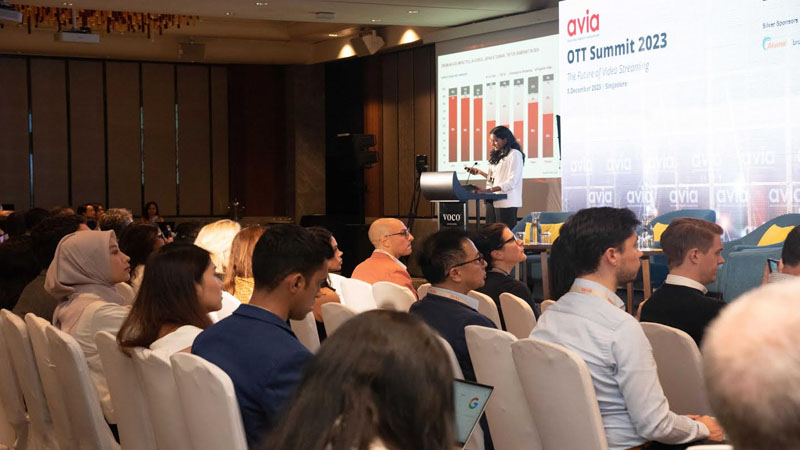
    Mumbai: The Asia Video Industry Association (AVIA), held its annual OTT Summit in Singapore on 5 December, where over 90 per cent of the speakers were senior female executives from across the video industry in Asia Pacific. This year’s summit was designed to try and redress the gender imbalance seen in many industry conferences.

    The Summit opened with Media Partners Asia head of content & platform insights, lead analyst Dhivya T, presenting an overview of the state of streaming in Asia, a market where competition was very much driven by a battle for share of time, with premium video on demand (VOD) fighting with social media and user-generated content (UGC).  

    Competition was also giving rise to new business models and strategies beyond the traditional AVOD and SVOD models, including mobile gaming, ecommerce and bundle subscriptions becoming more common. And with a higher focus in increasing ARPUs, price increases have also become prevalent.

    Ex-China, online video revenues in Asia Pacific were expected to hit US$46 billion in 2028, up from US$29 billion this year. While SVOD was expected to have a CAGR of 6.4 percent, premium AVOD will see a growth rate of almost 18 percent, led by Japan, India, and Korea. In Southeast Asia, Indonesia was emerging as the leading market for AVOD, with Thailand for SVOD.

    In terms of content trends and investment, although pay TV remained the largest vertical, online video was the growth engine of video content investment, with local and Asian content leading premium VOD viewership with the highest reach. Hence local content remained key to acquiring subscribers in the region, and constantly over-indexing with new users.

    In the world of streaming, Free Ad-Supported Streaming TV (FAST) was also much talked about at the Summit as the new kid on the block, as it mimicked the experience of linear TV, delivering scheduled content, with advertising included. Driving the growth of FAST in Asia was the penetration of Smart TVs in the region, with 80 per cent of OTT viewers in APAC using Connected TV (CTV), and with one-third of OTT viewing on CTV, shared Samsung Ads APAC head of product marketing Samantha Cooke. But FAST channels were not always about making money, as FAST was also used for marketing, outreach and brand building, added Brightcove senior product marketing manager Roberta Cambio.

    Senior marketeers from the major platforms too chimed in on the importance of brand building, as the mantra was no longer acquiring subscribers at all costs but focus on keeping the ones you have. For Shemaroo Entertainment CMO Anuja Trivedi, marketing was now more aligned to the business, as consumers who saw campaigns engaged better as well. And partnerships which built more value can only build more excitement for the product and engagement for the platform, said Trivedi. Akamai Technologies senior solutions engineer Sarah Lim, also added that people, platform and the technology were what will help drive your strategy forward for the future. “Marketing is greater than the sum of its parts,” said Lim.

    With 71 per cent of viewers in APAC watching advertising supported streaming on top of linear TV viewing, OMG Singapore chair for media & measurement, AAMS & CEO Chloe Neo, was also seeing growth from regional clients with a greater inclination to look at branding, with the reallocation of budgets into OTT tending to be from the big brands, due to their expectations on quality content. While investment was coming from the linear TV side, more clients were now embracing CTV and addressability for strategic benefit, and not just for incremental reach, added GroupM CIO Southeast & North Asia, Chair, APAC Investment Committee Anita Munro.

    A strong focus on content closed off the Summit, with panellists agreeing that Asian content could not be lumped together. There was huge variety within what is labelled Chinese or Indian content. ZEE5 CCO Hindi Originals Nimisha Pandey emphasised that storytelling trumped investment. “Audiences don’t care how much money has gone into content, if it connects, it connects,” she said.

    Viu content acquisition and development chief Marianne Lee  noted, “Each local market has their own strategy which complements the regional strategy. While it is important for the content to travel outside, the content must also do well locally,” said Lee. In agreement, Agnes content director Agnes Rozario added, “There will always be certain types of content that travel better than others. But it has to work in the home market first.”

    One market which saw things a little differently was Thailand where True Corporation deputy director, planning & business development, strategic content group Kirana Cheewachuen, saw huge potential in the overseas growth and popularity of Thai content, and international success was her primary goal.

    Sharing her strategy for the Pacific Rim in the closing session, Paramount ANZ EVP, chief content officer & head Beverley McGarvey said that Australia was a mature market at a pivotal point now as audiences were adjusting between more traditional legacy media and streaming. Hence accelerating growth in streaming while maintaining linear businesses and making content that can work across platforms was what was needed in order to remain viable.

  • AVIA & TVB applaud Hong Kong Customs for crackdown on illegal streaming devices

    AVIA & TVB applaud Hong Kong Customs for crackdown on illegal streaming devices

    Mumbai: The Asia Video Industry Association (AVIA) and its anti-piracy arm, the Coalition Against Piracy (CAP), congratulate the Hong Kong Customs for their successful enforcement operation against 10 retail shops in Sham Shui Po and Yuen Long that were selling Illicit Streaming Devices (ISDs) that allowed users to watch illegally streamed content.

    Acting on information received from Television Broadcasts Ltd (TVB), Hong Kong Customs, supported by TVB throughout the action, raided the shops, seizing more than 1,000 ISDs and related computers and video equipment, with a value in excess of $150,000. In addition to the seizures, three shop owners and three salespersons were arrested. Investigations are ongoing and there may well be further arrests.

    The actions were the first in Hong Kong to apply the “communication right” in enforcement actions against ISD sellers since the implementation of the Copyright (Amendment) Ordinance 2022. Potential penalties for this enforcement include imprisonment of up to four years and fines of USD6,400 for each infringed work.

    TVB’s Sr IP enforcement advisor Michael Kwan stated, “TVB works closely with Hong Kong Customs in these enforcement actions, which demonstrate the unwavering commitment of both the Hong Kong  Customs and TVB to protecting intellectual property rights and ensuring a fair and sustainable creative industry. We applaud the collaborative efforts in sending a strong message against the sale and  distribution of ISDs.”

    “CAP’s data shows that Hong Kong has the highest per capita rates of illegal streaming of pirate content in the countries CAP monitors in Asia-Pacific, and consumer usage of ISDs to access pirate content is second only to social media1. Recent studies also show the real risks to consumers from accessing content via pirate sources,” said CAP general manager Matt Cheetham. “It is therefore vital that Hong  Kong’s enforcement authorities send a strong message that the sale and distribution of ISDs is illegal in  Hong Kong, and the Hong Kong Customs are to be congratulated for these actions that act to protect both  its creative economy and its consumers.”

  • Indonesia remains a market to watch as local players focus on growth, localisation and expansion beyond its shores

    Indonesia remains a market to watch as local players focus on growth, localisation and expansion beyond its shores

    Mumbai: The Asia Video Industry Association (AVIA) hosted over 200 delegates at its recent Indonesia in View conference that took place in Jakarta on 31 August.  

    The conference opened with industry leaders from across the TV and streaming space sharing their views on the state of TV and video in Indonesia, where total video industry revenues are expected to rise from US$2.5 billion in 2023 to reach US$3.7 billion by 2028, according to the latest research by Media Partners Asia (MPA).

    Netflix senior manager of business development, (Indonesia, Thailand, Malaysia) Tizar Patria was optimistic about the market as it continued to grow for Netflix, with a focus on content that works for  the market coupled with a quality experience for consumers. Vision+ managing director Clarissa Tanoesoedibjo added that an ecosystem was needed that reinforced all other parts, from pay TV to free to air and streaming, and that finding strategic partners in the market to maximise opportunities  was key. WeTV and iflix Indonesia country head Lesley Simpson, also concurred that growth in OTT  is here and can be achieved through strategic partnerships.

    With Indonesia representing Southeast Asia’s largest video content market, the battle for content  remains fierce. MNC Pictures president director Titan Hermawan saw the need to create original IP  and original stories as a big opportunity for new scriptwriters. For Visinema Group founder Angga Dwimas Sasongko, what was most important was to focus on a pipeline of talent to be able to  scale content production. However, the panellists agreed with Stew founder & CEO Abid Hussain that business models needed to change for the betterment of the producers. Netflix director- public policy Southeast Asia Ruben Hattari said that the industry needed to work on broadening its  skills base. Indonesia was also the only country without a production incentive scheme so more  needed to be done there to support the growth of the industry.

    However, piracy was still a major issue in Indonesia, with AVIA’s Coalition Against Piracy’s most recent  annual consumer surveys showing that 54 per cent of consumers in Indonesia access pirate services, the  fourth highest incidence of piracy in the region. In a major collaborative effort towards the fight against  piracy, CAP and the Video Streaming Association of Indonesia (AVISI) signed a Memorandum of  Understanding (MOU) in Jakarta on 30 August at CAP’s State of Piracy Summit which ran alongside  Indonesia in View. The MOU represented a significant step forward for AVIA and AVISI in combining  their resources to combat online piracy in Indonesia and protect Indonesia’s creative and media  industries.

    Indonesia in View shifted focus to the monetisation of premium video in the afternoon. Publica commercial director APAC Chris Mottershead said that with advertisers not planning as far ahead  these days, programmatic was likely to play a bigger role in monetization. Sharing insights from other  markets, Mottershead also added that FAST was a good way of bringing back consumers who dropped out of the pay ecosystem, as they could churn from OTT, go to FAST and then come back to OTT when  they could afford the subscription. PubMatic director of customer success SEAK Khin Mu Yar Soe also said that the programmatic space will continue to grow and evolve, with a more integrated  approach on both the buy side and sell side, as well as at a technology level.

    The conference closed off with a keynote conversation with MNC Group executive chairman Hary Tanoesoedibjo who outlined the next phase of his ambitious plans to shift focus to becoming primarily a content and entertainment company. He shared his plan to combine RCTI+ and Vision+ into a super  app where a two-tiered service will be offered under one brand combining FTA content which will  continue to be monetised through advertising as well as a premium subscription service. The plan was  also to create a bigger ecosystem and grow the service to target all of Asia by investing in more quality  content.

    When asked about rumours of the sale of MNC Play, Tanoesoedibjo shared that they will come to an arrangement to sell the data infrastructure part of the business while keeping the IPTV business and  continuing to bundle the services for both existing and future subscribers.

    Indonesia in View is proudly sponsored by Gold Sponsors Vidio and Vision+ and Silver Sponsors A+E  Networks Asia, Akamai, INVIDI, MEASAT, NAGRA VISION, Publica and PubMatic