Tag: TG

  • Star Jalsha associates with Pashchim Banga Bigyan to promote show

    MUMBAI: Star India’s Bengali general entertainment channel (GEC) has tied up with Pashchim Banga Bigyan Mancha (West Bengal Science Forum) for the promotion of its anti-superstition show Bidhir Badhan. The tie up began as a launch initiative, has now turned into a mass movement.

    Bidhir Bidhan speaks against the evils of blind faith and superstition. Taking forward the “Cholo Paltai” initiative Star Jalsa reaches out to the masses spreading the message of anti-superstition. This reflects the changing times and brings home a very strong social message against superstition. The core content Bidhir Bidhan endeavours to portray the futility of believing in unscientific prejudices and superstitions. The show tries to unveil the acts of unscrupulous people who befool commoners in the name of religion taking advantage of their dire mental condition through acts of deceit.

    Hence Bidhir Bidhan associated itself with Paschim Banga Vigyan Mancha (West Bengal Science Forum), an autonomous body propagating the involvement of science in our day to day life, to educate the commoners against superstition and unscientific ideas. The platform of Vigyan Mancha’s Anti Superstition Programme has been used to promote ‘Bidhir Bidhan’ across localities and marketplaces. 70 locations in Kolkata and nine districts of Bengal have been identified to conduct the roadshows and directly reach out to the TG with the show message. Daily shows of 2-3 hours duration are being performed in multiple localities to spread the message of awareness.

    For the launch event of the show, Star Jalsha in collaboration with the Pashchim Banga Bigyan Mancha had showcased some instances of quack practices that often mislead people into believing the supernatural powers of some men thus turning them into demi-gods. Scientists along with the cast and crew of Bidhir Bidhan spoke about the importance of such a project. It is crucial that the perils of such superstitions be reflected in the popular television entertainment so it reaches out to the homes of millions of TV viewers.

    Paschim Banga Vigyan Mancha was formed in the year 1986 and is one of the largest People Science Movement organisations of India. For over 25 years the organisation has been working on programmes like ‘Anti-superstition Movement’ to educate the commoners against superstition and unscientific ideas.

    Bidhir Bidhan, a production of Grassroots Productions, owned by renowned Bengali actor Jeet, debuted in Star Jalsha from November 2012 and is aired Mon-Sat at 5:30pm.

  • ‘No advertiser or competitor can ignore the disruption we have created in the marketplace’ : Channel [V] EVP and GM Prem Kamath

    ‘No advertiser or competitor can ignore the disruption we have created in the marketplace’ : Channel [V] EVP and GM Prem Kamath

    For Channel [V], the radical moment has arrived. The reinvention process it started in 2009 as music channelsfailed to create differentiated content and had to settle for low revenues. Making the shift, the Star group channel has decided to discontinue all the music slots in its programming lineup effective 1 July.


    The new avatar will do away with Bollywood music as it searches for youth audiences that are monetisable. The positioning that it will take is a complete youth entertainment channel with 100 per cent content customised for this target segment. 

    In an interview with Indiantelevision.com‘s Gaurav Laghate, Channel [V] EVP GM Prem Kamath talks about the channel‘s growth plans.


    Excerpts:

    Doing away with music is definitely a bold step. But what about the trailers that channel [V] airs?
    Trailers will continue as they are a source of revenue. We sell them as any other spot for promotions. But we won’t be airing any Bollywood music as part of our programming lineup.

    So from where did this idea come from? Do you see a lacuna in youth-targeted programming?
    The “Youth channel” word has become a misnomer in the Indian context with music channels calling themselves as youth channels. Unless you are creating youth content, you cannot be a youth channel.

    Music is as youth as a movie channel or a news channel or a sports channel is for that matter because if you see demographically with over 60 per cent of youth population, all the channels have youth as their main TG.

    So how is Channel [V] differentiated?
    We are very clear that we don’t want to be a commodity channel playing just music. If you see, all the music channels are in the same GRP (gross rating point) bracket and the content is identical.

    On the other hand, we offer 100 per cent customised youth content. And all our shows have worked really well and today ratings wise, we are two-and-a-half times of these channels.

    As you said, all channels have majority of their audience as youth. Why will an advertiser select Channel [V]?
    We are delivering to a youth audience, which is exclusive and substantial in number. This has made Channel [V] a vehicle through which the advertisers can target the said audience.

    ‘There is a risk in adding original content and not having anything to fall back on (like music) in case the shows don’t work‘

    So when did you finalise on shedding the Bollywood music completely?
    When we relaunched in June 2009, the plan was ready then. We were focussed on increasing the original content.

    In 2009, we had 75 per cent music content while 25 per cent was original content. And we gradually and consciously reversed that order. Since the last six months, we have been airing only three hours of music in a day.

    But don’t you think creating original content will increase the operational cost?
    Substantially, but we were clear that youth centric shows per hour cost a lot more than the usual music that runs on these kind of channels. We, therefore, built slot by slot.

    Today, we have 10 hours of original content per week. We have three successful fiction shows and will add on to have weekday primetime from 6-8.30 pm. And on Saturdays and Sundays, we will be airing a one-hour show at the 7 pm slot.

    Isn‘t one of your shows picked up by Star Plus?
    Yes, Gumraah, our weekly show, which we are changing to a daily. It is being aired on Star Plus at 8 pm as a repeat on Saturdays and Sundays. This also shows the strength of our content.

    Once you stop music, how will you fill up the slots?
    We will air all our shows three times a day. It suits our viewers also as India is predominantly a single TV householdand parents are in charge of the remote. So our TG can catch up on the show during the repeats. Also, colleges here operate in morning and afternoon shifts, so having three repeats will help in that case.

    If you see all the music channels, the main TRPs come from the morning band where you also were playing music. Don’t you think that removing music will affect badly on the ratings?
    Our channel is viewed by over 25 million people and we average over 50 GRPs week on week, which is a proof that our viewers are watching shows and not music.

    Moreover, as you pointed out, most of the GRPs on the music channels come from morning bands, which is ad free. So even if it helps in getting the ratings, it may not necessarily be monetisable.

    But these are safe GRPs?
    I agree that there is a risk in adding original content and not having anything to fall back on (like music) in case the shows don’t work. However, we are extremely confident about our content.

    Our break TVR is four times that of other channels. This goes to show the strength of our content – that is sticky and engaging. In case of music, people tend to change the channel the moment ad begins. Even our show to break conversion is as high as 80 per cent.

    But still when you say Channel [V] or MTV, the first image that comes to mind is that of a music channel. The legacy factor is there. Won‘t that get affected?
    Numbers are absolute truth and perception is not. And we have numbers to substantiate.

    How do you see current competition coming from music and youth channels?
    The disruption that we have created is so wide that it can’t be ignored by the advertisers or competitors. The current problem with music channels is that no advertiser is going to pay a premium, unless you have a differentiated offering.

    Having said that, top players will be profitable, albeit small. There will be a time when some of these players will have to relook on their business models.

    Earlier you had said that monetising the music content is difficult. How?
    Exactly. Today the same music is available on not just the music channels but also on multiple platforms like internet, mobiles and tablets. And consumption of music videos is very high on high-end mobiles and tablets.

    Anything that can get monetised on a television channel is loyalty. And that can‘t happen with the same content. That is why we decided to offer customised youth content.

    Everyone is bullish on digital today. What future role Channel [V] will have on the digital front?
    Everyone is trying to figure out the answer to this question. How and up to what extent digital entertainment will affect TV is yet to be seen. Having said that, if you understand your audience well and create content for them, it will work.

    Moreover, digital as a medium changes very fast, which adds further complexities. There are some myths,though, that are busting – like on internet only short form content works. Today, YouTube plays full length feature films and long format is also working well.

    Talking about our website, for now it will be an extension of the channel adding ancillary programming for TV.

    Unlike some of your competitors, you are not much into licensing and merchandising. Why?
    L&M for us is not making bags or T-shirts. It is not a marketing stunt and our belief is that L&M should be strongly differentiated and have big potential. So we have two properties – [V] Spots and IndiaFest.

    We have seen phenomenal success with [V] Spots. Both Saket (New Delhi) and Gurgaon outlets have broken even within a month of launch. We will soon be launching in Pune and by the end of our next fiscal (June 2013), we will have 10 [V] Spots across India. We are looking at Chandigarh and Bengaluru as potential markets.

    IndiaFest is one of its kind youth festival, which we organise in Goa every year. It is also growing year-on-year.

  • ‘Food chnnls have tremendous potential to grow’ : FoodFood COO Karthik Lakshminarayan

    ‘Food chnnls have tremendous potential to grow’ : FoodFood COO Karthik Lakshminarayan

    FoodFood, one of the three recently launched food specialty channels in India, is completing six months on 24 July. With Sanjeev Kapoor and Astro as promoters and Madhuri Dixit as the lifestyle promoter, the channel took up the challenge of growing a new genre in India.


    Indiantelevision.com‘s Gaurav Laghate caught up with FoodFood COO Karthik Lakshminarayan to talk about the plans ahead and the journey so far.


    Excerpts:

    FoodFood is completing six months of operations. Has it been a bumpy or a smooth ride for a channel that is exploring a new genre in India?
    We are on track as per our business plan. We launched in January and as we are completing our first phase, we are seeing a healthy growth in terms of ratings as well as revenues.


    Being a speciality channel in Hindi, our connectivity in the Hindi speaking markets is approximately 60 per cent, which is quite good. Also if you see our reach, we have a 5.7 per cent reach in C&S households, while in the core TG of Female 25+ Sec ABC, our reach is almost 9 per cent.

    Isn‘t the ratings too narrow at this stage?
    Our reach is growing and in the core TG we are in the 8-12 GRPs (gross rating points) band. We are more than double of the competition (Zee Khana Khazana and Food First) in terms of ratings as well as time spent on the channel. Our weekly average time spent is over 30 minutes per user, which is extremely healthy.


    So, you see, there is no immediate competition. However, having said that, we do feel there is more potential for the genre to grow. But there is no benchmark as such. If you see the US market, the food channels are doing really well, and we see similar potential here also.

    So are you planning to take the channel overseas?
    There are definitely plans to take the channel to the international markets. We have already signed carriage deals in the Middle East and will launch FoodFood there soon. We are a Hindi food channel and will cater mainly to the Indian diaspora.

    FoodFood seems to be the only channel in this genre that is spending on distribution. How big is your carriage payout?
    I do not call it spend. It is an investment me make for distributing the channel. And as far as our position on the cable platform is concerned, we try to get in the Hyper-band and we are also available on S-band in certain markets.


    The industry is very dynamic and one has to always fight for the right band.


    Having said that, we are now entering into the second phase of growth. We will step up our investments in distribution, marketing and content.

    We are now entering into the second phase of growth. We will step up our investments in distribution, marketing and content.

    And in content?
    When we launched the channel, the buzz generated by Bollywood actress Madhuri Dixit (lifestyle ambassador of the channel), and Sanjeev Kapoor (promoter, celebrity chef) took us to a certain level. Now with our programming, we are going to cash on it.


    Very soon, you will see the launch of our biggest reality show – Maha Challenge which will have both Dixit and Kapoor and their teams of women and men battling it out to answer who is the better cook – men or women. It is a battle of sexes in its true sense. The 13-part series is being produced by Fremantle India. We will launch it in September and you will see Dixit for the first time in this role on television.


    We will also launch another reality show Secret Recipes in which people will come with their recipes and will cook with Kapoor.

    How many advertisers do you have on board now?
    We have over a dozen advertisers right now including Amul and Samsung. Most of them are either kitchen appliances or food related clients, who get perfect exposure on FoodFood.


    And all these get integrated seamlessly in the shows that we air. We do not want to clutter our shows with advertisements at this time and we have only 4-5 minute ads in the half-hour slots.

  • ‘Sab is the only channel in India that is doing daily comedies’ : Sab EVP and business head Anooj Kapoor

    ‘Sab is the only channel in India that is doing daily comedies’ : Sab EVP and business head Anooj Kapoor

    The top three Hindi general entertainment channels punched hard at the second-tier channels with differentiated content, high-cost reality shows and big ticket movies. Barring Sab, the others such as Star One and Sahara One cracked under pressure.


    So what did Sab do right? It correctly positioned itself as a family comedy entertainment channel and brought in light-hearted content that worked.


    Sab had a basket of shows that crossed 1 TVR, catapaulting the channel to 101 GRPs for the week ended 12 June.


    The channel will stick to its low-cost programming but also introduce family-based reality shows.


    In an interview with Indiantelevision.com, Sab EVP and business head Anooj Kapoor talks about how the channel progressed in a difficult environment and what content is planned for its growth.


    Excerpts:

    The top three Hindi general entertainment channels are seeing high drama. How has Sab managed to march ahead in this adverse environment for the second-tier GECs?
    The channel has traveled a long way since its 28 GRP days that it used to collect two and a half years ago. We have even crossed 100 GRPs. Our progress happened after we repositioned Sab as a family entertainment channel. We aired daily family comedy shows, showcased warm and lovable characters and mixed differentiation with familiar content.

    The familiarities come in the form of joint family settings, female protagonists, and linear shows running from Monday to Thursday. The differentiating part is content that is light hearted and positive. We have the only set of shows where the consumer and ‘sasural‘ both love the female protagonist and the channel is as such the only one which has a brand slogan in the GEC sector. This helps in our positioning and it is now clear, specific and well defined.

    What led to this change of positioning of SAB from a youth to a comedy channel?
    Earlier the wisdom in the channel was one which felt the TG should be between the 16-25 years age group. But we forgot that the viewership pattern in India is different. There are more single TV households and it is the women who control the remote.


    Thus all prime time spots need the women onboard as that is the key. That‘s why all shows depicting women suffering, like dowry issues, female infanticides etc. which are such deep rooted stigmas, strike a chord with the audience that is predominantly female, and can empathise and relate easily to what‘s shown.


    We, on the other hand, are addressing the fact that times have changed, families are now more nuclear, and there is more balance and light-heartedness. We have barely done 50 per cent of what we can do, but consumers have understood the message we are sending-“Laugh as a family, than cry alone.”

    Has this led to an increase in advertisement revenues?
    Yes, in the last 30 months our advertising revenues have increased as well. Earlier we had just about 35 advertisers on board, but right now we have more than 60. Back then, Star One and Sahara were in the 70s and 80s as far as GRP‘s go and now they are nowhere close to us, even though they have bigger budgets. In fact even NDTV Imagine, which we are only marginally behind on the overall GRPs and now ahead of in the primetime Monday-Thursday slot, has a seven times higher budget than ours.

    Are you looking to come out with some high cost production shows in the future, seeing the current trend in GECs?
    No, we are not looking to do any high cost productions since they are currently not needed, as we have not yet hit the stagnation level and are still growing at a steady pace. We are also not looking for funding of any kind.

    How has the journey into the comedy space been for SAB?
    We are currently the only channel in India that is doing daily comedies. Most channels will run a weekly comedy at the most. Apart from this, our silent comedy, Gutur Gu, is only the second ever silent comedy to be really successful, after Mr. Bean, and we are now going to sell the show abroad via syndication. So, I‘d say the journey into this genre has been hugely satisfying, successful and fun for all of us.

    We are on the lookout for non-fiction or reality shows. Our plan is to have a family-based concept for a reality show

    Have the lower budgets hampered on the production value?
    Well not really, as we have been able to manage our costs very well, even though the sets we create and use are very huge too. In Lapataganj we have created an entire village, while in Tarak Mehta Ka Ultah Chasmah the set is an entire colony. And to top it all in our newest show to be aired, Papad Pol Shahuddin Rathod Ki Rangeen Duniya, we have created an entire town as the set!


    Thus we have been able to improve at an operational level without compromising on our sets or production values, while maintaining a tight budget and getting the desired results.

    What are you the most proud of when it comes to SAB‘s current standing and position in the market?
    Currently 5 of our shows have a 1+ rating and this is really quite an achievement. I say this not only because it is quite difficult to have shows with even a rating of 1, but more so as we achieved this irrespective of the huge constraints we face as a channel. These include us not having an afternoon slot. Due to budgeting, our programming is restricted predominantly from Mondays-Thursday; the number of hours of programming and even our overall reach are all major hurdles we are currently faced with.

    What areas are you concentrating on in terms of investments why?
    We are going to invest a lot in distribution. Trying to move from the 38 to 55 per cent reach is the first gap we are hoping to plug. In just a few weeks of work, we have already managed to move from 38 to 41. We are also going to improve the placement of the channel.


    Besides, we want to expand our programming to 6 days, including Saturdays, without trying anything different in terms of genre.

    The current flavour of all channels has been reality shows and non-fiction. Is SAB going to venture into that space as well?
    As far as non-fiction or reality shows go, that is definitely on the cards too, and is a genre we would like to look at. We are, in fact, on the look out for a family-based concept for a reality show but are yet to come across something.

    SAB is one of the few channels that markets the entire channel and not just shows. What are the initiatives you are currently involved in?
    We are in the midst of many marketing initiatives right now, specifically in places where families will be together like theatres, bus shelters and other OOH areas.

    We even had a SAB mela in Ahemdabad which was a family fair attended by 27000 people and this was truly a one of its kind consumer connect campaign.


    The fair was another platform for family entertainment where people even got to meet and spend time with many of the artists from the shows they like. The fair also had a school connect program, where different schools and college teams participated in entertainment activities like group dance performances. We also had a lot of local artists and cultural flavours at the fair, and the overall response was so encouraging that we have decided to repeat this initiative in 15 more cities this year.


    Our other marketing plans as a channel include a radio promo, SAB ka Damadji wherein the “damadji” character created comes on air and talks to a group of ladies who ask him questions and he answers them via jokes and funny anecdotes.


    Also the virals we have been airing have done very well and have helped get in more viewers.

    Tell us a little about your new show, Papad Pol Shahuddin Rathod Ki Rangeen Duniya, that will be aired soon?
    We like taking renowned pieces of literature and using it for our shows. This is the basis of our new show too, which Shahuddin Rathod, an author with global following, has penned. His humour is warm, family based, closed knit and has a message.

    Papad Pol is like a street or machala where most of the people living are in the papd business. It is their lives and day-to-day interaction that forms the show.

    What‘s next for SAB viewers to look forward to?
    Next in the line for SAB is another silent comedy which will hopefully hit the air by July. The pilot has already been shot and approved. Apart from that, another show along the lines of Pink Panther, which is about a bumbling detective who solves crimes, will be specifically for weekend viewing.

  • ‘We are getting into the broader international entertainment space’ : Ferzad Palia – Vh1 India associate GM

    ‘We are getting into the broader international entertainment space’ : Ferzad Palia – Vh1 India associate GM

    In May, Viacom18’s international music and lifestyle channel Vh1 started the makeover process. Repositioned as an international entertainment channel, it ushered in new shows and introduced a new tag line ‘Vh1 – Get with it’.


    Vh1 will, thus, stand on three legs – music, shows, and fashion and lifestyle. Music, however, will still constitute 50 per cent of the programming mix.


    In an interview with Indiantelevision.com’s Ashwin Pinto, Vh1 India associate GM Ferzad Palia says 25 shows will be launched during the fiscal and the new-look image will result in a 100 per cent revenue growth.


    Excerpts:

    What factors prompted the rebranding of Vh1 to an English GEC?
    We launched in 2005 when there was a need to fill the gap for international music. Music channels had all gone desi and mass. Vh1 came in as a flanker and a need gap fulfiller for lifestyle and international music. It has now been four years and we have achieved our targets. We have repopularised international music. We have also ensured that good international acts come into the country.


    In 2008 we did research as we felt there was a new need gap. The lifestyle shows on our channel like Pimp My Ride were popular. The audience felt that we were taking the lead towards differentiated international entertainment. This buoyed us into getting into the broader international entertainment space.


    Music still constitutes 50 per cent of our mix. But now we are also going towards international entertainment with a renewed vigour.

    What about content repositioning?
    The channel has a new look and feel to it. Our tagline is ‘Get with it’ and is demonstrative of our brand, personality and content that is new and cutting edge. We bring in trends from across the world. We have launched four reality shows in the Monday-Thursday 11 pm slot. We also launched an animation show, South Park. The good news is that these shows cut across our TG.


    Our focus for the next few weeks will be to launch content that allows people to gather information on entertainment on a real-time basis. We will look at new gadgets, gizmos, Formula One and Hollywood.


    Vh1 currently stands on three legs – music, shows, and fashion and lifestyle.

    What is the brand philosophy of Vh1?
    Vh1 is a combination of entertainment and edutainment. The brand is young and vibrant. The tagline, ‘Get with it,’ expresses that.

    What value is Vh1 looking to bring to the English general entertainment landscape?
    While other general English entertainment channels run similar shows, our product mix is different and daring. Nobody has taken the lead on international music. Going forward, you will see that Vh1 will cover the fashion and lifestyle segment the most.


    I don’t think that we fit into the English GEC space per se. Our focus is on international entertainment and it covers different formats.

    Who is your TG?
    Our TG is 15-45 SEC A,B. Most of our viewership comes from the southern metros. The interesting thing is that the mature audience from 25-45 watches us as much as the youngsters do due to the variety in our offerings.


    Our audience is 60 per cent male. We talk to different audiences at different time bands. Youngsters watch us in the morning, early in the evening and also after 11 pm which is when we air reality shows. The mature audience tune in at around 9 pm and, to an extent, early in the morning. While we do Hip Hop hustle for the youth, we also have Vh1 Jazz Masters for the older and more discerning viewer. Our analysis tells us that our audience watches news to get information – and then for entertainment they tune in to Vh1.

    We have 110 advertisers on board. We expect 100 per cent revenue growth for the year

    Could you talk about the shows that allow Vh1 to be differentiated and daring?
    Pimp My Ride is about taking a thrashed automobile and making it a wow machine. The audiences took note of us with this show. Then our positioning got accentuated with a show called Yo Ma Ma (it is about kids trash talking each other). This concept had never entered India. This was a big point. All our shows have had some sort of twist. Punked with Ashton Kutcher gave birth to MTV Bakra. The difference is that Kutcher punks his celebrity friends. We launched Saturday Night Live.


    We will launch 25 shows this fiscal.

    What are the plans for the weekend?
    Sunday Brunch with Jim Morisson will return. This airs rare, unseen footage about an artist. We are launching a party block from 10:30 pm-2 am on Saturday and Sunday. We also air stacks of episodes of shows like South Park on the weekend for people who might have missed out on episodes over the week. At the same time we are conscious of not repeating our content too much.

    You had mentioned giving people the latest news on fashion and Hollywood. How would this work?
    Content will be filmed and shown weekly. So we will launch a weekly show on Hollywood called The Scene over the next 10 days. We have a daily show at 10 pm from Monday to Friday, Daily 10, which is about the 10 top things that have happened in the world of entertainment. It is slightly gossipy in nature. Then there is The Fabulous Life which is one of our flagship shows. It takes you into the lives of the rich and famous celebrities. We also have a show that profiles what happens each week in the world of fashion. Another show BG Racing on Track is about Formula One. It tells you what happened in the previous race and also goes behind the scenes with the drivers and sees what they are doing and where they are partying.

    What marketing activities is Vh1 doing to spread awareness among viewers and advertisers about the repositioning?
    We have done a high decibel outdoor campaign. We used radio. We tied up with about 50 gyms and salons across the country. We use this as an activation platform. We are also on Facebook and Yahoo.

    Are you looking at creating local versions of any of your international shows?
    Yes! However we will be very selective in what we do or else there will no difference between us and competition. We are in the process of finalising a few concepts. A Pimp My Ride India is a distinct possibility.


    Then we will be doing an initiative called India Rules later this year. Here we will take Indian Acts abroad and give them an international platform. For us , it is a reverse migration and cross pollination of ideas.


    We have a lot of local talent but there is no platform to allow it to go to the next level. We feel that it is our responsibility to give them a platform. This I would like to clarify will not be a hunt for a rock band. Anybody with musical talent can approach us. Our message is that the world is waiting for you.

    What are Vh1’s plans on the events and digital space?
    We constantly do on-ground experiential events. We bring down international artists often. We are now looking at the consumer product space. A lot of brands have evinced interest in associating with Vh1 as there is synergy. We are looking at like minded brands. They have to be premium and have a certain amount of audience respect. Categories could be telecom, handsets, apparel, footwear. The tie ups will be in the nature of products and services.


    We will also make a big play on the digital space. It could involve packaging content for the mobile and the Internet.

    Do you see the brand tie up business growing to become a significant source of revenue, apart from advertising?
    It will eventually be a big source of revenue. At this point of time, our objective is to build the brand.

    How is the channel being pitched to advertisers?
    It is being pitched as a unique content channel. The way we integrate brands sets us apart. These days you have to work harder for every rupee. Nokia has an express music phone. We created a show Nokia Vh1 Playlist. Viewers decide what plays here; they send us their playlists. Nokia’s brand proposition is touch, play, share. On Nokia’s site you can see the playlist. When we play the song, your mug shot comes along with a few lines like why you like Bryan Adams’ song Summer of 69. You could dedicate it to your girlfriend.


    We started it last year as a weekly and now as it worked, we have made it a daily show. With Airtel we have an initiative Hello tunes Made Easy.

    How many clients do you have?
    We have 110 advertisers on board. We expect 100 per cent revenue growth for the year. The client list is diverse from a 50 paise candy to a Rs 500,000 jewelry set. We have not been affected by the slowdown to the extent that we had originally feared.
  • ‘2008 has been HBO’s best year in terms of quality and quantity of programming’ : Shruti Bajpai – HBO South Asia Country Manager

    ‘2008 has been HBO’s best year in terms of quality and quantity of programming’ : Shruti Bajpai – HBO South Asia Country Manager

    As the television landscape gets more crowded with new entrants, the challenge for existing players is to keep innovating. HBO, which has bought out the stakes of its partners in the Asia venture except Paramount, still has exclusive licensing arrangements with Sony, Universal, Warner Bros and Paramount/DreamWorks.

    Late last year, the English movie channel launched an anchor slot HBO Wicked Hour. The focus in this slot is on action, thrillers, suspense, sci-Fi and critically acclaimed movies for the late night male viewers. This is part of the channel’s strategy to create new programming blocks to cater to specific TGs.

    In an interview with Indiantelevision.com’s Ashwin Pinto, HBO South Asia country manager Shruti Bajpai talks about the challenges that confront English movie channels and the pressure to focus on content and branding.

    Excerpts:

    Why did HBO buy out its partners in the Asia venture except for Paramount?
    This was a management decision in keeping with HBO’s expansion plans across the world. HBO wanted to further build on its strong position in the US. The majority equity stake in HBO Asia is a further testament to this expansion.

    Does the channel now have to bid for new titles coming from its former partners?
    We have exclusive licensing arrangements with Sony, Universal, Warner Bros and Paramount/ DreamWorks. This arrangement continues uninterrupted. This is the reason why we have such a strong inventory.

    What are the challenges that are going to confront the English movie genre over the next few years?
    The last few months have seen a spate of launches in the Hollywood/International cinema and there are some more expected this year. There is an intense amount of clutter in the overall TV channel space and the viewer is spoilt for choice.

    I am of the firm opinion that channels with compelling and consistently ‘winning’ content will continue to flourish while the others will just about manage to survive at the periphery. Hollywood movies are beginning to grab a bigger chunk of India’s huge movie market, traditionally dominated by Bollywood.

    A larger Indian audience than ever before is viewing the Hollywood movies and the appetite for such content seems to be increasing. Breaking through the clutter and being able to hold on to the attention of the audience, which is usually short due to the ample choices available, will be a rising phenomena in this category.

    How has HBO fine tuned its programming strategy?
    HBO has been following the mantra of ‘Big, New, Most’ for Indian viewers. We have always devised innovative and topical themes around our movies, instead of fitting it in a “genre for each day” bracket. We do not believe in doing automatic repeats the morning after, like other channels.

    Has HBO spruced up the content this year because of new competition?
    It will not be wrong for me to state that 2008 has been HBO’s best year in terms of the quality and quantity of programming. We have a supply of blockbuster hits that take center stage every month like Superman Returns, Ghost Rider, Happy Feet and Mr. Bean’s Holiday.

    In addition, we also air critically acclaimed movies and blockbusters that anchor the Saturday primetime slot at 9 pm. These have included Munich, World Trade Centre, Memoirs Of a Geisha, Blood Diamond. Upcoming titles include Spiderman 3, Surf’s Up and The Pursuit Of Happyness.

    What is also important is our focus on entertaining themes. These are conceptualised for the channel every month. They target different TGs and advertisers. Some examples of these are HBO Animation Fest, Mad About Diamonds, Fast Cars and Gorgeous Babes, HBO Earth Day.

    Also playing a role are tentpole events. We did a Hollywood’s Best initiative which featured Oscar nominated/winning movies, HBO is Summer during May and June, which featured Summer of 60 Nights. Here, a blockbuster movie was shown every night. Moreover there were also mini-stunts under the HBO is summer umbrella like Entrapment, Martial Arts Specialists ‘Codename: SuperKids etc. All these have resounded with our target audience.

    To add to this, we have looked to raise the bar when it comes to quality programming with original series like Entourage, the third season of which has just begun on the channel and themes like HBO- Movies with a difference that showcases movies that make us sit and think.

    Have new programming blocks been created to cater to different TGs?
    Our most current anchor slot HBO Wicked Hour was launched late last year. It focuses on action, thrillers, suspense, sci-Fi and critically acclaimed movies for our late night male viewers.

    Right now, we are focussed on building this slot and also other key slots like It’s a Guy Thing, Midday Matinee, Family Sunday etc. We are always on the lookout for creating new programming blocks to cater to specific TGs.

    As the audience gets more fragmented in the metros, the challenge for English movie channels is to reach out to the smaller cities as well. How is HBO targeting these viewers who are aspirational?
    Television is one of the biggest sources of entertainment for people across categories in India. Where the audiences have evolved, programming has also seen a huge turn around on the small screen. With the choice and variety on offer for the Indian audiences, the television industry today is booming. It is not only in the metros but also the smaller towns where there are potential viewers. What matters ultimately is the content that is shown – if the content is different and unique, it is well appreciated by the viewers.

    The increase in multiplexes in smaller towns and the increase in global travel by Indians from all across the country have added to the familiarity with Hollywood movies and shows. HBO is a global brand and this helps in the affinity towards the channel.

    How has the channel fared on the ad sales front?
    The ad revenues are growing year-on-year. Turner, our ad sales partner, has done an excellent job to maximise revenues and also retain a number of advertisers exclusively on HBO.

    ‘DTH is growing, but the format is still the classic ‘one price for all channels’ rather than specialised packages. This is expected to change as the market matures

    Has perception among clients about this genre improved?
    HBO is perhaps one of the few channels that is more than just a channel; the brand gives a big boost to the channel’s perception.

    Also, English movies is a genre that our ad clients consume on a regular basis.

    What are the kind of packages you offer clients that go beyond the 30-second spot?
    We have different packages that are tailor made for different clients. One of our packages is the brand integration package where we seamlessly integrate the positioning of the brand that is being advertised into the theme for the month. We also have a lot of contests that we do for the advertisers that go beyond the 30-second spot.

    Channels have started advertising on rival bouquets. Does HBO accept ads from other channels that are not part of Zee Turner or is there a conflict of interest?
    We do accept advertising from other channels, but are careful in picking those that have the right fit. Some of the channels that have recently advertised on HBO are BBC Entertainment and English business channel UTVi.

    Is HBO looking to boost its content around news shows to add variety to filmed content?
    HBO has always believed in giving its Indian audiences the best of international programming and content across genres. We already have a diverse mix of blockbusters, all time favourites and original productions. In fact HBO is the only channel to have both the raters and the differentiators.

    The third season of the show Entourage just premiered in late June and we have Big Love coming soon. Also, the recently-aired two part mini-series in the US, The Andromeda Strain, which is based on the best-selling novel by Michael Crichton, is going to be on our channel soon.

    Does HBO do a lot of marketing and promotional activities to create awareness?
    HBO’s marketing and promotional activities have always looked to be innovative and clutter breaking. This year we have had many multimedia campaigns to announce our Summer line-up, our mega blockbusters and our shows.

    We have a well planned strategy for the rest of the year, especially during the festive season of October-December. As we speak, we are running a multimedia campaign that includes a contest, to promote Spiderman 3.

    The hope is that addressability will get a push this year with DTH (direct-tohome) seeing new launches this year. How do you see the distribution scenario evolving?
    As new launches increase, distribution becomes critical. We are also hoping that addressability gets implemented in the right manner.

    DTH is also growing, but the format is still the classic ‘one price for all channels’ rather than specialised packages and introduction of new tiers. This is expected to change as the market matures.

  • Galli Galli goes to the ‘gallies’

    Galli Galli goes to the ‘gallies’

    NEW DELHI: From the highest level of technology, the TV, to the oldest poor-man’s ‘movie’ entertainment, the bioscope: that’s what mass education programme Galli Galli Sim Sim, will give to the slum children in its mass education programme.

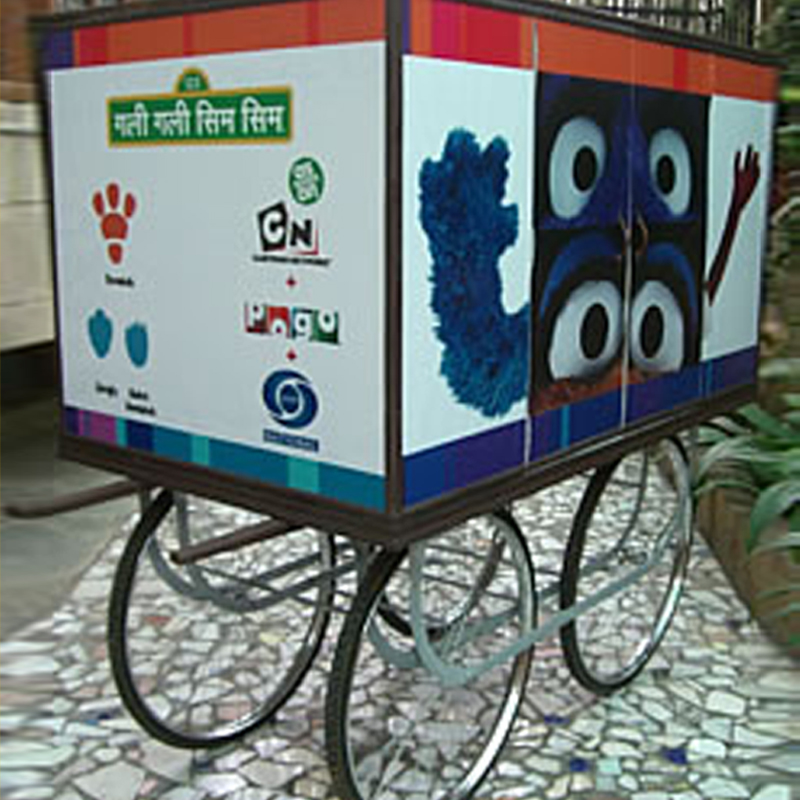
    At the moment, the programme will be shown to children through TV sets carried on designed pushcarts, but the prototype for the bioscope is being readied as well.

    “We have modernised the bioscope and we shall deploy these vends when these are ready to slums as part of our programme for mass education for those millions of children who cannot access TV,” Shaswati Banerjee, executive director Sesame Workshop India (SWI), which runs the programme, tells indiantelevision.com.

    The programme, Galli Galli Sim Sim, is a hit on Doordarshan and Pogo channels, with the TG of two to six-year-olds, and the funding for the initial educational outreach was provided by a corporate social responsibility grant from Turner Entertainment Networks Asia. In an effort to reach these millions, SWI, a subsidiary of Sesame Workshop, the non-profit educational organization behind Galli Galli Sim Sim and other educational media for children, has kicked off a mobile viewings programme, in which during the first phase, starting 15 February, one branded pushcart with a TV set and a DVD player will reach the poorest of slums and show the programme.

    Banerjee explained that the trial phase, in which a Maruti van was used to take the programme to the slums, proved too costly and could not give the intended impact. Hence, they designed a pushcart that can be taken to any corner of a slum.

    “Initially, we reached 22,000 children over the 25-day period of the pilot project. Using the cart, we shall be able to show the programmes to much larger numbers and run the programme during the whole day,” Banerjee said.

    She added that the cart is fitted with cells that would do away with the necessity of power connection, which means it would be able to look at localities where there is no regular power supply. Over all, this changed mode of delivery will increase the number of screenings from just three a day to between eight and 10. The trial with five pushcarts will start in Sanjay Colony, Bawana and Madanpur Khadar slums of Delhi, and in five locations in Mumbai, including Dharavi, Gavandi, Borivili and two other places yet to be finalised, she added.

    January to March will be the testing period, and from April the full programme will be launched. Sometime about then, the bioscope boxes, once extremely popular as entertainment source in villages and small towns, will be introduced as well.

    Testing of the prototype replacing the TV set with the bioscope will start too.

    The baseline survey will be conducted and impact measured during the pilot project. And finally the impact-based model for delivery will be worked out, Banerjee said.

    The cost per child, the ratio that funding agencies use to measure, varies according to the models, of which there are two, she added.

    In the outreach-based model, which is the pushcart with TV set model, in which the programmes are screened and also educational material left with the NGOs handling the Balwadis, costs Rs 25 per child.

    The cost for the impact-based model, in which only educational materials are given, costs Rs 15 per child. These are the ones being tested before being scaled up and become replicable across the country.

    Galli Galli Sim Sim is the Indian version of the world-renowned children’s television series Sesame Street, and airs on Cartoon Network, Pogo and Doordarshan.

    Commenting on the successful completion of the first phase of Galli Galli Sim Sim’s outreach initiatives, Soumitra Saha vice president, regional entertainment advertising sales for Turner Entertainment Networks Asia, said: “Turner’s partnership with Sesame Workshop goes beyond television.

    “Given how many young children in India don’t have access to basic educational and developmental needs, it is highly rewarding for Turner to partner with Sesame Workshop in their carefully created and well coordinated educational outreach programme to help fill this gap.”

    Based on the work in the pilot phase, the Michael & Susan Dell Foundation has awarded Sesame Workshop a grant, which the organisation will use to support Sesame Workshop India to research, develop, and implement similar educational interventions in slum areas in India’s six largest cities such that there are measurable improvements in children’s learning outcomes.

    “Sesame Workshop India’s unique outreach programme reaches large numbers of children and instills them with the power of learning at a very early age, which is extremely important in a country like India where several million children drop out of school before they reach the fifth grade,” said Barun Mohanty, Director of the Michael & Susan Dell Foundation in India.

    “Equally impressive is Sesame Workshop India’s commitment to measuring its impact on learning levels to ensure sustainable, positive changes in early childhood education, Mohanti added.

    “We are excited to help bring this program to India’s urban slums, as Sesame Workshop India draws upon its global expertise and lessons learned from similar communities in Egypt, South Africa and elsewhere,” Mohanti emphasised.

    The initiative is estimated to reach over 1.5 million children and caregivers over the next five years.