Tag: Telewise

  • Covid learnings: Brands need to remain authentic & relevant to their customer base

    Covid learnings: Brands need to remain authentic & relevant to their customer base

    MUMBAI: More and more, brands are focusing their energies on Bharat, which is poised on the cusp of vast prospects and explosive growth. Kannada is widely regarded as the country’s first success story from a regional language market standpoint. Many marketers have already switched to targeted, localised promotions instead of pan-India campaigns that blow out their budget. While it is apparent that the pay-off from regional and hyper-localised advertising is increasing, there still remains the question – which medium gives the best reach and dividends? The second session of the Tele-wise Kannada virtual summit had retail players and marketers, from national to Karnataka-focused brands, discuss the scope of content, advertising and distribution fronts in the Kannada market in the foreseeable future.

    The event organised by the Indiantelevision.com, in association with Colors Kannada, was moderated by Eggfirst advertising & design COO Kunal Jamuar, and consisted of esteemed panelists including: N Ranga Rao & Sons (manufacturer of Cycle Pure Agarbathies) CEO, Arjun M Ranga, Max Fashion India SVP marketing Jiten Mahendra, Levista Coffee VP, S Shriram, MK Agro Tech (Sunpure oil) head – brand marketing Vijesh C Vijayan, Wavemaker India chief growth officer & office head – south Kishan Kumar Shyamalan and Lodestar Um executive VP Laya Menon.

    The ripples caused by the pandemic are still affecting consumer behaviour and consequently, brand’s choices. Several hard and fast rules have gone out the window and new learnings have been gleaned.

    Max Fashion’s Jiten Mahendra said they were shocked by the lockdown just when the brand’s new collection was about to be launched. But they recovered soon. “We have become more omni-channel now. Eight to nine per cent of the business is coming from e-commerce, where earlier it was just three per cent of our sales and 90 per cent came from retail. May onwards we were able to launch in more markets.”

    Moreover, major operations have been shifted into the virtual realm from brick n mortar and many cross functions like home trial, video etc have been added to enhance customer experience.

    Mahendra went on to add: “Pre-covid, each channel had a separate KPI and brands were trying to deliver that. Now, brands are not channel driven. They need to be authentic and relevant to the customer base.”

    Ranga shared that as a consumer-focused brand they had to keep connected with their customer; to this end they organised online pujas across temples in Karnataka. “We also became more tactical. We moved out of big sponsorship and did smaller localised commercials,” he added.

    One needed to be quick, sharp and adapt their media mixes given the circumstances. “We realised the benefit of print advertising and our online business has of course increased exponentially. But for us, 95 per cent is still TV, with GECs topping the genre.”

    Levista Coffee’s Shriram said that after tasting unprecedented success during last year’s  lockdown and the subsequent months, the brand further stepped up its visibility in the media. On television, they tied up with Chennai Super Kings as coffee partners for the IPL which helped establish their presence further.

    “CSK is not a team, it’s an emotion, and IPL is entertainment. We created CSK ads and showed it in GECs and radio stations focusing on match scores. It was a measured risk which paid off,” he elaborated.

    Ranga added, “Our brand takes the third umpire branding on IPL as much as we can get with the tagline ‘Everyone has a reason to pray’.”

    On the other hand, Max Fashion took the conscious call not to associate with the previous season of the IPL. “Instead we went for Hotstar and targeted women-driven content. We had a far better engagement and affinity. Our core TG is women, the second TG is youth. We have done a lot of ground-level activations where it’s not just dependent on reach but engagement,” revealed Mahendra.

    When it comes to viewership, Kunal underlined a curious dichotomy – while digital growth has been mainly driven by women audiences, TV saw a lot of joint or male driven increase in viewership, which has made it a truly mass viewership medium following the lockdown.

    Talking about how brands are adapting to the medium’s gender dynamics, Sunpure’s Vijesh Vijayan detailed, “Two year ago, we decided to break the gender barrier. Today, our category isn’t dominated purely by one gender. The pandemic has shown us that everybody is a cook. So, our TG is not just women, but anyone who wants to cook or eat – basically anybody who loves food is our TG.”

    Jamuar pointed out that while a metro like Bengaluru tends to overpower the rest of regions when it came to content programming and marketing, it is important to give regional markets their share of inputs. Hence, planning for both sections needs to be separated. When it comes to TV it remains the lowest cost per 1,000 and each regional channel in the state has its pockets of viewership, he noted.

    Shriram felt the quality of content in the Kannada genre has improved tremendously with a lot of colourful fiction programs happening. “But as an advertiser, I would love a breakthrough in how our programming is planned in the GEC segment, which could be a game-changer.”

    Laya Menon felt while regional TV has a  “mass-ish sort of audience” there is “increasing alienation from youth, with the latter moving away to other mediums or screens like OTT/ digital.” So there’s a gap to ensure how to keep TV relevant – whether a national or regional channel – with content that will appeal equally or maybe even skewed to youth can reap dividends for advertisers , brands, broadcaster et al.

    Wavemaker’s Kishan Kumar concluded that just like marketing, in TV content, too, people today look for honesty and emotions at the core, things closer to life. Hence the content needs to mirror that and reflect our society in a better way.

  • Tamil Nadu viewers glued to TV; digital catching up fast

    Tamil Nadu viewers glued to TV; digital catching up fast

    MUMBAI: The advertising and marketing industry at the first edition of Tele-Wise Tamil urged the industry to look at TV and digital as two wheels rotating around one axis. They emphasised that the growth of television in any market can’t be calculated without considering that though being invented as isolated units, TV and digital have merged into one big medium now, because of technological advancements.

    Lowe Lintas regional creative officer Kapil Mishra said, “Whenever you ask someone to imagine a television, they either think of a box or a flat-screen on a TV unit. But TV is not just the hardware; it is also its software. Technology has separated these two and has liberated the software. Now, television is everywhere; on your phones, laptops, and your tablets.”

    He continued by saying that this segregation of TV software and hardware has greatly impacted the TV-viewing culture in every market. He insisted that now marketers and advertisers have more opportunities to harness this medium to reach their audience.

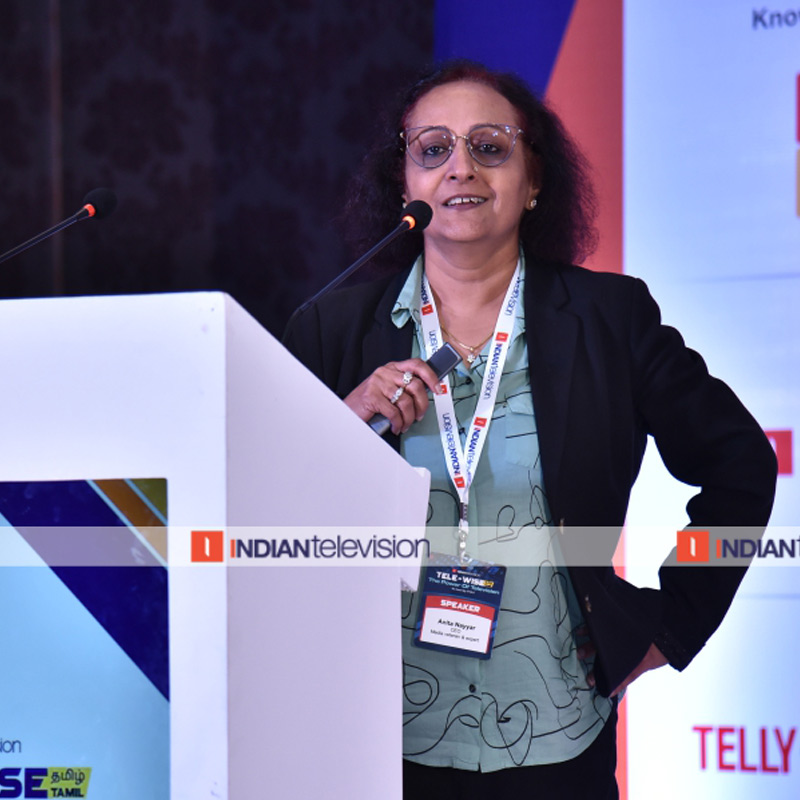
    Havas Media Group CEO India & Southeast Asia Anita Nayyar shared similar thoughts as she mentioned that one can’t neglect the role of digital in driving the growth of television medium. “When we think of TV, we should think audio-visual. The content is becoming screen-agnostic now.”

    Elaborating more on the potential that the Tamil Nadu market has for digital and TV media, Nayyar noted, “Tamil happens to be the third-largest content language being consumed online. 42 per cent of the population in Tamil Nadu has internet and mobiles. 42 Tamil channels have crossed more than 1 million followers on YouTube. Sun NXT today is talking about 1 crore installs of its app. In fact, Tamil originals are working great on other OTT platforms like Netflix, Amazon Prime, and Hotstar as well. Mobile definitely is the next most important device in one’s hand for content consumption.”

    Nayyar, however, also insisted that growth of alternate screens won’t perish the TV in its original form in Tamil Nadu or India.

    She highlighted that while the TV viewership in the country grew by 13 per cent in the last year, in Tamil Nadu this number was 14 per cent. She added that in South India, Tamil Nadu noted the second-highest time spent on television at 215 minutes a day vis-a-vis 245 minutes of Andhra Pradesh.

    Shedding some more light on the TV-viewing patterns in the state, Nayyar said, “Tamil Nadu is completely hooked to television. They prefer entertainment over any other genre. At prime time, 73 per cent of viewership is for GECs, which actually falls to an all-day average of 65 per cent. Tamil GEC is at 55.5 per cent in terms of genre preference, and the top shows are recording up to 23.4 TVRs, which are unheard in today’s time. People also prefer to watch movie channels during prime time. News and music viewership is quite low in the night time but they are most preferred in the morning.

    Tele-Wise Tamil was the inaugural edition of Indiantelevision.com’s Tele-Wise series that aims to look into the opportunities that regional markets have for broadcasters, advertisers, marketers, and other related shareholders. The event was concluded in Tamil Nadu recently with a number of industry veterans and experts in presence.