Tag: television ratings

  • News18 Rajasthan claims pole position in news category with 39 mn YouTube views

    News18 Rajasthan claims pole position in news category with 39 mn YouTube views

    Mumbai: According to Crowdtangle, Tubebuddy, and SocialBlade, News18 Rajasthan has surpassed all other news brands in the digital media landscape with 39 million YouTube views.

    Network18, has been leading on the digital front with 200 million digital unique viewers per month. In India, two out of every five internet users access Network18’s digital platforms for original programming. The reason for this achievement has been the viewers’ consumption habits.

    News18 Rajasthan stated that they have experienced exceptional growth online as a consequence of its smart programming and real-time delivery of current events.

    The fact that market share is consistently growing across segments is evidence of how well News18 Rajasthan’s offering of news, insights, and analysis has connected with viewers.

    The channel has helped establish new benchmarks in the news broadcasting industry, and the channel’s most recent achievement demonstrates how the audience prefers News18 Rajasthan for information on key subjects, without any bias and ensuring coverage of all points of views.

  • Audiences have replaced slots as the new language of transaction: Kantar’s Puneet Avasthi

    Audiences have replaced slots as the new language of transaction: Kantar’s Puneet Avasthi

    Mumbai: Following the ratings controversy in the US that led to the revocation of Nielsen’s MRC accreditation, the TV measurement Company late last month announced an “Impressions First Initiative” to support an industry-wide move to impression-based buying and selling in local markets across the US. This shift to an impression-based currency will lay the groundwork for implementing Nielsen ONE – Nielsen’s single cross-media product – across local, national, and digital measurement.

    The alacrity with which the Company has acted indicates the growing importance of CTV measurement for advertisers and how it has been at the core of the entire unrest. Closer home, similar voices are being heard, though at a much lower intensity. One may recall that at the height of the Barc TRP controversy last year, a section of the industry had expressed dissatisfaction with the ratings agency’s efforts and even intentions to bring forth a unified, cross-platform measurement system.

    According to Ormax Media’s recent research, the Indian OTT audience universe is now 353.2 million people, translating into a penetration of 25.3 per cent. This means that one in four Indians watched online videos at least once in the last one month. CTV viewing in India increased by 31 per cent as per mediasmart’s India CTV Report 2021. Amazon streaming services that were once considered niche in India are today being accessed by 99 per cent of the pin codes in the country. Now that Amazon has turned into a super app with the launch of Prime Video Channels, further massification is expected. Add to all this, the availability of linear TV on OTT platforms, and the medium becomes a staple in media plans for brands across categories.  

    Needless to say, advertisers are clamouring for a third party measurement system for OTT and a unified metric across linear and connected TV that serves all their data needs. While there is no industry body that has been recognised as the standard, individual players both global and independent, are working to meet marketers’ demands, with each contributing its own unique technology, methodology as well insights to evolve a robust and competitive OTT measurement ecosystem in the country.

    Taking the discussion forward, Indiantelevision.com’s Ashee Sharma connected with Kantar director (specialist businesses) –South Asia Insights Division, Puneet Avasthi to understand the work being done by the data and insights Company in the field of OTT measurement in India, and the shift in TV measurement over the years.

    Edited Excerpts:

    On the big shift in TV measurement

    The advertising market has seen a significant shift in recent years with the old order of having TV commercials placed on (time) slots changing. Instead of slots, audiences are being sold today, and that has become the new language of transaction. In the old linear TV viewing world where there used to be a fixed time for a content piece, we were measuring the viewership for a particular time spot. But now as viewership and programming become non-linear we have to offer audiences in terms of size and profile, at a particular point in time, and on the content of choice. This effectively means that what used to be a time-centric measurement system is today viewer-centric.

    On the challenges of measuring OTT

    OTT Measurement is challenging because, one has to not just measure the time when the audiences are available online but, also what content are they watching on the OTT platforms. In the earlier world, the task was principally to estimate how many people are going to be watching TV and which channel, and that could be used to ascertain the particular programme being watched and therefore you had the rating. Now you are estimating not just the viewership at a particular time slot, but also looking at the content that has been specifically beamed into a device. So, media measurement is going to be about both time as well as the content.

    On the problem of duplication

    In a world of multi-screeners, it is possible that a million impressions that have been counted might actually be fewer because the same individual who is toggling screens may have been served the ad multiple times. Therefore, when it comes to OTT viewership we should ideally be capturing the frequency i.e. how many times someone has watched a particular ad, and not how many times it was served. The latter is what the OTT platforms are able to tell anyway. 

    On how Kantar is addressing these issues

    Kantar, along with its partner VTION, measures OTT viewership through a consent-based app that can be installed on android devices of people who have been recruited into a 16000-strong panel online. We focus on all on-mobile viewership in towns that have a population of over one lakh. Since it is a recruited panel we have a fairly good understanding of the audience profile. The system allows us to tell the time of viewing and the content that is being watched. It is also possible to extend this service to measure ‘what ads have been served on various devices’, and therefore, theoretically speaking, it is possible to assess the reach of advertising, online.

    Another level at which we measure OTT is through the annual baseline or internet usage study called ICUBE. It is conducted on a sample size of 75000 to determine the reach of the internet across urban and rural India. Within that we track the usage of different internet services which includes video entertainment as well; OTT specifically. This gives us an idea of the reach and how it has evolved over a period of time for different OTT platforms.

    On Convergence

    Eventually, there has to be a convergence where one is able to integrate the viewership of programmes across different modes of content delivery, whether linear on OTT. That is something everybody is working towards. There are technologies that are available. 
  • ViacomCBS teams up with VideoAmp for TV Measurement after Nielsen loses accreditation

    ViacomCBS teams up with VideoAmp for TV Measurement after Nielsen loses accreditation

    New Delhi: Media and entertainment major ViacomCBS on Tuesday announced its partnership with software and data platform, VideoAmp for TV measurement data, possibly leading the way for other networks as they explore alternative means of counting their audiences.

    The announcement comes weeks after the US industry watchdog Media Rating Council (MRC) suspended the accreditation of Nielsen’s TV rating service. The suspension of the decades-old TV rating service followed a long standoff between Nielsen and the networks over the former’s services, including discrepancies in the data shared by the company during the pandemic. It was for the first time since the 1960s, that Nielsen’s measurement lost a “seal of approval” from the industry that uses it, leading advertisers and TV networks to seek alternate means of counting their audiences. 

    According to the partnership announced on Tuesday, VideoAmp will provide ViacomCBS with an alternative currency to plan, transact and measure national media campaigns accelerating the company’s multi-currency strategy. ViacomCBS which owns CBS, cable networks including Comedy Central and Nickelodeon, and ad-supported streaming services Pluto TV and Paramount Plus will leverage VideoAmp’s proprietary commingled TV Viewership dataset to guarantee linear media transactions against age and gender demographics.

    “The measurement marketplace needs diversification. VideoAmp is an innovator who can help us accelerate our vision around the future of currency. We are excited to leverage their platform to bring better insights and better measurement to advertisers and their agencies,” said ViacomCBS COO of advertising revenue John Halley in a statement.

    Additionally, the media and entertainment company will utilise VideoAmp’s data as an underlying currency to create and guarantee delivery of media campaigns against customised advanced audience segments through Vantage, ViacomCBS’ advanced advertising platform. Vantage is a sophisticated data-targeting platform, offering predictive modeling, continual optimisation, and insights to help advertisers understand their audiences and how best to reach them. 

    Meanwhile, VideoAmp aspires to redefine the way media is valued, bought, and sold. “The VideoAmp dataset is known for its scale as well as its proprietary methodology of combining STB and ACR data into a unified dataset, which enables a de-duplicated view of media delivery and advertising performance against any audience across traditional TV, streaming video, and digital media,” said the data platform in a statement.

    “We are thrilled to be partnering with ViacomCBS as an alternative currency as they go into a new broadcast season. We truly value ViacomCBS and its forward-thinking strategy when it comes to a new era of media transaction, measurement, and, ultimately, the currency options that power it. We want to unlock value for publishers in a privacy-safe way that keeps their audiences at the forefront, regardless of the channel they’re using,” said VideoAmp CEO and co-founder Ross McCray.

  • Republic TV continues lead as genre ratings rise

    Republic TV continues lead as genre ratings rise

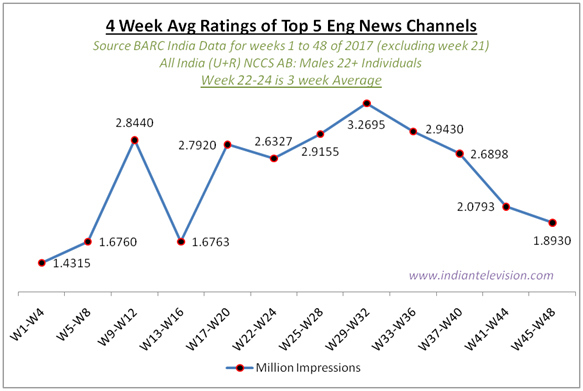
    BENGALURU:Two of weeks earlier, we had mentioned that the English News genre’s four week average ratings and weekly ratings have been falling since weeks 29 to 32 of 2017. The fall continued until week 47 of 2017 when the combined Broadcast Audience Research Council of India (BARC) weekly ratings of the top-five English News genre channels (All India (U+R) : NCCS AB : Males 22+ Individuals) fell to 1.877 million weekly impressions. The leader of the pack right from the week it launched–the Arnab Goswami-headed Republic TV–recorded the lowest ever ratings of 0.511 million weekly impressions in week 47 of 2017. The fortunes of the genre seem to have turned in week 48 of 2017 (Saturday, 25 November 2017 to Friday, 1 December 2017). The combined ratings of the top-five English News genre channels smartly increased to 2.116 million weekly impressions. However, this increase was not enough to avert the genre’s lowest four-week average ratings–1.893 million for weeks 45 to 48 of 2017 since the launch of Republic TV in week 19 of 2017.

    Refer to the chart below showing the four-week average of the top-five English News channels between weeks 1 to 48 of 2017. It may be noted that that the data for week 21 has not been considered in this report and, hence, the four-week average weekly impressions of 2.6327 million for the W22-24 period is actually a three-week average.

    f1_7.jpg

    Revisiting what we had said earlier—with addition of data for weeks 47 and 48 of 2017—the combined ratings of the top-five English News channels for weeks 1 to 48 of 2017 increased from the lowest viewership to date of 1.179 million weekly impressions in week 2 to the highest viewership in week 11 of 4.987 million weekly impressions. The ratings then started to decline until week 19 of 2017 which saw the launch of Republic TV.

    In week 19 of 2017, the genre witnessed its second highest combined weekly ratings of the top-five channels to date of 4.282 million weekly impressions. Republic TV has topped the genre right from the first week of its launch to date in 2017. Goswami’s channel helped increase the genre’s overall ratings but its eyeballs pull could only retard the slow decline that the genre has seen since then as can be seen from the chart above.

    Since news is event driven, the above statements also are evident if one were to go by the four-week average weekly impressions of the combined ratings of the top-five English News genre rather than weekly numbers. As mentioned above, the data for week 21 has not been considered in this report and, hence, the four-week average weekly impressions of 2.6327 million for the W22-24 period is actually a three-week average.

    In week 11 of 2017 (Weeks 9 to 12), elections results in five states of the country were announced and hence the ratings of news channels peaked. Weeks 13 to 16 saw a decline in the genre’s ratings, because week 14 of 2017 saw the launch of the Indian Premier League, which adversely affected the News genre’s ratings. Weeks 17 to 20 were Republic TV’s launch period and everyone wanted to see how Goswami would perform on his new English News channel, the genre’s ratings climbed to a four week average of 2.972 million. The four weeks (or rather 3 weeks’ average in this specific case) of weeks 22-24 was a small blip, and since the other English News channels withdrew themselves from BARC ratings, the data will not be discussed any further here.

    Weeks 25 to 28 numbers for the top-five channels saw the four-week average ratings climb to 2.9155 million weekly impressions, followed by the highest four-week average of the genre in 2017 until now of 3.2695 million weekly impressions in weeks 29 to 32. As is evident from the figure above, the genre’s four-week average ratings have only declined since then.

    Will the genre be able to garner improved ratings for the rest of weeks of 2017? Or will they slide, or remain stagnant? This is something that time will tell.

    Data for week 48 of 2017

    The top-five channels for week 48 of 2017 were the same as week 47 of 2017. The channels retained the same ranks during the week under review as compared to the trailing week, but at the cost of lower viewership.

    As mentioned above, Republic TV held the top rank in the genre during week 48 of2017 with 0.709 million weekly impressions, followed by Times Now with 0.621 million weekly impressions at second place. India Today Television came in at third place with 0.294 million weekly impressions, lower than the 0.340 million weekly impressions it had garnered for week 47 of 2017. NDTV 24×7 was ranked fourth with 0.263 million impressions in week 48, slightly lower than the 0.289 million weekly impressions in week 47. At fifth place was CNN News 18 with 0.229 million weekly impressions in week 48 of 2017 as compared to the 0.25 million weekly impressions in week 47 of 2017.


  • Republic TV, Times Now viewership moves up as genre ratings fall

    Republic TV, Times Now viewership moves up as genre ratings fall

    BENGALURU: The two top-ranked channels of the Indian English news genre saw small increases in their weekly viewership in week 46 of 2017 (Saturday, 11 November 2017 to Friday, 17 November 2017, period, week under consideration) as compared to the nadir of the previous week. Data from the Broadcast Audience Research Council (BARC) show that the genre topper from the time of its launch 28 weeks ago Republic TV saw its ratings increase to 0.566 million weekly impressions in week 46 from 0.524 million weekly impressions in week 45. The second-ranked Times Now saw its ratings increase to 0.502 million weekly impressions during the week under consideration from 0.489 million weekly impressions in the previous week.

    The other three channels from the top five English saw no change in ranks, but decline in viewership in the period as compared to week 45. They were: NDTV 24×7 at third place with 0.260 million weekly impressions (0.299 million weekly impressions in week 45); India Today Television with 0.250 million weekly impressions (0.295 million weekly impressions in week 45); and CNN News18 with 0.185 million weekly impressions (0.205 million weekly impressions in week 45).

    Genre ratings continue declining

    The English news genre has seen a decline in ratings over the past few weeks. Analysis of BARC data for the combined ratings of the top five English news channels for weeks 1 to 46 of 2017 increased from the lowest viewership to date of 1.179 million weekly impressions in week 2, to the highest viewership in week 11 to date of 4.987 million weekly impressions. The ratings then started to decline until week 19 of 2017 which saw the launch of the Arnab Goswami-led Republic TV.

    In week 19 of 2017, the genre witnessed its second-highest combined weekly ratings of top five channels to date of 4.282 million weekly impressions. Republic TV has topped the genre right from the first week of its launch to date in 2017. Goswami’s channel helped increase the genre’s overall ratings, but its eyeball pull could only retard the slow decline that the genre has seen since then as can be seen from the chart below.

    public://englsih.jpg

    Since news is event-driven, the above statements also are evident if one were to go by the four week average weekly impressions of the combined ratings of the top five English news genre, rather than weekly numbers. It may be noted that the data for week 21 has not been considered in this paper and hence the four week average weekly impressions of 2.6327 million for the W22-24 period is a three-week average. Further, the number for the last point on the graph (W45-46) of 1.7895 weekly impressions is a 2-week average.

    In week 11 of 2017 (Weeks 9 to 12), elections results in five states of the country were announced and hence the ratings of news channels peaked. Weeks 13 to 16 saw a decline in the genre’s ratings because week 14 of 2017 saw the launch of the Indian Premier League. Weeks 17 to 20 were Republic TV’s launch period and as everyone wanted to see how Goswami would perform, the genre’s ratings climbed to a four week average of 2.972 million. The average of weeks 22-24 was a small blip, and since the other English News channels withdrew themselves from BARC ratings, the data will not be discussed any further here.

    Weeks 25 to 28 numbers for the top five channels saw the 4-week average ratings climb smartly to 2.9155 million weekly impressions, followed by the highest four week average of the genre in 2017 until now of 3.2695 million weekly impressions in weeks 29 to 32. As is evident from the figure below, the genre’s 4-week average ratings have only declined since then.

    Ratings for the same period of the previous year can’t truly be compared to see if decline is a periodic trend because news is generally event driven as mentioned above. For example, in 2016, demonetisation was announced on November 8; in week 28 of 2017, ratings of the Hindi news genre peaked because the Supreme Court’s Ram Rahim verdict was announced in that week.