Tag: Television

  • Bihar Election 2020 – Political ad spend analysis: TAM data

    Bihar Election 2020 – Political ad spend analysis: TAM data

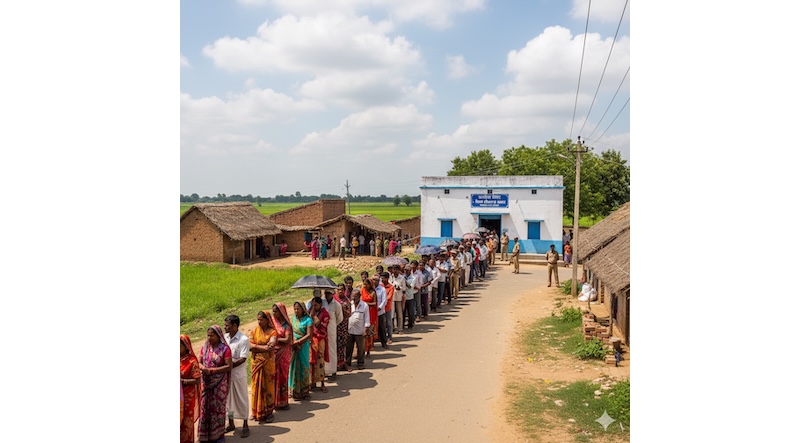
    MUMBAI: The battle for Bihar in 2020 wasn’t just fought on dusty village squares and opposition rallies. It raged across television screens and newspaper columns, with political parties unleashing millions in advertising rupees to woo voters. TAM Media’s advertising expenditure data reveals a lopsided affair: television gobbled up a staggering 93 per cent of all political advertising spend, leaving print media to scrap over a measly 7 per cent.

    The Bharatiya Janata Party emerged as the undisputed heavyweight, commanding 38.7 per cent of overall ad insertions—more than double its nearest competitor. On television, where the real money flowed, BJP’s dominance was even more pronounced at 41 per cent of all ad slots. The National Democratic Alliance, its coalition partner, secured 17.4 per cent overall, with an 18.6 per cent share on television.

    Congress, despite its third-place finish in overall spending at 17 per cent, displayed tactical nous in print advertising. The party ranked second in newspapers with 7.1 per cent of insertions as a standalone advertiser, while a Congress-led coalition (Congress-I/RJD/CPI variants) topped print spending at 15.7 per cent—edging past a BJP-led alliance’s 14.1 per cent.Top 5 ad spenders

    Rashtriya Janata Dal and Janata Dal United rounded out the top five, with 11.9 per cent and 8.9 per cent of overall insertions respectively. The fragmented opposition was evident in the numbers: 25 other parties collectively managed just 6.1 per cent of ad insertions, with print media seeing an even messier 44.6 per cent split among 15 smaller players.

    But the real story lies in the timing. TAM Media’s week-by-week analysis reveals a campaign that began as a whisper and ended as a roar. For the first six weeks—from early September through early October—political advertising barely registered on television. Print maintained a modest but steady presence during this period, with a slight peak in week three.

    Then came the deluge. From week seven onwards, television advertising exploded in a dramatic crescendo. By week nine (25-31 October), TV ad insertions hit their peak at 42 per cent of the entire campaign’s television spend—a staggering concentration just days before polling. Print advertising followed a similar trajectory, peaking at 31 per cent during the same crucial week nine, though it maintained a more consistent presence throughout the campaign compared to television’s late surge.

    The pattern is unmistakable: parties held their fire until voters’ attention was sharpest, then carpet-bombed the airwaves in the final fortnight. Week ten saw a slight decline as polling day arrived, but by then the damage—or persuasion—was done.

    The data, covering political advertisements across Bihar’s television channels and publications during the election period, paints a clear picture: in Bihar’s ad war, television was the main battleground, BJP brought the biggest guns, and everyone saved their ammunition for a final, frenzied assault on voters’ senses. Welcome to democracy, Bihar-style—where timing is everything and the biggest megaphone usually wins.

  • India’s ad market rebounds in H1 2025 as TV steals the show: Excellent Publicity report

    India’s ad market rebounds in H1 2025 as TV steals the show: Excellent Publicity report

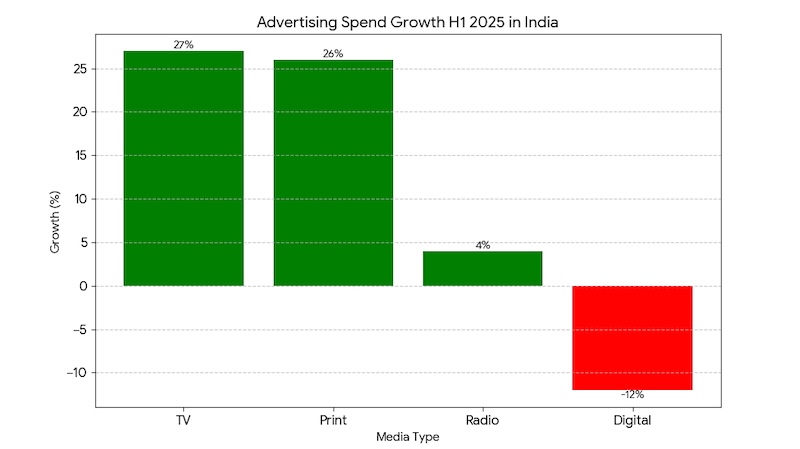
    MUMBAI: Here’s one report which is not talking of doom and gloom as far as ad spends in India are concerned. India’s advertising market kicked off 2025 on a high according to a half-yearly report by ad-tech and media planning agency Excellent Publicity, citing data from TAM Media Research, TAM AdEx and RCS India, reported Business Standard. The report said that  television powered ahead as the biggest gainer in the first half of the year, outspending print and radio, while digital was the lone laggard.

    Ad spends on TV per channel jumped 27 per cent year-on-year. Sports channels hoovered up 68.5 per cent of TV spends, trailed by general entertainment with 15.7 per cent. The e-commerce media, entertainment and social media category led volumes with a 25.6 per cent share. Star India kept its crown with 16.8 per cent of volumes, while Jio Hotstar topped the brand charts. Cellular services were the fastest risers, ballooning 17 times over the year.

    Print was no pushover either, posting a robust 26 per cent growth. Cars took pole position with 8.9 per cent of spends, while two-wheelers zipped ahead with a 31 per cent surge. Maruti Suzuki India was the top advertiser; Allen Career Institute, the top brand. Rajasthan led among states with 15.6 per cent of spends, and Delhi among cities with 7.1 per cent.

    Radio barely moved the needle, inching up 4 per cent. Properties and real estate dominated, cars followed, and pan masala muscled into the top 10. Maharashtra accounted for 19.3 per cent of radio spends, Delhi 18.1 per cent. Maruti Suzuki India again led advertisers, while Jeena Sikho Lifecare was the top brand.

    Digital, by contrast, shrank 12 per cent – the only medium to contract – though it logged the highest number of advertisers in three years. E-commerce online shopping led with an 11.2 per cent share. Amazon Online India was the top advertiser, Amazon.in the top brand. Programmatic buying made up 88.3 per cent of spends. Some niches bucked the trend: washing powders and liquids soared 21 times, perfumes and deodorants six times.

    “What’s really interesting is how brands are navigating a delicate balance,” said Excellent Publicity co-founder and director Vaishal Dalal.. “TV still captures attention, radio keeps the connection local and relatable, print is earning back trust, and digital is becoming sharper and more targeted.”

    Strangely the report did not talk about  outdoor spends. Was the situation hunky-dory in the sector like TV?

  • Eight years of GST: India’s landmark tax reform turns a corner

    Eight years of GST: India’s landmark tax reform turns a corner

    MUMBAI: Eight years after its midnight launch, the Goods and Services Tax (GST) stands as a defining milestone in India’s economic reform journey. Introduced by the Modi 1.0 government on 1 July 2017, GST replaced 17 indirect taxes and 13 cesses, creating a unified tax system aimed at transforming revenue collection and compliance mechanisms.

    From its inception, GST has aimed to simplify the tax landscape and improve compliance—especially for small and medium enterprises (SMEs). Prime Minister Narendra Modi recently reiterated this in a social media post, calling GST a “powerful engine” of economic growth and an exemplar of cooperative federalism, where states act as equal partners in market integration.

    GST revenues have seen consistent growth—from Rs 7.19 lakh crore in 2017–18 to Rs 22.08 lakh crore in 2024–25. Registrations have more than doubled, rising from 60 lakh to 1.51 crore active taxpayers. The government credits this to technology-led compliance features such as e-invoicing, auto-populated returns, AI-driven analytics, and e-way bills, which together have helped reduce fraud and encourage voluntary adherence.

    The media and marketing industry has also undergone a structural shift under GST. Earlier fragmented under multiple state-level service taxes, the sector now operates under a more uniform 18 per cent GST slab, enabling centralised billing and improving cash flow predictability for agencies and broadcasters. For the television industry, in particular, GST eliminated disparities between content producers and distributors across states, streamlining operations and reducing cascading taxes. However, smaller agencies have flagged concerns about delayed input credit refunds and compliance costs, prompting calls for more sector-specific easing.

    Leaders across industry reflected on GST’s journey. Anand Mahindra, chairman of Mahindra Group, called it “India awakening as a common market for the first time.” Vijay Shekhar Sharma, founder of Paytm, termed GST “the dawn of a new India.” Kiran Mazumdar-Shaw, executive chairperson of Biocon, described it as “transformational,” while also calling for further simplification.

    Despite progress, key issues remain. Over two lakh disputes are pending due to the delayed establishment of GST appellate tribunals. The presence of multiple tax slabs and inverted duty structures—particularly in textiles and fertilisers—continues to create inconsistencies. Petroleum products and real estate remain outside GST’s ambit, limiting its scope as a truly comprehensive indirect tax.

    Tax experts from PwC India advocate for rationalising the rate structure to three tiers and gradually bringing petroleum products under GST to remove economic distortions. The GST Council has indicated that such reforms are under active consideration. Plans to operationalise 31 appellate tribunals by December aim to address the litigation backlog.
     

  • JioStar blitzes in FY 2025, clocks Rs 10,006 crore in revenue since merger

    JioStar blitzes in FY 2025, clocks Rs 10,006 crore in revenue since merger

    MUMBAI: JioStar is scripting a blockbuster success story, delivering a knockout performance since its merger launch on 14 November 2024. The entertainment juggernaut reported gross revenues of Rs 10,006 crore and an EBITDA of Rs 774 crore, posting a margin of 7.7 per cent — all while still ramping up operations.

    At the heart of this meteoric rise lies JioHotstar, the OTT powerhouse that debuted on 14 February 2025 and rapidly changed the game. Within just five weeks, JioHotstar crossed the milestone of 100 million paid subscribers — a feat unrivalled in the Indian streaming landscape. By March-end, monthly active users (MAUs) hit a staggering 503 million, thanks to a blockbuster calendar packed with the ICC Champions Trophy, IPL, and a digital library boasting over 320,000 hours of content.

    Sport was JioStar’s turbocharger with IPL 2025 opening with fireworks, clocking 1.4 billion digital views (a 35 per cent spike year-on-year), 253 million TV viewers (up 14 per cent), and a colossal 49.6 billion minutes of total watch time across platforms (up 33 per cent). JioHotstar alone posted a dazzling 38 per cent jump in digital viewership, buoyed by a 47 per cent surge in connected TV (CTV) audiences and a 60 per cent higher CTV watch time.

    The ICC Champions Trophy 2025 turned out to be another mega-hit, recording the highest TV ratings ever for a multi-nation cricket tournament in India. The tournament delivered a 4.3 TVR — a 23 per cent gain over the ICC ODI World Cup 2023 — and set a new peak concurrency record with a staggering 61.2 million live viewers during the final.

    JioStar also scored with the Tata WPL season 3, which posted a 19 per cent ratings lift and expanded its reach by 49 per cent. On JioHotstar, WPL viewership surged by 34 per cent, underpinned by a massive 130 per cent growth in CTV engagement.

    In a strategic brand play, all sports channels were unified under the Star Sports banner, now comprising 24 channels — with dedicated Hindi, Tamil, Telugu, and Kannada sports offerings to deepen regional footprints.
    Beyond cricket fever, JioHotstar is claimed to be reshaping entertainment with a new wave of digital experiences. The Mahashivratri night live-stream drew an impressive 39 million views, while Coldplay’s Music of the Spheres tour streamed live to 8.3 million fans, bringing global experiences closer to Indian audiences.

    A new content vertical, “Sparks,” featuring short, snappy segments from India’s top digital superstars, has tapped into the nation’s appetite for quick-binge entertainment — a strategic play to capture Gen Z and millennial attention spans.

    Coupled with its arsenal of premium OTT originals and international content, JioHotstar is fast positioning itself as the de facto platform for premium digital storytelling.

    While the digital frontier blazed ahead, linear TV continued to deliver knockout blows.

    Star Plus cemented its dominance as India’s top Hindi GEC, with six out of the top 10 shows under its belt. Star Gold’s premiere of Stree 2 garnered a reach of 41.2 million, further reinforcing its draw among movie buffs.
    Regional GECs — Star Pravah (Marathi), Star Jalsha (Bengali), Star Maa (Telugu), Star Vijay (Tamil), and Asianet (Malayalam) — retained their #1 spots across states, showcasing JioStar’s deep local connect.

    Meanwhile, niche genres — Kids, Youth, and English — remained the network’s unchallenged playgrounds, extending JioStar’s leadership across every major viewer segment.

    In less than six months post-merger, JioStar has not just delivered on audacious promises — it has rewritten the rulebook. With a dominant hold across digital and linear entertainment, record-breaking sports audiences, and an evolving playbook for new-age content, JioStar is emerging as India’s undisputed entertainment giant.

    As Reliance’s media empire keeps building momentum, it’s clear that for rivals, the chase is only getting harder.

  • Tata Power Renewable Energy partners with Rajasthan discoms to boost solar adoption

    Tata Power Renewable Energy partners with Rajasthan discoms to boost solar adoption

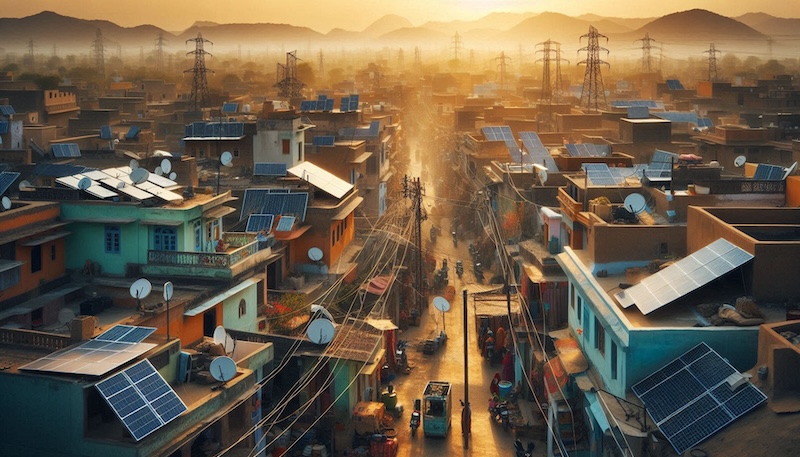
    MUMBAI: This one should be of interest to the television broadcasters, telecom companies, DTH players, and cable TV MSOs and operators.  A bane of most of these has been the sudden power breakdowns in the tier two and tier three towns. With the installation of rooftop solar power cells, the power tripping would be a thing of the past. 

    Tata Power Renewable Energy Ltd (TPREL), a subsidiary of Tata Power, has signed a memorandum of understanding (MoU) with Rajasthan’s discoms — Jaipur Vidyut Vitran Nigam Ltd (JVVNL), Ajmer Vidyut Vitran Nigam Ltd(AVVNL), and Jodhpur Vidyut Vitran Nigam Ltd  (JDVVNL). The collaboration aims to accelerate renewable energy adoption across the state, with a focus on promoting the Pradhan Mantri Surya Ghar: Muft Bijli Yojana (PMSG:MBY) in residential sectors.

    The agreement was formalised in the presence of Alok, additional chief secretary (energy); Arti Dogra, chairperson of the discoms; and senior officials from TPREL, including Deepesh Nanda, chief executive officer &  managing director, and Shivram Bikkina, chief of solar rooftop & EV charging.

    The initiative will prioritise rooftop solar installations in cities such as Jaipur, Udaipur, Jodhpur, Kota, and Bikaner, with plans for statewide expansion. Joint campaigns will promote solar adoption, providing households with affordable clean energy. The partnership also offers exclusive pricing and vendor training to ensure efficient installations.

    Speaking on the collaboration, Arti Dogra said, “This partnership marks a significant step towards positioning Rajasthan as a leader in solar energy adoption. By advancing initiatives like PMSG:MBY, we aim to provide clean, affordable energy access and bolster the state’s renewable energy infrastructure.”

    Deepesh Nanda added, “Our partnership with Rajasthan discoms reflects our commitment to shaping a sustainable energy future. Leveraging TPREL’s extensive experience, we aim to expedite solar adoption and support Rajasthan’s renewable energy transition.”

    As part of the Tata Group, Tata Power holds a diverse 15.5 GW portfolio, with 43% dedicated to clean energy. The company remains committed to achieving carbon neutrality by 2045 and continues to play a leading role in India’s clean energy transformation.

  • Unisys Infosolutions gets favorable Delhi high court injunction order against pirating websites

    Unisys Infosolutions gets favorable Delhi high court injunction order against pirating websites

    the domains.

    MUMBAI: Pirating websites in India beware. December has brought some bad news for you. Earlier this month, the Delhi High granted a permanent injunction order against 71 web sites which were pirating media tech firm Unisys Infosolutions content online.

    Unisys owns the copyright to a catalogue of 60 plus regional films which it exploits on YouTube under the channel  Saga Hits, on its own OTT  platform Kableone and other third-party platforms. The films have either been produced by it or in collaboration with other producers or acquired and include titles like Zindagi Zindabaad, Cheta Singh, Snowman, Kulche Chole, Television, Posti, Maa, Warning, Ikko Mikke, Happy Go Lucky, Manje Bistr, The Black Prince and Zindagi Kitni Haseen Hay.

    Sites such as desicinemas.tv, desicinemas.pk, tellygossips.tv, movies23.pk,  among many others were illegally show casing Unisys’ catalogue  of films and making money either off advertising online or through subscription fees. Hence, it filed a suit against them, including Google, ISPs, the department of telecommunications (DoT) and  ministry of electronics and information technology (Meity) as defendants.

    The Delhi high court, after listening to Unisys’ lawyers arguments, passed an injunction against the sites from showing the films and because the owners of the sites are not locate-able, it ordered Google to stop indexing them on its search engine. Additionally, it ordered the registrars and internet service providers to block the rogue domain names and make them inaccessible from Indian shores.  Finally, it ordered DoT and Meity to ensure that its orders for blockage are followed to the T by issuing a government notification in this regard.

    The court also issued a Joh Doe order under which any other future infringing or rogue sites would be treated similarly. Additionally, the court ordered Unisys to continue to inform the court about the progress of the blockage of the  current rogue web sites. mentioned in the petition

    The counsel for Google who was present in the court accepted the government’s notice and order and agreed to go ahead  with the government’s directions.

    However, a media  observer stated that while the order is a landmark one, Unisys will have to be on the alert as the rogue websites will easily move the content to another domain or URL.

    “The battle to overcome piracy is not over until those behind the piracy are put behind bars and the servers taken down,” she said. “This requires multinational coordination between legal authorities in neighbouring countries like Pakistan. Some of this is already happening in Europe where coalitions against piracy in various countries  are working together with the police  to book online pirates, apart from taking blockage measures.”

    Is anyone out there listening?

  • 2024 The year that was – Convergence redefines India’s media landscape

    2024 The year that was – Convergence redefines India’s media landscape

    MUMBAI: As 2024 draws to a close, India’s media and entertainment sector has undergone a profound transformation, reshaping how content is created, distributed, monetised and consumed. The industry’s trajectory is no longer defined by linear growth but by convergence – a blending of formats, technologies, and audience experiences. This article explores the standout trends of 2024 that have positioned India at the forefront of the global media revolution. 

    The Rise of Unified Media Ecosystems 

    In 2024, the fragmentation of content across platforms prompted a surge in unified media ecosystems. Major players integrated cable, satellite, and OTT services into seamless bundles. Partnerships like those between Tata Play and JioCinema offered consumers a singular subscription covering live TV, streaming, and interactive content. The merger of Disney+ Hotstar and JioCinema under the JioStar brand will further demonstrate this trend, combining Disney’s extensive content library with Jio’s robust technological and distribution infrastructure.  

    These developments addressed subscription fatigue by offering cost-effective and convenient bundled services. As telcos and streaming players increasingly leaned towards unified offerings, the next pivotal step emerged – creating singular OTT platforms to integrate multiple streaming services under one roof. Scalable and modular architectures have become essential, enabling flexibility and customisation to accommodate evolving service bundles and diverse consumer preferences. This shift underscores the industry’s adaptability in meeting the complex demands of modern consumers. 

    Sports Broadcasting Reinvented 

    India’s sports media landscape saw unprecedented innovation in 2024. Beyond traditional cricket broadcasts, kabaddi, football, and esports embraced hybrid delivery models. Augmented reality (AR) features allowed fans to experience matches with real-time statistics and dynamic visuals, while 5G-enabled immersive experiences brought stadium energy into living rooms. 

    Regional sports leagues also thrived by leveraging vernacular commentary and localised marketing, broadening their appeal and strengthening connections with diverse audiences. These efforts not only amplified audience engagement but also positioned regional sports as valuable contributors to India’s overall sports media ecosystem. 

    AI, Advertising, and Live Commerce Converge 

     Artificial intelligence, innovative advertising, and live commerce emerged as interconnected forces shaping the media landscape in 2024. AI-driven personalisation powered hyper-targeted recommendations and dynamic content delivery, tailoring experiences to individual, regional, or similar preferences. This capability extended into advertising, where AI analytics enabled micro-segmentation and dynamic ad formats. Brands also experimented with shoppable media embedded directly into OTT platforms, allowing users to interact with ads and make purchases seamlessly. 

    Live commerce further transformed engagement by integrating real-time shopping into live events. Cricket telecasts, for instance, featured exclusive merchandise drops available for purchase during key moments. Platforms with modular architectures and seamless third-party integrations supported these innovations, unlocking new revenue streams and enhancing viewer interactivity. These advancements reflect a significant evolution in how audiences engage with content and commerce simultaneously. 
     

    Deltatre

     Content Without Borders 

     In 2024, Indian content flourished on the global stage. Platforms like Netflix and Amazon Prime Video promoted Indian originals, while regional OTT platforms expanded into south Asia, the Middle East, and Africa. This cross-border success highlighted the universal appeal of culturally rich narratives. 

    International co-productions became more common, with Indian creators collaborating with global studios. Flexible monetisation models, including ad-supported, subscription-based, and hybrid offerings, enabled experimentation and growth, allowing platforms to cater to diverse audience needs. This trend underscores the global demand for authentic storytelling and India’s role as a leading content powerhouse. 

    Collaborative Ventures and Audience Co-Creation Redefine Engagement 

    Collaborative ventures between creators, platforms, and brands surged in 2024. Co-productions between Indian and international studios introduced fresh storytelling perspectives, while brands acted as content producers, funding original series that aligned with their ethos. 

    Audiences also became active contributors, engaging in interactive storytelling, user-generated content campaigns, and fan-led initiatives. This participatory approach fostered loyalty and transformed viewers into brand advocates. Platforms embracing flexible monetisation strategies and modular architectures capitalised on this trend, delivering sustainable revenue through community-driven content models. Such initiatives highlighted the importance of deeper connections between creators and audiences in driving content innovation. 

    Looking Ahead: 2025 and Beyond 

    As we step into 2025, the role of technology in shaping India’s media landscape cannot be overstated. Scalable, modular platforms will be critical in enabling media companies to grow and adapt without overhauling their infrastructure.  

    These technological advancements will not only enable cost-effective scaling but also foster innovation, allowing the industry to explore new content formats, distribution models, and audience engagement strategies. 

    India’s media and entertainment sector is poised to lead the way in leveraging technology for inclusivity and innovation. By embracing modularity, scalability, and flexibility, stakeholders can address the complexities of a rapidly evolving market, ensuring sustained growth and global relevance. 

    The author is country manager India, Deltatre.

    (The picture  for this article featured on Indiantelevison.com’s home page was generated using Microsoft’s AI Image generator. No copyright infringement is intended)

  • The ChangeMakers of the year that was 2024: Uday Shankar

    The ChangeMakers of the year that was 2024: Uday Shankar

    Indiantelevision.com brings you the folks who made a difference in 2024 to the media and entertainment industry. It will cover an eclectic bunch of executives and talent from television, film, OTT, advertising, marketing and media industries. Our hope is we end up doing a good job in selecting the right candidates as we write about their achievements in the year just gone by and challenges that lie ahead of them in 2025.

    Any errors of selection or perspective or narrative are inadvertent and unintended. 

    In the meanwhile, enjoy reading about the first of our selection: Uday Shankar who is ushering in change in the media and entertainment space in the streaming era just like Zee TV did in the nineties in satellite broadcasting. Read on to know our perspective on The Man who sees the future, not just tomorrow.

    Uday Shankar: The executive who sees the future, and bets on it

    He looms like a giant over all other executives in the media sector though  from shoes to the tip of his head , he does not exceed 6 ft in height. 2024 was Uday Shankar’s year by far. As will 2025 be.

    A master planner. 

    A master deal maker; he convinced James Murdoch to partner with him to invest in the Indian market  through Bodhi Tree.  More than that, he managed to get the third most powerful man in India (after prime minister Narendra Modi and home minister Amit Shah) Mukesh Ambani to agree to get into bed with Disney Star India (a company he once headed as CEO).

    On top of that, he got the by-then willing Disney CEO Bob Iger to nod in the affirmative for the alliance where the mouse house would cede management control to the Reliance group. The icing on the cake was that he convinced the two of them to give James and himself a piece of the pie in the joint venture that emerged – JioStar.

    Uday now leads a much bigger company – almost twice the size of Disney Star which he once headed. Yes, he has Mukesh’s wife Nita Ambani as chairperson and son Akash Ambani having oversight over his moves. But the reality is what Uday wants, he gets.  He can be persuasive with his cogent arguments and long-vision thinking and projections. Unlike other leaders in the media, Uday sees the future like others don’t. Probably only one other businessman has his way of thinking –  Mukesh Ambani. That’s why he got Asia’s richest businessman’s buy-in for his strategic and tactical moves. Both love to disrupt the status quo  – that’s the common thread between Mukesh and Uday. 
     

    Uday Shankar

    And Uday bets on that future. In most cases, his “third eye” gets it right.

    Now that the joint venture has got past regulatory clearances, Uday has been working on putting his core team in place. And his core team is working on putting their core teams in place. 2025 might see some blood-letting with the excessive manpower (which has emerged on account of  duplicated roles in the two companies)  being jettisoned. Already senior executives who did not fit into his plans for the corporate structure have been eased out.  The merger and joint venture will take some time to digest. Channels have to be shuttered.  Synergies need to be established. But eventually everything will fall into place. It normally does for Uday.

    And then it will be back to business for him. He is an executive on steroids. He, along with Mukesh and team, have probably already decided which streamer is going to lead – Hotstar  or JioCinema. But no announcements have been made. Executives have been told to port Hotstar’s shows on to JioCinema. However, the former’s technology stack is believed to be much more robust than the latter’s.

    The best part about Uday is that he knows how much he knows and how much he needs to know. He supplements what he does not know through his team mates who know a lot more about what  he does not know. (In simple English, he brings in  the best talent to help him). He then trusts them implicitly and delegates fully, something which the Murdochs did with him when he ran their Indian empire. That’s a trust which Mukesh Ambani has also put in him. Of course, there will be the checks and balances that the Ambanis put in the way they manage. But there’s entrepreneurial spirit a-plenty in the world of Reliance. 

    He will need a lot of that if one considers the IPL rights’ investments which both companies made three years back. The figures seem monstrous; but in Uday’s mind, these were bets which had to be made. So far, both advertising and subscription revenues have not matched the money pumped in. He and his troops have to ensure that the gap is reduced. That could prove challenging as the ad market for certain products was soft during the main spending festival period which went by a couple of months ago. There is no doubt he will drive his  foot soldiers hard like a general on the war front to get to their targets even if it seems difficult with bullets and bombs flying around.  And, like he is vaunt to, he will in all likelihood don his uniform and enter the battlefield himself. 

    To his advantage, if the external environment is rough, then there is enough spending ammunition available in-house in the rapid expansion and diversification drive that the Reliance Industries group is making into retail and fast-moving consumer goods. It is already the leading retailer in the country. As well as the leader in telecom and broadband delivery. On the FMCG side, Campa Cola has been relaunched. Snacks have been launched. Many more forays are in the planning stages.


    Uday shankar questions

    These initiatives will need platforms to reach out their advertising communications to consumers. What better ones can there be than Hotstar, JioCinema, Star Plus and Colors and of course the regional channels which are leading in their respective languages in different states. And then of course there’s the IPL which generates zillions of eyeballs in the country. Loyal ones. Still breakeven might be hard, is what observers are foretelling. However, should the wars  – one in the east and the other in the north – that are harming economies end – just like Donald Trumps wants them to – then we might be narrating a different story by this time next year. 

    At heart, Uday is a man who likes to create and tell stories. Under his tutelage, Star India flowered and bloomed like it had not in the past.  Uday understands what consumers want, and, what he did not, he picked up  from his colleague at Star India, the former Hindustan Unilever professional Sanjay Gupta who is now Google’s APAC head.  He  knows how to tell good stories but more than that he knows how to motivate other creative folks around him select good stories and tell them well. Just like he did earlier on in his career when he was a journalist at The Times of India, and  he led teams at the India Today group and at Star News.  

    Uday has been talking television, saying it has long legs within India with 90 million homes and almost 500 million individuals still watching it through pay TV platforms and free DTH from the public broadcaster. He’s determined to take JioStar’s TV channels deeper into India with stories that resonate with the audiences there. But there’s many a problem that plagues those in heartland India like power cuts and load shedding, that makes watching television continuously difficult on most occasions.  Hence, even if he succeeds with the drama series  and stories how will he ensure  continuous power supply? Or will he rely on innovation from within the Reliance group and its partners to help out on this front?

    Mukesh Ambani is quite in tune with prime minister Modi’s ambition to take Indian stories global just like south Korea and Turkey have been doing. Honest well-written Indian-made stories made with high production values, reflecting the modern India. And yes the content  will have to be made relatable to those in foreign lands. Netflix and Prime Video have done that in a small way by pushing India-made TV shows on their streaming platforms. But they have barely scratched the surface.

    It will be up to the likes of Mukesh Ambani and Uday Shankar – actually mostly up to Uday and his band of merry executives  – to take Indian content where it has not gone before.  Aggressive investments in developing original series and films need to be made either alone or as co-producers with international studios that have the know how and the distribution muscle. There’s Rs 11,500 crore that’s been pumped into the joint venture which needs to be deployed well. Some of that could be used to build the JioStar brand at markets like MipCom where the world’s biggest content creating studios congregate every year. 


    Uday Shankar gesticulating

    Within the country, Reliance Jio has distribution deltoids like no one else does.  With 400 million  plus subscribers consuming video – and hence data, either on mobile handsets or on connected TVs – it can only be win-win for the wireless and wired broadband telco. The more JioStar gets people to binge watch, the more the revenue that will come Jio’s way. Either as video on demand shows or as linear channels being streamed. They will contribute towards Jio’s top line as well as bottom line with data costs dropping – and dropping- and incentivising users to consume more.

    We are not sure if this will benefit Uday and his troops as much as it will Jio. But, on the other side, getting preferential carriage and promotional rates will, and could reduce costs for JioStar and its large bouquet of channels and streaming services.  Synergies there are a-plenty definitely, despite what we have been told. And what the regulators have been told too.

    2025 will keep Uday busy.  He is likely to emerge even stronger as the year goes by.  Most regard him as one of the top media – no, top business  –  leaders in India;  some say even globally (We, at indiantelevison.com tend to agree). And that’s no mean achievement for a media maverick who used to once travel on a two-wheeler to work every day as a journalist.  

  • Warc revises ad revenue growth estimates upwards for 2024

    Warc revises ad revenue growth estimates upwards for 2024

    MUMBAI: Bullish is the mood at marketing effectiveness specialist Warc. The  firm had forecast in August 2024 that global advertising spend is on course to grow 10.5 per cent this year to a total of $1.07 trillion. Now, it has revised that growth upwards by 0.2 percentage points; its latest projection is that ad spends globally will grow by 10.7 per cent to touch  $1.08 trillion – the strongest growth rate in six years and the largest absolute rise on record if the post-Covid recovery of 2021 (+27.9 per cent year-on-year) is disregarded. 

    Warc’s latest global projections are based on data aggregated from 100 markets worldwide. Online media is on course to drive the growth,  a good year for TV has also made a notable contribution. The good news is that spends on linear TV are rising and are expected to end the year higher by 1.9 per cent, at $153.6 billion, following two years of slippage. Political TV adverts (especially in the US), the Paris Olympics and Euro football in Q3 have buoyed the spends on TV. However, before you start apart applauding please note that  linear TV’s hold today stands at just 14.3 per cent of global advertising spend, much, much lower than the heady days of a 41.3 per cent share in 2013. 

    We have all heard it before: Alphabet, Amazon and Meta are Pacmen increasingly swallowing up ad dollars in large chunks of billions every year. Warc data supports that. It stated that pure play online internet businesses like that of the three big tech firms, will see ad revenue growths of 14.1 per cent reaching $741.4 billion – accounting for a total of 68.8 per cent of all spends. Gadzillions!

    Social media ad spends are expected to leap upwards by 19.3 per cent reaching $252.7 billion -equalling 23.5 per cent of the total ad market. This is mostly because the sales folks at Facebook, Instagram and TikTok have been selling hard leading to better than expected results at the three firms during the first nine months of this year. 

    Overall ad spend growth is also expected to be buoyant next year at 7.6 per cent in 2025, and seven per cent in 2026 taking the global ad market to $1.24 trillion. For all those who have been doomsayers predicting the slamming of brakes on advertising here’s some facts: global ad investments have more than doubled over  the past 10 years and have grown 2.8 times faster than global economic output since 2014.

    Warc director of data, intelligence and forecasting and author of the research James McDonald said: “Our latest forecast anticipates $104bn in incremental advertising spend worldwide this year, the largest rise in history if the post-pandemic recovery year of 2021 were discounted. Whether this boom will sustain remains unclear, however, as 2025 presents a sliding doors moment due to heightened regulatory pressures on Google and TikTok – together a quarter of the ad market outside of China. This, alongside an increasingly challenging geopolitical climate, may spell uncertain times ahead for the businesses that rely on advertising trade.”

    (The image for this report was created using OpenArt AI. No copyright infringement is intended)
     

  • Why you should watch Colors’ Bigg Boss18

    Why you should watch Colors’ Bigg Boss18

    MUMBAI: I used to be a proud advocate of Bigg Boss, championing it as the epitome of human emotions and behaviour. I’d write blogs and tell anyone who would listen that it was a grand experiment in teamwork, polarization, resource mobilisation, negotiation, storytelling and the delicate dance between truth and lies that could turn tides faster than you could drop your popcorn. Some seasons were not to my liking, and some taught me a few lessons. I even predicted the end of Bigg Boss and called it a deadly social experiment that the HR department can copy for an offsite. I auditioned for the show one fateful day and am happy that I did not make the cut. Bigg Boss needs a reality check

    It was, of course, before Vermajee—my dear friend, soul mentor, and consultant in all non-working things in life said. It opened my eyes to the actual sincerity of it all. His wisdom, delivered with the gravity of a man who had mastered the art of sidestepping unnecessary drama, made me see Bigg Boss in another shadow. 

    Let’s face it. When it comes to quality television, nothing quite compares to the highbrow, intellectual oasis that is Bigg Boss. Because who wouldn’t want to watch a group of people—handpicked for their impressive lack of emotional regulation—battle it out in an elaborate social experiment that makes a corn maze for mice seem like the height of human achievement? 

    Allow me to walk you through why this epic display of “reality” deserves your full attention. Grab some popcorn, lean back, and marvel at this masterpiece’s sheer brilliance. The moment of truth is here. Here’s what Vermajee said. Was that not a big thumping whack on my head? 

    No One Ever Doubted The Real Test Of Human Behaviour

    Have you ever wondered how people behave when locked in a house, deprived of dignity, and prompted by whispering producers? Vermajee insists that Bigg Boss provides that valuable insight which you never asked for. It’s like watching a Roman gladiator match, except the contestants are armed with petty insults and inflatable egos instead of swords. And they have a constraint- they cannot get physical- I mean in terms of fights. Would you not agree that it is truly an anthropologist’s dream and for the audience, a release from the pressure cooker called life? 

    The whole show is an arena where emotionally volatile individuals are crammed together in a space smaller than your average Ikea display room, forced to coexist like caged animals. You’ve got your classic tropes: the guy who can’t control his temper, the girl who cries at the drop of a hat, a person still trying to find the pronoun to respond to, a couple deeply in love with but with controversial background, someone who is trying to repurpose life and the one who’s just there to add to the furniture count. You’ll be left asking the existential question: “Is this what Darwin meant by the survival of the fittest?” 

    Not The Biggboss But The Scriptwriter: Your Unseen Puppet Master 

    You might think the contestants or the voting audiences are driving the drama, but don’t be fooled. The producers of Bigg Boss are like mischievous masters tossing lightning bolts from the heavens, causing chaos and ensuring the drama never stops. The participants aren’t just navigating their emotions but also carefully following a meticulously crafted script that nudges them towards confrontations with all the subtlety of a sledgehammer and sometimes like a jeweller.

    Watch closely, and you’ll see the magic unfold: contestants are guided with cryptic “challenges” that are about as natural as a sitcom laugh track. And when you are deceived into thinking they might be showing the slightest hint of genuine emotion, the production team jumps in to stir the pot. Because who wants emotional growth or understanding when you could have a screaming match over a pillow? Or, better still, a monologue of abuses and misunderstanding longer than the one you read in Ayan Rand’s novel. 

    A Wardrobe Malfunction Waiting to Happen 

    Now, let’s talk about the visual feast Bigg Boss offers. Have you ever wondered why the contestants look like they stepped out of a trendy but slightly trashy catalogue? That’s because they didn’t even pick their clothes. That’s right, they are dressed by designers who seem to be playing a prank on them. Clothes too tight, too loud, or too inappropriate for any real-life scenario—it’s fashion with the subtlety of a fireworks display. 
    Because, after all, nothing says “real human experience,” like a grown man in a neon tank top and sequined shorts screaming about loyalty. 

    Fights? They’re Gloriously Predictable 

    If you’re looking for intellectual conversations or meaningful discussions, what are you doing here? Bigg Boss is all about the fights, and boy, do they deliver. The drama unfolds faster than you can shout “TRP”. Contestants hurl insults, food, and sometimes furniture at each other, like toddlers in an adult playground. 
    And the best part? These aren’t just spontaneous moments of anger. Oh no. These are curated, finely tuned explosions of rage, timed perfectly to break the monotony of everyone sitting around a couch wondering how they got into this mess in the first place. It’s like Fight Club, but without any subtlety, depth, or Brad Pitt. And what more do you think the producers can cram in a 90-minute daily update? What do you think the contestants do the rest of the day- other than when the cue says- Camera- sound- fights? 

    The Voting – A Systematic Scam

    Ah, the thrill of voting! You, the audience, have the privilege of participating in a system that isn’t rigged. Week after week, you send in your votes, believing your voice truly matters. This misguided perception is truly adorable, like the playschool girl dancing to Chikani Chameli. Because let’s get real: the producers have already decided who stays and who is evicted with honourable escape routes. They’ve got their favourites—those who guarantee more drama, more sponsorship deals, are promised a more extended stay or are material for the follow-up reality shows. 

    You’re not voting for who you want to stay; you’re voting to keep the illusion alive. Have you ever wondered how Bigg Boss never reveals the vote percentages? Have you ever demanded? Are you satisfied with the lollipop of one of the audit firms endorsing the results? Don’t even try going that path. Bigg Boss is less democracy and more dictatorship with a touch of game show order. 

    The Host: Bias? What Bias? 

    Then there’s the host, the impartial face of the show. Or at least, he would be unbiased if they weren’t so clearly spoon-fed instructions to keep the show’s prized troublemakers in the game. Watch as the host subtly (or not-so-subtly) guides conversations, drops hints, and occasionally throws shade at the contestants they’ve been told to hate. It’s like watching a chess game, except one side doesn’t know they’re being played. The host is also genuinely human and bias is a human trait. 

    The Reality Show Contestant Manufacturing Line

    When it’s all said and done, when the “winner” emerges, the rest of the contestants move on to their next gig in the reality show carousel. Today’s Bigg Boss loser is tomorrow’s Khatron Ke khiladi contestant. Their career? A carefully curated series of reality show appearances, each more absurd than the last. And you’ll watch them all because, let’s be honest, there’s no escaping the pull of this car-crash television. 

    NET NET – Final Thoughts on BIGG BOSS (Not That You Need Them) 

    So, why should you watch Bigg Boss 18? Because it’s a masterclass in what happens when human dignity is tossed out the window for entertainment. It’s the TV equivalent of a sugar rush—quick, addictive, and utterly devoid of nutritional value. But hey, at least you can say you witnessed the unravelling of the human spirit in high definition. 

    And who knows? You might feel better about your own life in the process. Now go and watch Bigg Boss 18 and tell me if Vermajee is right and if it made you feel better. Seeing the participants of the Bigg Boss family foundering and falling apart like straws on the bar counter may even help create stronger family bonds. 

    DISCLAIMER. Even Vermajee’s more-than-accurate tutorials aimed at brainwashing an ardent BiggBoss fan have limited appeal. I will be glued to the initial weeks of Bigg Boss18, and if the contestants ignite my curiosity, I will travel with them on the unpredictable journey.

    (The views expressed in this comment piece are the author’s and the author’s alone. Indiantelevision.com does not endorse them. We are open to contrarian views to Sanjeev Kotnala’s and will happily carry them. There’s only one requirement: the write ups should be written coherently and well)