Tag: telecom

  • Telecom policy likely to be rolled out in June

    Telecom policy likely to be rolled out in June

    MUMBAI: The new telecom policy is likely to be implemented by next month, telecom secretary Aruna Sundararajan said yesterday.

    The draft policy, branded as National Digital Communications Policy 2018, was unveiled by the government yesterday. It aims to attract $100 billion or about Rs 6.5 lakh crore investments in the digital communications sector by 2022 with the help of reforms.

    “We want to place it (the telecom policy) before the cabinet in four weeks. It will be open for public comments for two weeks, then we will finalise everything in a week and send to the cabinet after that. It will be in place in June,” Sundararajan told reporters in Delhi.

    The Department of Telecommunications (DoT) has already issued a draft of the new telecom policy.

    Promising rationalisation of levies such as spectrum charges to rejuvenate debt-ridden telecom sector, the proposed new telecom policy seeks to provide broadband access to all with 50 mbps speed, 5G services and create 40 lakh new jobs by 2022.

    “The crux of the policy is to have broadband for all,” Sundararajan said. She said that spectrum usage charges will be rationalised within the ongoing financial year. “The investment in the sector will come once industry stabilises. There are efforts to stabilise industry soon.”

    Also Read :

    DoT addresses broadband issues in policy out for public consultation

    TRAI releases paper on National Telecom Policy 2018


  • DoT addresses broadband issues in policy out for public consultation

    DoT addresses broadband issues in policy out for public consultation

    MUMBAI: The Indian government is exploring renaming/replacing the National Telecom Policy (NTP) 2018 as the National Digital Communications Policy, which will aim to have increased synergies amongst ministries of telecom, IT and I&B.

    What the new draft policy, seeking public comments, does not look at is trying to make TRAI the converged regulator as had been suggested by TRAI in its feedback to the government on formulation of NTP 2018.

    Some of the important recommendations are:

    “Leveraging existing assets of the broadcasting and power sector to improve connectivity, affordability and sustainability”

    “Strengthening Satellite Communication Technologies in India
    (a) Review the regulatory regime for satellite communication technologies, including: 

    i. Revising licensing and regulatory conditions that limit the use of satellite communications, such as speed barriers, band allocation, etc.
    ii. Simplifying compliance requirements for VSAT operators to ensure faster roll out
    iii. Expanding scope of permissible services under the Unified Licensing regime using High Throughput Satellite communication systems

    (b) Optimise Satellite communications technologies in India, by: 

    i. Reviewing SATCOM policy for communication services, along with Department of Space, keeping in view international developments and social and economic needs of the country
    ii. Making available additional transponders and new spectrum bands (such as Ka band) for satellite-based commercial communication services
    iii. Rationalizing satellite transponder, spectrum charges and charges payable to WPC
    iv. Assessing the bandwidth demands across various spectrum bands used for satellite communications, in consultation with stakeholders
    v. Prioritising international engagement with ITU on spectrum management issues, specifically with respect to satellite communications in India

    (c) Develop an ecosystem for satellite communications in India, with focus on: 

    i. Streamlining administrative processes for assignment and allocations, clearances and permissions related to satellite communication systems
    ii. Promoting local manufacturing and development of satellite communications related infrastructure through appropriate policies
    iii. Promoting participation of private players, with due regard to national security and sovereignty”

    “Enabling Infrastructure Convergence of IT, telecom and broadcasting sectors:

    i. Amending the Indian Telegraph Act, 1885 and other relevant acts for the purpose of convergence in coordination with respective ministries
    ii. Establishing a unified policy framework and spectrum management regime for broadcast and broadband technologies
    iii. Restructuring of legal, licensing and regulatory frameworks for reaping the benefits of convergence”

    “Enabling unbundling of different layers (e.g. infrastructure, network, services and applications layer) through differential licensing”

    “Fostering an Intellectual Property Rights regime that promotes innovation, by:

    i. Implementing key recommendations in the National IPR Policy pertaining to Digital Communications, including a review of the legal regime around copyright, patents and trade marks
    ii. Assisting start-ups in filing copyright, patent and trademarks applications
    iii. Providing financial incentives for the development of Standard Essential Patents (SEPs) in the field of digital communications technologies
    iv. Promoting Indian IPR through international collaborations and active participation in standard development processes and IPR related events”

    “Recognising the need to uphold the core principles of net neutrality:

    i. Amending the license agreements to incorporate the principles of non-discriminatory treatment of content, along with appropriate exclusions and exceptions as necessary
    ii. Ensuring compliance with net neutrality principles, by introducing appropriate disclosure and transparency requirements”

    There are three aims- first is to connect India digitally, second is to propel India by using technologies like 5G, AI and IoT and third is to secure India which will enable the security of people’s privacy, security, data etc.

    After the Facebook-Cambridge Analytica scandal, the government will amend licences and terms and conditions to incorporate provisions for privacy and data security.

    This apart, the government aims to establish five million public wi-fi spots by 2020 and 10 million by 2022. It will also amend the Indian Telegraph Act to converge IT, telecom and broadcasting sectors.

    The government will re-look at the fees it levies at various places to enable investment of $100 billion in the digital communications sector. It will also revisit spectrum usage charges where telecom providers currently pay 3-6 per cent of adjusted gross revenue as fees. Licence fee is 8 per cent of the same.

    The Telecom Commission has also accepted the recommendations of the Telecom Regulatory Authority of India regarding a new framework for public data offices for setting up public wi-fi hotspots where people can purchase telecom or internet services in sachet-sized packets starting at Rs 2.

    Also Read :

    BSNL inks deals with SoftBank-backed OneWeb for satellite capacity 

    DEN expands broadband services; plans Rs 100 cr capex

    Zee, Star, NBA oppose converged regulator for broadcast and telecoms

  • BSNL inks deals with SoftBank-backed OneWeb for satellite capacity

    BSNL inks deals with SoftBank-backed OneWeb for satellite capacity

    MUMBAI: Government-run telecommunications company Bharat Sanchar Nigam Ltd (BSNL), which markets its broadband service as Data One, is talking to Greg Wyler’s proposed OneWeb satellite constellation about leasing capacity, according to Advanced-television.com.

    The plan is reportedly to “revolutionise” India’s broadband coverage by taking capacity from Japanese media conglomerate SoftBank, which is backing OneWeb. BSNL has reportedly signed a memorandum of understanding (MoU) with SoftBank.

    BSNL is quoted as being extremely enthusiastic about the prospects with chairman Anupam Shrivastava saying: “OneWeb is a newly conceived idea. SoftBank is coming up with 850 LEO satellites to cover every nook and corner of the earth with each satellite facing a land mass every time.” He added that: “If it succeeds, it has the potential to disrupt all telecom service providers worldwide. This technology will only need a gateway to pump bandwidth and distribute anywhere in the world.”

    Also Read :

    Feb-18: Mobile broadband numbers increase as wired internet subscribers decline

    Jio shifts focus to wired broadband

  • Mobile internet rates drop by 93% in three years

    Mobile internet rates drop by 93% in three years

    MUMBAI: Mobile internet rates witnessed a phenomenal drop of 93 per cent while data usage per user surged by more than 25 times in the three years ended 30 September 2017, the Department of Telecom (DoT) said in a tweet today.

    The mobile data consumption in India is now the highest in the world at 1.3 million GB per month–more than the combined data usage in the US and China. This trend has also been fueled by the penetration of smartphones—which has shot up from 190 million to 390 million—in the country.  Internet users have increased by about 66 per cent from 251 million to 429 million (in June 2017) between 2014 and 2017.

    “Cheapest tariff globally—Rs 33 per GB in 2014 to Rs 21 per GB as on September 2017, tariff reduction of 93 per cent,” the DoT tweeted. The data war started following the entry of Reliance Jio in 2016. The company this year slashed the prices to as low as Rs 4 per GB per day. With declining mobile internet rates, data usage also grew multi fold. “Average data usage per subscriber grew 25 times from 62 MB per month in 2014 to 1.6 GB per month in 2017,” the DoT said .


    The broadband access in the country increased from 61 million subscribers in March 2014 to 325 million subscribers in September 2017, the DoT said. According to latest performance indicator of the Telecom Regulatory Authority of India, there were 445.9 million internet subscribers at the end of December 2017.

    The DoT data showed that during the three-year period, the mobile base stations in the country more than doubled from 7.9 lakh in May 2014 to 16.8 lakh by 2017-end.

  • Vodafone urges people to upgrade life in latest ad

    Vodafone urges people to upgrade life in latest ad

    MUMBAI: Telecommunications service provider Vodafone has launched a new campaign encouraging customers to upgrade their life by upgrading their smartphones.

    In partnership with mobile handset manufacturer Samsung, Vodafone has made a select range of Samsung 4G smartphones more affordable and accessible to customers by offering a cash-back of Rs 1500. The exclusive association enables customers to upgrade to Samsung’s popular 4G smartphone models like J2 Pro, J7 Nxt and J7 Max and enjoy a better quality camera phone along with super-fast internet speed, entertainment and seamless connectivity.

    Vodafone India executive vice president of marketing Siddharth Banerjee says, “Customer expectations from their smart devices and service providers are rapidly evolving with the advent of newer technologies and smarter devices. Our recent communication reiterates Vodafone’s partnership with Samsung enabling customers to upgrade to an aspiring 4G smartphone and enjoy a rich voice and data experience on Vodafone SuperNet 4G.”

  • TRAI releases paper on National Telecom Policy 2018

    TRAI releases paper on National Telecom Policy 2018

    MUMBAI: Seeking views from stakeholders on the new telecom policy, the Telecom Regulatory Authority of India (TRAI) today released a consultation paper on inputs for formulation of the National Telecom Policy 2018.

    The Department of Telecommunications, through its letter dated 21 August 2017, requested the TRAI to suggest its policy inputs for formulation of the policy. Based on preliminary discussions with various stakeholders, including telecom service providers, telecom equipment manufacturers, industry associations, consulting firms, and cloud service providers, the regulator has prepared inputs for formulating the National Telecom Policy 2018 in line with the technological advancements in the sector and customer aspirations  for  digital services.

    The regulator is seeking views of stakeholders for formulating the policy by 19 January 2018.

    “National Telecom Policy-2018 can have twin goals viz. facilitate development of communication infrastructure and services to achieve inclusive socio-economic growth in the country,” the paper stated.

    “This policy would set the mission and objectives to be accomplished by the end of calendar year 2022, when India will be celebrating its 75 years of independence,” the paper added while underlining that the policy would also specify the strategies to accomplish such objectives as well as capacity building in general.

    The paper has set out the mission and objectives for the policy besides outlining common strategies to help India leapfrog to amongst the top-50 nations in international rankings in terms of network readiness, communications systems and services, and to attract an investment of USD 100 billion in telecommunications.

    Also Read:

    Trai to make recommendations on net neutrality today 

    TRAI tightens landing-page norms

    TRAI seeks better accessibility for persons with disabilities

  • TRAI tightens the screws on interconnectivity for telcos

    TRAI tightens the screws on interconnectivity for telcos

    Mumbai: The Telecom Regulatory Authority of India (TRAI) has issued a mandate to service providers directing them to enter into an interconnection agreement on a “non-discriminatory basis” within 30 days of receiving a connectivity request from another mobile operator.

    The regulator’s release on the subject comprises regulations on important aspects of interconnection such as interconnection agreement, provisioning of initial interconnection and augmentation of points of interconnection (Pols), interconnection charges, disconnection of Pols, and the financial disincentive on interconnection matters.  

    The regulations will come into effect from 1 February 2018 and “will apply to all the service providers offering telecom services in India,” the TRAI release stated.

    Through these regulations, the TRAI has mandated that every service provider shall, within thirty days of receipt of request from a service provider, enter into an interconnection agreement. In has also laid down the framework for provisioning and augmentation of ports at Pols, which stipulates a step­by-step process for provisioning of ports at Pols.

    In October 2016, the TRAI had issued a consultation paper on ‘Review of Regulatory Framework for Interconnection’ for seeking comments of the stakeholders. The comments and counter-comments received from the stakeholders were uploaded on the TRAI’s website.

    The issue of interconnectivity was a bone of contention in 2016 between then newbie Reliance Jio and other established telecom companies such as Airtel, Vodafone and Idea Cellular.

    Also Read:

    TRAI open house to discuss ease of doing broadcast biz

    TRAI landing page norms stayed till 22 December 2017

    Trai to make recommendations on net neutrality today 

  • The year the telecom sector quaked

    The year the telecom sector quaked

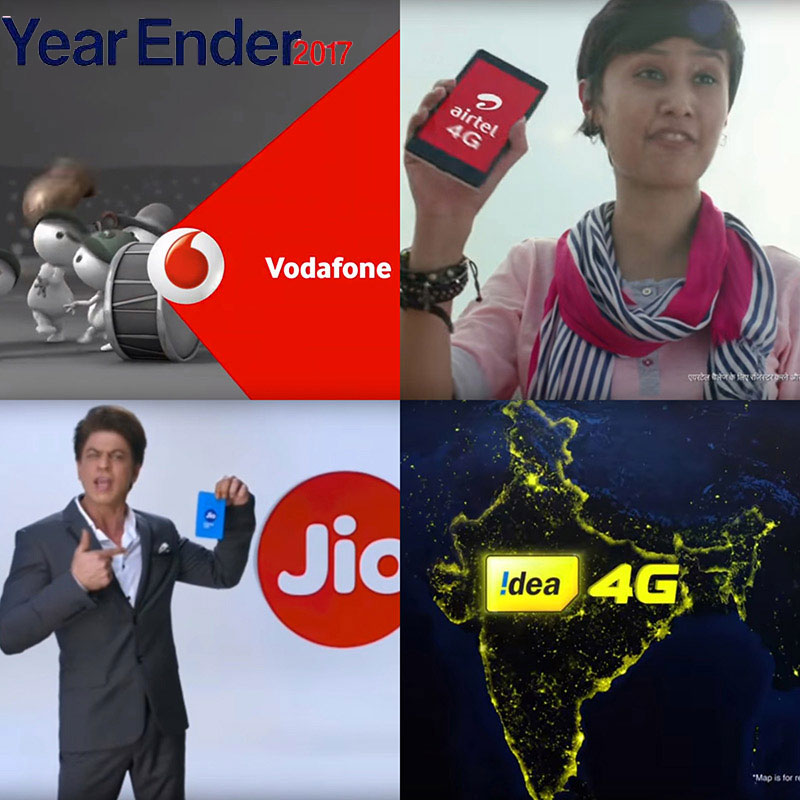
    An interplay of myriad factors contributed to India’s telecom industry witnessing both turmoil and revolution in 2017. Consolidation was the buzzword as some of the largest telecom operators merged even as Reliance Jio Infocomm Ltd (RJio) emerged as a frontrunner for Reliance Communications’ (RCom) assets according to reports. RJio can also take credit for ushering in a data revolution in the country.

    Moreover, smartphone penetration during the year increased three-fold with the aggregate number of users at more than 300 million. With smartphones still accounting for less than 50 per cent of handset users (650 million) in the country, another surge in data consumption is on the anvil.

    The price war

    Indian tycoon Mukesh Ambani sparked a price war in 2016 with the launch of Reliance Jio. As a consequence, the country’s large telcos have been burning through cash this year to hold on to their market share. Vodafone and Airtel tried luring customers through cheap data and unlimited calling offers. Reliance Jio, however, clearly won that battle. Within the first month of commercial operations, Jio announced that it had acquired 16 million subscribers. This was the fastest scaling up by any mobile network operator anywhere in the world. The operator crossed the 50 million subscriber mark 83 days from its launch, crossing 100 million subscribers on 22 February 2017. By October 2017, it had around 130 million subscribers. 

    With telcos looking to push for higher data pack purchases, 4G became cheaper than 3G. Today, 4G data costs are as low as 1 paisa per MB.

    Sectoral consolidation 

    From as many as 13 players at one point in time, we are now left with just five major contenders even as RCom sits on the brink of leaving the fray. Earlier this year, Vodafone India and Idea Cellular decided to merge operations to create India’s largest telecom operator worth more than $23 billion beating Sunil Bharti Mittal-led Airtel. With this deal, Vodafone India’s valuation stood at Rs 82,800 crore and Idea’s at Rs 72,200 crore. 

    RCom, reeling under a debt of around Rs 46,000 crore, shut down its voice services from 1 December 2017 after it failed to close its wireless business merger deal with Aircel. The Telecom Regulatory Authority of India (TRAI) has issued a directive to RCom’s customers to move to other networks by the end of this year. Vodafone, Airtel, and Jio created special packs for RCom customers to lure them to their networks. 

    Telcos and handsets 

    In July 2017, Jio introduced JioPhone–the company’s first affordable 4G feature phone powered by KaiOS. The phone was made available for a security deposit of Rs 1500, which could be reimbursed on returning the phone after three years. This phone was released for beta users on 15 August 2017 and pre-booking for regular users started on 24 August 2017. 

    To strengthen its presence amidst the battle for market share, Airtel launched Android-powered 4G smartphones in partnership with Indian cellphone manufacturer Karbonn Mobiles. Airtel also partnered various other mobile handset manufacturers, including Intex, to create an ‘open ecosystem’ of affordable 4G smartphones.

    Not one to be left out of the party, Vodafone and domestic handset maker Micromax came together to offer a smartphone priced a shade under Rs 1000 with a three-year rider.

    Internet of Things

    Despite posing privacy risks, Internet of Things, or IoT, remained one of the buzzwords in tech circles this year. According to Vodafone Plc’s annual IoT barometer report 2017-18, the percentage of companies with more than 50,000 connected devices active has doubled in the last 12 months with over 84 per cent of IoT adopters saying that their use of IoT has grown in the last year. From the Indian organisations that were a part of the study, 81% felt that IoT was key to digital transformation.

    In India, Vodafone marked itself as the first brand to undergo this evolution. The telco repositioned itself as a contemporary and future-fit brand. It is a significant metamorphosis for one of India’s most iconic and loved brands since the ‘Power to you’ tagline was introduced in 2009. This new positioning, a part of Vodafone’s rebranding exercise across 36 countries, is designed to underpin its belief in new technologies and digital services playing a positive role in transforming society.

    Net neutrality  

    In what was seen as a sign of things to come, the US Federal Communications Commission voted in December to scrap net neutrality, which requires internet service providers to treat all internet traffic equally. The TRAI, not too long after, came out in strong support of net neutrality in a series of recommendations following a long process of consultations on the issue. The regulator believes that the licensing terms should be amplified to provide explicit restrictions on any sort of discrimination in internet access based on the content being accessed, the protocols being used or the user equipment being deployed. 

    With IoT being the talk of the town, networks fighting to grab RCom’s assets and customers, and an ongoing telco war between Airtel, Vodafone, and Jio to become the country’s numero uno operator, it will be interesting to watch how the industry shapes up in 2018.

  • Trai paper seeks to streamline uplinking, downlinking norms

    Trai paper seeks to streamline uplinking, downlinking norms

    MUMBAI: Following a prod from the ministry of information and broadcasting (MIB) additional secretary Jayashree Mukherjee, the Telecom Regulatory Authority of India (TRAI) on 19 December issued an industry consultation paper which seeks to update guidelines related to uplinking, downlinking, of TV channels and the setting up of teleports.

    Mukherjee had sought the TRAI’s recommendations on these issues keeping in mind changes in technology, market scenarios and lessons learnt over the past six years since the guidelines were passed.  

    In its paper, Trai has asked stakeholders, such as broadcasters, if there was any need to redefine news and current affairs TV channels and non-news and current affairs TV channels more specifically.

    Pointing at a possible hike in the net-worth requirement of Rs 5 crore for obtaining a licence for uplinking or downlinking of TV channels, and an increase in process fees for applicants, the paper states that non-serious players were able to obtain licenses, which were either traded or leased to a different entity.

    “To  ensure  that  only  serious  players,  who  are  interested  in  the business of satellite TV channels, apply for obtaining license for  uplinking  or downlinking of TV channels, one way could be to increase the entry barriers. The other way could be to eliminate the incentives, which encourage trading and/or sub-leasing of licenses. Further, sub-leasing or trading of channels can also be controlled by putting in place certain checks, which discourage such practices,” the release stated.

    The paper argues that an increase in entry barriers for uplinking of TV channels from India may encourage diversion of such business opportunities to outside India. Moreover, Trai has raised the question of auctioning satellite TV channels as a complete package similar to FM radio channels. Or if industry thinks that it is possible to auction individual legs of satellite TV broadcasting – uplinking space spectrum, transponder capacity?

    And it has opened up an issue which has been a sore point for the industry: if it is advisable to restrict the use of foreign satellites for satellite TV broadcasting or uplinking of satellite TV channels to be downlinked in India from foreign soil? And also whether it is possible to auction channels without restricting the use of foreign satellites and uplinking of signals of TV channels from foreign soils. The paper appeals to stakeholders if there could be a better way to grant a licence for a TV satellite channel then what is presently followed in order to simply the procedure.

    Other issues the TRAI is seeking industry’s input on is whether encryption of all satellite TV signals – whether free to air or pay TV and what timeline should be given to licensed broadcasters to launch their channels from the date of issue of a licence and the penalties that should be levied on them in case they fail to restore their disrupted channels within a specified period. The consultation paper also approaches sensitive issues such as terms of  the tradeability of licences by a licencee.  

    On the teleport side, the TRAI is seeking to get industry’s understanding of what a teleport should be defined as in a new digital era, the licensing norms, fee structures for processing a licence, if there is a need to restrict the number of teleports in India, and their location like say in a park.

    The industry watchdog has requested that industry sends in its inputs by 18 January 2018.

    Also Read: TRAI sees merit in using satcom for broadband delivery

    TRAI’s Consultation Paper on VoIP can affect mobile TV, IPTV

    MSOs move Madras HC seeking relief on inter-connect pacts


  • RIL to plan IPO for Reliance Jio: Bloomberg

    RIL to plan IPO for Reliance Jio: Bloomberg

    Mumbai: Reliance Industries Ltd (RIL) may launch the initial public offering (IPO) for Reliance Jio by late 2018 or early 2019 to further challenge the collective might of Airtel and the Idea-Vodafone combine, according to a Bloomberg report. Reliance Jio, which hasn’t made a profit since its official launch last year, is targeting to improve its financial performance before diluting any stake.

    Reliance Jio reported net loss of Rs2.71 billion in the quarter ended 30 September 2017, though the business made profit before interest and taxes over the period. The wireless operator is “ahead of our schedule in terms of the returns” generated, Ambani said at a recent event.

    A Reliance Jio listing would cap a return to the mobile market for Ambani, more than a decade after a family feud that led him to cede control of a previous telecom venture to his younger brother. Reliance Jio, which is wholly owned by RIL, launched a free-for-life call service last year that triggered a price war and consolidation in one of the world’s most crowded mobile markets.

    Bharti Airtel Ltd this year agreed to absorb Tata Group’s mobile phone business, while Vodafone Group Plc and Idea Cellular Ltd announced they would merge their local operations to create the nation’s largest wireless operator. Despite being the newest entrant, Reliance Jio has accumulated more than 138.6 million subscribers, making it the fourth largest operator at the end of September, according to data from Trai.

    Deliberations about a Reliance Jio listing are at an early stage, and there’s no certainty they will lead to a transaction, Bloomberg’s sources said. A representative for Reliance Industries declined to comment.