Tag: Telecom Regulatory Authority of India

  • I&B ministry lays down guidelines for infrastructure sharing by MSOs

    I&B ministry lays down guidelines for infrastructure sharing by MSOs

    Mumbai: The ministry of information and broadcasting (I&B) has given its go-ahead to the multi-system operators (MSOs) to share infrastructure with other MSOs on a voluntary basis. As per the guidelines released by the ministry, the responsibility for compliance with guidelines and other regulations will lie with each MSO independently.

    According to the guidelines, each MSO will have to ensure encryption of signals and addressability of subscribers in all circumstances, and provide access of all the systems and the networks, used to provide broadcasting distribution network services, to the concerned broadcasters for audit as per the regulations and the authorised officers of the government and their representatives whenever demanded.

    The sharing of head-end used for cable TV services & transport streams transmitting signals of TV channels, among MSOs is permitted on a voluntary basis, said the ministry.

    Any MSO willing to share its transport stream of TV channels with another MSO should ensure that the latter has valid written interconnection agreements with concerned broadcasters for distribution of pay TV channels to the subscribers. They may share the common hardware for their SMS applications. But, the details of such arrangements should be reported to the MIB, the Trai, and the concerned broadcasters, 30 days in advance.

    As per the guidelines:

    ·Each MSO shall be accountable for ensuring the integrity and security of the CAS and the SMS data pertaining to such distributor.

    ·Each MSO shall maintain the backup of transaction logs and data of the CAS and the SMS, on a near real-time basis, for at least the past two years, at any point in time, on a secondary storage device.

    ·Each MSO shall undertake to provide access of the CAS and the SMS, used to provide broadcasting distribution network services, to the concerned broadcasters for the purpose of audit as per the regulations and the authorised officers of the government and their representatives whenever demanded.

    ·Each MSO sharing its infrastructure and transport streams of TV channels with other MSO, should set up systems and processes which ensure that the broadcasters are able to exercise their right of disconnection of signals in case of default of payment or due to any other reason, in terms of the interconnection agreement entered into between the broadcaster and the distributor and the relevant regulations in place.

    Under the new guidelines, the new applicant and existing licensee will jointly submit a detailed proposal for infrastructure sharing giving details of the infrastructure proposed to be shared and in the manner, infrastructure is proposed to be shared as well as roles and responsibilities of each to MIB. “The adherence and compliance to all the provisions of the rules and guidelines issued by MIB for grant of license to the MSO operator will be the responsibility of the existing operator and the new applicant proposing to share the infrastructure to the extent as may be required / applicable individually,” it added.

  • Trai to form committee for smooth rollout of NTO 2.0

    Trai to form committee for smooth rollout of NTO 2.0

    Mumbai: The Telecom Regulatory Authority of India (Trai) has decided to form a committee with representation from leading pay TV industry associations to ensure the smooth implementation of the New Regulatory Framework 2020 and identify impediments with counter-measures for the overall growth of the broadcast sector.

    In a letter dated 22 December, accessed by Indiantelevision.com, Trai had asked the Indian Broadcasting and Digital Foundation (IBDF), the All India Digital Cable Federation (AIDCF), and the DTH association to nominate a maximum of two representatives to be part of the implementation committee.

    Early this November, the regulator had notified stakeholders that implementation of the new tariff order (NTO 2.0) would be delayed until 1 April 2022. This decision was taken after various stakeholders expressed concerns to the regulator with respect to the timeframe for migration of 150 million pay TV consumers and sufficient time for service providers to upgrade their IT systems and incorporate various channels/bouquets before offering the same to consumers.

    In the latest development, Delhi-based Cable Operators Welfare Federation (COWF) has written to Trai to be a part of the implementation committee and include two local cable operator (LCO) representatives from four zones or four representatives from the All India Federation. “LCOs deserve to be treated as frontline workers who touch base with each subscriber at least once a month. During the implementation of the regulatory framework the best way to reach the subscriber is to communicate in person, in their language, using printed handouts to evaluate options and help subscribers make a well-informed decision,” the letter reads.

    The LCOs also argue that market discovery of prices of pay-TV channels and consumption pattern evolution cannot be back-end driven, rather the front-end instructions should drive the backend. “The DPOs manage the back-end that would implement the service requests coming in from the front-end and therefore should not impose any packages and choices on subscribers,” it added.

    COWF has now also written to prime minister Narendra Modi to halt the implementation of new tariff framework, discard NTO 2.0, and consider making “cable-operator friendly amendments” in Digital Addressable Systems (DAS) law. The operators also suggest that linear TV channels no longer be distributed on OTT platforms. They lettered dated 29 November, also says that the NTO 2.0 regulation will increase unemployment and result in the downturn of lakhs of people employed by the cable TV industry.

  • Trai asks broadcasters, DPOs to comply with interconnection agreements regulations

    Trai asks broadcasters, DPOs to comply with interconnection agreements regulations

    Mumbai: The Telecom Regulatory Authority of India (Trai) has asked broadcasters and distributors of TV channels to immediately implement the provisions of the Telecommunication (Broadcasting and Cable) Services Register of Interconnection Agreements and all such other matters Regulations, 2019.

    The regulator has asked broadcasters and distributors to submit the compliance report within 15 days from the date of issue of the letter on 8 December failing which actions would be taken as per provisions of the said regulations and the Trai Act, 1997.

    The regulations were supposed to come into force on 2 January 2020 but were challenged by the All India Digital Cable Federation (AIDCF) in the Kerala high court. The high court in its order dated 9 January 2020 had ordered that no coercive action will be taken by the respondents.

    The court disposed of the said writ petition, in its judgement dated 12 July, and partially set aside the provisions of the said regulations to the extent they require registration of placement/marketing agreements. Thus, all the provisions of the said regulations, except to the extent they require registration of placement/marketing agreements, are in operation.

    The regulator had developed a B&CS integrated portal system (BIPS) for the purpose of filing data/details pertaining to the said regulations. The regulations require broadcasters and DPOs to furnish, via their compliance officer, its reference interconnection offers when the same is published on their websites.

    The regulations are applicable to all commercial and technical arrangements entered into by broadcasters, distributors of television channels and local cable operators for providing broadcasting services. If broadcasters and distributors default in complying with the provisions, then Trai would take action by imposing a financial disincentive.

  • Star and Disney India postpones new channel launches till further intimation

    Star and Disney India postpones new channel launches till further intimation

    Mumbai: Star and Disney India has deferred the launch of 15 (SD+HD) channels and renaming of one channel until further intimation.

    “This is to inform all distributors of television channels that the launch of following 15 channels and name change of following one channel have been deferred till further intimation by Star,” it said.

    The channel launches that have been held back include Star Gold Romance, Star Gold Thrills, Jalsha Josh, Star Movies Select, Pravah Pictures, Star Kirano, Star Sports 1 Tamil HD, Star Sports 1 Telugu HD, Disney Channel HD, Hungama HD, Star Gold 2 HD, Pravah Pictures HD, Vijay Super HD, Asianet Movies HD and Star Kirano HD. The renaming of Marvel HQ to Super Hungama has also been delayed till further notice.

    The broadcaster had published its new reference interconnection offer (RIO) on 15 October mentioning the new channels and declaring the new channel and bouquet pricing in compliance with the new tariff order (NTO) 2.0. Star planned to launch its new channels between December 2021 and January 2022.  

    The Telecom Regulatory Authority of India (Trai) notified that it has extended the deadline for implementation of NTO 2.0 till 1 April 2022. In the meanwhile, broadcasters must revise their RIOs by 31 December and distribution platform operators must report their distribution retail price of pay channels and bouquets by 31 January 2022.

    The broadcasters’ association Indian Broadcasting and Digital Foundation (IBDF) and Trai have been embroiled in a legal battle on the matter of NTO 2.0 implementation. The final hearing of the Supreme Court on the matter is on 30 November.  

  • Reliance Jio lost 19 million wireless subscribers in September: Trai

    Reliance Jio lost 19 million wireless subscribers in September: Trai

    Mumbai: Reliance Jio lost 19.02 million wireless subscribers in the month of September, according to Telecom Regulatory Authority of India (Trai) subscription data. Bharti Airtel added 0.27 million subscribers and Vodafone Idea lost 1.07 million subscribers in the same period.

    Total wireless subscribers decreased from 1186.72 million to 1166.02 million. Wireless subscription from urban areas decreased from 650.39 million to 637.89 million. In rural areas, wireless subscription decreased from 536.33 million to 538.13 million.

    In terms of active base, there were 995.67 million wireless subscribers with Reliance Jio having the largest base of active users at 355.37 million followed by Bharti Airtel at 346.88 million and Vodafone Idea at 235.73 million.

    The number of telephone subscribers decreased from 1209.58 million to 1189.15 million. Urban telephone subscription decreased from 671.31 million to 659.09 million. Rural subscription decreased from 538.28 million to 530.06 million.

    Trai received information from 522 operators in September compared to 499 operators last month. The total number of broadband subscribers decreased from 813.47 million to 794.88 million. Mobile device users decreased from 787.94 million to 769.22 million. Wired subscribers increased marginally from 24.29 million to 24.39 million. Fixed wireless subscribers increased from 1.24 million to 1.28 million.

    The top five service providers were Reliance Jio Infocomm (428.78 million), Bharti Airtel (207.30 million), Vodafone Idea (122.37 million), BSNL (24.15 million), and Atria Convergence (1.96 million).

    The top five wired broadband service providers were BSNL (5.05 million), Reliance Jio Infocomm Ltd (3.94 million), Bharti Airtel (3.85 million), Atria Convergence Technologies (1.96 million), and Hathway Cable & Datacom (1.08 million).

    The top five wireless broadband service providers were Reliance Jio Infocomm Ltd (424.84 million), Bharti Airtel (203.45 million), Vodafone Idea (122.36 million), BSNL (19.10 million), and Tikona Infinet Ltd. (0.30 million).

    The total wireline subscribers increased from 22.86 million to 23.13 million and saw a net increase of 0.27 million. Reliance Jio added 237,411 subscribers followed by Bharti Airtel at 126,937 and Vodafone Idea at 3100.

  • Trai must focus on regulating process, not prices : Broadcasters at CII Big Picture Summit

    Trai must focus on regulating process, not prices : Broadcasters at CII Big Picture Summit

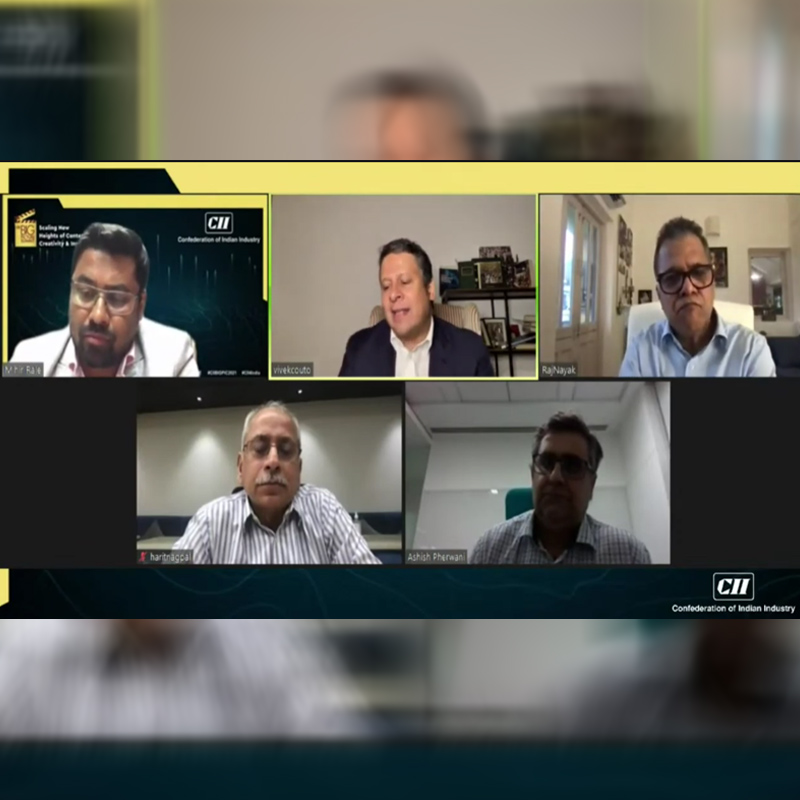
    Mumbai: As a regulator, the Telecom Regulatory Authority of India (Trai) must focus on regulating the process and not the prices, argued broadcast industry stakeholders at the CII Big Picture Summit held on Wednesday. The discussion was around the impact of new tariff order (NTO) 1.0 and 2.0 on linear TV broadcasting and the need for light touch regulation.

    The session was joined by Tata Sky managing director and CEO Harit Nagpal, Disney and Star India chief regional counsel Mihir Rale, House of Cheer Networks founder and managing director Raj Nayak, Ernst and Young Indian media and entertainment practice leader Ashish Pherwani and was moderated by Media Partners Asia co-founder and director Vivek Couto.

    The pay TV industry in India is the cheapest in the world and not by a small margin. Broadcasting is the largest contributor to India’s media and entertainment industry. India’s M&E industry accounts for 1.1 per cent of total GDP whereas in mature markets the contribution is usually 3-4 per cent. Panellists argued that excessive regulation by Trai is holding back the growth of the industry.

    “We belong to the service industry,” said Harit Nagpal. “A product like Tata Sky is aimed at customers who are willing to pay five to ten per cent extra to watch premium quality content. But when Trai regulates the prices, even if the customer is willing to pay extra, we can’t increase the prices. There is no incentive to invest in quality.”

    Trai’s intent seems noble on paper. The NTO regulations want to create parity in prices in linear TV broadcasting. However, there is a wide spectrum of customers in India that watch content. The players in the TV broadcast ecosystem understand the consumer’s needs and try to meet them with attractive prices. Trai’s regulation is akin to saying that a three BHK apartment must be priced the same whether you live in Cuffe Parade or the suburbs of Pune, remarked Raj Nayak.

    “When the regulator framed and implemented NTO 1.0 the stated objective was a-la-carte needs to be pushed in the interest of the consumer. Today, we know that if the consumer picks a-la-carte then his/her content costs will go up,” said Mihir Rale.

    Trai most contentious provisions in the NTO 2.0 were its twin conditions which mandated that average MRP prices of channels in a bouquet must not be more than 1.5 times the bouquet price. The second condition, which was struck down by a Bombay high court judgment, states that MRP of an individual channel in a bouquet should not exceed three times the average MRP of a channel in that bouquet.

    Rale said, “Linking a-la-carte pricing to bouquet pricing is a fundamentally flawed approach. The ability of the broadcaster to subsidise the cost to the consumer is important. Bouquets have an intrinsic value from an advertiser standpoint. We can customise and tailor our prices to everyone’s ability to pay. Why should that be taken away?”

    Stakeholders were of the view that Trai must step back and take a long hard look at the impact of NTO 1.0 regulation before implementing the amendment order. They said that consumer costs have gone up by 25-30 per cent and broadcasters have had to shut down a few of their channels. It was also noted that Trai must not assume every consumer is digitally savvy and will make the transition into the new regulatory mechanism easily. It is estimated that NTO 1.0 implementation resulted in the drop off of 12-15 million pay TV subscribers. 

    “We are in a free economy and the regulatory has come and put a price cap saying it is in the interest of the consumer. In fact, since there is a lot of competition in the linear broadcasting industry the fact is that broadcasters can’t raise prices indiscriminately without losing market share,” observed Raj Nayak.

    Trai has acknowledged that NTO implementation has yielded different results than what they expected. The need of the hour is for the industry to come together with the regulator and introspect on what’s best for the consumer.

    “The M&E industry is a creative industry. What we call different parts of the industry is just distribution. There are 130,000 digital influencers in India. How did this happen? Not by a regulated creative industry,” said Ashish Pherwnai. “The Indian media sector is $ 17 billion in size. How can regulation help us meet our targets in terms of percentage of GDP? Global companies like Disney and Lionsgate Universal get 50 per cent or more revenues from exports. In India that number is less than eight per cent.”

    Pherwani also talked about how the top studios in the US spend $20 billion on content, and in Europe, the top studios spend $40-45 billion. If 10 per cent of that market comes to us, then it is a $4 billion opportunity on a base of $17 billion, he said.

    The panellists hoped that the trust deficit between the regulator and broadcasting ecosystem can be dramatically reduced in the coming years and TV growth returns to 2017 levels.

  • Trai consults industry to address limitations in satellite gateway operations

    Trai consults industry to address limitations in satellite gateway operations

    Mumbai: The Telecom Regulatory Authority of India (Trai) on Monday released a consultation paper on licensing framework for establishing satellite earth station gateway. The telecom regulator is seeking inputs from stakeholders on the issues raised in the consultation paper by 13 December and counter comments by 27 December.

    The Department of Telecommunications (DoT) has asked Trai to address the limitations with respect to satellite gateway operations as there are no provisions regarding the use of gateway by service providers established by a satellite constellation operator. As per the current licensing regime in India, establishing a satellite earth station is linked with the service license, and there are no specific license/provisions for establishing earth station by satellite operators for providing satellite-based resources to the service licensee.

    The need has arisen to have a specific authorisation for establishing the satellite earth station gateway by a satellite operator or any entity having a tie-up with satellite the operator, noted Trai.

    Trai will examine all factors holistically and recommendations for a framework for satellite gateway(s) operations may be suggested including the entry fee, license fee, bank guarantee, NOCC charges, and any other issues which may be relevant for MEO/LEO/HTS systems.

    Trai has sought industry stakeholders’ responses to the following questions.

    1.     Whether there is a need for having a specific license for establishing satellite earth station gateway in India for the purpose of providing satellite-based resources to service licensees?

    2.     If yes, what kind of license/permission should be envisaged and the scope of the framework both technical and operational?

    3.     Whether such license should be made available to satellite operator or its subsidiary or any such entity having tie-up with satellite operator?

    4.     What mechanism/framework should be put in place to regulate the access to satellite transponder capacity and satellite-based resources of a satellite operator/earth station licensee by the service licensees to get the resources in a time-bound, fair, transparent, and non-discriminatory manner?

    5.     Whether Earth station licensee should be permitted to install baseband equipment also for providing satellite bandwidth to the service licensees as per need?

    6.     What amendments will be required to be made in the existing terms and conditions of the relevant service authorisations of Unified License, DTH License/Teleport permission to enable the service licensee to connect to the satellite earth station gateway established by earth station licensee/service licensee, for obtaining and using the satellite transponder bandwidth and satellite-based resources?

    7.     Whether the sharing of earth Station among the licensees (between proposed Earth station licensee and service licensee; and among service licensees) should be permitted?

    8.     What should be the methodology for the assignment of spectrum for establishing a satellite earth station?

    9.     What should be the charging mechanism for the spectrum assigned to the satellite earth Station licensee?

    10.  Comments on any related matter not covered in the consultation paper.

  • Trai extends deadline for NTO 2.0 implementation to 1 April 2022

    Trai extends deadline for NTO 2.0 implementation to 1 April 2022

    Mumbai: The Telecom Regulatory Authority of India (Trai) has extended the deadline for implementation of the new tariff order (NTO) 2.0 to 1 April 2022. The previous deadline was 1 December.

    Broadcasters will have to publish new reference interconnection offers (RIOs) to Trai by 31 December and simultaneously publish the required information about channel and bouquet offerings and their MRPs on their websites. The broadcasters who have already submitted their RIOs in compliance with NTO 2.0 can revise their RIOs by 31 December.

    The deadline was extended as Trai received representations from many service providers and their associations such as broadcasters, DTH operators, MSOs and DPOs, according to a report by ET. The authority, after considering the concerns expressed by various stakeholders and especially with respect to time frame for migration of subscribers and taking their choice, is of the view that paucity of time should not come in the way of implementation of the new regulatory framework 2020 in seeking informed choices of more than 150 million pay TV consumers.

    DPOs will have to obtain an option for subscription of new bouquets or channels from the subscribers in compliance with the provisions of NTO 2.0 from 1 February 2022 to 31 March 2022.

    DPOs will have to report the distributor retail price (DRP) of pay channels, composition of bouquet of pay channels/free-to-air channels and DRPs of bouquets of pay channels by 31 January 2022 besides simultaneously publishing the information on their websites.

    In June, the Bombay high court in its judgement upheld the NTO 2.0 order by Trai barring the second proviso of the twin conditions. The provision states that a-la-carte rates of pay channels shall not exceed more than three times the average rate of a pay channel of the bouquet of which such pay channel is part. TV broadcasters under the aegis of Indian Broadcasting Digital Foundation (IBDF) had moved to Bombay HC in January challenging the Trai order.

    After the Bombay HC pronounced its judgement, broadcasters escalated the matter to the Supreme Court. The final SC hearing is scheduled on 30 November. Meanwhile, Trai directed broadcasters to comply with the Bombay HC judgement and publish new prices of their pay channels and bouquets that comply with the tariff order.

    Leading broadcasters including Zee Entertainment Enterprises, Star and Disney India, Sony Pictures Networks India, Network18 Broadcast, Sun TV Network, Discovery Communications and WarnerMedia have published their RIOs effective from 1 December. As per NTO 2.0 provisions, Trai mandated a price cap of Rs 12 on pay channels to be included in a bouquet. To comply with this provision, major broadcasters pulled their popular channels from bouquets but also hiked the prices of these channels.  

  • Trai issues new consultation paper to regulate monopoly in Cable TV services

    Trai issues new consultation paper to regulate monopoly in Cable TV services

    New Delhi: The Telecom Regulatory Authority of India (Trai) has released a new consultation paper to regulate the market structure/ competition in Cable TV services across the country.

    The issue was initially raised by the ministry of information and broadcasting (MIB) in December 2012, when it sought the recommendation of the regulatory body. In its letter to Trai, the ministry highlighted how Cable TV distribution is virtually monopolised by a single entity in some states like Tamil Nadu, Punjab, Orissa, Kerala, Uttar Pradesh, and Andhra Pradesh.

    According to MIB, it has become necessary to examine whether there is a need to bring in certain reasonable restrictions on Multi-System Operators (MSOs) and Local Cable operators (LCOs), including restricting their area of operation or restricting the subscriber base to prevent monopoly. The Cable TV Act and the Cable TV Rules also do not restrict the number of MSOs/LCOs operating in any specific area.  

    After following a due consultation process, Trai issued its recommendations on 26 November 2013. However, Trai has now received a backreference from MIB mentioning therein that a considerable time has passed since the recommendations were made and that the media and entertainment (M&E) landscape has changed drastically, particularly with the advent of new digital technologies in this sector. Technological developments especially IP technology and the increasing use of packet-switched digital communications have made converged services possible.

    Therefore, some of the issues need further consideration by the authority and it may provide a fresh set of recommendations in the matter looking at the subsequent developments/expansion in the M&E sector, stated MIB.

    The regulatory body has now invited comments from the stakeholders by 22 November. Counter comments, if any, may be submitted by 6 December.

    As of September 2021, there are 1733 registered MSOs in the country and approximately 1. 55 lakh cable operators as of March 2021.

  • Broadcasters exploiting NTO 2.0 provisions for a-la-carte pricing: Trai

    Broadcasters exploiting NTO 2.0 provisions for a-la-carte pricing: Trai

    Mumbai: The Telecom Regulatory Authority of India (Trai) on Friday said that some broadcasters are exploiting the freedom given for al-a-carte pricing of TV channels and warned that it will keep a strict watch on the industry and not shy away from acting in the larger interest of consumers and the industry.

    With an increase in TV channel subscription rates impending, the Trai said in a statement that the new tariffs announced by leading broadcasters reflects their intention to raise the prices of driver and popular channels, according to a report by PTI.

    These driver channels include general entertainment channels (GECs) and sports channels. The regulator refrained from naming any broadcaster but alluded that some leading broadcasters had hiked channel tariffs arbitrarily.

    The regulator claimed that the prices that some of the broadcasters have announced for their channels are unsustainable, are not demand driven or market driven prices and are against the interest of the consumer.

    This price hike has been announced in the garb of complying with the NTO 2.0, which is not true and rather an attempt to defeat the purpose of NTO that has already benefited the consumer to a large extent, stated Trai.

    Trai further said, “A sustained and misleading campaign is being run to create an impression that the impending price increase is due to the new tariff regime (NTO) 2.0. It is being publicised that any/every consumer who opts for top GECs or sports channels will end up paying an extra amount of Rs 100,” according to the PTI report.

    The purpose of the amendments to regulations for broadcasting and cable services sector was to ensure that no service provider corners undue gains and profiteers at the expense of consumers, as per Trai. It pointed out, “the channel pricing has remained under the prescribed ceiling for 15 years since 2004.”

    Under the provisions of the new framework, broadcasters may freely fix the price of their television channels with certain conditions applicable for inclusion into a bouquet. The regulations state that a channel MRP greater than Rs 12 cannot be included into a bouquet. The framework should result in reduced bills for the consumers, said the regulator.

    The implementation of NTO 2.0 will lead to an era of transparent tariffs and usher in better channel content at the most competitive prices, stated Trai. The regulator said that it is conscious of the time required to implement necessary changes to be carried out to incorporate the considered choices of 150-160 million pay TV households.