Tag: Telecom Regulatory Authority of India

  • DD Free Dish announces Sony Pal & Colors Rishtey to go live effective 1 December

    DD Free Dish announces Sony Pal & Colors Rishtey to go live effective 1 December

    Mumbai: Prasar Bharti’s free direct-to-home (DTH) platform announced the return of two general entertainment channels, Sony Pal and Colors Rishtey, effective from 1 December. The free-to-air platform has unveiled the comeback news of big media giants via a tweet shared on 21 November.


    Colors Rishtey and Sony Pal won the 63rd e-auction process, which was conducted on 18 November 2022.

    Recently, the public broadcaster has invited applications for allotment of vacant MPEG-2 and MPEG-4 slots of DD Free Dish platform on a pro-rata basis for the period from 1 December 2022 to 31 March 2023.

    In April 2022, four big broadcasters—Zee Entertainment Enterprises, Viacom18 Network, Sony Pictures Networks, and Disney Star India—withdrew their flagship channels from bouquets. The decision came in January 2020, when the Telecom Regulatory Authority of India (Trai) announced NTO 2.0, which capped a bouquet channel price at Rs 12 instead of Rs 19 (as per the first NTO).

    In order to increase their advertising revenue and gross rating points (GRPs), the broadcasters decided to rejoin the DD Free Dish platform, as it has a lesser number (176+) of TV channels to compete with than private DTH (500+) services.

    Earlier, when the big players decided to quit the platform, they were completely aware that they had taken on the risk of losing subscribers and ad revenue through that move. Broadcasters knew that if they did not bring back their channels on the platform, then they may have to shut down these channels, as at present, free users are shifting to DD Free Dish for free entertainment and paid DTHs are moving towards OTT streaming apps.

  • Trai recommends an apex body for data governance to promote data economy 

    Trai recommends an apex body for data governance to promote data economy 

    Mumbai: The Telecom Regulatory Authority of India (Trai) has advocated for an apex body for data governance and to guide India’s digital economy as soon as the government introduced the new Personal Data Protection Bill, 2022.

    Trai noted that a statutory body should be established at the centre, with suitable representation from the department of telecommunications (DoT) and the ministry of electronics and information and technology (MeitY).

    Trai, after receiving comments from stakeholders on the consultation paper, has finalised recommendations for the establishment of data centres (DCs), content delivery networks (CDNs), and interconnect exchanges (IXPs) in India.

    The recommendations were made by the telecom watchdog at a time when the government suggested creating a Data Protection Board to address data-related issues.

    Also Read: Government announces draft bill on personal data protection; proposes penalty of up to Rs 500 cr

    To manage all matters relating to data, including digitisation, monetisation, sharing, and storage, a top organisation known as the Data Digitisation and Monetisation Council (DDMC) would be established by either changing the current law or creating a new one.

    The authority recommends that trusted source procurement, which is applicable for licensees under Section 4 of the India Telegraph Act 1885, be made applicable for DCs (data centres) for security-sensitive equipment.

    It might happen very soon that DCs companies will have to source equipment from trusted sources only. The government has designated the National Cyber Security Coordinator as the body in charge of determining whether or not a source is trustworthy. In addition, the regulatory body has said that the government should define certain fiscal and non-fiscal incentives for the data centre sector. These incentives should be applicable to all the states while giving the states further flexibility to announce additional incentives.

    The regulator further suggested CDN players should be registered with the department of telecommunications through a simple online registration process. DCs hosting CDNs are connected to each other and the internet cloud via internet exchange points (IXPs).

    Trai has recommended bringing IXPs under a separate authorization in a unified licence that is much less onerous than internet service providers’ licence authorization.

    The authority also recommends that any entity that intends to provide IXP services in India can do so either under an ISP licence or UL-ISP authorization or under standalone UL-IXP authorization.

    The authority also recommends that all existing players, including NIXI, be brought within this licensing framework in a stipulated time not exceeding six months.

  • Reliance Jio adds 2.9 mn wireless subscribers in July: Trai

    Reliance Jio adds 2.9 mn wireless subscribers in July: Trai

    Mumbai: Reliance Jio added 2.9 million wireless subscribers at the end of July, as per subscription data by the Telecom Regulatory Authority of India (Trai). Bharti Airtel added 0.51 million wireless subscribers during the same period. Vodafone Idea lost 1.54 wireless subscribers in July.

    The total number of wireless subscribers increased from 1,147.39 to 1,148.03 million in July. The number of wireless subscribers in urban areas decreased from 625.49 million to 626.74 million. However, wireless subscriptions in rural areas increased from 521.90 million to 521.29 million.

    As per Trai data, there were 1,013.18 million active wireless subscribers during the month. Reliance Jio had the highest number of active wireless subscribers at 382.17 million, followed by Bharti Airtel at 356.17 million and Vodafone Idea at 216.92 million. BSNL had 52.27 active wireless subscribers.

    As per information received from 694 operators in July, Trai found that total broadband subscribers increased from 800.94 million to 807.42 million. The broadband subscribers comprised 776.81 mobile device users, 29.47 million wired subscribers, and 1.14 million fixed wireless subscribers.

    The top five broadband service providers were Reliance Jio Infocomm with 422.23 million subscribers, Bharti Airtel with 222.12 million subscribers, Vodafone Idea with 122.98 million subscribers, BSNL with 25.25 million subscribers, and Atria Convergence with 2.13 million subscribers.

    The top five wired broadband service providers were Reliance Jio Infocomm with 6.27 million subscribers, Bharti Airtel with 4.99 million subscribers, BSNL with 3.85 million subscribers, Atria Convergence with 2.13 million subscribers, and Hathway Cable and Datacom with 1.13 million subscribers.

    The top five wireless broadband service providers were Reliance Jio Infocomm with 415.96 million, Bharti Airtel with 217.13 million, Vodafone Idea with 122.97 million, BSNL with 21.39 million, and Intech Online with 0.22 million.

    The number of wireline subscribers increased from 25.57 million to 25.63 million in July.

    The number of telephone subscribers in India increased from 1,172.96 million to 1,173.66 million. Urban telephone subscriptions increased from 649.09 million to 650.40 million. However, rural subscriptions decreased from 523.87 million to 523.26 million.

    During July, a total of 10.23 million requests were received for mobile number portability (MNP).

  • TRAI recommends MIB should not introduce any fresh regulations in Cable TV distribution sector

    TRAI recommends MIB should not introduce any fresh regulations in Cable TV distribution sector

    Mumbai: The Telecom Regulatory Authority of India (TRAI) has recommended to the Ministry of Information & Broadcasting (MIB) that the government should not introduce any new regulations or take any corrective measures to enhance the competition in the cable TV distribution sector.

    Trai has further requested the MIB to monitor but also intervene only at the appropriate time. However, Trai recommended, “The government may take suitable measures to facilitate & promote sharing of cable infrastructure by a local cable operator with Telecom Service Providers (TSP) to enable the last mile for provision of broadband services.”

    “The government may issue necessary amendments to existing rules/ guidelines, to enable the use of last mile infrastructure created by cable operators by TSPs for promoting broadband connections,” it wrote.

    Trai further said that the government may amend the rules under the Cable Television Networks (Regulation), Act 1995 to explicitly indicate the following:

    “Cable operators may strive to provide last mile access to Access service providers/Internet Service Providers in a fair, transparent and non-discriminatory manner for the proliferation of broadband services.”

    On 19 February 2021, MIB sent a letter to TRAI where the government informed the authority that considerable time has passed on the recommendations on “Monopoly/Market Dominance in the Cable TV services on 26 November 2013” and the media and entertainment landscape has changed drastically since then, particularly with the advent of digital technologies in this sector. Therefore, MIB has requested Trai to provide a fresh set of recommendations for the development and expansion of the M&E sector.

    For this, Trai issued a consultation paper seeking comments from stakeholders on 25 October 2021. The date of submission for comments and counter comments was extended continuously and Trai received comments on the consultation paper from 70 stakeholders and counter comments from 7 stakeholders. (recommendations are available on Trai’s website). An open house discussion (OHD) was also held on 27 January 2022 in this regard through an online mode. After considering all comments and counter-comments received from stakeholders and further analysis of the issues, the regulator has now finalised its recommendations and issued it to the MIB.

  • Trai extends deadline to receive stakeholder comments on ‘renewal of MSO registration’ consultation paper

    Trai extends deadline to receive stakeholder comments on ‘renewal of MSO registration’ consultation paper

    Mumbai: The Telecom Regulatory Authority of India (Trai) has extended the deadline to receive comments & counter comments on the consultation paper ‘renewal of multi-system operators (MSOs) registration’. Stakeholders can submit their written comments by 24 August and their counter comments by 31 August.

    Trai decided to delay the deadline after stakeholders sought an extension of time for sending their comments on the consultation paper, however, no further requests for extension would be considered, it said.

    The consultation paper seeks the comments of MSOs on relevant issues about renewal of MSO registration including the quantum fee to be paid for such renewal.

    The key issues addressed in the consultation paper are 1) what should be the qualifying conditions, if any, to be prescribed for MSO renewal? 2) list of necessary compliances for renewal of MSO registration 3) period of renewal 4) whether a one-time fee should be levied at the time of renewal? 5) should there be a window to apply for renewal before expiry of MSO registration? 6) provision to ensure continuity of service to consumers on expiry of registration.

    The ministry of information and broadcasting (MIB) plans to revise the policy guidelines regarding the renewal period of MSOs to maintain uniformity with the direct-to-home (DTH) and broadcasting sector. It has proposed to keep the renewal period for MSO registration after every ten years.

    Also Read: MIB proposes to introduce policy guidelines for renewal of registered MSO and HITS operators

  • Consumers subscribe to TV channels in bouquets rather than paying for individual channels: Study

    Consumers subscribe to TV channels in bouquets rather than paying for individual channels: Study

    Mumbai: There are gaps in the effective exercise of consumer choice in TV channel selection, according to a study on the TV consumer market, released on Wednesday.

    The key findings of the report suggest that most consumers avail TV channels via bouquets or packages and rely on distributors’ basic packages to make their choice. Based on the findings, the report states that the Telecom Regulatory Authority of India (Trai) could review the charges for Network Capacity Fee (NCF), which is a flat fee, and instead consider a Network Access Fee (NAF), which is charged on a per-channel basis.

    The nationwide survey of over 10,000 TV consumers was commissioned by Consumer Unity and Trust Society (CUTS) and Broadband India Forum (BIF) in the months of April and May 2022. The study evaluated consumers’ perception of TV channel selection and overall satisfaction.

    This is a first-of-its-kind evidence-based study conducted in India which captures the consumers’ perspective and level of satisfaction regarding TV viewership.

    TV consumers prefer bouquets/packages

    The study found that 54 per cent of consumers surveyed buy TV channels via bouquets or packages, and 35 per cent do so via a combination of bouquets and individual channels. With an effective total of 89 per cent of consumers surveyed preferring bouquets, the survey highlighted that it was the preferred choice of channel selection.

    According to 70 per cent of survey respondents, television provides good value for money, compared to only 27 per cent for digital/OTT platforms and only three per cent for TV apps.

    Most consumers factor in the price of a TV package when selecting a TV subscription, and a majority subscribe to the distributors’ basic package, which includes between 100 and 200 channels. The survey found that consumers typically pay between Rs 200 and Rs 400 for their subscriptions.

    40 per cent of survey respondents felt that their TV subscriptions catered to the viewing needs of the entire family. However, consumers felt that there was room for levels of satisfaction to grow, as they may want to watch new channels that they think they may like, highlighted the study.

    Quality of Service (QoS) found wanting

    The study pointed out that a majority of consumers, 75 per cent, were unaware of Trai’s channel selector app, launched in June 2020. Only 31 per cent were aware that they could add/remove TV channels from their subscription packages, 51 per cent were hesitant to add/remove channels themselves, and only 43 per cent of those who eventually added TV channels found the process convenient.

    The majority of consumers, 60 per cent, relied on manual channel addition and removal & required direct intervention from distribution, it found.

    In 2017, Trai issued quality of service (QoS) regulations requiring itemised billing, quick and convenient grievance redressal, and assistance with customer premises equipment.

    The study found that one in five consumers believes there has been a decline in grievance redressal, assistance with set-top-boxes (STBs), freedom to choose which channels to watch, and an increase in the number of advertisements.

    Furthermore, three out of every four customers claim to have never received an itemised bill. All of these are required by the current regulatory framework, and non-compliance with this framework is reflected in insufficient enforcement at the last mile of distribution, it said.

    Empower last mile service providers

    As per the conclusions of the study, the mismatch between consumer preferences and channel subscriptions could be reduced if more efforts are made to raise consumer awareness, e.g., capacity building through regional consumer cells, and if consumers have more say in deciding their bouquets.

    The study suggested that the charges for Network Capacity Fee (NCF) could be reviewed to ensure that subscriptions reflect consumer choice. Alternatively, a per-channel Network Access Fee (NAF) could be considered instead of a flat NCF charge.

    “Distributors could be incentivised to assist customers by providing appropriate channels and bouquets of their choice using this method,” said the statement.

    The regulator could also assist credible consumer organisations in raising awareness, developing capacity and acting as watchdogs for QoS compliance, channel selection availability, quality of content, viewing experience and quality of service.

    Last-mile service providers/distribution platform operators continue to be the primary point of contact for TV subscriptions, and it is crucial that QoS requirements and transparency mandates are accomplished.

    CUTS International secretary general Pradeep S. Mehta said, “The major findings indicate that there are gaps in the effective exercise of consumer choice as well as channel selection. Efforts to enhance consumer awareness around their rights as well as methods of channel selection are imperative. However, any further regulatory intervention should follow a detailed cost-benefit analysis.”

    Broadband India Forum president T.V. Ramachandran said, “The study assumes great significance and relevance, especially in the present times, when the general notion is that digital media and content are impacting the popularity of legacy and linear TV. The report indicates possible areas for regulatory and policy focus to help in the overall improvement of quality of services and consumer satisfaction.”
  • Pay DTH operators lost 1.6 mn subscribers in quarter ended 31 March 2022: TRAI

    Pay DTH operators lost 1.6 mn subscribers in quarter ended 31 March 2022: TRAI

    Mumbai: The number of pay direct-to-home (DTH) subscribers decreased sharply from 68.52 million to 66.92 million in the quarter ended on 31 March 2022, as per latest Telecom Regulatory Authority of India (TRAI) performance indicator report. It has lost a total of 1.6 million subscribers during the period.

    DTH operators have seen a consistent decline in their subscribers since reporting an all-time high of 70.99 million subscribers in December 2022.

    Also read: DTH segment expands its subscriber base by 1.01 mn in 2020 | Indian Television Dot Com

    The number of private satellite TV channels permitted by the ministry of information and broadcasting (MIB) for uplinking or downlinking also decreased from 909 to 898 channels. Broadcasters reported 345 pay channels down from 350 pay channels in the quarter ended on 31 December 2021. The number of free-to-air (FTA) channels also declined from 543 to 540 during the same period.

    Tata Play continued to be the leading DTH operator with 33.23 per cent market share down from 33.48 per cent in the previous quarter. Bharat Telemedia’s share stood at 26.24 per cent down from 26.37 per cent.

    Also Read: Geo-targeted campaigns ramp up as brands go hyperlocal

    Dish TV India increased its market share from 22.04 per cent to 22.10 per cent. Sun Direct also increased its market share from 18.11 per cent to 18.43 per cent.

    [[{“fid”:”1087009″,”view_mode”:”default”,”fields”:{“format”:”default”,”alignment”:””,”field_file_image_alt_text[und][0][value]”:false,”field_file_image_title_text[und][0][value]”:false},”type”:”media”,”field_deltas”:{“1”:{“format”:”default”,”alignment”:””,”field_file_image_alt_text[und][0][value]”:false,”field_file_image_title_text[und][0][value]”:false}},”attributes”:{“height”:”416″,”width”:”700″,”class”:”media-element file-default”,”data-delta”:”1″}}]]

    As per the ministry, there are 1764 registered multi-system operators (MSOs) in the country.

    There are 12 MSOs and 1 headend-in-the-sky (HITS) operator whose subscriber base is more than one million, according to the TRAI data.

    GTPL Hathway widened its lead as the largest MSO in the January-February-March 2022 quarter with 8,232,240 subscribers followed by SITI Networks at 7,281,041, Hathway Digital at 5,455,919 and Hathway Digital 4,458,103 subscribers.

    [[{“fid”:”1087019″,”view_mode”:”default”,”fields”:{“format”:”default”,”alignment”:””,”field_file_image_alt_text[und][0][value]”:false,”field_file_image_title_text[und][0][value]”:false},”type”:”media”,”field_deltas”:{“2”:{“format”:”default”,”alignment”:””,”field_file_image_alt_text[und][0][value]”:false,”field_file_image_title_text[und][0][value]”:false}},”attributes”:{“height”:”444″,”width”:”700″,”class”:”media-element file-default”,”data-delta”:”2″}}]]

    There were 20 internet protocol TV operators in the country as of 31 March 2022.


  • MIB proposes to introduce policy guidelines for renewal of registered MSO and HITS operators

    MIB proposes to introduce policy guidelines for renewal of registered MSO and HITS operators

    Mumbai: The Telecom Regulatory Authority of India (Trai) on Wednesday issued a consultation paper on the renewal of multi-system operators (MSOs) registration.

    The ministry of information and broadcasting (MIB) sent a reference to the telecom regulator seeking recommendations on issues pertaining to the MSO renewal procedure. As per the letter, MIB stated that the policy guidelines for uplinking/downlinking of channels prescribe ten years as the permission period. The renewal period is also mentioned as ten years. In the direct-to-home (DTH) sector, the guidelines mention the licence validity for a period of twenty years, renewable by ten years at a time.

    MIB said, “To maintain uniformity with the DTH and broadcasting sector and considering the validity of security clearance, MIB has proposed to keep the renewal period of MSO registration after every ten years.”

    MIB also noted that, at present, there is no provision for renewal in the existing guidelines for registration for headend-in-the-sky (HITS) services. It said that Trai may initiate a separate consultation for the renewal of HITS services.

    The consultation paper seeks the comments of stakeholders on relevant issues pertaining to the renewal of MSO registration, including the quantum fee to be paid for such renewal.

    The key issues addressed in the consultation paper are:1) what should be the qualifying conditions, if any, to be prescribed for MSO renewal? 2) list of required compliances for MSO registration renewal 3) Renewing period 4) Should a one-time fee be charged at the time of renewal? 5) Should there be a window to apply for renewal before the expiry of MSO registration? 6) provision to ensure continuity of service to consumers on the expiry of registration.

    Background

    The cable TV industry in India commenced as an unregulated service in the late 1980s. The services were driven by the need of customers for alternative entertainment options to Doordarshan. This sector saw exponential growth with the launch of channels such as Star TV and Zee TV in 1992. As more local cable operators mushroomed across the country, a need arose to regulate the service, leading to the promulgation of Cable Television Networks, Rules, 1995.

    Trai brought the broadcasting and cable services under the ambit of Trai in 2004, which ensured orderly growth of the sector while protecting the interests of consumers. According to EY, India is the second largest pay TV market after China, with 197 million TV households growing at a 7.5 per cent year on year rate.

    Pay TV services are primarily delivered through cable TV and direct-to-home (DTH) systems. Other modes of transmission, such as Internet Protocol TV (IPTV) and headend-in-the-sky (HITS), have a smaller subscriber base.

    The Cable Television Networks (Regulation) Act, 1995, formalised the cable TV sector in India but resulted in operational challenges for local cable operators (LCOs) who did not have sophisticated equipment or resources to receive broadcast signals from large numbers of satellites before sending them to their subscribers.

    This led to the launch of MSOs who received the signals of different television channels, combined them and transmitted this combined feed to multiple LCOs. The MSOs were the middle men in the hierarchy of the cable services sector, between the broadcasters on one hand and local cable operators on the other.

    The MSOs established head-ends in metros and major towns to receive TV signals from different TV broadcasters, aggregate and distribute these signals to LCOs, who further transmit them to subscribers through cables. In some instances, MSOs also provide the services directly to their consumers.

    The evolution of technology paved the way for the digitization of the cable TV sector. With the introduction of the digital addressable system (DAS), the government amended the Cable Television Networks Rules, 1994 by issuing the Cable Television Networks (Amendment) Rules, 2012.

    As per the amended rules, MSOs operating in DAS areas are required to obtain the necessary permission from MIB in addition to registration as a cable operator. As per MIB, the number of MSOs has grown from 29 in 2012 to 1762 in March 2022, as per MIB.
     

  • Bharti Airtel added 17.06 mn subscribers in 2021: Trai

    Bharti Airtel added 17.06 mn subscribers in 2021: Trai

    Mumbai: Bharti Airtel’s wireless subscribers increased and stood at 17.06 million last year, as per the Telecom Regulatory Authority of India’s (Trai) performance indicator report for 2021. Its subscriber base surged from 338.71 million to 355.77 million with yearly growth rate of 5.07 per cent.

    Reliance Jio continued to be the market leader with 36 per cent market share of total wireless telephone subscriber base followed by Bharti Telemedia at 30.81 per cent. Reliance Jio added only 6.94 million subscribers during the year bringing its subscriber count from 408.77 million to 415.72 million at a growth rate of 1.70 per cent.

    On the other hand, Vodafone Idea lost 18.74 million subscribers during the year, bringing its subscriber base from 284.26 million to 265.51 million. The company saw a 6.59 per cent rate of decline.

    Reliance Jio had the greatest number of rural wireless subscribers at 179.93 million, as per the data. It was followed by Bharti Airtel at 170.15 million and Vodafone Idea at 134.33 million.

    The total number of wireless subscribers increased from 1153.77 million to 1154.62 million with a net addition of 0.85 million wireless subscribers.

    Internet penetration

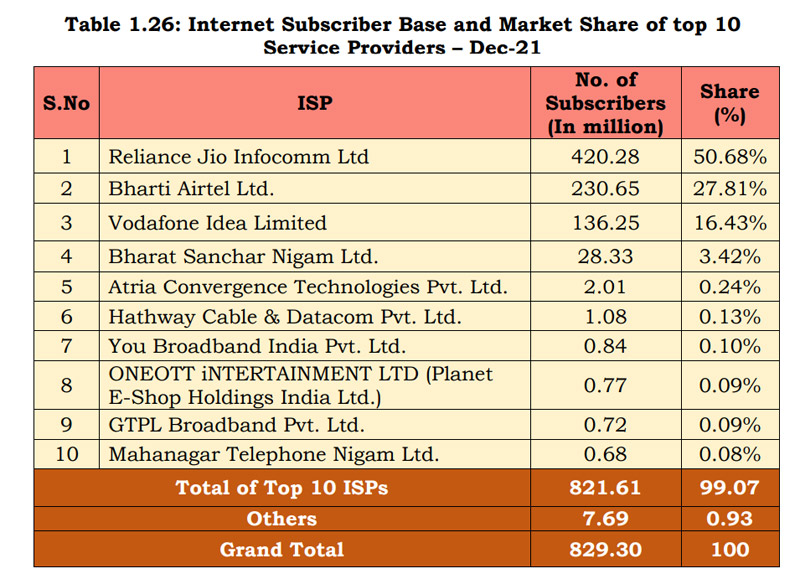
    The number of internet subscribers in India increased from 795.18 million to 829.30 million, as per the report. It showed that the total number of broadband internet subscribers increased from 747.41 million to 792.08 million and the number of wireless internet subscribers increased from 769.64 million to 802.72 million.

    Out of total broadband subscribers, 26.43 million are wired broadband subscribers while 765.65 million are wireless broadband subscribers.

    More than 96 per cent of total internet subscribers use wireless mobile technology to access internet services, as per Trai data.

    The number of rural internet subscribers increased from 308.17 million to 333.10 million and the number of urban internet subscribers also increased from 487.01 million to 496.20 million.

    Reliance Jio Infocomm was the biggest internet service provider with 50.68 per cent market share and 420.28 million subscribers. It was followed by Bharti Airtel with 27.81 per cent share and 230.65 million subscribers. Vodafone Idea had 16.43 per cent share 136.25 million subscribers.

    Revenue and usage

    The average revenue per user (ARPU) from wireless subscribers in the telecom sector increased from Rs 94.87 in 2020 to Rs 108.40 an increase of 14.25 per cent.

    The share of prepaid subscribers declined from 95.21 per cent to 93.62 per cent in 2021.

    Revenue from data usage per subscriber increased from Rs 81.81 in 2020 to Rs 96.71 in 2021. The total volume of wireless data usage increased from 103,522 million GB to 135,657 million GB with a yearly growth of 31.04 per cent.

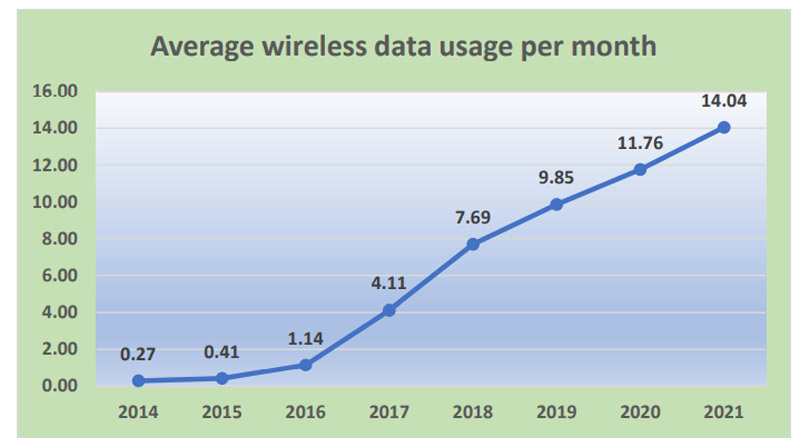
    The average revenue per user for wireless data usage per data subscriber per month has been in an upward trend since 2014 where it stood at Rs 71.25 climbing till Rs 139 in 2021.

    The average wireless data usage per wireless data subscriber per month increased from 11.76 GB during the year 2020 to 14.04 GB during the year 2021.

  • Trai further extends deadline for comments on consultation paper related to cross-media ownership

    Trai further extends deadline for comments on consultation paper related to cross-media ownership

    Mumbai: The Telecom Regulatory Authority of India (Trai) has once again extended the deadline for comments and counter comments on the consultation paper related to issues of media ownership. The new dates to submit comments are 28 June and 5 July, respectively.

    The consultation paper issued on 12 April seeks the views of the stakeholders on the need, nature and levels of safeguards with issues relating to media ownership, particularly cross-media ownership and vertical integration in the broadcasting sector.

    The regulatory authority had received a reference from the ministry of information and broadcasting (MIB) seeking reconsideration of its 2014 recommendations and issuance of a fresh set of recommendations in the light of the emerging changes in the media & entertainment industry, particularly with the advent of new digital technologies such as over-the-top (OTT) platforms.

    An industry analysis by KPMG shows that the media industry is undergoing a declining trend in terms of revenue generation from print, TV and radio while digital media is seeing a significant surge in revenue. Digital media revenues have grown from Rs 3,200 crore in 2014 to an estimated Rs 21,800 crore in 2021.

    Furthermore, Broadcast Audience Research Council (Barc) India’s TV Universe study highlights the changing TV distribution sector and the market share of cable, pay direct-to-home (DTH), free DTH and terrestrial. The data shows that the cable TV market share has declined from 63 million to 40 million while the share of pay DTH has increased from 23 million to 38 million between 2016 to 2021 (estimation). Free DTH has also doubled its market share from 12 million to 22 million (estimation) during the same period, as per the study.

    [[{“fid”:”1079179″,”view_mode”:”default”,”fields”:{“format”:”default”,”alignment”:””,”field_file_image_alt_text[und][0][value]”:false,”field_file_image_title_text[und][0][value]”:false},”type”:”media”,”field_deltas”:{“1”:{“format”:”default”,”alignment”:””,”field_file_image_alt_text[und][0][value]”:false,”field_file_image_title_text[und][0][value]”:false}},”attributes”:{“height”:”308″,”width”:”700″,”class”:”media-element file-default”,”data-delta”:”1″}}]]

    “The M&E industry has undergone a drastic change owing to technological developments, particularly those related to Intellectual property (IP) technology and increased use of packet-switched digital communications which have made converged services possible,” said Trai.

    The telecom networks can now provide access to the internet and broadcast content in addition to telecommunication services. “The technological convergence has manifested itself in changed consumer choices which, in turn, reflect the evolving dynamics of the M&E Sector,” remarked Trai.

    In its consultation paper, Trai has asked stakeholders if there is a need to monitor cross-media ownership and control & whether there should be a common mechanism to monitor ownership of print, television, radio and other internet-based news media. Currently, regulatory agencies such as the Competition Commission of India (CCI) and Securities and Exchange Board of India (SEBI) monitor and regulate mergers, acquisitions and takeovers. Trai asks stakeholders whether there is a need to monitor takeovers and acquisitions of media companies, especially news media companies & which government agency/ministry should be entrusted with data collection, regulation and monitoring.