Tag: telecom operators

  • Challenges we face in the production and broadcast industry are universal: Stefan Pfütze

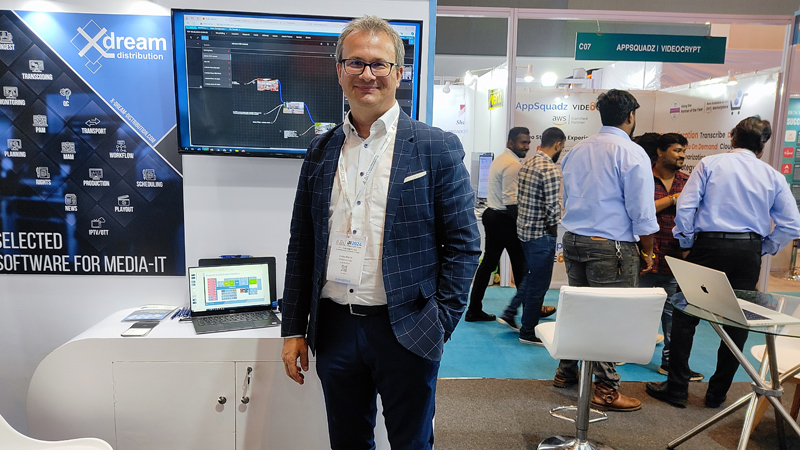
    Challenges we face in the production and broadcast industry are universal: Stefan Pfütze

    Mumbai: The second day of the Broadcast India Show at the Jio World Convention

    Centre in Mumbai pulsated with the vibrant energy of the broadcast media and

    infotainment sectors. In an industry where technology evolves at lightning speed, the

    impact on broadcast and entertainment is profound. For over 30 years, the Broadcast India Show has served as an interactive platform, showcasing groundbreaking shifts in infotainment technology while connecting attendees with the innovators behind these marvels.

    While exploring the booths, we were particularly drawn to x-dream-group, a full-service provider for the media industry as well as for any commercial or public organisation that utilises audiovisual media. Their clientele includes post-production facilities, broadcasters, telecom operators and public entities.

    Indiantelevision.com’s Rohin Ramesh at the sidelines of this event, caught up with x-dream-group managing director Stefan Pfütze, who shared insights about his organisation with a beaming smile.

    Edited excerpts

    On brief overview of your organisation:

    We are known as x-dream-group, which encompasses three distinct types of activities. One of these is x-media, our company that specialises in software integration, focusing on creating end-to-end solutions using products from other software providers. We are solely dedicated to software and do not engage in hardware manufacturing.

    Through our work at x-dream-media, we’ve identified several established engineering companies that offer excellent products—many now in their second or third generation—but lack international market reach. To address this gap, we established an umbrella organisation called extreme distribution, which serves as a brand ambassador and master distributor for these companies. I am currently representing these various brands at Broadcast India.

    On elaborating some of the productised solutions you have developed for your customers:

    In our journey of development, we began with plugins for transcoders, which have become less relevant over time. From that foundation, we created a business called 1 GUI—a centralised user interface that integrates with various tools such as transcoders, ingest tools, quality control tools, workflow tools, and file transport tools. This interface serves as a cockpit for managing workflow and job queues.

    Over time, we expanded our offerings by adding a workflow starter and a workflow layer. Our latest release is the broadcast suite, a desktop application designed for playback, recording, and multi-viewing—targeted at professional AV users and broadcasters in need of quality control and engineering solutions. While it may not function as a traditional video server in a server room, it provides similar capabilities on a desktop level.

    Our flagship product, extreme fabric, is an end-to-end solution tailored for the media industry. Unlike our software integration approach, which involves customising ecosystems for clients, extreme fabric is a ready-to-go, pre-designed, pre-integrated, and pre-configured solution. Users can simply download and install it to establish a fully functional TV station.

    This may sound ambitious, but our primary target customers are tier one broadcasters who seek custom solutions and want to collaborate closely with us. For tier two and tier three broadcasters, as well as clients from sectors like corporate, banking, insurance, and government, the need is different. These customers often lack broadcast engineering capabilities and require a ready-made solution. When we ask them about their production business processes, they often look at us in confusion—many have little understanding of the necessary workflows.

    We showcase our capabilities on our website and at conferences and trade shows, aiming to enhance the overall process. This challenge is prevalent not only in emerging markets but also in regional TV stations, where organisations may have one or two knowledgeable individuals but lack the capacity to manage large integration projects. They require a more accessible solution. As I travel to various countries, I often hear the excuse that “it’s different in our country” regarding technology, habits, business processes, or even infrastructure. I believe that the challenges we face in the production and broadcast industry are universal whether in India, the Middle East, Europe or America.

    On identifying and addressing the specific needs of your clients:

    To identify and address the specific needs of our clients, we begin with clear demands. For example, when selling individual products, a customer may say they need software to integrate their central ingest desk with their newsroom and post-production systems. From there, we ask probing questions: “Do you also manage remote offices? What about live feeds or social media content?” This often leads to a realisation of additional needs they hadn’t considered.

    When it comes to transcoding, some clients initially believe that open-source solutions are sufficient. However, as they aim for advanced features like 4K Ultra HD, HDR colour spaces, or delivery to professional platforms, they soon realise they must meet strict requirements, such as delivering certified ProRes formats to companies like Apple. This is where we step in to provide the necessary support.

    Monetisation is another crucial area where we see demand for features like ad insertion, graphic overlays, audio track management, and subtitle management—more sophisticated needs than the basics. When we engage with clients, particularly during visits or trade shows, we often hear about inefficiencies in their workflows, such as the inconvenience of using USB devices to transfer content between departments. We can certainly improve these processes, especially for companies with distributed setups that include on-premises installations, cloud services, and multiple facilities across different cities.

    Another significant project category involves managing the business side of operations, particularly through media asset management systems. These systems serve as essential repositories, often involved in both the beginning and end of media business processes. Many vendors offer mini MAM systems for temporary storage, but we approach media management on a larger scale. We focus on publication strategies for marketing, advertising, and B2B or B2C content sales. For B2C, this includes video-on-demand portals, while our B2B offering, called the media market, enables broadcasters and content producers to sell their content online to a global audience.

    Editing is also a critical aspect, where our goal is to manage the bridge between business processes and the editing suite. This includes project management, approval workflows, and remote editing capabilities. Our product portfolio consists of software solutions, allowing customers to select their own hardware, rather than being tied to specific storage systems.

    Additionally, we have introduced a new component we refer to as “storytelling,” which functions as a newsroom system. This terminology resonates with clients outside the media industry, making it more relatable. Our applications are designed to be cross-media, supporting not just TV but also radio, web, and social media. This means that our playout solutions are essentially a form of publication across multiple platforms.

    When it comes to integrating these production systems, aside from editing challenges, we also face issues like ensuring compatibility between various tools and managing different workflows efficiently. We overcome these challenges through thorough assessments of client needs, providing tailored solutions that enhance their overall operations.

    On some common challenges you face when integrating an isolated production system:

    As software developers, it’s natural for us to explore the APIs of various software solutions. Today, most applications typically offer RESTful APIs, though some might have soft APIs, database connections, or file-based integrations. About 99 per cent of software now utilises rest APIs, and when we integrate systems, we prefer this approach because it provides optimal control, monitoring, and failure handling when working with third-party software.

    A common scenario I frequently encounter among system integrators and other vendors involves the use of watch folders. Many systems still rely on a chain of watch folders, where one application drops files into the watch folder of another. This approach is outdated and leads to significant operational overhead, particularly in process management and troubleshooting.

    Another prevalent trend is the transition from on-premises solutions to cloud-based systems. For many of our projects related to publication, we emphasise a hosted approach. However, this doesn’t necessarily mean a public cloud; it could involve dedicated or boutique hosting solutions with either physical servers or virtual machines. While public clouds often rely on virtual machines, they may not be cost-efficient for long-term engagements—though they can be suitable for short-term needs.

    We are witnessing a shift from fully on-premises elements, such as archives and publication systems, to remote data centres. This transition is driven by improved network connections, enhanced security, and better hosting capabilities, including power supply and cooling. Offloading hardware management allows for 24/7 operations without constant oversight, which is a significant advantage of a hosted approach, whether private or public.

    We support this trend through hybrid systems. For instance, high-resolution operations can remain on-premises, where the personnel and content are physically located, and archives may still reside on LTO tapes. Meanwhile, we can move the access components of the system to a hosted solution, connecting both sides to function as a single entity.

    The challenge today is ensuring that these systems operate seamlessly together. Currently, the approach often results in a disruption; the inner system handles publishing to the outer system while the outer system feeds information back to the inner one. Unfortunately, these remain separate systems that do not behave as a unified business process, despite essentially being one.

    On some upcoming trends:

    Discussing trends can be challenging. We’ve seen fads like 3d technology, ultra hd, and hdr come and go. In hindsight, many of these were just hype—something everyone talked about but few actually implemented. Today, most television remains hd and sdr. However, AI is different; it’s here to stay. Currently, we see practical applications like transcriptions and translations being effectively utilised.

    In our portfolio, we offer a product that provides live subtitling with translation capabilities. This tool is actively used in practice, and customers are willing to invest in it because it’s reasonably priced, making it a sensible option.

    One trend I observe is the shift toward on-premises artificial intelligence. Many customers are often unaware of their options and feel compelled to rely on public cloud solutions simply because that’s what vendors are promoting. However, the same software can often be deployed on-premises, which can be advantageous. While it may be challenging to navigate training models and related complexities, the cost savings on data traffic, time, and hosting and processing fees can be substantial.

    Artificial intelligence will also significantly impact storytelling in news, but I view this with some caution. There’s a common misconception that you can simply input a topic into an artificial intelligence and receive a well-formed story. In reality, we still need journalists and reporters in the field, gathering information and engaging with people. Artificial technology can assist in processing and shaping that information into a coherent story, but it cannot create news on its own. While artificial intelligence can generate lyrics or fiction, the essence of news relies on human insight and experience. Ultimately, it is the human mind that remains irreplaceable.

  • Trai seeks views on Big Data & AI adoption to improve telecom services in future

    Trai seeks views on Big Data & AI adoption to improve telecom services in future

    Mumbai: The 5G spectrum auction that happened recently is a big step towards the launch of new internet and telecom experience in India. 5G will take India’s telecom services to the next level and bring it at par with countries like China, the US, and South Korea.

    A step towards fueling future innovation, the government is now trying to leverage & integrate artificial intelligence (AI) and big data (BD) in the telecommunication sector as both are inherently synergistic. To make this possible, The Telecom Regulatory Authority of India (Trai) has released a consultation paper on “Leveraging AI and BD in the telecommunication sector.” The regulatory body has asked its stakeholders to submit any consent and issues regarding the consultation paper by 16 September & 30 September will be the last date for counter comments.

    5G would bring advancement in the media & entertainment industry as the consumers soon be able to access faster internet speed and services. It will enable faster download speeds, lower latency (the response time to transfer computer information), greater flexibility and ability to support more devices.

    Through the 5G auction, a total of 51.2 GHz spectrum was sold and 71 percent of total spectrum was put up for sale. It helped the government to earn a record Rs 1.5 lakh crore recently.

    Further, the telecom regulator, in its consultation paper, sought opinions on areas where the telecom networks’ present and future capabilities could be used to leverage AI and BD. The paper also presented examples of AI and BD already deployed in telecom networks by the operators in India & other jurisdictions.

    Leveraging AI and BD in 6G era

    The regulator also looked at developments happening in the 6G and possibilities emerging in the 6G era to leverage AI and BD in the telecom sector as well as other sectors where telecom can play an important and crucial role.

    The consultation paper followed the department of telecom’s referral to Trai in June 2019, in which the department requested a recommendation on leveraging AI and BD in a synchronised and effective manner to improve the overall quality of service, spectrum management, network security, and reliability.

    The paper stated, “It has been noted that 5G and beyond networks will provide a plethora of data that may be useful for telecom as well as other sectors. Edge computing in the 5G era may offer opportunities to other sectors to train and validate their AI models in the telecom networks.”

    “In 5G and beyond, networks may also offer privacy-preserving architectures to adopt and accelerate AI and BD in other sectors,” the paper added.

    The paper covered risks associated with the adoption of AI and BD, such as unethical use, bias in data and algorithms, model instability, regulatory and legal noncompliance, and risk mitigation methods and mechanisms. Further, there is a risk of privacy among users, which includes data exploitation, the risk of identification and tracking, and individual profiling.

    It also further stated, “If privacy concerns are not addressed and trust is not instilled among the users, then it may become one of the biggest concerns in the adoption of AI.”

    The paper’s focus was on privacy concerns and their impact on developing intelligent solutions. The paper identified and presented various solutions and initiatives that may be taken to address the risks and concerns. It also suggested ways to overcome these constraints for faster adoption of AI.

    Trai mentioned in its paper that they also noted the latest developments in the field of AI, which may be useful in multi-domain, multi-vendor, and multi-AI model environments.

  • Hungama partners with telecom operators in Switzerland, Poland, Saudi Arabia and other countries

    Hungama partners with telecom operators in Switzerland, Poland, Saudi Arabia and other countries

    MUMBAI: Hungama, a digital entertainment company had announced strategic partnerships with leading telecom operators in Switzerland, Poland, Saudi Arabia and other countries, further strengthening its presence in international markets. These operators include the three largest telecom providers in Switzerland – Swisscom, Sunrise and Salt Mobile, T-Mobile Polska and Plus – two  telecom operators in Poland, and STC, Zain and Virgin Mobile – three of the primary telecom providers in Saudi Arabia. In addition to these, Hungama has also partnered with Ooredoo in Palestine, Batelco in Bahrain and Ncell in Nepal. Aimed at making subscriptions and billing more convenient, these partnerships will allow users to access a premium range of multilingual and multi-genre music and video content through Hungama Music, Hungama’s music streaming service and Hungama Play, Hungama’s video streaming platform.

    Through a Hungama Music subscription, international users gain access to an extensive range of HD music and music videos in leading Indian languages like Hindi, Punjabi, Tamil, Telugu, Kannada, Malayalam, Bengali, Marathi, Gujarati and more. A Hungama Play subscription gives users access to a premium library of Hindi and regional movies, original shows, TV shows, short films, kids’ content and short format videos across genres like music, lifestyle, humour etc.

    Speaking about the international expansion, Hungama Digital Media COO Siddhartha Roy said, “There is immense demand for Indian content in international markets. In the past 3 years, we have seen a 2x increase in consumption across various regions and have been taking significant steps that not only make it easier for users to subscribe to our services but also help us strengthen our global footprint. We are glad to partner with some of the leading telecom operators in each of these regions and look forward to offering an enriching experience to their users. Additionally, we are also actively working towards solidifying our presence further in Europe, North America, Africa and Asia Pacific regions.”

    Hungama Music and Hungama Play’s apps are available on all leading app stores across different ecosystems in over 190 countries. International users can subscribe using cards or various payment gateways offered by their telecom operators.

  • Net neutrality: TRAI open to ideas till 12 April

    NEW DELHI: A second extension has been given to stakeholders to give their views on the crucial issue of net neutrality, on which a consultation paper had been issued by theTelecom Regulatory Authority of India (TRAI) on 4 January, 2017,

    Those wanting to give their views on this subject may do so by 12 April with counter comments if any by 26 April 2017.

    Earlier, the date of 15 February 2017 had been extended to 15 March 2017. The regulator made it clear that no further extension would be given.

    The aim is to establish a comprehensive framework that allows non-discriminatory access to the internet since net neutrality has been a subject of debate between content providers and telecom operators.

    TRAI  posed 14 questions that attempt to define the concept of net neutrality in the Indian context in a 65-page document. This follows a pre-consultation paper on the subject last May. The aim is to ensure that access is not, blocked, throttled or preferentially treated by service providers.

    “The purpose of this second stage of consultation is to proceed towards the formulation of final views on policy or regulatory interventions, where required, on the subject of NN (net neutrality),” Trai said in the paper.

    The paper said telecom service providers (TSPs) have to adopt traffic management practices to ensure network efficiency but that these should not be misused.

    Also Read:

    TRAI issues fresh paper seeking views on Net Neutrality definition

    Net Neutrality ideas date open till 28 Feb

  • Shifting to green tech: TRAI extends ideas date till 14 March

    NEW DELHI: Stakeholders wanting to give suggestions to the Telecom Regulatory Authority’s efforts towards the effect of telecom on climate change and green house gas emissions have been asked to send in their views by 14 March 2017.

    Stressing this is the last extension, TRAI said the counter-comments can be sent by 28 March 2017.

    Following a request received from the Department of Telecom, TRAI had issued the Consultation Paper on Approach towards Sustainable Telecommunications in mid-January this year. The paper has raised fourteen questions.

    TRAI had issued a paper on similar issues in 2012 and the DoT had in fact given directions on that basis, but new issues have cropped up with emerging technologies.

    India has the second largest and fastest growing mobile telephone market in the world. Power and energy consumption for telecom network operations is by far the most important significant contributor of carbon emissions in the telecom industry.

    Hence, it is important for the telecom operators to shift to energy efficient technologies and alternative sources of energy. Moreover, Going Green has also become a business necessity for telecom operators with energy costs becoming as large as 25 per cent of total network operations costs. A typical communications company spends nearly one per cent of its revenues on energy which for large operators may amount to several million rupees.

    Also read:

    Shift to energy-efficient tech; TRAI seeks ideas by 27 Feb

  • CCI to await TRAI report even as Parliamentary Committee studies net neutrality

    CCI to await TRAI report even as Parliamentary Committee studies net neutrality

    NEW DELHI: Even as a Parliamentary Committee is meeting to discuss the net neutrality issue, Competition Commission of India (CCI) chairman Ashok Chawla has said net neutrality is a policy issue and Telecom Regularity Authority of India (TRAI) should first take a stand on it.


    Chawla said CCI would look into the matter when it will come to it. “It has not come to us. We will see when it comes. This is a policy issue. The regulator has to decide first. Based on whatever happens in terms of behaviour as in conformity and non-conformity of policy, we will see and in any case if they are going to interact with us they are welcome,” Chawla told reporters on the sidelines of an annual day function of the CCI.


    TRAI has already touched upon net neutrality in its Consultation Paper on over the top (OTT) services.


    Meanwhile, Parliamentary Ministry sources said that the Committee may hold more than one meeting on the issue, and will then place its report in the next session of Parliament. Representatives of some telecom companies are understood to have presented their views on the issue.


    CCI orders a probe only if there is prima-facie evidence of a violation of competition norms.


    The development comes at a time when some telecom operators have entered into tie-ups for offering free access to certain mobile apps and websites. Such activities have raised concerns on net neutrality. The last refers to equal treatment for all Internet traffic.


    Last month, Bharti Airtel launched Airtel Zero, an open marketing platform that allowed customers to access many mobile applications for free, with the data charges being paid by startups and large companies.


    Over the past few months, operators such as Reliance Communications and Uninor have partnered Internet companies such as Facebook, WhatsApp and Wikipedia to offer free usage to consumers.


    Such moves are being seen as being opposed to net neutrality, particularly to the extent that they affect communication OTT services like Viber, free calls on WhatsApp etc. 

  • 43% data service users unhappy with telecom operators: survey

    43% data service users unhappy with telecom operators: survey

    KOLKATA: The recently concluded spectrum auction for the telecom industry saw 19 days of fierce bidding and telecom companies competing for spectrum to strengthen mobile data services. However a community poll conducted by a social networking platform LocalCircles, revealed that around 43 per cent of phone users in India are dissatisfied with the quality of data services while another 43 per cent have rated it as average.


    According to the study, around 53 per cent of the surveyed people said the quality of network coverage was average, while 27 per cent expressed discontent with the coverage.


    Another 53 per cent felt that the tariffs charged by the operators were expensive, while 38 per cent voted it as a “value for money” proposition.


    Of the people surveyed, 53 per cent put faith on the accuracy of data billing and other services charged by the operators, while 32 per cent did not vote in its favour.


    “Immediate efforts are needed by the telecom regulators and the operators to improve the voice and data service quality by reducing call drops, improving coverage and quality,” LocalCircles said.


    As per the study, a whopping 77 per cent of respondents said the central government and telecom regulatory authorities have “not done enough” to address issues faced by consumers and another 77 per cent said they want operators to bill them based on usage and the services opted for instead of generalised packages.


    “Net neutrality is something that a majority of citizens support and want the telecom regulator to ensure consumer interest is protected at all costs,” it added.


    The company also said that the telecom regulatory body’s regulations are “loose” and the Department of Telecom’s monitoring of compliance on licensing requirements are falling short of expectations.


    The survey was conducted across India with 20,000 citizens responding to six poll questions followed by a “detailed structured discussion.”

  • Nokia unveils predictive marketing solution for telecom operators at Barcelona

    Nokia unveils predictive marketing solution for telecom operators at Barcelona

    NEW DELHI: Nokia has launched a predictive marketing solution that allows telecom operators to tap data to offer smarter services, boost revenues and improve customer loyalty.


    Addressing the Mobile World Congress (MWC 2015) in Barcelona, Nokia president and CEO Rajeev Suri said, “We see technology evolving to a point where almost all people and billions and billions of devices – 50 billion or more by 2025 – are connected, where software holds all those connections together, where analytics bring meaning, and where automation brings simplicity and efficiency.”


    The predictive marketing solution leverages Nokia Networks’ Customer Experience Management and the Mobile Marketing Suite from mapping and location HERE. It features a contextual element to data and the opportunity to set up personalized offers for services tailored to customer needs, said Nokia.


    In addition to predictive marketing, Nokia will show how the telecom cloud can help operators keep pace with the Internet world; how ultra-dense networks can ensure performance and meet capacity demands; explain how the latest application of location information can improve driving safety; and how to connect and manage the Internet of Things.

  • EU welcomes India’s decision to open telecom to FDI, concern about in-house testing

    EU welcomes India’s decision to open telecom to FDI, concern about in-house testing

    NEW DELHI: The European Union has noted with satisfaction India’s recent decision not to use security as justification for domestic manufacturing preference policies in telecom and electronic goods; and not to extend restrictive measures to private procurement (e.g. of telecom operators as licensees for radio spectrum).


    The EU has also supported India’s decision to open up the telecom sector to foreign direct investment (foreign ownership had been limited to 74 per cent).


    During a meeting of the EU-India Joint ICT Working Group met in Brussels, EU expressed concerns about mandatory ‘in country’ testing and certification of telecom network elements by Indian labs and demanded that mutual recognition for example under the Common Criteria Recognition Arrangement (CCRA) should be accepted. India has also mandated compulsory registration of 15 groups of consumer electronics products in order to comply with Indian product safety standards.


    It was decided at the meeting that two sub-groups will be established: one on Market Access and ICT Manufacturing (lead: EU) and another on internet security (lead: India) which should focus on matters of network and information security and provide input to EU-India Cyber Security Consultations.


    Both sides highlighted the crucial role ICT research and innovation can play in tackling the economic and societal challenges of our time, and agreed to deepen cooperation in this area. Interest was expressed particularly in the areas of e-Infrastructures, High Performance Computing, Cloud Computing, Wireless Broadband Communications, Internet of Things, and Electronics. Cooperation was proposed, inter alia on standardisation and interoperability matters, for which follow-up is envisaged.


    The Indian delegation was referred to the High Level Dialogue on Migration and Mobility as the “one-stop shop” where concerns regarding the ease of mobility of Indian IT professionals could be addressed.


    India’s request for “data adequacy status” under the EU data protection legislation (which is of high importance for Indian services and business process outsourcing businesses), will need to be addressed to an expert group of national data protection authorities, which is ready to meet with Indian representatives in order to advance the dialogue.


    The EU delegation was led by Gerard de Graaf, Director, DG Connect, and the Indian side by Raj Kumar Goyal, Joint Secretary for International Cooperation in the Department of Electronics and Information Technology, within the Ministry of Communications and Information Technology.


    DigitalEurope had hosted the EU-India ICT Industry Dialogue, where leading industry experts from Europe and India met with delegations of the Government of India (Department of Electronics and Information Technology) and of the EU (European Commission – DG Connect and European External Action Service). There was a unanimous call by both Indian and European participants for global approaches and global solutions.