Tag: telecom

  • Mobileum and NoHold partner for AI development for telecoms

    Mobileum and NoHold partner for AI development for telecoms

    CUPERTINO: Mobileum Inc., a leading global provider of analytics and network solutions, and NoHold, a pioneer in AI-powered automation solutions, have announced a strategic alliance to advance AI enablement in the telecom industry. The partnership is a major move toward creating a scalable AI ecosystem that integrates with multi-vendor telecom operations, allowing operators to fully leverage their data.

    As telecommunications companies race to modernise operations and monetise increasing amounts of customer and network data, the Mobileum-NoHold alliance seeks to streamline and accelerate AI adoption for communication service providers in increasingly complex environments. The joint effort will provide AI-powered support solutions capable of ingesting and interpreting data from diverse systems, improving alignment between customer needs and the reality of modern network services, analytics platforms, and 5G infrastructure.

    The alliance is built on a shared AI framework that connects telecom providers, technology partners, and sales and support leaders. This framework allows for interoperability between AI assistants from different vendors and systems, addressing long-standing support issues that arise when multiple vendors are involved in providing a single solution. It provides deeper insight into users’ needs and opportunities to continuously improve their experience.

    “As telecom ecosystems become more complex, delivering fast, effective support has never been more critical,” said NoHold CEO and founder Diego Ventura. “This alliance brings AI to the forefront of the telecom experience, helping providers resolve issues more intelligently and efficiently while reducing complexity for both customers and internal teams. We are excited to partner with Mobileum and deliver meaningful value to the industry together.”

    Mobileum chief product officer  Miguel Caramés added, “Mobileum has been a driver of telecom innovation for the last 25 years. We see generative AI and intelligent agents as the next frontier, not just for automation, but for creating entirely new revenue opportunities from telecom data. This alliance with NOHOLD allows us to bring this vision to market with agility, scale, and impact.”

    The alliance will provide telecom operators with the tools to monetise data by embedding AI-driven insights into enterprise services, deploying AI assistants that scale across consumer and B2B segments, and accelerating resolution and upsell opportunities through intelligent support automation. Mobileum and NoHold invite other telecom and technology leaders to join the alliance and shape the future of scalable, intelligent support and automation in the telecom industry.

  • Indian mobile count goes up as does broadband: TRAI data Jan 2025

    Indian mobile count goes up as does broadband: TRAI data Jan 2025

    MUMBAI: India’s telecom sector added a modest 2.1 million net subscribers in January 2025, nudging the total count to 1.19 billion, according to the Telecom Regulatory Authority of India’s monthly data release. But it wasn’t all smooth signal—wireline connections tanked, dropping over 10 per cent as TRAI shifted 5G Fixed Wireless Access (FWA) from wired to wireless accounting.

    Mobile still rules the roost, with 1.16 billion users riding the wireless wave, including 5.7 million FWA users. Urban India continued to drive growth, adding over 5 million new mobile connections. Meanwhile, rural areas quietly chipped in with just under a million more.

    Broadband subscriptions inched up 0.04 per cent to 945.16 million—an uninspiring climb, considering Reliance Jio and Bharti Airtel hold over 80 per cent of the market. Wireline broadband, meanwhile, shrank slightly as users cut the cord in favour of FWA.
    MARKETSHAREDATAMobile Number Portability (MNP) remained red-hot with 14.14 million requests in Jan alone—pushing the all-time tally past 1.09 billion. Uttar Pradesh (East) and Maharashtra topped the charts for most switched loyalties.
    The market remains firmly in private hands, with Jio and Airtel leading across broadband and mobile. 

    Government-owned players like BSNL and MTNL continue to struggle, holding just 8 per cent of wireless subscribers and less than a quarter of the wireline market.

    Tele-density stood at 84.54 per cent—Delhi being the most connected with an eye-popping 274 per cent, while Bihar lagged behind at 56.6 per cent.

    And while fixed lines may be flatlining, India’s telecom story continues to be a mostly wireless wonder.

  • AFAA turns the spotlight on brilliance in advertising

    AFAA turns the spotlight on brilliance in advertising

    MUMBAI: The Asian Federation of Advertising Associations (AFAA) is turning up the creative heat with the return of its Brilliance Awards, inviting entries for its highly anticipated second edition. With ten top advertising categories in the spotlight, the awards aim to honour campaigns that don’t just win trophies but genuinely build brands.

    “Awards should celebrate advertising that works, not just ads made for awards,” said AFAA chairman Srinivasan Swamy. “That’s why our jury—comprising top advertisers from across Asia—will focus on real brilliance, the kind that makes an impact in the real world.”

    After a resounding response to its inaugural edition, the Brilliance Awards 2025 are now open for submissions across categories such as automotives, banking, consumer durables, food & beverages, e-commerce, fashion, pharma, real estate, telecom, and travel. Brands and agencies can submit their entries online before the deadline on March 31, 2025.

    In keeping with AFAA’s ethos that true creativity is priceless, there’s no entry fee, only a stage to showcase work that truly shines.

  • Vodafone Idea posts Rs 111.2 billion revenue but struggles under debt burden

    Vodafone Idea posts Rs 111.2 billion revenue but struggles under debt burden

    MUMBAI: Vodafone Idea (Vi) is ringing in revenue growth, but the static of debt remains loud. The telecom giant reported Rs 111.2 billion in revenue for Q3FY25, marking a 1.7 per cent sequential increase, and clocked its highest quarterly cash EBITDA of Rs 24.5 billion since the Vodafone-Idea merger. However, despite operational improvements, Vi remains in the red, posting a net loss of Rs 66.1 billion.

    The company’s average revenue per user (ARPU) rose to Rs 173, reflecting a 4.7 per cent QoQ jump, largely driven by tariff hikes and customer upgrades. But its financial burden remains steep. Bank debt stands at Rs 23.3 billion, while spectrum and AGR dues total a staggering Rs 2.27 trillion, payable over two decades.

    Vi is pushing forward with a massive capex plan, spending Rs 53.3 billion in the first nine months of FY25, with a full-year target of Rs 100 billion. The company added 4,000 broadband towers, its highest in a single quarter since the merger, and expanded 4G coverage to 41 million more users, reaching 1.07 billion people.

    A phased 5G rollout is now officially in motion, with Mumbai set to go live by March 2025, followed by Delhi, Bengaluru, Chandigarh, and Patna in April. The telco is banking on this expansion to sharpen its competitive edge.

    To keep its balance sheet in check, Vi has secured Rs 19.1 billion in fresh equity capital from its promoter group, pushing its total equity infusion to Rs 260 billion in the last 10 months. The company also received a bank guarantee waiver on spectrum payments, offering temporary relief.

    Vodafone Idea is also in the middle of another fresh financial hurdle as the Department of Telecommunications (DoT) has demanded a Rs 6,090 crore bank guarantee by March 10 to cover spectrum obligations since 2015, offering an alternative cash payment of Rs 5,493 crore. The telco must choose one of these options and comply with the telecom department’s requirements, adding to its existing financial woes amid intense industry competition. This development comes as a major setback for Vi, which is already grappling with Rs 2.27 trillion in spectrum and AGR dues. However, some relief arrived in January when the Supreme Court upheld the Bombay High Court’s November 2023 decision granting Vi a Rs 1,600 crore tax refund, providing a temporary financial cushion as the telco continues its struggle to stabilise operations.  

    While Vi is making strides in revenue and expansion, the question remains, can it dial up a full-fledged recovery, or will the weight of its debt drop the call?

  • India, Africa growth propels Bharti Airtel to  strong Q3 FY25

    India, Africa growth propels Bharti Airtel to strong Q3 FY25

    MUMBAI:  It is one of the two telco bellwethers in India, the other being Jio. And it appears to be doing very well, thank you going by Bharti Airtel Ltd’s  consolidated results for the third quarter ended 31 December 2024. It reported significant growth driven by momentum in India and stable performance in Africa.

    Financial Highlights:

    * Consolidated revenue rose 19.1 per cent  year-on-year (YoY) to Rs 45,129 crore, up 8.8 per cent  sequentially.
    * Consolidated EBITDA stood at Rs 24,880 crore, marking a 24.1 per cent  YoY increase, with a margin of 55.1 per cent.
    * EBITDA after lease expenses (EBITDAaL) increased by 26.1 per cent  YoY to Rs 21,474 crore, reflecting a margin of 47.6 per cent .
    * EBIT grew 33.3 per cent  YoY to Rs 13,126 crore, with a margin of 29.1 per cent .
    * Net income (before exceptional items) reached Rs 5,514 crore, up 121.3 per cent  YoY.
    * Capex for the quarter totalled Rs 9,161 crore.

    India Business Performance:
    * Revenue from India operations rose 24.6 per cent  YoY to Rs 34,654 crore.
    * Mobile services revenue increased by 21.4 per cent  YoY, driven by tariff adjustments, higher smartphone adoption, and portfolio premiumisation.
    * Mobile average revenue per user (ARPU) improved to Rs 245, up from Rs 208 in Q3 FY24.
    * Mobile data consumption surged by 23.2 per cent  YoY, with average consumption per customer at 24.5 GB per month.
    * EBITDA rose 32.3 per cent  YoY to Rs 19,850 crore, with an EBITDA margin of 57.3 per cent .
    * EBITDAaL stood at Rs 17,641 crore, with a margin of 50.9 per cent .
    * Capex for India operations was Rs 7,980 crore.
     

    Segment Highlights:

    * Homes Business: Revenue grew by 18.7 per cent  YoY, with 674,000 net customer additions driven by fibre-to-the-home (FTTH) and fixed wireless access (FWA). The customer base reached 9.2 million.
    * Airtel Business: Revenue increased by 8.7 per cent  YoY despite global pressures. Emerging digital services, including cloud and security, showed strong growth.
    * Digital TV: Revenue declined by 2.9 per cent  YoY to Rs 761 crore. The customer base stood at 15.8 million.
    * Passive Infrastructure Services: Contributed 5.7 per cent  YoY and 5 per cent  quarter-on-quarter (QoQ) to India revenue growth.

    Africa Operations:
    * Revenue in constant currency rose by 21.3 per cent  YoY.
    * EBITDA margin stood at 47.1 per cent , while EBIT margin was 29.4 per cent .
    * Customer base reached 163.1 million.
    * Capex for Africa operations totalled Rs 1,181 crore.

    Operational Achievements:
    * Bharti Airtel rolled out approximately 5,200 towers and 16,300 mobile broadband stations during the quarter.
    * The company expanded its fibre network by 47,100 km YoY.
    * The anti-spam tool notified 252 million customers and identified over 1 million spammers.
    * Airtel’s AI-driven network detected over 7 million spam SMS daily.
    * Zee5 was added to the Airtel Xstream Play platform, enhancing content offerings.

    Debt Management:
    * Net debt to EBITDAaL ratio (excluding lease obligations) stood at 1.56 times.
    * The company prepaid Rs 3,626 crore towards deferred spectrum liabilities.

    Vice-chairman &  managing director Gopal Vittal commented: “We delivered a strong quarter with consolidated revenue of Rs 45,129 crore. Our India mobile business showed robust performance, driven by tariff adjustments and premiumisation. We continued to lead the industry with ARPU growth and added 6.5 million smartphone users. Homes business saw accelerated customer additions, while Airtel Business navigated global headwinds with stability.

    “Our strong cash generation and prudent capital allocation allowed us to continue deleveraging and prepay high-cost spectrum dues. Further tariff corrections are necessary to sustain investments and create long-term value for the industry,” he added.

  • CS Tech AI: The right way to rebrand a technology solutions provider

    CS Tech AI: The right way to rebrand a technology solutions provider

    MUMBAI: You are a technology solutions provider. Your company and the solutions  you provide are well known to those involved in the automotive, architecture/engineering, transportation, telecom, water management, energy and geospatial engineering spaces.  And to top it all your company name is Ceinsys Tech. And most people find the name strange and difficult to pronounce. Especially in the domestic sector; internationally, things are good as the name looks fancy enough for a tech firm.

    So what you do?

    Do you run a campaign telling customers the right way to pronounce the company’s name?  Or do you  totally change your moniker? Or  do you take the tack that  Rs 250 crore plus turnover Ceinsys Tech India operations managing director  Kaushik Khona did?

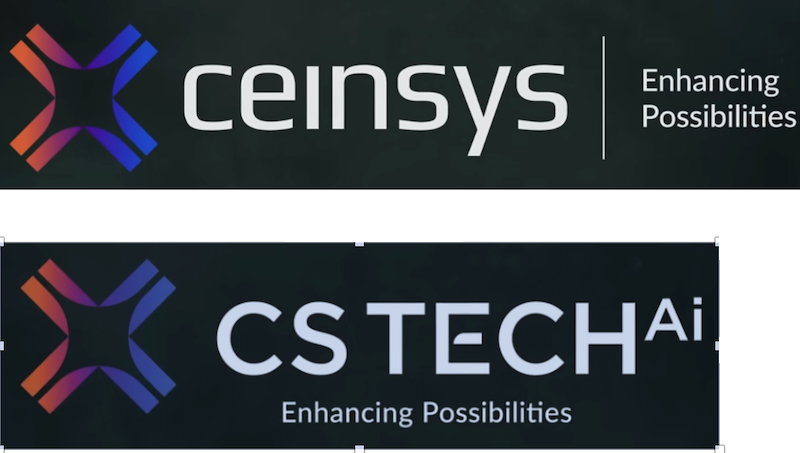
    What Kaushik and team did is they took the C and the S from the name and removed the redundant “einsy.”  So they were left with CS Tech. Well, to everyone that looked like a great change , but they also wanted to make the  brand look edgy and very design-driven  like many a tech company  takes the effort to look (remember Apple and its classy designer look in everything it does).

    In line with its  strategy to grow globally and be seen as a cutting edge global technology company which is adding dollops of artificial intelligence into its solutions and processes, a decision was taken to add the words AI next to the logo as a suffix.  This change, for the company,  marked a strategic shift to underscore its  focus on artificial intelligence (AI) and its role in driving technological innovation.

    “The move comes as Ceinsys positions itself for a future shaped by AI-driven solutions. The addition of “.ai” to the new rebranding reflects the company’s roadmap to integrate newer technologies including AI into the geospatial and technology solutions that enable smart infrastructure and utility development,” said the company.

    Hence the name of the company was changed to CS Tech AI.  

    Said Khona: “The rebranding of Ceinsys into CS Tech with inclusion of suffix ‘.ai’ is more than just a rebranding exercise—it represents our focus on the adoption of advanced technology into providing of solutions to our esteemed clients. AI is becoming the backbone of smart solutions, and this rebranding reinforces our commitment to innovation and relevance in a rapidly evolving landscape. It also allows us to communicate our vision more clearly and differentiate ourselves in the market.”

    A decision was taken to maintain the icon next to the logo as well as the tagline “Enhancing possibilities” as both only reinforced the high-tech look for the branding.  

    The corporate name Ceinsys Tech Ltd was maintained with  only the URL being changed to www. cstech.ai from www.ceinsys.com

  • TRAI website gets a facelift

    TRAI website gets a facelift

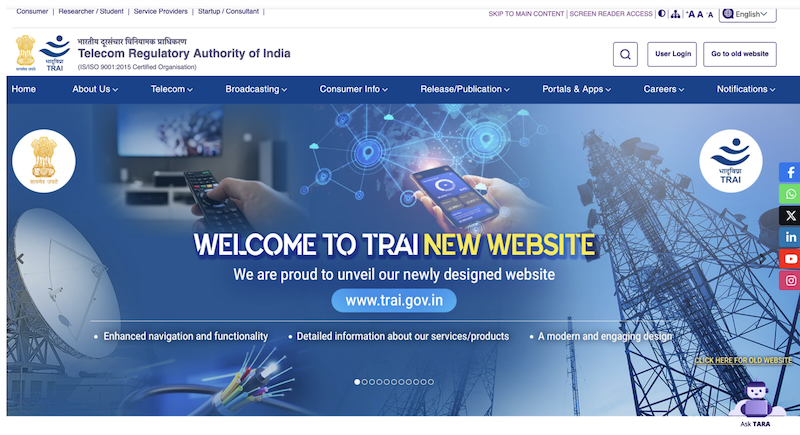
    MUMBAI: Industry watchdog the Telecom Regulatory Authority of India (TRAI) has got a new look online. It unveiled an upgraded website to broaden its reach to connect with a wider audience on 23 December 2024. 

    In recognition of the growing importance of social media, new sharing features facilitate the dissemination of regulatory information to all stakeholders. The website offers comprehensive information on telecom and broadcasting regulations, policies, laws, statistics and trends in India. These resources are easily accessible to the public, stakeholders, researchers, and international audiences.

    The new website includes the following additional features:

    • Introduction of a new dashboard for telecom & broadcasting sector.
    • Provision of data download for research.
    * A grid view feature, allowing users to view data in a new and interactive format.
    • In addition to sharing via email, users can now also share documents directly through major social media platforms, links for visualisation on Instagram, Youtube, Linkedin, Whatsapp, Facebook, X etc.
    • Online registration for subscription to latest TRAI  releases and updates.
    • Brief profile of the authority.
    • New website is compatible with iOS, Android & various platforms.
    • A blog with a facility for registered users to comment.
    • Provision to publish information about upcoming events.
    • Online registration for participation in open house discussions.
    • Compliance to accessibility features.
    • Tenders and notices
    • Concise and compiled regulations at a single place with amendments mentioned in foot notes.

    The new website, says a TRAI release,  will be hosted in the National Informatics Centre  (NIC) Cloud. The old website will run concurrently for three months after the going live of the new website. 

    A chatbot Tara (Telecom Authority Responsive Advisor) has been introduced to facilitate interactive search.

    Says an industry executive unwilling to be named: “It’s good that TRAI has renewed the look of its website online.  Hopefully, it will also start looking at industry with new eyes and listen to what the pay TV, OTT streamers, TV channels and distribution platform operators need to have healthy industry in which everyone benefits – including the government and the lay consumer.” 

  • Airtel’s AI solution flags eight billion spam calls in 2.5 months

    Airtel’s AI solution flags eight billion spam calls in 2.5 months

    MUMBAI: Remember the days when our phones buzzed incessantly with spam calls, and we wished for a magic wand to make them disappear? It felt like a far-off dream, especially during those pandemic days when AI was making life easier in ways we never imagined. Fast forward to today, and the digital universe is buzzing with AI tools for every conceivable purpose—yet the menace of spam calls persisted, poking its nose into our daily peace.

    But then, Airtel stepped in, promising us relief with its AI-driven spam-blocking innovation. The big question was: would it truly work, or would it just be another tech gimmick? Well, the results are in, and they’re nothing short of astonishing, albeit with a sprinkle of curiosity.

    In just 75 days, Airtel’s AI flagged a jaw-dropping eight billion spam calls and 800 million spam SMS messages. Impressive, right? But as we sift through the details, the big question looms: has Airtel really silenced the spam storm, or are there gaps to fill? Let’s dive into the numbers and see if this is the revolution we’ve been waiting for—or if we’re left wanting more.

    Airtel’s sophisticated AI algorithm has been instrumental in identifying approximately 1 million spammers daily, alerting 252 million unique customers to suspicious activities. This initiative has led to a 12 per cent reduction in the number of customers answering spam calls, marking a significant step toward user security.

    Key insights from Airtel’s spam report

    ●    Spam Sources: Over 35 per cent of spam calls originated from landlines, with Delhi leading as both the top spam call origin and recipient region. For SMS, Gujarat emerged as the top origin, targeting users in Mumbai, Chennai, and Gujarat.

    ●    Demographic Impact: Male customers accounted for 76 per cent of spam calls, with those aged 36–60 receiving 48 per cent of calls. Senior citizens were notably less targeted, at just 8 per cent.

    ●    Device Preferences: Phones priced between Rs 15,000 and Rs 20,000 were the most frequent recipients, comprising 22 per cent of spam calls.

    ●    Peak Hours: Spam activity peaked between noon and 3 PM, with a notable 40 per cent drop in volume on Sundays.

    Airtel’s AI-driven system meticulously analyses diverse parameters to provide real-time detection, ensuring privacy and convenience for its users. This innovation solidifies Airtel’s position as India’s first network to deploy a comprehensive spam-blocking solution, delivering industry-leading security measures.

    “We are committed to safeguarding our customers from the growing menace of spam. Our advanced AI system reflects our dedication to delivering superior experiences while prioritising user privacy,” an Airtel spokesperson said.

    With this initiative, Airtel reaffirms its commitment to enhancing user trust and redefining industry standards. The solution not only curbs intrusive communications but also paves the way for a safer and more secure digital environment.

  • Vi Business unveils Easy+ to streamline corporate and personal life seamlessly

    Vi Business unveils Easy+ to streamline corporate and personal life seamlessly

    MUMBAI: Dodging your boss’s relentless calls?

    Scrambling for excuses when your phone mysteriously ‘runs out of data’?

    Vanished on a work trip because international roaming decided to abandon you mid-flight?

    Sounds familiar?

    Say goodbye to corporate chaos and hello to seamless connectivity! Vi Business, the enterprise arm of Vodafone Idea, is rewriting the rulebook for corporate postpaid users with its groundbreaking Easy+ service. Now, whether it’s topping up your roaming pack, binging OTT shows, or avoiding awkward ‘unreachable’ moments, you can do it all—right from the Vi App, on your existing corporate plan. No drama. No hassle. Just effortless convenience.

    This game-changing feature simplifies how employees access value-added services, empowering them to personalise their mobile plans without the hassle of seeking approvals or managing separate numbers.

    Vi Business, executive vice president, enterprise mobility business & marketing, Roerich Kaushal emphasised the significance of the launch. “With Easy+, Vi Business is leading the way in transforming the corporate postpaid experience. Employees now have the flexibility to select and purchase services like international roaming, OTT subscriptions, and data packs for personal needs. In today’s connected world, they deserve an effortless solution that aligns with modern workforce expectations,” said Kaushal.

    He added, “With the upcoming holiday season, Easy+ provides a convenient way for employees to purchase international roaming packs, ensuring seamless connectivity and entertainment on the go.”

    Key Features of Easy+:

    ●    International Roaming Packs: Available across 29 countries with flexible durations – 24 hours, 10 days, or 14 days – priced between Rs 749 and Rs 4,999.

    ●    OTT Subscriptions: Users can subscribe to services like Sony LIV and Zee5, delivering their favourite entertainment directly to their devices.

    ●    Gifting Feature: Corporate users can gift OTT subscription packs to others, making it easier to share entertainment options.

    Corporate postpaid users can avail of Easy+ through the Vi App, which offers a user-friendly interface for purchasing these add-ons. The service reflects Vi Business’s commitment to blending convenience with innovation, making it a valuable tool for professionals on corporate plans.

    https://vi.app.link/viappisnt.

  • Tadiran Telecom to invest $10 million annually in IP phone manufacturing in India

    Tadiran Telecom to invest $10 million annually in IP phone manufacturing in India

    MUMBAI: Securing a visionary investor is the spark that fuels every entrepreneur’s ambition, and for Tadiran Telecom, it’s a dream realised with purpose. In a landmark move blending opportunity with innovation, the Israel-based leader in unified communications has unveiled its commitment to invest over $10 million annually in India, marking a new chapter in its 26-year journey in the country. Partnering with DCM Shriram, Tadiran is set to produce 100,000 cutting-edge IP telephones each year—a transformative step that underscores its unwavering belief in India’s potential as a global manufacturing hub.

    Tadiran Telecom CEO Moshe Mitz stated, “We plan to make 1,00,000 IP telephones in India every year. This is a conservative number. We have allocated $10 million for one year for our manufacturing project. Investment will increase based on the performance.”

    IP telephones, designed for businesses and supporting multiple communication functions, including conference calls, will be classified under class two equipment, making them eligible for government procurement.

    Mitz confirmed that Tadiran’s current business is driven 70 per cent by software and 30 per cent by hardware. This manufacturing initiative represents the first phase of the company’s ambitious expansion in India. “If we achieve success in meeting manufacturing targets, then we will launch our phase two expansion in India for software development,” Mitz added.

    The company has already initiated discussions with a leading Indian software giant to collaborate on software development in phase two of its plan.

    DCM Shriram president Rudra Shriram highlighted the group’s commitment to the partnership, noting that this is its first foray into electronics manufacturing. “Tadiran Telecom has the technology. We are putting in place a dedicated team for manufacturing their products. Besides manufacturing, our group will provide all supply chain support to Tadiran Telecom, including warehousing and logistics,” he said.

    Tadiran’s investment aligns with India’s growing focus on local manufacturing and advanced technology solutions. As Mitz remarked, “Manufacturing is phase one of our expansion plan in India. If successful, phase two will focus on software development, further solidifying our commitment to India.”

    This initiative underscores Tadiran’s strategy to bolster its hardware manufacturing capabilities while exploring advanced software development partnerships in the Indian market.