
Tag: Tele-wise Bangla

  • West Bengal consumers look for relatable and aspirational content: Zeel’s Samrat Ghosh

    West Bengal consumers look for relatable and aspirational content: Zeel’s Samrat Ghosh

    New Delhi: After a successful national run, Zee Entertainment Enterprises (Zeel) forayed into the West Bengal market in the year 1999, and Zee Bangla became the first Bengali TV channel to be launched in the country. Over two decades later, the channel continues to enjoy a strong presence in the regional market with several successful shows that connected with the local masses. It further bolstered its regional genre with the launch of the sister channel, Zee Bangla Cinema in 2012.

    As part of the inaugural edition of the Tele-wise Bangla summit, Indiantelevision.com, CEO and editor-in-chief Anil Wanwari got in a fireside chat with Zee Entertainment Enterprises Ltd (Zeel), cluster head, Samrat Ghosh who spearheaded the network’s journey to the east.

    Ghosh has been a member of Zeel for over two decades. He took over Zeel’s Bangla business in 2014 and has been responsible for overseeing a bouquet of channels which includes Zee Bangla, Zee Bangla Cinema, Zee Sarthak, Big Ganga, and Zee Biskope. The conversation delved upon the various facets of the network’s growth in the Bangla market, the psyche of local consumers, channel’s content offering, and the brand’s philosophy. 

    Edited excerpts:

    On Zee Bangla’s journey so far and the challenges along the way

    Zee Bangla had already established a strong brand identity when I took over the channel’s business in 2014. It was perceived to be a pioneer in the non-fiction space and had some advantages over several established brands. In the fiction space, we had some flashes of brilliance here and there. My main objective at that time was to further strengthen this brand identity, create brand equity and transform the brand into ‘a brand of love and relevance’. Adopting a consumer-centric approach is the key to success. So, we reached out to consumers and gained loads of consumer insights, and started designing our products accordingly which was all-inclusive. This inclusiveness helped us to get a wide spectrum of audiences and top the viewership charts. We brought lots of cultural relevance in fiction and non-fiction shows to build more engagement among viewers and remained invested in content.

    On selecting stories in the culturally rich east market

    Bengal consumers are very different from other regional markets. They are bilingual, well-read, and well-informed. The state literacy level is also high at 77 per cent and they are culturally very sensitive. They also look forward to something new all the time, which also makes them extremely loyal to the brand. If the brand talks in their language and understands their needs, then they remain faithful to the brand. They look forward to a unique blend of content offering, where their values are also embedded. Such content resonates well with Bengal consumers. We have also done biopics, including the one on Netaji Subhash Chandra Bose which was well-accepted by the audiences. Bengal consumers lap up content if it is relevant to them and appeals to their aspirations.

    On the choice between chasing ratings and a good story 

    Rating is a by-product of the content that you create. We have always embraced a consumer-centric approach. We take consumer insights to make the content more relatable and aspirational for our viewers. If we can create content like that with relevant storytelling, then the rating is bound to follow. We reach out to consumers before the launch of the product and after launch too. They are quite excited to dissect the product and tell about likes and dislikes, so content correction also happens along the way.

    On reaching out to non-Bengali consumers nationally 

    In the non-fiction space, we have had some reality shows which developed into cult brands in the market. We had a quiz show, called Dadagiri with Sourav Ganguly and Dance Bangla Dance, and the vernacular season of Sa Re Ga Ma Pa. Many non-Bengali consumers also watch some of our shows and find them relevant. Many shows have travelled to other parts of the country within the Zeel network. So, we have catered to a wide spectrum of audiences.

    On whether Bengali consumer is programme-loyal or channel-loyal

    Both exist in the Bangla market. First and foremost, the Brand inertia and affinity in a typical Bengali consumer is very high. So, if you win their heart once, they will remain loyal to you for a very long time. There is a high brand loyalty among the Bengali audiences. If the content is relatable and it appeals to their aspirations, then there is always an appetite for consumption. They will wait a year after year if they develop an affinity for a show. Some shows have been running on the channel for years. But most importantly, the content has to be relatable to them.

    On genres that Bengali viewer binges on

    Any kind of content that has high cultural relevance will always resonate with the consumer. When he sees that the brand understands their needs, they develop an affinity for it. Localised content drives engagement and regional channels always have a higher ability to connect with consumers. The show Didi no 1 is a game show for women and it appeals to their aspirations. At the core, the brand has to be consumer-centric.

    On the challenges in finding talent in writing and acting, and unique solutions adopted

    Bengali TV industry has seen an upsurge in content production in the last decade and ramping up of content production hours. So, the growing demand has led to a short supply of talent for acting, writing, etc. So, we have embraced multiple ways to overcome this challenge. First, we have widened our production eco-system and we are now collaborating not only with established production houses, but the emerging ones too. Secondly, we are producing in-house shows to nurture new talent. Thirdly, we have launched a talent nurturing platform, YesBangla.com for searching for new and nurturing talent. The response has been great for acting, but for screenwriting, it is limited so far.

    On the OTT boom and impact on TV

    Both complement each other. TV works in the family space, while OTT is in personal space. Both platforms cater to a different set of audiences and both will co-exist. If you see, 95 per cent of video consumption is in vernacular, so OTT will grow. But, in West Bengal, for instance, there is 60 per cent penetration of TV. So, there is a lot of headroom for growth there too.

    On some successful partnerships with brands and advertisers

    We have had a couple of examples in the recent past. We believe in providing a value proposition to our advertising clients. We collaborated with Senco Gold and Diamonds, a jewellery brand for a show based on a jewellers’ family. So, while the brand utilized the platform and used it to launch new product ranges, it also lent huge insights for us, especially while taking our main protagonist for workshops. So, we keep doing a lot of integrations, Dadagiri was another such TV show. We have witnessed continuous support from our advertisers who see immense value in the collaboration. At Zeel, we provide a holistic proposition to advertisers, creating a win-win for the channel and the advertisers. 

    (The virtual summit – Zee Bangla was organised by Indiantelevision.com in partnership with Zee Bangla on 29 June and witnessed insightful sessions with representatives from television, advertising, and media.)
  • National brands gauge the Bangla TV market on Tele-wise Bangla summit

    Mumbai: There is little doubt about television as a far-reaching instrument of viewership connecting masses pan India. It remains the medium of choice to build reach and brand salience. However, as the second wave of the pandemic swept through the country, it also impacted the overall TV viewership across regions. This, in turn led the advertisers and brands to reflect on the way they leveraged TV to reach out to their target audience.

    As a part of the inaugural edition of the Tele-wise Bangla Summit 2021 organised by Indiantelevision.com in partnership with Zee Bangla, industry experts and stakeholders from across sectors weighed in on the strength of the West Bengal TV market and the disruption caused by Covid-19 on people’s lives, their consumer spending, and TV viewing habits.

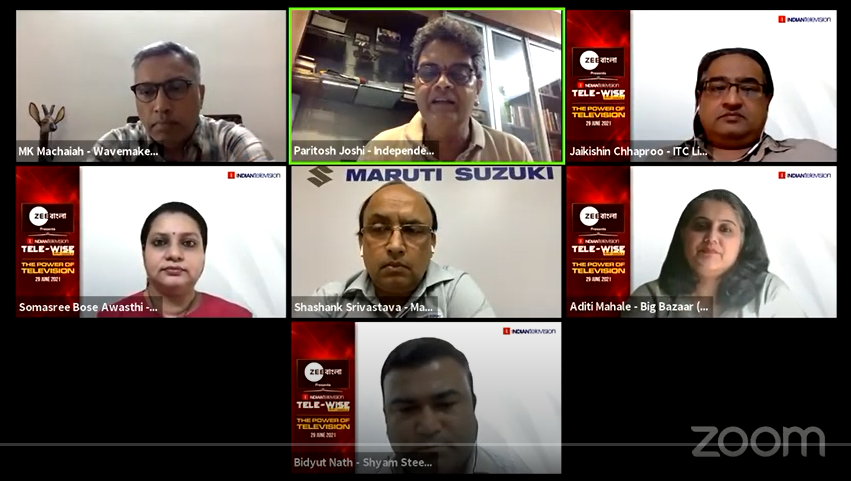
    In an informative discussion ‘Gauging the Might of the Market’ –  moderated by independent media consultant Paritosh Joshi, marketers debated on how the Bangla market remains highly relevant for national brands looking to make their presence felt in the state when it comes to TV ad spends.

    The session kicked off with Joshi observing that, although the pandemic has largely resulted in an overall bleak economic environment, FMCG remained the sole bright spot. Godrej Consumer Products Limited marketing head (homecare category) Somasree Bose Awasthi pitched in that it was true specifically with regards to essential items, which have been driving the growth in the sector. The premium or discretionary categories like grooming or hygiene products have suffered a setback in the last year. She added, however, that the reverse migration due to the pandemic had led to a revival in the rural economy across the country, including West Bengal.

    Shyam Steel India, head of brand marketing, Bidyut Nath corroborated this by saying that, while the pandemic had brought most large-scale construction activity in the cities to a standstill, with workers going back to their villages, it had continued almost uninterrupted in the rural areas as people did not cease to build houses for themselves, irrespective of the pandemic. So while there was little positive growth in the sector, it did reflect a steady growth with nearly 69 per cent of the populace constructing homes, he said.
    The panellists discussed how the pandemic also caused people to become risk-averse when it came to buying decisions, due to which market leaders in a particular sector and trusted brands gained.

    According to Maruti Suzuki India’s marketing & sales executive director Shashank Srivastava in such times, the trusted brands become the anchor for consumers. “That trust helped us, and our market share went up in most segments, despite Automobiles being a discretionary, high-value purchase. In general, the retail sales were better in 2020 than the previous year for Maruti, mainly because of the change in consumer perception towards public transport, resulting in more people becoming inclined towards owning private vehicles,” he said.

    However, the fall in incomes did show in the “telescoping of demand”, whereby the demand for a higher segment shifted towards a lower segment vehicle, he added.

    Future Group’s Big Bazaar marketing head Aditi Mahale shared that while the group had 15 to 20 stores across the state, nearly eight to ten of them were based out of Kolkata.

    “We had to cut back on TV ad-spend last year, mainly due to lack of fresh content, and we focused more on the news genre and digital,” said Mahale, but the group continues to use television as part of its marketing strategy, especially during regional festivals, for “retail is, by nature, always local” with even their competition being largely local in the genre.

    For ITC, which has its roots in West Bengal, the state is “priority #1 market”, said ITC’s Media & PR head Jaikishin Chhaproo, largely because of the unparalleled distribution strength that it provides.

    When it came to the media mix in the state, panellists shared that television had a regional reach of more than 70 per cent in the state. Hence brands try to capitalize on the richness of the regional content by preparing creatives with local flavour and by going “hyper-local”.

    “Becoming hyper-local is the need of the hour. Doing local TVCs with local actors really pays off. But brands face challenges in terms of talent & cost,” said Wavemaker India’s ITC lead and special initiatives president MK Machaiah.

    In West Bengal, like most other markets- there is an innate attachment to sports. So while Shyam Steel India did see great brand engagement post onboarding Virat Kohli and Anushka Sharma as brand ambassadors, Bidyuth Nath agreed that going hyper-local by engaging with local celebrities is also indispensable. All panellists agreed on the value that localised content brings to brand promotions in the state, regardless of the medium – print, television, or digital.

  • Bangla TV viewership sees sustained rise; Assembly polls insulate from Covid blow

    New Delhi: Even as the TV markets across the country reeled under the second wave, the regional Bangla market was insulated from its severe blow. The high-octane Assembly elections, which were also the longest-ever state polls to be held so far, kept the industry abuzz with a sustained rise in viewership.

    Overall, the viewership of Bangla news increased by 30 per cent during week 13-17 when the election process was underway, according to Broadcast Audience Research Council (BARC) data. The number of active advertisers on Bangla news channels also rose by 11 per cent during the election period, coupled with a 12 per cent growth in ad volume, as some national news networks also expanded their footprint into Bangla news to cash in on the election fervour.

    The data was presented by Broadcast Audience Research Council (BARC) India, head, client partnership & revenue function, Aaditya Pathak during the inaugural edition of the Tele-wise Bangla – the power of television organised by Indiantelevision.com on Tuesday. The day-long event was organised in partnership with Zee Bangla and witnessed insightful discussions with representatives from the field of television, advertising, marketing, and media.

    Impact of Second-wave & elections

    According to BARC, the overall television viewership across markets was subdued during the second wave. However, West Bengal witnessed less severe impacts, according to BARC. The state saw an eight per cent drop in viewership compared to last year, while the impact was much more severe in neighbouring Odisha, where the viewership declined by 18 per cent and north-eastern states of Assam and Sikkim where it dropped by 22 per cent.

    “In terms of Genres, the viewership for GECs sustained well during the second wave, with minimal disruption of original content. But, Bangla news and movie channels recorded higher viewership than the pre-Covid levels of 2020, partly on the back of tailwinds from elections,” said BARC India, head, client partnership & revenue function, Aaditya Pathak.

    West Bengal TV Market

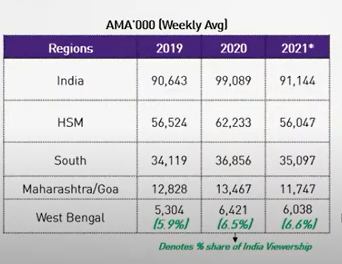
    West Bengal contributes roughly 15.3 million TV households (6.6 per cent) to the overall national TV market of 210 million TV households. This share has increased over the last three years, from 5.9 per cent in 2019 to 6.6 per cent in 2021, contrary to the viewership trends seen in Maharashtra/Goa, south, or the Hindi-speaking markets (HSM). (All India, 2+, Total TV viewership in AMA ‘000, weekly avg). Also, while the daily tune-ins fell across markets in 2021, they remained higher in West Bengal vs 2019 levels, showed BARC data.

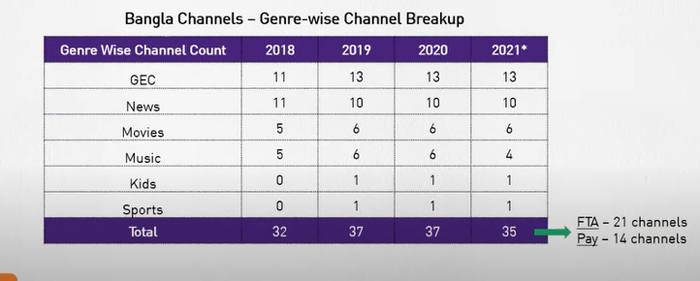
    As of 2021, the state has 35 channels on air that are part of the BARC ecosystem, out of which 21 channels are free-to-air (FTA), while 14 are on pay platforms. This includes 13 GECs, 10 news channels, six movie channels, four for music, and one each for kids and sports. The free platform contributes to 1.9 per cent of the TV viewership, while the share of the Pay platform stands at 98.1 per cent.

    However, unlike other regional markets like Maharashtra where Hindi rules TV viewership, the West Bengal TV market is dominated by its local language, Bangla which contributes 65 per cent to the overall TV viewership in the state, while Hindi’s share is 33 per cent. “In fact, Bangla is the fifth largest language in terms of TV viewership in the country, closely followed by Marathi,” said Pathak, “The average time spent on TV in West Bengal is also quite comparable to the Hindi-speaking market (HSM) average.”

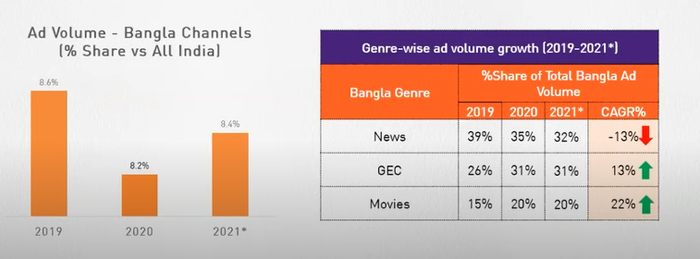
    Since 2019, the overall ad volume share for Bangla channels has not wavered much since 2019 and remained in the 8-9 per cent range compared to the all-India levels. “It’s a GEC-driven market and the ad volume shares for Bengali GEC and movies have demonstrated growth over the years of 13 per cent and 22 per cent, respectively. However, news channels have witnessed a decline in ad-volume of almost 13 per cent compared to 2019,” said Pathak.

  • Tele-wise Bangla to bring together top names from media and advertising

    KOLKATA: Several players including big broadcasters have a strong presence in the West Bengal market. Zee Entertainment and Star TV Network were among the fast movers in the Bengali entertainment industry, followed by Sony, Viacom18, and Sun TV. Over the years, the market has grown to be one of the most important ones for those planning to expand their national footprint.

    The increase of original content, viewership, and advertisers also led the industry to turn its eyes towards the market. Several local brands, pan-India advertisers also began investing in the market. Even amid the pandemic, Bengali GEC and Bengali News continued to contribute three per cent of total volumes each in 2020. Regional growth is here to stay, at least for some time now.

    This Tuesday, 29 June, Indiantelevision.com is all set to bring together some of the industry’s biggest names from the world of advertising, advertising, broadcasting, and production to understand the potential of the market. The leading b2b publication will host the inaugural edition of Tele-Wise Bangla, presented by Zee Bangla.

    The day-long virtual summit will open with a welcome note by Indiantelevision.com founder, CEO, and editor-in-chief Anil Wanvari. BARC India client partnership and revenue function head Aaditya Pathak will share insights on the viewership trends in the market. Kantar Insights Division director Puneet Avasthi will give a glimpse into the consumer profile in West Bengal.

    EMBED PIC 1

    In the session ‘Gauging the Might of the market’, representatives from Big Bazar, Godrej, ITC, Maruti Suzuki, Shyam Steel, Wavemaker India will discuss questions like what are the opportunities leveraged by brands on Bengali channels, how different are the approaches to strike a chord with Bengali audience, what are the most lucrative genres to invest in along with many other pertinent issues.

    As the regionalisation of TV channels has made it easier for the local brands to reach a specific audience, advertising spends on the channels have also risen. Leaders from Rollick Ice Cream, Ajanta Shoes, Initiative Media, Keya Seth Aromatherapy will deliberate on the growth of media spends in the last few years, challenges post-Covid, media spend ratio of local to national brands in the session ‘New Bastions for Growth’.

    EMBED PIC 2

    From a content perspective, the market has always seen progressive shows and experimentation with new concepts. With more formats of content now available, the audience has grown to accept content that is pushing the boundary of creativity. The panel will focus on the evolving content consumption trends, innovations, content investment in the West Bengal market in presence of spokespersons from Zee Bangla, Colors Bangla, Shashi Sumeet Productions, Acropolis Entertainment.

    To register: https://www.indiantelevision.com/events/telewise-bangla/

    The virtual event will begin at 3:00 pm on 29 June and will be live-streamed on YouTube, Facebook, and Twitter. 

    Join us for an insightful discussion!